REVIEW 3 major objections 6 minor 1 cited by
Design optimization of semiconductor manufacturing equipment using a novel multi-fidelity surrogate modeling approach
T0 review · 3 major / 6 minor · reviewed 2026-08-12 · deepseek-v4-flash
Pith's one-line read Combining cheap low-fidelity simulations with a few expensive high-fidelity ones produces a wafer-temperature surrogate that is about 10% more accurate than a high-fidelity-only model, while cutting data-generation cost by roughly 20% on…
desk verdict A competent industrial application of POD plus co-kriging to an ESC design problem, but the validation protocol has a potentially load-bearing leak that needs to be fixed before the numerical claims can be trusted. read the letter →
The pith
A machine-rendered reading of the paper's core claim, the machinery that carries it, and where it could break.
The reading
What carries the argument
The load-bearing mechanism is a two-stage reduction: first interpolation of both fidelity outputs onto a common 300×300 Cartesian grid, then singular value decomposition (proper orthogonal decomposition) of the combined snapshots to obtain a shared k-dimensional latent space (k = 20 is used). The latent variables of the low-fidelity field are modeled with one kriging surrogate, and the high-fidelity latent variables are modeled as a scaled version of the low-fidelity prediction plus a kriged discrepancy function, following the recursive co-kriging formulation. The full temperature field is recovered as $\hat{\mathbf{z}}_H \mathbf{V}_k^\top$.
What would settle it
Take the same seven-parameter ESC problem, generate high-fidelity and low-fidelity data at 30 new design points not used in training, and compare the mean-normalized low-fidelity fields to the high-fidelity fields; if the maximum difference exceeds about 6% at several points, or if the multi-fidelity surrogate's held-out RMSE is not at least 10% below the high-fidelity-only surrogate, the central claim is falsified.
Extended reading notes
Core claim
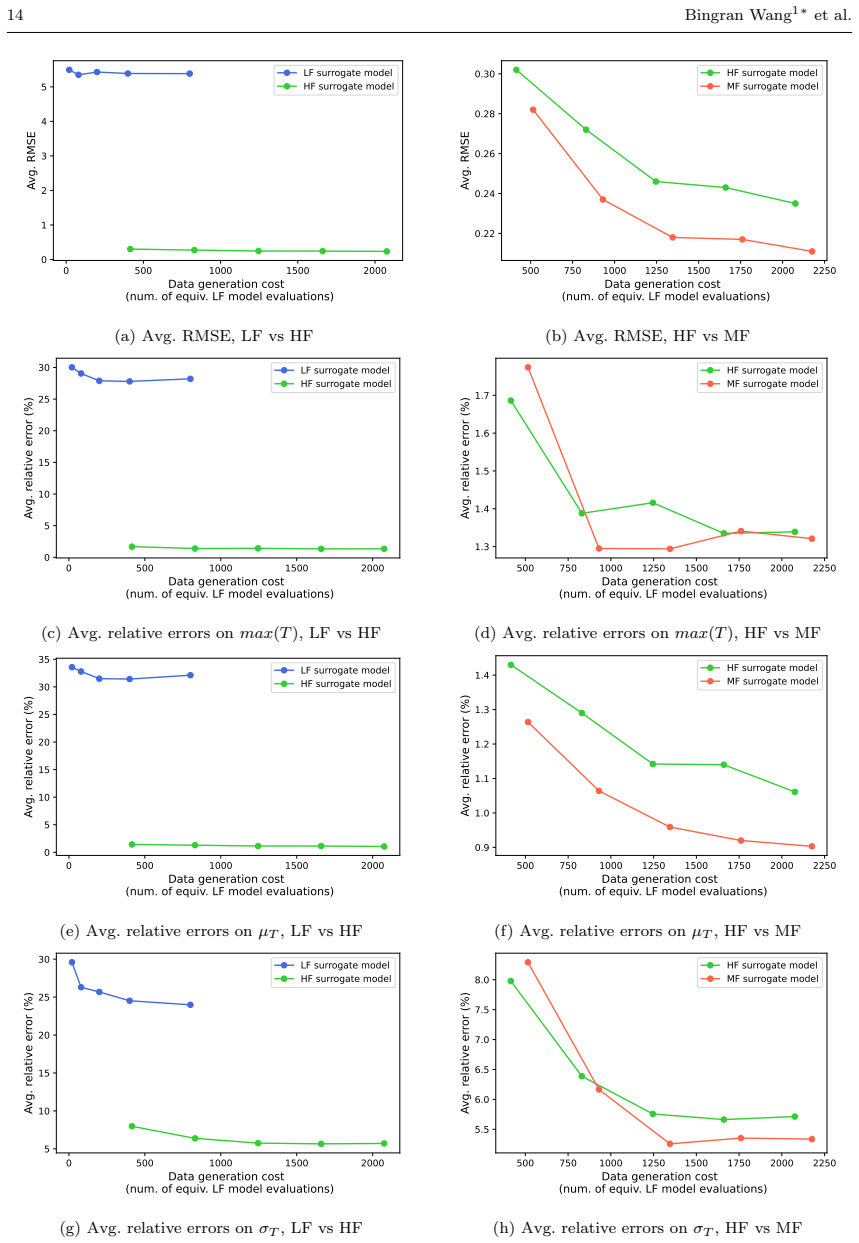
The central discovery is that the mean-normalized low-fidelity temperature field reproduces the high-fidelity field's spatial variation to within about 6%, even though the raw fields differ by about 40%. Exploiting that shared pattern, the paper's POD-plus-co-kriging workflow predicts the full temperature field from a handful of high-fidelity snapshots and a larger batch of low-fidelity snapshots. On the electrostatic chuck problem, this multi-fidelity surrogate achieves more than a 10% lower prediction error than kriging trained on either fidelity alone at equal data cost, and the optimized designs it produces satisfy constraints and improve all quantities of interest while consuming about 20% less data-generation budget than the high-fidelity-only route.
Load-bearing premise
The whole approach relies on the low-fidelity simulation, after dividing by its mean temperature, showing the same spatial variation pattern as the high-fidelity simulation; if that 6% similarity does not persist across the design space, the multi-fidelity surrogate can fall behind a high-fidelity-only surrogate.
Editorial extensions
If this is right
- For the ESC problem, using 60 high-fidelity and 100 low-fidelity points gives lower prediction error than using 80 high-fidelity points alone, so simulation budgets can be reduced without sacrificing surrogate quality.
- The optimal designs from the multi-fidelity surrogate improve the 3σ temperature, mean temperature, and maximum temperature relative to the reference design, with the best and second-best feasible solutions coming from the multi-fidelity models.
- Because the ESC must be re-optimized for each etching condition, the lower data cost of the multi-fidelity approach makes repeated optimization across many process steps more practical.
- The accuracy of the multi-fidelity surrogate is more sensitive to the number of high-fidelity points than to the number of low-fidelity points, indicating where scarce budget should be spent.
- If the method transfers to other field-output design problems, engineers could use a cheap approximate solver to guide optimization while reserving high-fidelity simulations for verification.
Reading between the lines
- The same POD-plus-co-kriging pipeline likely transfers to other design problems with high-dimensional field outputs—stress, flow, or concentration fields—where a low-fidelity model captures the variation pattern even if its absolute values are off.
- The 6% mean-normalized agreement between LF and HF fields is the empirical foundation; a practical user should re-check this similarity at a few new design points before trusting the multi-fidelity surrogate in an unexplored region.
- The claimed 20% data-cost savings depends on the low-fidelity model being at least an order of magnitude cheaper than the high-fidelity one; if that cost ratio shrinks in another application, the savings would shrink accordingly.
- Adding more low-fidelity data alone does not improve the low-fidelity-only surrogate, so the multi-fidelity gain comes specifically from the HF anchoring—this suggests a diminishing-returns regime where the marginal value of LF data falls as HF data increases.
Signed reviews
Editorial analysis
A structured set of objections, weighed in public.
Referee Report
Summary. The paper proposes a multi-fidelity surrogate modeling method for predicting high-dimensional temperature fields in an electrostatic chuck (ESC) design optimization problem. It combines proper orthogonal decomposition (POD) to project interpolated low-fidelity (LF) and high-fidelity (HF) field data onto a shared latent space, then uses co-kriging to predict HF latent variables from LF and HF data. The method is tested on an industrial ESC problem with seven design variables, using 1500 LF and 150 HF simulations, with 30 HF points held out for validation. The authors report that the multi-fidelity surrogate reduces RMSE by about 15% relative to an HF-only kriging surrogate at equal data-generation cost, and that optimization with the MF surrogate yields better designs across all quantities of interest while requiring about 20% less data-generation cost. The optimized designs are validated with the industry ground-truth HF model.
Significance. If the reported results hold, the paper describes a practically useful and computationally cheaper surrogate method for ESC design, an industrially relevant application where optimization is seldom applied. The strengths of the paper are the real industrial problem setting, the explicit comparison against HF-only and LF-only surrogates, and—importantly—the validation of the optimized designs with the ground-truth HF model, which goes beyond surrogate-error comparisons. The central quantitative claims, however, rest on the out-of-sample validation protocol. The manuscript does not state whether the POD basis used in the reported RMSE comparisons is constructed without the 30 validation HF points, and it reports only averaged metrics over three random splits without dispersion measures. These issues must be resolved before the claimed advantage can be considered established.
major comments (3)
- [§4.2, Eq. (2); §5.1] The POD basis is built from a snapshot matrix A containing all NL=1500 LF and NH=150 HF data, but the validation protocol in Section 5.1 excludes only the 30 validation HF points from the kriging training sets. The manuscript never states that the 30 validation points were also removed before computing the SVD in Eq. (2). If they were not removed, the validation fields directly contribute to the basis V_k, so Eq. (7) measures reconstruction-plus-regression error on fields that already shaped the basis. This is information leakage and can inflate all reported RMSE values; the bias need not be equal across the LF, HF, and MF methods because the MF method relies more heavily on the larger LF snapshot set in the combined SVD. The central claim of Section 5.1 (about a 15% RMSE reduction at equal cost) therefore needs to be either accompanied by an explicit statement that validation points were excluded from the SVD, or re-established by recomputing the POD basis after removing the validation points. The same issue affects the choice of k=20 in Fig. 4, which uses the combined LF and HF data.
- [§5.1; Table 4] Only the average RMSE over three random splits is reported, without standard deviations, per-split values, or the random seeds used. Since the three splits are drawn from only 120 non-validation HF points, the claimed MF advantage (roughly 15% RMSE reduction, and 32.4% vs. 31.0% improvement in 3-sigma_T in Table 4) could be within split-to-split variability. The authors should report per-split results and standard deviations, and should state whether the POD basis is recomputed for each split or fixed once; each choice changes the interpretation of the averaged error and the degree of leakage.
- [§5.1, Fig. 8; §5.2] The data sizes for the MF surrogate are stated inconsistently: the text in Section 5.1 says the model was trained with '60 HF and 100 LF data points,' whereas the Fig. 8 caption says '60 LF data + 100 HF data.' Section 5.2 later again uses '60 HF and 100 LF data points.' This must be corrected, because the data-generation-cost comparison in Table 4 and Fig. 9 depends on which fidelity contributes 60 points and which contributes 100 points.
minor comments (6)
- [§3.2] The phrase 'As seen in As shown in Fig. 2' contains a duplicated introductory clause; it should read 'As shown in Fig. 2.'
- [§6] In the concluding section, 'furthur' should be 'further.'
- [Table 1] The constraint 'CR1 + CR2 ≤ 10 (mm)' lists units of millimeters, but CR1 and CR2 are contact ratios with ranges 0.01 to 0.1; the units should be clarified or removed.
- [§4.3, Eq. (5)] The notation in Eq. (5) is ambiguous because \(\hat{z}_H\) and \(\hat{z}_L\) are k-vectors; the expression \(\rho f_L(x) + \delta(x)\) should be specified as elementwise, and the training of \(\rho\) and \(\delta(x)\) could be stated more explicitly rather than only citing Le Gratiet.
- [§5.1] The paper says all surrogates were trained with KPLS from the SMT toolbox, but it does not specify the kernel family, hyperparameter settings, or whether identical settings were used for the LF, HF, and MF models; providing these details would improve reproducibility.
- [§5.2, Table 3] The ranking row in Table 3 is difficult to read; the use of dashes and the phrase 'No constraints violation - 3rd - - 2nd 1st -' should be reformatted so that each case is explicitly labeled as feasible or infeasible and ranked accordingly.
Circularity Check
Validation leakage in the POD basis makes the reported multi-fidelity prediction-error reduction partly an in-sample reconstruction result.
-
fitted input called prediction
[Section 4.2, Eq. (2) and Eq. (6); Section 5.1 validation protocol]
"After the interpolations, we apply POD to project the interpolated outputs from LF and HF data onto the same latent variable space. This involves first assembling the LF and HF data in a matrix A ∈ R^{N ×m_I}, where N = N_L + N_H is the number of snapshots (combined LF and HF data). We then apply singular value decomposition (SVD) ... A = UΣV^T ... y′_H ≈ z_H V^T_k ... These 30 points were excluded from the training datasets and were used exclusively for testing the predictive performance of the surrogate models."
The basis V_k in Eq. (6) comes from SVD of A in Eq. (2), where A is the combined LF+HF snapshot matrix (N=N_L+N_H) with no stated exclusion of validation snapshots. Section 5.1 excludes the 30 validation points only from the kriging 'training datasets', not from A. Hence validation temperature fields help determine the POD modes used to project and reconstruct them, so Eq. (7) RMSE partly measures reconstruction of data already used to fit the basis, not pure out-of-sample prediction. MF uses many more LF snapshots in the basis than HF-only, so the leakage does not affect both methods equally; the ~15% RMSE reduction and >10% accuracy claim are therefore not established as genuine prediction gains.
full rationale
The derivation chain is otherwise self-contained: co-kriging follows Le Gratiet (2013) as an external reference, SMT is an external toolbox, and the optimization validation sends the final designs to the HF ground-truth simulator, so those parts are not circular. The only load-bearing circularity is the POD basis construction/validation protocol. If the SVD in Eq. (2) were computed after removing the 30 validation snapshots, the accuracy comparisons would be legitimate and the score would be 0–2. But the paper's text describes A as containing the combined LF and HF data and the validation exclusion only for the 'training datasets,' so the reader cannot verify that the reported prediction errors are out-of-sample. Because the paper's headline quantitative claims (more than 10% improvement, ~15% RMSE reduction) rest on those validation numbers, the central surrogate-accuracy claim is partially self-referential.
Assumptions & free parameters
free parameters (3)
- POD latent dimension k =
20
- Standard interpolation grid resolution =
300 x 300
- Co-kriging scaling constant rho =
estimated from HF data (not reported)
assumptions (4)
- standard math SVD/POD provides an optimal low-rank approximation of the snapshot matrix in Eq. (2).
- domain assumption The LF model captures the variation pattern of the HF temperature field after mean normalization.
- domain assumption LF and HF fields share a common latent space after interpolation.
- domain assumption HF training points are a subset of LF training points.
Cite this review
Pith. "Pith review of Design optimization of semiconductor manufacturing equipment using a novel multi-fidelity surrogate modeling approach." pith.science (2026). https://pith.science/paper/SMPPECJH
@misc{pith2026241108149,
  author       = {Pith},
  title        = {Pith review of: Design optimization of semiconductor manufacturing equipment using a novel multi-fidelity surrogate modeling approach},
  year         = {2026},
  howpublished = {\url{https://pith.science/paper/SMPPECJH}},
  note         = {Machine review of arXiv:2411.08149}
}
read the original abstract
Careful design of semiconductor manufacturing equipment is crucial for ensuring the performance, yield, and reliability of semiconductor devices. Despite this, numerical optimization methods are seldom applied to optimize the design of such equipment due to the difficulty of obtaining accurate simulation models. In this paper, we address a practical and industrially relevant electrostatic chuck (ESC) design optimization problem by proposing a novel multi-fidelity surrogate modeling approach. The optimization aims to improve the temperature uniformity of the wafer during the etching process by adjusting seven parameters associated with the coolant path and embossing. Our approach combines low-fidelity (LF) and high-fidelity (HF) simulation data to efficiently predict spatial-field quantities, even with a limited number of data points. We use proper orthogonal decomposition (POD) to project the spatially interpolated HF and LF field data onto a shared latent space, followed by the construction of a multi-fidelity kriging model to predict the latent variables of the HF output field. In the ESC design problem, with hundreds or fewer data, our approach achieves a more than 10% reduction in prediction error compared to using kriging models with only HF or LF data. Additionally, in the ESC optimization problem, our proposed method yields better solutions with improvements in all of the quantities of interest, while requiring 20% less data generation cost compared to the HF surrogate modeling approach.
Figures


Figures from the paper (10 more)




Forward citations
Cited by 1 Pith paper
-
Adaptive Learning Systems: Personalized Curriculum Design Using LLM-Powered Analytics
The paper presents an LLM-powered personalized curriculum framework whose claimed improvements are unsupported by the unrelated datasets and missing evidence.
Reference graph
Works this paper leans on
-
[1]
(2023) Gpt-4 technical report
Achiam J, Adler S, Agarwal S, Ahmad L, Akkaya I, Aleman FL, Almeida D, Altenschmidt J, Altman S, Anadkat S, et al. (2023) Gpt-4 technical report. arXiv preprint arXiv:230308774
2023
-
[2]
Structural and Multidisciplinary Optimization 53:935--952
Bouhlel MA, Bartoli N, Otsmane A, Morlier J (2016) Improving kriging surrogates of high-dimensional design models by partial least squares dimension reduction. Structural and Multidisciplinary Optimization 53:935--952
work page 2016
-
[3]
Advances in Engineering Software p 102662, doi:https://doi.org/10.1016/j.advengsoft.2019.03.005
Bouhlel MA, Hwang JT, Bartoli N, Lafage R, Morlier J, Martins JRRA (2019) A python surrogate modeling framework with derivatives. Advances in Engineering Software p 102662, doi:https://doi.org/10.1016/j.advengsoft.2019.03.005
-
[4]
Bubenzer A, Schmitt J (1990) Plasma processes under vacuum conditions. Vacuum 41(7-9):1957--1961
work page 1990
-
[5]
Buhmann MD (2000) Radial basis functions. Acta numerica 9:1--38
work page 2000
-
[6]
European Journal of Industrial Engineering 4 5(3):254--271
Chien CF, Dauz \`e re-P \'e r \`e s S, Ehm H, Fowler JW, Jiang Z, Krishnaswamy S, Lee TE, Moench L, Uzsoy R (2011) Modelling and analysis of semiconductor manufacturing in a shrinking world: challenges and successes. European Journal of Industrial Engineering 4 5(3):254--271
work page 2011
-
[7]
arXiv preprint arXiv:160907196
Fern \'a ndez-Godino MG (2016) Review of multi-fidelity models. arXiv preprint arXiv:160907196
work page 2016
-
[8]
Aerospace Science and Technology 75:74--87
Hwang JT, Martins JR (2018) A fast-prediction surrogate model for large datasets. Aerospace Science and Technology 75:74--87
work page 2018
Show all 34 references
-
[9]
Journal of Intelligent Manufacturing 35(2):925--935
Jin Z, Lim DD, Zhao X, Mamunuru M, Roham S, Gu GX (2024) Machine learning enabled optimization of showerhead design for semiconductor deposition process. Journal of Intelligent Manufacturing 35(2):925--935
2024
-
[10]
Journal of the Royal Statistical Society: Series B (Statistical Methodology) 63(3):425--464
Kennedy MC, O'Hagan A (2001) Bayesian calibration of computer models. Journal of the Royal Statistical Society: Series B (Statistical Methodology) 63(3):425--464
2001
-
[11]
Journal of Vacuum Science & Technology B: Microelectronics and Nanometer Structures Processing, Measurement, and Phenomena 24(6):2509--2517
Klick M, Bernt M (2006) Microscopic approach to an equation for the heat flow between wafer and e-chuck. Journal of Vacuum Science & Technology B: Microelectronics and Nanometer Structures Processing, Measurement, and Phenomena 24(6):2509--2517
2006
-
[12]
Journal of the Southern African Institute of Mining and Metallurgy 52(6):119--139
Krige DG (1951) A statistical approach to some basic mine valuation problems on the witwatersrand. Journal of the Southern African Institute of Mining and Metallurgy 52(6):119--139
1951
-
[13]
PhD thesis, Universit \'e Paris-Diderot-Paris VII
Le Gratiet L (2013) Multi-fidelity gaussian process regression for computer experiments. PhD thesis, Universit \'e Paris-Diderot-Paris VII
2013
-
[14]
AIAA Journal 60(7):4413--4427
Li K, Kou J, Zhang W (2022) Deep learning for multifidelity aerodynamic distribution modeling from experimental and simulation data. AIAA Journal 60(7):4413--4427
2022
-
[15]
Heat and Mass Transfer 54:115--123
Liao C, Hsiau S, Chuang T (2018) Modeling and designing a new gas injection diffusion system for metalorganic chemical vapor deposition. Heat and Mass Transfer 54:115--123
2018
-
[16]
Economic geology 58(8):1246--1266
Matheron G (1963) Principles of geostatistics. Economic geology 58(8):1246--1266
1963
-
[17]
John Wiley & Sons
May GS, Spanos CJ (2006) Fundamentals of semiconductor manufacturing and process control. John Wiley & Sons
2006
-
[18]
In: 23rd fluid dynamics, plasmadynamics, and lasers conference, p 2906
Menter F (1993) Zonal two equation kw turbulence models for aerodynamic flows. In: 23rd fluid dynamics, plasmadynamics, and lasers conference, p 2906
1993
-
[19]
Journal of Vacuum Science & Technology A: Vacuum, Surfaces, and Films 10(4):1863--1868
O’Hanlon JF, Parks HG (1992) Impact of vacuum equipment contamination on semiconductor yield. Journal of Vacuum Science & Technology A: Vacuum, Surfaces, and Films 10(4):1863--1868
1992
-
[20]
Siam Review 60(3):550--591
Peherstorfer B, Willcox K, Gunzburger M (2018) Survey of multifidelity methods in uncertainty propagation, inference, and optimization. Siam Review 60(3):550--591
2018
-
[21]
nature 323(6088):533--536
Rumelhart DE, Hinton GE, Williams RJ (1986) Learning representations by back-propagating errors. nature 323(6088):533--536
1986
-
[22]
In: AIAA SCITECH 2024 Forum, p 0013
Shen Y, Patel HC, Xu Z, Alonso JJ (2024) Application of multi-fidelity transfer learning with autoencoders for efficient construction of surrogate models. In: AIAA SCITECH 2024 Forum, p 0013
2024
-
[23]
In: Proceedings of the 1968 23rd ACM national conference, pp 517--524
Shepard D (1968) A two-dimensional interpolation function for irregularly-spaced data. In: Proceedings of the 1968 23rd ACM national conference, pp 517--524
1968
-
[24]
Computer Methods in Applied Mechanics and Engineering 361:112732
Sun L, Gao H, Pan S, Wang JX (2020) Surrogate modeling for fluid flows based on physics-constrained deep learning without simulation data. Computer Methods in Applied Mechanics and Engineering 361:112732
2020
-
[25]
Computational intelligence and neuroscience 2018(1):7068349
Voulodimos A, Doulamis N, Doulamis A, Protopapadakis E (2018) Deep learning for computer vision: A brief review. Computational intelligence and neuroscience 2018(1):7068349
2018
-
[26]
Proceedings of the IEEE 108(4):478--482
Wong HSP, Akarvardar K, Antoniadis D, Bokor J, Hu C, King-Liu TJ, Mitra S, Plummer JD, Salahuddin S (2020) A density metric for semiconductor technology [point of view]. Proceedings of the IEEE 108(4):478--482
2020
-
[27]
Journal of Vacuum Science & Technology B 41(4)
Yoon TW, Cho SI, Choi M, Hong SJ (2023) Heat transfer mechanism of electrostatic chuck surface and wafer backside to improve wafer temperature uniformity. Journal of Vacuum Science & Technology B 41(4)
2023
-
[28]
Japanese Journal of Applied Physics 63(4):04SP72
Youn JH, Hong SJ (2024) Enhanced temperature uniformity of electrostatic chuck: ceramic surface contact ratio and backside gas pressure. Japanese Journal of Applied Physics 63(4):04SP72
2024
-
[29]
, " * write output.state after.block = add.period write newline
ENTRY address archive author booktitle chapter doi edition editor eid eprint howpublished institution journal key month note number organization pages publisher school series title type url volume year label extra.label sort.label short.list INTEGERS output.state before.all mi...
-
[30]
write newline
" write newline "" before.all 'output.state := FUNCTION add.period duplicate empty 'skip "." * add.blank if FUNCTION if.digit duplicate "0" = swap duplicate "1" = swap duplicate "2" = swap duplicate "3" = swap duplicate "4" = swap duplicate "5" = swap duplicate "6" = swap dupl...
-
[31]
, " * write output.state after.block = add.period write newline
ENTRY address author booktitle chapter doi edition editor eid howpublished institution journal key month note number organization pages publisher school series title type url volume year label INTEGERS output.state before.all mid.sentence after.sentence after.block FUNCTION in...
-
[32]
write newline
" write newline "" before.all 'output.state := FUNCTION if.digit duplicate "0" = swap duplicate "1" = swap duplicate "2" = swap duplicate "3" = swap duplicate "4" = swap duplicate "5" = swap duplicate "6" = swap duplicate "7" = swap duplicate "8" = swap "9" = or or or or or or...
-
[33]
, " * write output.state after.block = add.period write newline
ENTRY address author booktitle chapter doi edition editor eid howpublished institution journal key month note number organization pages publisher school series title type url volume year label INTEGERS output.state before.all mid.sentence after.sentence after.block FUNCTION in...
-
[34]
write newline
" write newline "" before.all 'output.state := FUNCTION if.digit duplicate "0" = swap duplicate "1" = swap duplicate "2" = swap duplicate "3" = swap duplicate "4" = swap duplicate "5" = swap duplicate "6" = swap duplicate "7" = swap duplicate "8" = swap "9" = or or or or or or...
Reviewed August 12, 2026 · model on record in the stance chip above.
Discussion (0). Continue with ORCID to comment.