REVIEW 3 major objections 5 minor 1 cited by
RESOLVE: Relational Reasoning with Symbolic and Object-Level Features Using Vector Symbolic Processing
T0 review · 3 major / 5 minor · reviewed 2026-08-12 · deepseek-v4-flash
Pith's one-line read RESOLVE claims that a vector-symbolic layer superposing object and relational codes in high-dimensional bipolar space solves both pure and partial relational reasoning tasks more accurately and more generally than transformer and…
desk verdict A creative VSA twist on relational reasoning whose central attention mechanism is unvalidated and whose efficiency gains don't show up in the data. read the letter →
The pith
A machine-rendered reading of the paper's core claim, the machinery that carries it, and where it could break.
The reading
What carries the argument
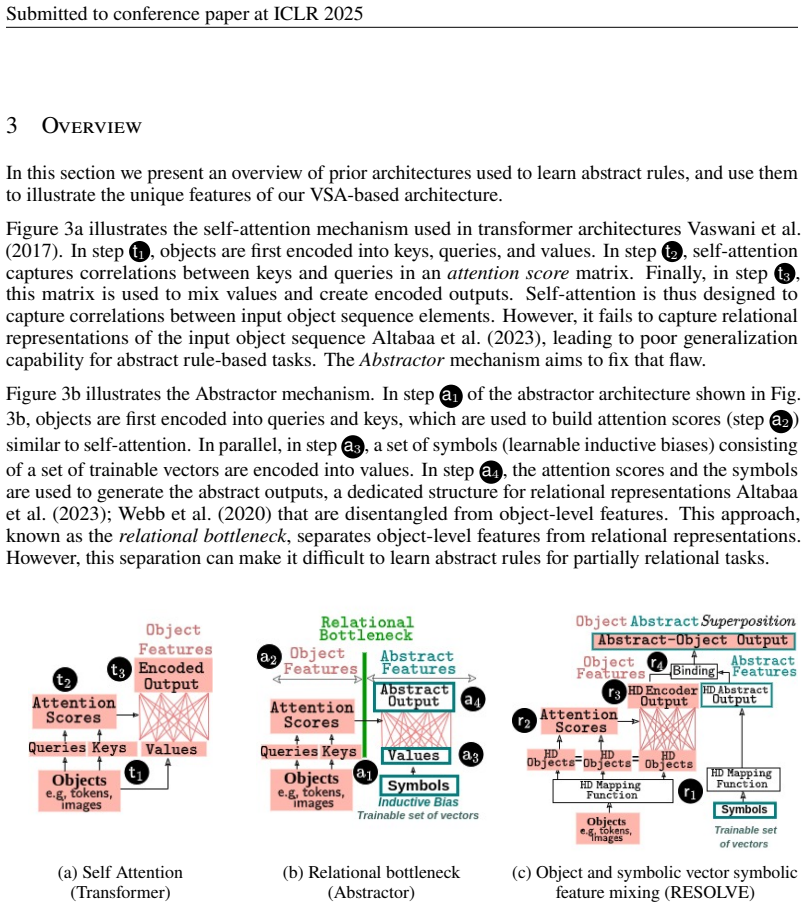
The load-bearing object is the HD-Attention score $R_{ij} = \cos\bigl(\delta(h_{O_i}), \delta(h_{O_i} \oplus h_{O_j})\bigr)$ computed in a bipolar high-dimensional space, together with bundling $\oplus$ (coordinate-wise summation) and binding $\otimes$ (Hadamard product). The score measures how much the coarse direction of object $i$'s hypervector changes when object $j$ is bundled into it; this directional change is what the paper treats as the relation between the two objects. The binding of the attention-mixed object hypervector with learned symbolic hypervectors is what lets object-level and relational content occupy the same vector with low interference, and the bipolar representation is what makes the score computable with fast sign and addition operations.
What would settle it
Ablate the learned symbols by replacing the learned symbolic hypervectors with random fixed bipolar vectors and retraining only the surrounding encoder and decoder. If accuracy on sorting or ordering stays high, the relational content is not coming from the learned symbols; if accuracy collapses, the symbols are load-bearing. A companion check is to verify on the pairwise-order task that the raw attention scores are order-consistent, i.e., $R_{ij} > R_{ji}$ whenever $o_i \prec o_j$, on held-out pairs.
Extended reading notes
Core claim
The central discovery claimed is that a vector-symbolic layer can learn abstract relations while preserving object identity, instead of routing relational information through a separate abstractor module. The layer maps each input object to a high-dimensional bipolar vector (entries in $\{-1,+1\}$, dimension $D \sim 10^3$) with a learnable convolution encoder, then computes attention scores $$R_{ij} = \cos\bigl(\delta(h_{O_i}), \delta(h_{O_i} \oplus h_{O_j})\bigr),$$ where $\oplus$ is elementwise bundling and $\delta$ binarizes each coordinate. These scores are softmax-normalized, used to mix the object hypervectors, and the mixed vector is bound (Hadamard product) with learned symbolic hypervectors. The paper's argument is that high dimensionality keeps the superposed object-level and relational codes quasi-orthogonal, so they do not destructively interfere, and that the bipolar form makes attention cheap. On this basis it claims better accuracy and few-sample generalization than the Abstractor and transformer baselines on sorting, pairwise ordering, SET classification, MNIST subtraction, and three math-problem datasets.
Load-bearing premise
The whole method depends on one unproven assumption: that comparing an object with the summed representation of itself and another object, after binarizing, is a trustworthy measure of the relation between the two objects. The paper does not verify this score on its own, only as part of the full model.
Editorial extensions
If this is right
- A single RESOLVE module can replace the abstractor in an encoder-decoder, because object and relational codes coexist in one high-dimensional vector rather than being separated into different pathways.
- Bipolar attention scores lower the compute and memory cost of self-attention, as shown by the reported roofline bandwidth and peak-performance numbers.
- Few-sample generalization improves: the paper reports above 80% accuracy on pairwise ordering with 210 training samples and on low-processed SET classification with 600 samples.
- On the math-problem datasets, RESOLVE outperforms both the Abstractor and the transformer on average accuracy and is the strongest model in the 100-sample training regime.
Reading between the lines
- The attention score can be read as a directional-change measure: bundling object $j$ into object $i$ moves $i$'s bipolar hypervector, and the cosine drop is a proxy for how much $j$ alters $i$. This reading suggests the same layer could be tested on other asymmetric relations, such as spatial containment or causal precedence, without redesigning the score.
- The quasi-orthogonality argument predicts graceful degradation as sequence length grows, because longer sequences place more bundled objects in superposition; this is testable by running RESOLVE on sorting inputs longer than the six-object training range.
- Because the decoder receives object and relational information in one vector, the module may transfer to multimodal reasoning where input objects come from different modalities; the paper mentions multimodal learning only as future work, so this remains an extension, not a claim of the paper.
Editorial analysis
A structured set of objections, weighed in public.
Referee Report
Summary. The paper proposes RESOLVE, a neuro-vector symbolic architecture for relational reasoning. Objects are encoded into high-dimensional bipolar vectors via a learnable HD encoder; a novel HD-attention mechanism computes relation scores using cosine similarity between binarized object vectors and binarized bundles of pairs; the resulting mixed object representation is bound (Hadamard product) with learnable symbol vectors to superpose object-level and relational information. The architecture is evaluated on pairwise ordering, SET classification, MNIST-Math, object sorting, and math problem-solving, comparing against transformers, the Relational Abstractor, CoRelNet, PrediNet, MLP, and LEN. The paper claims higher accuracy, better generalizability, and lower computational overhead than state-of-the-art methods.
Significance. If the claims are substantiated, RESOLVE would be a useful contribution to relational reasoning, particularly for partially relational tasks where object and relational information must coexist. The release of code and detailed hyperparameters in the appendix is a strength. However, the evidence for the central claims is incomplete: the novel HD-attention mechanism is not analyzed or independently validated, and the empirical gains over baselines are mostly confined to the low-data regime with small margins that lack statistical support. The computational overhead comparison also uses mismatched dimensions, weakening the efficiency claim.
major comments (3)
- [§5, Eq. (1)] The derivation of the HD-attention score is incorrect. The paper states that because the HD objects are bipolar, their L2 norm is sqrt(D), allowing the cosine similarity to be replaced by ⟨δ(hOi), δ(hOi ⊕ hOj)⟩/D. However, the bundle hOi ⊕ hOj is the real-valued sum of two bipolar vectors; after applying δ, entries where hOi and hOj disagree become zero, so δ(hOi ⊕ hOj) is ternary, not bipolar, and its L2 norm is not sqrt(D) in general. More fundamentally, the paper provides no evidence that this score captures asymmetric relations such as ordering or subtraction: for random i.i.d. inputs the expected score is 1/2, and the paper does not show that training shapes the attention matrix into a meaningful relation. Since contribution 2 and the explanation for the accuracy gains rest on this mechanism, the authors should correct the derivation, provide a theoretical characterization, or analyze the learned attention matrix independently of end-task accuracy.
- [§7.4, Table 1] The claim of 'better generalizability' and 'higher accuracy' is only partially supported. At the largest training size (10,000 samples), RESOLVE is behind Rel-Abstractor on all three tasks (Comparison 52.36 vs 52.46, Closest 66.84 vs 69.19, Place Value 98.68 vs 99.43). The reported averages (e.g., 41.86 vs 41.01 overall) are dominated by low-data performance, and no error bars or statistical significance tests are reported for these numbers. The conclusion that RESOLVE 'outperforms the state of the art' should be qualified to the small-data regime, or supported with variance estimates and significance tests.
- [§7.5, Table 2] The computational efficiency comparison is not apples-to-apples: HD-Attention operates in D=1024 dimensions while the self-attention baseline uses embedding sizes 32 and 64. The roofline metrics (π and β) therefore reflect different problem sizes, not the claimed advantage. The table also reports no direct latency or energy measurements. To support contribution 3, the comparison should match dimensionality or report end-to-end runtime and memory for the full models.
minor comments (5)
- [Throughout] The manuscript contains numerous typos and grammatical errors, e.g., 'an high-dimensional', 'have generated have generated', 'intereference', 'mechansim', and 'descriminative'; a careful proofread is needed.
- [§7, Appendix A.1] Section 7 lists LEN as a baseline, but no LEN results are reported in any experiment; Appendix A.1 also refers to 'LARS-VSA' without defining it.
- [Figures 8, 10, 12] The figures do not show error bars or confidence intervals even though the appendix reports multiple runs (5 trials for pairwise order, 10 runs for sorting); without these, the accuracy differences are difficult to assess.
- [§5, Step 1] The HD-encoder equation hOi[j] = Σ_k Oi[k]·Bi[j-k] is not fully specified: the dimensions of Bi (RN×(D-F+1)) and the relationship between the convolution output length and D should be clarified.
- [§5, bundling] The sentence 'It captures the dominant or relevant features of an object pair' is informal and should be replaced with a precise definition of what bundling is intended to encode and how it relates to the attention score.
Circularity Check
No significant circularity: the accuracy claims are empirical evaluations of a trained architecture, and the few self-citations are provenance/motivation only.
full rationale
The paper's central claims are not derived from its own definitions. The HD-Attention score in Eq. 1 is a proposed architectural form; the paper does not assert that its test accuracies follow analytically from this form, and no equation in Section 5 is defined in terms of the reported outputs. Bundling and binding are standard VSA operations, and the claim that bipolar vectors have L2 norm sqrt(D) is a straightforward identity that does not smuggle in the target result. The experimental results are obtained by fitting the encoder, symbols, and downstream layers to training losses and measuring accuracy on held-out test splits (sorting, SET, MNIST-MATH, math problem-solving); no fitted parameter is renamed as a prediction. The self-citations to Mejri et al. (2024a,b) are used only to attribute the convolution-based encoder implementation and to note that HDC is known to be low-overhead; the latter is also directly measured in Table 2. Neither citation carries the accuracy or generalization claims. No uniqueness theorem from the authors' prior work is invoked, and no ansatz is imported as an external fact. The paper is therefore self-contained against external benchmarks, and no circular step can be exhibited.
Assumptions & free parameters
free parameters (1)
- hypervector dimension D =
1024
assumptions (4)
- domain assumption High-dimensional bipolar vectors are quasi-orthogonal, allowing superposition of object and relational information with low interference.
- ad hoc to paper Bundling (element-wise summation) captures the dominant or relevant features of an object pair.
- domain assumption A linear projection can map the bound hypervector hS⊗EO to a low-dimensional space with low information loss.
- domain assumption The learnable symbols S can represent abstract relations after training.
Cite this review
Pith. "Pith review of RESOLVE: Relational Reasoning with Symbolic and Object-Level Features Using Vector Symbolic Processing." pith.science (2026). https://pith.science/paper/HTDX7STG
@misc{pith2026241108290,
  author       = {Pith},
  title        = {Pith review of: RESOLVE: Relational Reasoning with Symbolic and Object-Level Features Using Vector Symbolic Processing},
  year         = {2026},
  howpublished = {\url{https://pith.science/paper/HTDX7STG}},
  note         = {Machine review of arXiv:2411.08290}
}
read the original abstract
Modern transformer-based encoder-decoder architectures struggle with reasoning tasks due to their inability to effectively extract relational information between input objects (data/tokens). Recent work introduced the Abstractor module, embedded between transformer layers, to address this gap. However, the Abstractor layer while excelling at capturing relational information (pure relational reasoning), faces challenges in tasks that require both object and relational-level reasoning (partial relational reasoning). To address this, we propose RESOLVE, a neuro-vector symbolic architecture that combines object-level features with relational representations in high-dimensional spaces, using fast and efficient operations such as bundling (summation) and binding (Hadamard product) allowing both object-level features and relational representations to coexist within the same structure without interfering with one another. RESOLVE is driven by a novel attention mechanism that operates in a bipolar high dimensional space, allowing fast attention score computation compared to the state-of-the-art. By leveraging this design, the model achieves both low compute latency and memory efficiency. RESOLVE also offers better generalizability while achieving higher accuracy in purely relational reasoning tasks such as sorting as well as partial relational reasoning tasks such as math problem-solving compared to state-of-the-art methods.
Figures


Figures from the paper (10 more)


Forward citations
Cited by 1 Pith paper
-
A Vision Toward Energy-Efficient Domain-Specific Artificial Intelligence Models and Agents
A position paper proposing compact, domain-specific AI agents as the path to ≥1000× energy efficiency, without demonstrating the claim.
Reference graph
Works this paper leans on
-
[2]
Relational Concept Bottleneck Models
Pietro Barbiero, Francesco Giannini, Gabriele Ciravegna, Michelangelo Diligenti, and Giuseppe Marra. Relational concept based models.arXiv preprint arXiv:2308.11991,
-
[4]
On neural architecture inductive biases for relational tasks.arXiv preprint arXiv:2206.05056,
GiancarloKerg,SarthakMittal,DavidRolnick,YoshuaBengio,BlakeRichards,andGuillaumeLajoie. On neural architecture inductive biases for relational tasks.arXiv preprint arXiv:2206.05056,
-
[9]
Taylor Webb, Shanka Subhra Mondal, and Jonathan D Cohen. Systematic visual reasoning through object-centric relational abstraction.Advances in Neural Information Processing Systems, 36, 2024a. Taylor W Webb, Ishan Sinha, and Jonathan D Cohen. Emergent symbols through binding in external memory. arXiv preprint arXiv:2012.14601,
arXiv 2012
-
[14]
We use a batch size of 128 and train for 500 epochs
Training and Evaluation The models are trained using cross-entropy loss and the Adam optimizer with a learning rate of5 · 10−4. We use a batch size of 128 and train for 500 epochs. To evaluate 14 Submitted to conference paper at ICLR 2025 the learning curves, we vary the training set size, sampling random subsets ranging from 260 to 460 samples in increments of
work page 2025
-
[64]
The relation activation function isσrel = Softmax. Positional symbols are used as the symbol assignment mechanism, which are learned parameters of the model. Transformer Architecture We implemented the standard Transformer architecture as described by (Vaswani et al., 2017). Both the Encoder and Decoder modules share the same hyperparameters, with an incr...
work page 2017
-
[1024]
set" with probability 1/2 and a non-
The outputs are flattened and passed through a feedforward hidden layer with dimension dff = 64, followed by a final layer with a single neuron and sigmoid activation. A dropout rate of 0.4 is used to prevent overfitting. Abstractor Architecture: The Abstractor module uses the following hyperparameters: number of layersL = 1, relation dimensiondr = 4, sym...
work page 2025
-
[1700]
A.3 Single Output Partially Relational Tasks A.3.1 SET WeusedthesamesettingsasinthepreviousSETexperiment. However, inthistask, theinputfeatures used as a sequence of objects are derived from the first convolutional layer of the pre-trainedCNN. This approach avoids using highly processed object-level features, allowing us to assess the ability of RESOLVEan...
work page 2018
-
[1938]
Same-different problems strain convolutional neural networks
Matthew Ricci, Junkyung Kim, and Thomas Serre. Same-different problems strain convolutional neural networks.arXiv preprint arXiv:1802.03390,
Show all 14 references
-
[2017]
Analysing mathematical reasoning abilities of neural models.arXiv preprint arXiv:1904.01557,
11 Submitted to conference paper at ICLR 2025 David Saxton, Edward Grefenstette, Felix Hill, and Pushmeet Kohli. Analysing mathematical reasoning abilities of neural models.arXiv preprint arXiv:1904.01557,
2025 arXiv
-
[2018]
Adare-hd: Adaptive-resolution framework for efficient object detection and tracking via hd-computing
Mohamed Mejri, Chandramouli Amarnath, and Abhijit Chatterjee. Adare-hd: Adaptive-resolution framework for efficient object detection and tracking via hd-computing. In2024 IEEE 67th International Midwest Symposium on Circuits and Systems (MWSCAS), pp. 811–817. IEEE, 2024a. Moham...
-
[2019]
Single Output Tasks In this section, we provide comprehensive information on the architectures, hyperparameters, and implementation details of our experiments
A Appendix Code and Reproducibility The code, detailed experimental logs, and instructions for reproducing our experimental results are available at:https://github.com/mmejri3/RESOLVE. Single Output Tasks In this section, we provide comprehensive information on the architectur...
2025
-
[2022]
Logic tensor networks
10 Submitted to conference paper at ICLR 2025 Samy Badreddine, Artur d’Avila Garcez, Luciano Serafini, and Michael Spranger. Logic tensor networks. Artificial Intelligence, 303:103649,
2025
-
[2023]
arXivpreprintarXiv:1410.5401,
AlexGraves,GregWayne,andIvoDanihelka.Neuralturingmachines. arXivpreprintarXiv:1410.5401,
-
[2024]
Slot abstractors: Toward scalable abstract visual reasoning.arXiv preprint arXiv:2403.03458,
Shanka Subhra Mondal, Jonathan D Cohen, and Taylor W Webb. Slot abstractors: Toward scalable abstract visual reasoning.arXiv preprint arXiv:2403.03458,
Reviewed August 12, 2026 · model on record in the stance chip above.
Discussion (0). Continue with ORCID to comment.