REVIEW 4 major objections 6 minor 70 references
Parameter estimation of protoneutron stars from gravitational wave signals using the Hilbert-Huang transform
T0 review · 4 major / 6 minor · reviewed 2026-08-12 · deepseek-v4-flash
Pith's one-line read The paper claims that a Hilbert-Huang transform pipeline estimates protoneutron-star mass-radius ratios from supernova gravitational waves with accuracy comparable to STFT, and equivalent after cWB reconstruction.
desk verdict A clean, honest head-to-head showing HHT matches STFT for PNS g-mode parameter estimation, with a post-hoc IMF-summing rule that needs independent validation before the method generalizes. read the letter →
The pith
A machine-rendered reading of the paper's core claim, the machinery that carries it, and where it could break.
The reading
What carries the argument
The pipeline runs in three stages. Coherent WaveBurst (cWB) reconstructs the transient signal from the three-detector network using a time-frequency excess-power search with Wilson-Daubechies-Meyer wavelets. Complementary ensemble empirical mode decomposition (CEEMD) then splits the reconstructed time series into four intrinsic mode functions (IMFs) plus a residual, adding and subtracting Gaussian noise in 1000 realisations to stabilise the decomposition. Finally, the Hilbert transform of each IMF gives an instantaneous frequency ${\rm IF}_k(t)$; because the 2g2 mode is split across the first three IMFs, the sum ${\rm IF}_{1..3}={\rm IF}_1+{\rm IF}_2+{\rm IF}_3$ (with IMF4 discarded) is taken as the mode frequency and inserted into the cubic universal relation $f = a + bx + cx^{2} + dx^{3}$, whose solution $x = M_{\rm PNS}/R_{\rm PNS}^{2}$ is evaluated at each time step.
What would settle it
Inject a synthetic waveform with an artificially prescribed g-mode chirp and known mass-radius relation into detector noise, run the cWB+HHT pipeline, and check whether the summed IF1..3 follows the injected frequency at every post-bounce time; a systematic deviation at some frequencies would falsify the summing rule.
Extended reading notes
Core claim
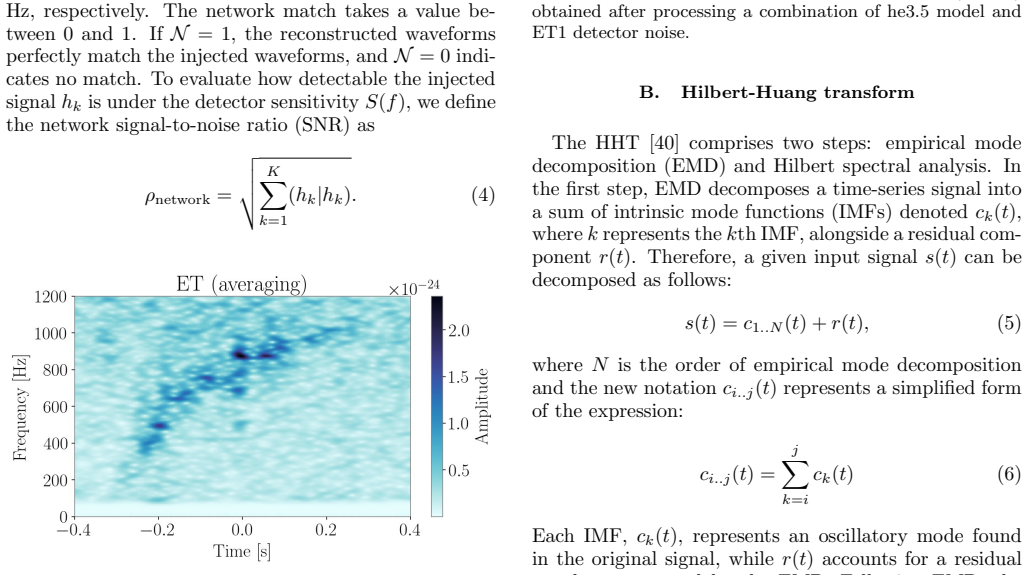
The central claim is that the g-mode frequency needed for parameter estimation can be recovered by summing the instantaneous frequencies of the first three intrinsic mode functions produced by complementary ensemble empirical mode decomposition, and that solving the universal relation for the 2g2 mode with this summed frequency yields estimates of $M_{\rm PNS}/R_{\rm PNS}^{2}$ with accuracy comparable to or better than STFT. In the noiseless case the HHT root-mean-square error is 33.9% lower for the he3.5 waveform and 4.1% lower for y20. In detector-noise simulations with coherent WaveBurst reconstruction, the RMSE of cWB+HHT and cWB+STFT are statistically equivalent, supporting the paper's conclusion that the two frequency-extraction methods have comparable accuracy.
Load-bearing premise
The method assumes that the 2g2 g-mode frequency is recovered by summing the instantaneous frequencies of the first three IMFs and discarding the fourth, a rule chosen after observing the mode split in these two waveforms.
Editorial extensions
If this is right
- A future core-collapse supernova gravitational-wave detection could have its protoneutron-star mass-radius ratio estimated by two time-frequency methods that do not share the STFT's resolution limitations.
- The HHT's smoother, continuous frequency tracks allow the g-mode evolution to be traced without the time-discontinuities that appear in the STFT maximum-amplitude track.
- In the noise-injected runs, the estimation error grows with source distance in the same way for both methods, and the distance at which it degrades tracks the cWB network match.
- Because the pipeline does not assume a waveform model, it can be paired with other reconstruction methods, such as the BayesWave algorithm suggested by the authors as future work.
Reading between the lines
- The sum-of-first-three-IMFs rule has only been checked on two waveforms; testing it on a larger set of progenitors and equations of state would reveal whether it introduces a systematic bias in the recovered $M/R^2$.
- Injecting synthetic chirps with a known frequency evolution and known $M/R$ would isolate the frequency extractor from the universal-relation uncertainty and directly test the decomposition heuristic.
- The HHT's ability to localise features in time-frequency space could be turned on other CCSN signatures (SASI, convection, f/p-modes), giving independent constraints on the same protoneutron-star parameters.
Signed reviews
Editorial analysis
A structured set of objections, weighed in public.
Referee Report
Summary. The paper proposes a parameter-estimation pipeline for protoneutron stars (PNSs) in core-collapse supernova gravitational-wave signals. The method combines coherent WaveBurst (cWB) reconstruction with the Hilbert-Huang transform (HHT) based on complementary ensemble empirical mode decomposition (CEEMD) to extract the 2g2 g-mode frequency, which is then inserted into empirical universal relations to infer MPNS/R2PNS. The authors compare this approach with a short-time Fourier transform (STFT) baseline, first on pure simulated signals and then on signals injected into simulated Einstein Telescope noise over 100 realizations. They report comparable or slightly better RMSE for the HHT-based method in the pure-signal case and comparable accuracy in the noise-injected case.
Significance. If the reported accuracy is robust, the method provides a complementary time-frequency tool for CCSN asteroseismology that does not suffer from the time-frequency resolution tradeoff of STFT. The paper includes Monte Carlo simulations with 100 noise realizations and uses publicly available waveform models, which is a strength. However, the central claim rests on a heuristic IMF-summation rule and an unspecified root-selection procedure for the cubic universal relation, and the pure-signal comparison lacks uncertainty quantification. These issues currently limit the reproducibility and generalizability of the result.
major comments (4)
- [Sec. III C] The procedure for solving the cubic universal relation Eq. (10) is incomplete. The text states that roots are computed via the eigenvalues of the companion matrix, but a cubic equation generally has up to three real roots, and the paper does not specify how the physically relevant root for MPNS/R2PNS is selected. Without this selection rule, the RMSE results in Fig. 10 and Fig. 12 cannot be reproduced by an independent reader.
- [Sec. IV A, Fig. 9] The rule of summing IMF1 through IMF3 and excluding IMF4 is adopted after observing mode splitting in the he3.5 pure signal, with the justification that IMF4 has small IA and IF below 200 Hz. This is a post-hoc heuristic with no quantitative threshold or model-based criterion, and it is not validated for other waveforms, for cWB-reconstructed signals, or across noise realizations. The authors' own observation in Fig. 8 that IF1 lies between the 2g1 and 2g2 modes near -0.2 to -0.1 s indicates that mode mixing can bias the instantaneous frequency, so the summed IF may not faithfully represent the 2g2 mode. The paper needs either a principled rule for selecting the IMFs to sum or an independent validation that the chosen summation tracks the 2g2 frequency without bias.
- [Sec. IV A] The pure-signal RMSE ratios (0.66 for he3.5 and, implicitly, 0.959 for y20) are computed from a single noise-free realization for each model. No uncertainty is associated with these numbers, so the reported 33.9% and 4.1% improvements of HHT over STFT cannot be distinguished from random variability. A bootstrap over time samples or multiple independent realizations would be needed to support the claim of higher accuracy in the noiseless case.
- [Sec. IV B] Although the box plots in Fig. 12 show that the cWB+HHT and cWB+STFT methods produce similar RMSE distributions, the paper does not report any statistical test comparing the two methods across the 100 noise realizations (e.g., a paired test at each distance). The conclusion of comparable accuracy is visually plausible but would be strengthened by a quantitative comparison that accounts for the pairing of noise realizations.
minor comments (6)
- [Sec. II A] The sentence 'In this simulation, the GW signal comprises two polarization states' should use plural form: 'In these simulations'.
- [Sec. IV A] The paper reports the HHT/STFT RMSE ratio for he3.5 as 0.66 but does not explicitly give the corresponding ratio for y20; stating both values would make the comparison clearer.
- [Sec. IV B] The caption of Fig. 12 contains a typo: 'Each box plot shows its an interquartile range' should be 'shows its interquartile range'.
- [Sec. III B] The CEEMD parameters in Table I (number of IMFs, ensemble size, noise standard deviation, stoppage criterion) are fixed without a sensitivity study or a reference justifying these specific values; a brief discussion of their robustness would help the reader assess the method's reliability.
- [Sec. III B, Eq. (9)] The definition of the analytic signal is given for an IMF ck(t), but the text later says it applies to 'any combination of IMFs'; it would be clearer to define the Hilbert transform for an arbitrary time series or to explicitly state that the analytic signal of the summed IMFs is used in the frequency extraction.
- [Sec. IV B] The STFT reference method uses the frequency bin of maximum amplitude at each time; this estimator is known to be biased in the presence of noise, which may explain the increasing RMSE of the STFT-based method at large distances. The authors could mention this as a possible reason for the observed gap and as a caveat when interpreting the comparison.
Circularity Check
Minor in-sample tuning of the IMF-summation rule; the central cWB+HHT vs cWB+STFT comparison remains independent.
-
other
[Sec. IV A, Figs. 8–9 (and Sec. III B on HHT)]
"In this case, summing the IMFs before applying Hilbert spectral analysis is one empirical method to mitigate the effect of mode splitting. Figure 9 shows the sums of the three IFs and three IAs, labeled as IF 1..3 and IA 1..3, respectively. Note that IMF4 is excluded from the summation due to its relatively small IA and the estimated IF being below 200 Hz, which is outside the frequency range of the 2g2 mode."
The extraction rule (sum IMF1–3, drop IMF4) is selected after observing that the 2g2 mode is split across these same IMFs in the he3.5 signal: the paper states that 'the 2g2 mode appears to be separated into several IFs' (Fig. 8). The same he3.5 signal is then used to compute the reported RMSE improvement of 33.9% over STFT against the simulation's true MPNS/R2PNS. Thus the pure-signal accuracy figure is partly an in-sample consistency check: the estimator was chosen by visual alignment with the true mode on the very waveform being evaluated, so that particular RMSE comparison is not a fully out-of-sample prediction.
full rationale
The paper's central claim is a comparative accuracy statement between cWB+HHT and cWB+STFT for estimating MPNS/R2PNS. The universal relation Eq. (10) with Table II is an external empirical input from Refs. [33,34], not derived in this paper, and the estimated quantity x is obtained by solving that cubic for a measured frequency. The HHT procedure itself is standard and described in Sec. III B, with fixed CEEMD parameters in Table I; the authors' self-citations [42,43,45] provide implementation details but are not load-bearing. The only data-dependent choice is the heuristic IMF-summation rule, adopted after observing mode splitting in the he3.5 signal and then applied to y20 and to cWB-reconstructed noisy data. This is a mild in-sample tuning of the frequency extractor for the pure-signal comparison, which slightly inflates the reported HHT-vs-STFT RMSE advantage. However, it is not a fitted parameter that makes the result true by construction, and the main noise-injected comparison remains an independent, fixed-rule test of two pipelines. The paper itself acknowledges in Sec. V that further validation with additional simulations is necessary. Overall, no load-bearing self-citation chain or definitional circularity exists; the derivation is substantially self-contained, with a minor heuristic-selection caveat.
Assumptions & free parameters
free parameters (4)
- Number of IMFs for CEEMD =
4
- Ensemble size for CEEMD =
1000
- Standard deviation of added Gaussian noise =
0.8
- Stoppage criterion =
7e-4
assumptions (3)
- domain assumption Universal relation f(t) = a + b x + c x^2 + d x^3 with coefficients from Torres-Forné et al. holds for he3.5 and y20 models
- domain assumption Extracted HHT frequencies correspond to the 2g2 g-mode of the PNS
- domain assumption ET-D sensitivity curve and Gaussian noise are representative of the Einstein Telescope
Cite this review
Pith. "Pith review of Parameter estimation of protoneutron stars from gravitational wave signals using the Hilbert-Huang transform." pith.science (2026). https://pith.science/paper/3TGYVWXD
@misc{pith2026241108407,
  author       = {Pith},
  title        = {Pith review of: Parameter estimation of protoneutron stars from gravitational wave signals using the Hilbert-Huang transform},
  year         = {2026},
  howpublished = {\url{https://pith.science/paper/3TGYVWXD}},
  note         = {Machine review of arXiv:2411.08407}
}
read the original abstract
Core-collapse supernovae (CCSNe) are potential multimessenger events detectable by current and future gravitational wave (GW) detectors. The GW signals emitted during these events are expected to provide insights into the explosion mechanism and the internal structures of neutron stars. In recent years, several studies have empirically derived the relationship between the frequencies of the GW signals originating from the oscillations of protoneutron stars (PNSs) and the physical parameters of these stars. This study applies the Hilbert-Huang transform (HHT) [Proc. R. Soc. A 454, 903 (1998)] to extract the frequencies of these modes to infer the physical properties of the PNSs. The results exhibit comparable accuracy to a short-time Fourier transform-based estimation, highlighting the potential of this approach as a complementary method for extracting physical information from GW signals of CCSNe.
Figures


Figures from the paper (8 more)



Reference graph
Works this paper leans on
-
[1]
, N), where each sequence represents white Gaussian noise with mean zero and standard de- viation σ
Generate N time-series sequences {nk(t)} (k = 1, . . . , N), where each sequence represents white Gaussian noise with mean zero and standard de- viation σ
-
[2]
Construct noise-added signal s(+) k (t) and noise- subtracted signal s(−) k (t) to the target signal s(t): s(±) k (t) = s(t) ± nk(t), (A1) for k = 1, . . . , N
-
[3]
Employ EMD to each s(±) k (t) with the stoppage criterion based on a Cauchy convergence test with a predetermined value ϵ [42] to obtain IMFs {c(±) i,k (t)}, alongside the residuals r(±) k (t): s(±) k (t) = X i c(±) i,k (t) + r(±) k (t). (A2)
-
[4]
Calculate the final IMFs and residue by ci(t) = 1 2N NX k=1 c(+) i,k (t) + c(−) i,k (t) , (A3) r(t) = 1 2N NX k=1 r(+) k (t) + r(−) k (t) . (A4) 9 FIG. 10. Estimates of MPNS/R2 PNS calculated using the pure GW signal from 10 kpc. True values are obtained from numerical simulation. FIG. 11. Distributions of the network match as the function of distance or ...
-
[5]
B. P. Abbott et al. (LIGO Scientific Collaboration and Virgo Collaboration), GWTC-1: A gravitational-wave transient catalog of compact binary mergers observed by LIGO and Virgo during the first and second observing runs, Phys. Rev. X 9, 031040 (2019)
work page 2019
-
[6]
R. Abbott et al. (LIGO Scientific Collaboration and Virgo Collaboration), GWTC-2: Compact binary coa- lescences observed by LIGO and Virgo during the first half of the third observing run, Phys. Rev. X 11, 021053 (2021)
work page 2021
-
[7]
Abbott et al
R. Abbott et al. (The LIGO Scientific Collaboration and the Virgo Collaboration), GWTC-2.1: Deep ex- tended catalog of compact binary coalescences observed by LIGO and Virgo during the first half of the third ob- serving run, Phys. Rev. D 109, 022001 (2024)
2024
-
[8]
R. Abbott et al. (LIGO Scientific Collaboration, Virgo Collaboration, and KAGRA Collaboration), GWTC-3: Compact binary coalescences observed by LIGO and Virgo during the second part of the third observing run, Phys. Rev. X 13, 041039 (2023)
work page 2023
Show all 70 references
-
[9]
Janka, Explosion mechanisms of core-collapse su- pernovae, Annu
H.-T. Janka, Explosion mechanisms of core-collapse su- pernovae, Annu. Rev. Nucl. Part. Sci. 62, 407 (2012)
2012
-
[10]
Mezzacappa and M
A. Mezzacappa and M. Zanolin, Gravitational waves from neutrino-driven core collapse supernovae: Pre- dictions, detection, and parameter estimation (2024), arXiv:2401.11635
2024 arXiv
-
[11]
Aasi et al
J. Aasi et al. (LIGO Scientific Collaboration), Advanced LIGO, Classical Quantum Gravity 32, 074001 (2015)
2015
-
[12]
Acernese et al., Advanced Virgo: A second-generation interferometric gravitational wave detector, Classical Quantum Gravity 32, 024001 (2014)
F. Acernese et al., Advanced Virgo: A second-generation interferometric gravitational wave detector, Classical Quantum Gravity 32, 024001 (2014)
2014
-
[13]
Akutsu et al., KAGRA: 2.5 generation interferometric gravitational wave detector, Nat
T. Akutsu et al., KAGRA: 2.5 generation interferometric gravitational wave detector, Nat. Astron. 3, 35 (2019)
2019
-
[14]
M. J. Szczepa´ nczyk, J. M. Antelis, M. Benjamin, M. Cavagli` a, D. Gondek-Rosi´ nska, T. Hansen, S. Kli- menko, M. D. Morales, C. Moreno, S. Mukherjee, G. Nurbek, J. Powell, N. Singh, S. Sitmukhambetov, P. Szewczyk, O. Valdez, G. Vedovato, J. Westhouse, M. Zanolin, and Y. Zhe...
2021
-
[15]
Hayama, T
K. Hayama, T. Kuroda, K. Kotake, and T. Takiwaki, Coherent network analysis of gravitational waves from three-dimensional core-collapse supernova models, Phys. Rev. D 92, 122001 (2015)
2015
-
[16]
B. P. Abbott et al., Exploring the sensitivity of next gen- eration gravitational wave detectors, Classical Quantum Gravity 34, 044001 (2017)
2017
-
[17]
Reitze, R
D. Reitze, R. X. Adhikari, S. Ballmer, B. Barish, L. Bar- sotti, G. Billingsley, D. A. Brown, Y. Chen, D. Coyne, R. Eisenstein, M. Evans, P. Fritschel, E. D. Hall, A. Laz- zarini, G. Lovelace, J. Read, B. S. Sathyaprakash, D. Shoemaker, J. Smith, C. Torrie, S. Vitale, R. Weiss...
2019 arXiv
-
[18]
Punturo et al., The Einstein Telescope: A third- generation gravitational wave observatory, Classical Quantum Gravity 27, 194002 (2010)
M. Punturo et al., The Einstein Telescope: A third- generation gravitational wave observatory, Classical Quantum Gravity 27, 194002 (2010)
2010
-
[19]
Ackley et al., Neutron star extreme matter observa- tory: A kilohertz-band gravitational-wave detector in the global network, Pub
K. Ackley et al., Neutron star extreme matter observa- tory: A kilohertz-band gravitational-wave detector in the global network, Pub. Astron. Soc. Aust. 37, e047 (2020)
2020
-
[20]
Szczepa´ nczyk and M
M. Szczepa´ nczyk and M. Zanolin, Gravitational waves from a core-collapse supernova: Perspectives with detec- tors in the late 2020s and early 2030s, Galaxies 10, 70 (2022)
2022
-
[21]
Klimenko, I
S. Klimenko, I. Yakushin, A. Mercer, and G. Mitsel- makher, A coherent method for detection of gravitational wave bursts, Classical Quantum Gravity 25, 114029 (2008)
2008
-
[22]
Klimenko, G
S. Klimenko, G. Vedovato, M. Drago, F. Salemi, V. Ti- wari, G. A. Prodi, C. Lazzaro, K. Ackley, S. Tiwari, C. F. Da Silva, and G. Mitselmakher, Method for detection and reconstruction of gravitational wave transients with net- works of advanced detectors, Phys. Rev. D 93, 0420...
2016
-
[23]
Drago et al., Coherent WaveBurst, A pipeline for un- modeled gravitational-wave data analysis, SoftwareX 14, 100678 (2021)
M. Drago et al., Coherent WaveBurst, A pipeline for un- modeled gravitational-wave data analysis, SoftwareX 14, 100678 (2021)
2021
-
[24]
Astone, P
P. Astone, P. Cerd´ a-Dur´ an, I. Di Palma, M. Drago, F. Muciaccia, C. Palomba, and F. Ricci, New method to observe gravitational waves emitted by core collapse supernovae, Phys. Rev. D 98, 122002 (2018)
2018
-
[25]
A. Iess, E. Cuoco, F. Morawski, and J. Powell, Core- collapse supernova gravitational-wave search and deep learning classification, Mach. Learn. 1, 025014 (2020)
2020
-
[26]
M. L. Chan, I. S. Heng, and C. Messenger, Detection and classification of supernova gravitational wave signals: A deep learning approach, Phys. Rev. D 102, 043022 (2020)
2020
-
[27]
L´ opez, I
M. L´ opez, I. Di Palma, M. Drago, P. Cerd´ a-Dur´ an, and F. Ricci, Deep learning for core-collapse supernova de- tection, Phys. Rev. D 103, 063011 (2021)
2021
-
[28]
A. Iess, E. Cuoco, F. Morawski, C. Nicolaou, and O. La- hav, LSTM and CNN application for core-collapse su- pernova search in gravitational wave real data, Astron. Astrophys. 669, A42 (2023)
2023
-
[29]
Sasaoka, N
S. Sasaoka, N. Koyama, D. Dominguez, Y. Sakai, K. Somiya, Y. Omae, and H. Takahashi, Visualizing convolutional neural network for classifying gravitational waves from core-collapse supernovae, Phys. Rev. D 108, 123033 (2023)
2023
-
[30]
M. C. Edwards, Classifying the equation of state from ro- tating core collapse gravitational waves with deep learn- ing, Phys. Rev. D 103, 024025 (2021)
2021
-
[31]
Saiz-P´ erez, A
A. Saiz-P´ erez, A. Torres-Forn´ e, and J. A. Font, Classifi- cation of core-collapse supernova explosions with learned dictionaries, Mon. Not. R. Astron. Soc. 512, 3815 (2022)
2022
-
[32]
Mitra, D
A. Mitra, D. Orel, Y. S. Abylkairov, B. Shukirgaliyev, and E. Abdikamalov, Probing nuclear physics with su- pernova gravitational waves and machine learning, Mon. Not. R. Astron. Soc. 529, 3582 (2024)
2024
-
[33]
Powell, A
J. Powell, A. Iess, M. Llorens-Monteagudo, M. Ober- gaulinger, B. M¨ uller, A. Torres-Forn´ e, E. Cuoco, and J. A. Font, Determining the core-collapse supernova ex- plosion mechanism with current and future gravitational- wave observatories, Phys. Rev. D 109, 063019 (2024)
2024
-
[34]
Andersson and K
N. Andersson and K. D. Kokkotas, Towards gravitational wave asteroseismology, Mon. Not. R. Astron. Soc. 299, 1059 (1998)
1998
-
[35]
Sotani and T
H. Sotani and T. Takiwaki, Gravitational wave astero- 11 seismology with protoneutron stars, Phys. Rev. D 94, 044043 (2016)
2016
-
[36]
Sotani, T
H. Sotani, T. Kuroda, T. Takiwaki, and K. Kotake, De- pendence of the outer boundary condition on protoneu- tron star asteroseismology with gravitational-wave signa- tures, Phys. Rev. D 99, 123024 (2019)
2019
-
[37]
Torres-Forn´ e, P
A. Torres-Forn´ e, P. Cerd´ a-Dur´ an, M. Obergaulinger, B. M¨ uller, and J. A. Font, Universal relations for gravitational-wave asteroseismology of protoneutron stars, Phys. Rev. Lett. 123, 051102 (2019)
2019
-
[38]
Torres-Forn´ e, P
A. Torres-Forn´ e, P. Cerd´ a-Dur´ an, M. Obergaulinger, B. M¨ uller, and J. A. Font, Erratum: Universal relations for gravitational-wave asteroseismology of protoneutron stars [Phys. Rev. Lett. 123, 051102 (2019)], Phys. Rev. Lett. 127, 239901 (2021)
2019
-
[39]
Sotani, T
H. Sotani, T. Takiwaki, and H. Togashi, Universal re- lation for supernova gravitational waves, Phys. Rev. D 104, 123009 (2021)
2021
-
[40]
Bizouard, P
M.-A. Bizouard, P. Maturana-Russel, A. Torres-Forn´ e, M. Obergaulinger, P. Cerd´ a-Dur´ an, N. Christensen, J. A. Font, and R. Meyer, Inference of protoneutron star prop- erties from gravitational-wave data in core-collapse su- pernovae, Phys. Rev. D 103, 063006 (2021)
2021
-
[41]
Powell and B
J. Powell and B. M¨ uller, Inferring astrophysical parame- ters of core-collapse supernovae from their gravitational- wave emission, Phys. Rev. D 105, 063018 (2022)
2022
-
[42]
Bruel, M.-A
T. Bruel, M.-A. Bizouard, M. Obergaulinger, P. Maturana-Russel, A. Torres-Forn´ e, P. Cerd´ a-Dur´ an, N. Christensen, J. A. Font, and R. Meyer, Inference of protoneutron star properties in core-collapse supernovae from a gravitational-wave detector network, Phys. Rev. D 107, ...
2023
-
[43]
Casallas-Lagos, J
A. Casallas-Lagos, J. M. Antelis, C. Moreno, M. Zano- lin, A. Mezzacappa, and M. J. Szczepa´ nczyk, Character- izing the temporal evolution of the high-frequency gravi- tational wave emission for a core collapse supernova with laser interferometric data: A neural network appro...
2023
-
[44]
N. E. Huang, Z. Shen, S. R. Long, M. C. Wu, H. H. Shih, Q. Zheng, N. C. Yen, C. C. Tung, and H. H. Liu, The em- pirical mode decomposition and the Hilbert spectrum for nonlinear and non-stationary time series analysis, Proc. R. Soc. A 454, 903 (1998)
1998
-
[45]
J. B. Camp, J. K. Cannizzo, and K. Numata, Application of the Hilbert-Huang transform to the search for gravi- tational waves, Phys. Rev. D 75, 061101 (2007)
2007
-
[46]
Kaneyama, K
M. Kaneyama, K. Oohara, H. Takahashi, Y. Sekiguchi, H. Tagoshi, and M. Shibata, Analysis of gravitational waves from binary neutron star merger by Hilbert-Huang transform, Phys. Rev. D 93, 123010 (2016)
2016
-
[47]
I. Yoda, K. Oohara, H. Takahashi, and K. Sakai, Pre- cise analysis of gravitational waves from binary neutron star coalescence using Hilbert-Huang transform based on Akima spline interpolation, Prog. Theor. Exp. Phys. 2023, 083E01 (2023)
2023
-
[48]
Sakai, K
K. Sakai, K. Oohara, H. Nakano, M. Kaneyama, and H. Takahashi, Estimation of starting times of quasi- normal modes in ringdown gravitational waves with the Hilbert-Huang transform, Phys. Rev. D 96, 044047 (2017)
2017
-
[49]
Takeda, Y
M. Takeda, Y. Hiranuma, N. Kanda, K. Kotake, T. Kuroda, R. Negishi, K. Oohara, K. Sakai, Y. Sakai, T. Sawada, H. Takahashi, S. Tsuchida, Y. Watanabe, and T. Yokozawa, Application of the Hilbert-Huang trans- form for analyzing standing-accretion-shock-instability induced gravit...
2021
-
[50]
Powell and B
J. Powell and B. M¨ uller, Gravitational wave emission from 3D explosion models of core-collapse supernovae with low and normal explosion energies, Mon. Not. R. Astron. Soc. 487, 1178 (2019)
2019
-
[51]
Powell and B
J. Powell and B. M¨ uller, Three-dimensional core-collapse supernova simulations of massive and rotating progeni- tors, Mon. Not. R. Astron. Soc. 494, 4665 (2020)
2020
-
[52]
M¨ uller, H.-T
B. M¨ uller, H.-T. Janka, and H. Dimmelmeier, A new multi-dimensional general relativistic neutrino hydrody- namic code for core-collapse supernovae. I. Method and code tests in spherical symmetry, Astrophys. J. Suppl. Ser. 189, 104 (2010)
2010
-
[53]
Branchesi et al., Science with the Einstein Telescope: A comparison of different designs, J
M. Branchesi et al., Science with the Einstein Telescope: A comparison of different designs, J. Cosmol. Astropart. Phys. 2023 (07), 068
2023
-
[54]
Punturo, ET sensitivities page, https://www.et- gw.eu/index.php/etsensitivities (2011)
M. Punturo, ET sensitivities page, https://www.et- gw.eu/index.php/etsensitivities (2011)
2011
-
[55]
Hild et al., Sensitivity studies for third-generation gravitational wave observatories, Classical Quantum Gravity 28, 094013 (2011)
S. Hild et al., Sensitivity studies for third-generation gravitational wave observatories, Classical Quantum Gravity 28, 094013 (2011)
2011
-
[56]
C. J. Moore, R. H. Cole, and C. P. L. Berry, Gravitational-wave sensitivity curves, Classical and Quantum Gravity 32, 015014 (2014)
2014
-
[57]
Nitz et al., gwastro/pycbc: v2.3.3 release of pycbc (2024)
A. Nitz et al., gwastro/pycbc: v2.3.3 release of pycbc (2024)
2024
-
[58]
Y. Xu, S. Tiwari, and M. Drago, PycWB: A user-friendly, modular, and python-based framework for gravitational wave unmodelled search, SoftwareX 26, 101639 (2024)
2024
-
[59]
B. P. Abbott et al. (LIGO Scientific Collaboration and Virgo Collaboration and ASAS-SN Collaboration and DLT40 Collaboration), Optically targeted search for gravitational waves emitted by core-collapse supernovae during the first and second observing runs of Advanced LIGO and ...
2020
-
[60]
Necula, S
V. Necula, S. Klimenko, and G. Mitselmakher, Tran- sient analysis with fast wilson-daubechies time-frequency transform, J. Phys. Conf. Ser. 363, 012032 (2012)
2012
-
[61]
B. P. Abbott et al. (LIGO Scientific Collaboration and Virgo Collaboration), Observing gravitational-wave tran- sient GW150914 with minimal assumptions, Phys. Rev. D 93, 122004 (2016)
2016
-
[62]
Wu and N
Z. Wu and N. E. Huang, Ensemble empirical mode decomposition: A noise-assisted data analysis method, Adv. Adapt. Data Anal. 01, 1 (2009)
2009
-
[63]
Yeh, J.-S
J.-R. Yeh, J.-S. Shieh, and N. E. Huang, Complementary ensemble empirical mode decomposition: A novel noise enhanced data analysis method, Adv. Adapt. Data Anal. 02, 135 (2010)
2010
-
[64]
Anderson, Z
E. Anderson, Z. Bai, C. Bischof, L. S. Blackford, J. Dem- mel, J. J. Dongarra, J. Du Croz, S. Hammarling, A. Greenbaum, A. McKenney, and D. Sorensen, LA- PACK Users’ guide (third ed.)(Society for Industrial and Applied Mathematics, USA, 1999)
1999
-
[65]
Bizouard, P
M.-A. Bizouard, P. Maturana-Russel, A. Torres-Forn´ e, M. Obergaulinger, P. Cerd´ a-Dur´ an, N. Christensen, J. A. Font, and R. Meyer, Inference of protoneutron star prop- erties from gravitational-wave data in core-collapse su- pernovae, Physical Review D 103, 063006 (2021)
2021
-
[66]
Sotani, B
H. Sotani, B. M¨ uller, and T. Takiwaki, Universality in su- pernova gravitational waves with protoneutron star prop- 12 erties, Physical Review D 109, 123021 (2024)
2024
-
[67]
L. F. Roberts, G. Shen, V. Cirigliano, J. A. Pons, S. Reddy, and S. E. Woosley, Protoneutron star cool- ing with convection: The effect of the symmetry energy, Phys. Rev. Lett. 108, 061103 (2012)
2012
-
[68]
Kuroda, K
T. Kuroda, K. Kotake, and T. Takiwaki, A new gravitational-wave signature from standing accretion shock instability in supernovae, Astrophys. J. Lett. 829, L14 (2016)
2016
-
[69]
N. J. Cornish and T. B. Littenberg, Bayeswave: Bayesian inference for gravitational wave bursts and instrument glitches, Classical Quantum Gravity 32, 135012 (2015)
2015
-
[70]
N. J. Cornish, T. B. Littenberg, B. B´ ecsy, K. Chatzi- ioannou, J. A. Clark, S. Ghonge, and M. Millhouse, Bayeswave analysis pipeline in the era of gravitational wave observations, Phys. Rev. D 103, 044006 (2021)
2021
Reviewed August 12, 2026 · model on record in the stance chip above.
Discussion (0). Continue with ORCID to comment.