REVIEW 3 major objections 4 minor 1 cited by
Evolution of Electronic Correlations in the Ruddlesden-Popper Nickelates
T0 review · 3 major / 4 minor · reviewed 2026-08-12 · deepseek-v4-flash
Pith's one-line read As nickelate layers stack from n=2 to n=∞, optical measurements show electronic correlations weaken, placing La3Ni2O7 near a Mott insulator and the higher-layer members as correlated metals.
desk verdict A clean systematic optical study showing decreasing correlations with layer number, but the 150 K measurement temperature relative to the density-wave ordering is unstated and needs checking. read the letter →
The pith
A machine-rendered reading of the paper's core claim, the machinery that carries it, and where it could break.
The reading
What carries the argument
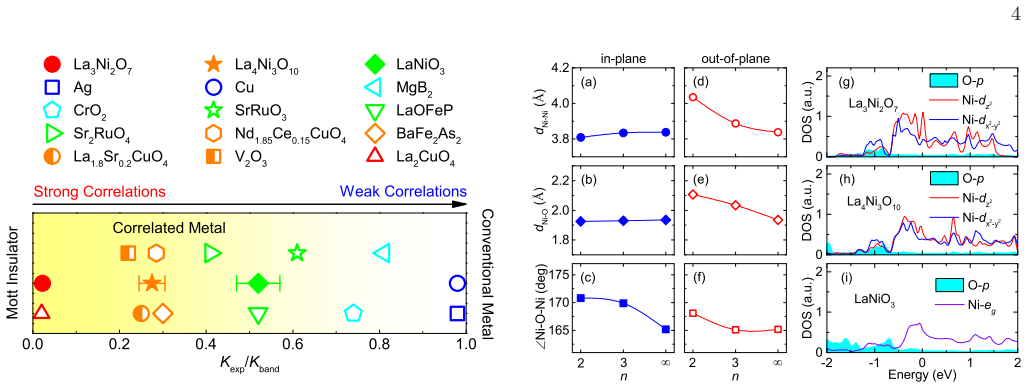
The key quantitative tool is the kinetic-energy ratio K_exp/K_band, where K is defined through the optical sum rule K = ($2ℏ^{2}$ c0 / π $e^{2}$) ∫$_0^{{ω_c}}$ σ1(ω) dω. The experimental Drude weight is isolated from interband weight by fitting the measured σ1(ω) to a Drude-Lorentz model with two Drude components and a set of Lorentz oscillators; the band-theory reference K_band comes from density-functional theory (DFT). The ratio measures how much interactions suppress itinerant motion relative to the noninteracting picture, and it is used to place each compound on a correlation scale calibrated against conventional metals, doped cuprates, iron pnictides, and Mott insulators. The second ingredient is the orbital analysis: comparing in-plane versus out-of-plane lattice parameters and the DFT partial density of states attributes the n-dependent correlation change to the Ni-dz2 orbital's c-axis hopping, which the van Hove singularity in the bilayer makes particularly effective at localizing charge.
What would settle it
Angle-resolved photoemission measurements of the Ni-3d band mass renormalization in La3Ni2O7, La4Ni3O10, and LaNiO3 would independently confirm or refute the monotonic correlation trend deduced from the optical kinetic-energy ratio.
Extended reading notes
Core claim
The central claim is that in the Ruddlesden–Popper nickelate family La_{n+1}Ni_nO_{3n+1}, electronic correlations weaken monotonically as the number n of stacked NiO6 octahedra layers grows. Using the ratio of the kinetic energy extracted from the measured optical conductivity to that computed from band theory, the paper obtains K_exp/K_band = 0.023 for bilayer La3Ni2O7, 0.26 for trilayer La4Ni3O10, and 0.48 for infinite-layer LaNiO3 (at a 5000 $cm^{{-1}}$ cutoff after subtracting interband contributions), with consistent values from the Drude plasma frequencies. The bilayer thus lies close to the Mott insulating limit, while the other two are moderately correlated metals. The paper further attributes the correlation evolution to the Ni-dz2 orbital, whose c-axis dispersion is suppressed in the bilayer by the rock-salt LaO spacers, producing a sharp van Hove singularity near the Fermi level, and becomes increasingly dispersive at higher n. The authors close by noting the parallel between this decrease in correlations and the drop in maximum Tc from 80 K in the bilayer to 30 K in the trilayer, suggesting correlation strength is intertwined with the superconducting mechanism.
Load-bearing premise
The quantitative ratios rely on the Drude-Lorentz fit cleanly separating intraband from interband spectral weight, and on the band-theory calculation providing an unbiased kinetic-energy reference for all three compounds.
Editorial extensions
If this is right
- La3Ni2O7 should be described as a strongly correlated metal on the verge of a Mott transition rather than a weakly correlated band metal in models of its superconductivity.
- La4Ni3O10 and LaNiO3 are moderately correlated metals comparable to iron-based superconductors and doped cuprates, so single-particle band calculations should be more reliable for them.
- Correlation strength in this family is set primarily by c-axis Ni-dz2 hopping, not by in-plane Ni–O–Ni bond geometry, supporting theoretical models built on the dz2 orbital.
- If the correlation–Tc correlation is causal, reducing dz2 correlation (by adding layers or applying strain) should systematically lower Tc, a testable pressure and composition trend.
- Strain is a strong control knob: reported LaNiO3 films show K_exp/K_band ranging from 0.04 to 0.67, so epitaxial strain can move compounds across the correlated-metal regime.
Reading between the lines
- A natural extension is to include n=1 (La2NiO4) in the same optical analysis; if the monotonic trend holds, it should sit on or beyond the Mott side of La3Ni2O7, completing the series.
- The same kinetic-energy-ratio approach could be applied to the quintuple-layer nickelate Nd6Ni5O12 to see whether its superconducting Tc fits the correlation–Tc trend.
- The paper's strain-sensitivity result implies that tensile or compressive epitaxy on La3Ni2O7 thin films could tune K_exp/K_band continuously, directly testing the proposed correlation–Tc link in a single compound.
- If the relationship holds, the maximum Tc in this family might be optimized at an intermediate n where correlations are strong but the system is still metallic, rather than at the most correlated bilayer.
Editorial analysis
A structured set of objections, weighed in public.
Referee Report
Summary. The paper reports optical reflectivity measurements at 150 K on three Ruddlesden-Popper nickelates, La3Ni2O7 (n=2), La4Ni3O10 (n=3), and LaNiO3 (n=∞). Using a Drude-Lorentz decomposition of the optical conductivity, the authors extract the experimental kinetic energy K_exp and compare it with the band-theory value K_band from PBE DFT, obtaining K_exp/K_band = 0.023, 0.26, and 0.48 respectively. They interpret the increase of this ratio with n as a reduction of electronic correlations, place the bilayer near the Mott insulating phase, and argue on the basis of lattice parameters and DFT density of states that the evolution is controlled by the Ni-3d_z2 orbital. A comparison with other materials places the trilayer and infinite-layer compounds in the correlated-metal regime.
Significance. If the trend is quantitatively robust, the paper provides a systematic empirical characterization of correlation strength across the RP nickelate family and connects it to the observed Tc dome, which is of broad interest for the nickelate superconductivity community. The strengths of the paper are its use of a well-established optical-spectroscopy methodology, the explicit cross-check between direct integration and plasma-frequency extraction, and the demonstration that the K_exp/K_band ordering is independent of the integration cutoff (Fig. 2(a)). The paper also openly acknowledges the strain sensitivity of LaNiO3 from prior work. However, the central claim currently rests on a single-temperature measurement and on a model-dependent decomposition for which no uncertainties are reported, so the quantitative conclusion is not yet fully established.
major comments (3)
- [Fig. 2 and text after Eq. (2)] The optical data are taken at a single temperature, 150 K, and the manuscript does not state whether this temperature lies above or below the density-wave transitions in La3Ni2O7 and La4Ni3O10, both of which are cited as exhibiting such transitions at ambient pressure. If 150 K is at or below the ordering temperature, partial gapping of the Fermi surface would suppress the Drude spectral weight independently of correlations, and the very small K_exp/K_band = 0.023 for the bilayer would mix a single-particle gap effect into the 'close to the Mott insulating phase' conclusion. The authors should state the density-wave transition temperatures of the measured crystals and, ideally, show the temperature dependence of the Drude weight across the transition to separate the gap contribution from the correlation contribution.
- [Eq. (2) and reported values in the text after Fig. 2(a)] The key quantitative results, K_exp/K_band = 0.023, 0.26, and 0.48, are presented without any uncertainties. The Drude-Lorentz fit is explicitly model-dependent: it assumes two Drude components for all compounds and a particular set of Lorentz oscillators, and different choices of the number/position of oscillators or of the way interband background is assigned will shift the extracted Drude weights. The authors should provide error bars or a sensitivity analysis (e.g., varying the number of Lorentzians, the relative weights of the two Drude terms, or the fitting range) to demonstrate that the monotonic ordering is robust within the fitting ambiguity.
- [Fig. 3 and discussion of LaNiO3 thin films] The infinite-layer anchor K_exp/K_band = 0.48 is sample-dependent: the manuscript itself cites previous LaNiO3 thin-film studies giving values from 0.04 to 0.67 depending on substrate-induced strain. With such a wide spread, the specific value used here could be only one point on a strain-tuned continuum, and the claimed monotonic decrease of correlations with increasing n would not hold if a less-correlated LaNiO3 specimen (e.g., with K_exp/K_band nearer 0.04) were used as the n=∞ reference. The authors should discuss how strain in their LaNiO3 film (or bulk, if available) compares with the cited samples and whether the trend with n survives when the range of reported LaNiO3 values is taken into account.
minor comments (4)
- [Title and header] The title line in the manuscript contains a typographical artifact ('Ruddlesden-Po pper'); this should be corrected to 'Ruddlesden-Popper'.
- [Text after Eq. (2)] There is a typographical error in the definition of the total experimental plasma frequency: 'ω^2_p,exp = ω^2_p,D1 + ω^2_p,D1' should read 'ω^2_p,D1 + ω^2_p,D2'.
- [Fig. 2(a) and the choice of cutoff] The choice of ω_c = 5000 cm^-1 for the reported numeric values is stated but not justified; while the monotonic ordering is shown to be independent of ω_c, the authors should explain why this particular cutoff is used for the headline numbers and whether saturation of the dashed curves occurs at that frequency.
- [Supplementary Materials] The paper relies on the Supplementary Materials for experimental details, DFT parameters, and additional fits, but the main text gives almost no information about the measurement geometry, film/bulk nature of the LaNiO3 sample, or the number of fitting parameters; a brief summary of these details in the main text would improve readability.
Circularity Check
No circularity: K_exp/K_band is built from independent optical data and DFT, with no fitted parameter enforcing the trend.
full rationale
The central quantity K_exp/K_band is defined by Eq. (1) from the measured optical conductivity and from DFT band-theory calculations, and the monotonic trend across n is read directly from Fig. 2(a). No parameter is fitted to force the ordering K_exp/K_band(La3Ni2O7) < K_exp/K_band(La4Ni3O10) < K_exp/K_band(LaNiO3); the two independent estimators (integration after interband subtraction and the Drude plasma-frequency ratio) agree. The self-citation to Ref. [29] for strong correlations in La3Ni2O7 appears alongside the present direct measurement and is not load-bearing for the trend. The Drude-Lorentz decomposition in Eq. (2) is a standard modeling choice, not a reduction of the result to its inputs, and the paper checks that the ordering is robust to cutoff frequency. The note added citing an independent optical study of La4Ni3O10 provides an external consistency check. Concerns about whether 150 K is above or below the density-wave transitions are correctness risks about the normal-state assignment, not circularity.
Assumptions & free parameters
free parameters (4)
- Drude plasma frequency for La3Ni2O7 =
0.478 eV
- Drude plasma frequency for La4Ni3O10 =
1.85 eV
- Drude plasma frequency for LaNiO3 =
2.66 eV
- Integration cutoff frequency omega_c =
5000 cm^-1
assumptions (3)
- domain assumption The Drude weight in optical conductivity is proportional to the electron kinetic energy, and electronic correlations reduce this weight compared to band theory.
- domain assumption DFT with the PBE functional provides a reliable reference for the band-theory kinetic energy and optical conductivity.
- domain assumption The Drude-Lorentz decomposition with two Drude components and a series of Lorentz oscillators correctly separates intraband and interband contributions.
Cite this review
Pith. "Pith review of Evolution of Electronic Correlations in the Ruddlesden-Popper Nickelates." pith.science (2026). https://pith.science/paper/X3BJRI6N
@misc{pith2026241108539,
  author       = {Pith},
  title        = {Pith review of: Evolution of Electronic Correlations in the Ruddlesden-Popper Nickelates},
  year         = {2026},
  howpublished = {\url{https://pith.science/paper/X3BJRI6N}},
  note         = {Machine review of arXiv:2411.08539}
}
abstract
We report on optical studies of the Ruddlesden-Popper nickelates La$_{n+1}$Ni$_{n}$O$_{3n+1}$ with $n = 2$ (La$_{3}$Ni$_{2}$O$_{7}$), $n = 3$ (La$_{4}$Ni$_{3}$O$_{10}$) and $n = \infty$ (LaNiO$_{3}$). As the number of the NiO$_{6}$ octahedra layers $n$ grows, the ratio of the kinetic energy determined from the experimental optical conductivity and that from band theory $K_{\text{exp}}/K_{\text{band}}$ increases, suggesting a reduction of electronic correlations. While the strong electronic correlations in the bilayer La$_{3}$Ni$_{2}$O$_{7}$ place it on the verge of the Mott insulating phase, the trilayer La$_{4}$Ni$_{3}$O$_{10}$ and infinite-layer LaNiO$_{3}$ exhibit moderate electronic correlations, falling into the regime of correlated metals. The evolution of the electronic correlations in La$_{n+1}$Ni$_{n}$O$_{3n+1}$ is likely to be dominated by the Ni-$d_{z^2}$ orbital. Our results provide important information for understanding the superconductivity in Ruddlesden-Popper nickelates.
Figures


Forward citations
Cited by 1 Pith paper
-
Direct Visualization of an Incommensurate Unidirectional Charge Density Wave in La$_4$Ni$_3$O$_{10}$
STM/STS directly images an incommensurate unidirectional charge density wave with qCDW ≈ 0.76 qb and a Fermi-level gap of 2Δ ≈ 71 meV in La4Ni3O10.
Reference graph
Works this paper leans on
-
[1]
V. I. Anisimov, D. Bukhvalov, and T. M. Rice, Phys. Rev. B 59, 7901 (1999)
work page 1999
-
[2]
D. Li, K. Lee, B. Y. Wang, M. Osada, S. Crossley, H. R. Lee, Y. Cui, Y. Hikita, and H. Y. Hwang, Nature 572, 624 (2019)
2019
-
[3]
D. Li, B. Y. Wang, K. Lee, S. P. Harvey, M. Osada, B. H. Goodge, L. F. Kourkoutis, and H. Y. Hwang, Phys. Rev. Lett. 125, 027001 (2020)
2020
-
[4]
S. Zeng, C. S. Tang, X. Yin, C. Li, M. Li, Z. Huang, J. Hu, W. Liu, G. J. Omar, H. Jani, et al., Phys. Rev. Lett. 125, 147003 (2020)
work page 2020
- [5]
- [6]
-
[7]
W. Sun, Y. Li, R. Liu, J. Yang, J. Li, W. Wei, G. Jin, S. Yan, H. Sun, W. Guo, et al., Adv. Mater. 35, 2303400 (2023)
work page 2023
-
[8]
S. Zeng, C. Li, L. E. Chow, Y. Cao, Z. Zhang, C. S. Tang, X. Yin, Z. S. Lim, J. Hu, P. Yang, et al., Sci. Adv. 8, eabl9927 (2022)
work page 2022
Show all 79 references
-
[9]
G. A. Pan, D. Ferenc Segedin, H. LaBollita, Q. Song, E. M. Nica, B. H. Goodge, A. T. Pierce, S. Doyle, S. No- vakov, D. C´ ordova Carrizales, et al., Nat. Mater. 21, 160 (2022)
2022
-
[10]
N. N. Wang, M. W. Yang, Z. Yang, K. Y. Chen, H. Zhang, Q. H. Zhang, Z. H. Zhu, Y. Uwatoko, L. Gu, X. L. Dong, et al., Nat. Commun. 13, 4367 (2022)
2022
-
[11]
Q. Li, C. He, J. Si, X. Zhu, Y. Zhang, and H.-H. Wen, Commun. Mater. 1, 16 (2020)
2020
-
[12]
B.-X. Wang, H. Zheng, E. Krivyakina, O. Chmaissem, P. P. Lopes, J. W. Lynn, L. C. Gallington, Y. Ren, S. Rosenkranz, J. F. Mitchell, et al., Phys. Rev. Materials 4, 084409 (2020)
2020
-
[13]
M. Huo, Z. Liu, H. Sun, L. Li, H. Lui, C. Huang, F. Liang, B. Shen, and M. Wang, Chin. Phys. B 31, 107401 (2022)
2022
-
[14]
H. Sun, M. Huo, X. Hu, J. Li, Z. Liu, Y. Han, L. Tang, Z. Mao, P. Yang, B. Wang, et al., Nature 621, 493 (2023)
2023
-
[15]
G. Wang, N. N. Wang, X. L. Shen, J. Hou, L. Ma, L. F. Shi, Z. A. Ren, Y. D. Gu, H. M. Ma, P. T. Yang, et al., Phys. Rev. X 14, 011040 (2024)
2024
-
[16]
Zhang, D
Y. Zhang, D. Su, Y. Huang, Z. Shan, H. Sun, M. Huo, K. Ye, J. Zhang, Z. Yang, Y. Xu, et al., Nat. Phys. 20, 1269 (2024)
2024
-
[17]
Y. Zhu, D. Peng, E. Zhang, B. Pan, X. Chen, L. Chen, H. Ren, F. Liu, Y. Hao, N. Li, et al., Nature 631, 531 (2024)
2024
-
[18]
Li, Y.-J
Q. Li, Y.-J. Zhang, Z.-N. Xiang, Y. Zhang, X. Zhu, and H.-H. Wen, Chin. Phys. Lett. 41, 017401 (2024)
2024
-
[19]
Zhang, C
M. Zhang, C. Pei, X. Du, W. Hu, Y. Cao, Q. Wang, J. Wu, Y. Li, H. Liu, C. Wen, et al., arXiv (2023), arXiv:2311.07423
2023 arXiv
-
[20]
Li, C.-Q
J. Li, C.-Q. Chen, C. Huang, Y. Han, M. Huo, X. Huang, P. Ma, Z. Qiu, J. Chen, X. Hu, et al., Sci. China Phys. Mech. Astron. 67, 117403 (2024)
2024
-
[21]
Huang, H
X. Huang, H. Zhang, J. Li, M. Huo, J. Chen, Z. Qiu, P. Ma, C. Huang, H. Sun, and M. Wang, arXiv (2024), arXiv:2410.07861
2024 arXiv
-
[22]
K. Chen, X. Liu, J. Jiao, M. Zou, C. Jiang, X. Li, Y. Luo, Q. Wu, N. Zhang, Y. Guo, et al., Phys. Rev. Lett. 132, 256503 (2024)
2024
-
[23]
Zhang, D
J. Zhang, D. Phelan, A. S. Botana, Y.-S. Chen, H. Zheng, M. Krogstad, S. G. Wang, Y. Qiu, J. A. Rodriguez- Rivera, R. Osborn, et al., Nat. Commun. 11, 6003 (2020)
2020
-
[24]
Z. Liu, H. Sun, M. Huo, X. Ma, Y. Ji, E. Yi, L. Li, H. Liu, J. Yu, Z. Zhang, et al., Sci. China Phys. Mech. Astron. 66, 217411 (2023)
2023
-
[25]
X. Chen, J. Choi, Z. Jiang, J. Mei, K. Jiang, J. Li, 6 S. Agrestini, M. Garcia-Fernandez, X. Huang, H. Sun, et al., arXiv (2024), arXiv:2401.12657
2024 arXiv
-
[26]
Z. Dan, Y. Zhou, M. Huo, Y. Wang, L. Nie, M. Wang, T. Wu, and X. Chen, arXiv (2024), arXiv:2402.03952
2024 arXiv
-
[27]
H. Li, X. Zhou, T. Nummy, J. Zhang, V. Pardo, W. E. Pickett, J. F. Mitchell, and D. S. Dessau, Nat. Commun. 8, 704 (2017)
2017
-
[28]
J. Yang, H. Sun, X. Hu, Y. Xie, T. Miao, H. Luo, H. Chen, B. Liang, W. Zhu, G. Qu, et al., Nat. Com- mun. 15, 4373 (2024)
2024
-
[29]
Z. Liu, M. Huo, J. Li, Q. Li, Y. Liu, Y. Dai, X. Zhou, J. Hao, Y. Lu, M. Wang, et al., Nat. Commun. 15, 7570 (2024)
2024
-
[30]
S. Fan, Z. Luo, M. Huo, Z. Wang, H. Li, H. Yang, M. Wang, D.-X. Yao, and H.-H. Wen, Phys. Rev. B 110, 134520 (2024)
2024
-
[31]
S. N. Abadi, K.-J. Xu, E. G. Lomeli, P. Puphal, M. Isobe, Y. Zhong, A. V. Fedorov, S.-K. Mo, M. Hashimoto, D.-H. Lu, et al., arXiv (2024), arXiv:2402.07143
2024
-
[32]
Y. Li, X. Du, Y. Cao, C. Pei, M. Zhang, W. Zhao, K. Zhai, R. Xu, Z. Liu, Z. Li, et al., arXiv (2024), arXiv:2407.07501
2024 arXiv
-
[33]
X. Du, Y. D. Li, Y. T. Cao, C. Y. Pei, M. X. Zhang, W. X. Zhao, K. Y. Zhai, R. Z. Xu, Z. K. Liu, Z. W. Li, et al., arXiv (2024), arXiv:2405.19853
2024
-
[34]
Lechermann, J
F. Lechermann, J. Gondolf, S. B¨ otzel, and I. M. Eremin, Phys. Rev. B 108, L201121 (2023)
2023
-
[35]
Z. Liao, L. Chen, G. Duan, Y. Wang, C. Liu, R. Yu, and Q. Si, Phys. Rev. B 108, 214522 (2023)
2023
-
[36]
Sakakibara, N
H. Sakakibara, N. Kitamine, M. Ochi, and K. Kuroki, Phys. Rev. Lett. 132, 106002 (2024)
2024
-
[37]
Zhang, H.-K
J.-X. Zhang, H.-K. Zhang, Y.-Z. You, and Z.-Y. Weng, Phys. Rev. Lett. 133, 126501 (2024)
2024
-
[38]
C. Lu, Z. Pan, F. Yang, and C. Wu, Phys. Rev. Lett. 132, 146002 (2024)
2024
-
[39]
Yang, G.-M
Y.-f. Yang, G.-M. Zhang, and F.-C. Zhang, Phys. Rev. B 108, L201108 (2023)
2023
-
[40]
Jiang, Z
K. Jiang, Z. Wang, and F.-C. Zhang, Chin. Phys. Lett. 41, 017402 (2024)
2024
-
[41]
Qu, D.-W
X.-Z. Qu, D.-W. Qu, J. Chen, C. Wu, F. Yang, W. Li, and G. Su, Phys. Rev. Lett. 132, 036502 (2024)
2024
-
[42]
Oh and Y.-H
H. Oh and Y.-H. Zhang, Phys. Rev. B 108, 174511 (2023)
2023
-
[43]
See Supplementary Materials for more details
-
[44]
C. C. Homes, M. Reedyk, D. A. Cradles, and T. Timusk, Appl. Opt. 32, 2976 (1993)
1993
-
[45]
Dressel and G
M. Dressel and G. Gr¨ uner, Electrodynamics of Solids (Cambridge University press, 2002)
2002
-
[46]
D. B. Tanner, Optical Effeccts in Solids (Cambridge Uni- versity press, 2019)
2019
-
[47]
A. J. Millis, A. Zimmers, R. P. S. M. Lobo, N. Bontemps, and C. C. Homes, Phys. Rev. B 72, 224517 (2005)
2005
-
[48]
M. M. Qazilbash, J. J. Hamlin, R. E. Baumbach, L. Zhang, D. J. Singh, M. B. Maple, and D. N. Basov, Nat. Phys. 5, 647 (2009)
2009
-
[49]
Q. Si, Nat. Phys. 5, 629 (2009)
2009
-
[50]
Blaha, K
P. Blaha, K. Schwarz, G. K. H. Madsen, D. Kvasnicka, and J. Luitz, WIEN2K, An Augmented Plane Wave + Local Orbitals Program for Calculating Crystal Properties (Technische Universit¨ at Wien, Vienna, Austria, 2001)
2001
-
[51]
J. P. Perdew, K. Burke, and M. Ernzerhof, Phys. Rev. Lett. 77, 3865 (1996)
1996
-
[52]
A. A. Schafgans, S. J. Moon, B. C. Pursley, A. D. LaForge, M. M. Qazilbash, A. S. Sefat, D. Mandrus, K. Haule, G. Kotliar, and D. N. Basov, Phys. Rev. Lett. 108, 147002 (2012)
2012
-
[53]
Degiorgi, New J
L. Degiorgi, New J. Phys. 13, 023011 (2011)
2011
-
[54]
Y. Shao, A. N. Rudenko, J. Hu, Z. Sun, Y. Zhu, S. Moon, A. J. Millis, S. Yuan, A. I. Lichtenstein, D. Smirnov, et al., Nat. Phys. 16, 636 (2020)
2020
-
[55]
Y. Xu, J. Zhao, C. Yi, Q. Wang, Q. Yin, Y. Wang, X. Hu, L. Wang, E. Liu, G. Xu, et al., Nat. Commun. 11, 3985 (2020)
2020
-
[56]
X. Zhou, Y. Li, X. Fan, J. Hao, Y. Xiang, Z. Liu, Y. Dai, Z. Wang, Y. Yao, and H.-H. Wen, Phys. Rev. B 107, 165123 (2023)
2023
-
[57]
Nakata, D
M. Nakata, D. Ogura, H. Usui, and K. Kuroki, Phys. Rev. B 95, 214509 (2017)
2017
-
[58]
Zhang, L.-F
Y. Zhang, L.-F. Lin, A. Moreo, and E. Dagotto, Phys. Rev. B 108, L180510 (2023)
2023
-
[59]
J.-X. Wang, Z. Ouyang, R.-Q. He, and Z.-Y. Lu, Phys. Rev. B 109, 165140 (2024)
2024
-
[60]
I. V. Leonov, Phys. Rev. B 109, 235123 (2024)
2024
-
[61]
Yang, K.-Y
Q.-G. Yang, K.-Y. Jiang, D. Wang, H.-Y. Lu, and Q.-H. Wang, Phys. Rev. B 109, L220506 (2024)
2024
-
[62]
C.-Q. Chen, Z. Luo, M. Wang, W. W´ u, and D.-X. Yao, Phys. Rev. B 110, 014503 (2024)
2024
-
[63]
Malashevich and S
A. Malashevich and S. Ismail-Beigi, Phys. Rev. B 92, 144102 (2015)
2015
-
[64]
Geisler, L
B. Geisler, L. Fanfarillo, J. J. Hamlin, G. R. Stew- art, R. G. Hennig, and P. Hirschfeld, arXiv (2024), arXiv:2401.04258
2024 arXiv
-
[65]
D. G. Ouellette, S. Lee, J. Son, S. Stemmer, L. Balents, A. J. Millis, and S. J. Allen, Phys. Rev. B 82, 165112 (2010)
2010
-
[66]
M. K. Stewart, C.-H. Yee, J. Liu, M. Kareev, R. K. Smith, B. C. Chapler, M. Varela, P. J. Ryan, K. Haule, J. Chakhalian, et al., Phys. Rev. B 83, 075125 (2011)
2011
-
[67]
Ardizzone, M
I. Ardizzone, M. Zingl, J. Teyssier, H. U. R. Strand, O. Peil, J. Fowlie, A. B. Georgescu, S. Catalano, N. Bachar, A. B. Kuzmenko, et al., Phys. Rev. B 102, 155148 (2020)
2020
-
[68]
J.-X. Zhu, R. Yu, H. Wang, L. L. Zhao, M. D. Jones, J. Dai, E. Abrahams, E. Morosan, M. Fang, and Q. Si, Phys. Rev. Lett. 104, 216405 (2010)
2010
-
[69]
Z. P. Yin, K. Haule, and G. Kotliar, Nat. Mater. 10, 932 (2011)
2011
-
[70]
Nakajima, T
M. Nakajima, T. Tanaka, S. Ishida, K. Kihou, C. H. Lee, A. Iyo, T. Kakeshita, H. Eisaki, and S. Uchida, Phys. Rev. B 88, 094501 (2013)
2013
-
[71]
M. Yi, M. Wang, A. F. Kemper, S.-K. Mo, Z. Hus- sain, E. Bourret-Courchesne, A. Lanzara, M. Hashimoto, D. H. Lu, Z.-X. Shen, et al., Phys. Rev. Lett. 115, 256403 (2015)
2015
-
[72]
X. Zhou, Y. Li, Z. Liu, J. Hao, Y. Dai, Z. Wang, Y. Yao, and H.-H. Wen, Phys. Rev. B 107, 125124 (2023)
2023
-
[73]
X. Chen, J. Zhang, A. S. Thind, S. Sharma, H. LaBollita, G. Peterson, H. Zheng, D. P. Phelan, A. S. Botana, R. F. Klie, et al., J. Am. Chem. Soc. 146, 3640 (2024)
2024
-
[74]
Zhang, H
J. Zhang, H. Zheng, Y.-S. Chen, Y. Ren, M. Yonemura, A. Huq, and J. F. Mitchell, Phys. Rev. Materials 4, 083402 (2020)
2020
-
[75]
J. L. Garc ´ ıa-Mu˜ noz, J. Rodr ´ ıguez-Carvajal, P. Lacorre, and J. B. Torrance, Phys. Rev. B 46, 4414 (1992)
1992
-
[76]
Mravlje, M
J. Mravlje, M. Aichhorn, T. Miyake, K. Haule, G. Kotliar, and A. Georges, Phys. Rev. Lett. 106, 096401 (2011)
2011
-
[77]
G. Li, A. Luican, J. M. B. Lopes dos Santos, A. H. Cas- 7 tro Neto, A. Reina, J. Kong, and E. Y. Andrei, Nat. Phys. 6, 109 (2010)
2010
-
[78]
F. B. Kugler, M. Zingl, H. U. R. Strand, S.-S. B. Lee, J. von Delft, and A. Georges, Phys. Rev. Lett. 124, 016401 (2020)
2020
-
[79]
Xu, C.-Q
S. Xu, C.-Q. Chen, M. Huo, D. Hu, H. Wang, Q. Wu, R. Li, D. Wu, M. Wang, D.-X. Yao, et al., arXiv (2024), arXiv:2405.19161
2024 arXiv
Reviewed August 12, 2026 · model on record in the stance chip above.
Discussion (0). Continue with ORCID to comment.