REVIEW 2 major objections 4 minor 84 references
ClevrSkills: Compositional Language and Visual Reasoning in Robotics
T0 review · 2 major / 4 minor · reviewed 2026-08-12 · deepseek-v4-flash
Pith's one-line read Even after pretraining, vision-language models fail to compose robot skills into new tasks.
desk verdict Useful benchmark artifact, but the central claim about compositional failure is undercut by unreliable L0 base skills; needs a conditional-success analysis. read the letter →
The pith
A machine-rendered reading of the paper's core claim, the machinery that carries it, and where it could break.
The reading
What carries the argument
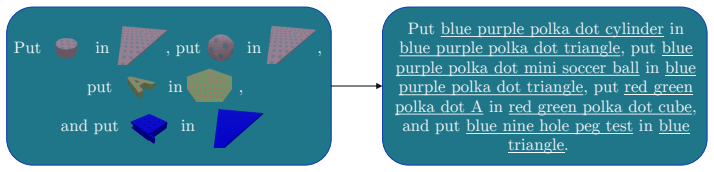
The load-bearing mechanism is the three-level task curriculum built on predicate-based task definitions. Physical predicates (such as EEAtPos, OnTop, Inside, Touch) specify target states, and logical predicates (Set, Sequence, Once) combine them into tasks, so every L1 and L2 task is explicitly a composition of L0-level skills and can be solved by scripted oracle 'solver' policies that recursively invoke lower-level solvers. This design makes it possible to train on L0, then test zero-shot on L1 and L2, and to know exactly which skill compositions are required. The accompanying dataset provides 330k trajectories, hierarchical language annotations, bounding boxes, key-step frames, and multi-modal prompts. The oracle trajectories both define the demonstration data and act as a ceiling for evaluating the learned policies.
What would settle it
Train a policy to near-perfect success (for example, above 95%) on every L0 skill separately, then evaluate it zero-shot on L1 and L2 tasks. If such a policy solves the composed tasks at high rates, the paper's conclusion that current models fail at compositional generalization would be overturned; if it still fails, the composition bottleneck would be confirmed. A simpler check would be to rerun the paper's evaluation while conditioning only on episodes where the model completed all L0 subskills, and see whether L1/L2 success rises.
Extended reading notes
Core claim
The paper's central claim is that state-of-the-art vision-language models, despite broad pre-training and additional fine-tuning, cannot compose previously learned low-level manipulation skills to perform novel high-level tasks in a closed-loop robotics setting. The evidence is the benchmark's L0->L1->L2 curriculum: models trained on L0 reach at best roughly 63% success on those simple skills, yet their zero-shot success on L1 and L2 tasks is essentially zero, and fine-tuning on L1 and L2 leaves most success rates in single digits. The paper also shows that multi-modal (text-plus-image) prompts are harder for several baselines than text-only prompts, suggesting part of the difficulty lies in grounding visual task specifications. The authors conclude that compositional generalization in robotics remains unsolved by current VLM-based policies.
Load-bearing premise
The conclusion assumes that near-zero success on L1 and L2 tasks reflects an inability to compose skills, not the models' incomplete mastery of the L0 skills themselves; since the best model reaches only about 63% success on L0, a composed task can fail simply because a base skill misfires.
Editorial extensions
If this is right
- If the finding holds, evaluating compositional generalization in robotics requires controlling for base-skill mastery; raw task success on composed tasks cannot separate planning failures from execution failures.
- Current VLM-based policies trained on large internet and robotics datasets will not generalize zero-shot to novel task specifications that recombine known skills.
- Fine-tuning on the composed tasks themselves does not close the gap, so the failure is not merely a matter of seeing the task distribution; the models lack a general composition mechanism.
- The benchmark's predicate structure lets future work measure progress per skill and per composition, rather than with a single end-to-end metric.
- Multi-modal prompts add difficulty beyond text-only instructions, so visual grounding of task specifications is itself a bottleneck.
Reading between the lines
- Because the best model only masters about 63% of L0 skills, part of the L1/L2 failure could be downstream of unreliable base skills rather than compositional reasoning; a policy with near-perfect L0 performance would be needed to isolate the composition deficit.
- If the bottleneck is compositional, then collecting more demonstration data for component skills alone will not suffice; methods that explicitly train on predicate-level composition or symbolic planning with learned skill modules would be a natural testable next step.
- The same benchmark design could be extended to test whether hierarchical policies that separately learn skills and a high-level selector outperform end-to-end video-conditioned policies.
- A real-robot counterpart would be needed to see whether the failure persists outside simulation, since sim-to-real transfer may add new confounds.
Editorial analysis
A structured set of objections, weighed in public.
Referee Report
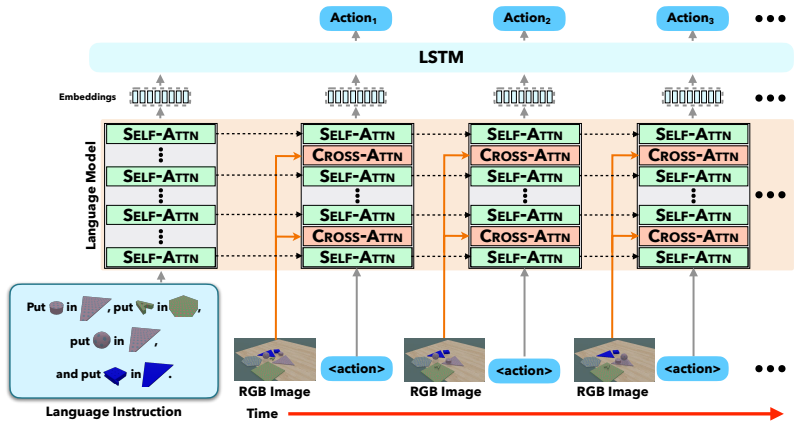
Summary. The paper introduces ClevrSkills, a benchmark built on ManiSkill2 with 33 manipulation tasks organized into three levels of compositional difficulty (L0 base skills, L1 intermediate compositions, L2 complex compositions), together with a dataset of roughly 330k oracle-generated trajectories with multi-modal prompts, language annotations, bounding boxes, key steps, and dense rewards. The authors benchmark several open-source vision-language policies (JAT, Octo, RoboFlamingo, and their own StreamRoboLM) under zero-shot and fine-tuned conditions. The central claim is that current VLMs, even after pre-training on large amounts of data, fail at compositional generalization in robotics: they can partially acquire L0 skills but cannot compose them into novel L1/L2 tasks.
Significance. The benchmark infrastructure is a genuine contribution: a three-level curriculum explicitly designed around skill composition, a large dataset with rich annotations, oracle solvers with motion planning, and a public release commitment. The evaluation is clean in the sense that the oracle policies are scripted and the models are measured empirically, so there is no circular derivation or fitted-parameter concern. The per-task results and the comparison across four baselines are useful. However, the central negative claim—that observed L1/L2 failures demonstrate a compositional generalization deficit—is currently confounded by incomplete mastery of L0 skills, as detailed in the major comments. If that confound is addressed with a conditional analysis, the benchmark would be a valuable resource for the robotics and VLM communities.
major comments (2)
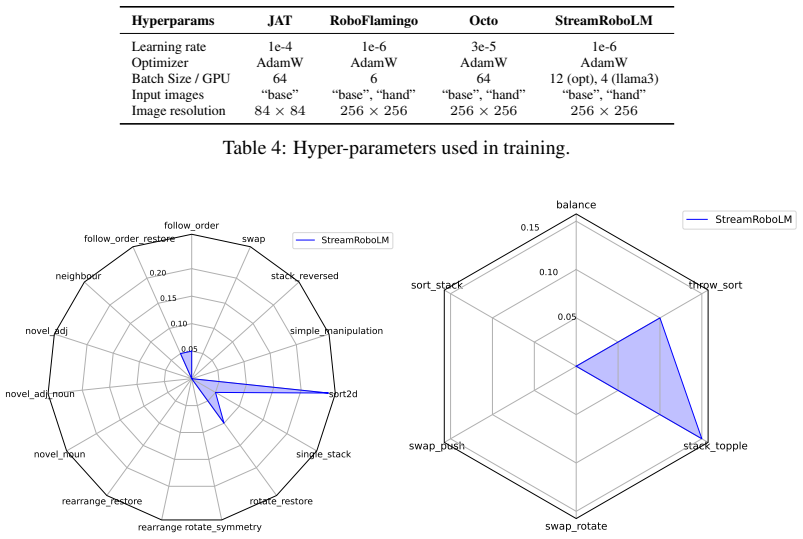
- [§5.3, Table 2, Figure 5] The central negative claim—that failures at L1/L2 reflect compositional generalization failure—is not supported by the current evidence because the prerequisite L0 skills are not reliably mastered. Table 2 shows that the best L0 success is 62.91% (StreamRoboLM-OPT, seen attributes) and 55.41% (StreamRoboLM-Llama3, unseen attributes), and Figure 5 shows particularly low per-task success on pick, place, push, rotate, and touch variants. Since §5.3 states that L1 and L2 tasks require roughly 9 and 11 successful L0-skill executions respectively, even a flawless compositional planner with per-primitive success probability p ≈ 0.63 would complete a 9-primitive L1 episode with probability approximately 0.63^9 ≈ 1.6%, which is the same regime as the reported near-zero L1 success. The observed L1/L2 failures are therefore quantitatively consistent with low-level skill unreliability alone, independent of any compositional deficit. The phrase 'reasonable performance on the L0 base skills' in §5.3 is not supported by the reported numbers. Please add a conditional analysis that reports L1/L2 success only on episodes in which the requisite L0 sub-skills were individually executed successfully, or otherwise control for L0 failure modes before attributing failure to composition.
- [§5.3, Table 3] The sentence 'only Octo [43] achieves non-zero success rate on any of the tasks' is contradicted by Table 3: in the L2 zero-shot columns, JAT reports 0.83% success and Octo reports 0.83%; in the L1 zero-shot columns, Octo reports 0.33%. Please correct the text to agree with the table, e.g., by stating that almost all zero-shot L1/L2 success rates are at or near zero, with Octo and JAT occasionally reporting small non-zero values.
minor comments (4)
- [Appendix B.1] The file name 'succes.npy' appears to be a typo; it should be 'success.npy'.
- [Appendix G] The text refers to 'RTT Connect', which should be 'RRT-Connect' (the rapidly-exploring random tree connect variant used by OMPL).
- [Appendix A.1, Task 4] Prompt (b) for the Place task reads 'Put object with tex:object 1 texture on object with tex:object2 texture' and appears to have missing braces around the placeholders; it should likely be 'Put object with {tex:object}1 texture on object with {tex:object}2 texture'.
- [Appendix A.3, Task 3] The description of Stack topple contains the typo 'compostion' instead of 'composition'.
Circularity Check
No circularity: the benchmark's conclusions are empirical measurements, not derivations from fitted inputs.
full rationale
ClevrSkills is a benchmark paper: the central claim is that benchmarked VLMs fail compositional generalization, supported by success-rate tables from a fixed evaluation protocol. There is no fitted parameter, no predictive equation, and no derived quantity that is equivalent to its input by construction. The L0-to-L1/L2 hierarchy is a design assumption about what counts as composition, not a result derived from the data, so it cannot be circular. The only in-house citation (LRR for StreamRoboLM) is used for architectural adaptation, not as load-bearing evidence for the failure claim; the failure claim is directly measured on the released tasks. The reviewer-flagged confound that weak L0 skills (best 62.91% success) could explain near-zero L1/L2 zero-shot results is a measurement-validity concern about attribution, not a circularity of the kind where an output equals its input; accordingly it does not raise the circularity score. Because the paper's conclusions reduce to empirical success rates of externally defined baselines on a public benchmark, the derivation chain is self-contained and no circular step is exhibited.
Assumptions & free parameters
assumptions (4)
- domain assumption Oracle policies generate correct demonstrations and that filtered failed trajectories do not bias the dataset.
- domain assumption The predicate decomposition of tasks accurately reflects compositional generalization.
- domain assumption The success criteria are reasonable and consistent across tasks.
- domain assumption ManiSkill2's simulated physics and rendering are adequate for evaluating manipulation policies.
Cite this review
Pith. "Pith review of ClevrSkills: Compositional Language and Visual Reasoning in Robotics." pith.science (2026). https://pith.science/paper/AZDVPMZC
@misc{pith2026241109052,
  author       = {Pith},
  title        = {Pith review of: ClevrSkills: Compositional Language and Visual Reasoning in Robotics},
  year         = {2026},
  howpublished = {\url{https://pith.science/paper/AZDVPMZC}},
  note         = {Machine review of arXiv:2411.09052}
}
read the original abstract
Robotics tasks are highly compositional by nature. For example, to perform a high-level task like cleaning the table a robot must employ low-level capabilities of moving the effectors to the objects on the table, pick them up and then move them off the table one-by-one, while re-evaluating the consequently dynamic scenario in the process. Given that large vision language models (VLMs) have shown progress on many tasks that require high level, human-like reasoning, we ask the question: if the models are taught the requisite low-level capabilities, can they compose them in novel ways to achieve interesting high-level tasks like cleaning the table without having to be explicitly taught so? To this end, we present ClevrSkills - a benchmark suite for compositional reasoning in robotics. ClevrSkills is an environment suite developed on top of the ManiSkill2 simulator and an accompanying dataset. The dataset contains trajectories generated on a range of robotics tasks with language and visual annotations as well as multi-modal prompts as task specification. The suite includes a curriculum of tasks with three levels of compositional understanding, starting with simple tasks requiring basic motor skills. We benchmark multiple different VLM baselines on ClevrSkills and show that even after being pre-trained on large numbers of tasks, these models fail on compositional reasoning in robotics tasks.
Figures


Figures from the paper (5 more)


Reference graph
Works this paper leans on
-
[43]
O. M. Team, D. Ghosh, H. Walke, K. Pertsch, K. Black, O. Mees, S. Dasari, J. Hejna, T. Kreiman, C. Xu, et al. Octo: An open-source generalist robot policy. arXiv preprint arXiv:2405.12213, 2024
arXiv 2024
-
[1]
Alayrac, J
J.-B. Alayrac, J. Donahue, P. Luc, A. Miech, I. Barr, Y . Hasson, K. Lenc, A. Mensch, K. Millican, M. Reynolds, et al. Flamingo: a visual language model for few-shot learning. Advances in neural information processing systems, 35:23716–23736, 2022
2022
-
[2]
Bahdanau, H
D. Bahdanau, H. de Vries, T. J. O’Donnell, S. Murty, P. Beaudoin, Y . Bengio, and A. Courville. Closure: Assessing systematic generalization of clevr models, 2020
2020
-
[3]
C. Bao, H. Xu, Y . Qin, and X. Wang. Dexart: Benchmarking generalizable dexterous manipula- tion with articulated objects. In Proceedings of the IEEE/CVF Conference on Computer Vision and Pattern Recognition, pages 21190–21200, 2023
2023
-
[4]
Bhattacharyya, S
A. Bhattacharyya, S. Panchal, R. Pourreza, M. Lee, P. Madan, and R. Memisevic. Look, remember and reason: Grounded reasoning in videos with language models. In The Twelfth International Conference on Learning Representations, 2023
2023
- [5]
- [6]
- [7]
Show all 84 references
-
[8]
Dosovitskiy, L
A. Dosovitskiy, L. Beyer, A. Kolesnikov, D. Weissenborn, X. Zhai, T. Unterthiner, M. Dehghani, M. Minderer, G. Heigold, S. Gelly, et al. An image is worth 16x16 words: Transformers for image recognition at scale. arXiv preprint arXiv:2010.11929, 2020
2010 arXiv
-
[9]
Dubey, A
A. Dubey, A. Jauhri, A. Pandey, A. Kadian, A. Al-Dahle, A. Letman, A. Mathur, A. Schelten, A. Yang, A. Fan, et al. The llama 3 herd of models. arXiv preprint arXiv:2407.21783, 2024
2024 arXiv
-
[10]
Ebert, Y
F. Ebert, Y . Yang, K. Schmeckpeper, B. Bucher, G. Georgakis, K. Daniilidis, C. Finn, and S. Levine. Bridge data: Boosting generalization of robotic skills with cross-domain datasets. arXiv preprint arXiv:2109.13396, 2021
2021 arXiv
-
[11]
H.-S. Fang, H. Fang, Z. Tang, J. Liu, J. Wang, H. Zhu, and C. Lu. Rh20t: A robotic dataset for learning diverse skills in one-shot. arXiv preprint arXiv:2307.00595, 2023
2023 arXiv
-
[12]
Gallouédec, E
Q. Gallouédec, E. Beeching, C. Romac, and E. Dellandréa. Jack of all trades, master of some, a multi-purpose transformer agent. arXiv preprint arXiv:2402.09844, 2024
2024 arXiv
-
[13]
Gebru, J
T. Gebru, J. Morgenstern, B. Vecchione, J. W. Vaughan, H. Wallach, H. D. Iii, and K. Crawford. Datasheets for datasets. Communications of the ACM, 64(12):86–92, 2021
2021
-
[14]
R. Gong, J. Huang, Y . Zhao, H. Geng, X. Gao, Q. Wu, W. Ai, Z. Zhou, D. Terzopoulos, S.-C. Zhu, et al. Arnold: A benchmark for language-grounded task learning with continuous states in realistic 3d scenes. In Proceedings of the IEEE/CVF International Conference on Computer Vis...
2023
-
[15]
something something
R. Goyal, S. Ebrahimi Kahou, V . Michalski, J. Materzynska, S. Westphal, H. Kim, V . Haenel, I. Fruend, P. Yianilos, M. Mueller-Freitag, et al. The" something something" video database for learning and evaluating visual common sense. In Proceedings of the IEEE international co...
2017
-
[16]
J. Gu, F. Xiang, X. Li, Z. Ling, X. Liu, T. Mu, Y . Tang, S. Tao, X. Wei, Y . Yao, et al. Maniskill2: A unified benchmark for generalizable manipulation skills. In The Eleventh International Conference on Learning Representations, 2023
2023
-
[17]
Hao Su’s Lab
U. Hao Su’s Lab. MPlib: a lightweight motion planning library. https://github.com/ haosulab/MPlib, 2024
2024
-
[18]
Hochreiter and J
S. Hochreiter and J. Schmidhuber. Long short-term memory. Neural computation, 9(8): 1735–1780, 1997
1997
-
[19]
E. J. Hu, Y . Shen, P. Wallis, Z. Allen-Zhu, Y . Li, S. Wang, L. Wang, and W. Chen. LoRA: Low-rank adaptation of large language models. In International Conference on Learning Representations, 2022. 10
2022
-
[20]
Jiang, A
Y . Jiang, A. Gupta, Z. Zhang, G. Wang, Y . Dou, Y . Chen, L. Fei-Fei, A. Anandkumar, Y . Zhu, and L. Fan. Vima: General robot manipulation with multimodal prompts. In Fortieth International Conference on Machine Learning, 2023
2023
-
[21]
Johnson, B
J. Johnson, B. Hariharan, L. van der Maaten, L. Fei-Fei, C. L. Zitnick, and R. Girshick. Clevr: A diagnostic dataset for compositional language and elementary visual reasoning. In CVPR, 2017
2017
-
[22]
Kahneman
D. Kahneman. Thinking, fast and slow . Farrar, Straus and Giroux, New York,
-
[23]
Kolve, R
E. Kolve, R. Mottaghi, W. Han, E. VanderBilt, L. Weihs, A. Herrasti, M. Deitke, K. Ehsani, D. Gordon, Y . Zhu, et al. Ai2-thor: An interactive 3d environment for visual ai.arXiv preprint arXiv:1712.05474, 2017
2017 arXiv
-
[24]
S. M. LaValle. Rapidly-exploring random trees: A new tool for path planning. TR 98-11, Computer Science Dept., Iowa State University, October 1998, 1998
1998
-
[25]
Lerer, S
A. Lerer, S. Gross, and R. Fergus. Learning physical intuition of block towers by example. In M. F. Balcan and K. Q. Weinberger, editors,Proceedings of The 33rd International Conference on Machine Learning, volume 48 of Proceedings of Machine Learning Research, pages 430– 438,...
2016
-
[26]
C. Li, F. Xia, R. Martín-Martín, M. Lingelbach, S. Srivastava, B. Shen, K. Vainio, C. Gokmen, G. Dharan, T. Jain, et al. igibson 2.0: Object-centric simulation for robot learning of everyday household tasks. arXiv preprint arXiv:2108.03272, 2021
2021 arXiv
-
[27]
C. Li, R. Zhang, J. Wong, C. Gokmen, S. Srivastava, R. Martín-Martín, C. Wang, G. Levine, M. Lingelbach, J. Sun, et al. Behavior-1k: A benchmark for embodied ai with 1,000 everyday activities and realistic simulation. In Conference on Robot Learning, pages 80–93. PMLR, 2023
2023
-
[28]
X. Li, M. Liu, H. Zhang, C. Yu, J. Xu, H. Wu, C. Cheang, Y . Jing, W. Zhang, H. Liu, et al. Vision-language foundation models as effective robot imitators. The Twelfth International Conference on Learning Representations, 2024
2024
-
[29]
H. Liu, C. Li, Q. Wu, and Y . J. Lee. Visual instruction tuning. In NeurIPS, 2023
2023
-
[30]
J. Luo, C. Xu, F. Liu, L. Tan, Z. Lin, J. Wu, P. Abbeel, and S. Levine. Fmb: a functional manipulation benchmark for generalizable robotic learning. arXiv preprint arXiv:2401.08553, 2024
2024 arXiv
-
[31]
Mandlekar, Y
A. Mandlekar, Y . Zhu, A. Garg, J. Booher, M. Spero, A. Tung, J. Gao, J. Emmons, A. Gupta, E. Orbay, et al. Roboturk: A crowdsourcing platform for robotic skill learning through imitation. In Conference on Robot Learning, pages 879–893. PMLR, 2018
2018
-
[32]
O. Mees, L. Hermann, E. Rosete-Beas, and W. Burgard. Calvin: A benchmark for language- conditioned policy learning for long-horizon robot manipulation tasks. IEEE Robotics and Automation Letters, 7(3):7327–7334, 2022
2022
-
[33]
Padalkar, A
A. Padalkar, A. Pooley, A. Jain, A. Bewley, A. Herzog, A. Irpan, A. Khazatsky, A. Rai, A. Singh, A. Brohan, et al. Open x-embodiment: Robotic learning datasets and rt-x models. arXiv preprint arXiv:2310.08864, 2023
2023 arXiv
-
[34]
Paszke, S
A. Paszke, S. Gross, F. Massa, A. Lerer, J. Bradbury, G. Chanan, T. Killeen, Z. Lin, N. Gimelshein, L. Antiga, et al. Pytorch: An imperative style, high-performance deep learning library. Advances in neural information processing systems, 32, 2019
2019
-
[35]
Radford, J
A. Radford, J. Wu, R. Child, D. Luan, D. Amodei, I. Sutskever, et al. Language models are unsupervised multitask learners. OpenAI blog, 1(8):9, 2019
2019
-
[36]
S. Reed, K. Zolna, E. Parisotto, S. G. Colmenarejo, A. Novikov, G. Barth-Maron, M. Gimenez, Y . Sulsky, J. Kay, J. T. Springenberg, et al. A generalist agent.arXiv preprint arXiv:2205.06175, 2022
2022 arXiv
-
[37]
Riveland and A
R. Riveland and A. Pouget. Natural language instructions induce compositional generalization in networks of neurons. Nature Neuroscience, pages 1–12, 2024. 11
2024
-
[38]
S. Ross, G. Gordon, and D. Bagnell. A reduction of imitation learning and structured prediction to no-regret online learning. In Proceedings of the fourteenth international conference on artifi- cial intelligence and statistics, pages 627–635. JMLR Workshop and Conference Proc...
2011
-
[39]
Shridhar, L
M. Shridhar, L. Manuelli, and D. Fox. Cliport: What and where pathways for robotic manipula- tion. In Conference on robot learning, pages 894–906. PMLR, 2022
2022
-
[40]
Shridhar, L
M. Shridhar, L. Manuelli, and D. Fox. Perceiver-actor: A multi-task transformer for robotic manipulation. In Conference on Robot Learning, pages 785–799. PMLR, 2023
2023
-
[41]
I. A. ¸ Sucan, M. Moll, and L. E. Kavraki. The Open Motion Planning Library.IEEE Robotics & Automation Magazine, 19(4):72–82, December 2012. doi: 10.1109/MRA.2012.2205651. https://ompl.kavrakilab.org
2012
-
[42]
A. Szot, A. Clegg, E. Undersander, E. Wijmans, Y . Zhao, J. Turner, N. Maestre, M. Mukadam, D. S. Chaplot, O. Maksymets, et al. Habitat 2.0: Training home assistants to rearrange their habitat. Advances in neural information processing systems, 34:251–266, 2021
2021
-
[44]
Weston, A
J. Weston, A. Bordes, S. Chopra, A. M. Rush, B. van Merriënboer, A. Joulin, and T. Mikolov. Towards ai-complete question answering: A set of prerequisite toy tasks, 2015
2015
-
[45]
Winograd
T. Winograd. Understanding Natural Language. Academic Press, 1972. ISBN 9780127597508. URL https://books.google.ca/books?id=-FxQAAAAMAAJ
1972
-
[46]
J. Wu, J. J. Lim, H. Zhang, J. B. Tenenbaum, and W. T. Freeman. Physics 101: Learning physical object properties from unlabeled videos. In British Machine Vision Conference, 2016
2016
-
[47]
K. Yi*, C. Gan*, Y . Li, P. Kohli, J. Wu, A. Torralba, and J. B. Tenenbaum. Clevrer: Collision events for video representation and reasoning. In International Conference on Learning Representations, 2020. URL https://openreview.net/forum?id=HkxYzANYDB
2020
-
[48]
Q. Yu, C. Hao, J. Wang, W. Liu, L. Liu, Y . Mu, Y . You, H. Yan, and C. Lu. Manipose: A comprehensive benchmark for pose-aware object manipulation in robotics. arXiv preprint arXiv:2403.13365, 2024
2024 arXiv
-
[49]
T. Yu, D. Quillen, Z. He, R. Julian, K. Hausman, C. Finn, and S. Levine. Meta-world: A benchmark and evaluation for multi-task and meta reinforcement learning. In Conference on robot learning, pages 1094–1100. PMLR, 2020
2020
-
[50]
Zhang, S
S. Zhang, S. Roller, N. Goyal, M. Artetxe, M. Chen, S. Chen, C. Dewan, M. Diab, X. Li, X. V . Lin, et al. Opt: Open pre-trained transformer language models.arXiv preprint arXiv:2205.01068, 2022. 12 A ClevrSkills Task Suite In this section, we present a detailed description of ...
2022 arXiv
-
[52]
Match the pose of the end effector in {ks:keystep_1}, {ks:keystep_2} followed by {ks:keystep_3}
Match pose: • Prompts: (a) "Match the pose of the end effector in {ks:keystep_1}, {ks:keystep_2} followed by {ks:keystep_3}". • Description: The image placeholder {ks:keystep_1} is the goal image showing the pose of the robot that it needs to achieve. The number of goals can v...
-
[53]
• Description: Similar to 1, but with an additional constraint of avoiding objects sus- pended in air
Move without hitting: • Prompts: (a) Match the pose of the end effector in {ks:keystep_1} without hitting any objects. • Description: Similar to 1, but with an additional constraint of avoiding objects sus- pended in air. The number of obstacles may vary from 1 to 5. • Success...
-
[54]
13 (b) Grab the {obj:object}
Pick: • Prompts: (a) Pick up the {obj:object}. 13 (b) Grab the {obj:object}. (c) Lift the {obj:object}. (d) Pick up the object with {tex:object} texture. (e) Grab the object with {tex:object} texture. (f) Lift the object with {tex:object} texture. • Description: The robot is r...
-
[55]
(b) Put object with tex:object 1 texture on object with tex:object2 texture
Place: • Prompts: (a) Put {obj:object} 1 on {obj:object}2. (b) Put object with tex:object 1 texture on object with tex:object2 texture. • Description: The agent starts off with an object ({obj:object}1) attached to the end- effector and is tasked to place it on the specified o...
-
[56]
(b) Push object with {tex:object} 1 texture towards object with {tex:object}2 texture
Push: • Prompts: (a) Push {obj:object} 1 towards {obj:object}2. (b) Push object with {tex:object} 1 texture towards object with {tex:object}2 texture. • Description: The agent is tasked to push the specified object {obj:object}1 towards another object {obj:object}2. • Success ...
-
[57]
(b) Rotate object with {tex:object} 1 {angles} degrees {direction}
Rotate: • Prompts: (a) Rotate {obj:object} 1 {angles} degrees {direction}. (b) Rotate object with {tex:object} 1 {angles} degrees {direction}. • Description: The placeholder {obj:object} 1 specifies the object to be rotated by {angles} in {direction}. The angles can take value...
-
[58]
(b) Hit {obj:object} 2 with {obj:object}1
Throw: • Prompts: (a) Throw {obj:object} 1 to {obj:object}2. (b) Hit {obj:object} 2 with {obj:object}1. • Description: The agent is tasked to throw {obj:object}1 to {obj:object}2. {obj:object}1 is initialized at the end-effector so the robot does not need to first pick it up. ...
-
[59]
(b) Hit {obj:object} 2 with {obj:object}1 such that {obj:object}2 falls over
Throw topple: • Prompts: (a) Throw {obj:object} 1 to {obj:object}2 such that {obj:object}2 falls over. (b) Hit {obj:object} 2 with {obj:object}1 such that {obj:object}2 falls over. • Description: Similar to 7, with the additional constraint that the target object must topple o...
-
[60]
• Description: The agent is tasked to gently touch a specified object without moving it
Touch: • Prompts: (a) Touch {obj:object} 1. • Description: The agent is tasked to gently touch a specified object without moving it. The task is supposed to teach the agent to control the force with which it carries out the task. • Success Criteria: The specified object must b...
-
[61]
• Description: Similar to 9, but now the specified object must move from its original position without the agent ever grasping it or the object toppling over
Touch push: 15 • Prompts: (a) Touch and push {obj:object} 1. • Description: Similar to 9, but now the specified object must move from its original position without the agent ever grasping it or the object toppling over. • Success Criteria: The specified object must move at lea...
-
[62]
• Description: Similar to 9, but now the object must topple over
Touch topple: • Prompts: (a) Touch and topple {obj:object} 1, {obj:object}2. • Description: Similar to 9, but now the object must topple over. • Success Criteria: The specified object should be touched and toppled over i.e. there should be at least 45 degree change in the vert...
-
[63]
• Description: The agent is tasked to touch goal positions specified by green spheres suspended in air
Trace: • Prompts: (a) Trace the sequence of goals by moving to the next green goal. • Description: The agent is tasked to touch goal positions specified by green spheres suspended in air. Once a goal is touched, it turns to yellow and another goal turns green. The agent can on...
-
[64]
(b) Put object with {tex:object} 1 texture on object with {tex:object}2 texture
Simple manipulation: • Prompts: (a) Put {obj:object} 1 on {obj:object}1. (b) Put object with {tex:object} 1 texture on object with {tex:object}2 texture. • Description: The tasks combined pick and place skills. The agent is tasked to pick a specified object {obj:object}1 and p...
-
[65]
• Description: Given a specified object {obj:object} 1 and a set of goal states {ks:keystep1}, the agent is tasked to achieve the goal states for the specified object in order
Follow order: • Prompts: (a) Follow the motion for {obj:object} 1: {ks:keystep1}. • Description: Given a specified object {obj:object} 1 and a set of goal states {ks:keystep1}, the agent is tasked to achieve the goal states for the specified object in order. There may be multi...
-
[66]
• Description: Similar to Task 2 in L1, with the additional constraint that the specified object must be returned to it’s original state
Follow order and restore: • Prompts: (a) Follow the motion for {obj:object} 1: {ks:keystep1} and then restore. • Description: Similar to Task 2 in L1, with the additional constraint that the specified object must be returned to it’s original state. • Success Criteria: All the ...
-
[67]
The direction can take values of north, south, east and west
Neighbour: • Prompts: (a) First put {obj:object} 1 in {obj:object} 2 and then put the object that was at its {direction} in the same {obj:object}2 • Description: The agent is tasked to pick and place {obj:object}1 in {obj:object}2 and then pick and place the neighbour of {obj:...
-
[68]
daxer", “blicker
Novel Adjective: 17 • Prompts: (a) {obj:object}1 is {adjective} than {obj:object}2. Put the {adjective} {obj:object}3 on {obj:object}4. • Description: The task is similar to Task 1 in L1, however instead of directly specifying the object with an image, the object is specified ...
-
[69]
dax", “blicket
Novel Noun: • Prompts: (a) {obj:object} 1 is {noun}1 and {obj:object}2 is {noun}2. Put {noun}1 on {noun}2. • Description: This is similar to Task 5 in L1, however instead of an adjective the object is specified by a random noun. The {noun} can take values “dax", “blicket", “wu...
-
[70]
This is a {noun}2 {obj:object}2
Novel Adjective and Noun: • Prompts: (a) This is a {noun}1 {obj:object}1. This is a {noun}2 {obj:object}2. {obj:object}3 is {adjective} than {obj:object}4, {obj:object}5 is {adjective} than {obj:object}6. Put the {adjective} {noun}1 on {noun}2 • Description: This task is the c...
-
[71]
• Success Criteria: All the objects in the scene are placed at the positions specified in the scene image {ks:scene}
Rearrange: 18 • Prompts: (a) Rearrange to {ks:scene} • Description: Here, the agent is tasked with rearranging the scene to object configura- tion shown in the scene image {ks:scene}. • Success Criteria: All the objects in the scene are placed at the positions specified in the...
-
[72]
Rearrange and restore: • Prompts: (a) Rearrange to {ks:scene} and then restore. • Description: This is similar to Task 8 in L1 with an additional constraint that after rearranging to the specified scene, the agent must bring the objects to their initial positions i.e. rearrang...
-
[73]
• Success Criteria: The specified object is rotated in the correct direction within 5 degrees of the specified angle
Rotate and restore: • Prompts: (a) Rotate {obj:object} {angle} degrees {direction} and then restore • Description: This task is similar to Task 6 in L0 with an additional constraint that once the rotation is complete, the agent needs to restore the object to its starting posit...
-
[74]
• Success Criteria: All the objects with the specified texture are rotated by {angle} degrees in the correct {direction}
Rotate symmetry: 19 • Prompts: (a) Rotate objects with {tex:object} texture {angle} degrees {direction} (b) Rotate identically textured objects {angle} degrees {direction} • Description: The task is similar to Task 6 in L0, however the object is specified using texture so the ...
-
[75]
• Success Criteria: The objects in the scene are stacked in the correct order
Stack: • Prompts: (a) Stack {obj:object} 1 on {obj:object}2, and {obj:object}3 on {obj:object}1 (b) Stack object with {tex:object}1 texture on object with {tex:object}2 texture, object with {tex:object}3 texture on object with {tex:object}1 texture (c) Stack objects as in {ks:...
-
[76]
• Success Criteria: The objects in the scene are stacked in the reverse order of what is specified
Stack reversed: • Prompts: (a) Stack {obj:object}1, {obj:object}2, {obj:object}3, {obj:object}4 in the reversed order • Description: The task is similar to Task 12 in L1 however the agent is tasked to stack the specified objects in the reverse order. • Success Criteria: The ob...
-
[77]
• Success Criteria: All the objects are placed in the areas which have same texture as the objects
Sort: • Prompts: (a) Place the objects in the identically textured areas • Description: In this task, the agent is required to place objects in the areas with similar texture as the object. • Success Criteria: All the objects are placed in the areas which have same texture as ...
-
[78]
The only way to achieve the result is to move one of the object away and then place the other object in its place and then repeating the same with the initial object
Swap: • Prompts: (a) Swap positions of {obj:object} 1 and {obj:object}2 • Description: The agent is tasked to swap the positions of two objects as specified in the prompt. The only way to achieve the result is to move one of the object away and then place the other object in i...
-
[79]
The weight of the objects is proportional to their size
Balance: • Prompts: (a) Place all the objects on the scale while keeping it in balance • Description: The agent is tasked to balance a weight scale by placing the objects with appropriate weights on either side. The weight of the objects is proportional to their size. We initi...
-
[80]
The agent here is required to sort the objects according to their texture however, instead of just placing the objects on an area, it is tasked to stack them on top of each other
Sort Stack: • Prompts: (a) Stack identically textured objects (b) Place identically textured objects on top of each other • Description: The task is a composition of Task 12 and Task 14 in L1. The agent here is required to sort the objects according to their texture however, i...
-
[81]
• Success Criteria: The objects are first stacked as specified in the prompt and then are toppled such that all the objects end up on the ground
Stack topple: 21 • Prompts: (a) Stack {obj:object}1 on {obj:object}2, and {obj:object}3 on {obj:object}1 and then topple the stack (b) Stack object with {tex:object}1 texture on object with {tex:object}2 texture, object with {tex:object}3 texture on object with {tex:object}1 t...
-
[82]
• Success Criteria: The positions of the two objects are swapped without the objects being grasped
Swap with push: • Prompts: (a) Swap positions of {obj:object} 1 and {obj:object}2 by pushing • Description: The task is similar to Task 15 in L1 but instead of swapping by pick and place skills, the agent is tasked to do the same by pushing the objects. • Success Criteria: The...
-
[83]
• Success Criteria: The positions of the two objects are swapped and the objects are rotated by {angles} degrees in {direction} with respect to their initial pose
Swap and rotate: • Prompts: (a) Swap positions of {obj:object} 1 and {obj:object} 2 but rotate them by {angle} degrees {direction} • Description: The task is similar to Task 15 in L1 with an additional constraint that the objects must be rotated by {angles} degrees in {directi...
-
[84]
thrown” in the areas instead of “placed
Throw sort (sort by throwing): 22 • Prompts: (a) Place the objects in the identically textured areas by throwing • Description: The task is similar to Task 14 in L1 but instead of sorting by picking and placing, the agent needs to throw the objects into specified areas. To for...
-
[2011]
URL https://www.amazon.de/ Thinking-Fast-Slow-Daniel-Kahneman/dp/0374275637/ref=wl_it_dp_o_pdT1_ nS_nC?ie=UTF8&colid=151193SNGKJT9&coliid=I3OCESLZCVDFL7
ISBN 9780374275631 0374275637. URL https://www.amazon.de/ Thinking-Fast-Slow-Daniel-Kahneman/dp/0374275637/ref=wl_it_dp_o_pdT1_ nS_nC?ie=UTF8&colid=151193SNGKJT9&coliid=I3OCESLZCVDFL7
Reviewed August 12, 2026 · model on record in the stance chip above.
Discussion (0). Continue with ORCID to comment.