REVIEW 3 major objections 5 minor 60 references
Effect of viewing angle in Gamma-ray Burst properties
T0 review · 3 major / 5 minor · reviewed 2026-08-12 · deepseek-v4-flash
Pith's one-line read The paper argues that among detected gamma-ray bursts, extreme off-axis events are best identified by low fluence and soft spectra, not by duration, and that some X-ray transients from new missions likely come from off-axis jets.
desk verdict Off-axis GRB population study: clean model, honest caveats, but the 'soft and faint' signature is shakier than the abstract implies because it leans on a narrow spectral parameter box. read the letter →
The pith
A machine-rendered reading of the paper's core claim, the machinery that carries it, and where it could break.
The reading
What carries the argument
The central object is a homogeneous top-hat jet: a uniform relativistic jet with constant Lorentz factor and energy inside a half-opening angle $\theta_j$ and zero outside. The prompt emission is computed with the Woods and Loeb 1999 formalism for an optically and geometrically thin shell, using a broken power-law intrinsic spectrum with high-energy index $m_2$ and co-moving break frequency $\nu'_b$, and an exponential decay timescale $\tau$. Hardness is the fluence ratio $F(50\text{--}300\,\mathrm{keV})/F(10\text{--}50\,\mathrm{keV})$, and duration is the time the flux stays above a fixed detection threshold. The machinery maps intrinsic jet parameters to observed duration and hardness, and its key behavior is that hardness changes mainly through the position of $\nu'_b$ in the detector band, while duration changes through the competition between high-latitude pulse broadening and Doppler deboosting.
What would settle it
Recompute the hardness-versus-viewing-angle curve with a single power-law spectrum, or with $\nu'_b$ outside 0.5--1.5 keV and $m_2$ outside 1--1.2: if the hardness no longer declines for $\theta_v > \theta_j$, the central claim fails. Observationally, one could measure the prompt spectrum and afterglow-derived jet angle for a nearby low-luminosity soft burst and check whether its softness matches the model's prediction.
Extended reading notes
Core claim
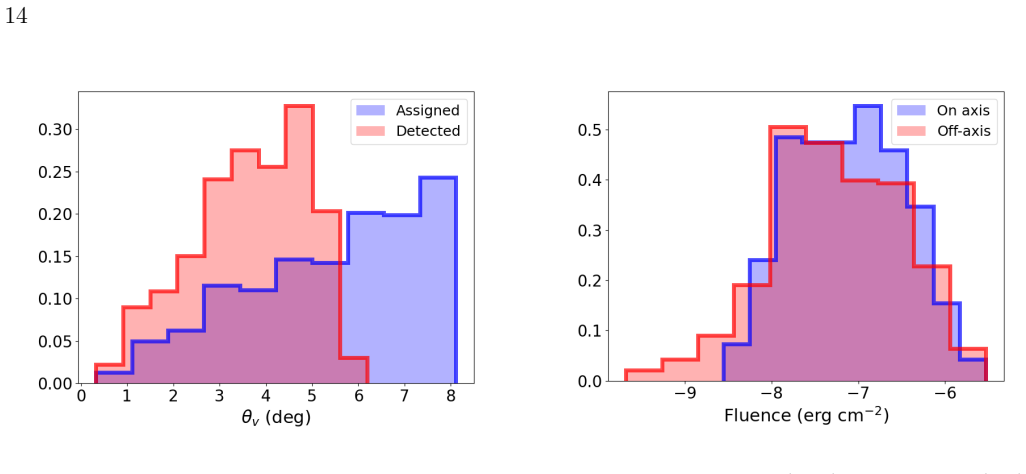
Under the model assumptions, the main result is that fluence and hardness, not duration, are the key parameters for identifying off-axis bursts, and that soft bursts with lower fluence have a high chance of being extreme off-axis events. Duration is less useful because the geometric pulse stretching from high-latitude photons is largely cancelled by the reduction of peak flux, so off-axis durations fall within on-axis ranges; only nearby off-axis bursts can appear longer than distant on-axis twins. The spectral hardness, defined as the ratio of photon fluxes in the 50--300 keV band to the 10--50 keV band, drops for extreme off-axis angles because the Doppler boost is weaker and the co-moving break frequency moves down within the detector band. The authors therefore predict that extreme off-axis GRBs in the detected population are soft and faint, and that some fast X-ray transients and X-ray-rich GRBs detected by the Einstein Probe and SVOM missions originate from off-axis jets.
Load-bearing premise
The hardness result depends on the assumed broken power-law intrinsic spectrum and the particular parameter ranges chosen by fitting simulated on-axis spectra to the GBM catalogue; with a different intrinsic spectrum, the off-axis hardness decline could be weaker or absent.
Editorial extensions
If this is right
- Detected extreme off-axis bursts in this simulated top-hat population are soft and faint, with durations that overlap the on-axis duration distribution.
- Viewing geometry alone can move a burst across the long/short duration boundary without changing the progenitor, because a nearby off-axis twin of an on-axis long burst can appear short.
- Off-axis jets are detectable only if energetic or nearby: in the chosen parameter range, about 11% of extreme off-axis events are detected for $\theta_j=5^\circ$ and about 6% for $\theta_j=3^\circ$.
- Soft X-ray instruments such as EP/WXT and SVOM/ECLAIRS should preferentially catch off-axis bursts, so some of the newly reported X-ray transients are likely off-axis GRBs.
- Burst classification based purely on the duration-hardness plane mixes off-axis and on-axis populations, and low-luminosity soft bursts may not be a separate progenitor class.
Reading between the lines
- If jets are structured rather than top-hat, the Doppler deboosting is gentler, so the soft-and-faint signature may weaken or shift to different energy bands; the paper's conclusion is therefore a top-hat prediction until structured-jet simulations are done.
- The same logic implies that hardness and fluence, used jointly, could serve as a cheap statistical prior for selecting off-axis candidates from existing gamma-ray catalogues, with afterglow observations as confirmation.
- A testable extension is that the rate of off-axis bursts should be higher in soft X-ray surveys than in hard gamma-ray monitors, so the Einstein Probe and SVOM detections can be used to test the predicted ratio of soft to hard off-axis events.
Editorial analysis
A structured set of objections, weighed in public.
Referee Report
Summary. The paper investigates how the observer's viewing angle affects two observable properties of gamma-ray bursts (GRBs), duration and spectral hardness, using a single-pulse, optically thin, homogeneous top-hat jet model following Woods & Loeb (1999). The intrinsic spectrum is a broken power law, and the authors compute the light curve and time-integrated spectrum as a function of viewing angle, then simulate a population of 1000 bursts with random intrinsic parameters and viewing angles. They find that the spectral hardness decreases significantly for extreme off-axis viewing angles, while the duration (defined as the time above a fixed flux threshold) changes less systematically and generally shortens because of Doppler deboosting. The paper concludes that fluence and hardness, not duration, are the key observables for identifying off-axis bursts, and suggests that some soft X-ray transients and X-ray-rich GRBs detected by Einstein Probe and SVOM may be off-axis events. The authors explicitly acknowledge several simplifying assumptions, including the broken power-law spectral shape, the threshold-based duration proxy, and the use of uniform parameter distributions.
Significance. If the central claim is robust, the paper provides a useful, quantitative expectation for identifying off-axis GRBs in current and upcoming soft X-ray surveys, with the specific falsifiable prediction that extreme off-axis bursts are soft, faint, and have durations similar to on-axis bursts. The forward model is standard and is applied consistently; the paper is commendably explicit about its assumptions and limitations, stating that a direct comparison with the observed population is not appropriate. However, the headline result that hardness is a key discriminator is not demonstrated to be independent of the chosen spectral parameter box, and the duration conclusion rests on a threshold-based proxy that the authors themselves flag as a 'critical assumption'. These caveats limit the significance of the result as it stands.
major comments (3)
- [Section 4.1 and 4.3] The hardness decline for off-axis bursts is driven by the narrow spectral parameter ranges adopted in Section 4.1: the high-energy index m2 is restricted to 1-1.2 and the co-moving break frequency nu'_b to 0.5-1.5 keV, chosen by fitting the simulated on-axis broken power law to the GBM catalogue. For large viewing angles, the Doppler-shifted break falls below the 10-50 keV band, so the hardness ratio is controlled almost entirely by m2. With a steeper high-energy index, which is typical of many GBM bursts (e.g., Band beta ~2.3 corresponds to m2 ~1.3, and softer bursts have beta ~2.5-3), the on-axis hardness is already lower and the additional off-axis softening is much weaker, increasing the overlap between on-axis and off-axis populations. The paper itself concedes in Section 4.3 that 'the result can change depending on the spectral shape and parameters' and defers the spectral-shape dependence to a future paper. Because the conclusion 'fluence and hardness, not duration, are the key parameters' depends on this restricted spectral box, the paper should quantify the robustness of the separation by repeating the population simulation over a wider m2 range or with an alternative intrinsic spectral shape, and show whether the claimed discrimination persists.
- [Section 3 and 4.3] The conclusion that duration is not useful for identifying off-axis bursts is based on a specific definition of duration as the time during which the pulse flux exceeds a fixed threshold of 0.5 photons cm^-2 s^-1, which the paper calls a 'critical assumption' that this is a measure of T90. This proxy ignores detector response, background noise, and the 5%-90% fluence accumulation that defines the actual T90. The paper notes in Section 5 that a more rigorous calculation would require these effects, but the statement 'duration is not useful for identifying potential off-axis bursts' is presented as a general result. Since the threshold-based duration can behave differently from a fluence-based T90 (e.g., for nearby bursts the pulse stretching may increase the time above threshold, as shown in Figure 2 right), the paper should either validate the proxy against a proper T90 calculation for a subset of the simulated pulses or explicitly limit the duration claim to the adopted threshold-based measure.
- [Section 4.2] The sampling distribution for the viewing angle is stated as 'cos θv ∼ U(−1, cos 8◦)', which would correspond to θv ranging from 8 degrees to 180 degrees. This is inconsistent with the surrounding text, which says 'We restricted the viewing angle to 8 degrees as no bursts were detectable beyond this,' and with the reported numbers: if θv were sampled up to 180 degrees, the probability of θv ≤ θj (θj = 5 degrees) would be about 0.2 percent, not the 388 out of 1000 events reported. The intended distribution is presumably uniform in cos θv over [cos 8 degrees, 1], i.e., θv in [0, 8 degrees]. The equation should be corrected, and the simulation description should clarify whether the quoted detected fractions (11% for θj = 5 degrees and 6% for θj = 3 degrees) are conditional on the restricted range; as written, the sampling statement would mislead a reader trying to reproduce the population.
minor comments (5)
- [Throughout] The reference list contains several duplicates: Burns et al. (2018) appears twice, L¨u et al. (2022a/b) share the same bibliographic entry, Pescalli et al. (2015a/b) are identical, Troja et al. (2018a/b) are identical, and von Kienlin et al. (2019) appears twice. These should be consolidated or disambiguated.
- [Section 2.1] There is a typo in the opening sentence of Section 3: 'we present the specturm and light curve' should be 'spectrum'.
- [Figure 4 caption] The caption states 'The marker sizes from left to right are γ, τ, and m1, respectively,' but Figure 4 contains three panels with varying parameters; the caption should specify that the left, middle, and right panels vary γ, τ, and the spectral parameters respectively, and the marker sizes are not described in the text.
- [Section 4.2] The sentence 'This shows that in the observed population of GRBs, extremely off-axis events are highly likely to be present' is stronger than the model warrants, since the detected fraction depends on the assumed uniform distributions of Eγ,iso, dL, and θj; the paper later acknowledges this sensitivity, so the wording should be softened to reflect that this is a model-dependent expectation.
- [Section 5] The statement 'our conclusions also hold for bursts with complex light curves' is not directly supported by the single-pulse simulations; while plausible, the paper does not demonstrate that multi-pulse or extended-emission bursts behave identically under off-axis viewing, so this claim should be either justified or removed.
Circularity Check
No significant circularity: the off-axis soft-faint trend is a forward-model consequence of calibrated spectral inputs, not a fit to the conclusion.
full rationale
The paper's derivation is self-contained forward modeling. It adopts the Woods & Loeb (1999) thin-shell top-hat jet formalism, an exponential emissivity, and a broken power-law co-moving spectrum, then computes the observed flux via Eqs. (5) and (7) as a function of viewing angle. The spectral parameter ranges in Section 4.1 are calibrated by requiring that simulated on-axis spectra match the GBM spectral catalogue (Gruber et al. 2014); this is calibration of input assumptions, not fitting to the off-axis conclusion. The reported softening with viewing angle follows from the Doppler-shifted break frequency moving through the fixed GBM hardness bands, a nontrivial consequence of the assumed spectrum rather than a restatement of the inputs. The duration conclusion is explicitly presented as conditional on the simplified threshold-based definition: the paper calls it a 'critical assumption' and notes that broadening can in principle increase duration, so the reduced duration is an assumption effect rather than a circular prediction. The only author-overlapping citation is Resmi et al. (2018), used as one of several corroborating afterglow references for the GRB 170817A viewing angle; it is not load-bearing and is independently supported by other teams. Finally, the paper itself concedes the main sensitivity: 'The result can change depending on the spectral shape and parameters' and 'the observed hardness distribution is strongly sensitive to the assumed spectral shape.' Those caveats limit robustness against alternative spectral assumptions, but they do not make the derivation circular. No step was found in which a fitted parameter is renamed as a prediction, a result is assumed by definition, or a load-bearing premise rests solely on a self-citation.
Assumptions & free parameters
free parameters (6)
- co-moving break frequency range =
0.5 to 1.5 keV
- high-energy spectral index m2 =
1 to 1.2
- low-energy spectral index m1 =
-0.3 to 0.3
- detection threshold flux =
0.5 photons cm^-2 s^-1
- jet half-opening angle theta_j =
3 deg and 5 deg
- viewing angle sampling range =
0 to 8 degrees (effectively)
assumptions (7)
- domain assumption The emitting shell is optically and geometrically thin, with emissivity described by a delta function in radius
- domain assumption The jet has a uniform top-hat structure with sharp edges
- domain assumption The comoving emissivity decays exponentially with time, A(t) = A0 e^{-t/tau}
- domain assumption The intrinsic spectrum is a broken power law
- domain assumption Viewing angles follow an isotropic distribution, sampled uniformly in cos theta_v
- standard math The Woods and Loeb (1999) line-element approximation and the flux integral are valid
- ad hoc to paper The time a simulated pulse spends above a fixed flux threshold is a measure of T90
Cite this review
Pith. "Pith review of Effect of viewing angle in Gamma-ray Burst properties." pith.science (2026). https://pith.science/paper/2BRKAPXH
@misc{pith2026241109609,
  author       = {Pith},
  title        = {Pith review of: Effect of viewing angle in Gamma-ray Burst properties},
  year         = {2026},
  howpublished = {\url{https://pith.science/paper/2BRKAPXH}},
  note         = {Machine review of arXiv:2411.09609}
}
read the original abstract
The empirical classification of Gamma-Ray Bursts (GRBs) is based on their distribution in the plane of burst duration and spectral hardness. Two distinct distributions, long-soft and short-hard bursts, are observed in this plane, forming the basis for the long and short classification scheme. Traditionally, this scheme was mapped to two different GRB progenitor classes. However, several recent bursts have challenged this mapping. This work investigates how an observer's viewing angle relative to the jet axis influences the duration-hardness plane. We simulate single-pulse GRBs using an optically and geometrically thin homogeneous top-hat jet model. Bursts are simulated with an isotropic viewing angle distribution, and we calculate the pulse duration and spectral hardness corresponding to \textit{FERMI} Gamma-Ray Burst Monitor (GBM) energy bands. The viewing angle significantly impacts spectral hardness for our assumed broken power-law spectra, while its effect on duration is less pronounced. Our analysis indicates that soft and low-luminous bursts are likely off-axis events. It is possible that some of the fast X-ray transients and X-ray rich GRBs observed by the Einstein Probe and the Space Variable Objects Monitor (SVOM) missions originate from off-axis jets.
Figures


Figures from the paper (4 more)



Reference graph
Works this paper leans on
-
[1]
2021, International Journal of Modern Physics D, 31, doi: 10.1142/s0218271822300087
Atteia, J.-L., Cordier, B., & Wei, J. 2021, International Journal of Modern Physics D, 31, doi: 10.1142/s0218271822300087
-
[2]
2024, Experimental Astronomy, 57, 23, doi: 10.1007/s10686-024-09923-1
Bhalerao, V., Sawant, D., Pai, A., et al. 2024, Experimental Astronomy, 57, 23, doi: 10.1007/s10686-024-09923-1
-
[3]
2011, The Astrophysical Journal Letters, 739, L55, doi: 10.1088/2041-8205/739/2/L55
Bromberg, O., Nakar, E., & Piran, T. 2011, The Astrophysical Journal Letters, 739, L55, doi: 10.1088/2041-8205/739/2/L55
-
[5]
2018, ApJL, 863, L34, doi: 10.3847/2041-8213/aad813
Burns, E., Veres, P., Connaughton, V., et al. 2018, ApJL, 863, L34, doi: 10.3847/2041-8213/aad813
-
[6]
R., Sakamoto, T., Suzuki, M., et al
Butler, N. R., Sakamoto, T., Suzuki, M., et al. 2005, ApJ, 621, 884, doi: 10.1086/427746
-
[7]
2021, ApJ, 915, 46, doi: 10.3847/1538-4357/ac00b4
Chen, J.-C., Urata, Y., & Huang, K. 2021, ApJ, 915, 46, doi: 10.3847/1538-4357/ac00b4
-
[8]
2024, ApJL, 962, L27, doi: 10.3847/2041-8213/ad22e2
Du, Z., L¨ u, H., Yuan, Y., Yang, X., & Liang, E. 2024, ApJL, 962, L27, doi: 10.3847/2041-8213/ad22e2
-
[9]
Eichler, D., Livio, M., Piran, T., & Schramm, D. N. 1989, Nature, 340, 126, doi: 10.1038/340126a0
doi:10.1038/340126a0 1989
Show all 60 references
-
[10]
2024, The Soft X-ray Aspect of Gamma-ray Bursts in the Einstein Probe Era
Gao, H.-X., Geng, J.-J., Wu, X.-F., et al. 2024, The Soft X-ray Aspect of Gamma-ray Bursts in the Einstein Probe Era. https://arxiv.org/abs/2410.21687 20
2024 arXiv
-
[11]
2019, ApJL, 877, L40, doi: 10.3847/2041-8213/ab224b
Geng, J.-J., Zhang, B., K¨ olligan, A., Kuiper, R., & Huang, Y.-F. 2019, ApJL, 877, L40, doi: 10.3847/2041-8213/ab224b
2019 doi
-
[12]
2023, MNRAS, 524, L78, doi: 10.1093/mnrasl/slad075
Gill, R., & Granot, J. 2023, MNRAS, 524, L78, doi: 10.1093/mnrasl/slad075
2023 doi
-
[13]
2017, The Astrophysical Journal Letters, 848, L14, doi: 10.3847/2041-8213/aa8f41
Goldstein, A., Veres, P., Burns, E., et al. 2017, The Astrophysical Journal Letters, 848, L14, doi: 10.3847/2041-8213/aa8f41
2017 doi
-
[14]
W., et al
Gruber, D., Goldstein, A., von Ahlefeld, V. W., et al. 2014, The Astrophysical Journal Supplement Series, 211, 12, doi: 10.1088/0067-0049/211/1/12
2014 doi
-
[15]
2009, A&A, 499, 439, doi: 10.1051/0004-6361/200911719
Guidorzi, C., Clemens, C., Kobayashi, S., et al. 2009, A&A, 499, 439, doi: 10.1051/0004-6361/200911719
2009 doi
-
[16]
A., Fishman, G
Kouveliotou, C., Meegan, C. A., Fishman, G. J., et al. 1993, ApJL, 413, L101, doi: 10.1086/186969
1993 doi
-
[17]
P., Lyman, J
Lamb, G. P., Lyman, J. D., Levan, A. J., et al. 2019, ApJL, 870, L15, doi: 10.3847/2041-8213/aaf96b
2019 doi
-
[18]
J., et al
Lazzati, D., Perna, R., Morsony, B. J., et al. 2018, PhRvL, 120, 241103, doi: 10.1103/PhysRevLett.120.241103
2018 doi
-
[19]
J., Jonker, P
Levan, A. J., Jonker, P. G., Saccardi, A., et al. 2024, arXiv e-prints, arXiv:2404.16350, doi: 10.48550/arXiv.2404.16350 L¨ u, H.-J., Yuan, H.-Y., Yi, T.-F., et al. 2022a, ApJL, 931, L23, doi: 10.3847/2041-8213/ac6e3a —. 2022b, ApJL, 931, L23, doi: 10.3847/2041-8213/ac6e3a
-
[20]
2017, The Astrophysical Journal Letters, 848, L20, doi: 10.3847/2041-8213/aa9057
Margutti, R., Berger, E., Fong, W., et al. 2017, The Astrophysical Journal Letters, 848, L20, doi: 10.3847/2041-8213/aa9057
2017 doi
-
[21]
Meszaros, P., & Rees, M. J. 1992, ApJ, 397, 570, doi: 10.1086/171813
1992 doi
-
[22]
1992, ApJL, 395, L83, doi: 10.1086/186493
Narayan, R., Paczynski, B., & Piran, T. 1992, ApJL, 395, L83, doi: 10.1086/186493
1992 doi
-
[23]
2017, MNRAS, 465, 811, doi: 10.1093/mnras/stw2771 O’Connor, B., Pasham, D., Andreoni, I., et al
Nava, L., Desiante, R., Longo, F., et al. 2017, MNRAS, 465, 811, doi: 10.1093/mnras/stw2771 O’Connor, B., Pasham, D., Andreoni, I., et al. 2024, Characterization of a peculiar Einstein Probe transient EP240408a: an exotic gamma-ray burst or an abnormal jetted tidal disruption ...
2017 arXiv
-
[24]
P., O’Brien, P
Patel, M., Gompertz, B. P., O’Brien, P. T., et al. 2023, Monthly Notices of the Royal Astronomical Society, 523, 4923, doi: 10.1093/mnras/stad1703
2023 doi
-
[25]
S., et al
Pescalli, A., Ghirlanda, G., Salafia, O. S., et al. 2015a, MNRAS, 447, 1911, doi: 10.1093/mnras/stu2482 —. 2015b, MNRAS, 447, 1911, doi: 10.1093/mnras/stu2482
1911 doi
-
[26]
2013, ApJ, 763, 15, doi: 10.1088/0004-637X/763/1/15 21
Qin, Y., Liang, E.-W., Liang, Y.-F., et al. 2013, ApJ, 763, 15, doi: 10.1088/0004-637X/763/1/15 21
2013 doi
-
[27]
C., Gompertz, B
Rastinejad, J. C., Gompertz, B. P., Levan, A. J., et al. 2022, Nature, 612, 223, doi: 10.1038/s41586-022-05390-w
2022 doi
-
[28]
Rees, M. J. 1966, Nature, 211, 468, doi: 10.1038/211468a0
1966 doi
-
[29]
H., et al
Resmi, L., Schulze, S., Ishwara-Chandra, C. H., et al. 2018, ApJ, 867, 57, doi: 10.3847/1538-4357/aae1a6
2018 doi
- [30]
-
[31]
2015, ApJ, 799, 3, doi: 10.1088/0004-637X/799/1/3
Zhang, B.-B. 2015, ApJ, 799, 3, doi: 10.1088/0004-637X/799/1/3
2015 doi
-
[32]
2015, MNRAS, 450, 3549, doi: 10.1093/mnras/stv766
Ghirlanda, G., & Nappo, F. 2015, MNRAS, 450, 3549, doi: 10.1093/mnras/stv766
2015 doi
-
[33]
2016, Monthly Notices of the Royal Astronomical Society, 461, 3607, doi: 10.1093/mnras/stw1549
Ghirlanda, G., & Nappo, F. 2016, Monthly Notices of the Royal Astronomical Society, 461, 3607, doi: 10.1093/mnras/stw1549
2016 doi
-
[34]
2021, MNRAS, 504, 5647, doi: 10.1093/mnras/stab1273
Sato, Y., Obayashi, K., Yamazaki, R., Murase, K., & Ohira, Y. 2021, MNRAS, 504, 5647, doi: 10.1093/mnras/stab1273
2021 doi
-
[35]
Y., Lutovinov, A
Sazonov, S. Y., Lutovinov, A. A., & Sunyaev, R. A. 2004, Nature, 430, 646, doi: 10.1038/nature02748
2004 doi
-
[36]
M., Frail, D
Soderberg, A. M., Frail, D. A., & Wieringa, M. H. 2004, ApJL, 607, L13, doi: 10.1086/421722
2004 doi
-
[37]
R., Levan, A
Stanway, E. R., Levan, A. J., Tanvir, N., et al. 2015, MNRAS, 446, 3911, doi: 10.1093/mnras/stu2286
2015 doi
-
[38]
2015, Ap&SS, 359, 20, doi: 10.1007/s10509-015-2473-6
Tarnopolski, M. 2015, Ap&SS, 359, 20, doi: 10.1007/s10509-015-2473-6
2015 doi
-
[39]
B., et al
Troja, E., Sakamoto, T., Cenko, S. B., et al. 2016, ApJ, 827, 102, doi: 10.3847/0004-637X/827/2/102
2016 doi
-
[40]
2017, Nature, 551, 71, doi: 10.1038/nature24290
Troja, E., Piro, L., van Eerten, H., et al. 2017, Nature, 551, 71, doi: 10.1038/nature24290
2017 doi
-
[41]
2018a, Nature Communications, 9, 4089, doi: 10.1038/s41467-018-06558-7 —
Troja, E., Ryan, G., Piro, L., et al. 2018a, Nature Communications, 9, 4089, doi: 10.1038/s41467-018-06558-7 —. 2018b, Nature Communications, 9, 4089, doi: 10.1038/s41467-018-06558-7
-
[42]
L., O’Connor, B., et al
Troja, E., Fryer, C. L., O’Connor, B., et al. 2022, Nature, 612, 228, doi: 10.1038/s41586-022-05327-3
2022 doi
-
[43]
2015, ApJ, 806, 222, doi: 10.1088/0004-637X/806/2/222 van Dalen, J
Urata, Y., Huang, K., Yamazaki, R., & Sakamoto, T. 2015, ApJ, 806, 222, doi: 10.1088/0004-637X/806/2/222 van Dalen, J. N. D., Levan, A. J., Jonker, P. G., et al. 2024, The Einstein Probe transient EP240414a: Linking Fast X-ray Transients, Gamma-ray Bursts and Luminous Fast Blu...
2015 arXiv
-
[44]
2024, in EAS2024, European Astronomical Society Annual Meeting, 1176
Wichern, H., Ravasio, M., Jonker, P., et al. 2024, in EAS2024, European Astronomical Society Annual Meeting, 1176
2024
-
[45]
1999, The Astrophysical Journal, 523, 187, doi: 10.1086/307738
Woods, E., & Loeb, A. 1999, The Astrophysical Journal, 523, 187, doi: 10.1086/307738
1999 doi
-
[46]
Woosley, S. E. 1993, ApJ, 405, 273, doi: 10.1086/172359
1993 doi
-
[47]
Xu, D., Starling, R. L. C., Fynbo, J. P. U., et al. 2009, ApJ, 696, 971, doi: 10.1088/0004-637X/696/1/971
2009 doi
-
[48]
R., Fan, Y
Xue, R. R., Fan, Y. Z., & Wei, D. M. 2009, A&A, 498, 671, doi: 10.1051/0004-6361/200811361
2009 doi
-
[49]
2002a, ApJL, 571, L31, doi: 10.1086/341225 —
Yamazaki, R., Ioka, K., & Nakamura, T. 2002a, ApJL, 571, L31, doi: 10.1086/341225 —. 2002b, ApJL, 571, L31, doi: 10.1086/341225 —. 2004a, ApJL, 606, L33, doi: 10.1086/421084 —. 2004b, ApJL, 606, L33, doi: 10.1086/421084
-
[50]
2003, ApJL, 594, L79, doi: 10.1086/378736
Yamazaki, R., Yonetoku, D., & Nakamura, T. 2003, ApJL, 594, L79, doi: 10.1086/378736
2003 doi
-
[51]
2022, Nature, 612, 232, doi: 10.1038/s41586-022-05403-8
Yang, J., Ai, S., Zhang, B.-B., et al. 2022, Nature, 612, 232, doi: 10.1038/s41586-022-05403-8
2022 doi
-
[52]
2024, Nature, 626, 742, doi: 10.1038/s41586-023-06979-5
Yang, Y.-H., Troja, E., O’Connor, B., et al. 2024, Nature, 626, 742, doi: 10.1038/s41586-023-06979-5
2024 doi
-
[53]
I., Zhang, B.-B., Yang, J., et al
Yin, Y.-H. I., Zhang, B.-B., Yang, J., et al. 2024, ApJL, 975, L27, doi: 10.3847/2041-8213/ad8652
2024 doi
-
[54]
2022, in Handbook of X-ray and Gamma-ray Astrophysics, ed
Yuan, W., Zhang, C., Chen, Y., & Ling, Z. 2022, in Handbook of X-ray and Gamma-ray Astrophysics, ed. C. Bambi & A. Sangangelo, 86, doi: 10.1007/978-981-16-4544-0 151-1
2022 doi
-
[55]
2007, ApJL, 655, L25, doi: 10.1086/511781
Zhang, B., Zhang, B.-B., Liang, E.-W., et al. 2007, ApJL, 655, L25, doi: 10.1086/511781
2007 doi
-
[56]
J., et al
Zhang, B., Zhang, B.-B., Virgili, F. J., et al. 2009, ApJ, 703, 1696, doi: 10.1088/0004-637X/703/2/1696
2009 doi
-
[57]
B., Zhang, B., Sun, H., et al
Zhang, B. B., Zhang, B., Sun, H., et al. 2018, Nature Communications, 9, 447, doi: 10.1038/s41467-018-02847-3
2018 doi
-
[58]
B., Liu, Z
Zhang, B. B., Liu, Z. K., Peng, Z. K., et al. 2021, Nature Astronomy, 5, 911, doi: 10.1038/s41550-021-01395-z
2021 doi
-
[59]
E., & MacFadyen, A
Zhang, W., Woosley, S. E., & MacFadyen, A. I. 2003, ApJ, 586, 356, doi: 10.1086/367609
2003 doi
-
[60]
B., & Choi, C
Zhang, Z. B., & Choi, C. S. 2008, A&A, 484, 293, doi: 10.1051/0004-6361:20079210
2008 doi
-
[61]
2011, ApJ, 726, 89, doi: 10.1088/0004-637X/726/2/89
Zhao, X.-H., Li, Z., & Bai, J.-M. 2011, ApJ, 726, 89, doi: 10.1088/0004-637X/726/2/89
2011 doi
Reviewed August 12, 2026 · model on record in the stance chip above.
Discussion (0). Continue with ORCID to comment.