REVIEW 3 major objections 8 minor 55 references
Tangi: a Tool to Create Tangible Artifacts for Sharing Insights from 360$^\circ$ Video
T0 review · 3 major / 8 minor · reviewed 2026-08-12 · deepseek-v4-flash
Pith's one-line read A web tool converts 360° video frames into printable paper artifacts that support collaborative sense-making in design workshops, adding spatial orientation and detail-to-context linking.
desk verdict Useful tool paper with an overclaimed abstract: one-on-one reflection sessions are not evidence of collaborative workshops. read the letter →
The pith
A machine-rendered reading of the paper's core claim, the machinery that carries it, and where it could break.
The reading
What carries the argument
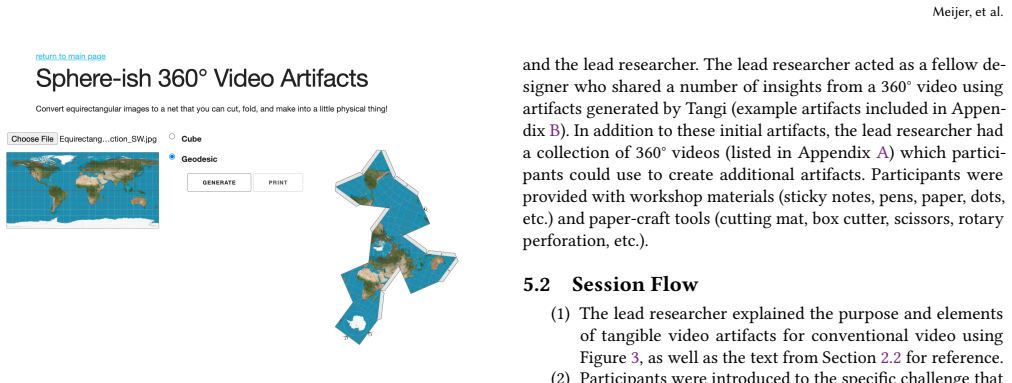
The central object is the Tangible 360° Frame artifact, generated by Tangi from a single equirectangular 360° frame, the standard flat format that maps the spherical image onto a rectangle. It comes in two classes: the flat artifact, which combines an undistorted perspective screenshot of the area of interest with a mini-map showing the full spherical context and cartographic graticules (a grid of lines that gives coordinate information) to orient the crop within the sphere, and the sphere-ish artifact, a cut-and-fold template of a cube or cuboctahedron (a polyhedron with square and triangular faces) onto which the full frame is projected. The mechanism that carries the argument is the projection onto a polyhedral net: it moves spherical visual information into the tangible domain without the severe distortion of a flat equirectangular print, and its facets give collaborators a shared set of sides for orienting discussion.
What would settle it
Run real collaborative workshops with groups of three or more designers analyzing the same 360° video, half using Tangi artifacts and half using conventional flat screenshots or a shared VR view. If the Tangi teams show no systematic improvement in agreeing on spatial orientation and in linking details to the whole scene, or if groups ignore the facets and mini-map and treat the artifacts as flat images, the central claim fails.
Extended reading notes
Core claim
Tangi demonstrates that the spherical format of 360° video does not have to be abandoned when designers leave the screen. By projecting a frame onto either a flat composite print or a foldable polyhedron, the tool produces tangible artifacts that retain the full visual context of the 360° scene while keeping distortion low enough to work with. The evaluation with nine experienced designers found that the artifacts enable the tangible interactions used in collaborative video analysis, and two new functions unique to 360° content: orientation, using the facets and mini-map to agree on spatial relations and direction, and context-detail linking, connecting a specific element to the wider scene. Participants also modified the paper artifacts into meta-frame booklets, multi-cube timelines, and motion-overlay models, which the authors read as evidence that paper-based 360° artifacts act as emergent boundary objects that adapt to a team's needs.
Load-bearing premise
The load-bearing premise is that one-on-one reflection sessions with the lead researcher can stand in for real multi-person design workshops, so the interactions observed with nine designers predict how the artifacts will function when a team shares, points, and negotiates around them.
Editorial extensions
If this is right
- Design teams can run collaborative sense-making on 360° video without VR headsets or special displays, using paper prints that support pointing, annotation, and rearrangement.
- The two new capabilities, orientation and context-detail linking, give tangible 360° artifacts a distinct advantage over conventional storyboards for spatially complex scenes such as cycling, orchestral performance, or emergency training.
- Because the artifacts are paper, designers can quickly cut, fold, and annotate them, allowing a workshop's artifacts to evolve into bespoke boundary objects rather than remaining fixed outputs.
- Paper artifacts persist after a session, so they can serve as documentation that later teams or stakeholders can re-engage with.
- Open-sourcing Tangi lets practitioners generate and share new artifact types, supporting a community-driven exploration of tangible 360° video artifacts.
Reading between the lines
- Beyond the paper's workshop framing, the orientation function suggests a testable use in multi-person training contexts, such as firefighter or medical instruction, where a group must agree on where in a 360° scene an event happened.
- A natural next test is whether the two claimed capabilities survive in real multi-person workshops, since the evaluation was conducted one-on-one with the lead researcher acting as a design partner.
- The participants' split reactions to the cube versus the cuboctahedron imply a measurable trade-off: cube artifacts may support faster detail-finding because they isolate single faces, while cuboctahedra may support a more holistic overview by inviting continuous rotation.
- The design space the paper sketches, with spherical-flat and digital-tangible as axes, could serve as a coordinate system for classifying future artifact types beyond 360° video, such as tangible outputs from volumetric or panoramic recordings.
Signed reviews
Editorial analysis
A structured set of objections, weighed in public.
Referee Report
Summary. This paper presents Tangi, a web-based tool that converts equirectangular 360° video frames into tangible paper artifacts, either as flat artifacts with a mini-map orientation aid or as foldable 'sphere-ish' polyhedra (cube and cuboctahedron). The authors motivate the tool by arguing that 360° video's spherical nature prevents designers from creating the tangible video artifacts (storyboards, frame clusters) that support collaborative sense-making in Video Design Ethnography. They describe a design space of 360° video artifacts, three design considerations, the tool implementation, and a qualitative evaluation with nine experienced designers in one-on-one sessions. The reported results include four themes: differences between artifact classes, two functions specific to tangible 360° artifacts (orientation and context-detail link), participants' extensions beyond single frames, and observations about tangibility and time. The paper claims that the evaluation demonstrates that Tangi's artifacts enable tangible interactions found in collaborative workshops and introduce two new capabilities.
Significance. If the central claims hold, Tangi addresses a real gap: it makes 360° video content amenable to paper-based artifacts, which prior work identifies as important for collaborative design analysis. The paper's strengths include a clear design-space framing, a working open-source tool with printable templates, and a qualitative study that documents experienced designers' reactions with quotes and artifact photos. The two candidate capabilities—orientation in 360° space and linking details to a broader context—are plausible and interesting. However, the evaluation design supports a more modest conclusion than the abstract states. Because the sessions were one-on-one reflections rather than observed group collaboration, and because the 'context-detail link' emerged only through participants' externally added annotations, the paper's strongest claims need to be scaled back or re-evidenced. The contribution remains useful as an exploratory tool study, but the current wording overstates what the data can demonstrate.
major comments (3)
- [Abstract; §5.1; §5.2; §7.4] The abstract claims that the evaluation 'demonstrates that the artifacts Tangi creates enable tangible interactions found in collaborative workshops,' but the study did not observe collaborative workshops. As stated in §5.1, 'the 2 to 3 hour sessions were conducted one-on-one with a participant and the lead researcher,' and §5.2 describes the lead researcher demonstrating, sharing, and guiding reflection rather than multiple designers collaborating with one another. The 'tangible interactions' reported in §6 (pointing, rotating, annotating, arranging) appear as participants' descriptions or individual prototypes, not as observed multi-party behavior. The authors' own §7.4 limits the findings to 'a limited number of designers ... for a single session.' The verb 'demonstrates' therefore overstates the evidence; at most the study elicits designers' judgments about expected utility. I recommend reframing the central claim as providing initial evidence or suggesting potential, and explicitly distinguishing anticipated from observed collaborative interactions.
- [§6, F2; §6, M1; Abstract] The second claimed new capability, 'linking specific details to the broader 360° context,' is not directly attributable to the artifacts Tangi creates. In F2, the authors note that this linking function was 'missing in the sphere-ish artifacts,' and participants addressed the shortcoming by creating external booklets, flags, magnetic notes, QR-code stickers, and other meta-frame additions (M1). Thus the data show that unmodified Tangi artifacts leave this capability lacking, and that users invent supplementary attachments to achieve it. Attributing the capability to 'the artifacts Tangi creates' conflates the tool's output with participants' modifications. The paper should either reframe this as a design requirement that emerged from the study, or provide evidence that the base artifacts themselves support the context-detail link without modification.
- [§5.2; §5.3; §6] The evaluation was designed, facilitated, and analyzed by the same team that built Tangi, with the lead researcher acting as a 'fellow designer' and guiding participants through reflection. While this is common in exploratory HCI tool evaluations, it raises a risk that the two 'new capabilities' are partly researcher-led framings rather than independent discoveries. For instance, the reflective prompts in §5.2 explicitly ask about functions unique to 360° video, and the lead researcher demonstrated pre-assembled artifacts before eliciting reactions. The paper would be strengthened by acknowledging this interpretive risk, reporting the specific prompts used, and ideally including independent coding or member checking to support the claimed themes.
minor comments (8)
- [§5] The recruitment sentence is grammatically incomplete: 'We used snowball sampling to recruit participants (shown in Table 1) that to conduct a 2-3 hour in-person sessions...' should be rewritten.
- [§4] There is a duplicated word: 'both of which can can be quickly created with Tangi's online interface.'
- [§3.1] The sentence 'This tangibility also supports provides the practical benefits...' contains a typo ('supports provides').
- [§7.1] The phrase 'modify modify 360° video' contains a duplicated word.
- [§7.3.2] Typos: 'flexibilty' should be 'flexibility' and 'Therefor' should be 'Therefore.'
- [§4.1] 'orthagonal' should be 'orthogonal.'
- [Appendix B] Figure 10 is captioned 'geodesic octahedron artifact,' but the text consistently refers to the polyhedron as a 'cuboctahedron.' The caption and terminology should be made consistent.
- [Footnotes 2 and 4] The footnote text appears truncated and repeated: 'this term has been used by Ylirisku and Buur [51] to describe similar boundary objects made from video.' Should be cleaned up.
Circularity Check
No circular derivation: Tangi's claims rest on qualitative evaluation, and no load-bearing step reduces to its inputs or to a self-citation.
full rationale
This is an HCI tool paper rather than a formal derivation, so the circularity pass looks for self-definitional or self-citation-driven reductions. The paper builds a web tool, generates artifacts, and uses reflective sessions with nine designers. The main claims—that the artifacts are tangible, preserve 360° context, and support orientation and context-detail linking—are supported by participant quotes and session observations, not by equations or by fitting parameters to data. No prediction is derived from a fitted input; the two 'new capabilities' are reported as themes from the sessions, not encoded into Tangi's design by construction. The paper cites prior work by the same authors [30] for background and video selection, but that citation supports motivation rather than the claimed evaluation outcome, and the central evaluation evidence is the recorded sessions. Limitations of the evaluation—one-on-one sessions with the lead researcher, snowball sample, single sessions—are acknowledged in Section 7.4 and reduce the strength of the generalization, but they are not circularity; the observed data are not equivalent by construction to the paper's conclusions.
Assumptions & free parameters
assumptions (3)
- domain assumption Tangible video artifacts are essential for collaborative video analysis in design ethnography
- domain assumption Participants' self-reports during a single one-on-one session can evidence the utility of Tangi's artifacts in real collaborative workshops
- domain assumption Snowball sampling produced a representative sample of designers experienced with 360-degree video
Cite this review
Pith. "Pith review of Tangi: a Tool to Create Tangible Artifacts for Sharing Insights from 360$^\circ$ Video." pith.science (2026). https://pith.science/paper/S4ISLRVW
@misc{pith2026241110192,
  author       = {Pith},
  title        = {Pith review of: Tangi: a Tool to Create Tangible Artifacts for Sharing Insights from 360$^\circ$ Video},
  year         = {2026},
  howpublished = {\url{https://pith.science/paper/S4ISLRVW}},
  note         = {Machine review of arXiv:2411.10192}
}
abstract
Designers often engage with video to gain rich, temporal insights about the context of users, collaboratively analyzing it to gather ideas, challenge assumptions, and foster empathy. To capture the full visual context of users and their situations, designers are adopting 360$^\circ$ video, providing richer, more multi-layered insights. Unfortunately, the spherical nature of 360$^\circ$ video means designers cannot create tangible video artifacts such as storyboards for collaborative analysis. To overcome this limitation, we created Tangi, a web-based tool that converts 360$^\circ$ images into tangible 360$^\circ$ video artifacts, that enable designers to embody and share their insights. Our evaluation with nine experienced designers demonstrates that the artifacts Tangi creates enable tangible interactions found in collaborative workshops and introduce two new capabilities: spatial orientation within 360$^\circ$ environments and linking specific details to the broader 360$^\circ$ context. Since Tangi is an open-source tool, designers can immediately leverage 360$^\circ$ video in collaborative workshops.
Figures


Figures from the paper (7 more)




Reference graph
Works this paper leans on
-
[1]
sizima soft . 2017. SAYA360. https://sizima.com/paper360/index_jp.html
work page 2017
- [2]
-
[3]
Eva Brandt. 2007. How Tangible Mock-Ups Support Design Collaboration.Knowl- edge, Technology & Policy 20, 3 (Oct. 2007), 179–192. https://doi.org/10.1007/ s12130-007-9021-9
work page 2007
-
[4]
Virginia Braun and Victoria Clarke. 2006. Using thematic analysis in psychology. Qualitative Research in Psychology 3, 2 (Jan. 2006), 77–101. https://doi.org/10. 1191/1478088706qp063oa
2006
-
[5]
Virginia Braun and Victoria Clarke. 2022. Thematic analysis: a practical guide . SAGE, London ; Thousand Oaks, California. OCLC: on1247204005
work page 2022
-
[6]
Jacob Buur, Thomas Binder, and Eva Brandt. 2000. Taking Video Beyond ’Hard Data’ in User Centered Design. In In Proceedings of Participatory Design Confer- ence. 21–29
work page 2000
-
[7]
Jacob Buur, Euan Fraser, Soila Oinonen, and Max Rolfstam. 2010. Ethnographic video as design specs. In Proceedings of the 22nd Conference of the Computer- Human Interaction Special Interest Group of Australia on Computer-Human Inter- action (OZCHI ’10). Association for Computing Machinery, New York, NY, USA, 49–56. https://doi.org/10.1145/1952222.1952235
arXiv 2010
-
[8]
Jacob Buur and Astrid Soendergaard. 2000. Video card game: an augmented environment for user centred design discussions. In Proceedings of DARE 2000 on Designing augmented reality environments (DARE ’00). Association for Computing Machinery, New York, NY, USA, 63–69. https://doi.org/10.1145/354666.354673
arXiv 2000
Show all 55 references
-
[9]
Peter Dalsgaard, Kim Halskov, and Ditte Amund Basballe. 2014. Emergent boundary objects and boundary zones in collaborative design research projects. In Proceedings of the 2014 conference on Designing interactive systems . ACM, Vancouver BC Canada, 745–754. https://doi.org/10....
2014
-
[10]
Jacob Davidsen, Dorthe Vinther Larsen, Lucas Paulsen, and Sten Rasmussen
-
[11]
Siu, Jennifer Healey, Curtis Wigington, Chang Xiao, and Tong Sun
Mustafa Doga Dogan, Alexa F. Siu, Jennifer Healey, Curtis Wigington, Chang Xiao, and Tong Sun. 2023. StandARone: Infrared-Watermarked Documents as Portable Containers of AR Interaction and Personalization. In Extended Abstracts of the 2023 CHI Conference on Human Factors in Co...
2023
-
[12]
Stanley Donen. 1963. Charade
1963
-
[13]
Kees Dorst and Judith Dijkhuis. 1995. Comparing paradigms for describing design activity. Design Studies 16, 2 (April 1995), 261–274. https://doi.org/10.1016/0142- 694X(94)00012-3
1995 doi
-
[14]
Dan B Goldman, Brian Curless, David Salesin, and Steven M. Seitz. 2006. Schematic storyboarding for video visualization and editing. ACM Transactions Tangi on Graphics 25, 3 (July 2006), 862–871. https://doi.org/10.1145/1141911.1141967
2006 arXiv
-
[15]
Shuqi He, Haonan Yao, Luyan Jiang, Kaiwen Li, Nan Xiang, Yue Li, Hai-Ning Liang, and Lingyun Yu. 2024. Data Cubes in Hand: A Design Space of Tangible Cubes for Visualizing 3D Spatio-Temporal Data in Mixed Reality. InProceedings of the CHI Conference on Human Factors in Computi...
2024
-
[16]
Philippe Hurbain. 2003. 3-D panorama printing: enter physical real- ity... https://web.archive.org/web/20030413190851/https://www.philohome. com/rhombicuboctahedron/rhombicuboctahedron.htm
2003
-
[17]
Tero Jokela, Jarno Ojala, and Kaisa Väänänen. 2019. How people use 360-degree cameras. In Proceedings of the 18th International Conference on Mobile and Ubiqui- tous Multimedia. ACM, Pisa Italy, 1–10. https://doi.org/10.1145/3365610.3365645
2019
-
[18]
Seung-Nam Kim and Hanwool Lee. 2022. Capturing reality: Validation of omnidirectional video-based immersive virtual reality as a streetscape qual- ity auditing method. Landscape and Urban Planning 218 (Feb. 2022), 104290. https://doi.org/10.1016/j.landurbplan.2021.104290
2022
-
[19]
Jan Koenderink and Andrea van Doorn. 2017. The Planispheric Optic Ar- ray. i-Perception 8, 3 (June 2017), 2041669517705388. https://doi.org/10.1177/ 2041669517705388 Publisher: SAGE Publications
2017
-
[20]
Kosko, Jennifer Heisler, and Enrico Gandolfi
Karl W. Kosko, Jennifer Heisler, and Enrico Gandolfi. 2022. Using 360-degree video to explore teachers’ professional noticing. Computers & Education 180 (April 2022), 104443. https://doi.org/10.1016/j.compedu.2022.104443
2022
-
[21]
Mark A. M. Kramer. 2022. Innovating Methods: Observing In Situ Tech- nology Experiences Using Novel Visual Research Methods. International Journal of Human–Computer Interaction 38, 3 (Feb. 2022), 253–262. https: //doi.org/10.1080/10447318.2021.1938388 Publisher: Taylor & Franc...
2022
-
[22]
David Ledo, Steven Houben, Jo Vermeulen, Nicolai Marquardt, Lora Oehlberg, and Saul Greenberg. 2018. Evaluation Strategies for HCI Toolkit Research. In Proceedings of the 2018 CHI Conference on Human Factors in Computing Systems . ACM, Montreal QC Canada, 1–17. https://doi.org...
2018
-
[23]
L P Lee. 1944. The Nomenclature and Classification of Map Projections. Empire Survey Review 7, 50 (Jan. 1944), 190–200
1944
-
[24]
Jiannan Li, Jiahe Lyu, Mauricio Sousa, Ravin Balakrishnan, Anthony Tang, and Tovi Grossman. 2021. Route Tapestries: Navigating 360 ° Virtual Tour Videos Using Slit-Scan Visualizations. In The 34th Annual ACM Symposium on User Interface Software and Technology . ACM, Virtual Ev...
2021
-
[25]
Zhengqing Li, Shio Miyafuji, Toshiki Sato, and Hideki Koike. 2016. OmniEyeball: Spherical Display Embedded With Omnidirectional Camera Using Dynamic Spherical Mapping. In Adjunct Proceedings of the 29th Annual ACM Symposium on User Interface Software and Technology (UIST ’16 A...
2016
-
[26]
Panagiotis Louridas. 1999. Design as bricolage: anthropology meets design thinking. Design Studies 20, 6 (Nov. 1999), 517–535. https://doi.org/10.1016/ S0142-694X(98)00044-1
1999
-
[27]
Andrés Lucero, Peter Dalsgaard, Kim Halskov, and Jacob Buur. 2016. Designing with Cards. InCollaboration in Creative Design, Panos Markopoulos, Jean-Bernard Martens, Julian Malins, Karin Coninx, and Aggelos Liapis (Eds.). Springer Inter- national Publishing, Cham, 75–95. https...
2016 doi
-
[28]
Radwa Mabrook and Jane B. Singer. 2019. Virtual Reality, 360° Video, and Journal- ism Studies: Conceptual Approaches to Immersive Technologies.Journalism Stud- ies 20, 14 (Oct. 2019), 2096–2112. https://doi.org/10.1080/1461670X.2019.1568203
2019
-
[29]
MacEachren
Alan M. MacEachren. 2004. How maps work: representation, visualization, and design (paperback edition ed.). Guilford Press, New York. http://catdir.loc.gov/ catdir/enhancements/fy0626/2005276848-t.html OCLC: 56039088
2004
-
[30]
Wo Meijer, Jacky Bourgeois, Wilhelm Frederik van der Vegte, and Gerd Kortuem
-
[31]
Daniel Neubauer, Verena Paepcke-Hjeltness, Pete Evans, Betsy Barn- hart, and Tor Finseth. 2017. Experiencing Technology Enabled Empa- thy Mapping. The Design Journal 20, sup1 (July 2017), S4683–S4689. https://doi.org/10.1080/14606925.2017.1352966 Publisher: Routledge _eprint: ...
2017
-
[32]
Cuong Nguyen, Stephen DiVerdi, Aaron Hertzmann, and Feng Liu. 2017. Vremiere: In-Headset Virtual Reality Video Editing. In Proceedings of the 2017 CHI Conference on Human Factors in Computing Systems . ACM, Denver Colorado USA, 5428–5438. https://doi.org/10.1145/3025453.3025675
2017
-
[33]
Nicolas Nova. 2014. Beyond design ethnography. SHS Publishing
2014
-
[34]
Marza, Mihai- Octavian Botea, and Ovidiu A
Alina Petrica, Diana Lungeanu, Alexandru Ciuta, Adina M. Marza, Mihai- Octavian Botea, and Ovidiu A. Mederle. 2021. Using 360-degree video for teaching emergency medicine during and beyond the COVID-19 pan- demic. Annals of Medicine 53, 1 (Jan. 2021), 1520–1530. https://doi. o...
2021
-
[35]
Daniel Pimentel, Sri Kalyanaraman, Yu-Hao Lee, and Shiva Halan. 2021. Voices of the unsung: The role of social presence and interactivity in building empathy in 360 video. New Media & Society 23, 8 (Aug. 2021), 2230–2254. https://doi.org/ 10.1177/1461444821993124 Publisher: SA...
2021 doi
-
[36]
Martin Porcheron, Leigh Clark, Stuart Alan Nicholson, and Matt Jones. 2023. Cyclists’ Use of Technology While on Their Bike. In Proceedings of the 2023 CHI Conference on Human Factors in Computing Systems . ACM, Hamburg Germany, 1–15. https://doi.org/10.1145/3544548.3580971
2023
-
[37]
Claudius Ptolemaeus. 1845. Geographia. Vol. 3. Tauchnitz
-
[38]
Tony Salvador, Genevieve Bell, and Ken Anderson. 1999. Design Ethnography. Design Management Journal (Former Series) 10, 4 (1999), 35–41. https://doi.org/10.1111/j.1948-7169.1999.tb00274.x _eprint: https://onlinelibrary.wiley.com/doi/pdf/10.1111/j.1948-7169.1999.tb00274.x
1999
-
[39]
Ayush Sarkar, Anh Nguyen, Zhisheng Yan, and Klara Nahrstedt. 2022. A 360- Degree Video Analytics Service for In-Classroom Firefighter Training. In 2022 Workshop on Cyber Physical Systems for Emergency Response (CPS-ER) . 13–18. https://doi.org/10.1109/CPS-ER56134.2022.00009
2022
-
[40]
Paul Schlosser and Ben Matthews. 2022. Designing for Inaccessible Emergency Medical Service Contexts: Development and Evaluation of the Contextual Sec- ondary Video Toolkit. InProceedings of the 2022 CHI Conference on Human Factors in Computing Systems (CHI ’22) . Association ...
2022
-
[41]
Donghee Shin. 2018. Empathy and embodied experience in virtual environment: To what extent can virtual reality stimulate empathy and embodied experience? Computers in Human Behavior 78 (Jan. 2018), 64–73. https://doi.org/10.1016/j. chb.2017.09.012
2018 doi
-
[42]
Taufik Akbar Sitompul and Markus Wallmyr. 2019. Analyzing Online Videos: A Complement to Field Studies in Remote Locations. In Human-Computer Interaction – INTERACT 2019 , David Lamas, Fernando Loizides, Lennart Nacke, Helen Petrie, Marco Winckler, and Panayiotis Zaphiris (Eds...
2019 doi
-
[43]
Chareen Snelson and Yu-Chang Hsu. 2020. Educational 360-Degree Videos in Virtual Reality: a Scoping Review of the Emerging Research. TechTrends 64, 3 (May 2020), 404–412. https://doi.org/10.1007/s11528-019-00474-3 Company: Springer Distributor: Springer Institution: Springer L...
2020 doi
-
[44]
Griesemer
Susan Leigh Star and James R. Griesemer. 1989. Institutional Ecology, ’Transla- tions’ and Boundary Objects: Amateurs and Professionals in Berkeley’s Museum of Vertebrate Zoology, 1907-39. Social Studies of Science 19, 3 (1989), 387–420. https://www.jstor.org/stable/285080 Pub...
1989
- [45]
-
[46]
Naoya Tojo, Tomoko Oto, and Sumaru Niida. 2021. How Ethnographic Practices Are Reconfigured with 360-degree Cameras. 115–122. https://doi.org/10.5220/ 0010639000003060
2021
-
[47]
Phillip Vannini. 2020. The Routledge International Handbook of ethnographic film and video. Routledge
2020
-
[48]
Anna Vatanen, Heidi Spets, Maarit Siromaa, Mirka Rauniomaa, and Tiina Keisa- nen. 2022. Experiences in Collecting 360° Video Data and Collaborating Remotely in Virtual Reality. QuiViRR: Qualitative Video Research Reports 3 (Sept. 2022), a0005–a0005. https://doi.org/10.54337/oj...
2022 doi
-
[49]
Alissa Vermast and Wolfgang Hürst. 2023. Introducing 3D Thumbnails to Ac- cess 360-Degree Videos in Virtual Reality. IEEE Transactions on Visualization and Computer Graphics 29, 5 (May 2023), 2547–2556. https://doi.org/10.1109/ TVCG.2023.3247462 Conference Name: IEEE Transacti...
2023
-
[50]
Ehinger, Aude Oliva, and Antonio Torralba
Jianxiong Xiao, Krista A. Ehinger, Aude Oliva, and Antonio Torralba. 2012. Recognizing scene viewpoint using panoramic place representation. In 2012 IEEE Conference on Computer Vision and Pattern Recognition . 2695–2702. https: //doi.org/10.1109/CVPR.2012.6247991 ISSN: 1063-6919
2012
-
[51]
Salu Pekka Ylirisku and Jacob Buur. 2007. Designing with Video: Focusing the user-centred design process . Springer Science & Business Media. https://link. springer.com/book/10.1007/978-1-84628-961-3
2007 doi
-
[52]
Takehiko Yoshida. [n. d.]. How to use the PazuCraft. https://www.chihayafuru. jp/pazucraft/howtouse_en.html
-
[53]
Horn, Orit Shaer, and Robert J
Jamie Zigelbaum, Michael S. Horn, Orit Shaer, and Robert J. K. Jacob. 2007. The tangible video editor: collaborative video editing with active tokens. In Pro- ceedings of the 1st international conference on Tangible and embedded interaction (TEI ’07). Association for Computing...
2007
-
[2022]
Journal of Problem Based Learning in Higher Education 10, 1 (Oct
360VR PBL: A New Format of Digital Cases in Clinical Medicine. Journal of Problem Based Learning in Higher Education 10, 1 (Oct. 2022). https://doi.org/ 10.54337/ojs.jpblhe.v10i1.7097 Number: 1
2022 doi
-
[2024]
In Nordic Conference on Human-Computer Interaction (NordiCHI 2024)
Sphere Window: Challenges and Opportunities of 360° Video in Collabora- tive Design Workshops.. In Nordic Conference on Human-Computer Interaction (NordiCHI 2024). Association for Computing Machinery, New York, NY, USA. https://doi.org/10.1145/3679318.3685407
2024
Reviewed August 12, 2026 · model on record in the stance chip above.
Discussion (0). Continue with ORCID to comment.