REVIEW 4 major objections 5 minor 60 references
Forecast of solar activity based on mean-field dynamo model and neural network
T0 review · 4 major / 5 minor · reviewed 2026-08-12 · deepseek-v4-flash
Pith's one-line read A nonlinear mean-field dynamo model corrected by a NARX neural network predicts the smoothed sunspot number up to 18 months ahead with small, stable errors.
desk verdict A useful extension of the authors' hybrid dynamo+NN forecasting pipeline, with genuine real-time output since 2021, but the headline error comparison mixes evaluation windows and no ablation against the NN alone, so the central claim of 'joint use' advantage is not yet nailed down. read the letter →
The pith
A machine-rendered reading of the paper's core claim, the machinery that carries it, and where it could break.
The reading
What carries the argument
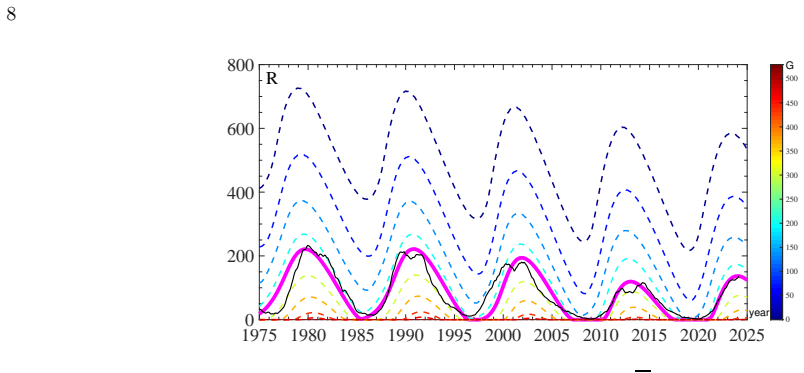
The load-bearing mechanism is the two-stage conversion of dynamo-generated magnetic field into a forecastable sunspot index. First, a nonlinear axisymmetric $\alpha\Omega$ dynamo (Eqs. 1-2) with dynamic nonlinearity from small-scale magnetic helicity (Eq. 9) produces the large-scale toroidal and poloidal fields. Second, a budget equation for the surface density of sunspot number (Eqs. 11-12) models sunspot formation via NEMPI: production occurs only where the mean field exceeds a critical value $B_{\rm cr}$, with rate $I(t,\theta)=|\gamma_{\rm inst}|\,|B-B_{\rm cr}|\,\Theta(B-B_{\rm cr})$, and decay has field-dependent timescale $\tau_s(B)=\tau_*\exp(C_s\,\partial B/\partial t)$. The resulting model sunspot series and four lagged observed values form the input vector of a two-layer recurrent NARX network, a nonlinear autoregressive network with exogenous inputs, whose output is the corrected forecast. Equations (11)-(12) are what turn dynamo physics into a sunspot-number forecast; the neural network's role is to align that physical forecast with current observations.
What would settle it
A controlled ablation would settle it: retrain the NARX network with the same observed inputs but with the dynamo model output replaced by a phase-randomized surrogate with the same smoothness, and compare forecast errors on the same 2017-2024 window. If errors do not worsen substantially, the dynamo output carries no independent physical signal. A second check is to compare against a persistence forecast that simply holds the current smoothed value; the 1-month error of 1.24 must beat that baseline to support the claim of genuine skill.
Extended reading notes
Core claim
On the paper's own terms, the central claim is that the 13-month smoothed sunspot number can be stably predicted up to 1.5 years ahead by a hybrid that feeds the output of a nonlinear mean-field $\alpha\Omega$ dynamo, together with four recent observed values, into a NARX neural network. The dynamo solves equations for the toroidal and poloidal mean fields with algebraic and magnetic-helicity nonlinearities; a post-processing budget equation based on NEMPI converts the mean field into a model sunspot series. The network is trained on cycles 20-21, validated on cycle 22, and then applied with monthly corrections by current observations. In the reported test interval the forecast error remains small and grows only mildly with horizon, and the paper compares favorably with McNish-Lincoln, standard, and combined methods. The authors conclude that despite a strong chaotic component, short-range solar activity can be well predicted by the joint use of the physics-based model and the neural network.
Load-bearing premise
The forecast stands on the assumption that the mapping from mean magnetic field to sunspot number, through the NEMPI threshold $B_{\rm cr}=265\,$G and decay coefficient $C_s=5.47\times 10^{-4}$, is a faithful representation of real sunspot formation; these constants are calibrated to reproduce observed cycle heights rather than derived from first principles.
Editorial extensions
If this is right
- Operational forecasts of the smoothed sunspot number can be issued monthly at horizons up to 18 months, with errors growing only from about 1.2 to 7 smoothed sunspot units over that range.
- The method gives a concrete counterexample to the position that mean-field dynamo output cannot be used for solar cycle prediction: the model supplies cycle-scale memory while the network supplies observation-based correction.
- The same architecture can be applied to other solar activity indices that have a smooth monthly index and a physics-based model output, such as facular area or radio flux.
- The forecast confidence intervals can be extended to 6, 12, and 18 months with stably small error, which the authors identify as an advantage over methods that degrade quickly at longer horizons.
Reading between the lines
- Editorial extension: The reported errors are on a heavily smoothed 13-month running mean, so adjacent monthly targets are highly autocorrelated; a persistence baseline that simply holds the last observed value should be added to Table 1 before the 1-month skill is interpreted as model skill rather than smoothness of the target.
- Editorial extension: An ablation replacing the dynamo output with a smooth surrogate (for example a sinusoid or phase-randomized noise) would quantify how much of the forecast skill comes from the physics as opposed to the network's own extrapolation of the observed series.
- Editorial extension: Because $B_{\rm cr}$ and $C_s$ are calibrated to cycle heights 20-24, the cleanest out-of-sample test is the current Cycle 25 maximum; if the error on the descending phase remains below about 10 units, the calibration generalizes.
- Editorial extension: The same hybrid structure could be ported to other magnetically active stars where a mean-field dynamo model and a smooth activity index such as photometric spot coverage exist, turning the method into a general stellar activity forecaster.
Editorial analysis
A structured set of objections, weighed in public.
Referee Report
Summary. The paper proposes a hybrid method for short-term solar activity forecasting that combines a nonlinear mean-field αΩ dynamo model, a NEMPI-based post-processing step for sunspot number production, and a two-layer NARX neural network used as a correction scheme. The network input vector w in Eq. (13) contains four prior observed smoothed SSN values and four dynamo-model output values. The authors report forecast RMS errors over horizons of 1, 6, 12, and 18 months, claiming errors of 1.24–7.03 in smoothed sunspot units over Nov 2017–Oct 2024 for the NARX with corrections, and compare these with several standard methods. They also show one-month forecast tracks, mention real-time forecasts since 2021 with results on a public GitHub repository, and argue that the joint use of the physical model and the neural network yields stable predictive skill despite the chaotic component of solar activity.
Significance. If the central claim holds, this is a practically valuable contribution: it would demonstrate that a physically motivated dynamo/NEMPI model can stabilize neural-network short-term forecasts and provide a transparent, reproducible forecasting pipeline. The paper’s strengths include a public repository with real-time forecast results, a physically grounded NEMPI-based mapping from mean magnetic field to sunspot number, explicit discussion of non-stationarity and of the difficulty of immediate verification, and a clearly stated method for extending the forecast horizon. However, the quantitative case for the headline claim is currently not established because the comparison table mixes evaluation intervals, the calibration of the physical output overlaps the evaluation window, and no ablation isolates the contribution of the dynamo block from the autoregressive use of the observed series.
major comments (4)
- [Table 1 and its footnote] The headline comparison is not valid as presented. The NARX-with-corrections row is computed over Nov 2017–Oct 2024, whereas the M&L, SM, and CM rows are taken from Podladchikova & Van der Linden (2012) over Sept 1997–May 2010. These intervals cover different solar cycle phases and activity levels, and the paper itself notes that the statistical properties of the process are not stationary. The lower RMS values in the NARX row may therefore reflect easier forecast conditions rather than method superiority. The 'NARX without corrections' row is not footnoted with the asterisk, so it appears to be evaluated over the 1997–2010 interval as well; comparing it with the 2017–2024 NARX row does not isolate the effect of corrections. Please recompute all methods on the same evaluation interval, or restrict the comparison to matched intervals.
- [§4, Eq. (13), and §5] The central claim that the dynamo/NEMPI block contributes predictive skill is unsupported because no ablation removes the dynamo input. The input vector w already contains four observed values W_obs; a NARX using only those entries is a standard nonlinear autoregressive predictor. The paper compares 'NARX with corrections' against 'NARX without corrections' (the latter being the raw dynamo output, apparently on a different interval), but it does not compare against an NN that uses observations alone with the same architecture. Section 5 asserts that a neural network without the mean-field solution provides reasonable agreement for only a few years, but no experiment is reported. Please train and evaluate the same architecture with the W_model entries removed or set to zero on the same 2017–2024 interval; this ablation is necessary to support the joint-use claim.
- [§3 and §1] The physical-model and post-processing parameters are selected to fit observed sunspot data, and the evaluation window overlaps the calibration data. Section 3 states that the parameter choice, including Bcr = 265 G and Cs = 5.47 × 10^-4, 'has been made as providing the best fit ... for solar cycles 20-24,' and §1 says the parameters are selected by comparing with solar sunspot data since 1750. The Table 1 evaluation interval begins in Nov 2017, inside Cycle 24, so the errors over the first part of the window are partly in-sample for the calibrated dynamo output. This does not invalidate the real-time component reported since 2021, but it means the quoted error statistics cannot be read as purely out-of-sample. Please report errors separately for the pre-2021 and post-2021 portions, or recalibrate on cycles up to 19 only and evaluate on cycles 20–25.
- [Table 1 and Fig. 4] No uncertainty quantification is provided for the reported RMS errors, and the confidence intervals in Fig. 4 are not defined. The differences between methods (e.g., 1.24 vs 3.1 at 1 month) are presented without error bars, significance tests, or a description of how the forecast confidence intervals are constructed. Given the acknowledged chaotic component and the short non-stationary series, the 'almost stably small' claim requires at least bootstrap or Monte Carlo intervals around each RMS value, and a definition of the plotted intervals in Fig. 4.
minor comments (5)
- [§4] The phrase 'based on epignose' is unclear; please clarify what is meant (likely 'epochs' or 'early stopping'?).
- [Table 1] Please state explicitly that the RMS values are in units of smoothed sunspot number and specify whether the forecast targets are the 13-month running mean or the monthly values.
- [Fig. 4] The shaded 'forecast confidence intervals' are not described in the caption or the text; please define their construction and coverage probability.
- [§3, Eqs. (11)–(12)] The values of Φ_s and τ_* are not given explicitly (only τ_* γ_inst ~ 10 is stated); please list all numerical constants used in the post-processing so the W_model series is reproducible.
- [Throughout] The GitHub repository should be referenced with a version or commit identifier and a description of which files generate Table 1, to support reproducibility of the claimed forecast errors.
Circularity Check
Partially circular: the dynamo post-processing parameters are fit to cycles 20-24, and the headline evaluation window starts inside cycle 24, so part of the reported forecast skill is in-sample fit; the 2021-2024 segment remains genuinely out-of-sample.
-
fitted input called prediction
[Section 3, Eqs. (11)-(12) and parameter choice; Table 1 note]
"τs(B) = τ∗ exp(Cs ∂B/∂t) with Cs = 5.47 × 10⁻⁴ ... This particular choice of model and post-processing parameters has been made as providing the best fit of model time series W to the observational data of solar sunspot number v.2.0 for solar cycles 20-24 ... the line marked ∗ which corresponds to the interval from Nov 2017 to October 2024"
The constants Bcr=265 G and Cs are calibrated so that the post-processed dynamo series W matches observed sunspot numbers for cycles 20-24. The headline NARX evaluation window begins in November 2017, i.e., during cycle 24 (which ends in December 2019). Hence the W_model values entering Eq. (13) for roughly 2017-2019 are fit outputs, not independent forecasts, and the RMSE reported for the whole 2017-2024 window credits calibration for part of its apparent skill. The 2021-2024 segment is out-of-sample, so the circularity is partial rather than total.
full rationale
The paper is not circular by construction in its main architecture: the dynamo equations (1)-(9) are solved forward, Eq. (11) converts mean-field output to a sunspot-number proxy, and the NARX network (13) is trained on cycles 20-21. The use of prior author work for the NEMPI mechanism is backed by independent DNS citations and is not a uniqueness theorem, so self-citation is not load-bearing. The central quantitative claim, however, is partially circular because the post-processing constants in Eqs. (11)-(12) were chosen by fitting W to observed SSN for cycles 20-24, while the tabulated NARX evaluation interval starts in Nov 2017, inside cycle 24. Thus part of the reported forecast error covers data used for calibration, mixing in-sample fit with genuine prediction. The 2021-2024 portion is genuinely out-of-sample, giving the hybrid independent content. Additionally, the paper asserts that a neural network without the dynamo fails after a few years but reports no ablation, so the claimed advantage of joint use is asserted rather than demonstrated; this is an evidence gap, not itself circularity. Overall the derivation chain is independent in its core physics but the headline forecast-skill statistic is partly contaminated by in-sample calibration.
Assumptions & free parameters
free parameters (6)
- Dynamo model parameter set (D, sigma_rho, kappa_T, R_alpha, T, S1, S2, mu, xi) =
D=-8450, sigma_rho=3, kappa_T=0.1, R_alpha=2, T=6.3, S1=0.051, S2=0.95, mu=3, xi=0.3
- NEMPI threshold Bcr =
265 G
- Sunspot decay coefficient Cs =
5.47e-4
- Dipole reflection coefficients =
0.5 and 0.05
- tau_* gamma_inst ratio =
~10
- NARX network weights (K1, K2, c1, c2) =
not published
assumptions (6)
- domain assumption The no-r mean-field alpha-Omega dynamo equations (1)-(2) with turbulent diffusion and quenching functions adequately describe large-scale solar magnetic field evolution.
- domain assumption Sunspot number is determined by NEMPI through Eqs. (11)-(12): production I(t,theta)=|gamma_inst||B-Bcr| Theta(B-Bcr) and decay tau_s(B)=tau_* exp(Cs dB/dt).
- domain assumption The NEMPI growth rate and critical field in Appendix A, Eqs. (A1)-(A2), apply to the solar convective zone.
- domain assumption The relationship learned by the NARX network on cycles 20-21, with cycle 22 for validation, transfers to later cycles.
- standard math The 13-month running average sunspot number v2.0 from SILSO is a valid ground truth for forecast error.
- ad hoc to paper Forecast error statistics from Sept 1997-May 2010 are representative of error statistics in Nov 2017-Oct 2024, allowing cross-method comparison.
Cite this review
Pith. "Pith review of Forecast of solar activity based on mean-field dynamo model and neural network." pith.science (2026). https://pith.science/paper/P7KRFBYA
@misc{pith2026241110380,
  author       = {Pith},
  title        = {Pith review of: Forecast of solar activity based on mean-field dynamo model and neural network},
  year         = {2026},
  howpublished = {\url{https://pith.science/paper/P7KRFBYA}},
  note         = {Machine review of arXiv:2411.10380}
}
abstract
We discuss a prediction of the solar activity on a short time-scale applying the method based on a combination of a nonlinear mean-field dynamo model and the artificial neural network. The artificial neural network which serves as a correction scheme for the forecast, uses the currently available observational data (e.g., the 13 month running average of the observed solar sunspot numbers) and the dynamo model output. The nonlinear mean-field $\alpha\,\Omega$ dynamo produces the large-scale magnetic flux which is redistributed by negative effective magnetic pressure instability (NEMPI) producing sunspots and active regions. The nonlinear mean-field dynamo model includes algebraic nonlinearity (caused by the feedback of the growing magnetic field on the plasma motion) and dynamic nonlinearities (related to the dynamics of the magnetic helicity of small-scale magnetic field). We compare the forecast errors with a horizon of 1, 6, 12 and 18 months, for different forecast methods, with the same corrections on the current monthly observations. Our forecast is in good agreement with the observed solar activity, the forecast error is almost stably small over short-medium ranges of forecasting windows. Despite a strong level of chaotic component in the solar magnetic activity we present quantitative evidence that the solar activity on a short range can be stably well predicted, by the joint use of the physically based model with the neural network. This result may have an immediate practical implementation for predictions of various phenomena of solar activity and other astrophysical processes, so may be of interest to a broad community.
Figures


Figures from the paper (1 more)

Reference graph
Works this paper leans on
- [1]
-
[2]
Bhowmik, P., Jiang, J., Upton, L., Lemerle, A., & Nandy, D. 2023, SSRv, 219
work page 2023
- [3]
- [4]
-
[5]
Blackman, E. G., & Field, G. 2000, ApJ, 534, 984, doi: 10.1086/308767
doi:10.1086/308767 2000
-
[6]
2011, ApJ, 740, L50, doi: 10.1088/2041-8205/740/2/L50
Rogachevskii, I. 2011, ApJ, 740, L50, doi: 10.1088/2041-8205/740/2/L50
-
[7]
Brandenburg, A., Rogachevskii, I., & Kleeorin, N. 2016, New J. Phys., 18, 125011, doi: 10.1088/1367-2630/aa513e
-
[8]
Brandenburg, A., & Subramanian, K. 2005, Phys. Rep, 417, 1, doi: 10.1016/j.physrep.2005.06.005
Show all 60 references
-
[9]
2007, ApJ, 661, 128, doi: 10.1086/516628
Bushby, P., & Tobias, S. 2007, ApJ, 661, 128, doi: 10.1086/516628
2007 doi
-
[10]
2007a, PhRvL, 98, 131103, doi: 10.1103/PhysRevLett.98.131103 —
Choudhuri, A., Chatterjee, P., & Jiang, J. 2007a, PhRvL, 98, 131103, doi: 10.1103/PhysRevLett.98.131103 —. 2007b, PhRvL, 98, 131103 De Jager, C., & Duhau, S. 2009, J. Atmosph. and Sol.-Terr. Phys., 71, 239, doi: 10.1016/j.jastp.2008.11.006
2009 doi
-
[11]
2006, Geophys
Dikpati, M., de Toma, G., & Gilman, P. 2006, Geophys. Res. Lett., 33, L05102
2006
-
[12]
2006, ApJ, 649, 498, doi: 10.1086/506314
Dikpati, M., & Gilman, P. 2006, ApJ, 649, 498, doi: 10.1086/506314
2006 doi
-
[13]
2000, SoPh, 195, 209
Dmitrieva, I., Kuzanyan, K., & Obridko, V. 2000, SoPh, 195, 209
2000
-
[14]
1999, ApJ, 513, 638, doi: 10.1086/306877
Field, G., Blackman, E., & Chou, H. 1999, ApJ, 513, 638, doi: 10.1086/306877
1999 doi
-
[15]
Frisch, U., Pouquet, A., Leorat, I., & Mazure, A. 1975, J. Fluid Mech., 68, 769
1975
-
[16]
2023, ApJ, 943, 66, doi: 10.3847/1538-4357/aca808
Gopalakrishnan, K., & Subramanian, K. 2023, ApJ, 943, 66, doi: 10.3847/1538-4357/aca808
2023 doi
-
[17]
Guo, W., Jiang, J., & Wang, J. X. 2021, SoPh, 296
2021
-
[18]
X., Jiao, Q
Jiang, J., Wang, J. X., Jiao, Q. R., & Cao, J. B. 2018, ApJ, 863, 159
2018
-
[19]
Jiang, J., Zhanga, Z., & Petrovay, K. 2023, J. Atmosph. and Sol.-Terr. Phys., 243
2023
-
[20]
2007, SoPh, 246, 487, doi: 10.1007/s11207-007-9050-2
Kane, R. 2007, SoPh, 246, 487, doi: 10.1007/s11207-007-9050-2
2007 doi
-
[21]
2011, in Lecture Notes in
Kitiashvili, I., & Kosovichev, A. 2011, in Lecture Notes in
2011
-
[22]
832 (Springer-Verlag Berlin Heidelberg), 121, doi: 10.1007/978-3-642-19928-8 3
Physics, Vol. 832 (Springer-Verlag Berlin Heidelberg), 121, doi: 10.1007/978-3-642-19928-8 3
-
[23]
Kitiashvili, I. N. 2016, ApJ, 831, 15, doi: 10.3847/0004-637X/831/1/15
2016 doi
-
[24]
N., & Kosovichev, A
Kitiashvili, I. N., & Kosovichev, A. G. 2008, ApJ, 688, L49
2008
-
[25]
2003, A&A, 409, 1097, doi: 10.1051/0004-6361:20031126
Kleeorin, N., Kuzanyan, K., Moss, D., et al. 2003, A&A, 409, 1097, doi: 10.1051/0004-6361:20031126
2003 doi
-
[26]
1996, A&A, 307, 293 12
Kleeorin, N., Mond, M., & Rogachevskii, I. 1996, A&A, 307, 293 12
1996
- [27]
-
[28]
1994, Phys
Kleeorin, N., & Rogachevskii, I. 1994, Phys. Rev. E., 50, 2716, doi: 10.1103/PhysRevE.50.2716 —. 1999, Phys. Rev. E, 59, 6724, doi: 10.1103/PhysRevE.59.6724 —. 2022, MNRAS, 515, 5437, doi: 10.1093/mnras/stac2141
1994 doi
-
[29]
1989, Sov
Kleeorin, N., Rogachevskii, I., & Ruzmaikin, A. 1989, Sov. Astron. Lett., 15, 274 —. 1990, Sov. Phys. JETP, 70, 878
1989
-
[30]
1995, A&A, 297, 159
Kleeorin, N., Rogachevskii, I., & Ruzmaikin, A. 1995, A&A, 297, 159
1995
-
[31]
2023, MNRAS, 526, 1601, doi: 10.1093/mnras/stad2708
Kleeorin, N., Rogachevskii, I., Safiullin, N., Gershberg, R ., & Porshnev, S. 2023, MNRAS, 526, 1601, doi: 10.1093/mnras/stad2708
2023 doi
-
[32]
1982, Magnetohydrodynamics, 18, 116
Kleeorin, N., & Ruzmaikin, A. 1982, Magnetohydrodynamics, 18, 116
1982
-
[33]
M., et al
Kleeorin, N., Safiullin, N., Kuzanyan, K. M., et al. 2020, MNRAS, 495, 238, doi: 10.1093/mnras/staa1047
2020 doi
-
[34]
2016, MNRAS, 460, 3960, doi: 10.1093/mnras/stw1267
Kleeorin, Y., Safiullin, N., Kleeorin, N., et al. 2016, MNRAS, 460, 3960, doi: 10.1093/mnras/stw1267
2016 doi
-
[35]
1980, Mean-Field Magnetohydrodynamics and Dynamo Theory (Oxford: Pergamon)
Krause, F., & R¨ adler, K.-H. 1980, Mean-Field Magnetohydrodynamics and Dynamo Theory (Oxford: Pergamon)
1980
-
[36]
Kumar, P., Biswas, A., & Karak, B. B. 2022, MNRAS, 513, L112
2022
-
[37]
2019, SoPh, 294, 82
Labonville, F., Charbonneau, P., & Lemerle, A. 2019, SoPh, 294, 82
2019
-
[38]
1949, EOS, 30, 673, doi: 10.1029/TR030i005p00673
McNish, A., & Lincoln, J. 1949, EOS, 30, 673, doi: 10.1029/TR030i005p00673
1949 doi
-
[39]
D., G´ omez, D
Mininni, P. D., G´ omez, D. O., & Mindlin, G. B. 2002, PhRvL, 89 Moffatt, H. K. 1978, Magnetic Field Generation in Electrically Conducting Fluids (New York: Cambridge University Press) Moffatt, H. K., & Dormy, E. 2019, Self-Exciting Fluid Dynamos (Cambridge: Cambridge University Press)
2002
-
[40]
1995, SoPh, 156, 179
Obridko, V. 1995, SoPh, 156, 179
1995
-
[41]
2008, SoPh, 248, 191, doi: 10.1007/s11207-008-9138-3
Obridko, V., & Shelting, B. 2008, SoPh, 248, 191, doi: 10.1007/s11207-008-9138-3
2008 doi
-
[42]
N., & Shelting, B
Obridko, V. N., & Shelting, B. D. 2009, Astron. Lett., 35, 247
2009
-
[43]
1966, Soln
Ohl, A. 1966, Soln. Dann., 84 —. 1968, Probl. of Arctic and Antarctic, 137 —. 1976, Soln. Dann., 73
1966
-
[44]
1979, Solar-Terrestrial Predictions Proc., R.E Donnelly (ed.), Boulder, U.S.A., 2, 246
Ohl, A., & Ohl, G. 1979, Solar-Terrestrial Predictions Proc., R.E Donnelly (ed.), Boulder, U.S.A., 2, 246
1979
-
[45]
1979, Cosmical Magnetic Fields (Oxford: Clarendon)
Parker, E. 1979, Cosmical Magnetic Fields (Oxford: Clarendon)
1979
-
[46]
Pesnell, W. D. 2012, SoPh, 281, 507, doi: 10.1007/s11207-012-9997-5
2012 doi
-
[47]
I., & Vasiljeva, I
Pishkalo, M. I., & Vasiljeva, I. E. 2023, Kinematics and Physics of Celestial Bodies, 39, 225
2023
-
[48]
2012, SoPh, 277, 397, doi: 10.1007/s11207-011-9899-y
Podladchikova, T., & Van der Linden, R. 2012, SoPh, 277, 397, doi: 10.1007/s11207-011-9899-y
2012 doi
-
[49]
Pouquet, A., Frisch, U., & Leorat, J. 1976, J. Fluid Mech., 77, 321, doi: 10.1017/S0022112076002140
1976 doi
-
[50]
2021, Introduction to Turbulent Transpor t of Particles, Temperature and Magnetic Fields (Cambridge: Cambridge University Press)
Rogachevskii, I. 2021, Introduction to Turbulent Transpor t of Particles, Temperature and Magnetic Fields (Cambridge: Cambridge University Press)
2021
-
[51]
2000, Phys
Rogachevskii, I., & Kleeorin, N. 2000, Phys. Rev. E, 61, 5202, doi: 10.1103/PhysRevE.61.5202 —. 2004, Phys. Rev. E, 70, 046310, doi: 10.1103/PhysRevE.70.046310 —. 2007, Phys. Rev. E, 76, 056307, doi: 10.1103/PhysRevE.76.056307 Safiullin, N., Kleeorin, N., Porshnev, S., Rogachev...
2000 doi
-
[52]
Ruzmaikin, A. 2018, J. Plasma Phys., 84, 735840306, doi: 10.1017/S0022377818000600
2018 doi
-
[53]
2009, SoPh, 260, 465
Tlatov, A. 2009, SoPh, 260, 465
2009
-
[54]
Tlatov, A. G. 2015, Advances in Space Research, 55, 851, doi: 10.1016/j.asr.2014.06.024
2015 doi
-
[55]
Upton, L., & Hathaway, D. 2023, J. Geophys. Res.: Space Phys., 128
2023
-
[56]
A., & Hathaway, D
Upton, L. A., & Hathaway, D. H. 2018, Geophys. Res. Lett., 45, 8091
2018
-
[57]
Usoskin, I. G. 2017, Living Rev. Solar Phys., 14, 3, doi: 10.1007/s41116-017-0006-9
2017 doi
-
[58]
2016, ˚ a, 589, A125, doi: 10.1051/0004-6361/201525880
Rogachevskii, I. 2016, ˚ a, 589, A125, doi: 10.1051/0004-6361/201525880
2016 doi
-
[59]
R., Brandenburg, A., Kleeorin, N., & Rogachevskii, I
Warnecke, J., Losada, I. R., Brandenburg, A., Kleeorin, N., & Rogachevskii, I. 2013, ApJ, 777, L37, doi: 10.1088/2041-8205/777/2/L37
2013 doi
-
[60]
B., Ruzmaikin, A
Zeldovich, Y. B., Ruzmaikin, A. A., & Sokoloff, D. D. 1983, Magnetic Fields in Astrophysics (New York: Gordon and Breach)
1983
Reviewed August 12, 2026 · model on record in the stance chip above.
Discussion (0). Continue with ORCID to comment.