REVIEW 4 major objections 6 minor 44 references
Learning a Neural Association Network for Self-supervised Multi-Object Tracking
T0 review · 4 major / 6 minor · reviewed 2026-08-12 · deepseek-v4-flash
Pith's one-line read The paper shows that data association for multi-object tracking can be learned from unlabeled detections alone by maximizing the Kalman-smoothed likelihood of the observations under Sinkhorn-normalized soft permutations.
desk verdict A useful self-supervised MOT method with strong benchmark results, but the paper overstates its theory: the objective is not a true marginal likelihood and the EM framing is misleading. read the letter →
The pith
A machine-rendered reading of the paper's core claim, the machinery that carries it, and where it could break.
The reading
What carries the argument
The load-bearing object is the neural association network gθ together with the Sinkhorn layer that turns its pairwise score matrix into a doubly stochastic permutation matrix A_t, and the Kalman filter/smoother whose observation model p(z_t|x_t,P_t)=N(z_t; H_t P_t x_t, R_t) uses that permutation to assign detections to states. The training objective is the negative smoothed log-likelihood, eq. (8), which is minimized by gradient descent. Kalman smoothing propagates information through the whole batch of frames in both directions, so the objective rewards associations that produce smooth, globally consistent trajectories. The appearance model φθ is then fine-tuned by minimizing the KL divergence between the learned permutation matrix and the cosine-similarity matrix of appearance features.
What would settle it
On a synthetic clip of two identical objects moving at constant velocity and crossing paths, the method should preserve each identity through the crossing; if the learned association network swaps them, the smoothed-likelihood objective is not rewarding the correct association.
Extended reading notes
Core claim
The central claim is that a maximum-likelihood objective over a Kalman filter, with the observation model conditioned on a network-predicted association matrix, provides enough training signal to learn data association from unlabeled detections. The permutations are made differentiable by Sinkhorn normalization, so the whole pipeline can be trained end-to-end by back-propagating the negative log marginal likelihood computed by Kalman smoothing. On the paper's own terms, this is an expectation-maximisation procedure that alternates between inferring state trajectories and identifying permutations mapping observations to trajectories. On MOT17 and MOT20 with public detections, the method achieves state-of-the-art results among self-supervised trackers, and it also improves over SORT on BDD100K.
Load-bearing premise
The approach assumes that maximizing the likelihood of the observed detections under the network's own predicted associations—rather than averaging over all possible associations—still steers the network toward correct matches rather than degenerate ones.
Editorial extensions
If this is right
- Self-supervised MOT becomes a single differentiable maximum-likelihood problem, removing the need for hand-designed pseudo labels or path-consistency heuristics.
- Because the association network trains in minutes rather than hours, the practical cost of building a tracker for a new video domain drops sharply.
- The learned motion and appearance affinities combine naturally in an online Kalman-filter tracking loop, supporting near-real-time inference.
- The same label-free training procedure transfers across MOT17, MOT20, and BDD100K, suggesting it can scale to new datasets without annotation effort.
- On public detections the method outperforms prior self-supervised trackers on HOTA and IDF1 on MOT17 and on all reported metrics on MOT20.
Reading between the lines
- A decisive test of the objective would use synthetic videos with known ground-truth associations: if the learned permutations recover the ground truth even when appearance is ambiguous, the motion prior is doing the expected work; if not, the loss may be a heuristic that happens to succeed on the evaluated benchmarks.
- The same EM-plus-Sinkhorn recipe could transfer to other assignment problems with a Markov structure, such as cell tracking in microscopy, where identity labels are even harder to obtain.
- The paper leaves open the regime where the random-walk motion assumption is violated, such as abrupt camera cuts or erratic motion; there the smoothed-likelihood objective may degrade, and a learned or nonlinear motion model would be needed.
- One extension is to iterate appearance fine-tuning and association training in a fully self-supervised loop, which could further reduce identity switches in crowded scenes.
Editorial analysis
A structured set of objections, weighed in public.
Referee Report
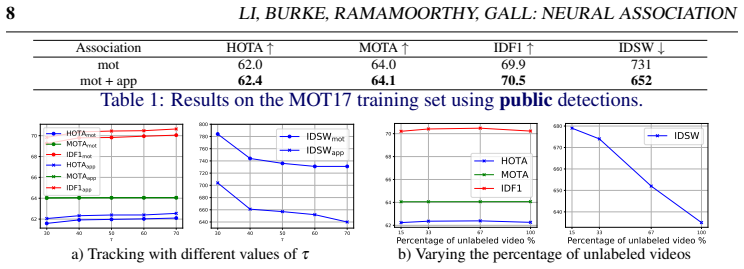
Summary. The paper proposes a self-supervised multi-object tracking method. Detections in short video clips are associated into tracks by an MLP that outputs score matrices, followed by Sinkhorn normalization to obtain doubly stochastic association matrices. These matrices parameterize the observation model of a Kalman filter with a random-walk motion model, and Kalman smoothing is used to form the training objective in Eq. (8), which the paper describes as maximizing the marginal probability of the observations. An appearance model is then fine-tuned against the learned associations via a KL divergence. At inference, the learned motion and appearance affinities are combined in an online Hungarian matching procedure. Experiments on MOT17, MOT20, and BDD100K report state-of-the-art results among self-supervised trackers using public detections, together with ablations over tracking parameters, the amount of unlabeled data, and Sinkhorn iterations.
Significance. If the probabilistic derivation were sound, this would be an attractive contribution: a fast, fully differentiable, self-supervised tracker with a principled objective and strong empirical results. The paper has clear strengths: the pipeline is carefully described, the ablations cover the main hyperparameters, the training time is remarkably short compared with prior self-supervised trackers, and the final evaluation is against external MOT benchmarks. However, the central theoretical claim is not established. The quantity in Eq. (6), and therefore the objective in Eq. (8), is not a marginal likelihood for the observations because the conditioning set includes the observation being scored. Algorithm 1 is also not an expectation-maximization procedure, since no expectation over the latent association variables is taken. The stress-test concern about a self-confirmatory objective lands directly on Eqs. (6) and (8) and is reinforced by the training noise settings in Appendix 6.
major comments (4)
- [§3.1, Eqs. (6) and (8)] The quantity p(zt | z1:T, P1:T) is not a likelihood for zt, because zt is included in the conditioning set. Once z1:T is conditioned on, the conditional distribution of zt is point mass at the observed value; the Gaussian expression in Eq. (6) is a reconstruction density, not a predictive or marginal likelihood. The correct filtering likelihood is p(zt | z1:t-1, P1:t-1) from Eq. (5), evaluated at the observed zt. Maximizing Eq. (8) is therefore not maximum likelihood estimation, and the abstract's and Section 1's claim of maximizing 'the marginal probability of observations' is unsupported.
- [§3.1, Algorithm 1] The procedure is not an EM algorithm. There is no E-step over the latent association variables P_t: the permutation matrices are deterministic functions of the observations through g_theta and Sinkhorn normalization, and the algorithm alternates only between computing smoothed densities and taking gradient steps on theta. An EM treatment would require a complete-data likelihood, a posterior over P_t given the observations, and an expected complete-data log-likelihood (or a variational lower bound). The repeated use of 'expectation maximisation' in the abstract, Section 1, Section 3.1, and the conclusion is not justified by the presented algorithm, which is direct gradient descent on a self-conditioned reconstruction loss.
- [Appendix 6 and Eq. (8)] The training configuration Q=150, R=5 makes the smoother rely heavily on the observations. In that regime, for any locally consistent P_t, the smoothed mean approximately satisfies H_t P_t tilde_mu_t ≈ z_t, so the objective in Eq. (8) is high regardless of whether P_t recovers the true correspondences. Because P_t enters both the observation operator and the state estimate, gradient descent can reduce the loss by making P_t copy current detections into the state rather than by identifying correct associations. The paper reports no experiment that would expose this failure mode: there is no evaluation of association accuracy against known correspondences, no baseline with random or identity P_t, and no comparison of Eq. (8) with the predictive-likelihood objective of Eq. (5). Without such a control, the benchmark gains could be driven by the geometric and appearance features and by the KCF preprocessing rather than by the training objective.
- [Appendix 6, Preprocessing Detections] The training clips are generated with the KCF tracker, which is initialized independently for each detection in the first frame and is used to replace missing detections and to discard detections with low IoU against tracked boxes. KCF is a single-object tracker, so its outputs carry temporal identity information that is injected into the supposedly label-free training signal. This should be disclosed and discussed as a form of pseudo-labeling; the self-supervision claim should be qualified, and an ablation without KCF (for example, using raw detections with varying K per clip) should be reported.
minor comments (6)
- [Eq. (4)] The denominator 'p(zt | z1:t−1P1:t)' is missing a comma; it should read p(zt | z1:t-1, P1:t).
- [Eq. (7) and surrounding text] The paper uses 'permutation matrix' for the output of the Sinkhorn layer, but that output is a doubly stochastic matrix, not a hard permutation. The distinction matters because P_t is defined as a product of soft matrices; the terminology should be made precise.
- [Figure 2 caption] The notation 'Pt:t+2' in the caption is confusing, since P_t is defined per frame in Section 3; please clarify what the subscripts range over.
- [Section 2] The reference to 'Favyen et al.' should be 'Bastani et al.' when referring to citation [1].
- [Table 2] The explanation that UnsupTrack uses CenterNet detections appears in a footnote after the table; it should be moved into the table caption or the main text for clarity.
- [Algorithm 1, line 10] The label 'marginal probability of observations' is inconsistent with Eq. (6), whose conditioning set includes those observations; consider renaming this quantity a 'reconstruction density' if the objective is retained as a heuristic.
Circularity Check
Mild self-referential training objective in Eq. (8); final benchmark evaluation is external, so overall circularity is low.
-
self definitional
[Section 3.1, Eq. (6) and Eq. (8); Algorithm 1, lines 10-12]
"Kalman smoothing [34] is then used to obtain the marginal probability of observations given the inferred states, producing a training objective to maximize this marginal probability using gradient descent. ... argminθ −∑Tt=1logN(zt;HtPt ˜µt,(HtPt)˜Σt(HtPt)T +Rt). (8)"
Eq. (8) maximizes p(zt | z1:T, P1:T), where z1:T already contains zt and P1:T is itself computed from the same detections via gθ and Sinkhorn (Pt = product of Sinkhorn-normalized gθ(zt−1, zt)). The observation whose probability is maximized is therefore also an input that determines the association matrix and the smoothed state used to reconstruct it. With the training noise settings (R=5, Q=150), the filter relies heavily on observations, so HtPt˜µt can match zt for locally consistent but possibly incorrect permutations; the objective rewards reconstruction of the conditioning observation rather than enforcing correct correspondence. Algorithm 1 is direct gradient descent on this self-conditioned density, not an EM step over a held-out predictive marginal.
full rationale
The paper's central training objective in Eq. (8) is self-referential in that the smoothed density p(zt | z1:T, P1:T) conditions on the same observations zt that it scores, and the permutation matrices P1:T are functions of the same detections through gθ and Sinkhorn. This is a genuine methodological weakness, but it is not the kind of circularity that invalidates the claimed benchmark results: the final evaluation is against external MOT17, MOT20, and BDD100K test sets, with no evidence that benchmark metrics were fit as free parameters. The paper does not rely on self-citation for its load-bearing claims; citations to Kalman filtering and Sinkhorn are standard prior art. The self-referential training objective is a heuristic approximation, and the paper lacks an analysis of degenerate solutions, but the circularity score should be low because the empirical claims stand on externally evaluated performance. Hence score 2, reflecting the mild self-referential training signal but no reduction of the final results to the training objective by construction.
Assumptions & free parameters
free parameters (7)
- Training process noise Q =
σ_q = 150
- Training observation noise R =
σ_r = 5
- Track termination threshold τ =
60
- Appearance cost scaling κ and threshold s_min =
κ = 5, s_min = 0.85
- Inference Kalman noise σ_pos and σ_vel =
σ_pos = 1/20, σ_vel = 1/160
- Training clip length T =
10
- Sinkhorn iterations =
20
assumptions (4)
- domain assumption Detections follow a linear Gaussian state-space model with a random-walk motion model (eq. 1).
- domain assumption Each training clip contains exactly K objects visible in all T frames, with missing detections filled by a KCF tracker.
- domain assumption A doubly stochastic Sinkhorn matrix can act as a soft permutation in the observation model.
- ad hoc to paper The network-predicted association P_t can be treated as fixed when computing the smoothed likelihood, even though it is a function of the same observations z_t.
Cite this review
Pith. "Pith review of Learning a Neural Association Network for Self-supervised Multi-Object Tracking." pith.science (2026). https://pith.science/paper/75LZ7UMT
@misc{pith2026241111514,
  author       = {Pith},
  title        = {Pith review of: Learning a Neural Association Network for Self-supervised Multi-Object Tracking},
  year         = {2026},
  howpublished = {\url{https://pith.science/paper/75LZ7UMT}},
  note         = {Machine review of arXiv:2411.11514}
}
read the original abstract
This paper introduces a novel framework to learn data association for multi-object tracking in a self-supervised manner. Fully-supervised learning methods are known to achieve excellent tracking performances, but acquiring identity-level annotations is tedious and time-consuming. Motivated by the fact that in real-world scenarios object motion can be usually represented by a Markov process, we present a novel expectation maximization (EM) algorithm that trains a neural network to associate detections for tracking, without requiring prior knowledge of their temporal correspondences. At the core of our method lies a neural Kalman filter, with an observation model conditioned on associations of detections parameterized by a neural network. Given a batch of frames as input, data associations between detections from adjacent frames are predicted by a neural network followed by a Sinkhorn normalization that determines the assignment probabilities of detections to states. Kalman smoothing is then used to obtain the marginal probability of observations given the inferred states, producing a training objective to maximize this marginal probability using gradient descent. The proposed framework is fully differentiable, allowing the underlying neural model to be trained end-to-end. We evaluate our approach on the challenging MOT17, MOT20, and BDD100K datasets and achieve state-of-the-art results in comparison to self-supervised trackers using public detections.
Figures


Reference graph
Works this paper leans on
-
[1]
Self-supervised multi-object track- ing with cross-input consistency
Favyen Bastani, Songtao He, and Samuel Madden. Self-supervised multi-object track- ing with cross-input consistency. Advances in Neural Information Processing Systems , 34:13695–13706, 2021
work page 2021
-
[2]
Tracking without bells and whistles
Philipp Bergmann, Tim Meinhardt, and Laura Leal-Taixe. Tracking without bells and whistles. In Proceedings of the IEEE/CVF International Conference on Computer Vi- sion, pages 941–951, 2019
work page 2019
-
[3]
Evaluating multiple object tracking perfor- mance: the clear mot metrics
Keni Bernardin and Rainer Stiefelhagen. Evaluating multiple object tracking perfor- mance: the clear mot metrics. EURASIP Journal on Image and Video Processing, 2008: 1–10, 2008
work page 2008
-
[4]
Simple online and realtime tracking
Alex Bewley, Zongyuan Ge, Lionel Ott, Fabio Ramos, and Ben Upcroft. Simple online and realtime tracking. In 2016 IEEE international conference on image processing (ICIP), pages 3464–3468. IEEE, 2016
2016
-
[5]
Pkf: Probabilistic data associ- ation kalman filter for multi-object tracking
Hanwen Cao, George J Pappas, and Nikolay Atanasov. Pkf: Probabilistic data associ- ation kalman filter for multi-object tracking. arXiv preprint arXiv:2411.06378, 2024
arXiv 2024
-
[6]
Unifying short and long-term tracking with graph hierarchies
Orcun Cetintas, Guillem Brasó, and Laura Leal-Taixé. Unifying short and long-term tracking with graph hierarchies. In Proceedings of the IEEE/CVF conference on com- puter vision and pattern recognition , pages 22877–22887, 2023
work page 2023
-
[7]
Cvpr19 tracking and detection challenge: How crowded can it get? arxiv 2019
P Dendorfer, H Rezatofighi, A Milan, J Shi, D Cremers, I Reid, S Roth, K Schindler, and L Leal-Taixe. Cvpr19 tracking and detection challenge: How crowded can it get? arxiv 2019. arXiv preprint arXiv:1906.04567, 2019
arXiv 2019
-
[8]
Ob- ject detection with discriminatively trained part-based models
Pedro F Felzenszwalb, Ross B Girshick, David McAllester, and Deva Ramanan. Ob- ject detection with discriminatively trained part-based models. IEEE transactions on pattern analysis and machine intelligence , 32(9):1627–1645, 2009. 14 LI, BURKE, RAMAMOORTHY , GALL: NEURAL ASSOCIA TION
work page 2009
Show all 44 references
-
[9]
Memotr: Long-term memory-augmented transformer for multi-object tracking
Ruopeng Gao and Limin Wang. Memotr: Long-term memory-augmented transformer for multi-object tracking. In Proceedings of the IEEE/CVF International Conference on Computer Vision, pages 9901–9910, 2023
2023
-
[10]
Deep residual learning for image recognition
Kaiming He, Xiangyu Zhang, Shaoqing Ren, and Jian Sun. Deep residual learning for image recognition. In Proceedings of the IEEE conference on computer vision and pattern recognition, pages 770–778, 2016
2016
-
[11]
High-speed tracking with kernelized correlation filters
João F Henriques, Rui Caseiro, Pedro Martins, and Jorge Batista. High-speed tracking with kernelized correlation filters. IEEE transactions on pattern analysis and machine intelligence, 37(3):583–596, 2014
2014
-
[12]
A two-stage minimum cost multicut approach to self-supervised multiple person tracking
Kalun Ho, Amirhossein Kardoost, Franz-Josef Pfreundt, Janis Keuper, and Margret Ke- uper. A two-stage minimum cost multicut approach to self-supervised multiple person tracking. In Proceedings of the Asian conference on computer vision , 2020
2020
-
[13]
Lifted disjoint paths with application in multiple object tracking
Andrea Hornakova, Roberto Henschel, Bodo Rosenhahn, and Paul Swoboda. Lifted disjoint paths with application in multiple object tracking. In International Conference on Machine Learning, pages 4364–4375. PMLR, 2020
2020
-
[14]
Making higher order mot scalable: An efficient approximate solver for lifted disjoint paths
Andrea Hornakova, Timo Kaiser, Paul Swoboda, Michal Rolinek, Bodo Rosenhahn, and Roberto Henschel. Making higher order mot scalable: An efficient approximate solver for lifted disjoint paths. In Proceedings of the IEEE/CVF International Confer- ence on Computer Vision, pages 6...
2021
-
[15]
Simple unsupervised multi- object tracking
Shyamgopal Karthik, Ameya Prabhu, and Vineet Gandhi. Simple unsupervised multi- object tracking. arXiv preprint arXiv:2006.02609, 2020
2006 arXiv
-
[16]
Multiple hypothesis tracking revisited
Chanho Kim, Fuxin Li, Arridhana Ciptadi, and James M Rehg. Multiple hypothesis tracking revisited. In Proceedings of the IEEE International Conference on Computer Vision, pages 4696–4704, 2015
2015
-
[17]
Multi-object tracking with neural gating using bilinear lstm
Chanho Kim, Fuxin Li, and James M Rehg. Multi-object tracking with neural gating using bilinear lstm. In Proceedings of the European conference on computer vision (ECCV), pages 200–215, 2018
2018
-
[18]
Adam: A method for stochastic optimization
Diederik P Kingma and Jimmy Ba. Adam: A method for stochastic optimization. arXiv preprint arXiv:1412.6980, 2014
2014 arXiv
-
[19]
Deep kalman filters
Rahul G Krishnan, Uri Shalit, and David Sontag. Deep kalman filters. arXiv preprint arXiv:1511.05121, 2015
2015 arXiv
-
[20]
The hungarian method for the assignment problem
Harold W Kuhn. The hungarian method for the assignment problem. Naval research logistics quarterly, 2(1-2):83–97, 1955
1955
-
[21]
Rudolf E. Kálmán. A new approach to linear filtering and prediction problems. Journal of Basic Engineering, 82(Series D):35–45, 1960
1960
-
[22]
Learning of global objective for network flow in multi-object tracking
Shuai Li, Yu Kong, and Hamid Rezatofighi. Learning of global objective for network flow in multi-object tracking. InProceedings of the IEEE/CVF conference on computer vision and pattern recognition, pages 8855–8865, 2022. LI, BURKE, RAMAMOORTHY , GALL: NEURAL ASSOCIA TION 15
2022
-
[23]
Unsupervised multi-object tracking via dynamical vae and variational inference
Xiaoyu Lin. Unsupervised multi-object tracking via dynamical vae and variational inference. In Proceedings of the 30th ACM International Conference on Multimedia , pages 6910–6914, 2022
2022
-
[24]
Uncertainty- aware unsupervised multi-object tracking
Kai Liu, Sheng Jin, Zhihang Fu, Ze Chen, Rongxin Jiang, and Jieping Ye. Uncertainty- aware unsupervised multi-object tracking. In Proceedings of the IEEE/CVF Interna- tional Conference on Computer Vision, pages 9996–10005, 2023
2023
-
[25]
Online multi-object tracking with unsupervised re-identification learning and occlusion estimation
Qiankun Liu, Dongdong Chen, Qi Chu, Lu Yuan, Bin Liu, Lei Zhang, and Nenghai Yu. Online multi-object tracking with unsupervised re-identification learning and occlusion estimation. Neurocomputing, 483:333–347, 2022
2022
-
[26]
Self-supervised multi-object tracking with path consistency
Zijia Lu, Bing Shuai, Yanbei Chen, Zhenlin Xu, and Davide Modolo. Self-supervised multi-object tracking with path consistency. In Proceedings of the IEEE/CVF confer- ence on computer vision and pattern recognition , pages 19016–19026, 2024
2024
-
[27]
Hota: A higher order metric for evaluating multi-object tracking
Jonathon Luiten, Aljosa Osep, Patrick Dendorfer, Philip Torr, Andreas Geiger, Laura Leal-Taixé, and Bastian Leibe. Hota: A higher order metric for evaluating multi-object tracking. International journal of computer vision , 129:548–578, 2021
2021
-
[28]
Trackformer: Multi-object tracking with transformers
Tim Meinhardt, Alexander Kirillov, Laura Leal-Taixe, and Christoph Feichten- hofer. Trackformer: Multi-object tracking with transformers. In Proceedings of the IEEE/CVF conference on computer vision and pattern recognition , pages 8844–8854, 2022
2022
-
[29]
Learning latent permutations with gumbel-sinkhorn networks
Gonzalo Mena, David Belanger, Scott Linderman, and Jasper Snoek. Learning latent permutations with gumbel-sinkhorn networks. International Conference on Learning Representations, 2018
2018
-
[30]
Tracking without label: Unsuper- vised multiple object tracking via contrastive similarity learning
Sha Meng, Dian Shao, Jiacheng Guo, and Shan Gao. Tracking without label: Unsuper- vised multiple object tracking via contrastive similarity learning. In Proceedings of the IEEE/CVF International Conference on Computer Vision , pages 16264–16273, 2023
2023
-
[31]
Learning data as- sociation for multi-object tracking using only coordinates
Mehdi Miah, Guillaume-Alexandre Bilodeau, and Nicolas Saunier. Learning data as- sociation for multi-object tracking using only coordinates. Pattern Recognition, 160: 111169, 2025
2025
-
[32]
Mot16: A benchmark for multi-object tracking
Anton Milan, Laura Leal-Taixé, Ian Reid, Stefan Roth, and Konrad Schindler. Mot16: A benchmark for multi-object tracking. arXiv preprint arXiv:1603.00831, 2016
2016 arXiv
-
[33]
Quasi-dense similarity learning for multiple object tracking
Jiangmiao Pang, Linlu Qiu, Xia Li, Haofeng Chen, Qi Li, Trevor Darrell, and Fisher Yu. Quasi-dense similarity learning for multiple object tracking. In Proceedings of the IEEE/CVF conference on computer vision and pattern recognition, pages 164–173, 2021
2021
-
[34]
Maximum likelihood estimates of linear dynamic systems
Herbert E Rauch, F Tung, and Charlotte T Striebel. Maximum likelihood estimates of linear dynamic systems. AIAA journal, 3(8):1445–1450, 1965
1965
-
[35]
Faster r-cnn: Towards real- time object detection with region proposal networks
Shaoqing Ren, Kaiming He, Ross Girshick, and Jian Sun. Faster r-cnn: Towards real- time object detection with region proposal networks. Advances in Neural Information Processing Systems, 28:91–99, 2015. 16 LI, BURKE, RAMAMOORTHY , GALL: NEURAL ASSOCIA TION
2015
-
[36]
Probabilistic tracklet scoring and inpainting for multiple object track- ing
Fatemeh Saleh, Sadegh Aliakbarian, Hamid Rezatofighi, Mathieu Salzmann, and Stephen Gould. Probabilistic tracklet scoring and inpainting for multiple object track- ing. In Proceedings of the IEEE/CVF conference on computer vision and pattern recog- nition, pages 14329–14339, 2021
2021
-
[37]
A relationship between arbitrary positive matrices and doubly stochastic matrices
Richard Sinkhorn. A relationship between arbitrary positive matrices and doubly stochastic matrices. The annals of mathematical statistics , 35(2):876–879, 1964
1964
-
[38]
Simple online and realtime track- ing with a deep association metric
Nicolai Wojke, Alex Bewley, and Dietrich Paulus. Simple online and realtime track- ing with a deep association metric. In 2017 IEEE international conference on image processing (ICIP), pages 3645–3649. IEEE, 2017
2017
-
[39]
Exploit all the layers: Fast and accurate cnn object detector with scale dependent pooling and cascaded rejection classifiers
Fan Yang, Wongun Choi, and Yuanqing Lin. Exploit all the layers: Fast and accurate cnn object detector with scale dependent pooling and cascaded rejection classifiers. In Proceedings of the IEEE conference on computer vision and pattern recognition, pages 2129–2137, 2016
2016
-
[40]
Hard to track ob- jects with irregular motions and similar appearances? make it easier by buffering the matching space
Fan Yang, Shigeyuki Odashima, Shoichi Masui, and Shan Jiang. Hard to track ob- jects with irregular motions and similar appearances? make it easier by buffering the matching space. In Proceedings of the IEEE/CVF Winter Conference on Applications of Computer Vision, pages 4799–...
2023
-
[41]
Bdd100k: A diverse driving dataset for hetero- geneous multitask learning
Fisher Yu, Haofeng Chen, Xin Wang, Wenqi Xian, Yingying Chen, Fangchen Liu, Vashisht Madhavan, and Trevor Darrell. Bdd100k: A diverse driving dataset for hetero- geneous multitask learning. In Proceedings of the IEEE/CVF conference on computer vision and pattern recognition, p...
2020
-
[42]
Motr: End-to-end multiple-object tracking with transformer
Fangao Zeng, Bin Dong, Yuang Zhang, Tiancai Wang, Xiangyu Zhang, and Yichen Wei. Motr: End-to-end multiple-object tracking with transformer. In European confer- ence on computer vision , pages 659–675. Springer, 2022
2022
-
[43]
Bytetrack: Multi-object tracking by associating every detection box
Yifu Zhang, Peize Sun, Yi Jiang, Dongdong Yu, Fucheng Weng, Zehuan Yuan, Ping Luo, Wenyu Liu, and Xinggang Wang. Bytetrack: Multi-object tracking by associating every detection box. InEuropean conference on computer vision, pages 1–21. Springer, 2022
2022
-
[44]
Motrv2: Bootstrapping end-to-end multi-object tracking by pretrained object detectors
Yuang Zhang, Tiancai Wang, and Xiangyu Zhang. Motrv2: Bootstrapping end-to-end multi-object tracking by pretrained object detectors. In Proceedings of the IEEE/CVF conference on computer vision and pattern recognition , pages 22056–22065, 2023
2023
Reviewed August 12, 2026 · model on record in the stance chip above.
Discussion (0). Continue with ORCID to comment.