REVIEW 2 major objections 4 minor 3 cited by
High-fidelity universal gates in the $^{171}$Yb ground state nuclear spin qubit
T0 review · 2 major / 4 minor · reviewed 2026-08-12 · deepseek-v4-flash
Pith's one-line read The paper reports a universal gate set on the 171Yb ground-state nuclear spin qubit, with a two-qubit CZ fidelity of 99.72(3)% (post-selected) measured by two-qubit Clifford randomized benchmarking.
desk verdict Solid experimental milestone with a useful calibration tool, but the headline CZ fidelity may be biased upward by a small normalization error in the 1Q-error subtraction. read the letter →
The pith
A machine-rendered reading of the paper's core claim, the machinery that carries it, and where it could break.
The reading
What carries the argument
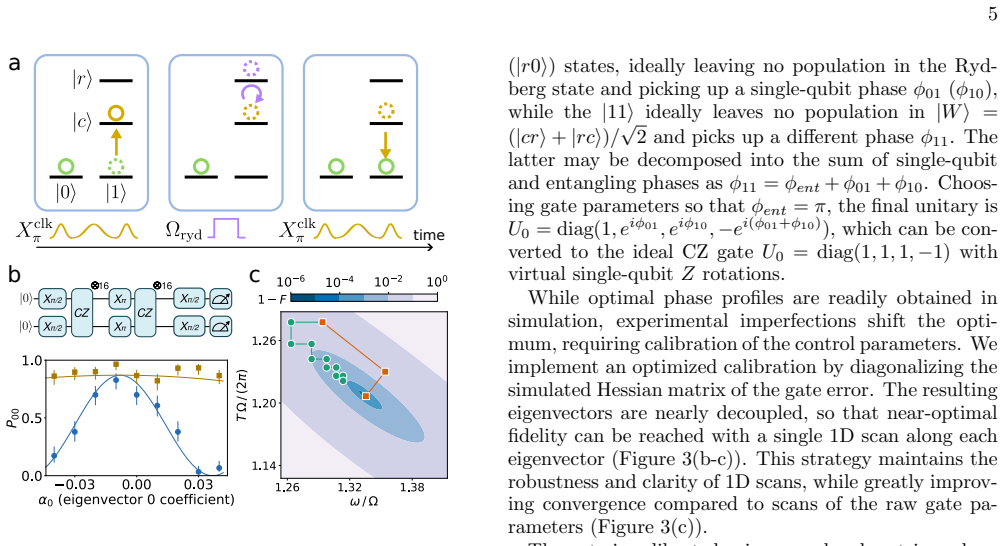
The load-bearing mechanism is the sequential state-selective CZ gate built from three steps: a Blackman-shaped composite clock pulse $Y_{\pi/2}-X_{\pi}-Y_{\pi/2}$ shelves $|1\rangle$ into the long-lived clock state $|c\rangle$; a global UV pulse drives the clock-to-Rydberg transition with a sinusoidal phase profile $\phi(t) = A\cos(\omega t - \phi) + \Delta t$ that approximates a time-optimal gate, so that $|01\rangle$ and $|10\rangle$ return to the clock manifold while $|11\rangle$ acquires the entangling phase $\pi$ through Rydberg blockade; and a second composite pulse unshelves. The gate's five control parameters are calibrated by a new method: computing the Hessian of the gate infidelity from simulation, diagonalizing it, and scanning once along each nearly decoupled eigenvector, which reaches the optimum in a fixed number of one-dimensional scans. Fidelity extraction relies on two-qubit Clifford randomized benchmarking with individual addressing, which samples the full two-qubit Hilbert space; the per-CZ fidelity is obtained by subtracting the known single-qubit error using the average native-gate counts of 1.51 CZ and 4.36 $X_{\pi/2}$ gates per Clifford under a depolarizing error model.
What would settle it
Run a noise-characterization experiment that does not assume depolarizing errors, such as gate-set tomography of the CZ gate, or interleaved randomized benchmarking in which the random Clifford circuits are recompiled to use different ratios of CZ to single-qubit gates at fixed Clifford depth. If the inferred per-CZ fidelity changes with the circuit composition or shows a coherent component, the depolarizing assumption behind the headline number is wrong. A less expensive check already sits in the paper's data: the simulated error budget predicts 0.375% infidelity per CZ gate while the pre-selected Clifford RB measurement gives 0.60(3)%, so an experiment that locates the missing roughly 0.2% (for example, by testing whether pair loss during the gate exceeds the single-atom Rydberg lifetime prediction) would either close the budget or invalidate the error model.
Extended reading notes
Core claim
The paper's central claim is that the $^{171}$Yb ground-state nuclear spin qubit now supports a universal, individually controlled gate set with fidelity high enough for fault-tolerant designs: a CZ gate measured at 99.72(3)% with post-selection and 99.40(3)% without, extracted from two-qubit Clifford randomized benchmarking circuits that run up to roughly 150 Clifford gates, or more than 200 CZ gates, on one or two atom pairs simultaneously, together with a single-qubit Clifford RB fidelity of 99.963(2)%. The entangling gate uses a sequential excitation scheme: a shaped composite clock pulse shelves $|1\rangle$ into the metastable clock state $|c\rangle$, a global 302 nm pulse couples the clock state to a Rydberg state with a phase profile chosen so that the $|11\rangle$ component picks up a $\pi$ entangling phase through Rydberg blockade, and a second composite pulse unshelves. A symmetric-subspace benchmark (CZ-GERB) that echoes away single-qubit phases measures 99.84(6)% with post-selection, and the paper attributes most of the gap between the two metrics to quasi-static clock-laser detuning, which appears as single-qubit phase error. The authors state that combining these gates with continuous loading, mid-circuit measurement, and erasure conversion is expected to enable complex error-corrected circuits.
Load-bearing premise
The headline 99.72% CZ number assumes that the noise in the benchmarking circuits is depolarizing and gate-independent, so that the per-gate error can be recovered by multiplying average native-gate counts; if the real errors are coherent, biased toward some states, or correlated between gates, the extracted fidelity could be off.
Editorial extensions
If this is right
- With post-selected CZ fidelity of 99.72(3)% and single-qubit fidelity of 99.963(2)%, the demonstrated gates clear the commonly cited 99% surface-code threshold, so the remaining work toward error correction on this platform is integration (mid-circuit measurement, erasure conversion, rearrangement) rather than raising gate quality.
- Because ground-state nuclear spin qubits have near-infinite lifetime and low sensitivity to trap light shifts, the same gate set should transfer to large rearranged arrays with flexible connectivity, which the paper argues enables efficient error-correction encodings.
- The dominant identified error sources, clock-laser detuning drift and phase noise, produce mostly detectable leakage and loss rather than silent in-subspace errors, so state-selective readout can convert the main physical errors into erasure events that error correction handles more cheaply.
- The Hessian-eigenvector calibration method reduces multi-parameter gate optimization to a fixed number of decoupled one-dimensional scans, a recipe the paper argues applies to any entangling gate with several interdependent control parameters.
Reading between the lines
- A testable consequence of the paper's own numbers: the simulated error budget predicts 0.375% infidelity per CZ gate while pre-selected Clifford RB measures 0.60(3)%, so roughly 0.2% of the error is unaccounted for, and locating it (the authors suspect Rydberg pair-state dynamics and Doppler-sensitive motion) is the most direct route to sub-0.1% two-qubit gates.
- Because the gap between the two fidelity metrics is attributed to quasi-static clock-laser detuning that appears as single-qubit phase error, active frequency stabilization or echo-based phase correction could plausibly push the practical two-qubit fidelity closer to the 99.84(6)% GERB number without any hardware change.
- Since leakage into the clock state and atom loss are each measured per gate (about 0.12-0.14% per CZ), the platform is already set up for erasure-biased error correction; a natural next experiment is a small erasure-checking code whose logical error rate tracks the detected-leakage budget, using the mid-circuit measurement and state-selective readout the paper cites as existing.
Signed reviews
Editorial analysis
A structured set of objections, weighed in public.
Referee Report
Summary. This paper reports a universal gate set on the 171Yb ground-state nuclear-spin qubit in arrays of optical tweezers. The central results are a single-qubit Clifford randomized benchmarking fidelity of 99.963(2)% per Clifford gate and a two-qubit CZ fidelity of 99.72(3)% with post-selection and 99.40(3)% without post-selection, extracted from two-qubit Clifford RB using average native-gate counts of 1.51 CZ gates and 4.36 Xπ/2 pulses per Clifford. A symmetric-subspace CZ-GERB measurement gives 99.84(6)% (99.56(5)%) with (without) post-selection. The paper also introduces an eigenvector-based multi-parameter calibration of the Rydberg gate and provides a detailed error budget with separate accounting of leakage and loss.
Significance. If correct, the results are significant: the ground-state nuclear-spin qubit combines long coherence and insensitivity to trap light shifts, and the reported CZ fidelities exceed commonly cited fault-tolerance thresholds for the surface code. The paper is unusually transparent on several points: it reports pre-selected and post-selected values side by side, gives separate leakage and loss measurements, and explicitly acknowledges where the simulated error budget does not reproduce measured infidelities. The Hessian-eigenvector calibration strategy is a useful methodological contribution that goes beyond the usual brute-force multi-parameter scans. The manuscript does not ship machine-checked proofs or an independent code repository, but it does cite the Qiskit Experiments package used for circuit generation.
major comments (2)
- [Appendix F, Sec. IV.C, Fig. 8] The extraction of the per-CZ error from the 2Q CRB decay subtracts the 1Q CRB error multiplied by 4.36, where 4.36 is the average number of native Xπ/2 pulses per 2Q Clifford. The 1Q CRB error quoted in Sec. III is the error per 1Q Clifford gate, not per native Xπ/2 pulse. If the average number of Xπ/2 pulses per 1Q Clifford is n_x > 1, this subtraction overestimates the single-qubit contribution by a factor 1 - 1/n_x, biasing the headline CZ fidelity upward. For n_x in the range 1.25-1.5, the bias is roughly 0.01-0.03 percentage points, which is comparable to or larger than the quoted 0.03% statistical uncertainty. The manuscript does not report n_x or the decomposition counts for the 1Q Clifford circuits, and the consistency statement in Appendix B (0.32(2)% per eight Xπ/2 pulses versus eight times the 1Q CRB error) appears to assume n_x = 1. Please report n_x, justify that the per-Clifford error equals the per-pulse error for the compilation actually used, or correct the extraction accordingly.
- [Sec. IV.C and Appendix G] The per-CZ fidelities are obtained under a depolarizing, gate-independent error model, and only statistical uncertainties are quoted. The systematic uncertainty from model dependence is not quantified, although the paper itself provides a useful cross-check: the CZ-GERB estimate and the 2Q CRB estimate differ by more than the statistical errors. The authors attribute much of this difference to single-qubit phase errors, but a quantitative decomposition is not given. Since the headline 99.72(3)% includes a third decimal place, the authors should state the model-dependent systematic uncertainty explicitly, for example by treating the spread between CRB- and GERB-based estimates as a partial bound and by reporting the sensitivity of the extracted CZ error to plausible non-depolarizing noise components.
minor comments (4)
- [Appendix B] The sentence 'an additional readout step preceded by an clock repumping state' contains a grammar error; it should read 'preceded by a clock repumping step'.
- [Figure 3(c)] The figure shows simulated optimization trajectories, but the caption does not explicitly state that the green and orange curves are simulation results rather than experimental data; this should be clarified.
- [Appendix F, Eq. (F1)] The conversion 1 - F = (1 - p)(1 - b) is stated without derivation; a brief derivation or a reference would help readers understand how the fixed baseline b enters the reported infidelities.
- [Section IV.C] The paper does not report the number of random circuits and repetitions for the CZ-GERB depth scan in the same detail as for the 2Q CRB scan; Appendix F mentions 10 circuits and about 20 repetitions, but the main text could state this more explicitly.
Circularity Check
No significant circularity: headline fidelities are measured against external Clifford randomized benchmarking standards, and the error budget is a post-hoc model that does not feed the reported fidelities.
full rationale
The paper's central claims are the single-qubit CRB fidelity of 99.963(2)% and the two-qubit CZ fidelity extracted from two-qubit Clifford RB as 99.72(3)% (with post-selection) and 99.40(3)% (without). These numbers come from randomized benchmarking against ideal Clifford operations, which is an external standard independent of the paper's own model; the decay fits and the depolarizing-model decomposition are standard practice and do not define the target fidelity in terms of itself. The Appendix G error budget is a post-hoc accounting exercise: its simulated 0.375% infidelity is compared with, not used to produce, the experimental RB numbers. Self-citations to Refs. [1, 7, 10, 26] document the apparatus and prior system capabilities; they are not invoked to justify the gate fidelities or to forbid alternative interpretations. The only notable concern is in Appendix F, where the single-qubit error subtraction multiplies the 'known 1Q CRB error' by the average number of native Xπ/2 gates per 2Q Clifford; since the CRB error is quoted per 1Q Clifford gate, a units mismatch is possible if one Clifford compiles to more than one Xπ/2 pulse. This is a correctness/normalization issue that could bias the headline number, but it is not circular: both the 1Q CRB error and the 2Q CRB decay are independently measured inputs, and the per-CZ fidelity is not equal to any of those inputs by construction. The paper also honestly declines to include poorly characterized errors in the budget ('We decline to include errors in the error budget which are not experimentally well-characterized'), which is a transparency statement rather than a circular step. Overall, the derivation chain is self-contained against external benchmarking standards, and no load-bearing step reduces to its own inputs.
Assumptions & free parameters
free parameters (3)
- Rydberg gate phase parameters (A, omega, phi, T, Delta) =
Calibrated per session via Hessian-eigenvector scans
- Single-qubit Xpi/2 pulse area and differential light shift =
Tuned via RPE-based calibrations
- Clock pulse area and static detuning width =
Detuning drift width 33 Hz used in error budget
assumptions (4)
- domain assumption Rydberg blockade creates a conditional phase when two atoms are excited to the Rydberg state
- domain assumption Randomized benchmarking extracts average gate fidelity under a depolarizing, gate-independent error model
- domain assumption The clock shelving transition and UV excitation are state-selective for the qubit encoding
- domain assumption Errors from single-qubit gates subtract linearly from two-qubit benchmarks
Cite this review
Pith. "Pith review of High-fidelity universal gates in the $^{171}$Yb ground state nuclear spin qubit." pith.science (2026). https://pith.science/paper/VYAYPAVL
@misc{pith2026241111708,
  author       = {Pith},
  title        = {Pith review of: High-fidelity universal gates in the $^171$Yb ground state nuclear spin qubit},
  year         = {2026},
  howpublished = {\url{https://pith.science/paper/VYAYPAVL}},
  note         = {Machine review of arXiv:2411.11708}
}
abstract
Arrays of optically trapped neutral atoms are a promising architecture for the realization of quantum computers. In order to run increasingly complex algorithms, it is advantageous to demonstrate high-fidelity and flexible gates between long-lived and highly coherent qubit states. In this work, we demonstrate a universal high-fidelity gate-set with individually controlled and parallel application of single-qubit gates and two-qubit gates operating on the ground-state nuclear spin qubit in arrays of tweezer-trapped $^{171}$Yb atoms. We utilize the long lifetime, flexible control, and high physical fidelity of our system to characterize native gates using single and two-qubit Clifford and symmetric subspace randomized benchmarking circuits with more than 200 CZ gates applied to one or two pairs of atoms. We measure our two-qubit entangling gate fidelity to be 99.72(3)% (99.40(3)%) with (without) post-selection. In addition, we introduce a simple and optimized method for calibration of multi-parameter quantum gates. These results represent important milestones towards executing complex and general quantum computation with neutral atoms.
Figures


Figures from the paper (6 more)


Forward citations
Cited by 3 Pith papers
-
Universal gates for a metastable qubit in strontium-88
A universal gate set with erasure conversion is demonstrated on the metastable fine-structure qubit in strontium-88, along with a state-resolved detection scheme.
-
A Universal Circuit Set Using the $S_3$ Quantum Double
A complete circuit-level blueprint for universal quantum computation using the D(S3) quantum double, with anyon interferometry and a concatenated local error-correcting code.
-
Strategic Plan for Neutral Atom Quantum Computation
If qubit-count growth (~1.8x/yr) and gate-error reduction (~0.62x/yr) continue, neutral-atom quantum computers could reach practical quantum advantage within a decade, this roadmap projects.
Reference graph
Works this paper leans on
- [1]
-
[2]
G. Pichard, D. Lim, E. Bloch, J. Vaneecloo, L. Boura- chot, G.-J. Both, G. M´ eriaux, S. Dutartre, R. Hostein, J. Paris, B. Ximenez, A. Signoles, A. Browaeys, T. La- haye, and D. Dreon, Rearrangement of individual atoms in a 2000-site optical-tweezer array at cryogenic temper- atures, Phys. Rev. Appl. 22, 024073 (2024)
work page 2024
-
[3]
H. J. Manetsch, G. Nomura, E. Bataille, K. H. Leung, X. Lv, and M. Endres, A tweezer array with 6100 highly coherent atomic qubits (2024), arXiv:2403.12021
arXiv 2024
-
[4]
Singh, C
K. Singh, C. Bradley, S. Anand, V. Ramesh, R. White, and H. Bernien, Mid-circuit correction of correlated phase errors using an array of spectator qubits, Science 380, 1265 (2023)
2023
-
[5]
E. Deist, Y.-H. Lu, J. Ho, M. K. Pasha, J. Zeiher, Z. Yan, and D. M. Stamper-Kurn, Mid-circuit cavity measure- ment in a neutral atom array, Phys. Rev. Lett. 129, 203602 (2022)
work page 2022
-
[6]
T. M. Graham, L. Phuttitarn, R. Chinnarasu, Y. Song, C. Poole, K. Jooya, J. Scott, A. Scott, P. Eichler, and M. Saffman, Mid-circuit measurements on a single- species neutral alkali atom quantum processor, Phys. Rev. X 13, 041051 (2023)
work page 2023
-
[7]
M. A. Norcia, W. B. Cairncross, H. Kim, et al., Mid- circuit qubit measurement and rearrangement in a 171Yb atomic array, Phys. Rev. X 13, 041034 (2023)
work page 2023
-
[8]
J. W. Lis, A. Senoo, W. F. McGrew, F. R¨ onchen, A. Jenkins, and A. M. Kaufman, Mid-circuit operations using the omg architecture in neutral atom arrays, Phys. Rev. X 13, 041035 (2023)
work page 2023
Show all 59 references
-
[9]
Bluvstein, S
D. Bluvstein, S. J. Evered, A. A. Geim, S. H. Li, H. Zhou, T. Manovitz, et al., Logical quantum processor based on reconfigurable atom arrays, Nature 626, 58 (2024)
2024
-
[10]
Barnes, P
K. Barnes, P. Battaglino, B. J. Bloom, K. Cassella, R. Coxe, N. Crisosto, J. P. King, S. S. Kondov, K. Kotru, S. C. Larsen, et al., Assembly and coherent control of a register of nuclear spin qubits, Nature Communications 13, 2779 (2022)
2022
-
[11]
A. M. Stephens, Fault-tolerant thresholds for quantum error correction with the surface code, Phys. Rev. A 89, 022321 (2014)
2014
-
[12]
Levine, A
H. Levine, A. Keesling, G. Semeghini, A. Omran, T. T. Wang, S. Ebadi, H. Bernien, M. Greiner, V. Vuleti´ c, H. Pichler, and M. D. Lukin, Parallel implementation of high-fidelity multiqubit gates with neutral atoms, Phys. Rev. Lett. 123, 170503 (2019)
2019
-
[13]
S. J. Evered, D. Bluvstein, M. Kalinowski, S. Ebadi, T. Manovitz, H. Zhou, S. H. Li, A. A. Geim, T. T. Wang, N. Maskara, H. Levine, G. Semeghini, M. Greiner, V. Vuleti´ c, and M. D. Lukin, High-fidelity parallel entan- gling gates on a neutral-atom quantum computer, Nature 622...
2023
-
[14]
I. S. Madjarov, J. P. Covey, A. L. Shaw, J. Choi, A. Kale, 14 A. Cooper, H. Pichler, V. Schkolnik, J. R. Williams, and M. Endres, High-fidelity entanglement and detection of alkaline-earth Rydberg atoms, Nature Physics 16, 857 (2020)
2020
-
[15]
Peper, Y
M. Peper, Y. Li, D. Y. Knapp, M. Bileska, S. Ma, G. Liu, P. Peng, B. Zhang, S. P. Horvath, A. P. Burgers, and J. D. Thompson, Spectroscopy and modeling of 171Yb Rydberg states for high-fidelity two-qubit gates (2024), arXiv:2406.01482
2024 arXiv
-
[16]
Jenkins, J
A. Jenkins, J. W. Lis, A. Senoo, W. F. McGrew, and A. M. Kaufman, Ytterbium nuclear-spin qubits in an op- tical tweezer array, Phys. Rev. X 12, 021027 (2022)
2022
-
[17]
Q. Xu, J. P. Bonilla Ataides, C. A. Pattison, N. Raveen- dran, D. Bluvstein, J. Wurtz, B. Vasi´ c, M. D. Lukin, L. Jiang, and H. Zhou, Constant-overhead fault-tolerant quantum computation with reconfigurable atom arrays, Nature Physics , 1 (2024)
2024
-
[18]
Y. Hong, M. Marinelli, A. M. Kaufman, and A. Lucas, Long-range-enhanced surface codes, Phys. Rev. A 110, 022607 (2024)
2024
-
[19]
J. I. Cirac and P. Zoller, Quantum computations with cold trapped ions, Phys. Rev. Lett. 74, 4091 (1995)
1995
-
[20]
Sørensen and K
A. Sørensen and K. Mølmer, Quantum computation with ions in thermal motion, Phys. Rev. Lett. 82, 1971 (1999)
1999
-
[21]
Urban, T
E. Urban, T. A. Johnson, T. Henage, L. Isenhower, D. D. Yavuz, T. G. Walker, and M. Saffman, Observation of Rydberg blockade between two atoms, Nature Physics 5, 110 (2009)
2009
-
[22]
C. H. Baldwin, B. J. Bjork, J. P. Gaebler, D. Hayes, and D. Stack, Subspace benchmarking high-fidelity en- tangling operations with trapped ions, Phys. Rev. Res. 2, 013317 (2020)
2020
-
[23]
R. B.-S. Tsai, X. Sun, A. L. Shaw, R. Finkelstein, and M. Endres, Benchmarking and linear response modeling of high-fidelity Rydberg gates (2024), arXiv:2407.20184
2024 arXiv
-
[24]
Emerson, R
J. Emerson, R. Alicki, and K. ˙Zyczkowski, Scalable noise estimation with random unitary operators, Journal of Optics B: Quantum and Semiclassical Optics 7, S347 (2005)
2005
-
[25]
Dankert, R
C. Dankert, R. Cleve, J. Emerson, and E. Livine, Exact and approximate unitary 2-designs and their application to fidelity estimation, Phys. Rev. A 80, 012304 (2009)
2009
-
[26]
B. W. Reichardt, A. Paetznick, D. Aasen, I. Basov, J. M. Bello-Rivas, et al., Logical computation demonstrated with a neutral atom quantum processor, arXiv preprint arXiv:2411.11822 (2024)
2024 arXiv
-
[27]
T. O. H¨ ohn, E. Staub, G. Brochier, N. Darkwah Op- pong, and M. Aidelsburger, State-dependent potentials for the 1S0 and 3P0 clock states of neutral ytterbium atoms, Phys. Rev. A 108, 053325 (2023)
2023
-
[28]
D. C. McKay, C. J. Wood, S. Sheldon, J. M. Chow, and J. M. Gambetta, Efficient Z gates for quantum comput- ing, Phys. Rev. A 96, 022330 (2017)
2017
-
[29]
J. P. Gaebler, A. M. Meier, T. R. Tan, R. Bowler, Y. Lin, D. Hanneke, J. D. Jost, J. P. Home, E. Knill, D. Leibfried, and D. J. Wineland, Randomized benchmarking of mul- tiqubit gates, Phys. Rev. Lett. 108, 260503 (2012)
2012
-
[30]
Magesan, J
E. Magesan, J. M. Gambetta, and J. Emerson, Scalable and robust randomized benchmarking of quantum pro- cesses, Phys. Rev. Lett. 106, 180504 (2011)
2011
-
[31]
Magesan, J
E. Magesan, J. M. Gambetta, and J. Emerson, Charac- terizing quantum gates via randomized benchmarking, Phys. Rev. A 85, 042311 (2012)
2012
-
[32]
Kimmel, G
S. Kimmel, G. H. Low, and T. J. Yoder, Robust calibra- tion of a universal single-qubit gate set via robust phase estimation, Phys. Rev. A 92, 062315 (2015)
2015
-
[33]
T. Wilk, A. Ga¨ etan, C. Evellin, J. Wolters, Y. Mirosh- nychenko, P. Grangier, and A. Browaeys, Entanglement of two individual neutral atoms using Rydberg blockade, Phys. Rev. Lett. 104, 010502 (2010)
2010
-
[34]
T. M. Graham, M. Kwon, B. Grinkemeyer, Z. Marra, X. Jiang, M. T. Lichtman, Y. Sun, M. Ebert, and M. Saffman, Rydberg-mediated entanglement in a two- dimensional neutral atom qubit array, Phys. Rev. Lett. 123, 230501 (2019)
2019
-
[35]
S. Ma, A. P. Burgers, G. Liu, J. Wilson, B. Zhang, and J. D. Thompson, Universal gate operations on nuclear spin qubits in an optical tweezer array of 171Yb atoms, Phys. Rev. X 12, 021028 (2022)
2022
-
[36]
Jaksch, J
D. Jaksch, J. I. Cirac, P. Zoller, S. L. Rolston, R. Cˆ ot´ e, and M. D. Lukin, Fast quantum gates for neutral atoms, Phys. Rev. Lett. 85, 2208 (2000)
2000
-
[37]
D. J. Wineland and W. M. Itano, Laser cooling of atoms, Phys. Rev. A 20, 1521 (1979)
1979
-
[38]
Finkelstein, R
R. Finkelstein, R. B.-S. Tsai, X. Sun, P. Scholl, S. Di- rekci, T. Gefen, J. Choi, A. L. Shaw, and M. Endres, Universal quantum operations and ancilla-based read-out for tweezer clocks, Nature 634, 321 (2024)
2024
-
[39]
H. Ball, W. D. Oliver, and M. J. Biercuk, The role of master clock stability in quantum information process- ing, npj Quantum Information 2, 1 (2016)
2016
-
[40]
Jiang, J
X. Jiang, J. Scott, M. Friesen, and M. Saffman, Sensitiv- ity of quantum gate fidelity to laser phase and intensity noise, Phys. Rev. A 107, 042611 (2023)
2023
-
[41]
D¨ orscher, R
S. D¨ orscher, R. Schwarz, A. Al-Masoudi, S. Falke, U. Sterr, and C. Lisdat, Lattice-induced photon scatter- ing in an optical lattice clock, Phys. Rev. A 97, 063419 (2018)
2018
-
[42]
Wineland, C
D. Wineland, C. Monroe, W. Itano, D. Leibfried, B. King, and D. Meekhof, Experimental issues in coher- ent quantum-state manipulation of trapped atomic ions, Journal of Research of the National Institute of Stan- dards and Technology 103, 259 (1998)
1998
-
[43]
M. H. Levitt, Composite pulses, Progress in Nuclear Magnetic Resonance Spectroscopy 18, 61 (1986)
1986
-
[44]
M. H. Levitt and R. Freeman, NMR population inversion using a composite pulse, Journal of Magnetic Resonance 33, 473 (1979)
1979
-
[45]
K´ ef´ elian, H
F. K´ ef´ elian, H. Jiang, P. Lemonde, and G. Santarelli, Ultralow-frequency-noise stabilization of a laser by lock- ing to an optical fiber-delay line, Opt. Lett. 34, 914 (2009)
2009
-
[46]
Saffman, Quantum computing with atomic qubits and Rydberg interactions: progress and challenges, Journal of Physics B: Atomic, Molecular and Optical Physics 49, 202001 (2016)
M. Saffman, Quantum computing with atomic qubits and Rydberg interactions: progress and challenges, Journal of Physics B: Atomic, Molecular and Optical Physics 49, 202001 (2016)
2016
-
[47]
J. T. Wilson, S. Saskin, Y. Meng, S. Ma, R. Dilip, A. P. Burgers, and J. D. Thompson, Trapping Alkaline Earth Rydberg atoms optical tweezer arrays, Phys. Rev. Lett. 128, 033201 (2022)
2022
-
[48]
Jandura and G
S. Jandura and G. Pupillo, Time-optimal two-and three- qubit gates for Rydberg atoms, Quantum 6, 712 (2022)
2022
-
[49]
Gottesman, An Introduction to Quantum Error Correction and Fault-Tolerant Quantum Computation (2009), arXiv:0904.2557
D. Gottesman, An Introduction to Quantum Error Correction and Fault-Tolerant Quantum Computation (2009), arXiv:0904.2557
2009 arXiv
-
[50]
J. P. Gaebler, A. M. Meier, T. R. Tan, R. Bowler, Y. Lin, D. Hanneke, J. D. Jost, J. P. Home, E. Knill, 15 D. Leibfried, and D. J. Wineland, Randomized Bench- marking of Multiqubit Gates, Physical Review Letters 108, 260503 (2012)
2012
-
[51]
S. Ma, G. Liu, P. Peng, B. Zhang, S. Jandura, J. Claes, A. P. Burgers, G. Pupillo, S. Puri, and J. D. Thompson, High-fidelity gates and mid-circuit erasure conversion in an atomic qubit, Nature 622, 279 (2023)
2023
-
[52]
Javadi-Abhari, M
A. Javadi-Abhari, M. Treinish, K. Krsulich, C. J. Wood, J. Lishman, J. Gacon, S. Martiel, P. D. Nation, L. S. Bishop, A. W. Cross, et al., Quantum computing with qiskit, arXiv preprint arXiv:2405.08810 (2024)
2024 arXiv
-
[53]
Bluvstein, H
D. Bluvstein, H. Levine, G. Semeghini, T. T. Wang, S. Ebadi, M. Kalinowski, A. Keesling, N. Maskara, H. Pichler, M. Greiner, et al., A quantum processor based on coherent transport of entangled atom arrays, Nature 604, 451 (2022)
2022
-
[54]
Sahay, J
K. Sahay, J. Jin, J. Claes, J. D. Thompson, and S. Puri, High-threshold codes for neutral-atom qubits with biased erasure errors, Phys. Rev. X 13, 041013 (2023)
2023
-
[55]
L. Li, W. Huie, N. Chen, B. DeMarco, and J. P. Covey, Active cancellation of servo-induced noise on stabilized lasers via feedforward, Phys. Rev. Appl. 18, 064005 (2022)
2022
-
[56]
Hummel, S
F. Hummel, S. Weber, J. M¨ ogerle, H. Menke, J. King, B. Bloom, S. Hofferberth, and M. Li, Engineer- ing Rydberg-pair interactions in divalent atoms with hyperfine-split ionization thresholds, Phys. Rev. A 110, 042821 (2024)
2024
-
[57]
Bomb ´ ın, Single-shot fault-tolerant quantum error cor- rection, Phys
H. Bomb ´ ın, Single-shot fault-tolerant quantum error cor- rection, Phys. Rev. X 5, 031043 (2015)
2015
-
[58]
Nogrette, H
F. Nogrette, H. Labuhn, S. Ravets, D. Barredo, L. B´ eguin, A. Vernier, T. Lahaye, and A. Browaeys, Single-atom trapping in holographic 2D arrays of micro- traps with arbitrary geometries, Phys. Rev. X 4, 021034 (2014)
2014
-
[59]
L.-S. Ma, P. Jungner, J. Ye, and J. L. Hall, Delivering the same optical frequency at two places: accurate can- cellation of phase noise introduced by an optical fiber or other time-varying path, Opt. Lett. 19, 1777 (1994)
1994
Reviewed August 12, 2026 · model on record in the stance chip above.
Discussion (0). Continue with ORCID to comment.