REVIEW 3 major objections 5 minor 52 references
Design And Optimization Of Multi-rendezvous Manoeuvres Based On Reinforcement Learning And Convex Optimization
T0 review · 3 major / 5 minor · reviewed 2026-08-12 · deepseek-v4-flash
Pith's one-line read A three-stage optimizer pairs learned routing with convex refinement to plan multi-rendezvous missions near-optimally.
desk verdict Solid engineering framework, but the near-optimality claim rests on an unvalidated tour-level cost model. read the letter →
The pith
A machine-rendered reading of the paper's core claim, the machinery that carries it, and where it could break.
The reading
What carries the argument
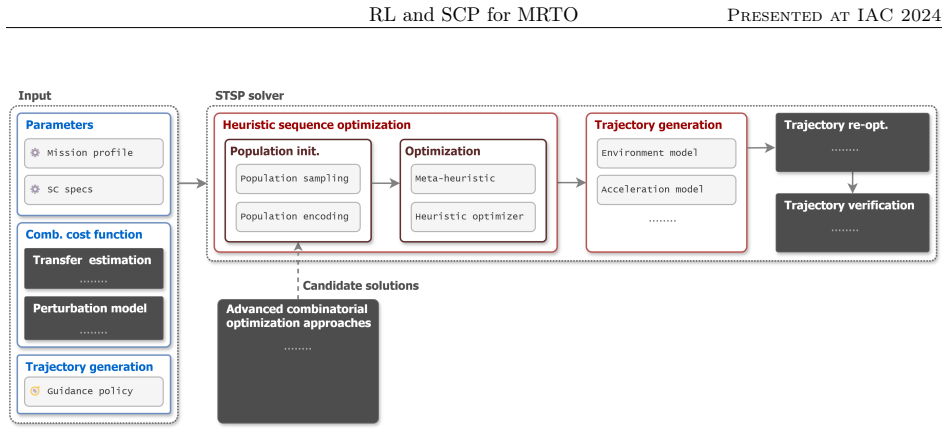
The load-bearing machinery is a two-level cost pipeline. At the combinatorial level, tours are scored by an analytical estimator that sequences Multiple Hohmann Transfers and Nodal Inclination Changes, choosing the node order to perform the inclination change at the highest semi-major axis, and propagates the J2 secular drift of RAAN and argument of perigee. This estimator produces the fuel, delta-V, and time-of-flight values that the heuristic search and the reinforcement learning policy optimize. At the trajectory level, a sequential convex programming solver takes each combinatorial arc as a warm start, normalizes state and control variables, and enforces thrust-magnitude and duty-cycle constraints while minimizing terminal state error. The third element is the RL attention policy itself: a graph-attention encoder and pointer decoder trained with policy-gradient methods, whose samples and beam-search trajectories seed the combinatorial search.
What would settle it
Generate a random sample of tours, compute each tour's cost with the analytical estimator and then with the high-fidelity SCP or functional simulator, and compare the rankings: if the analytical order disagrees with the refined order on a meaningful fraction of tour pairs, the RL training signal and heuristic search inherit a biased cost model and the reported gaps do not reflect true mission performance.
Extended reading notes
Core claim
The central claim is that reinforcement learning for combinatorial optimization transfers successfully to spacecraft routing, and that a decomposition-based framework can exploit it. The framework combines heuristic combinatorial optimization over target sequences, a fast analytical transfer-cost estimator based on sequential Multiple Hohmann Transfer and Nodal Inclination Change maneuvers under J2 secular drift, and a sequential convex programming layer that converts each analytical transfer into a feasible, thrust-constrained trajectory in modified equinoctial elements. On the OSSIE mission case study, the paper reports that the learned policy with beam search reaches a mean 3.02% optimality gap relative to near-optimal heuristic solutions, outperforms the four handcrafted heuristics, and that the convex refinement layer meets orbit injection accuracy requirements while keeping delta-V close to the combinatorial estimate. The paper also reports a Monte Carlo campaign of 5000 mission scenarios showing the framework can map the mission design envelope and identify the main cost drivers.
Load-bearing premise
The load-bearing premise is that the analytical transfer-cost model, which uses J2-only secular propagation and idealized MHT-NIC maneuvers, ranks candidate tours in the same order as the true high-fidelity dynamics would, and this ranking is never validated tour-by-tour.
Editorial extensions
If this is right
- Multi-rendezvous missions with a dozen or more targets can be optimized in a modular pipeline, so new target sets or propulsion limits require swapping modules rather than reformulating the whole problem.
- An RL-trained routing policy can serve as a learned heuristic that accelerates and improves population-based search on this space traveling salesman problem variant, with beam search giving the best final solutions.
- The same framework can be run in a Monte Carlo loop to map the feasible mission-design envelope, identifying which mission parameters drive cost—here, number of deployment bundles and inclination spread.
- SCP re-optimization can turn idealized impulsive transfer sequences into feasible trajectories under actuator on/off constraints, and high-fidelity simulation confirms that the optimized trajectory is followable in at least one test case.
Reading between the lines
- Beyond the paper: because the RL policy is trained on the analytical cost model, replacing that model with a higher-fidelity propagator would likely change tour rankings, so measuring the policy's gap against high-fidelity-corrected tours is a natural next test.
- Beyond the paper: the same decomposition—search over sequences scored by a cheap estimator followed by convex refinement of arcs—should transfer to other drifting-target problems such as active debris removal or constellation deployment, where the mass-deployment sequence also affects cost.
- Beyond the paper: the SCP layer's warm-start assumption, in which combinatorial timing fixes the actuator windows, may be the main source of suboptimality when several arcs are optimized together, and relaxing it could recover additional propellant savings.
Signed reviews
Editorial analysis
A structured set of objections, weighed in public.
Referee Report
Summary. This manuscript proposes a three-stage framework for the multi-target rendezvous trajectory optimization problem, demonstrated on the UARX Space OSSIE mission. Stage one performs population-based heuristic combinatorial optimization over visit sequences, with optional seeding from an attention-based routing policy trained by REINFORCE, A2C, or PPO; transfer costs are estimated by an analytical sequential MHT-NIC model with secular J2 drift. Stage two re-optimizes individual transfer arcs with a Sequential Convex Programming solver tailored to OSSIE thrust constraints. Stage three verifies selected trajectories in the SENER Functional Engineering Simulator. The authors report a 3.02% mean gap between their best RL-policy solutions and heuristic solutions, SCP injection errors within mission requirements, and a successful preliminary FES verification of one coplanar transfer arc.
Significance. The modular architecture with standardized interfaces is a genuine strength, and the idea of using an RL-trained attention policy to seed heuristic population-based search is a sensible way to combine neural combinatorial optimization with an existing optimization pipeline. The SCP formulation is standard, and the four test cases provide an initial demonstration of actuator-constrained re-optimization; the FES verification, although preliminary, grounds the work in an industry mission context. If the near-optimality and mission-feasibility claims were fully supported, the framework would be a useful practical design tool for multi-rendezvous missions. At present, however, the tour-level evidence is insufficient: the combinatorial and RL layers rely entirely on an analytical cost model that is not validated at tour level, and the reported optimality gaps are measured against heuristic solutions produced with that same model.
major comments (3)
- [§4, §5.2.2, §6.1, §7.6] The MHT-NIC/J2 cost model (Eqs. 9-15 and Algorithm 1) is the only tour-ranking oracle for the heuristic optimizer, the RL training signal, and the 5000-scenario Monte Carlo analysis, but the paper provides no tour-level validation of this estimator against high-fidelity dynamics; the only FES verification (Section 7.6) covers a single coplanar transfer arc. Since SCP re-optimizes individual arcs from warm starts and does not reorder tours, any ranking bias in the analytical model is inherited by the final sequence. Table 5 itself shows that the decomposition is approximate, with an 8.53% ΔV reduction on one non-coplanar arc, so the missing tour-level validation is load-bearing. Please add a tour-level comparison of estimator costs against FES or an equivalent high-fidelity propagator for a representative set of tours, and quantify rank correlation or maximum cost inversion.
- [§7.3, Table 3] The quantity labeled 'optimality gap' is not an optimality gap in the usual sense: it is the relative difference between the RL policy's tours and heuristic solutions computed with the same MHT-NIC cost model. A 3.02% gap therefore shows that the learned policy is competitive with the considered heuristics in-domain, but it does not establish near-optimality of the tours for the actual mission. Please rename this metric (e.g., 'gap to heuristic baseline') and, if near-optimality is claimed, compare against an exact method, a lower bound, or at least a substantially different independent solver.
- [§7.4-§7.6] The statement that OSSIE is 'on average capable of fulfilling its mission and decommissioning afterwards' (Section 7.4) is based on 5000 scenarios solved with the analytical estimator only. SCP re-optimization is demonstrated for four transfer arcs, and FES verification for one arc, so the full-dynamics feasibility of the mission-level Monte Carlo envelope is not established. Please either temper the mission-feasibility claim to 'feasible under the analytical model' or extend SCP/FES verification to a representative sample of tours covering the scenario distribution.
minor comments (5)
- [§4.1.1, Eq. (9)] In Eqs. (9b) and (9c), the symbol 'n' inside the square roots appears to be a typo for 'ξ'; as printed, the expressions are dimensionally inconsistent with the standard Hohmann transfer formulas.
- [Table 5] The header of Table 5 lists 'Δe_target[deg]' and 'Δi_target[-]', but the units appear to be swapped: eccentricity error is dimensionless and inclination error is in degrees.
- [§7.3] The reported training batch size of 5096 is suspicious; please confirm whether this is 512, 5096, or another value, and report the other RL hyperparameters and the heuristic-optimizer settings used to generate the benchmark solutions.
- [§5.1, Eq. (19)] The phrase 'strict feasibility guarantees' overstates what Eq. (19) provides, because the final-state constraint is relaxed into a weighted penalty; the later acknowledgment that attitude constraints are omitted should also be reflected in this phrasing.
- [§7.6] The text states that the FES test 'is compliant with client requirements' but does not give the quantitative requirement or the achieved errors; please report the actual numbers so the verification can be assessed.
Circularity Check
No significant circularity: the optimization loop is internal to a stated cost model, with independent arc-level SCP and FES verification; the only self-citation ([23]) is for solver implementation details and is not load-bearing.
full rationale
The derivation chain is self-contained rather than circular. The combinatorial objective (Eq. 16) is defined by the MHT-NIC/J2 cost model, and both the heuristic optimizer and the RL policy minimize exactly that objective; the reported 3.02% "optimality gap" in Table 3 is a gap to heuristic solutions computed with the same model, so it is an in-domain algorithmic benchmark, not a fitted quantity disguised as a prediction. No parameter is fit to a subset and then used to predict a quantity it was fit to: the RL policy is trained by REINFORCE/A2C/PPO on the cost signal, and the heuristic benchmark is a separate solver on the same cost. The SCP block (Sec. 5.4) re-optimizes arcs under nonlinear MEE dynamics and thrust constraints from warm starts; this is an independent refinement, and one coplanar arc is checked in the high-fidelity FES (Sec. 7.6), which includes drag, higher-order zonals, third-body and SRP. The only self-citation, [23], supplies SCP solver details and is not used to forbid alternatives or to import a uniqueness theorem; the algorithm is described as classical SCP with trust regions. The absence of tour-level validation of the MHT-NIC estimator against full-dynamics propagation is a genuine external-validity/correctness gap, but it is not circularity: the estimator's ranking bias would not be hidden by the in-domain gap, yet the paper's claims are explicitly relative to its model and arc-level verification. Hence no step reduces by construction to its inputs.
Assumptions & free parameters
free parameters (4)
- SCP weight matrices P and R (Equation 19)
- RL policy network weights (attention model) =
Trained on 100,000 scenarios
- Mission scenario distribution parameters (Table 2) =
SMA spread 50 km; SSO inclination range; exponential mass with floor; uniform bundles between 2 and 13
- RL training hyperparameters =
batch size 5096; 50 epochs; 128-dim embedding; search strategies greedy/stochastic/beam
assumptions (5)
- domain assumption J2-only secular perturbation model (Equation 8) is sufficient to propagate target states and the OTV state over mission durations.
- domain assumption The sequential MHT-NIC decomposition (Algorithm 1), performing the inclination change at the highest semi-major axis, is a near-optimal guidance policy for combined altitude and inclination changes under OSSIE's thrust constraints.
- domain assumption The SCP solver from SOTB (based on trust-region sequential convex programming and interior-point methods) converges to a feasible, locally optimal trajectory for the discretized OCP.
- domain assumption The OSSIE mission scenario model (Table 2) is representative of real client payload requests.
- standard math Standard two-body dynamics with J2 perturbation in Modified Equinoctial Elements (Equations 1-7) are sufficient for SCP trajectory re-optimization.
Cite this review
Pith. "Pith review of Design And Optimization Of Multi-rendezvous Manoeuvres Based On Reinforcement Learning And Convex Optimization." pith.science (2026). https://pith.science/paper/QADIKLP4
@misc{pith2026241111778,
  author       = {Pith},
  title        = {Pith review of: Design And Optimization Of Multi-rendezvous Manoeuvres Based On Reinforcement Learning And Convex Optimization},
  year         = {2026},
  howpublished = {\url{https://pith.science/paper/QADIKLP4}},
  note         = {Machine review of arXiv:2411.11778}
}
read the original abstract
Optimizing space vehicle routing is crucial for critical applications such as on-orbit servicing, constellation deployment, and space debris de-orbiting. Multi-target Rendezvous presents a significant challenge in this domain. This problem involves determining the optimal sequence in which to visit a set of targets, and the corresponding optimal trajectories: this results in a demanding NP-hard problem. We introduce a framework for the design and refinement of multi-rendezvous trajectories based on heuristic combinatorial optimization and Sequential Convex Programming. Our framework is both highly modular and capable of leveraging candidate solutions obtained with advanced approaches and handcrafted heuristics. We demonstrate this flexibility by integrating an Attention-based routing policy trained with Reinforcement Learning to improve the performance of the combinatorial optimization process. We show that Reinforcement Learning approaches for combinatorial optimization can be effectively applied to spacecraft routing problems. We apply the proposed framework to the UARX Space OSSIE mission: we are able to thoroughly explore the mission design space, finding optimal tours and trajectories for a wide variety of mission scenarios.
Figures


Figures from the paper (7 more)


Reference graph
Works this paper leans on
-
[1]
D. Izzo, I. Getzner, D. Hennes, and L. Simões, “Evolving Solutions to TSP Variants for Ac- tive Space Debris Removal: Genetic and Evo- lutionary Computation Conference (GECCO),” Proceedings of the 17th annual conference on Genetic and evolutionary computation (GECCO 2015), S. Silva, Ed., pp. 1207–1214, 2015, Pub- lisher: ACM Press, issn: 9781450334723. do...
arXiv 2015
-
[3]
Evo- lutionary Optimization of Multirendezvous Im- pulsive Trajectories,
L. Federici, A. Zavoli, and G. Colasurdo, “Evo- lutionary Optimization of Multirendezvous Im- pulsive Trajectories,” International Journal of Aerospace Engineering, vol. 2021, pp. 1–19, May
work page 2021
-
[4]
Trajectory optimization for multi-target Active Debris Removal missions,
L. Medioni et al., “Trajectory optimization for multi-target Active Debris Removal missions,” Advances in Space Research, Space Environment Management and Space Sustainability, vol. 72, no. 7, pp. 2801–2823, Oct. 2023,issn: 0273-1177. doi: 10.1016/j.asr.2022.12.013 . [Online]. Available: https://www.sciencedirect.com/ science / article / pii / S0273117722...
-
[5]
A. Barea, H. Urrutxua, and L. Cadarso, “Large- scale object selection and trajectory planning for multi-target space debris removal missions,” Acta Astronautica, vol. 170, pp. 289–301, May 2020, issn: 0094-5765. doi: 10 . 1016 / j . actaastro.2020.01.032 . [Online]. Available: https://www.sciencedirect.com/science/ article/pii/S0094576520300436 (visited o...
work page 2020
-
[6]
S. Narayanaswamy, B. Wu, P. Ludivig, F. Soboczenski, K. Venkataramani, and C. J. Damaren, “Low-thrust rendezvous trajectory generation for multi-target active space debris removal using the RQ-Law,”Advances in Space Research, vol. 71, no. 10, pp. 4276–4287, May 2023, issn: 0273-1177. doi: 10 . 1016 / j . asr . 2022.12.049.[Online].Available: https://www. ...
work page 2023
-
[7]
Review of Ac- tive Space Debris Removal Methods,
C. P. Mark and S. Kamath, “Review of Ac- tive Space Debris Removal Methods,” Space Policy, vol. 47, pp. 194–206, Feb. 2019,issn: 0265-9646. doi: 10.1016/j.spacepol.2018. 12 . 005. [Online]. Available: https : / / www . sciencedirect.com/science/article/pii/ S0265964618300110 (visited on 09/18/2024)
-
[8]
Active debris removal: Recent progress and cur- rent trends,
C. Bonnal, J.-M. Ruault, and M.-C. Desjean, “Active debris removal: Recent progress and cur- rent trends,” Acta Astronautica, vol. 85, pp. 51– 60, Apr. 2013,issn: 0094-5765. doi: 10.1016/j. actaastro.2012.11.009 . [Online]. Available: https://www.sciencedirect.com/science/ article/pii/S0094576512004602 (visited on 09/18/2024)
doi:10.1016/j 2013
-
[9]
On-Orbit Servicing Missions: Challenges and Solutions for Space- craft Operations,
F. Sellmaier, T. Boge, J. Spurmann, S. Gully, T. Rupp, and F. Huber, “On-Orbit Servicing Missions: Challenges and Solutions for Space- craft Operations,” en, inSpaceOps 2010 Con- ference, Huntsville, Alabama: American Insti- tute of Aeronautics and Astronautics, Apr. 2010, p. 11, isbn: 978-1-62410-164-9. doi: 10.2514/6. 2010-2159. [Online]. Available:http...
doi:10.2514/6 2010
Show all 52 references
-
[11]
Multi- orbit routing and scheduling of refuellable on- orbit servicing space robots,
S. E. Sorenson and S. G. N. Pinkley, “Multi- orbit routing and scheduling of refuellable on- orbit servicing space robots,”Computers & In- dustrial Engineering, vol. 176, p. 108852, Feb. 2023, issn: 0360-8352. doi: 10 . 1016 / j . cie . 2022.108852.[Online].Available: https://...
2023
-
[12]
A Survey on Low-Thrust Trajectory Optimization Approaches,
D. Morante, M. Sanjurjo Rivo, and M. Soler, “A Survey on Low-Thrust Trajectory Optimization Approaches,” Aerospace, vol. 8, no. 3, 2021,issn: 2226-4310. doi: 10.3390/aerospace8030088 . [Online]. Available: https://www.mdpi.com/ 2226-4310/8/3/88
2021 doi
-
[13]
Petropouloset al., GTOC9: Methods and Re- sults from the Jet Propulsion Laboratory Team , May 2017
A. Petropouloset al., GTOC9: Methods and Re- sults from the Jet Propulsion Laboratory Team , May 2017
2017
-
[14]
GTOC 11: Results found at Beijing Institute of Technology and China Academy of Space Technology,
S. Luet al., “GTOC 11: Results found at Beijing Institute of Technology and China Academy of Space Technology,”Acta Astronautica, vol. 202, pp. 876–888, Jan. 2023,issn: 0094-5765. doi: 10.1016/j.actaastro.2022.07.039. [Online]. Available: https://www.sciencedirect.com/ science...
2023 doi
-
[15]
Deep networks as approximators of optimal low-thrust and multi-impulse cost in multitarget missions,
H. Li, S. Chen, D. Izzo, and H. Baoyin, “Deep networks as approximators of optimal low-thrust and multi-impulse cost in multitarget missions,” Acta Astronautica, vol. 166, pp. 469–481, Jan. 2020, ADS Bibcode: 2020AcAau.166..469L,issn: 0094-5765. doi: 10.1016/j.actaastro.2019. ...
2020 doi
-
[16]
François, Q
A. François, Q. Cappart, and L.-M. Rousseau, How to Evaluate Machine Learning Approaches for Combinatorial Optimization: Application to the Travelling Salesman Problem,Sep.2019.[On- line]. Available: https : / / arxiv . org / abs / 1909.13121
2019 arXiv
-
[17]
GTOC 9, Multiple Space Debris Rendezvous Trajectory Design in the J2 environment,
M. Hallmann et al., “GTOC 9, Multiple Space Debris Rendezvous Trajectory Design in the J2 environment,” inActa Futura 11, Jun. 2017, p. 9
2017
-
[18]
A parallel global multi- objective framework for optimization: Pagmo,
F. Biscani and D. Izzo, “A parallel global multi- objective framework for optimization: Pagmo,” en, Journal of Open Source Software , vol. 5, no. 53, p. 2338, Sep. 2020, issn: 2475-9066. doi: 10 . 21105 / joss . 02338. [Online]. Avail- able: https://joss.theoj.org/papers/10. 2...
2020
-
[19]
Pymoo: Multi-Objective Optimization in Python,
J. Blank and K. Deb, “Pymoo: Multi-Objective Optimization in Python,”IEEE Access, vol. 8, pp. 89497–89509, 2020, Conference Name: IEEE Access, issn: 2169-3536. doi: 10.1109/ ACCESS . 2020 . 2990567 . [Online]. Available: https : / / ieeexplore . ieee . org / document / 9078759...
2020
-
[20]
Solving non-convex optimal con- trol problems by convex optimization,
P. L. X. Liu, “Solving non-convex optimal con- trol problems by convex optimization,”Journal of Guidance, Control, and Dynamics , vol. 37, no. 3, pp. 750–765, 2014
2014
-
[21]
Ecos: An socp solver for embedded systems,
S. B. A. Domahidi E. Chu, “Ecos: An socp solver for embedded systems,” European Control Con- ference (ECC), 2013
2013
-
[22]
Optimal guid- ance and control with nonlinear dynamics us- ing sequential convex programming,
F. Y. H. R. Foust S. Chung, “Optimal guid- ance and control with nonlinear dynamics us- ing sequential convex programming,”Journal of Guidance Control & Dynamics , vol. 43, no. 4, pp. 633–644, 2020
2020
-
[23]
Sequential convex program- ming for optimal line of sight steering in agile missions,
L. H. J. Ramirez, “Sequential convex program- ming for optimal line of sight steering in agile missions,” 9th European Conference for Aero- nautics and Aerospace Sciences (EUCASS) , 2022
2022
-
[24]
Rapid low-thrust trajectory optimization in deep space based on convex programming,
F. T. C. Hofmann, “Rapid low-thrust trajectory optimization in deep space based on convex programming,” Journal of Guidance, Control, and Dynamics, 2021
2021
-
[25]
S. J. W. J. Nocedal,Numerical Optimization. New York, NY, USA: Springer, 2nd edition, 2006
2006
-
[26]
ESA, ESA Space Debris Mitigation Require- ments, English, Oct. 2023. [Online]. Available: https : / / technology . esa . int / upload / media / DGHKMZ _ 6542582e18e33 . pdf(visited on 09/23/2024)
2023
-
[27]
Survey of Orbit Element Sets,
G. Hintz, “Survey of Orbit Element Sets,”Jour- nal of Guidance Control and Dynamics - J GUID CONTROL DYNAM , vol. 31, pp. 785– 790, May 2008.doi: 10.2514/1.32237
2008 doi
-
[28]
Chapter 2 - Fundamen- tal Astrodynamics,
K. T. Alfriend, S. R. Vadali, P. Gurfil, J. P. How, and L. S. Breger, “Chapter 2 - Fundamen- tal Astrodynamics,” in Spacecraft Formation Flying, K. T. Alfriend, S. R. Vadali, P. Gur- fil, J. P. How, and L. S. Breger, Eds., Oxford: Butterworth-Heinemann, Jan. 2010, pp. 13–38, i...
2010 doi
-
[29]
2015,isbn: 978-94-6186-419-
K.Wakker, Fundamentals of Astrodynamics.TU Delft Library, Jan. 2015,isbn: 978-94-6186-419-
2015
-
[30]
Sampling Permutations for Shapley Value Esti- mation,
R. Mitchell, J. Cooper, E. Frank, and G. Holmes, “Sampling Permutations for Shapley Value Esti- mation,” Journal of Machine Learning Research, vol. 23, no. 43, pp. 1–46, 2022,issn: 1533-7928. 16 RL and SCP for MRTO Presented at IAC 2024 [Online]. Available:http://jmlr.org/pape...
2022
-
[31]
Fisher-Yates shuffle,
M. Eberl, “Fisher-Yates shuffle,” Arch. Formal Proofs , 2016. [Online]. Available: https : / / www . semanticscholar . org / paper / Fisher - Yates - shuffle - Eberl / 5e24ffebdc35e8e11af823505cbd5c6d5407f23e (visited on 09/19/2024)
2016
-
[32]
Available: https : / / repository
[Online]. Available: https : / / repository . tudelft . nl / islandora / object / uuid % 5C % 3A3fc91471-8e47-4215-af43-718740e6694e
-
[33]
Non-Null Ranking Models. I,
C. L. Mallows, “Non-Null Ranking Models. I,” Biometrika, vol. 44, no. 1/2, pp. 114–130, 1957, Publisher: [Oxford University Press, Biometrika Trust], issn: 0006-3444. doi: 10.2307/2333244. [Online]. Available:https://www.jstor.org/ stable/2333244 (visited on 09/19/2024)
1957
-
[34]
Sampling and learning distance- based probability models for permutation spaces,
E. Irurozki, “Sampling and learning distance- based probability models for permutation spaces,” es, Ph.D. dissertation, Universidad del País Vasco - Euskal Herriko Unibertsitatea,
-
[35]
Group Representations in Proba- bility and Statistics,
P. Diaconis, “Group Representations in Proba- bility and Statistics,”Lecture Notes-Monograph Series, vol. 11, pp. i–192, 1988, Publisher: Insti- tute of Mathematical Statistics,issn: 0749-2170. [Online]. Available:https://www.jstor.org/ stable/4355560 (visited on 09/19/2024)
1988
-
[36]
Novel Random Key Encoding Schemes for the Dif- ferential Evolution of Permutation Problems,
P. Krömer, V. Uher, and V. Snášel, “Novel Random Key Encoding Schemes for the Dif- ferential Evolution of Permutation Problems,” IEEE Transactions on Evolutionary Computa- tion, vol. 26, no. 1, pp. 43–57, Feb. 2022, Con- ference Name: IEEE Transactions on Evolu- tionary Comput...
2022
-
[37]
Biased random-key genetic algorithms: A review,
M. A. Londe, L. S. Pessoa, C. E. Andrade, and M. G. C. Resende, “Biased random-key genetic algorithms: A review,”European Journal of Op- erational Research, Mar. 2024,issn: 0377-2217. doi: 10.1016/j.ejor.2024.03.030 . [Online]. Available: https://www.sciencedirect.com/ science...
2024 doi
-
[38]
The open-source astrodynamics Tudatpy software - overview for planetary mis- sion design and science analysis,
D. Dirkxet al., “The open-source astrodynamics Tudatpy software - overview for planetary mis- sion design and science analysis,” en,European Planetary Science Congress , EPSC2022–253, Sep. 2022. doi: 10.5194/epsc2022-253 . [On- line]. Available:https://ui.adsabs.harvard. edu /...
2022 doi
-
[39]
Genetic Algorithms and Random Keys for Sequencing and Optimization,
J. C. Bean, “Genetic Algorithms and Random Keys for Sequencing and Optimization,”ORSA Journal on Computing, vol. 6, no. 2, pp. 154–160, May 1994, Publisher: ORSA,issn: 0899-1499. doi: 10.1287/ijoc.6.2.154 . [Online]. Avail- able: https : / / pubsonline . informs . org / doi / ...
1994 doi
-
[40]
Inter- planetary transfers via deep representations of the optimal policy and/or of the value func- tion,
D. Izzo, E. Öztürk, and M. Märtens, “Inter- planetary transfers via deep representations of the optimal policy and/or of the value func- tion,” in Proceedings of the Genetic and Evo- lutionary Computation Conference Companion , ser. GECCO ’19, event-place: Prague, Czech Republ...
2019
-
[41]
Bertoet al., RL4CO: An Extensive Reinforce- ment Learning for Combinatorial Optimization Benchmark, arXiv:2306.17100 [cs], Jun
F. Bertoet al., RL4CO: An Extensive Reinforce- ment Learning for Combinatorial Optimization Benchmark, arXiv:2306.17100 [cs], Jun. 2024. doi: 10.48550/arXiv.2306.17100 . [Online]. Available: http : / / arxiv . org / abs / 2306 . 17100 (visited on 09/18/2024)
-
[42]
Atten- tion, Learn to Solve Routing Problems!
W. Kool, H. v. Hoof, and M. Welling, “Atten- tion, Learn to Solve Routing Problems!” en, in International Conference on Learning Rep- resentations 2019, 2019, p. 25. [Online]. Avail- able: https : / / openreview . net / forum ? id = ByxBFsRqYm (visited on 07/24/2024)
2019
-
[43]
A survey on artificial intelligence trends in spacecraft guid- ance dynamics and control,
D. Izzo, M. Märtens, and B. Pan, “A survey on artificial intelligence trends in spacecraft guid- ance dynamics and control,” en,Astrodynamics, vol. 3, no. 4, pp. 287–299, Dec. 2019,issn: 2522-
2019
-
[44]
Actor-Critic Algorithms,
V. Konda and J. Tsitsiklis, “Actor-Critic Algorithms,” in NeurIPS Proceedings, vol. 12, MIT Press, 1999, p. 7. [Online]. Avail- able: https : / / proceedings . neurips . cc / paper _ files / paper / 1999 / hash / 6449f44a102fde848669bdd9eb6b76fa - Abstract.html (visited on 09/20/2024)
1999
-
[45]
Mnih et al., Asynchronous Methods for Deep Reinforcement Learning, arXiv:1602.01783 [cs], Jun
V. Mnih et al., Asynchronous Methods for Deep Reinforcement Learning, arXiv:1602.01783 [cs], Jun. 2016. doi: 10.48550/arXiv.1602.01783. [Online]. Available: http://arxiv.org/abs/ 1602.01783 (visited on 09/20/2024)
-
[46]
Schulman, F
J. Schulman, F. Wolski, P. Dhariwal, A. Rad- ford, and O. Klimov, Proximal Policy Opti- mization Algorithms, arXiv:1707.06347 [cs], Aug
-
[47]
T. M. Inc., Simulation and Model-Based De- sign, Natick, Massachusetts, United States, 2023. [Online]. Available:https://mathworks.com/ products/simulink.html
2023
-
[48]
Simple statistical gradient- following algorithms for connectionist reinforce- ment learning,
R. J. Williams, “Simple statistical gradient- following algorithms for connectionist reinforce- ment learning,” en, Machine Learning, vol. 8, no. 3, pp. 229–256, May 1992,issn: 1573-0565. doi: 10.1007/BF00992696. [Online]. Available: https://doi.org/10.1007/BF00992696 (vis- it...
1992 doi
-
[54]
T. M. Inc.,MATLAB version: 23.2.0 (R2023b) , Natick, Massachusetts, United States, 2023. [On- line]. Available:https://www.mathworks.com. 18
2023
-
[98]
[On- line]
doi: 10.1007/s42064-018-0053-6. [On- line]. Available: https://doi.org/10.1007/ s42064-018-0053-6 (visited on 09/18/2024)
2024 doi
-
[2014]
Available: https : / / dialnet
[Online]. Available: https : / / dialnet . unirioja . es / servlet / tesis ? codigo = 213087 (visited on 09/19/2024)
2024
- [2017]
-
[2021]
doi: 10.1155/2021/9921555
2021 doi
-
[4650]
[Online]
doi: 10.2514/1.A35094. [Online]. Avail- able: https://doi.org/10.2514/1.A35094 (visited on 09/18/2024)
2024 doi
Reviewed August 12, 2026 · model on record in the stance chip above.
Discussion (0). Continue with ORCID to comment.