REVIEW 3 major objections 4 minor 91 references
Developing a Non-Newtonian Fluid Model for Dust, for Application to Astrophysical Flows
T0 review · 3 major / 4 minor · reviewed 2026-08-12 · deepseek-v4-flash
Pith's one-line read Collisionless dust in a turbulent gas carries a dynamically important anisotropic stress, so the pressureless-dust approximation fails, and the correct fluid description is a Maxwell-type viscoelastic model.
desk verdict A serious, self-contained derivation of anisotropic dust stress in turbulent gas, but the second-moment closure rests on an explicitly unproven assumption that the numerics do not probe. read the letter →
The pith
A machine-rendered reading of the paper's core claim, the machinery that carries it, and where it could break.
The reading
What carries the argument
The load-bearing object is the 6-dimensional phase-space formulation: dust position $x^i$ plus a set of dummy gas displacement coordinates $x^i_{\mathrm g}$, with a metric connection that keeps the gas axes aligned with the dust axes and (necessarily) carries torsion. In this space the dust velocity and the velocity of the fluid seen sit on the same footing, so the Fokker-Planck equation for the joint distribution has one 6D stress tensor. A moment expansion of that Fokker-Planck equation, closed by dropping the third velocity moment, gives the fluid equations; the second-moment equation is the constitutive relation, written with a Maxwell-like convective derivative $D_2$ that couples the three 3D stress blocks (dust kinetic, cross-correlation, gas Reynolds). The closure is justified by two asymptotic orderings, well-coupled dust and near-Maxwellian dynamically cool dust, plus the assumption that thermal stability damps higher moments.
What would settle it
Run a particle-resolved simulation of monodisperse dust in a turbulent gas in a shearing box at high Stokes number and strong shear, and measure the third and fourth velocity moments: if those moments do not decay to negligible size relative to the stress tensor while the second-moment equations are thermally stable, the closure used to derive the fluid model is false. A second check is whether the predicted steady anisotropic stress of Section 7.1 is reproduced by the particle statistics.
Extended reading notes
Core claim
The central claim is that the continuum mechanics of collisionless dust entrained in a turbulent gas is a 6-dimensional anisotropic Maxwell fluid: after averaging over the dummy gas dimensions, the dust fluid has a rheological stress tensor $T_{\alpha\beta}$ whose evolution is governed by a Maxwell-type constitutive relation, with drag and turbulent diffusion as sources and sinks. The dust kinetic tensor, the dust-gas cross-correlation tensor, and the Reynolds stress of the fluid seen combine into a single stress tensor advected by the 6D flow. This constitutive relation yields an anisotropic stress in rotating shear flows, so the dust is not pressureless; it supports P- and S-waves, and in the low-Deborah-number limit it reduces to an effective isothermal pressure plus an anisotropic viscosity, while in the high-Deborah-number limit it behaves elastically.
Load-bearing premise
The model's fluid closure stands on the assumption, stated in Section 4.3.3, that thermal stability of the dust fluid is enough to guarantee the damping of higher-order velocity moments; if simultaneous perturbations to several moments can be sustained, the truncated equations are not justified.
Editorial extensions
If this is right
- Collisionless dust in turbulent gas has a non-zero anisotropic stress, so dust settling and drift will be halted or modified where stress gradients balance gravity and drag; pressureless-dust simulations miss this force.
- The dust fluid supports seismic P- and S-waves with anisotropic speeds set by the rheological stress; in rotating shear flows the wave speeds become direction-dependent and can vanish where the stress tensor has no steady state.
- Small dust grains do not necessarily inherit gas velocity correlations: an eddy-Knudsen number $\mathrm{Kn}_{\mathrm e}$ controls whether dust sees turbulence as a continuum or as individual eddies, so small grains can be poorly mixed even when tightly coupled.
- In accretion discs the model predicts that a gas-pressure maximum is not a perfect dust trap: dust can pass through it given enough time, which changes how solids are transported and retained in protoplanetary discs.
- In the low-Deborah-number limit the dust behaves like an inviscid isothermal gas with a lower effective sound speed and an anisotropic viscosity, while at high Deborah number it behaves elastically; both limits are testable predictions of the constitutive relation.
Reading between the lines
- The same 6D moment machinery could be transferred to other weakly collisional particle-laden flows, such as sediment transport or volcanic ash, by swapping the gas Ornstein-Uhlenbeck model for the relevant stochastic forcing; the paper does not make that transfer.
- The zero-stress curves of the paper's Figure 2 amount to a predicted boundary of validity for the fluid description; this boundary could be checked against particle-resolved shearing-box simulations at high Stokes number and strong shear.
- A laboratory test is possible in a dusty Taylor-Couette flow: if the eddy-Knudsen number criterion is right, dust velocity correlations should depart from gas correlations when the continuum assumption fails, with the departure appearing near $\mathrm{Kn}_{\mathrm e}\sim 1$.
- Because the closure assumes thermal stability damps higher-order moments, a kinetic or particle simulation that excites several moments simultaneously would determine whether the fluid model is an attractor or only one branch of the dynamics; the authors explicitly flag this as open.
Signed reviews
Editorial analysis
A structured set of objections, weighed in public.
Referee Report
Summary. The paper develops a continuum fluid model for collisionless dust entrained in turbulent gas, starting from a stochastic differential equation for individual grains and performing a covariant moment expansion of the associated Fokker-Planck equation in a six-dimensional phase space. The dust and gas-seen velocities are treated on equal footing, and the authors close the moment hierarchy at second order to obtain a continuity equation, a momentum equation, and a constitutive relation for a rheological stress tensor. The model is applied to rotating shear flows, where steady-state stresses, seismic P/S wave modes, and one-dimensional accretion-flow simulations are analysed. The central claim is that collisionless dust in turbulent gas should be described as an anisotropic Maxwell fluid with a dynamically important rheological stress tensor, rather than as a pressureless fluid.
Significance. If the central claim holds, the paper is significant for protoplanetary disc and dusty-gas modelling: it provides a systematic replacement for the ubiquitous pressureless-dust approximation, predicts anisotropic dust stress, dust-supported seismic waves, and a distinction between the gas velocity and the fluid-seen velocity that drives turbulent dispersion. The derivation is largely self-contained, uses no fitted parameters (the turbulence strength, stopping time, and correlation time are prescribed inputs from standard models), and the authors explicitly state and localise their main closure assumption. The covariant six-dimensional formulation, the realisability argument in Appendix B.1, and the explicit hyperbolic structure in Section 6 are useful contributions regardless of the closure caveat. The numerical section is clearly presented as a proof of concept rather than a production code.
major comments (3)
- [Section 4.3.3, Eqs. (4.49)-(4.58)] The truncation of the moment hierarchy at second order, used in Eqs. (4.26) and (4.61), rests on the claim that thermal stability ensures damping of higher-order velocity moments. The argument presented in Eqs. (4.49)-(4.58) treats an isolated perturbation to a single k-th moment while all other moments retain the fluid ordering; the authors explicitly acknowledge in this section that perturbations to multiple moment orders simultaneously could be self-sustaining and that this possibility is left for future work. This is load-bearing because the constitutive relation, the wave speeds in Eq. (6.12), and the steady stresses in Section 7 all assume Π^{αβγ}=0. I would like to see either a proof for coupled higher-moment perturbations in a simplified shear/turbulence model, or a concrete numerical test, such as evolving the first few moments of the Fokker-Planck equation or direct SDE simulations, to verify that the third moment does in fact remain small when the fluid is thermally stable. As written, the central claim that the dust fluid 'corresponds to a higher-dimensional anisotropic Maxwell fluid' is conditional on an unproven assumption.
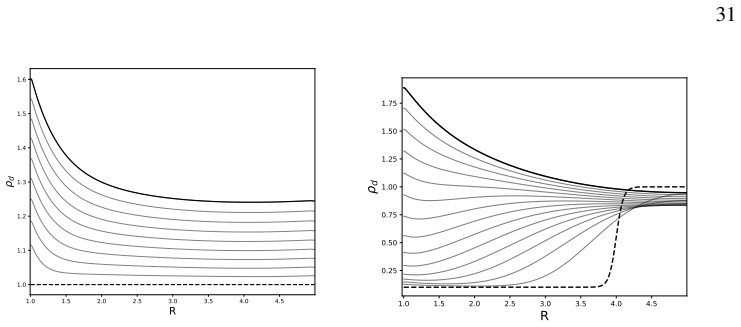
- [Section 7.2 and Figs. 5-6] The numerical simulations are restricted to St=0.01 and τ_c=0.1 or 0.01, which the authors themselves describe as the well-coupled regime, and they state that the solver struggles to maintain positivity of the stress tensor at larger correlation times, reaching only τ_c=0.1 instead of the τ_c=1-5 expected for realistic disc turbulence. These simulations therefore do not exercise the regime where the near-Maxwellian closure ordering is most needed, and the agreement with the steady-state stresses of Section 7.1 in the inner disc does not provide evidence for the validity of the closure at the boundary of its domain. I recommend either extending the solver to realistic correlation times or explicitly labelling the numerical results as a proof of concept that is not intended to validate the closure in the parameter regime where the model is most novel.
- [Appendix A.2, Eqs. (A.17)-(A.24)] The gas-phase closure used for the background flow in Section 7.2 relies on a near-Maxwellian ordering whose attractor property is also left unproven, as the authors note in Appendix A.2. Since the dust fluid equations in Section 7.2 are driven by the gas Reynolds stress through this closure, any error in the gas closure propagates into the dust stress evolution. At minimum, the paper should state clearly that both closure assumptions have the same status, and ideally provide a numerical check for the gas closure in the same rotating-shear context.
minor comments (4)
- [Throughout] There are several typographical and grammatical errors: 'preformed' for 'performed' in the Introduction, 'manor' for 'manner' in several places, 'Reimann' for 'Riemann', 'summery' for 'summary' in the Conclusion, and 'Boltzman’s H-theorem' should be 'Boltzmann’s H-theorem'. A careful proofreading pass is needed.
- [Figure 2 caption] The caption lists 'Black Dashed: τ_c=10^{-2}, Black Dotted: τ_c=10^{-2}', with the same value for two different line styles; presumably one of these should be a different value such as 10^{-1}. Please correct.
- [Section 3.1 and Eq. (3.20)] The torsion tensor of the non-Levi-Civita connection is introduced but the subsequent use of the vorticity and the convective derivative is somewhat terse; a short remark on why the torsion contribution in Eq. (4.64) does not affect the main constitutive relation would improve readability.
- [Section 6, Eq. (6.12)] The eigenvalue calculation is clear, but the paper does not discuss whether the P-wave and S-wave speeds remain real when the stress tensor loses positive semidefiniteness, which the authors note can occur in Rayleigh-unstable regimes. A brief discussion of the connection between hyperbolicity and realisability would be useful.
Circularity Check
No significant circularity: the dust-fluid derivation is self-contained, and the one explicit closure caveat is a stated assumption rather than a hidden restatement of the target result.
full rationale
The paper derives a dust fluid model from a stated stochastic differential equation (Eq. 3.10) via a Fokker-Planck equation (Eq. 4.8) and a moment expansion (Eqs. 4.16-4.26), with no target quantity fitted from the data it later predicts. The closure Π^{αβγ}=0 (Eqs. 4.26, 4.61) is justified by two explicit asymptotic ordering schemes (Sections 4.3.1 and 4.3.2), and the paper openly identifies the remaining gap in Section 4.3.3: 'For now we shall work under the assumption that thermal stability is sufficient to ensure the damping of higher-order velocity moments, however the exploration of the stability of the fluid description against more general perturbations should be explored if the dust fluid model finds widespread use.' This is an acknowledged correctness risk, not a circular step: the assumption is not secretly identical to the claimed result, and the paper's asymptotic analysis is a self-consistency check rather than a derivation of the closure from nothing. The authors cite their own prior work (Lynch & Ogilvie 2021) for the positive-semi-definiteness argument, but the relevant proof is reproduced in Appendix B.1 using the paper's own constitutive relation, so the self-citation is not load-bearing. Numerical simulations in Section 7.2 are consistency checks between a solver implementing the same equations and the steady-state solutions of those same equations, not independent empirical predictions; the paper does not present them as external validation. No parameter is tuned to force the Maxwell-fluid interpretation; the identification with an anisotropic Maxwell fluid is a physical interpretation of the constitutive equation in the appropriate Deborah-number regime (Appendix B.2). Overall, the derivation chain is self-contained and no specific reduction of a prediction to a fitted input or self-citation was found.
Assumptions & free parameters
assumptions (5)
- domain assumption Ornstein-Uhlenbeck model of gas turbulence
- domain assumption Collisionless monodisperse dust with Epstein drag
- domain assumption Neglect of dust back reaction on the gas
- ad hoc to paper Third and higher velocity moments are negligible
- ad hoc to paper Physical independence of the dummy gas coordinates
invented entities (1)
-
Dummy gas displacement coordinates (3 extra dimensions)
Cite this review
Pith. "Pith review of Developing a Non-Newtonian Fluid Model for Dust, for Application to Astrophysical Flows." pith.science (2026). https://pith.science/paper/K4P4AQLM
@misc{pith2026241112462,
  author       = {Pith},
  title        = {Pith review of: Developing a Non-Newtonian Fluid Model for Dust, for Application to Astrophysical Flows},
  year         = {2026},
  howpublished = {\url{https://pith.science/paper/K4P4AQLM}},
  note         = {Machine review of arXiv:2411.12462}
}
read the original abstract
In the astrophysics community it is common practice to model collisionless dust, entrained in a gas flow, as a pressureless fluid. However a pressureless fluid is fundamentally different from a collisionless fluid - the latter of which generically possess a non-zero anisotropic pressure or stress tensor. In this paper we derive a fluid model for collisionless dust, entrained in a turbulent gas, starting from the equations describing the motion of individual dust grains. We adopt a covariant formulation of our model to allow for the geometry and coordinate systems prevalent in astrophysics, and provide a closure valid for the accretion disc context. We show that the continuum mechanics properties of a dust fluid corresponds to a higher-dimensional anisotropic Maxwell fluid, after the extra dimensions are averaged out, with a dynamically important rheological stress tensor. This higher-dimensional treatment has the advantage of keeping the dust velocity and velocity of the fluid seen, and their respective moments, on the same footing. This results in a simplification of the constitutive relation describing the evolution of the dust Rheological stress.
Figures


Figures from the paper (4 more)



Reference graph
Works this paper leans on
-
[1]
& Tremaine , S
Araki , S. & Tremaine , S. 1986 The dynamics of dense particle disks . 65 (1), 83--109
1986
-
[2]
2020 Astrophysics of Planet Formation\/ , 2nd edn
Armitage, Philip J. 2020 Astrophysics of Planet Formation\/ , 2nd edn. Cambridge University Press
2020
-
[3]
Particle-Gas Dynamics with Athena: Method and Convergence
Bai , Xue-Ning & Stone , James M. 2010 Particle-gas Dynamics with Athena: Method and Convergence . 190 (2), 297--310 , arXiv:arXiv: 1005.4980
work page Pith review arXiv 2010
-
[4]
Baines , M. J. , Williams , I. P. & Asebiomo , A. S. 1965 Resistance to the motion of a small sphere moving through a gas . 130 , 63
1965
-
[5]
Balbus , S. A. & Hawley , J. F. 1991 A powerful local shear instability in weakly magnetized disks. I - Linear analysis. II - Nonlinear evolution . 376 , 214--233
1991
-
[6]
Balsara , Dinshaw S. , Tilley , David A. , Rettig , Terrence & Brittain , Sean D. 2009 Dust settling in magnetorotationally driven turbulent discs - I. Numerical methods and evidence for a vigorous streaming instability . 397 (1), 24--43 , arXiv:arXiv: 0810.0246
work page Pith review arXiv 2009
-
[7]
Barker , A. J. & Ogilvie , G. I. 2014 Hydrodynamic instability in eccentric astrophysical discs . 445 , 2637--2654 , arXiv:arXiv: 1409.6488
work page Pith review arXiv 2014
-
[8]
Dust distribution in protoplanetary disks - Vertical settling and radial migration
Barri \`e re-Fouchet , L. , Gonzalez , J. F. , Murray , J. R. , Humble , R. J. & Maddison , S. T. 2005 Dust distribution in protoplanetary disks. Vertical settling and radial migration . 443 (1), 185--194 , arXiv:arXiv: astro-ph/0508452
work page Pith review arXiv 2005
Show all 91 references
-
[9]
2016 FARGO3D: A New GPU-oriented MHD Code
Ben \' tez-Llambay , Pablo & Masset , Fr \'e d \'e ric S. 2016 FARGO3D: A New GPU-oriented MHD Code . 223 (1), 11 , arXiv:arXiv: 1602.02359
2016 arXiv
-
[10]
Bi , Jiaqing , Lin , Min-Kai & Dong , Ruobing 2021 Puffed-up Edges of Planet-opened Gaps in Protoplanetary Disks. I. Hydrodynamic Simulations . 912 (2), 107 , arXiv:arXiv: 2103.09254
2021 arXiv
-
[11]
525 (3), 4299--4320 , arXiv:arXiv: 2306.06103
Binkert , Fabian 2023 Beyond diffusion: a generalized mean-field theory of turbulent dust transport in protoplanetary discs . 525 (3), 4299--4320 , arXiv:arXiv: 2306.06103
2023 arXiv
-
[12]
In Akademiia Nauk SSSR Doklady\/ , , vol
Bobylev, Aleksandr Vasil’evich 1982 The chapman-enskog and grad methods for solving the boltzmann equation. In Akademiia Nauk SSSR Doklady\/ , , vol. 262 , pp. 71--75
1982
-
[13]
Bobylev, A. V. 2018 Boltzmann equation and hydrodynamics beyond navier–stokes . Philosophical Transactions of the Royal Society A: Mathematical, Physical and Engineering Sciences 376 (2118), 20170227 , arXiv:arXiv: https://royalsocietypublishing.org/doi/pdf/10.1098/rsta.2017.0227
2018
-
[14]
& Clarke , Cathie J
Booth , Richard A. & Clarke , Cathie J. 2021 Modelling the delivery of dust from discs to ionized winds . 502 (2), 1569--1578 , arXiv:arXiv: 2101.04121
2021 arXiv
-
[15]
, Goldreich , P
Borderies , N. , Goldreich , P. & Tremaine , S. 1985 A granular flow model for dense planetary rings . 63 (3), 406--420
1985
-
[16]
Capecelatro, Jesse , Desjardins, Olivier & Fox, Rodney O 2016 a\/ Strongly coupled fluid-particle flows in vertical channels. i. reynolds-averaged two-phase turbulence statistics . Physics of Fluids 28 (3)
2016
-
[17]
Capecelatro, Jesse , Desjardins, Olivier & Fox, Rodney O 2016 b\/ Strongly coupled fluid-particle flows in vertical channels. ii. turbulence modeling . Physics of Fluids 28 (3)
2016
-
[18]
373 (4), 1633--1640 , arXiv:arXiv: astro-ph/0610075
Carballido , Augusto , Fromang , S \'e bastien & Papaloizou , John 2006 Mid-plane sedimentation of large solid bodies in turbulent protoplanetary discs . 373 (4), 1633--1640 , arXiv:arXiv: astro-ph/0610075
2006 arXiv
-
[19]
Cambridge university press
Chapman, Sydney & Cowling, Thomas George 1990 The mathematical theory of non-uniform gases: an account of the kinetic theory of viscosity, thermal conduction and diffusion in gases\/ . Cambridge university press
1990
-
[20]
, Lebreuilly , U
Commer c on , B. , Lebreuilly , U. , Price , D. J. , Lovascio , F. , Laibe , G. & Hennebelle , P. 2023 Dynamics of dust grains in turbulent molecular clouds. Conditions for decoupling and limits of different numerical implementations . 671 , A128 , arXiv:arXiv: 2301.04946
2023 arXiv
-
[21]
Journal of Atmospheric Sciences 20 (3), 201--208
Csanady, GT 1963 Turbulent diffusion of heavy particles in the atmosphere . Journal of Atmospheric Sciences 20 (3), 201--208
1963
-
[22]
Diamond, P. H. , Liang, Y.-M. , Carreras, B. A. & Terry, P. W. 1994 Self-regulating shear flow turbulence: A paradigm for the l to h transition . Phys. Rev. Lett. 72 , 2565--2568
1994
-
[23]
, Morfill , G
Dubrulle , B. , Morfill , G. & Sterzik , M. 1995 The dust subdisk in the protoplanetary nebula. 114 (2), 237--246
1995
-
[24]
Eleuterio, F Toro 1999 Riemann solvers and numerical methods for fluid dynamics
1999
-
[25]
1924 On the Resistance Experienced by Spheres in their Motion through Gases
Epstein , Paul S. 1924 On the Resistance Experienced by Spheres in their Motion through Gases . Physical Review 23 (6), 710--733
1924
-
[26]
, Turner , Neal J
Flock , Mario , Nelson , Richard P. , Turner , Neal J. , Bertrang , Gesa H. M. , Carrasco-Gonz \'a lez , Carlos , Henning , Thomas , Lyra , Wladimir & Teague , Richard 2017 Radiation Hydrodynamical Turbulence in Protoplanetary Disks: Numerical Models and Observational Constrai...
2017 arXiv
-
[27]
2014 On multiphase turbulence models for collisional fluid–particle flows
Fox, Rodney O. 2014 On multiphase turbulence models for collisional fluid–particle flows . Journal of Fluid Mechanics 742 , 368–424
2014
-
[28]
& Papaloizou , J
Fromang , S. & Papaloizou , J. 2006 Dust settling in local simulations of turbulent protoplanetary disks . 452 (3), 751--762 , arXiv:arXiv: astro-ph/0603153
2006 arXiv
-
[29]
& Gouin, H
Gavrilyuk, S. & Gouin, H. 2012 Geometric evolution of the reynolds stress tensor . International Journal of Engineering Science 59 , 65--73 , the Special Issue in honor of VICTOR L. BERDICHEVSKY
2012
-
[30]
& Tremaine , S
Goldreich , P. & Tremaine , S. 1978 The excitation and evolution of density waves. 222 , 850--858
1978
-
[31]
New York University
Grad, Harold 1948 Approximation to the Boltzmann equation by moments\/ . New York University
1948
-
[32]
Communications on pure and applied mathematics 2 (4), 331--407
Grad, Harold 1949 On the kinetic theory of rarefied gases . Communications on pure and applied mathematics 2 (4), 331--407
1949
-
[33]
SIAM review 25 (1), 35--61
Harten, Amiram , Lax, Peter D & Leer, Bram van 1983 On upstream differencing and godunov-type schemes for hyperbolic conservation laws . SIAM review 25 (1), 35--61
1983
-
[34]
Hawley, John F & Balbus, Steven A 1991 A powerful local shear instability in weakly magnetized disks. ii. nonlinear evolution . The Astrophysical Journal 376 , 223
1991
-
[35]
Hawley , J. F. , Gammie , C. F. & Balbus , S. A. 1995 Local Three-dimensional Magnetohydrodynamic Simulations of Accretion Disks . 440 , 742
1995
-
[36]
Cambridge University Press
Hobson, Michael Paul , Efstathiou, George P & Lasenby, Anthony N 2006 General relativity: an introduction for physicists\/ . Cambridge University Press
2006
-
[37]
& Chibbaro, Sergio 2019 A lagrangian probability-density-function model for collisional turbulent fluid–particle flows
Innocenti, Alessio , Fox, R. & Chibbaro, Sergio 2019 A lagrangian probability-density-function model for collisional turbulent fluid–particle flows . Journal of Fluid Mechanics 862 , 449
2019
-
[38]
& Chibbaro, Sergio 2021 A Lagrangian probability-density-function model for turbulent particle-laden channel flow in the dense regime
Innocenti, Alessio , Fox, Rodney O. & Chibbaro, Sergio 2021 A Lagrangian probability-density-function model for turbulent particle-laden channel flow in the dense regime . Physics of Fluids 33 (5), 053308 , arXiv:arXiv: https://pubs.aip.org/aip/pof/article-pdf/doi/10.1063/5.00...
2021 doi
-
[39]
494 (4), 5134--5147 , arXiv:arXiv: 2004.03689
Laibe , Guillaume , Br \'e hier , Charles-Edouard & Lombart , Maxime 2020 On the settling of small grains in dusty discs: analysis and formulae . 494 (4), 5134--5147 , arXiv:arXiv: 2004.03689
2020 arXiv
-
[40]
2012 a\/ Dusty gas with smoothed particle hydrodynamics - I
Laibe , Guillaume & Price , Daniel J. 2012 a\/ Dusty gas with smoothed particle hydrodynamics - I. Algorithm and test suite . 420 (3), 2345--2364 , arXiv:arXiv: 1111.3090
2012 arXiv
-
[41]
2012 b\/ Dusty gas with smoothed particle hydrodynamics - II
Laibe , Guillaume & Price , Daniel J. 2012 b\/ Dusty gas with smoothed particle hydrodynamics - II. Implicit timestepping and astrophysical drag regimes . 420 (3), 2365--2376 , arXiv:arXiv: 1111.3089
2012 arXiv
-
[42]
2014 Dusty gas with one fluid
Laibe , Guillaume & Price , Daniel J. 2014 Dusty gas with one fluid . 440 (3), 2136--2146 , arXiv:arXiv: 1402.5248
2014 arXiv
-
[43]
520 (1), 1128--1145 , arXiv:arXiv: 2301.03289
Larue , R \'e my , Latter , Henrik & Rein , Hanno 2023 Thermal hysteresis and front propagation in dense planetary rings . 520 (1), 1128--1145 , arXiv:arXiv: 2301.03289
2023 arXiv
-
[44]
& Ogilvie , Gordon I
Latter , Henrik N. & Ogilvie , Gordon I. 2008 Dense planetary rings and the viscous overstability . 195 (2), 725--751 , arXiv:arXiv: 0803.4123
2008 arXiv
-
[45]
& Papaloizou , John 2017 Local models of astrophysical discs
Latter , Henrik N. & Papaloizou , John 2017 Local models of astrophysical discs . 472 (2), 1432--1446 , arXiv:arXiv: 1708.09285
2017 arXiv
-
[46]
, Ercolano , B
Lesur , G. , Ercolano , B. , Flock , M. , Lin , M. K. , Yang , C. C. , Barranco , J. A. , Benitez-Llambay , P. , Goodman , J. , Johansen , A. , Klahr , H. , Laibe , G. , Lyra , W. , Marcus , P. , Nelson , R. P. , Squire , J. , Simon , J. B. , Turner , N. , Umurhan , O. M. & Yo...
2022 arXiv
-
[47]
Journal of statistical Physics 83 , 1021--1065
Levermore, C David 1996 Moment closure hierarchies for kinetic theories . Journal of statistical Physics 83 , 1021--1065
1996
-
[48]
485 (4), 5221--5234 , arXiv:arXiv: 1903.03620
Lin , Min-Kai 2019 Dust settling against hydrodynamic turbulence in protoplanetary discs . 485 (4), 5221--5234 , arXiv:arXiv: 1903.03620
2019 arXiv
-
[49]
2015 Cooling Requirements for the Vertical Shear Instability in Protoplanetary Disks
Lin , Min-Kai & Youdin , Andrew N. 2015 Cooling Requirements for the Vertical Shear Instability in Protoplanetary Disks . 811 (1), 17 , arXiv:arXiv: 1505.02163
2015 arXiv
-
[50]
2017 A Thermodynamic View of Dusty Protoplanetary Disks
Lin , Min-Kai & Youdin , Andrew N. 2017 A Thermodynamic View of Dusty Protoplanetary Disks . 849 (2), 129 , arXiv:arXiv: 1708.02945
2017 arXiv
-
[51]
& Ogilvie , Gordon I
Lynch , Elliot M. & Ogilvie , Gordon I. 2021 Importance of magnetic fields in highly eccentric discs with applications to tidal disruption events . 501 (4), 5500--5516 , arXiv:arXiv: 2101.01221
2021 arXiv
-
[52]
Masset , F. S. 2000 FARGO: A Fast Eulerian Transport Algorithm for Differentially Rotating Disks . In Disks, Planetesimals, and Planets\/ (ed. G. Garz \'o n , C. Eiroa , D. de Winter & T. J. Mahoney ) , Astronomical Society of the Pacific Conference Series , vol. 219 , p. 75
2000
-
[53]
, Flock , M
Mignone , A. , Flock , M. & Vaidya , B. 2019 A Particle Module for the PLUTO Code. III. Dust . 244 (2), 38 , arXiv:arXiv: 1908.10793
2019 arXiv
-
[54]
Minier, Jean-Pierre 2001 Probabilistic approach to turbulent two-phase flows modelling and simulation: theoretical and numerical issues 7 (3-4), 295--310
2001
-
[55]
Progress in Energy and Combustion Science 50 , 1--62
Minier, Jean-Pierre 2015 On lagrangian stochastic methods for turbulent polydisperse two-phase reactive flows . Progress in Energy and Combustion Science 50 , 1--62
2015
-
[56]
Physics Reports 665 (2016) , 1--122
Minier, jean-pierre 2016 Statistical descriptions of polydisperse turbulent two-phase flows . Physics Reports 665 (2016) , 1--122
2016
-
[57]
Physics of Fluids 26 (11), 113303
Minier, Jean-Pierre , Chibbaro, Sergio & Pope, Stephen B 2014 Guidelines for the formulation of lagrangian stochastic models for particle simulations of single-phase and dispersed two-phase turbulent flows . Physics of Fluids 26 (11), 113303
2014
-
[58]
arXiv e-prints p
Minier , Jean-Pierre & Henry , Christophe 2023 The dynamics of discrete particles in turbulent flows: open issues and current challenges in statistical modeling . arXiv e-prints p. arXiv:2311.01921 , arXiv:arXiv: 2311.01921
2023 arXiv
-
[59]
Physics Reports 352 (1), 1--214
Minier, Jean-Pierre & Peirano, Eric 2001 The pdf approach to turbulent polydispersed two-phase flows . Physics Reports 352 (1), 1--214
2001
-
[60]
Physics of fluids 16 (7), 2419--2431
Minier, Jean-Pierre , Peirano, Eric & Chibbaro, Sergio 2004 Pdf model based on langevin equation for polydispersed two-phase flows applied to a bluff-body gas-solid flow . Physics of fluids 16 (7), 2419--2431
2004
-
[61]
, Gressel , Oliver & Umurhan , Orkan M
Nelson , Richard P. , Gressel , Oliver & Umurhan , Orkan M. 2013 Linear and non-linear evolution of the vertical shear instability in accretion discs . 435 (3), 2610--2632 , arXiv:arXiv: 1209.2753
2013 arXiv
-
[62]
Ogilvie , G. I. 2003 On the dynamics of magnetorotational turbulent stresses . 340 (3), 969--982 , arXiv:arXiv: astro-ph/0212442
2003 arXiv
-
[63]
Ogilvie , G. I. & Barker , A. J. 2014 Local and global dynamics of eccentric astrophysical discs . 445 , 2621--2636 , arXiv:arXiv: 1409.6487
2014 arXiv
-
[64]
Ogilvie , G. I. & Latter , H. N. 2013 a\/ Hydrodynamic instability in warped astrophysical discs . 433 , 2420--2435 , arXiv:arXiv: 1303.0264
2013 arXiv
-
[65]
Ogilvie , G. I. & Latter , H. N. 2013 b\/ Local and global dynamics of warped astrophysical discs . 433 , 2403--2419 , arXiv:arXiv: 1303.0263
2013 arXiv
-
[66]
Oldroyd , J. G. 1950 On the Formulation of Rheological Equations of State . Proceedings of the Royal Society of London Series A 200 (1063), 523--541
1950
-
[67]
Ormel , C. W. & Cuzzi , J. N. 2007 Closed-form expressions for particle relative velocities induced by turbulence . 466 (2), 413--420 , arXiv:arXiv: astro-ph/0702303
2007 arXiv
-
[68]
& Liu , Beibei 2018 Catching drifting pebbles
Ormel , Chris W. & Liu , Beibei 2018 Catching drifting pebbles. II. A stochastic equation of motion for pebbles . 615 , A178 , arXiv:arXiv: 1803.06150
2018 arXiv
-
[69]
Papaloizou , J. C. B. 2005 a\/ Global numerical simulations of differentially rotating disks with free eccentricity . 432 (3), 757--769
2005
-
[70]
Papaloizou , J. C. B. 2005 b\/ The local instability of steady astrophysical flows with non circular streamlines with application to differentially rotating disks with free eccentricity . 432 (3), 743--755 , arXiv:arXiv: astro-ph/0412587
2005 arXiv
-
[71]
, Chibbaro, S
Peirano, E. , Chibbaro, S. , Pozorski, J. & Minier, J.-P. 2006 Mean-field/pdf numerical approach for polydispersed turbulent two-phase flows . Progress in Energy and Combustion Science 32 (3), 315--371
2006
-
[72]
1985 Pdf methods for turbulent reactive flows
Pope, S.B. 1985 Pdf methods for turbulent reactive flows . Progress in Energy and Combustion Science 11 (2), 119--192
1985
-
[73]
The Physics of fluids 30 (8), 2374--2379
Pope, SB 1987 Consistency conditions for random-walk models of turbulent dispersion . The Physics of fluids 30 (8), 2374--2379
1987
-
[74]
2000 Turbulent Flows\/
Pope, Stephen B. 2000 Turbulent Flows\/ . Cambridge University Press
2000
-
[75]
Physics of Fluids 14 (7), 2360--2375
Pope, Stephen B 2002 A stochastic lagrangian model for acceleration in turbulent flows . Physics of Fluids 14 (7), 2360--2375
2002
-
[76]
Journal of computational physics 43 (2), 357--372
Roe, Philip L 1981 Approximate riemann solvers, parameter vectors, and difference schemes . Journal of computational physics 43 (2), 357--372
1981
-
[77]
Physics of Fluids A: Fluid Dynamics 3 (6), 1577--1586
Sawford, BL 1991 Reynolds number effects in lagrangian stochastic models of turbulent dispersion . Physics of Fluids A: Fluid Dynamics 3 (6), 1577--1586
1991
-
[78]
2022 Wavelike nature of the vertical shear instability in global protoplanetary discs
Svanberg , Eleonora , Cui , Can & Latter , Henrik N. 2022 Wavelike nature of the vertical shear instability in global protoplanetary discs . 514 (3), 4581--4587 , arXiv:arXiv: 2206.03840
2022 arXiv
-
[79]
, Birnstiel , T
Testi , L. , Birnstiel , T. , Ricci , L. , Andrews , S. , Blum , J. , Carpenter , J. , Dominik , C. , Isella , A. , Natta , A. , Williams , J. P. & Wilner , D. J. 2014 Dust Evolution in Protoplanetary Disks . In Protostars and Planets VI\/ (ed. Henrik Beuther , Ralf S. Klessen...
2014 arXiv
-
[80]
Geophysics 51 (10), 1954--1966
Thomsen, Leon 1986 Weak elastic anisotropy . Geophysics 51 (10), 1954--1966
1986
-
[81]
Journal of fluid mechanics 180 , 529--556
Thomson, DJ 1987 Criteria for the selection of stochastic models of particle trajectories in turbulent flows . Journal of fluid mechanics 180 , 529--556
1987
-
[82]
Shock waves 4 , 25--34
Toro, Eleuterio F , Spruce, Michael & Speares, William 1994 Restoration of the contact surface in the hll-riemann solver . Shock waves 4 , 25--34
1994
-
[83]
In 16th aiaa computational fluid dynamics conference\/ , p
Van Leer, Bram 2006 Upwind and high-resolution methods for compressible flow: From donor cell to residual-distribution schemes. In 16th aiaa computational fluid dynamics conference\/ , p. 3559
2006
-
[84]
Whipple , F. L. 1972 On certain aerodynamic processes for asteroids and comets . In From Plasma to Planet\/ (ed. Aina Elvius ) , p. 211
1972
-
[85]
1985 The moments of the multivariate normal
Withers, C.S. 1985 The moments of the multivariate normal . Bulletin of the Australian Mathematical Society 32 (1), 103–107
1985
-
[86]
224 (2), 39 , arXiv:arXiv: 1603.08523
Yang , Chao-Chin & Johansen , Anders 2016 Integration of Particle-gas Systems with Stiff Mutual Drag Interaction . 224 (2), 39 , arXiv:arXiv: 1603.08523
2016 arXiv
-
[87]
& Johansen , A
Youdin , A. & Johansen , A. 2007 Protoplanetary Disk Turbulence Driven by the Streaming Instability: Linear Evolution and Numerical Methods . 662 (1), 613--626 , arXiv:arXiv: astro-ph/0702625
2007 arXiv
-
[88]
& Lithwick , Yoram 2007 Particle stirring in turbulent gas disks: Including orbital oscillations
Youdin , Andrew N. & Lithwick , Yoram 2007 Particle stirring in turbulent gas disks: Including orbital oscillations . 192 (2), 588--604 , arXiv:arXiv: 0707.2975
2007 arXiv
-
[89]
, Rafikov , Roman R
Zhu , Zhaohuan , Stone , James M. , Rafikov , Roman R. & Bai , Xue-ning 2014 Particle Concentration at Planet-induced Gap Edges and Vortices. I. Inviscid Three-dimensional Hydro Disks . 785 (2), 122 , arXiv:arXiv: 1308.0648
2014 arXiv
-
[90]
, " * write output.state after.block = add.period write newline
ENTRY address author booktitle chapter edition editor howpublished institution journal key month note number organization pages publisher school series title type volume year eprint label extra.label sort.label short.list INTEGERS output.state before.all mid.sentence after.sen...
-
[91]
write newline
" write newline "" before.all 'output.state := FUNCTION n.dashify 't := "" t empty not t #1 #1 substring "-" = t #1 #2 substring "--" = not "--" * t #2 global.max substring 't := t #1 #1 substring "-" = "-" * t #2 global.max substring 't := while if t #1 #1 substring * t #2 gl...
Reviewed August 12, 2026 · model on record in the stance chip above.
Discussion (0). Continue with ORCID to comment.