REVIEW 4 major objections 4 minor 60 references
Decoupling Training-Free Guided Diffusion by ADMM
T0 review · 4 major / 4 minor · reviewed 2026-08-12 · deepseek-v4-flash
Pith's one-line read ADMMDiff rewrites conditional generation as two coupled variables, one for the diffusion prior and one for the condition, and proves the coupled iteration converges to a stationary point.
desk verdict Good algorithm, bad proof: the ADMM decoupling idea and the empirical results are promising, but Theorem 2's convergence analysis doesn't analyze the algorithm and its rho bounds contradict. read the letter →
The pith
A machine-rendered reading of the paper's core claim, the machinery that carries it, and where it could break.
The reading
What carries the argument
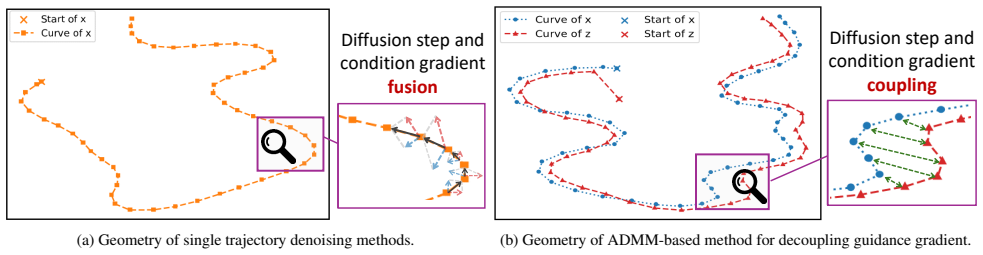
The load-bearing identity is Proposition 1: a single reverse diffusion step, $x_{t-1} = \frac{1}{\sqrt{\alpha_t}}(x_t + \beta_t s_\theta(x_t,t)) + \sqrt{\frac{1-\bar\alpha_{t-1}}{1-\bar\alpha_t}}\beta_t \epsilon$, is a first-order approximation to the proximal operator of $-\frac{1}{\rho}\log q_\phi(x)$ at $x_t$, with $\rho = \frac{\beta_t}{1-\beta_t}$. The auxiliary variable $z$ is updated by Tweedie's formula, $\tilde z_0(z_t) = \frac{1}{\sqrt{\bar\alpha_t}}(z_t + (1-\bar\alpha_t)s_t)$, followed by $K_t$ gradient descent steps on the guidance loss $\log c_\theta(\tilde z_0(z), y)$, which the paper treats as a first-order approximation to the proximal operator of $-\log c_\theta(z,y)$. These two inexact proximal steps are coupled by ADMM's dual variable $\nu_t$ and penalty coefficient $\rho$, which adaptively balance prior fidelity and condition satisfaction.
What would settle it
Run Algorithm 1 on CelebA-HQ segmentation guidance and measure $\min_j (\|z_{j+1}-z_j\|^2 + \|x_{j+1}-x_j\|^2)$ against $T$; Theorem 2 predicts this quantity decays as $o(1/T)$, so any plateau above zero contradicts the claimed stationary-point convergence. Also record $\sum_t \delta_t$ for that guidance loss; if it diverges, the theorem's assumptions are not satisfied.
Extended reading notes
Core claim
The authors' discovery is that conditional generation can be formulated as a constrained optimization problem in which the diffusion prior and the guidance function live in separate variables, so the usual tuned weight is replaced by an ADMM coupling mechanism. They write the objective as $\max_{x,z} \log q_\phi(x) + \log c_\theta(z,y)$ subject to $x = z$, solve it with alternating updates, and show that the diffusion reverse step serves as an inexact proximal operator for the prior. The paper's central theoretical claim is that this ADMM-based loop converges to a stationary point of the coupled objective, with the residual measure $\min_j (\|z_{j+1}-z_j\|^2 + \|x_{j+1}-x_j\|^2)$ decaying as $o(1/T)$ under stated assumptions. Empirically, the paper reports state-of-the-art or competitive performance on nonlinear guided image synthesis, linear inverse problems, and controllable motion synthesis.
Load-bearing premise
The load-bearing premise is Proposition 1 — that a single reverse diffusion step is a first-order approximation to the proximal operator of the prior's negative log-likelihood, a statement the paper cites rather than proves — together with the unproved gradient-descent proxy for the guidance subproblem and the convergence theorem's assumption that the accumulated approximation errors stay finite.
Editorial extensions
If this is right
- No tuned guidance weight is needed: ADMM's dual variable and penalty coefficient set the balance between prior fidelity and condition satisfaction adaptively.
- The same algorithm works across nonlinear losses, such as segmentation maps, sketches, and CLIP text embeddings, and linear measurements such as super-resolution, inpainting, and deblurring.
- If the assumptions of Theorem 2 hold, the coupled iteration converges to a stationary point of the posterior-approximation objective at rate $o(1/T)$, not merely in the limit.
- The method extends to off-the-shelf motion diffusion models, giving trajectory-following behavior with lower objective and embedding distance than the tested guided-motion baselines.
Reading between the lines
- The proximal-step view suggests a compatibility criterion for other samplers: any sampler whose reverse step can be certified as a proximal approximation could be inserted into the ADMM loop, so the scheme is not inherently tied to the DDPM update used in the paper.
- A testable extension is to adapt $K_t$ online from the primal and dual residuals instead of fixing it, which would make each subproblem's accuracy track the observed coupling error.
- Because the two variables evolve separately before being fused, the framework could support swapping the guidance function mid-generation without restarting the diffusion process; the paper does not explore this.
- The theorem's summability assumption is what separates convergence from failure in practice; measuring $\sum_t \delta_t$ for a given guidance loss would make convergence checking a one-time calibration rather than a faith-based assumption.
Signed reviews
Editorial analysis
A structured set of objections, weighed in public.
Referee Report
Summary. The paper proposes ADMMDiff, a training-free conditional generation framework that decouples the unconditional diffusion prior from a differentiable guidance loss by introducing an auxiliary variable z and the constraint x=z. The algorithm alternates a single reverse diffusion step, interpreted as an approximate proximal update for -log q_phi(x), with gradient descent on a Tweedie-estimated guidance loss for z, followed by a dual-variable update. The authors claim convergence to a stationary point of problem (P) at a sublinear rate under smoothness and summability assumptions, and they report experiments on non-linear guidance, linear inverse problems, and controllable motion synthesis. The central theoretical assertion is that one diffusion reverse step is a first-order approximation of the proximal operator of -log q_phi(x), so a pretrained diffusion model can be plugged into ADMM without retraining.
Significance. Conditional generation with off-the-shelf guidance functions is an active problem, and a principled decoupling that avoids a hand-tuned guidance weight would be a valuable contribution. The empirical results are suggestive: ADMMDiff leads most nonlinear image-guidance metrics in Table 1, most linear-inverse metrics in Table 3, and the trajectory objective in Table 4. The paper also gives a clear conceptual framing of diffusion reverse steps as proximal operators. However, the convergence analysis is an advertised core contribution, and as written the proof of Theorem 2 does not analyze the algorithm that is actually run. The theoretical significance is therefore not realized in the current manuscript. The empirical evidence alone would need fuller reproducibility details to carry the paper.
major comments (4)
- [§4, Algorithm 1; Appendix A.2, Step 1] Theorem 2's proof does not analyze the z-update of Algorithm 1. Step 1 defines z*_{k+1} := argmin_z L(x_{k+1}, z, mu_k) with g(z) := -log c_theta(z,y), and then bounds ||z_{k+1} - z*_{k+1}|| by a contraction of K_k gradient-descent steps on that exact subproblem. Algorithm 1 instead updates z with the gradient of log c_theta(tilde_z0(z), y), where tilde_z0 is the Tweedie estimate. These two sequences coincide only if log c_theta(tilde_z0(z),y) equals log c_theta(z,y) up to a z-independent constant, a condition that is neither stated nor satisfied by BiSeNet, sketch generators, CLIP, or motion encoders. Consequently, the Lyapunov argument in (A.5)-(A.6) bounds a different sequence from the one produced by Algorithm 1, and Theorem 2 is not established for ADMMDiff.
- [Theorem 2 statement and Appendix A.2, Step 4] There is a direct contradiction between the theorem's stated hypothesis rho <= 1/(6L) and the proof's Step 4, which invokes "Because rho > 6L" before defining the constants in (A.6). Both conditions cannot hold for L > 0. Since Proposition 1 gives rho = beta/(1-beta), and standard DDPM schedules have beta in the range 0.01-0.02, the proof's regime rho > 6L is not shown to be compatible with the diffusion schedules used in the experiments. The convergence rate claim therefore has no valid proof under the stated assumptions.
- [Appendix A.1, Proof of Theorem 1] The proof of Theorem 1 begins with the assertion "Note that x_{t-1} = x_t - eta * grad h_t(x_t)", but Algorithm 1 does not define h_t or a gradient step for x; the x-update is the single reverse-diffusion formula. No derivation is supplied showing that this reverse step is equivalent to the gradient descent form, and Proposition 1 is delegated to reference [60] rather than proved. This gap is load-bearing because Theorem 1 provides the delta_t error terms that enter the summability assumption of Theorem 2.
- [Theorem 2 assumptions] The assumption that sum_t delta_t < +infinity is effectively an assumption that the errors of the inexact proximal steps vanish sufficiently fast. In Theorem 1, delta_t contains a term proportional to ||x_t - tilde_x0||^2 (Appendix A.1), and no argument is given that this term is summable for the pretrained diffusion models and off-the-shelf guidance functions tested. Since the paper presents this convergence result as the rigorous justification of ADMMDiff, the summability condition needs to be either proved for the tested settings or explicitly recognized as a substantive restriction rather than a mild assumption.
minor comments (4)
- [Algorithm 1, x-update block] In the x-update block, the second line evaluates s_theta at hat{x}_t, but only hat{x}_{t-1} was defined earlier in the block; the notation should be corrected, for example by defining hat{x}_t = z_t - nu_t/rho and then computing x_{t-1} from hat{x}_t.
- [Algorithm 1, z-update block] The z-update writes -eta*rho*(z_t^{(k)} - x_t - nu_t), but Section 3's update is -eta*rho*(z_t - x_t - (1/rho)*nu_t). The missing 1/rho factor gives the dual variable incorrect units relative to the augmented Lagrangian formulation.
- [Section 5.2 and Table 3] The text states that ADMMDiff achieves the best FID in 9 of 10 tasks, but in the FFHQ Inpaint(random) row DPS has FID 21.19 versus ADMMDiff's 22.04; the statement should be made task-specific rather than leaving the reader to identify the exception.
- [Section 5, general reproducibility] The paper does not report the values of rho, eta, and K_t used in the experiments for any of the three tasks, which makes the strong empirical tables difficult to reproduce without additional information.
Circularity Check
No significant circularity: the derivation is self-contained; the formal gaps are correctness risks, not reductions of the conclusion to its inputs.
full rationale
ADMMDiff does not fit any parameter to a subset of outputs and then predict a closely related quantity; rho, eta, and K_t are algorithmic hyperparameters rather than fitted constants. The x-subproblem is identified with a diffusion reverse step through Proposition 1, but that identification is attributed to external work [60], not to a self-citation chain by the present authors, and it is not used to define a quantity that already contains the paper's conclusions. The z-subproblem is an explicit algorithmic choice (gradient descent on the Tweedie-estimated guidance), and no theorem is claimed for it; the convergence proof instead bounds an exact z*-subproblem. Theorem 2 is conditional: it assumes smoothness, sum_t delta_t < infinity, and sum_t 2^{-K_t} < infinity. The summability of delta_t is strong and effectively requires the inexact proximal errors to vanish in the limit, which is indeed close to the property needed for convergence; however it is an explicit hypothesis, not a conclusion obtained by renaming an input, and the same is true of the assumption that the variational score matches the ground-truth score. The mismatch between the analyzed z-update and the implemented z-update, and the conflicting rho bounds (Theorem 2 states rho <= 1/(6L) while the proof invokes rho > 6L), are serious technical defects that undermine the formal guarantee as stated, but they are not circularity: the theorem does not reduce to its own assumptions by construction, and no load-bearing claim rests on a self-citation. The empirical comparisons are against external baselines and not derived from fitted constants, so the experimental claims are also not circular.
Assumptions & free parameters
free parameters (3)
- rho (penalty coefficient) =
not reported in main text
- eta (z update step size) =
not reported
- K_t (inner gradient iterations) =
not reported
assumptions (4)
- ad hoc to paper -log q_phi and -log c_theta are L-smooth
- domain assumption A single diffusion reverse step is a first-order approximation of prox_{1/rho(-log q_phi)}
- ad hoc to paper The error sequence delta_t is summable
- domain assumption Samples z_k lie in [0,1]^d
Cite this review
Pith. "Pith review of Decoupling Training-Free Guided Diffusion by ADMM." pith.science (2026). https://pith.science/paper/QPUQE3SH
@misc{pith2026241112773,
  author       = {Pith},
  title        = {Pith review of: Decoupling Training-Free Guided Diffusion by ADMM},
  year         = {2026},
  howpublished = {\url{https://pith.science/paper/QPUQE3SH}},
  note         = {Machine review of arXiv:2411.12773}
}
abstract
In this paper, we consider the conditional generation problem by guiding off-the-shelf unconditional diffusion models with differentiable loss functions in a plug-and-play fashion. While previous research has primarily focused on balancing the unconditional diffusion model and the guided loss through a tuned weight hyperparameter, we propose a novel framework that distinctly decouples these two components. Specifically, we introduce two variables ${x}$ and ${z}$, to represent the generated samples governed by the unconditional generation model and the guidance function, respectively. This decoupling reformulates conditional generation into two manageable subproblems, unified by the constraint ${x} = {z}$. Leveraging this setup, we develop a new algorithm based on the Alternating Direction Method of Multipliers (ADMM) to adaptively balance these components. Additionally, we establish the equivalence between the diffusion reverse step and the proximal operator of ADMM and provide a detailed convergence analysis of our algorithm under certain mild assumptions. Our experiments demonstrate that our proposed method ADMMDiff consistently generates high-quality samples while ensuring strong adherence to the conditioning criteria. It outperforms existing methods across a range of conditional generation tasks, including image generation with various guidance and controllable motion synthesis.
Figures


Figures from the paper (2 more)


Reference graph
Works this paper leans on
-
[60]
Yuanzhi Zhu, Kai Zhang, Jingyun Liang, Jiezhang Cao, Bihan Wen, Radu Timofte, and Luc Van Gool. Denois- ing diffusion models for plug-and-play image restora- tion. In Proceedings of the IEEE/CVF Conference on Computer Vision and Pattern Recognition , pages 1219–1229, 2023. 4 11 A. Theoretical Analysis Assumptions. To derive the sequel propositions and the...
work page 2023
-
[1]
Blended diffusion for text-driven editing of natural images
Omri Avrahami, Dani Lischinski, and Ohad Fried. Blended diffusion for text-driven editing of natural images. In Proceedings of the IEEE/CVF Conference on Computer Vision and Pattern Recognition , pages 18208–18218, 2022. 1
work page 2022
-
[2]
Universal guidance for diffusion models
Arpit Bansal, Hong-Min Chu, Avi Schwarzschild, Soumyadip Sengupta, Micah Goldblum, Jonas Geiping, and Tom Goldstein. Universal guidance for diffusion models. In Proceedings of the IEEE/CVF Conference on Computer Vision and Pattern Recognition , pages 843–852, 2023. 8
work page 2023
-
[3]
Modeling tem- poral data as continuous functions with process diffu- sion
Marin Biloš, Kashif Rasul, Anderson Schneider, Yuriy Nevmyvaka, and Stephan Günnemann. Modeling tem- poral data as continuous functions with process diffu- sion. arXiv preprint arXiv:2211.02590, 2022. 1
arXiv 2022
-
[4]
Stephen Boyd, Neal Parikh, Eric Chu, Borja Peleato, Jonathan Eckstein, et al. Distributed optimization and statistical learning via the alternating direction method of multipliers. Foundations and Trends® in Machine learning, 3(1):1–122, 2011. 3, 4
work page 2011
-
[5]
Accurate sampling using langevin dynamics
Giovanni Bussi and Michele Parrinello. Accurate sampling using langevin dynamics. Physical Review E—Statistical, Nonlinear, and Soft Matter Physics, 75 (5):056707, 2007. 2
work page 2007
-
[6]
Performance analysis of plug-and- play admm: A graph signal processing perspective
Stanley H Chan. Performance analysis of plug-and- play admm: A graph signal processing perspective. IEEE Transactions on Computational Imaging, 5(2): 274–286, 2019. 8
work page 2019
-
[7]
Stanley H Chan, Xiran Wang, and Omar A Elgendy. Plug-and-play admm for image restoration: Fixed- point convergence and applications.IEEE Transactions on Computational Imaging, 3(1):84–98, 2016. 6, 7, 8, 15, 16
work page 2016
Show all 60 references
-
[8]
Diffusion posterior sampling for general noisy inverse problems
Hyungjin Chung, Jeongsol Kim, Michael T Mccann, Marc L Klasky, and Jong Chul Ye. Diffusion posterior sampling for general noisy inverse problems. arXiv preprint arXiv:2209.14687, 2022. 2, 5, 6, 8, 15, 16
2022 arXiv
-
[9]
Improving diffusion models for inverse problems using manifold constraints
Hyungjin Chung, Byeongsu Sim, Dohoon Ryu, and Jong Chul Ye. Improving diffusion models for inverse problems using manifold constraints. Advances in Neu- ral Information Processing Systems, 35:25683–25696,
-
[10]
Probability theory: The coupling method
Frank Den Hollander. Probability theory: The coupling method. Lecture notes available online (http://websites. math. leidenuniv. nl/probability/lecturenotes/Couplin- gLectures. pdf), 2012. 3
2012
-
[11]
Imagenet: A large-scale hierarchical image database
Jia Deng, Wei Dong, Richard Socher, Li-Jia Li, Kai Li, and Li Fei-Fei. Imagenet: A large-scale hierarchical image database. In 2009 IEEE conference on computer vision and pattern recognition, pages 248–255. Ieee,
2009
-
[12]
Diffusion models beat gans on image synthesis
Prafulla Dhariwal and Alexander Nichol. Diffusion models beat gans on image synthesis. Advances in neural information processing systems, 34:8780–8794,
-
[13]
Diffusion posterior sam- pling for linear inverse problem solving: A filtering perspective
Zehao Dou and Yang Song. Diffusion posterior sam- pling for linear inverse problem solving: A filtering perspective. In The Twelfth International Conference on Learning Representations, 2024. 8
2024
-
[14]
Tweedie’s formula and selection bias
Bradley Efron. Tweedie’s formula and selection bias. Journal of the American Statistical Association , 106 (496):1602–1614, 2011. 2
2011
-
[15]
A general framework for a class of first order primal-dual algorithms for convex optimization in imaging science
Ernie Esser, Xiaoqun Zhang, and Tony F Chan. A general framework for a class of first order primal-dual algorithms for convex optimization in imaging science. SIAM Journal on Imaging Sciences, 3(4):1015–1046,
-
[16]
A dual algorithm for the solution of nonlinear variational problems via finite element approximation
Daniel Gabay and Bertrand Mercier. A dual algorithm for the solution of nonlinear variational problems via finite element approximation. Computers & mathemat- ics with applications, 2(1):17–40, 1976. 2
1976
-
[17]
Sur l’approximation, par éléments finis d’ordre un, et la résolution, par pénalisation-dualité d’une classe de problèmes de dirichlet non linéaires
Roland Glowinski and Americo Marroco. Sur l’approximation, par éléments finis d’ordre un, et la résolution, par pénalisation-dualité d’une classe de problèmes de dirichlet non linéaires. Revue française d’automatique, informatique, recherche opérationnelle. Analyse numérique, ...
1975
-
[18]
Diffusion models as plug-and- play priors
Alexandros Graikos, Nikolay Malkin, Nebojsa Jojic, and Dimitris Samaras. Diffusion models as plug-and- play priors. Advances in Neural Information Process- ing Systems, 35:14715–14728, 2022. 2, 8
2022
-
[19]
Generating diverse and natural 3d human motions from text
Chuan Guo, Shihao Zou, Xinxin Zuo, Sen Wang, Wei Ji, Xingyu Li, and Li Cheng. Generating diverse and natural 3d human motions from text. In Proceedings of the IEEE/CVF Conference on Computer Vision and Pattern Recognition, pages 5152–5161, 2022. 8
2022
-
[20]
Manifold preserving guided diffusion
Yutong He, Naoki Murata, Chieh-Hsin Lai, Yuhta Takida, Toshimitsu Uesaka, Dongjun Kim, Wei-Hsiang Liao, Yuki Mitsufuji, J Zico Kolter, Ruslan Salakhutdi- nov, et al. Manifold preserving guided diffusion. arXiv preprint arXiv:2311.16424, 2023. 2, 5, 8
2023 arXiv
-
[21]
Prompt- to-prompt image editing with cross attention control
Amir Hertz, Ron Mokady, Jay Tenenbaum, Kfir Aber- man, Yael Pritch, and Daniel Cohen-Or. Prompt- to-prompt image editing with cross attention control. arXiv preprint arXiv:2208.01626, 2022. 1
2022 arXiv
-
[22]
Denoising diffusion probabilistic models
Jonathan Ho, Ajay Jain, and Pieter Abbeel. Denoising diffusion probabilistic models. Advances in neural information processing systems, 33:6840–6851, 2020. 1, 2
2020
-
[23]
Alternat- ing direction method of multipliers for real and com- plex polynomial optimization models
Bo Jiang, Shiqian Ma, and Shuzhong Zhang. Alternat- ing direction method of multipliers for real and com- plex polynomial optimization models. Optimization, 63(6):883–898, 2014. 3 9
2014
-
[24]
A style- based generator architecture for generative adversarial networks
Tero Karras, Samuli Laine, and Timo Aila. A style- based generator architecture for generative adversarial networks. In Proceedings of the IEEE/CVF confer- ence on computer vision and pattern recognition, pages 4401–4410, 2019. 6
2019
-
[25]
Guided motion diffusion for controllable human motion synthesis
Korrawe Karunratanakul, Konpat Preechakul, Supa- sorn Suwajanakorn, and Siyu Tang. Guided motion diffusion for controllable human motion synthesis. In Proceedings of the IEEE/CVF International Confer- ence on Computer Vision, pages 2151–2162, 2023. 7, 8
2023
-
[26]
Denoising diffusion restoration models
Bahjat Kawar, Michael Elad, Stefano Ermon, and Ji- aming Song. Denoising diffusion restoration models. Advances in Neural Information Processing Systems, 35:23593–23606, 2022. 6, 8, 15, 16
2022
-
[27]
Imagic: Text-based real image editing with dif- fusion models
Bahjat Kawar, Shiran Zada, Oran Lang, Omer Tov, Huiwen Chang, Tali Dekel, Inbar Mosseri, and Michal Irani. Imagic: Text-based real image editing with dif- fusion models. In Proceedings of the IEEE/CVF Con- ference on Computer Vision and Pattern Recognition, pages 6007–6017, 2023. 1
2023
-
[28]
Diffusionclip: Text-guided diffusion models for robust image manipulation
Gwanghyun Kim, Taesung Kwon, and Jong Chul Ye. Diffusionclip: Text-guided diffusion models for robust image manipulation. In Proceedings of the IEEE/CVF Conference on Computer Vision and Pattern Recogni- tion, pages 2426–2435, 2022. 1
2022
-
[29]
Diffusion-lm im- proves controllable text generation.Advances in Neural Information Processing Systems, 35:4328–4343, 2022
Xiang Li, John Thickstun, Ishaan Gulrajani, Percy S Liang, and Tatsunori B Hashimoto. Diffusion-lm im- proves controllable text generation.Advances in Neural Information Processing Systems, 35:4328–4343, 2022. 1
2022
-
[30]
Magic3d: High-resolution text-to-3d content creation
Chen-Hsuan Lin, Jun Gao, Luming Tang, Towaki Takikawa, Xiaohui Zeng, Xun Huang, Karsten Kreis, Sanja Fidler, Ming-Yu Liu, and Tsung-Yi Lin. Magic3d: High-resolution text-to-3d content creation. In Proceedings of the IEEE/CVF Conference on Com- puter Vision and Pattern Recognit...
-
[31]
Lectures on the coupling method
Torgny Lindvall. Lectures on the coupling method . Courier Corporation, 2002. 3
2002
-
[32]
Numerical methods for non- linear variational problems
WB Liu and JW Barrett. Numerical methods for non- linear variational problems. ESAIM: Mathematical Modelling and Numerical Analysis, 28(725-744), 1994. 3
1994
-
[33]
Latent diffusion for language generation
Justin Lovelace, Varsha Kishore, Chao Wan, Eliot Shekhtman, and Kilian Q Weinberger. Latent diffusion for language generation. Advances in Neural Informa- tion Processing Systems, 36, 2024. 1
2024
-
[34]
On the con- vergence of alternating direction lagrangian methods for nonconvex structured optimization problems
Sindri Magnússon, Pradeep Chathuranga Weeraddana, Michael G Rabbat, and Carlo Fischione. On the con- vergence of alternating direction lagrangian methods for nonconvex structured optimization problems. IEEE Transactions on Control of Network Systems, 3(3):296– 309, 2015. 3
2015
-
[35]
Sdedit: Guided image synthesis and editing with stochastic dif- ferential equations
Chenlin Meng, Yutong He, Yang Song, Jiaming Song, Jiajun Wu, Jun-Yan Zhu, and Stefano Ermon. Sdedit: Guided image synthesis and editing with stochastic dif- ferential equations. arXiv preprint arXiv:2108.01073,
-
[36]
Proximité et dualité dans un espace hilbertien
Jean-Jacques Moreau. Proximité et dualité dans un espace hilbertien. Bulletin de la Société mathématique de France, 93:273–299, 1965. 2
1965
-
[37]
T2i-adapter: Learning adapters to dig out more controllable ability for text-to-image diffusion models
Chong Mou, Xintao Wang, Liangbin Xie, Yanze Wu, Jian Zhang, Zhongang Qi, and Ying Shan. T2i-adapter: Learning adapters to dig out more controllable ability for text-to-image diffusion models. In Proceedings of the AAAI Conference on Artificial Intelligence, pages 4296–4304, 2024. 1
2024
-
[38]
Lectures on convex optimization
Yurii Nesterov et al. Lectures on convex optimization. Springer, 2018. 12
2018
-
[39]
Proximal algorithms
Neal Parikh, Stephen Boyd, et al. Proximal algorithms. Foundations and trends® in Optimization, 1(3):127– 239, 2014. 2
2014
-
[40]
Dreamfusion: Text-to-3d using 2d diffu- sion
Ben Poole, Ajay Jain, Jonathan T Barron, and Ben Mildenhall. Dreamfusion: Text-to-3d using 2d diffu- sion. arXiv preprint arXiv:2209.14988, 2022. 1
2022 arXiv
-
[41]
Hierarchical text-conditional image generation with clip latents
Aditya Ramesh, Prafulla Dhariwal, Alex Nichol, Casey Chu, and Mark Chen. Hierarchical text-conditional image generation with clip latents. arXiv preprint arXiv:2204.06125, 1(2):3, 2022. 1
2022 arXiv
-
[42]
Autoregressive denoising diffusion models for multivariate probabilistic time series fore- casting
Kashif Rasul, Calvin Seward, Ingmar Schuster, and Roland V ollgraf. Autoregressive denoising diffusion models for multivariate probabilistic time series fore- casting. In International Conference on Machine Learning, pages 8857–8868. PMLR, 2021. 1
2021
-
[43]
A convergence theorem for non negative almost supermartingales and some applications
Herbert Robbins and David Siegmund. A convergence theorem for non negative almost supermartingales and some applications. In Optimizing methods in statistics, pages 233–257. Elsevier, 1971. 12
1971
-
[44]
Variational analysis
R Tyrrell Rockafellar and Roger J-B Wets. Variational analysis. Springer Science & Business Media, 2009. 2
2009
-
[45]
High-resolution im- age synthesis with latent diffusion models
Robin Rombach, Andreas Blattmann, Dominik Lorenz, Patrick Esser, and Björn Ommer. High-resolution im- age synthesis with latent diffusion models. In Proceed- ings of the IEEE/CVF conference on computer vision and pattern recognition, pages 10684–10695, 2022. 1
2022
-
[46]
Photorealistic text-to-image diffusion models with deep language understanding
Chitwan Saharia, William Chan, Saurabh Saxena, Lala Li, Jay Whang, Emily L Denton, Kamyar Ghasemipour, Raphael Gontijo Lopes, Burcu Karagol Ayan, Tim Sal- imans, et al. Photorealistic text-to-image diffusion models with deep language understanding. Advances in Neural Informati...
2022
-
[47]
Deep unsupervised 10 learning using nonequilibrium thermodynamics
Jascha Sohl-Dickstein, Eric Weiss, Niru Mah- eswaranathan, and Surya Ganguli. Deep unsupervised 10 learning using nonequilibrium thermodynamics. In International conference on machine learning, pages 2256–2265. PMLR, 2015. 1
2015
-
[48]
Loss-guided diffusion models for plug- and-play controllable generation
Jiaming Song, Qinsheng Zhang, Hongxu Yin, Morteza Mardani, Ming-Yu Liu, Jan Kautz, Yongxin Chen, and Arash Vahdat. Loss-guided diffusion models for plug- and-play controllable generation. In International Con- ference on Machine Learning , pages 32483–32498. PMLR, 2023. 2, 5, 7, 8
2023
-
[49]
Generative modeling by estimating gradients of the data distribution
Yang Song and Stefano Ermon. Generative modeling by estimating gradients of the data distribution. Ad- vances in neural information processing systems, 32,
-
[50]
Score-based generative modeling through stochastic differential equations
Yang Song, Jascha Sohl-Dickstein, Diederik P Kingma, Abhishek Kumar, Stefano Ermon, and Ben Poole. Score-based generative modeling through stochastic differential equations. arXiv preprint arXiv:2011.13456, 2020. 1, 2, 6, 7, 8, 15, 16
2011 arXiv
-
[51]
Human motion diffusion model
Guy Tevet, Sigal Raab, Brian Gordon, Yoni Shafir, Daniel Cohen-or, and Amit Haim Bermano. Human motion diffusion model. In The Eleventh International Conference on Learning Representations, 2023. 7
2023
-
[52]
Sketch-guided text-to-image diffusion models
Andrey V oynov, Kfir Aberman, and Daniel Cohen-Or. Sketch-guided text-to-image diffusion models. In ACM SIGGRAPH 2023 Conference Proceedings, pages 1–11,
2023
-
[53]
Parameter-free plug- and-play admm for image restoration
Xiran Wang and Stanley H Chan. Parameter-free plug- and-play admm for image restoration. In 2017 IEEE International Conference on Acoustics, Speech and Signal Processing (ICASSP), pages 1323–1327. IEEE,
2017
-
[54]
Adversarial open domain adaptation for sketch-to-photo synthesis
Xiaoyu Xiang, Ding Liu, Xiao Yang, Yiheng Zhu, Xi- aohui Shen, and Jan P Allebach. Adversarial open domain adaptation for sketch-to-photo synthesis. In Proceedings of the IEEE/CVF Winter Conference on Applications of Computer Vision , pages 1434–1444,
-
[55]
Interpolation and denoising of graph signals using plug- and-play admm
Yoshinao Yazaki, Yuichi Tanaka, and Stanley H Chan. Interpolation and denoising of graph signals using plug- and-play admm. In ICASSP 2019-2019 IEEE Interna- tional Conference on Acoustics, Speech and Signal Processing (ICASSP), pages 5431–5435. IEEE, 2019. 8
2019
-
[56]
Tfg: Unified training-free guidance for diffu- sion models
Haotian Ye, Haowei Lin, Jiaqi Han, Minkai Xu, Sheng Liu, Yitao Liang, Jianzhu Ma, James Zou, and Stefano Ermon. Tfg: Unified training-free guidance for diffu- sion models. arXiv preprint arXiv:2409.15761, 2024. 2, 8
2024 arXiv
-
[57]
Bisenet: Bilateral segmentation network for real-time semantic segmen- tation
Changqian Yu, Jingbo Wang, Chao Peng, Changxin Gao, Gang Yu, and Nong Sang. Bisenet: Bilateral segmentation network for real-time semantic segmen- tation. In Proceedings of the European conference on computer vision (ECCV), pages 325–341, 2018. 5
2018
-
[58]
Freedom: Training-free energy-guided conditional diffusion model
Jiwen Yu, Yinhuai Wang, Chen Zhao, Bernard Ghanem, and Jian Zhang. Freedom: Training-free energy-guided conditional diffusion model. In Proceedings of the IEEE/CVF International Conference on Computer Vi- sion, pages 23174–23184, 2023. 2, 5, 8
2023
-
[59]
Adding conditional control to text-to-image diffusion models
Lvmin Zhang, Anyi Rao, and Maneesh Agrawala. Adding conditional control to text-to-image diffusion models. In Proceedings of the IEEE/CVF International Conference on Computer Vision , pages 3836–3847,
Reviewed August 12, 2026 · model on record in the stance chip above.
Discussion (0). Continue with ORCID to comment.