REVIEW 3 major objections 5 minor 2 cited by
Open-World Amodal Appearance Completion
T0 review · 3 major / 5 minor · reviewed 2026-08-12 · deepseek-v4-flash
Pith's one-line read Text plus image reconstructs hidden objects across any category
desk verdict A genuinely new integration for text-query amodal completion with a reasonable human study, but the occlusion-ordering step is the least-evidenced link in the chain. read the letter →
The pith
A machine-rendered reading of the paper's core claim, the machinery that carries it, and where it could break.
The reading
What carries the argument
The load-bearing mechanism is the occluder mask $M_{\text{occ}}$, built by InstaOrderNet's pairwise occlusion decisions over every object mask and morphological background segment (Eq. 2), with boundary-aware dilation when the target touches the image edge (Eq. 3). This mask tells the inpainting model which pixels are hidden by other things and therefore must be reconstructed. The other carrier is the prompt-selection step (Eq. 4), which uses CLIP to choose the descriptor from the image tags or the user query that best matches the visible target, so abstract queries still yield a concrete inpainting condition. The pipeline then iterates masked inpainting with adaptive termination.
What would settle it
Take the pipeline's 2,379 evaluation images, run InstaOrderNet alone over the same segment inventory the pipeline uses, and compare its pairwise occlusion labels with human judgments; if its accuracy on novel classes or background segments is near chance, then the occluder mask is initialized from wrong pixels and the claimed completions cannot be attributed to correct occlusion reasoning.
Extended reading notes
Core claim
The paper's core discovery is that reasoning-based amodal completion can be decomposed into four frozen components that need no training: a vision-language model turns the text query into a visible mask for the target object; an open-set tagging and detection chain inventories every nameable object while morphological operations partition ambiguous background into segments; an occlusion-ordering network assigns each segment a binary 'occludes the target' label to form the occluder mask; and an inpainting diffusion model, guided by a CLIP-selected prompt, iteratively fills the masked region and outputs an RGBA layer. The authors argue that because the query, rather than a predefined class list, selects the target, the framework generalizes across 553 object classes and produces completions that human raters prefer to existing closed-set and diffusion-based baselines. The central output is not just an inpainted image but a layerable transparent element ready for downstream composition.
Load-bearing premise
The whole result rests on the occlusion-ordering network's binary pairwise decisions being trustworthy for every segment the pipeline feeds it, including masks from open-vocabulary detectors and morphological background blobs, even though the paper never reports how often those decisions are correct on its own segment inventory.
Editorial extensions
If this is right
- A text query plus an image becomes enough to recover a full amodal appearance for objects from categories never seen in training.
- Abstract or context-dependent queries, such as 'the mammal in this image', produce completions without requiring the user to know the class name.
- RGBA outputs let the completed object be composited directly into image editing, novel-view synthesis, and 3D reconstruction workflows.
- Because each module is frozen and replaceable, the whole framework improves automatically when better segmentation, occlusion-ordering, or inpainting models appear.
- The new dataset and preference protocol provide a common benchmark for open-world amodal appearance completion.
Reading between the lines
- Editorial inference: the paper never measures InstaOrderNet's own accuracy on its segment inventory, so a natural extension is to ablate the pipeline by replacing the occlusion-order network with human-annotated occlusion labels; the gap would reveal how much of the final quality rests on that one component.
- Editorial inference: the same chain could be applied to video frames, but temporal consistency of completed appearances would need an explicit constraint that the current single-image pipeline does not provide.
- Editorial inference: completions could serve as pseudo-ground-truth for distilling a smaller, faster end-to-end model, since the current engine runs several large pre-trained models per object.
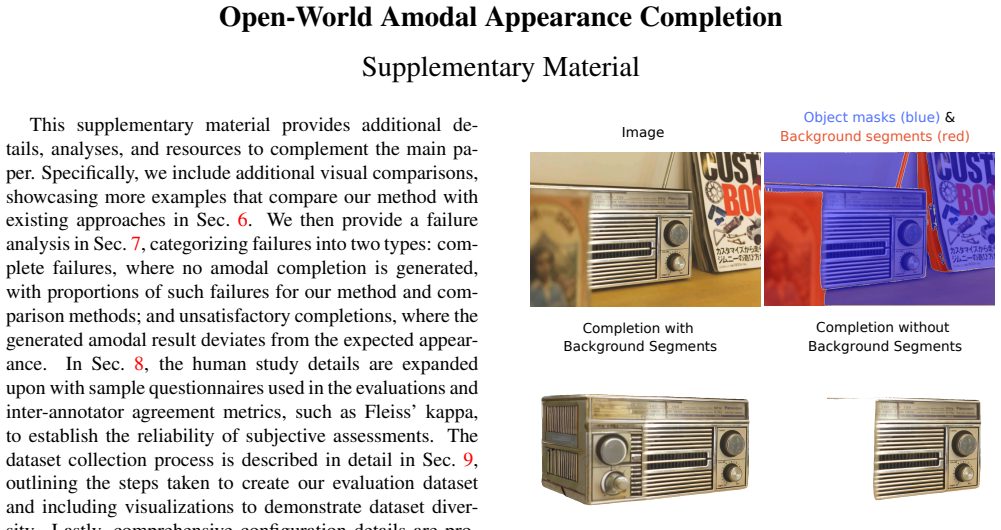
- Editorial inference: the morphological handling of unlabeled background regions is what lets the method treat foliage and blur as occluders, a setting where closed-set baselines fail; a targeted stress test on heavy-background occlusion would make this contribution stand out.
Signed reviews
Editorial analysis
A structured set of objections, weighed in public.
Referee Report
Summary. The paper proposes a training-free framework for open-world amodal appearance completion. Given an image and a natural-language query, the pipeline uses LISA to obtain a visible mask, Grounded-SAM plus morphological background partitioning to enumerate candidate segments, InstaOrderNet to determine which segments occlude the target (Eq. 2), CLIP to select an inpainting prompt (Eq. 4), and Stable Diffusion inpainting with iterative refinement to synthesize the occluded appearance, finally outputting an RGBA layer. The authors introduce a new evaluation dataset of 2379 images spanning 553 classes and report a human preference study (Table 2), quantitative metrics (Table 3), and ablations (Table 4).
Significance. If the results hold, this is a useful step toward open-world amodal completion: it moves beyond closed category sets, integrates off-the-shelf models without fine-tuning, and produces compositable RGBA outputs. The new benchmark with natural occlusions and the human-preference evaluation are valuable assets. However, the central empirical claim rests on a preference study without statistical inference, and the occlusion-analysis module is not validated on the pipeline's own segment inventory; these issues need to be addressed before the claims are fully supported.
major comments (3)
- [§4.3, Table 2] The headline result that 'Ours' is preferred (41.86% overall vs. 27.95% for Pix2gestalt) is reported without confidence intervals or significance tests. Given that each image appears to be rated by only three participants (per Fig. 5), the 13.9-point gap could be within noise for a subset of images; the paper should provide per-image bootstrap or subject-level confidence intervals and a paired test (e.g., Wilcoxon across images).
- [§3.2, Eq. (2)] The occluder mask is built from binary decisions of InstaOrderNet applied to every segment in S∪B, including masks produced by Grounded-SAM and morphological background blobs. No accuracy or agreement measure is reported for InstaOrderNet on this segment inventory, and there is no oracle ablation replacing it with ground-truth occlusion order. Because an incorrect binary decision either leaves an occluder unpainted or masks visible target pixels that then get hallucinated, the open-world claim is only as strong as this unverified transfer. The supplementary failure analysis (Sec. 7) attributes 4.1% complete failures to undetectable objects, not to occlusion-order errors, so this failure mode is not disentangled.
- [§3.3 vs. §4.2] The CLIP score metric in Table 3 is partly circular. The evaluation uses the ground-truth class label as the query Q, and Eq. (4) selects the inpainting prompt from T∪{Q} with CLIP; the same label is then matched against the output with CLIP. This inflates the reported CLIP scores, particularly for 'Ours', and makes the cross-method comparison on this metric difficult to interpret. A fairer protocol would blind prompt selection to the evaluation label or use a distinct text encoder for evaluation.
minor comments (5)
- [§3.1, Eq. (1)] The morphological operations (erosion and dilation structuring element sizes, number of passes) are not specified; please report them in the supplementary configuration details for reproducibility.
- [§4.3] The human study should state how many participants rated each image, whether each image was rated by the same set of three participants, and whether the text query was shown to participants; Fig. 5 implies three raters per image, but this is not stated in the main text.
- [Table 4] The symbols '!' and '#' are not defined in the table caption; the row 'T ∪ Q #' is ambiguous about whether background segments are included or excluded.
- [§3.1 and §4.4] There are several typos: 'an segmentation process' should be 'a segmentation process', 'our method of consider' should be 'our method to consider', and 'evalution' should be 'evaluation' in §4.4.
- [§4.4] The sentence 'In our evalution dataset, the Q prompt achieves the highest CLIP score' should explicitly point to Table 4 and clarify that the T∪Q row with background segments is the chosen configuration despite having a slightly lower CLIP score.
Circularity Check
CLIP 'class relevance' is partly circular: the ground-truth label is fed in as the query (Eq. 4) and inpainting prompt (Eq. 6), then the same label is the CLIP evaluation target; the paper concedes this in Sec. 4.4. Human preference and pixel metrics remain independent.
-
fitted input called prediction
[Sec. 4.2 'Evaluation metrics' with Sec. 3.3 Eq. (4) and Sec. 3.4 Eq. (6); conceded in Sec. 4.4]
"We use CLIP score [26] to measure how well the amodal completions align with the class labels. Specifically, we compare the amodal completion of each object with the ground-truth class label associated with the object. ... In our evalution dataset, the Q prompt achieves the highest CLIP score, because it directly aligns with ground-truth target object class labels."
The evaluation dataset supplies a ground-truth class label for each occluded object, and that label is used as the language query Q. Eq. (4) selects the inpainting prompt P from T ∪ {Q}, so the ground-truth label is an allowed prompt; Eq. (6) then conditions the diffusion inpainting on P. The CLIP metric in Sec. 4.2 scores the resulting completion against the same ground-truth label. Thus the 'class relevance' numbers in Table 3 partly measure whether the generator followed a prompt that already contained the answer, not independent open-world generalization. The paper concedes this in Sec. 4.4, saying the Q-only prompt wins the CLIP score because it directly aligns with the ground-truth labels.
full rationale
The framework itself is not circular: it takes an image and a text query and produces an RGBA completion through frozen components (LISA mask, Grounded-SAM with SAM segments, morphological background partition, InstaOrderNet pairwise occlusion, CLIP prompt selection, and Stable Diffusion inpainting). None of the pipeline equations define the output in terms of the CLIP evaluation target; Eq. (2) is a union of InstaOrderNet binary occlusion decisions and Eq. (6) is conditional inpainting. The unverified transfer of InstaOrderNet to open-vocabulary and background segments is a generalization risk, not a circularity, since no oracle ablation or per-module accuracy is reported; that concern belongs under correctness risk. The only concrete circular step is evaluative: the dataset's ground-truth class label is fed into the pipeline as Q via Eq. (4), the selected P conditions the inpainting in Eq. (6), and the CLIP metric in Sec. 4.2 scores the completion against that same label. The paper's own Sec. 4.4 remark that the Q prompt achieves the highest CLIP score 'because it directly aligns with ground-truth target object class labels' acknowledges this bias. Human preference in Table 2 and LPIPS/SSIM in Table 3 provide independent evidence not affected by this step, and the only self-citation ([1]) is a background survey, not load-bearing. Therefore the circularity is partial and confined to one supporting metric, yielding a score of 4.
Assumptions & free parameters
free parameters (5)
- epsilon (occluder mask stability threshold) =
not reported
- maximum inpainting iterations T =
3
- dilation structuring element for boundary-aware occlusion =
not reported
- morphological kernel for background segmentation =
not reported
- alpha blend transition width =
not reported
assumptions (6)
- domain assumption Pretrained models (LISA, GroundingDINO, SAM, RAM++, InstaOrderNet, Stable Diffusion) provide sufficient world knowledge to segment, reason, and inpaint arbitrary open-world objects without task-specific training.
- domain assumption LISA's text-grounded mask correctly isolates the visible region of the queried object.
- domain assumption InstaOrderNet's pairwise occlusion decisions transfer to masks produced by open-vocabulary detectors and to morphological background segments.
- domain assumption CLIP similarity between the masked visible object and candidate tags selects the correct inpainting prompt.
- domain assumption Human preference on Prolific with gold-standard checks is a reliable proxy for amodal completion quality.
- domain assumption Visible-region reference metrics (LPIPS, SSIM, VGG feature similarity) are meaningful quality proxies for amodal completion.
Cite this review
Pith. "Pith review of Open-World Amodal Appearance Completion." pith.science (2026). https://pith.science/paper/MFCPPBYD
@misc{pith2026241113019,
  author       = {Pith},
  title        = {Pith review of: Open-World Amodal Appearance Completion},
  year         = {2026},
  howpublished = {\url{https://pith.science/paper/MFCPPBYD}},
  note         = {Machine review of arXiv:2411.13019}
}
read the original abstract
Understanding and reconstructing occluded objects is a challenging problem, especially in open-world scenarios where categories and contexts are diverse and unpredictable. Traditional methods, however, are typically restricted to closed sets of object categories, limiting their use in complex, open-world scenes. We introduce Open-World Amodal Appearance Completion, a training-free framework that expands amodal completion capabilities by accepting flexible text queries as input. Our approach generalizes to arbitrary objects specified by both direct terms and abstract queries. We term this capability reasoning amodal completion, where the system reconstructs the full appearance of the queried object based on the provided image and language query. Our framework unifies segmentation, occlusion analysis, and inpainting to handle complex occlusions and generates completed objects as RGBA elements, enabling seamless integration into applications such as 3D reconstruction and image editing. Extensive evaluations demonstrate the effectiveness of our approach in generalizing to novel objects and occlusions, establishing a new benchmark for amodal completion in open-world settings. The code and datasets will be released after paper acceptance.
Figures


Figures from the paper (9 more)




Forward citations
Cited by 2 Pith papers
-
SynergyAmodal: Deocclude Anything with Text Control
SynergyAmodal co-synthesizes a 16K amodal dataset from EntitySeg images with human and model guidance, and trains a diffusion model that completes occluded objects with optional text control.
-
CAPTURe: Evaluating Spatial Reasoning in Vision Language Models via Occluded Object Counting
CAPTURe, a new benchmark for occluded pattern counting, shows that six vision-language models count far worse when objects are hidden, while humans make almost no errors.
Reference graph
Works this paper leans on
-
[1]
Image amodal completion: A survey
Jiayang Ao, Qiuhong Ke, and Krista A Ehinger. Image amodal completion: A survey. Computer Vision and Image Understanding, 229:103661, 2023. 2
work page 2023
-
[2]
Text2live: Text-driven layered image and video editing
Omer Bar-Tal, Dolev Ofri-Amar, Rafail Fridman, Yoni Kas- ten, and Tali Dekel. Text2live: Text-driven layered image and video editing. In European Conference on Computer Vision, pages 707–723. Springer, 2022. 1
work page 2022
-
[3]
In- structpix2pix: Learning to follow image editing instructions
Tim Brooks, Aleksander Holynski, and Alexei A Efros. In- structpix2pix: Learning to follow image editing instructions. In Proceedings of the IEEE/CVF Conference on Computer Vision and Pattern Recognition, pages 18392–18402, 2023. 1
2023
-
[4]
Segan: Segmenting and generating the invisible
Kiana Ehsani, Roozbeh Mottaghi, and Ali Farhadi. Segan: Segmenting and generating the invisible. In Proceedings of the IEEE Conference on Computer Vision and Pattern Recognition, pages 6144–6153, 2018. 5
work page 2018
-
[5]
Learning to see the invisible: End-to-end trainable amodal instance segmen- tation
Patrick Follmann, Rebecca K ¨onig, Philipp H ¨artinger, Michael Klostermann, and Tobias B ¨ottger. Learning to see the invisible: End-to-end trainable amodal instance segmen- tation. In 2019 IEEE Winter Conference on Applications of Computer Vision, pages 1328–1336. IEEE, 2019. 5
work page 2019
-
[6]
Im- age style transfer using convolutional neural networks
Leon A Gatys, Alexander S Ecker, and Matthias Bethge. Im- age style transfer using convolutional neural networks. In Proceedings of the IEEE Conference on Computer Vision and Pattern Recognition, pages 2414–2423, 2016. 6
work page 2016
-
[7]
Panodr: Spherical panorama diminished reality for indoor scenes
Vasileios Gkitsas, Vladimiros Sterzentsenko, Nikolaos Zioulis, Georgios Albanis, and Dimitrios Zarpalas. Panodr: Spherical panorama diminished reality for indoor scenes. In Proceedings of the IEEE/CVF Conference on Computer Vi- sion and Pattern Recognition, pages 3716–3726, 2021. 1
work page 2021
-
[8]
Language-grounded dy- namic scene graphs for interactive object search with mobile manipulation
Daniel Honerkamp, Martin B ¨uchner, Fabien Despinoy, Tim Welschehold, and Abhinav Valada. Language-grounded dy- namic scene graphs for interactive object search with mobile manipulation. IEEE Robotics and Automation Letters, 2024. 1
work page 2024
Show all 44 references
-
[9]
Sail-vos: Semantic amodal in- stance level video object segmentation-a synthetic dataset and baselines
Yuan-Ting Hu, Hong-Shuo Chen, Kexin Hui, Jia-Bin Huang, and Alexander G Schwing. Sail-vos: Semantic amodal in- stance level video object segmentation-a synthetic dataset and baselines. In Proceedings of the IEEE/CVF Conference on Computer Vision and Pattern Recognition , pages...
2019
-
[10]
Open-set image tagging with multi-grained text su- pervision
Xinyu Huang, Yi-Jie Huang, Youcai Zhang, Weiwei Tian, Rui Feng, Yuejie Zhang, Yanchun Xie, Yaqian Li, and Lei Zhang. Open-set image tagging with multi-grained text su- pervision. arXiv e-prints, pages arXiv–2310, 2023. 4, 6
2023
-
[11]
Organi- zation in vision: Essays on gestalt perception
Gaetano Kanizsa, Paolo Legrenzi, and Paolo Bozzi. Organi- zation in vision: Essays on gestalt perception. 1979. 1
1979
-
[12]
Segment any- thing
Alexander Kirillov, Eric Mintun, Nikhila Ravi, Hanzi Mao, Chloe Rolland, Laura Gustafson, Tete Xiao, Spencer White- head, Alexander C Berg, Wan-Yen Lo, et al. Segment any- thing. In Proceedings of the IEEE/CVF International Con- ference on Computer Vision, pages 4015–4026, 2023. 4, 6
2023
-
[13]
Visual genome: Connecting language and vision using crowdsourced dense image annotations
Ranjay Krishna, Yuke Zhu, Oliver Groth, Justin Johnson, Kenji Hata, Joshua Kravitz, Stephanie Chen, Yannis Kalan- tidis, Li-Jia Li, David A Shamma, et al. Visual genome: Connecting language and vision using crowdsourced dense image annotations. International Journal of Compute...
2017
-
[14]
Lisa: Reasoning segmentation 6 via large language model
Xin Lai, Zhuotao Tian, Yukang Chen, Yanwei Li, Yuhui Yuan, Shu Liu, and Jiaya Jia. Lisa: Reasoning segmentation 6 via large language model. In Proceedings of the IEEE/CVF Conference on Computer Vision and Pattern Recognition , pages 9579–9589, 2024. 2, 3, 6
2024
-
[15]
The measurement of observer agreement for categorical data
J Richard Landis and Gary G Koch. The measurement of observer agreement for categorical data. biometrics, pages 159–174, 1977. 4
1977
-
[16]
Instance-wise occlusion and depth orders in natural scenes
Hyunmin Lee and Jaesik Park. Instance-wise occlusion and depth orders in natural scenes. In Proceedings of the IEEE/CVF Conference on Computer Vision and Pattern Recognition, pages 21210–21221, 2022. 4, 6
2022
-
[17]
2d amodal instance segmentation guided by 3d shape prior
Zhixuan Li, Weining Ye, Tingting Jiang, and Tiejun Huang. 2d amodal instance segmentation guided by 3d shape prior. In European Conference on Computer Vision , pages 165–
-
[18]
Muva: A new large-scale benchmark for multi-view amodal instance segmentation in the shopping scenario
Zhixuan Li, Weining Ye, Juan Terven, Zachary Bennett, Ying Zheng, Tingting Jiang, and Tiejun Huang. Muva: A new large-scale benchmark for multi-view amodal instance segmentation in the shopping scenario. In Proceedings of the IEEE/CVF International Conference on Computer Vi- s...
2023
-
[19]
Variational amodal object completion
Huan Ling, David Acuna, Karsten Kreis, Seung Wook Kim, and Sanja Fidler. Variational amodal object completion. Advances in Neural Information Processing Systems , 33: 16246–16257, 2020. 1
2020
-
[20]
Grounding dino: Marrying dino with grounded pre-training for open-set object detection
Shilong Liu, Zhaoyang Zeng, Tianhe Ren, Feng Li, Hao Zhang, Jie Yang, Qing Jiang, Chunyuan Li, Jianwei Yang, Hang Su, et al. Grounding dino: Marrying dino with grounded pre-training for open-set object detection. In Eu- ropean Conference on Computer Vision. Springer, 2024. 4, 6
2024
-
[21]
Object-level scene deocclusion
Zhengzhe Liu, Qing Liu, Chirui Chang, Jianming Zhang, Daniil Pakhomov, Haitian Zheng, Zhe Lin, Daniel Cohen-Or, and Chi-Wing Fu. Object-level scene deocclusion. In ACM SIGGRAPH 2024 Conference Papers, pages 1–11, 2024. 2
2024
-
[22]
Towards open- world interactive disambiguation for robotic grasping
Yuchen Mo, Hanbo Zhang, and Tao Kong. Towards open- world interactive disambiguation for robotic grasping. In 2023 IEEE International Conference on Robotics and Au- tomation, pages 8061–8067. IEEE, 2023. 1
2023
-
[23]
pix2gestalt: Amodal segmentation by synthesizing wholes
Ege Ozguroglu, Ruoshi Liu, D ´ıdac Sur´ıs, Dian Chen, Achal Dave, Pavel Tokmakov, and Carl V ondrick. pix2gestalt: Amodal segmentation by synthesizing wholes. In 2024 IEEE/CVF Conference on Computer Vision and Pattern Recognition, pages 3931–3940. IEEE Computer Society,
2024
-
[24]
How to make a pizza: Learning a compositional layer-based gan model
Dim P Papadopoulos, Youssef Tamaazousti, Ferda Ofli, In- gmar Weber, and Antonio Torralba. How to make a pizza: Learning a compositional layer-based gan model. In pro- ceedings of the IEEE/CVF Conference on Computer Vision and Pattern Recognition, pages 8002–8011, 2019. 2
2019
-
[25]
Instant automatic emptying of panoramic indoor scenes
Giovanni Pintore, Marco Agus, Eva Almansa, and Enrico Gobbetti. Instant automatic emptying of panoramic indoor scenes. IEEE Transactions on Visualization and Computer Graphics, 28(11):3629–3639, 2022. 1
2022
-
[26]
Learn- ing transferable visual models from natural language super- vision
Alec Radford, Jong Wook Kim, Chris Hallacy, Aditya Ramesh, Gabriel Goh, Sandhini Agarwal, Girish Sastry, Amanda Askell, Pamela Mishkin, Jack Clark, et al. Learn- ing transferable visual models from natural language super- vision. In International Conference on Machine Learning...
2021
-
[27]
Grounded sam: Assembling open-world models for diverse visual tasks
Tianhe Ren, Shilong Liu, Ailing Zeng, Jing Lin, Kunchang Li, He Cao, Jiayu Chen, Xinyu Huang, Yukang Chen, Feng Yan, et al. Grounded sam: Assembling open-world models for diverse visual tasks. arXiv preprint arXiv:2401.14159 ,
-
[28]
High-resolution image synthesis with latent diffusion models
Robin Rombach, Andreas Blattmann, Dominik Lorenz, Patrick Esser, and Bj ¨orn Ommer. High-resolution image synthesis with latent diffusion models. In Proceedings of the IEEE/CVF conference on Computer Vision and Pattern Recognition, pages 10684–10695, 2022. 5, 6
2022
-
[29]
Laion-400m: Open dataset of clip-filtered 400 million image-text pairs
Christoph Schuhmann, Richard Vencu, Romain Beaumont, Robert Kaczmarczyk, Clayton Mullis, Aarush Katta, Theo Coombes, Jenia Jitsev, and Aran Komatsuzaki. Laion-400m: Open dataset of clip-filtered 400 million image-text pairs. arXiv preprint arXiv:2111.02114, 2021. 6, 3, 4, 5
2021 arXiv
-
[30]
Zero123++: a single image to consistent multi-view dif- fusion base model
Ruoxi Shi, Hansheng Chen, Zhuoyang Zhang, Minghua Liu, Chao Xu, Xinyue Wei, Linghao Chen, Chong Zeng, and Hao Su. Zero123++: a single image to consistent multi-view dif- fusion base model. arXiv preprint arXiv:2310.15110, 2023. 8
-
[31]
Mulan: A multi layer anno- tated dataset for controllable text-to-image generation
Petru-Daniel Tudosiu, Yongxin Yang, Shifeng Zhang, Fei Chen, Steven McDonagh, Gerasimos Lampouras, Ignacio Iacobacci, and Sarah Parisot. Mulan: A multi layer anno- tated dataset for controllable text-to-image generation. In Proceedings of the IEEE/CVF Conference on Computer Vi...
2024
-
[32]
Visionllm: Large language model is also an open- ended decoder for vision-centric tasks
Wenhai Wang, Zhe Chen, Xiaokang Chen, Jiannan Wu, Xizhou Zhu, Gang Zeng, Ping Luo, Tong Lu, Jie Zhou, Yu Qiao, et al. Visionllm: Large language model is also an open- ended decoder for vision-centric tasks. Advances in Neural Information Processing Systems, 36, 2024. 2
2024
-
[33]
Cogvlm: Visual expert for pretrained language models
Weihan Wang, Qingsong Lv, Wenmeng Yu, Wenyi Hong, Ji Qi, Yan Wang, Junhui Ji, Zhuoyi Yang, Lei Zhao, Xixuan Song, et al. Cogvlm: Visual expert for pretrained language models. Advances in Neural Information Processing Sys- tems, 36, 2024. 2
2024
-
[34]
Image quality assessment: from error visibility to structural similarity
Zhou Wang, Alan C Bovik, Hamid R Sheikh, and Eero P Si- moncelli. Image quality assessment: from error visibility to structural similarity. IEEE Transactions on Image Process- ing, 13(4):600–612, 2004. 6
2004
-
[35]
Amodal com- pletion via progressive mixed context diffusion
Katherine Xu, Lingzhi Zhang, and Jianbo Shi. Amodal com- pletion via progressive mixed context diffusion. In Proceed- ings of the IEEE/CVF Conference on Computer Vision and Pattern Recognition, pages 9099–9109, 2024. 1, 2, 4, 5, 7, 3
2024
-
[36]
Visualizing the invisible: Oc- cluded vehicle segmentation and recovery
Xiaosheng Yan, Feigege Wang, Wenxi Liu, Yuanlong Yu, Shengfeng He, and Jia Pan. Visualizing the invisible: Oc- cluded vehicle segmentation and recovery. In Proceedings of the IEEE/CVF International Conference on Computer Vi- sion, pages 7618–7627, 2019. 2
2019
-
[37]
Amodal ground truth and completion in the wild
Guanqi Zhan, Chuanxia Zheng, Weidi Xie, and Andrew Zis- serman. Amodal ground truth and completion in the wild. In Proceedings of the IEEE/CVF Conference on Computer Vision and Pattern Recognition, pages 28003–28013, 2024. 1 7
2024
-
[38]
Self-supervised scene de- occlusion
Xiaohang Zhan, Xingang Pan, Bo Dai, Ziwei Liu, Dahua Lin, and Chen Change Loy. Self-supervised scene de- occlusion. In Proceedings of the IEEE/CVF conference on Computer Vision and Pattern Recognition , pages 3784– 3792, 2020. 2
2020
-
[39]
Transparent im- age layer diffusion using latent transparency
Lvmin Zhang and Maneesh Agrawala. Transparent im- age layer diffusion using latent transparency. ACM Trans. Graph., 43(4), 2024. 1, 2, 8
2024
-
[40]
Face de-occlusion with deep cascade guidance learn- ing
Ni Zhang, Nian Liu, Junwei Han, Kaiyuan Wan, and Ling Shao. Face de-occlusion with deep cascade guidance learn- ing. IEEE Transactions on Multimedia , 25:3217–3229,
-
[41]
The unreasonable effectiveness of deep features as a perceptual metric
Richard Zhang, Phillip Isola, Alexei A Efros, Eli Shecht- man, and Oliver Wang. The unreasonable effectiveness of deep features as a perceptual metric. In Proceedings of the IEEE Conference on Computer Vision and Pattern Recogni- tion, pages 586–595, 2018. 6
2018
-
[42]
Visiting the invisible: Layer-by- layer completed scene decomposition
Chuanxia Zheng, Duy-Son Dao, Guoxian Song, Tat-Jen Cham, and Jianfei Cai. Visiting the invisible: Layer-by- layer completed scene decomposition. International Journal of Computer Vision, 129:3195–3215, 2021. 2
2021
-
[43]
Human de-occlusion: Invisible perception and recovery for humans
Qiang Zhou, Shiyin Wang, Yitong Wang, Zilong Huang, and Xinggang Wang. Human de-occlusion: Invisible perception and recovery for humans. In Proceedings of the IEEE/CVF Conference on Computer Vision and Pattern Recognition , pages 3691–3701, 2021. 2
2021
-
[44]
Semantic amodal segmentation
Yan Zhu, Yuandong Tian, Dimitris Metaxas, and Piotr Doll´ar. Semantic amodal segmentation. In Proceedings of the IEEE Conference on Computer Vision and Pattern Recognition, pages 1464–1472, 2017. 5, 6, 3, 4 8
2017
Reviewed August 12, 2026 · model on record in the stance chip above.
Discussion (0). Continue with ORCID to comment.