REVIEW 3 major objections 4 minor 1 cited by
GA-NIFS: A galaxy-wide outflow in a Compton-thick mini-BAL quasar at z = 3.5 probed in emission and absorption
T0 review · 3 major / 4 minor · reviewed 2026-08-12 · deepseek-v4-flash
Pith's one-line read This paper claims that the UV-absorbing mini-BAL clouds and the [O III] emission in quasar GS133 are the same kiloparsec-scale outflow, at least partially mixed along the line of sight.
The pith
A machine-rendered reading of the paper's core claim, the machinery that carries it, and where it could break.
The reading
What carries the argument
The central mechanism is the combination of single-cloud Cloudy photoionisation modelling with the distance relation U = Q / (4 pi $R_out^{2}$ n_H c): matching the observed column densities of C II, C IV, N V, and Si IV yields the hydrogen density and ionisation parameter, from which the distance R_out = 1 to 10 kpc follows for the low-density branch. Alongside this, the MOKA3D biconical kinematic model reproduces the [O III] velocity and flux maps with an approaching cone inclined 40 degrees to the line of sight. Together these two tools connect spatially unresolved UV absorption along the line of sight to spatially resolved optical emission on kiloparsec scales.
What would settle it
An independent measurement of the absorbing gas density, for example through resolved Balmer absorption line widths or a metastable-level diagnostic, that gives n_H near $10^{5}$ to $10^{6}$ $cm^{-3}$, or an independent distance estimate placing the mini-BAL within 100 pc of the nucleus, would falsify the claimed kiloparsec-scale co-location and the partial-mixing conclusion.
Extended reading notes
Core claim
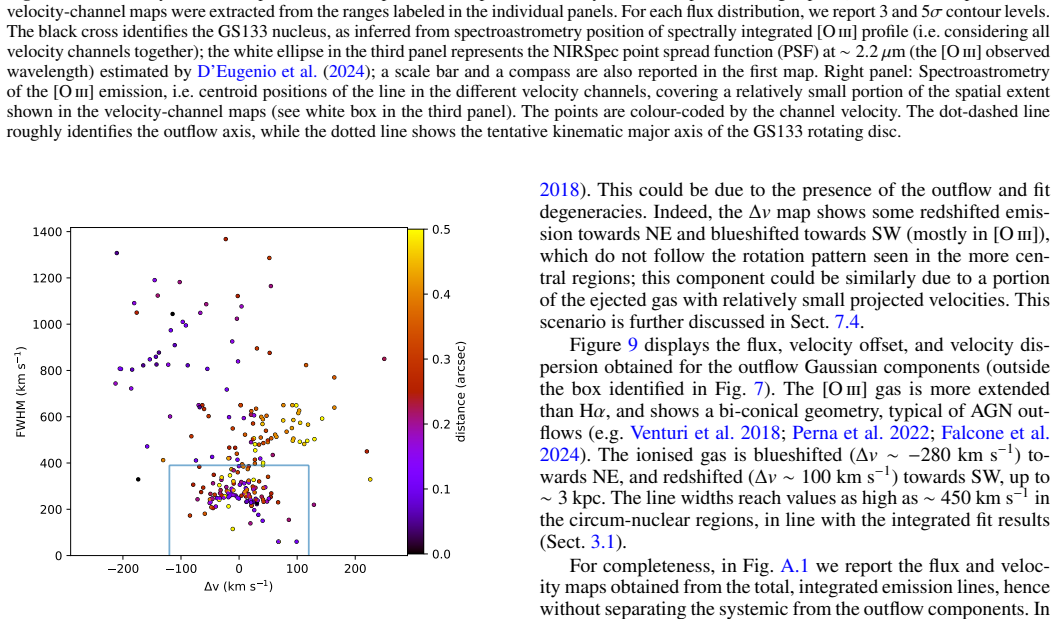
The central claim is that the mini-BAL absorbing gas and the [O III] emitting gas in GS133 are at least partially mixed in a single kpc-scale outflow. The UV spectrum shows two outflow components at about -900 and -1900 km/s, while the optical lines reveal a rotating disk plus a biconical outflow at roughly +/-1000 km/s extending to about 3 kpc. Photoionisation modelling with single-cloud Cloudy models and the ionisation-parameter distance relation places the absorbing clouds at 1 to 10 kpc, matching the distance of the [O III] gas, and 3D kinematic modelling of the [O III] bicone requires the approaching cone to intersect our line of sight. The paper concludes that similarities in velocity, location, and line-of-sight extension suggest at least partial mixing between the mini-BAL and [O III] outflows, while the faster -1900 km/s absorption component has no detected emission counterpart and may trace a different or fainter gas phase.
Load-bearing premise
Everything hinges on the photoionisation model's assumed AGN spectrum and free N/C and Si/C abundance ratios picking out the low-density branch, n_H of about 10 to 1000 $cm^{-3}$, as the true physical solution for the absorbing gas.
Editorial extensions
If this is right
- If the mini-BAL and [O III] gas are the same outflow, then at least some UV absorption outflows in high-redshift quasars are galaxy-wide winds on kiloparsec scales rather than nuclear, parsec-scale ejecta.
- The inferred energetics imply an energy-conserving wind: the momentum ratio of 4 to 40 and kinetic coupling of 0.1 to 1 percent of L_bol exceed what momentum-driven winds would naturally produce at these distances.
- With a mass-loading factor of 1 to 10 relative to the star-formation rate, the outflow can remove a substantial fraction of the gas available for star formation, supporting a feedback role on galactic scales.
- The fast -1900 km/s absorption component with no [O III] counterpart suggests that the outflow is not a single homogeneous phase, so future studies should allow absorbing clouds with different physical conditions or emission faintness.
- The methodology demonstrates a route to connecting unresolved UV absorption measurements to resolved IFS emission maps for high-redshift AGN, a combination that has rarely been applied beyond individual nearby objects.
Reading between the lines
- The paper leaves implicit that the apparent dichotomy between absorption-selected and emission-selected AGN outflows in large samples may be largely a viewing-angle effect: sources whose bicone crosses our line of sight show both tracers, while others show only one.
- A testable extension would be to apply the same Cloudy plus 3D kinematic modelling combination to a small sample of mini-BAL and BAL quasars with both JWST IFS and UV spectra; the fraction with kiloparsec-scale absorbing gas would calibrate how often the low-density single-cloud solution is the physically correct one.
- If the low-density branch is correct, the inferred high N/C abundance may instead reflect a separate density-bounded N V cloud rather than bulk enrichment; a higher-resolution UV spectrum that spatially or kinematically resolves N V from C IV absorption could test this.
- The tentative Balmer absorption at similar velocities, if confirmed with deeper data, would provide a direct optical absorption counterpart at the same velocity and a possible probe of hydrogen density through damping wings.
Editorial analysis
A structured set of objections, weighed in public.
Referee Report
Summary. This paper presents JWST/NIRSpec IFS and VLT/VIMOS observations of GS133, a Compton-thick AGN at z≈3.47. A multi-component kinematic decomposition of optical emission lines reveals a rotating disk with M_dyn≈2×10^10 M_sun and a bi-conical outflow extending about 3 kpc with v≈1000 km/s. The UV absorption lines show two mini-BAL components at v≈-900 km/s and -1900 km/s. Single-cloud Cloudy photoionisation models are used to infer the hydrogen density and ionisation parameter of the absorbing gas, from which the distance is derived via Eq. (4), yielding R_out=1-10 kpc. The MOKA3D model of the [O III] emission, with the approaching cone constrained to intersect the LOS, leads the authors to claim at least partial mixing between the mini-BAL and [O III] outflows. The outflow energetics imply mass-loading factors of 1-10 and kinetic coupling efficiencies of 0.1-1%, suggesting significant feedback on galactic scales.
Significance. If the kpc-scale distance and partial-mixing claims hold, this is a rare and valuable direct link between UV absorption and resolved optical emission outflows in a z≈3.5 Compton-thick quasar, supporting the picture of galaxy-scale AGN feedback. The observational analysis is careful and transparent, with explicit discussion of degeneracies (Sect. 7.2) and tentative detections (Sect. 3.3). The kinematic decomposition, spatial maps, and multi-species absorption fitting are solid, and the paper makes good use of complementary JWST and VLT datasets. The main caveats are the branch degeneracy in the photoionisation models and the construction of the 3D model, which are load-bearing for the central claim; the significance is therefore conditional on these assumptions.
major comments (3)
- [Sect. 7.2, Fig. 11, Eq. (4)] The distance R_out=1-10 kpc for the mini-BAL is not uniquely determined by the data: the single-cloud Cloudy models produce two families of solutions, a low-density branch (log n_H ≈ 1-3) and a high-density branch (log n_H ≈ 4-6), with comparable χ², as shown in Fig. 11. The paper rejects the high-density branch because the implied cloud thickness N_H/n_H is 'orders of magnitude smaller' than typical BLR cloud sizes and than sizes 'normally assumed in BAL models'. This is a theoretical prior rather than an observational constraint, and it implicitly assumes a volume filling factor of order unity. If the high-density branch is correct, Eq. (4) places the absorber at tens of parsecs, which would eliminate the claimed spatial coincidence with the 3-5 kpc [O III] bicone and reduce the 'partial mixing' conclusion to a coincidental velocity match. The paper acknowledges this degeneracy in Sect. 7.2, and it appropriately cautions about the extreme N/C ratio, but the central claim is stated without this caveat in the abstract and conclusions. I recommend adding a direct density diagnostic, such as the C II*/C II ratio available in the VIMOS spectrum, or explicitly quantifying how the distance and the mixing claim depend on the adopted prior.
- [Sect. 7.4] The MOKA3D setup enforces the conclusion it later draws. The model is constructed by requiring the approaching cone to have an inclination angle in [–45°, +45°] with respect to the LOS, so the finding that a portion of the [O III] gas lies along the LOS is guaranteed by the input geometry. The fit demonstrates compatibility with such a geometry, but no alternative geometry (e.g., cones oriented away from the LOS, different semi-aperture angles, or a model with the LOS intersecting only the receding cone) is tested. The 'partial mixing' conclusion in Sect. 9 therefore needs to be presented as a test of one specific geometry, or the authors should compare models with and without the LOS-overlap constraint.
- [Sect. 7.5, Table 5] The energetics argument described as an 'independent (but still indirect) confirmation of the kpc-scale location' is circular. The UV outflow momentum and kinetic power are computed using Eq. (1) and (2) with R_out=1-10 kpc, the very values whose validity the argument is supposed to test. The statement that a compact (R_out=1 pc) mini-BAL would have a momentum flux four orders of magnitude lower than the Hβ outflow is a restatement of the assumed radius, not an independent measurement. The comparison with the Hβ outflow momentum therefore cannot arbitrate between the Cloudy density branches.
minor comments (4)
- [Table 2] The transition labelled 'C ii 1335' in Table 2 is referred to as C ii λ1334.53 in Sect. 3.2.2; please clarify the wavelength convention (air vs vacuum) used in the table entries.
- [Sects. 3.1 and 3.2.1] The fitting algorithm is called 'Levenberg-Marquardt' in Sect. 3.1 and 'Levenberg–Markwardt' in Sect. 3.2.1; the spelling should be made consistent.
- [References] The reference list contains a duplicate entry for Kauffmann et al. (2003); one of the two entries should be removed.
- [Sect. 7.3] Because Eq. (5) scales as 1/n_e, the assumed n_e=1000 cm^-3 leads to a factor-of-several uncertainty in the mass outflow rate and kinetic power; this should be stated explicitly alongside the quoted values of 200 M_sun/yr and 3×10^43 erg/s.
Circularity Check
Partially circular: the kpc-scale mini-BAL distance is fed back into the 'independent' energetics confirmation, and MOKA3D enforces the LOS-intersecting cone that is then reported as evidence for partial mixing.
-
fitted input called prediction
[Sect. 7.5, Table 5 note; Eq. (1)]
"for the mini-BAL, we considered two potential outflow extents, 1 and 10 kpc, which align with the range determined from the Cloudy models in Sect. 7.1... Summarising, the computation of outflow energetics allowed us to obtain an independent (but still indirect) confirmation of the kpc-scale location of the mini-BAL."
The UV outflow energetics are computed from Eq. (1), in which the mass rate and hence the momentum flux scale linearly with the assumed Rout. Table 5 explicitly sets Rout = 1 and 10 kpc, the same values produced by the Cloudy models in Sect. 7.2. Sect. 7.5 then presents the resulting momentum ratios as an 'independent (but still indirect) confirmation' of the kpc-scale location. This is a consistency loop: Rout is an input to the energetics, and the energetics are then read as evidence for Rout. The Hβ momentum is independent, but it does not determine Rout for the absorber, so it cannot break the loop.
-
self definitional
[Sect. 7.4, MOKA3D modelling paragraph and conclusions]
"For the approaching cone, we required an inclination angle with respect to the LOS in the range [–45◦, +45◦], to ensure the overlap with our LOS; for the receding cone, we required an inclination angle in the range [180◦−45◦, 180◦+45◦]... this suggests that both the absorbing gas and part of the emitting [O III] could lie along our LOS and may be associated with the same outflow, possibly even physically mixed."
The MOKA3D parameter search is restricted to biconical geometries whose approaching side intersects the line of sight. The best-fit model therefore contains LOS-overlapping emitting gas by construction. Concluding from this fit that the [O III] and mini-BAL absorbing gas are 'partially mixed' or that 'a portion of the emitting gas resides along our line of sight' is a restatement of the imposed prior, not an independent spatial inference. The coincident velocity of about 900 km/s is an empirical consistency check, but it cannot discriminate between a LOS-intersecting bicone and other orientations, so it does not add independent evidence for spatial mixing.
full rationale
The empirical core of the paper is independent: the VIMOS mini-BAL absorption profiles, the NIRSpec [O III] bicone maps, and the tentative Balmer absorption are direct detections, and the Cloudy photoionisation fit itself is not circular—it matches observed ionic column densities with free n_H, U, N/C, and Si/C, then inverts Eq. (4) for Rout using an assumed AGN SED. The high-density solution family that would place the absorber at parsec scales is acknowledged (Sect. 7.2, Fig. 11) and rejected with an external cloud-thickness prior, which is a model-selection assumption rather than a self-referential reduction. However, two load-bearing conclusions do reduce by construction. First, the 'independent confirmation' of the kpc distance in Sect. 7.5 uses Rout = 1–10 kpc from the Cloudy models as input to the UV energetics, so the momentum flux it compares is not an independent test. Second, the MOKA3D 'partial mixing' claim is generated by restricting the fit to cones that intersect the LOS; the conclusion is an output of that constraint. No load-bearing self-citation chain or imported uniqueness theorem is present; MOKA3D and GA-NIFS citations are code/data provenance, not circular evidence. Because part of the central spatial-coincidence claim reduces by construction while the photometric/kinematic measurements and the Cloudy inversion retain independent content, the paper is partially circular rather than fully equivalent to its inputs.
Assumptions & free parameters
free parameters (7)
- ne_outflow =
1000 cm^-3
- Rout_emission =
3 kpc
- vout_emission =
1000 km/s
- Covering factor Cf =
1 (maximised)
- Cloudy N/C and Si/C =
log(N/C)=1, Si depletion 0.52 dex
- MOKA3D geometry =
semi-aperture 45 deg, inclination 40/225 deg, velocities 800-900 km/s, radius 5 kpc
- Lbol fiducial =
1.6e45 erg/s (X-ray with BC=260)
assumptions (6)
- ad hoc to paper Cloudy single-cloud models with the assumed SED (Eq. 3) describe the absorbing gas
- domain assumption AGN ionising SED shape from Eq. 3 with TBB=1e6 K, alpha_ox=-1.4, alpha_x=-1, alpha_uv=-0.5
- ad hoc to paper FWHM of systemic Halpha traces circular velocity with sin(i) correction, R=1 kpc disk radius
- domain assumption Outflowing gas has solar metallicity for [O III]-based energetics
- ad hoc to paper MOKA3D biconical geometry with constant radial velocities and 45 degree semi-aperture angle
- domain assumption Duras et al. bolometric correction 260 applied to X-ray luminosity
Cite this review
Pith. "Pith review of GA-NIFS: A galaxy-wide outflow in a Compton-thick mini-BAL quasar at z = 3.5 probed in emission and absorption." pith.science (2026). https://pith.science/paper/UQAMXS46
@misc{pith2026241113698,
  author       = {Pith},
  title        = {Pith review of: GA-NIFS: A galaxy-wide outflow in a Compton-thick mini-BAL quasar at z = 3.5 probed in emission and absorption},
  year         = {2026},
  howpublished = {\url{https://pith.science/paper/UQAMXS46}},
  note         = {Machine review of arXiv:2411.13698}
}
read the original abstract
Studying the distribution and properties of ionised gas in outflows driven by AGN is crucial for understanding the feedback mechanisms at play in extragalactic environments. In this study, we explore the connection between ionised outflows traced by rest-frame UV absorption and optical emission lines in GS133, a Compton thick AGN at z = 3.47. We combine observations from the JWST NIRSpec Integral Field Spectrograph (IFS) with archival VLT VIMOS long-slit spectroscopic data, as part of the GA-NIFS project. We perform a multi-component kinematic decomposition of the UV and optical line profiles to derive the physical properties of the absorbing and emitting gas in GS133. Our kinematic decomposition reveals two distinct components in the optical lines. The first component likely traces a rotating disk with a dynamical mass of 2e10 Msun. The second component corresponds to a galaxy-wide, bi-conical outflow, with a velocity of 1000 km/s and an extension of 3 kpc. The UV absorption lines show two outflow components, with bulk velocities v_out = -900 km/s and -1900 km/s, respectively. This characterises GS133 as a mini-BAL system. Balmer absorption lines with similar velocities are tentatively detected in the NIRSpec spectrum. Both photoionisation models and outflow energetics suggest that the ejected absorbing gas is located at 1-10 kpc from the AGN. We use 3D gas kinematic modelling to infer the orientation of the [O III] bi-conical outflow, and find that a portion of the emitting gas resides along our line of sight, suggesting that [O III] and absorbing gas clouds are partially mixed in the outflow. The derived mass-loading factor (i.e. the mass outflow rate divided by the SFR) of 1-10, and the kinetic coupling efficiency (i.e. the kinetic power divided by LAGN) of 0.1-1% per cent suggest that the outflow in GS133 provides significant feedback on galactic scales.
Figures


Figures from the paper (10 more)




Forward citations
Cited by 1 Pith paper
-
XMM/HST monitoring of the ultra-soft highly accreting Narrow Line Seyfert 1 RBS 1332
For RBS 1332, broadband UV-to-X-ray spectra favor a warm Comptonization origin for the soft X-ray excess, with only marginal relativistic reflection.
Reference graph
Works this paper leans on
-
[1]
N., Adelman-McCarthy, J
Abazajian, K. N., Adelman-McCarthy, J. K., Agüeros, M. A., et al. 2009, ApJS, 182, 543
2009
-
[2]
2024, ApJ, 968, 77
Ahmed, H., Shemmer, O., Matthews, B., et al. 2024, ApJ, 968, 77
2024
-
[3]
2013, MNRAS, 436, 3286
Arav, N., Borguet, B., Chamberlain, C., Edmonds, D., & Danforth, C. 2013, MNRAS, 436, 3286
2013
-
[4]
2014, A&A, 568, A14
Arribas, S., Colina, L., Bellocchi, E., Maiolino, R., & Villar-Martín, M. 2014, A&A, 568, A14
2014
-
[5]
A., Phillips, M
Baldwin, J. A., Phillips, M. M., & Terlevich, R. 1981, PASP, 93, 5
1981
-
[6]
2010, A&A, 512, A12 Article number, page 16 of 21 M
Balestra, I., Mainieri, V ., Popesso, P., et al. 2010, A&A, 512, A12 Article number, page 16 of 21 M. Perna et al.: GA-NIFS: A galaxy-wide outflow in a Compton thick quasar at z = 3.5
2010
-
[7]
& Netzer, H
Baron, D. & Netzer, H. 2019, MNRAS, 486, 4290
2019
-
[8]
2024, arXiv e-prints, arXiv:2408.16821
Bertola, E., Circosta, C., Ginolfi, M., et al. 2024, arXiv e-prints, arXiv:2408.16821
arXiv 2024
Show all 147 references
-
[9]
2024, ApJ, 970, 9 Böker, T., Arribas, S., Lützgendorf, N., et al
Bischetti, M., Choi, H., Fiore, F., et al. 2024, ApJ, 970, 9 Böker, T., Arribas, S., Lützgendorf, N., et al. 2022, A&A, 661, A82
2024
-
[10]
J., Hardmeier, E., et al
Bordoloi, R., Lilly, S. J., Hardmeier, E., et al. 2013, ArXiv e-prints [arXiv:1307.6553]
2013 arXiv
-
[11]
2019, A&A, 630, A111
Bruni, G., Piconcelli, E., Misawa, T., et al. 2019, A&A, 630, A111
2019
-
[12]
2018, A&A, 612, A29 Calabrò, A., Pentericci, L., Feltre, A., et al
Brusa, M., Cresci, G., Daddi, E., et al. 2018, A&A, 612, A29 Calabrò, A., Pentericci, L., Feltre, A., et al. 2023, A&A, 679, A80 Cano-Díaz, M., Maiolino, R., Marconi, A., et al. 2012, A&A, 537, L8
2018
-
[13]
2017, MNRAS, 466, 798
Cappellari, M. 2017, MNRAS, 466, 798
2017
-
[14]
A., Clayton, G
Cardelli, J. A., Clayton, G. C., & Mathis, J. S. 1989, ApJ, 345, 245
1989
-
[15]
C., Walker, S., McLure, R
Carnall, A. C., Walker, S., McLure, R. J., et al. 2020, MNRAS, 496, 695
2020
-
[16]
2015, A&A, 580, A102
Carniani, S., Marconi, A., Maiolino, R., et al. 2015, A&A, 580, A102
2015
-
[17]
2003, PASP, 115, 763
Chabrier, G. 2003, PASP, 115, 763
2003
-
[18]
2021, ApJ, 920, 24
Chartas, G., Cappi, M., Vignali, C., et al. 2021, ApJ, 920, 24
2021
-
[19]
C., Liu, X., et al
Chen, Y .-C., Gross, A. C., Liu, X., et al. 2024, arXiv e-prints, arXiv:2409.16351
2024 arXiv
-
[20]
M., Dabbieri, C., et al
Choi, H., Leighly, K. M., Dabbieri, C., et al. 2022, ApJ, 936, 110
2022
-
[21]
2014, A&A, 562, A21
Cicone, C., Maiolino, R., Sturm, E., et al. 2014, A&A, 562, A21
2014
-
[22]
2015, A&A, 576, A10
Ciesla, L., Charmandaris, V ., Georgakakis, A., et al. 2015, A&A, 576, A10
2015
-
[23]
2004, in Astrophysics and Space Science Library, V ol
Comastri, A. 2004, in Astrophysics and Space Science Library, V ol. 308, Super- massive Black Holes in the Distant Universe, ed. A. J. Barger, 245–+
2004
-
[24]
T., Daddi, E., Sargent, M
Coogan, R. T., Daddi, E., Sargent, M. T., et al. 2018, MNRAS, 479, 703
2018
-
[25]
A., et al
Costantin, L., Gillman, S., Boogaard, L. A., et al. 2024, arXiv e-prints, arXiv:2407.00153
2024 arXiv
-
[26]
2015, ApJ, 799, 82
Cresci, G., Mainieri, V ., Brusa, M., et al. 2015, ApJ, 799, 82
2015
-
[27]
2023, arXiv e-prints, arXiv:2301.11060
Cresci, G., Tozzi, G., Perna, M., et al. 2023, arXiv e-prints, arXiv:2301.11060
2023 arXiv
-
[28]
2000, A&A, 359, 489
Cristiani, S., Appenzeller, I., Arnouts, S., et al. 2000, A&A, 359, 489
2000
-
[29]
2024, ApJ, 969, 99
Dai, X., Hao, L., Jiang, P., et al. 2024, ApJ, 969, 99
2024
-
[30]
L., Belli, S., Park, M., et al
Davies, R. L., Belli, S., Park, M., et al. 2024, MNRAS, 528, 4976 De Rosa, A., Vignali, C., Bogdanovi´c, T., et al. 2019, New A Rev., 86, 101525
2024
-
[31]
P., et al
Decarli, R., Loiacono, F., Farina, E. P., et al. 2024, arXiv e-prints, arXiv:2406.06697
2024 arXiv
-
[32]
P., et al
Decarli, R., Walter, F., Venemans, B. P., et al. 2018, ApJ, 854, 97 Del Zanna, G., Landini, M., & Mason, H. E. 2002, A&A, 385, 968 D’Eugenio, F., Pérez-González, P. G., Maiolino, R., et al. 2024, Nature Astron- omy [arXiv:2308.06317] Di Matteo, T., Springel, V ., & Hernquist, ...
2018 arXiv
-
[33]
P., Bautista, M., Arav, N., et al
Dunn, J. P., Bautista, M., Arav, N., et al. 2010, ApJ, 709, 611
2010
-
[34]
2020, A&A, 636, A73
Duras, F., Bongiorno, A., Ricci, F., et al. 2020, A&A, 636, A73
2020
-
[35]
M., Fischer, T
Falcone, J., Crenshaw, D. M., Fischer, T. C., et al. 2024, ApJ, 971, 17 Faucher-Giguère, C.-A. & Quataert, E. 2012, MNRAS, 425, 605
2024
-
[36]
2016, MNRAS, 456, 3354
Feltre, A., Charlot, S., & Gutkin, J. 2016, MNRAS, 456, 3354
2016
-
[37]
J., Chatzikos, M., Guzmán, F., et al
Ferland, G. J., Chatzikos, M., Guzmán, F., et al. 2017, Revista Mexicana de As- tronomía y Astrofísica, 53, 385
2017
-
[38]
2017, A&A, 601, A143
Fiore, F., Feruglio, C., Shankar, F., et al. 2017, A&A, 601, A143
2017
-
[39]
C., Crenshaw, D
Fischer, T. C., Crenshaw, D. M., Kraemer, S. B., Schmitt, H. R., & Turner, T. J. 2014, ApJ, 785, 25 Förster Schreiber, N. M., Renzini, A., Mancini, C., et al. 2018, ApJS, 238, 21 Förster Schreiber, N. M., Übler, H., Davies, R. L., et al. 2019, ApJ, 875, 21
2014
-
[40]
2021, A&A, 647, A150
Garilli, B., McLure, R., Pentericci, L., et al. 2021, A&A, 647, A150
2021
-
[41]
M., Rosario, D., et al
Genzel, R., Förster Schreiber, N. M., Rosario, D., et al. 2014, ApJ, 796, 7
2014
-
[42]
C., Koekemoer, A
Giavalisco, M., Ferguson, H. C., Koekemoer, A. M., et al. 2004, ApJ, 600, L93
2004
-
[43]
& Proga, D
Giustini, M. & Proga, D. 2019, A&A, 630, A94
2019
-
[44]
J., & Scott, P
Grevesse, N., Asplund, M., Sauval, A. J., & Scott, P. 2010, Ap&SS, 328, 179
2010
-
[45]
M., Ji, X., Chatzikos, M., Yan, R., & Ferland, G
Gunasekera, C. M., Ji, X., Chatzikos, M., Yan, R., & Ferland, G. 2023, MNRAS, 520, 4345
2023
-
[46]
2020, MNRAS, 492, 1887
Guo, X., Gu, Q., Ding, N., Contini, E., & Chen, Y . 2020, MNRAS, 492, 1887
2020
-
[47]
2021, ApJ, 908, 169
Guo, X., Gu, Q., Ding, N., Yu, X., & Chen, Y . 2021, ApJ, 908, 169
2021
-
[48]
2019, MNRAS, 483, 1808
Hamann, F., Herbst, H., Paris, I., & Capellupo, D. 2019, MNRAS, 483, 1808
2019
-
[49]
& Sabra, B
Hamann, F. & Sabra, B. 2004, in Astronomical Society of the Pacific Conference
2004
-
[50]
M., Alexander, D
Harrison, C. M., Alexander, D. M., Swinbank, A. M., et al. 2012, MNRAS, 426, 1073
2012
-
[51]
M., Costa, T., Tadhunter, C
Harrison, C. M., Costa, T., Tadhunter, C. N., et al. 2018, Nature Astronomy, 2, 198
2018
-
[52]
M., Johnson, H
Harrison, C. M., Johnson, H. L., Swinbank, A. M., et al. 2017, MNRAS, 467, 1965
2017
-
[53]
M., Kauffmann, G., Brinchmann, J., et al
Heckman, T. M., Kauffmann, G., Brinchmann, J., et al. 2004, ApJ, 613, 109
2004
-
[54]
F., Hernquist, L., Cox, T
Hopkins, P. F., Hernquist, L., Cox, T. J., & Kereš, D. 2008, ApJS, 175, 356
2008
-
[55]
2014, ApJ, 796, 60
Hsu, L.-T., Salvato, M., Nandra, K., et al. 2014, ApJ, 796, 60
2014
-
[56]
B., Crenshaw, D
Hutchings, J. B., Crenshaw, D. M., Kraemer, S. B., et al. 2002, AJ, 124, 2543
2002
-
[57]
C., & Hewett, P
Ishibashi, W., Fabian, A. C., & Hewett, P. C. 2024, MNRAS, 533, 4384
2024
-
[58]
A., et al
Jakobsen, P., Ferruit, P., de Oliveira, C. A., et al. 2022, A&A, 661, A80
2022
-
[59]
Jenkins, E. B. 2009, ApJ, 700, 1299 Juodžbalis, I., Ji, X., Maiolino, R., et al. 2024, arXiv e-prints, arXiv:2407.08643
2009 arXiv
-
[60]
2020, A&A, 642, A147
Kakkad, D., Mainieri, V ., Vietri, G., et al. 2020, A&A, 642, A147
2020
-
[61]
J., & Bonfield, D
Karouzos, M., Jarvis, M. J., & Bonfield, D. 2014, MNRAS, 439, 861
2014
-
[62]
S., Rose, C., Vanderhoof, B
Kartaltepe, J. S., Rose, C., Vanderhoof, B. N., et al. 2023, ApJ, 946, L15
2023
-
[63]
J., Matthee, J., et al
Kashino, D., Lilly, S. J., Matthee, J., et al. 2023, ApJ, 950, 66
2023
-
[65]
M., Tremonti, C., et al
Kauffmann, G., Heckman, T. M., Tremonti, C., et al. 2003, MNRAS, 346, 1055
2003
-
[66]
P., Feibelman, W
Keenan, F. P., Feibelman, W. A., & Berrington, K. A. 1992, ApJ, 389, 443
1992
-
[67]
E., Forster Schreiber, N
Kehoe, E., Shapley, A. E., Forster Schreiber, N. M., et al. 2024, arXiv e-prints, arXiv:2406.07621
2024 arXiv
-
[68]
J., Dopita, M
Kewley, L. J., Dopita, M. A., Sutherland, R. S., Heisler, C. A., & Trevena, J. 2001, ApJ, 556, 121
2001
-
[69]
& Pounds, K
King, A. & Pounds, K. 2015, ARA&A, 53, 115
2015
-
[70]
D., Finkelstein, S
Kocevski, D. D., Finkelstein, S. L., Barro, G., et al. 2024, arXiv e-prints, arXiv:2404.03576
2024 arXiv
-
[71]
2018, arXiv e-prints, arXiv:1803.01187
Krogager, J.-K. 2018, arXiv e-prints, arXiv:1803.01187
2018 arXiv
-
[72]
S., Reeves, J., et al
Laha, S., Reynolds, C. S., Reeves, J., et al. 2021, Nature Astronomy, 5, 13
2021
-
[73]
2024, A&A, 691, A153
Lamperti, I., Arribas, S., Perna, M., et al. 2024, A&A, 691, A153
2024
-
[74]
2022, A&A, 668, A45
Lamperti, I., Pereira-Santaella, M., Perna, M., et al. 2022, A&A, 668, A45
2022
-
[75]
2017, A&A, 602, A123
Lanzuisi, G., Delvecchio, I., Berta, S., et al. 2017, A&A, 602, A123
2017
-
[76]
2024, arXiv e-prints, arXiv:2406.12057
Lanzuisi, G., Matzeu, G., Baldini, P., et al. 2024, arXiv e-prints, arXiv:2406.12057
2024 arXiv
-
[77]
2015, A&A, 578, A120
Lanzuisi, G., Perna, M., Delvecchio, I., et al. 2015, A&A, 578, A120
2015
-
[78]
2019, ApJ, 877, 5
Li, J., Xue, Y ., Sun, M., et al. 2019, ApJ, 877, 5
2019
-
[79]
Liu, G., Arav, N., & Rupke, D. S. N. 2015, ApJS, 221, 9
2015
-
[80]
L., Greene, J
Liu, G., Zakamska, N. L., Greene, J. E., Nesvadba, N. P. H., & Liu, X. 2013, MNRAS, 436, 2576
2013
-
[81]
N., Xue, Y
Luo, B., Brandt, W. N., Xue, Y . Q., et al. 2017, ApJS, 228, 2
2017
-
[82]
2015, A&A, 576, A56
Maeder, A., Meynet, G., & Chiappini, C. 2015, A&A, 576, A56
2015
-
[83]
& Mannucci, F
Maiolino, R. & Mannucci, F. 2019, A&A Rev., 27, 3
2019
-
[84]
1998, A&A, 338, 781
Maiolino, R., Salvati, M., Bassani, L., et al. 1998, A&A, 338, 781
1998
-
[85]
2024, Nature, 627, 59
Maiolino, R., Scholtz, J., Witstok, J., et al. 2024, Nature, 627, 59
2024
-
[86]
2023, arXiv e-prints, arXiv:2306.00953
Maiolino, R., Uebler, H., Perna, M., et al. 2023, arXiv e-prints, arXiv:2306.00953
2023 arXiv
-
[87]
2023, arXiv e-prints, arXiv:2305.07396
Mannucci, F., Scialpi, M., Ciurlo, A., et al. 2023, arXiv e-prints, arXiv:2305.07396
2023 arXiv
-
[88]
2023, A&A, 677, A58
Marconcini, C., Marconi, A., Cresci, G., et al. 2023, A&A, 677, A58
2023
-
[89]
2024, A&A, 689, A78
Marconi, A., Amiri, A., Feltre, A., et al. 2024, A&A, 689, A78
2024
-
[90]
A., Perna, M., Willott, C
Marshall, M. A., Perna, M., Willott, C. J., et al. 2023, A&A, 678, A191
2023
-
[91]
A., Yue, M., Eilers, A.-C., et al
Marshall, M. A., Yue, M., Eilers, A.-C., et al. 2024, arXiv e-prints, arXiv:2410.11035
2024
-
[92]
2023, A&A, 674, A221
Mascia, S., Pentericci, L., Saxena, A., et al. 2023, A&A, 674, A221
2023
-
[93]
P., Brammer, G., et al
Matthee, J., Naidu, R. P., Brammer, G., et al. 2024, ApJ, 963, 129
2024
-
[94]
A., Brusa, M., Lanzuisi, G., et al
Matzeu, G. A., Brusa, M., Lanzuisi, G., et al. 2023, A&A, 670, A182
2023
-
[95]
J., Pentericci, L., Cimatti, A., et al
McLure, R. J., Pentericci, L., Cimatti, A., et al. 2018, MNRAS, 479, 25
2018
-
[96]
M., Schmitt, H
Meena, B., Crenshaw, D. M., Schmitt, H. R., et al. 2021, ApJ, 916, 31
2021
-
[97]
A., Brusa, M., et al
Mehdipour, M., Kriss, G. A., Brusa, M., et al. 2023, A&A, 670, A183
2023
-
[98]
A., Hamann, F., Capellupo, D
Moravec, E. A., Hamann, F., Capellupo, D. M., et al. 2017, MNRAS, 468, 4539
2017
-
[99]
R., Alexander, D
Mullaney, J. R., Alexander, D. M., Fine, S., et al. 2013, MNRAS, 433, 622 Müller-Sánchez, F., Comerford, J., Stern, D., & Harrison, F. A. 2016, ApJ, 830, 50
2013
-
[100]
2023, A&A, 679, A84
Musiimenta, B., Brusa, M., Liu, T., et al. 2023, A&A, 679, A84
2023
-
[101]
2018, A&A, 612, A94
Nakajima, K., Schaerer, D., Le Fèvre, O., et al. 2018, A&A, 612, A94
2018
-
[102]
P., et al
Neeleman, M., Novak, M., Venemans, B. P., et al. 2021, ApJ, 911, 141
2021
-
[103]
2019, MNRAS, 488, 5185
Netzer, H. 2019, MNRAS, 488, 5185
2019
-
[104]
Osterbrock, D. E. & Ferland, G. J. 2006, Astrophysics of gaseous nebulae and active galactic nuclei (University Science Books)
2006
-
[105]
2024b, arXiv e-prints, arXiv:2407.19008
Parlanti, E., Carniani, S., Venturi, G., et al. 2024b, arXiv e-prints, arXiv:2407.19008
-
[106]
2024, A&A, 684, A119
Pensabene, A., Cantalupo, S., Cicone, C., et al. 2024, A&A, 684, A119
2024
-
[107]
2018, A&A, 616, A171
Pereira-Santaella, M., Colina, L., García-Burillo, S., et al. 2018, A&A, 616, A171
2018
-
[108]
2020, A&A, 643, A139
Perna, M., Arribas, S., Catalán-Torrecilla, C., et al. 2020, A&A, 643, A139
2020
-
[109]
2022, A&A, 662, A94
Perna, M., Arribas, S., Colina, L., et al. 2022, A&A, 662, A94
2022
-
[110]
2023a, arXiv e-prints, arXiv:2310.03067
Perna, M., Arribas, S., Lamperti, I., et al. 2023a, arXiv e-prints, arXiv:2310.03067
-
[111]
2015, A&A, 574, A82
Perna, M., Brusa, M., Cresci, G., et al. 2015, A&A, 574, A82
2015
-
[112]
2019, A&A, 623, A171
Perna, M., Cresci, G., Brusa, M., et al. 2019, A&A, 623, A171
2019
-
[113]
2017, A&A, 603, A99
Perna, M., Lanzuisi, G., Brusa, M., Mignoli, M., & Cresci, G. 2017, A&A, 603, A99
2017
-
[114]
T., Brusa, M., et al
Perna, M., Sargent, M. T., Brusa, M., et al. 2018, A&A, 619, A90
2018
-
[115]
L., et al
Perrotta, S., Hamann, F., Zakamska, N. L., et al. 2019, MNRAS, 488, 4126
2019
-
[116]
A., Reeves, J
Pounds, K. A., Reeves, J. N., King, A. R., et al. 2003, MNRAS, 345, 705
2003
-
[117]
J., Arendt, R
Rauscher, B. J., Arendt, R. G., Fixsen, D. J., et al. 2017, PASP, 129, 105003
2017
-
[118]
2023, PASP, 135, 048001 Rodríguez Del Pino, B., Perna, M., Arribas, S., et al
Rigby, J., Perrin, M., McElwain, M., et al. 2023, PASP, 135, 048001 Rodríguez Del Pino, B., Perna, M., Arribas, S., et al. 2024, A&A, 684, A187
2023
-
[119]
G., Trevese, D., Vagnetti, F., Perna, M., & Dadina, M
Saturni, F. G., Trevese, D., Vagnetti, F., Perna, M., & Dadina, M. 2016, A&A, 587, A43
2016
-
[120]
2024, arXiv e-prints, arXiv:2411.07695 Article number, page 17 of 21 A&A proofs: manuscript no
Scholtz, J., Curti, M., D’Eugenio, F., et al. 2024, arXiv e-prints, arXiv:2411.07695 Article number, page 17 of 21 A&A proofs: manuscript no. gs133
2024 arXiv
-
[121]
2023, arXiv e-prints, arXiv:2311.18731
Scholtz, J., Maiolino, R., D’Eugenio, F., et al. 2023, arXiv e-prints, arXiv:2311.18731
2023 arXiv
-
[122]
2018, ApJ, 853, 167
Schulze, A., Misawa, T., Zuo, W., & Wu, X.-B. 2018, ApJ, 853, 167
2018
-
[123]
2017, ApJ, 848, 104
Schulze, A., Schramm, M., Zuo, W., et al. 2017, ApJ, 848, 104
2017
-
[124]
Schwarz, U. J. 1978, A&A, 65, 345
1978
-
[125]
2024, A&A, 690, A57
Scialpi, M., Mannucci, F., Marconcini, C., et al. 2024, A&A, 690, A57
2024
-
[126]
T., Strauss, M
Shen, Y ., Richards, G. T., Strauss, M. A., et al. 2011, ApJS, 194, 45
2011
-
[127]
2016, ApJ, 819, 99
Shi, X., Zhou, H., Shu, X., et al. 2016, ApJ, 819, 99
2016
-
[128]
2024, MNRAS, 533, 2948
Stepney, M., Banerji, M., Tang, S., et al. 2024, MNRAS, 533, 2948
2024
-
[129]
J., Rankine, A
Temple, M. J., Rankine, A. L., Banerji, M., et al. 2024, MNRAS, 532, 424
2024
-
[130]
2019, ApJ, 877, 72
Tian, Q., Shi, X., Lu, H., et al. 2019, ApJ, 877, 72
2019
-
[131]
W., Stark, D
Topping, M. W., Stark, D. P., Senchyna, P., et al. 2024, arXiv e-prints, arXiv:2407.19009
2024 arXiv
-
[132]
2021, A&A, 648, A99
Tozzi, G., Cresci, G., Marasco, A., et al. 2021, A&A, 648, A99
2021
-
[133]
2024, arXiv e-prints, arXiv:2407.04099 Übler, H., D’Eugenio, F., Perna, M., et al
Tozzi, G., Cresci, G., Perna, M., et al. 2024, arXiv e-prints, arXiv:2407.04099 Übler, H., D’Eugenio, F., Perna, M., et al. 2024a, MNRAS, 533, 4287 Übler, H., Maiolino, R., Curtis-Lake, E., et al. 2023, A&A, 677, A145 Übler, H., Maiolino, R., Pérez-González, P. G., et al. 2024...
2024 arXiv
-
[134]
2024a, arXiv e-prints, arXiv:2407.08505
Ulivi, L., Perna, M., Lamperti, I., et al. 2024a, arXiv e-prints, arXiv:2407.08505
-
[135]
2005, ARA&A, 43, 769
Veilleux, S., Cecil, G., & Bland-Hawthorn, J. 2005, ARA&A, 43, 769
2005
-
[136]
2018, A&A, 619, A74
Venturi, G., Nardini, E., Marconi, A., et al. 2018, A&A, 619, A74
2018
-
[137]
2023, A&A, 678, A127 Véron-Cetty, M
Venturi, G., Treister, E., Finlez, C., et al. 2023, A&A, 678, A127 Véron-Cetty, M. P., Véron, P., & Gonçalves, A. C. 2001, A&A, 372, 730
2023
-
[138]
2003, ApJ, 599, 116
Vestergaard, M. 2003, ApJ, 599, 116
2003
-
[139]
2022, A&A, 668, A87 Villar Martín, M., Perna, M., Humphrey, A., et al
Vietri, G., Misawa, T., Piconcelli, E., et al. 2022, A&A, 668, A87 Villar Martín, M., Perna, M., Humphrey, A., et al. 2020, A&A, 634, A116
2022
-
[140]
2004, ApJ, 615, L17
Walter, F., Carilli, C., Bertoldi, F., et al. 2004, ApJ, 615, L17
2004
-
[141]
L., et al
Wang, B., de Graa ff, A., Davies, R. L., et al. 2024, arXiv e-prints, arXiv:2403.02304
2024 arXiv
-
[142]
J., Carswell, R
Weymann, R. J., Carswell, R. F., & Smith, M. G. 1981, ARA&A, 19, 41
1981
-
[143]
2016, ApJ, 817, 108
Woo, J.-H., Bae, H.-J., Son, D., & Karouzos, M. 2016, ApJ, 817, 108
2016
-
[144]
Wylezalek, D., Vayner, A., Rupke, D. S. N., et al. 2022, ApJ, 940, L7
2022
-
[145]
L., Arav, N., Miller, T., & Benn, C
Xu, X., Zakamska, N. L., Arav, N., Miller, T., & Benn, C. 2020, MNRAS, 495, 305
2020
-
[146]
2023, ApJ, 951, L5
Yang, J., Wang, F., Fan, X., et al. 2023, ApJ, 951, L5
2023
-
[147]
Zakamska, N. L. & Greene, J. E. 2014, MNRAS, 442, 784
2014
-
[148]
2015, ApJ, 815, 113 Article number, page 18 of 21 M
Zhang, S., Zhou, H., Shi, X., et al. 2015, ApJ, 815, 113 Article number, page 18 of 21 M. Perna et al.: GA-NIFS: A galaxy-wide outflow in a Compton thick quasar at z = 3.5 Appendix A: Spaxel-by-spaxel multi-Gaussian fit of the NIRSpec datacube Appendix B: Spatially integrated ...
2015
Reviewed August 12, 2026 · model on record in the stance chip above.
Discussion (0). Continue with ORCID to comment.