REVIEW 3 major objections 7 minor 2 cited by
Detecting Human Artifacts from Text-to-Image Models
T0 review · 3 major / 7 minor · reviewed 2026-08-12 · deepseek-v4-flash
Pith's one-line read This paper claims that human-body artifacts in text-to-image output can be localized by a detector trained on many generators, and that feeding its predictions back as negative prompts reduces those artifacts.
desk verdict Useful multi-generator artifact dataset and detector, but the central generalization claim lacks quantitative out-of-domain evaluation. read the letter →
The pith
A machine-rendered reading of the paper's core claim, the machinery that carries it, and where it could break.
The reading
What carries the argument
The load-bearing mechanism is the pairing of a labeled artifact dataset with a detection model that has seen healthy human bodies as negative examples. Local artifacts are annotated per body part and global artifacts as missing or extra parts, with a separate detector for each. Real human images with no artifact boxes are included in training so the model learns that normal anatomy is not an artifact; this is what lets it transfer to unseen generators and report fewer detections as image quality improves. The correction loop then uses detector confidence scores to decide which generations to keep: finetuning prepends artifact-type identifiers that are later used as negative prompts, and inpainting picks the candidate with the lowest artifact score.
What would settle it
Re-annotate a random sample of HAD images with multiple independent annotators and measure pairwise agreement; if agreement is near chance on images from the higher-fidelity generators, the AP50 values that support HADM's generalization are measuring label noise rather than detection ability.
Extended reading notes
Core claim
The central claim is that human artifacts in text-to-image output are localizable, and that a detector trained on diverse generator outputs generalizes better than aesthetic scorers, vision-language models, and prior artifact detectors. The authors curate the Human Artifact Dataset with 84,852 labeled instances across six local body-part classes and twelve global structural classes, train separate local and global detection models, and report that the local model performs best on generators with frequent artifacts while still catching subtle errors in higher-fidelity generators, including some not seen in training. The paper further claims that using detector-selected images with artifact-type identifiers as negative prompts during low-rank finetuning of a diffusion model reduces artifact scores, that human raters prefer the finetuned model, and that the detector selects better results in an iterative inpainting correction pipeline.
Load-bearing premise
The whole pipeline assumes that 'artifact' is a well-defined ground truth: individual human annotators decide what counts as a distorted, missing, or extra body part, and the paper reports no agreement check, so subjective and missed labels are baked into both the training signal and every evaluation number.
Editorial extensions
If this is right
- HAD and HADM provide a reusable benchmark for ranking text-to-image models by how often they distort human bodies, not just by aesthetics.
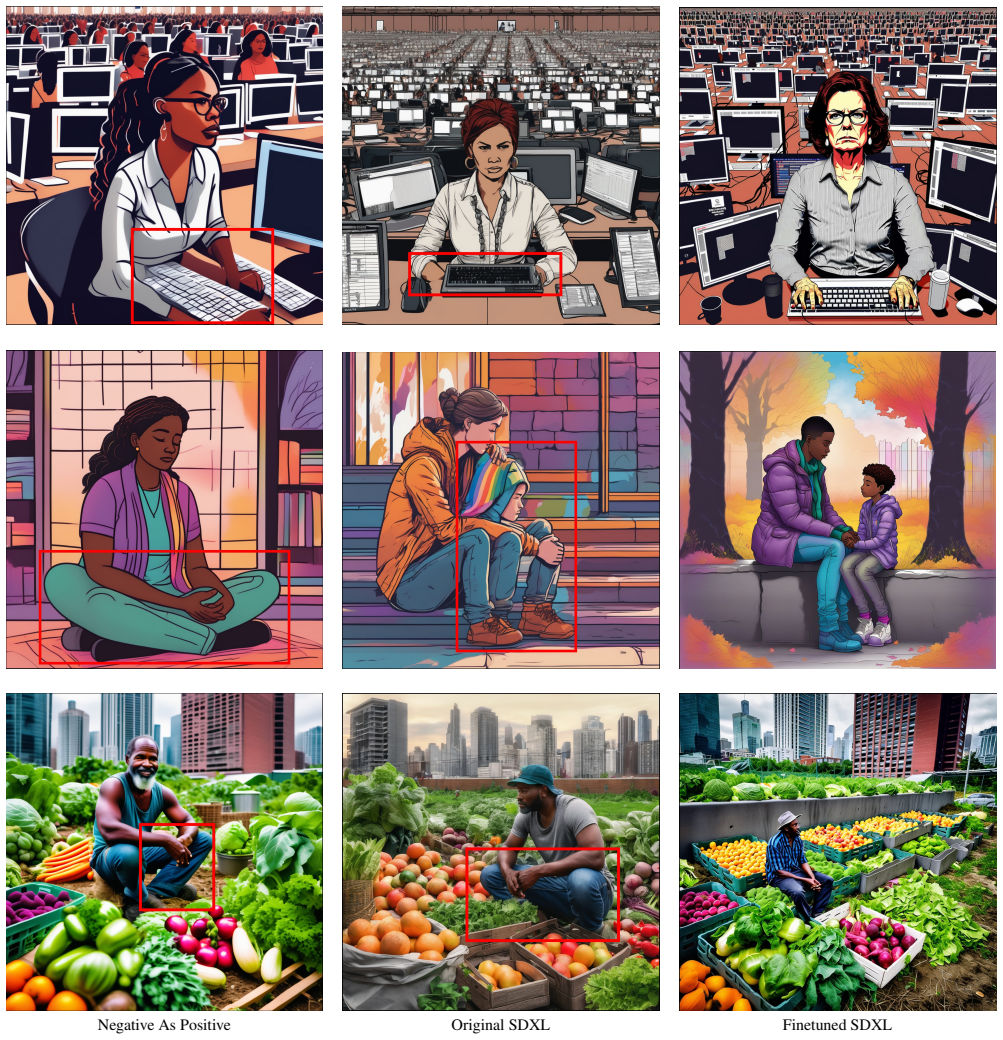
- Detector feedback can be folded into diffusion finetuning: artifact-type identifiers used as negative prompts lower both detector-measured and user-perceived artifact severity.
- Because the detector is trained to treat real human images as clean, it can be pointed at new generators and will flag fewer and lower-confidence artifacts as generator quality improves.
- The same detector can act as an automatic quality gate inside an inpainting loop, repeatedly fixing the most severe local artifact in an image.
Reading between the lines
- If the generalization claim holds, HADM-style detectors could serve as an automatic anatomy-specific reward for aligning future generation models, complementing coarse aesthetic preference models.
- The acknowledged annotator ambiguity suggests the low scores on high-fidelity generators may be as much label noise as detector error; re-annotating a sample with adjudicated majority labels would clarify this.
- A natural extension is to combine artifact boxes with pose or segmentation priors, which could resolve the ambiguous extra-limb cases the paper itself flags as corner cases.
Editorial analysis
A structured set of objections, weighed in public.
Referee Report
Summary. The paper curates the Human Artifact Dataset (HAD), containing 37,554 images from SDXL, DALL-E 2, DALL-E 3, and Midjourney with 84,852 bounding-box annotations covering six local artifact classes (face, torso, arm, hand, leg, feet) and twelve global artifact classes (missing and extra body parts). It trains two detectors, HADM-L and HADM-G, using ViTDet with an EVA-02 backbone and a Cascade R-CNN head, reporting in-domain AP50 of 43.3 for local and 23.9 for global artifacts and an AUC-based comparison against HumanRefiner, HPS-v2, ImageReward, GPT-4o, LLaVA, and Llama on a binarized classification version of the validation set. The paper further claims strong generalization to unseen generators, including SD1.4, PixArt-Sigma, FLUX.1-dev, Sana, and the real-image dataset 300W; it presents a LoRA finetuning of SDXL that uses HADM predictions as negative-prompt feedback, and an iterative inpainting pipeline for artifact correction, supported by a 15-participant user study that prefers the finetuned model.
Significance. If the claims held as stated, HAD would be a valuable released benchmark for human-structure evaluation in text-to-image models, and the demonstration that a dedicated detector outperforms strong vision-language models and aesthetics metrics on in-domain artifact ranking is a genuinely useful result. The paper ships dataset and models on GitHub, includes ablations of backbone and training choices, and provides a user study as an independent check of the finetuning claim; these are real strengths. However, the headline claim of strong generalization to unseen generators currently rests on qualitative examples and prediction statistics rather than on any ground-truth-based metric, and the quantitative finetuning evaluation is partly circular because it relies on HADM itself; both issues must be resolved for the stated contribution to stand.
major comments (3)
- [Abstract, Sec. 1 contributions, and Sec. 4.2 'Performance on Unseen Domains'] The claim that HADM 'demonstrate[s] strong generalization, even on images from unseen generators' is not supported by any ground-truth-based metric on out-of-domain data. All AP50 and AUC results (Tabs. 1-2, Fig. 4) are computed on the in-domain HAD validation set; for SD1.4, PixArt-Sigma, FLUX.1-dev, Sana, and 300W the evidence is a selection of top predictions (Figs. 6-7) and prediction-count/confidence statistics (Tab. 3). Neither measures correctness, and the decreasing prediction counts on FLUX.1-dev and Sana in Tab. 3 could equally reflect confidence calibration or domain shift, while the low count on 300W could reflect a false-negative pattern; the interpretation of Tab. 3 as sensitivity to artifact severity is underdetermined. The stress-test concern lands here: even with perfectly reliable labels, the unseen-generator claim would remain unsupported without a labeled out-of-domain evaluation. I recommend annotating a labeled subset of images from at least the four unseen generators and reporting AP50/AUC there, or substantially tempering the generalization claim in the abstract and the contribution list.
- [Sec. 5.1 and supplementary Sec. 10 (Figs. 12-13, 14)] The primary quantitative evidence for artifact reduction uses HADM scores on images generated by the finetuned model, but HADM is also the detector that selected the finetuning training data (Sec. 3.3). A model trained to avoid detector-flagged regions is expected to obtain lower scores on that same detector even without genuine artifact reduction, so Figs. 12-13 and the hyperparameter analysis in Fig. 14 are partly circular. The user study in Tab. 4 is an independent check, but as reported it is small (15 participants, 200 pairs), no statistical test or confidence interval is given, and the stated preference (55% vs. 38.7%) is modest; the study design and inter-participant variability should be reported. I suggest evaluating the finetuned model on a fresh human-annotated sample outside the finetuning loop, or adding a second independent detector as an additional quantitative sanity check.
- [Sec. 3.1.2 (Annotation Pipeline) and Sec. 4.2] The ground truth is based on human annotation with no reported inter-annotator agreement, and the authors themselves acknowledge missed annotations and subjective ambiguity (Fig. 5 and the discussion of 'occasional oversight by annotators' and 'corner cases'). Because these ambiguous cases are stated to concentrate in the DALLE-3 and Midjourney domains, where AP50 is lowest (Tab. 1), the per-domain performance differences may partly reflect label noise rather than detector behavior, which in turn affects the validity of the in-domain benchmark claim. I recommend reporting annotation agreement (e.g., Cohen's kappa or IoU-based agreement on a re-annotated subset) and, if feasible, re-estimating per-domain AP50 after adjudication of the ambiguous cases.
minor comments (7)
- [Tabs. 1-2] Several per-category AP50 cells are computed on one or two instances (e.g., DALLE-2 torso at 100.0/1, DALLE-3 extra torso at 33.3/1, and multiple Tab. 2 cells with fewer than ten instances), so per-category values are statistically unstable; please add a caveat, report confidence intervals, or exclude categories below a minimum instance count.
- [Fig. 4 and Sec. 4.1] The y-axis of Fig. 4 is not labeled, and the paper should state the score convention for the quality-based baselines: for HPS-v2 and ImageReward, where higher scores indicate higher quality, an AUC below 50% may simply reflect inverse correlation rather than 'poor' performance, so the sign convention and the interpretation of below-50% AUC should be clarified.
- [Fig. 5 caption] The caption is ambiguous about which boxes are predictions and which constitute the reference annotation, particularly because the blue boxes are described both as detections and as context; please specify the visual encoding of red and blue boxes and what FP and FN are measured against.
- [Supplementary Sec. 7.4] The inpainting selection rule 'closest to half of the original score' is introduced as an empirical heuristic without supporting evidence or an ablation; please provide a justification or explicitly mark it as a limitation.
- [Abstract and Sec. 5.2] The inpainting pipeline is described as a 'novel application,' yet the paper itself cites iterative inpainting with confidence feedback in [65,66]; please clarify the specific novelty relative to those works and to HumanRefiner's refinement stage.
- [Reference list] Many reference entries carry stray trailing numbers after the year (e.g., [2] '... CVPR, pages 6154-6162, 2018. 4, 1'), which appear to be citation-page artifacts and should be cleaned up in the final version.
- [Ethical Considerations and Sec. 4.2] The ethical statement discourages applying the model to real-human images, but Sec. 4.2 evaluates on the real-image dataset 300W; please add one sentence clarifying that this evaluation is a controlled analysis of false-positive behavior and not an endorsement of deployment on real humans.
Circularity Check
Fine-tuning and inpainting results are evaluated with the same HADM detector that supplies the training/selection signal; the independent user study is small, so the artifact-reduction claim is only partially circular.
-
fitted input called prediction
[Supplementary Material, Sec. 10, Figs. 12-13; cf. Sec. 3.3]
"We then compute the total scores per image and the average scores of the top10% predictions from HADM-L and HADM-G on the generated images, presenting the results in Fig. 12 and Fig. 13. These results show that, compared to the original SDXL, our finetuned model produces fewer artifacts in terms of both quantity (lower total scores) and quality (lower average scores), which aligns with our user studies."
HADM provides the finetuning supervision: Sec. 3.3 states 'We then select the top k% of predicted bounding boxes from each category to identify artifacts' and prepends 'weird [ARTIFACT-TYPE]' identifiers. The finetuned model is trained with these HADM-derived negative prompts, so HADM is the instrument that defines which regions are artifacts and the target the model is taught to avoid. Re-scoring the finetuned model with the same HADM detector therefore measures success at the optimization objective rather than an independent reduction in human artifacts. Lower HADM scores are substantially forced by the training signal. The user study is the only independent check, and it is small (15 participants, 200 pairs) with no reported significance test.
-
self definitional
[Sec. 5.2 and Fig. 9 caption]
"For each detected artifact, we apply inpainting with 20 different random seeds and select the result based on HADM-L’s confidence scores. This iterative process integrates HADM-L into the inpainting pipeline, automating artifact correction and producing a refined final image."
The selection rule is literally 'select the result based on HADM-L's confidence scores' (with the precise rule in Sec. 7.4 being closest to half the original HADM-L score). The chosen inpainted image is thus the one that best satisfies HADM-L's own scoring among the 20 seeds. Presenting the output as a 'refined final image' and claiming 'improving image quality' in the abstract uses HADM-L as both the selector and the implicit quality measure, with no human or third-party evaluation reported for the inpainting results. The demonstration therefore reduces to the detector's own scoring definition.
full rationale
The paper's central detection contribution is self-contained: HADM is trained on HAD's human annotations and evaluated on the HAD validation set with AP50/AUC against those same human labels, so the in-domain detection numbers are not circular. The 'strong generalization to unseen generators' claim is not backed by ground-truth metrics, only by selected examples and prediction statistics (Tab. 3), but that is a missing-evaluation problem rather than a definitional circularity, so it is not scored as a circular step. No load-bearing self-citation chain appears. The circularity is confined to the two application demonstrations. In Secs. 3.3 and 5.1, HADM's own detections define the finetuning data (top-k% boxes become 'weird [ARTIFACT-TYPE]' negative prompts), and the main quantitative evidence of artifact reduction (Figs. 12-13) is HADM re-scoring the finetuned model; the finetuned model is expected to move away from HADM-flagged patterns, so lower HADM scores are substantially a consequence of the training signal. The 15-participant user preference study (Tab. 4) is an independent check and prevents a fully circular verdict, but it is small and reported without statistical testing. Similarly, the inpainting demonstration selects outputs by HADM-L confidence and then presents the chosen output as 'refined,' which is self-definitional without external evaluation. Overall, this is partial circularity in the artifact-reduction evidence, warranting a score of 6.
Assumptions & free parameters
free parameters (5)
- k (top-k ratio for artifact box selection during finetuning) =
30%
- LoRA rank =
32
- Inpainting selection rule =
closest to half of original artifact score
- Detection confidence threshold =
0.05
- Number of inpainting random seeds =
20
assumptions (5)
- domain assumption The six body parts and local/global taxonomy capture all relevant human artifacts
- domain assumption Artifacts in the four training generators are representative of artifacts in unseen generators
- domain assumption HADM artifact scores are a valid proxy for human-perceived artifact severity
- domain assumption Real human images with empty annotations improve robustness without biasing detection
- standard math Standard object detection metrics (AP50, AUC) are appropriate for artifact localization
Cite this review
Pith. "Pith review of Detecting Human Artifacts from Text-to-Image Models." pith.science (2026). https://pith.science/paper/BTICJZAT
@misc{pith2026241113842,
  author       = {Pith},
  title        = {Pith review of: Detecting Human Artifacts from Text-to-Image Models},
  year         = {2026},
  howpublished = {\url{https://pith.science/paper/BTICJZAT}},
  note         = {Machine review of arXiv:2411.13842}
}
read the original abstract
Despite recent advancements, text-to-image generation models often produce images containing artifacts, especially in human figures. These artifacts appear as poorly generated human bodies, including distorted, missing, or extra body parts, leading to visual inconsistencies with typical human anatomy and greatly impairing overall fidelity. In this study, we address this challenge by curating Human Artifact Dataset (HAD), a diverse dataset specifically designed to localize human artifacts. HAD comprises over 37,000 images generated by several popular text-to-image models, annotated for human artifact localization. Using this dataset, we train the Human Artifact Detection Models (HADM), which can identify different artifacts across multiple generative domains and demonstrate strong generalization, even on images from unseen generators. Additionally, to further improve generators' perception of human structural coherence, we use the predictions from our HADM as feedback for diffusion model finetuning. Our experiments confirm a reduction in human artifacts in the resulting model. Furthermore, we showcase a novel application of our HADM in an iterative inpainting framework to correct human artifacts in arbitrary images directly, demonstrating its utility in improving image quality. Our dataset and detection models are available at: https://github.com/wangkaihong/HADM.
Figures


Figures from the paper (17 more)


Forward citations
Cited by 2 Pith papers
-
GeneVA: A Dataset of Human Annotations for Generative Text to Video Artifacts
GeneVA is the first large-scale benchmark with human-annotated bounding boxes and text descriptions for artifacts in text-to-video generation.
-
Unified Backbone Refinement for Diffusion Models via Internal-Latent Analysis
Early abrupt deviations in deep diffusion latents track artifacts; EMA detection plus backbone-specific suppression (DUNE) reduces them without retraining.
Reference graph
Works this paper leans on
-
[1]
Tim Brooks, Aleksander Holynski, and Alexei A. Efros. In- structpix2pix: Learning to follow image editing instructions. In CVPR, pages 18392–18402, 2023. 1
2023
-
[2]
Cascade R-CNN: delv- ing into high quality object detection
Zhaowei Cai and Nuno Vasconcelos. Cascade R-CNN: delv- ing into high quality object detection. InCVPR, pages 6154– 6162, 2018. 4, 1
work page 2018
-
[3]
SynArtifact: Classifying and allevi- ating artifacts in synthetic images via vision-language model
Bin Cao, Jianhao Yuan, Yexin Liu, Jian Li, Shuyang Sun, Jing Liu, and Bo Zhao. SynArtifact: Classifying and allevi- ating artifacts in synthetic images via vision-language model. CoRR, abs/2402.18068, 2024. 2, 3
arXiv 2024
-
[4]
Pixart- Σ: Weak-to-strong training of dif- fusion transformer for 4k text-to-image generation
Junsong Chen, Chongjian Ge, Enze Xie, Yue Wu, Lewei Yao, Xiaozhe Ren, Zhongdao Wang, Ping Luo, Huchuan Lu, and Zhenguo Li. Pixart- Σ: Weak-to-strong training of dif- fusion transformer for 4k text-to-image generation. CoRR, abs/2403.04692, 2024. 4, 6, 7
arXiv 2024
-
[5]
Mark Everingham, Luc Van Gool, Christopher K. I. Williams, John M. Winn, and Andrew Zisserman. The pas- cal visual object classes (VOC) challenge. IJCV, pages 303– 338, 2010. 2
work page 2010
-
[6]
Guian Fang, Wenbiao Yan, Yuanfan Guo, Jianhua Han, Zu- tao Jiang, Hang Xu, Shengcai Liao, and Xiaodan Liang. HumanRefiner: Benchmarking abnormal human generation and refining with coarse-to-fine pose-reversible guidance. In ECCV, pages 201–217, 2024. 2, 3, 5
work page 2024
-
[7]
EV A-02: A visual representa- tion for neon genesis
Yuxin Fang, Quan Sun, Xinggang Wang, Tiejun Huang, Xin- long Wang, and Yue Cao. EV A-02: A visual representa- tion for neon genesis. Image and Vision Computing , page 105171, 2024. 4, 1
work page 2024
-
[8]
An introduction to ROC analysis
Tom Fawcett. An introduction to ROC analysis. Pattern Recognition Letters, (8):861–874, 2006. 2
work page 2006
Show all 78 references
-
[9]
Make-a-scene: Scene- based text-to-image generation with human priors
Oran Gafni, Adam Polyak, Oron Ashual, Shelly Sheynin, Devi Parikh, and Yaniv Taigman. Make-a-scene: Scene- based text-to-image generation with human priors. InECCV, pages 89–106, 2022. 1, 2
2022
-
[10]
Synthclip: Are we ready for a fully synthetic CLIP training? CoRR, abs/2402.01832, 2024
Hasan Abed Al Kader Hammoud, Hani Itani, Fabio Pizzati, Philip Torr, Adel Bibi, and Bernard Ghanem. Synthclip: Are we ready for a fully synthetic CLIP training? CoRR, abs/2402.01832, 2024. 1
2024 arXiv
-
[11]
Clipscore: A reference-free evaluation met- ric for image captioning
Jack Hessel, Ari Holtzman, Maxwell Forbes, Ronan Le Bras, and Yejin Choi. Clipscore: A reference-free evaluation met- ric for image captioning. In EMNLP, pages 7514–7528,
-
[12]
Gans trained by a two time-scale update rule converge to a local nash equilib- rium
Martin Heusel, Hubert Ramsauer, Thomas Unterthiner, Bernhard Nessler, and Sepp Hochreiter. Gans trained by a two time-scale update rule converge to a local nash equilib- rium. In NeurIPS, pages 6626–6637, 2017. 2
2017
-
[13]
Denoising diffu- sion probabilistic models
Jonathan Ho, Ajay Jain, and Pieter Abbeel. Denoising diffu- sion probabilistic models. In NeurIPS, 2020. 2
2020
-
[14]
Hu, Yelong Shen, Phillip Wallis, Zeyuan Allen- Zhu, Yuanzhi Li, Shean Wang, Lu Wang, and Weizhu Chen
Edward J. Hu, Yelong Shen, Phillip Wallis, Zeyuan Allen- Zhu, Yuanzhi Li, Shean Wang, Lu Wang, and Weizhu Chen. Lora: Low-rank adaptation of large language models. In ICLR. OpenReview.net, 2022. 4
2022
-
[15]
T2I-CompBench: A comprehensive benchmark for open-world compositional text-to-image generation
Kaiyi Huang, Kaiyue Sun, Enze Xie, Zhenguo Li, and Xi- hui Liu. T2I-CompBench: A comprehensive benchmark for open-world compositional text-to-image generation. In NeurIPS, 2023. 2
2023
-
[16]
Midjourney
Midjourney Inc. Midjourney. https : / / www . midjourney.com/, 2023. 1, 2, 3
2023
-
[17]
YOLOv8: State-of-the-Art Object Detection and Segmentation Models
Glenn Jocher and Ultralytics. YOLOv8: State-of-the-Art Object Detection and Segmentation Models. https:// github.com/ultralytics/ultralytics, 2023. 2
2023
-
[18]
Imagic: Text-based real image editing with diffusion models
Bahjat Kawar, Shiran Zada, Oran Lang, Omer Tov, Huiwen Chang, Tali Dekel, Inbar Mosseri, and Michal Irani. Imagic: Text-based real image editing with diffusion models. In CVPR, pages 6007–6017, 2023. 1
2023
-
[19]
Pick-a-pic: An open dataset of user preferences for text-to-image generation
Yuval Kirstain, Adam Polyak, Uriel Singer, Shahbuland Ma- tiana, Joe Penna, and Omer Levy. Pick-a-pic: An open dataset of user preferences for text-to-image generation. In NeurIPS, 2023. 2
2023
-
[20]
Black Forest Lab. Flux. https://blackforestlabs. ai/, 2023. 1, 4, 6, 7
2023
-
[21]
Holistic evaluation of text-to-image models
Tony Lee, Michihiro Yasunaga, Chenlin Meng, Yifan Mai, Joon Sung Park, Agrim Gupta, Yunzhi Zhang, Deepak Narayanan, Hannah Teufel, Marco Bellagente, Minguk Kang, Taesung Park, Jure Leskovec, Jun-Yan Zhu, Fei-Fei Li, Jiajun Wu, Stefano Ermon, and Percy Liang. Holistic evaluatio...
2023
-
[22]
GenAI-Bench: Evaluat- ing and improving compositional text-to-visual generation
Baiqi Li, Zhiqiu Lin, Deepak Pathak, Jiayao Li, Yixin Fei, Kewen Wu, Tiffany Ling, Xide Xia, Pengchuan Zhang, Gra- ham Neubig, and Deva Ramanan. GenAI-Bench: Evaluat- ing and improving compositional text-to-visual generation. CoRR, abs/2406.13743, 2024. 2
2024 arXiv
-
[23]
Towards real world human parsing: Multiple-human parsing in the wild
Jianshu Li, Jian Zhao, Yunchao Wei, Congyan Lang, Yidong Li, and Jiashi Feng. Towards real world human parsing: Multiple-human parsing in the wild. CoRR, abs/1705.07206,
-
[24]
Girshick, and Kaiming He
Yanghao Li, Hanzi Mao, Ross B. Girshick, and Kaiming He. Exploring plain vision transformer backbones for object de- tection. In ECCV, pages 280–296, 2022. 4
2022
-
[25]
Kohlhoff, Deepak Ramachandran, and Vidhya Navalpakkam
Youwei Liang, Junfeng He, Gang Li, Peizhao Li, Arseniy Klimovskiy, Nicholas Carolan, Jiao Sun, Jordi Pont-Tuset, Sarah Young, Feng Yang, Junjie Ke, Krishnamurthy Dj Dvi- jotham, Katie Collins, Yiwen Luo, Yang Li, Kai J. Kohlhoff, Deepak Ramachandran, and Vidhya Navalpakkam. Ri...
2024
-
[26]
Belongie, James Hays, Pietro Perona, Deva Ramanan, Piotr Doll ´ar, and C
Tsung-Yi Lin, Michael Maire, Serge J. Belongie, James Hays, Pietro Perona, Deva Ramanan, Piotr Doll ´ar, and C. Lawrence Zitnick. Microsoft COCO: common objects in context. In ECCV, pages 740–755, 2014. 4
2014
-
[27]
Evaluating text-to-visual generation with image-to-text gen- eration
Zhiqiu Lin, Deepak Pathak, Baiqi Li, Jiayao Li, Xide Xia, Graham Neubig, Pengchuan Zhang, and Deva Ramanan. Evaluating text-to-visual generation with image-to-text gen- eration. In ECCV, pages 366–384, 2024. 2
2024
-
[28]
Llava-next: Im- proved reasoning, ocr, and world knowledge, 2024
Haotian Liu, Chunyuan Li, Yuheng Li, Bo Li, Yuanhan Zhang, Sheng Shen, and Yong Jae Lee. Llava-next: Im- proved reasoning, ocr, and world knowledge, 2024. 1, 5
2024
-
[29]
Decoupled weight decay regularization
Ilya Loshchilov and Frank Hutter. Decoupled weight decay regularization. In ICLR, 2019. 8, 1
2019
-
[30]
Handrefiner: Refining malformed hands in generated images by diffusion-based conditional inpainting
Wenquan Lu, Yufei Xu, Jing Zhang, Chaoyue Wang, and Dacheng Tao. Handrefiner: Refining malformed hands in generated images by diffusion-based conditional inpainting. CoRR, abs/2311.17957, 2023. 2
2023 arXiv
-
[31]
Generating images from captions with attention
Elman Mansimov, Emilio Parisotto, Lei Jimmy Ba, and Rus- lan Salakhutdinov. Generating images from captions with attention. In ICLR, 2016. 1, 2
2016
-
[32]
Llama 3.2
Meta. Llama 3.2. https://ai.meta.com/blog/ llama - 3 - 2 - connect - 2024 - vision - edge - mobile-devices/, 2024. 5, 7, 1
2024
-
[33]
Hand- iffuser: Text-to-image generation with realistic hand appear- ances
Supreeth Narasimhaswamy, Uttaran Bhattacharya, Xiang Chen, Ishita Dasgupta, Saayan Mitra, and Minh Hoai. Hand- iffuser: Text-to-image generation with realistic hand appear- ances. In CVPR, pages 2468–2479, 2024. 2
2024
-
[34]
Glide: Towards photorealis- tic image generation and editing with text-guided diffusion models
Alexander Quinn Nichol, Prafulla Dhariwal, Aditya Ramesh, Pranav Shyam, Pamela Mishkin, Bob McGrew, Ilya Sutskever, and Mark Chen. Glide: Towards photorealis- tic image generation and editing with text-guided diffusion models. In ICML, pages 16784–16804, 2022. 2
2022
-
[35]
DALL-E 2
OpenAI. DALL-E 2. https://openai.com/index/ dall-e-2/, 2022. 1, 2, 3
2022
-
[36]
DALL-E 3
OpenAI. DALL-E 3. https://openai.com/index/ dall-e-3/, 2023. 1, 2, 3
2023
-
[37]
OpenAI. GPT-4. https://openai.com/index/ gpt-4/, 2023. 3
2023
-
[38]
OpenAI. GPT-4o. https://openai.com/index/ hello-gpt-4o/, 2024. 1, 5
2024
-
[39]
Toward verifiable and reproducible human evaluation for text-to-image generation
Mayu Otani, Riku Togashi, Yu Sawai, Ryosuke Ishigami, Yuta Nakashima, Esa Rahtu, Janne Heikkil ¨a, and Shin’ichi Satoh. Toward verifiable and reproducible human evaluation for text-to-image generation. In CVPR, pages 14277–14286,
-
[40]
On aliased resizing and surprising subtleties in GAN evaluation
Gaurav Parmar, Richard Zhang, and Jun-Yan Zhu. On aliased resizing and surprising subtleties in GAN evaluation. In CVPR, pages 11400–11410, 2022. 2
2022
-
[41]
Giving a hand to diffusion models: A two-stage ap- proach to improving conditional human image generation
Anton Pelykh, Ozge Mercanoglu Sincan, and Richard Bow- den. Giving a hand to diffusion models: A two-stage ap- proach to improving conditional human image generation. In FG, pages 1–10, 2024. 2
2024
-
[42]
SDXL: Improving latent diffusion mod- els for high-resolution image synthesis
Dustin Podell, Zion English, Kyle Lacey, Andreas Blattmann, Tim Dockhorn, Jonas M ¨uller, Joe Penna, and Robin Rombach. SDXL: Improving latent diffusion mod- els for high-resolution image synthesis. In ICLR, 2024. 1, 2, 3, 4
2024
-
[43]
HandCraft: Anatomically correct restoration of malformed hands in diffusion generated images.CoRR, abs/2403.01693,
Zhenyue Qin, Yiqun Zhang, Yang Liu, and Dylan Campbell. HandCraft: Anatomically correct restoration of malformed hands in diffusion generated images.CoRR, abs/2403.01693,
-
[44]
Zero-shot text-to-image generation
Aditya Ramesh, Mikhail Pavlov, Gabriel Goh, Scott Gray, Chelsea V oss, Alec Radford, Mark Chen, and Ilya Sutskever. Zero-shot text-to-image generation. In ICML, 2021. 2
2021
-
[45]
High-resolution image syn- thesis with latent diffusion models
Robin Rombach, Andreas Blattmann, Dominik Lorenz, Patrick Esser, and Bj¨orn Ommer. High-resolution image syn- thesis with latent diffusion models. In CVPR, pages 10674– 10685, 2022. 1, 2, 4, 6, 7
2022
-
[46]
300 faces in-the-wild challenge: The first facial landmark localization challenge
Christos Sagonas, Georgios Tzimiropoulos, Stefanos Zafeiriou, and Maja Pantic. 300 faces in-the-wild challenge: The first facial landmark localization challenge. In ICCV Workshop, pages 397–403, 2013. 4, 7
2013
-
[47]
Goodfellow, Wojciech Zaremba, Vicki Cheung, Alec Radford, and Xi Chen
Tim Salimans, Ian J. Goodfellow, Wojciech Zaremba, Vicki Cheung, Alec Radford, and Xi Chen. Improved techniques for training gans. In NeurIPS, pages 2226–2234, 2016. 2
2016
-
[48]
Crowdhuman: A benchmark for detecting human in a crowd
Shuai Shao, Zijian Zhao, Boxun Li, Tete Xiao, Gang Yu, Xi- angyu Zhang, and Jian Sun. Crowdhuman: A benchmark for detecting human in a crowd. CoRR, abs/1805.00123, 2018. 4
2018 arXiv
-
[49]
Objects365: A large-scale, high-quality dataset for object detection
Shuai Shao, Zeming Li, Tianyuan Zhang, Chao Peng, Gang Yu, Xiangyu Zhang, Jing Li, and Jian Sun. Objects365: A large-scale, high-quality dataset for object detection. In ICCV, pages 8429–8438, 2019. 1
2019
-
[50]
Emu edit: Precise image editing via recognition and genera- tion tasks
Shelly Sheynin, Adam Polyak, Uriel Singer, Yuval Kirstain, Amit Zohar, Oron Ashual, Devi Parikh, and Yaniv Taigman. Emu edit: Precise image editing via recognition and genera- tion tasks. In CVPR, pages 8871–8879, 2024. 1
2024
-
[51]
Codel: a human co-detection and labeling framework
Jianping Shi, Renjie Liao, and Jiaya Jia. Codel: a human co-detection and labeling framework. In ICCV, pages 2096– 2103, 2013. 4
2013
-
[52]
Is synthetic data all we need? benchmarking the robustness of models trained with synthetic images
Krishnakant Singh, Thanush Navaratnam, Jannik Holmer, Simone Schaub-Meyer, and Stefan Roth. Is synthetic data all we need? benchmarking the robustness of models trained with synthetic images. In CVPRW, pages 2505–2515, 2024. 1
2024
-
[53]
Weiss, Niru Mah- eswaranathan, and Surya Ganguli
Jascha Sohl-Dickstein, Eric A. Weiss, Niru Mah- eswaranathan, and Surya Ganguli. Deep unsupervised learning using nonequilibrium thermodynamics. In ICML, pages 2256–2265, 2015. 2
2015
-
[54]
Facial descriptors for human interaction recognition in still images
Gokhan Tanisik, Cemil Zalluhoglu, and Nazli Ikizler-Cinbis. Facial descriptors for human interaction recognition in still images. Pattern Recognition Letters, 73:44–51, 2016. 4
2016
-
[55]
DF-GAN: A simple and effec- tive baseline for text-to-image synthesis
Ming Tao, Hao Tang, Fei Wu, Xiaoyuan Jing, Bing-Kun Bao, and Changsheng Xu. DF-GAN: A simple and effec- tive baseline for text-to-image synthesis. In CVPR, pages 16494–16504, 2022. 1, 2
2022
-
[56]
StableRep: Synthetic images from text-to- image models make strong visual representation learners
Yonglong Tian, Lijie Fan, Phillip Isola, Huiwen Chang, and Dilip Krishnan. StableRep: Synthetic images from text-to- image models make strong visual representation learners. In NeurIPS, 2023. 1
2023
-
[57]
Learning vision from models rivals learning vision from data
Yonglong Tian, Lijie Fan, Kaifeng Chen, Dina Katabi, Dilip Krishnan, and Phillip Isola. Learning vision from models rivals learning vision from data. In CVPR, pages 15887– 15898, 2024. 1
2024
-
[58]
Is this generated person existed in real-world? fine-grained detecting and calibrating abnor- mal human-body
Zeqing Wang, Qingyang Ma, Wentao Wan, Haojie Li, Keze Wang, and Yonghong Tian. Is this generated person existed in real-world? fine-grained detecting and calibrating abnor- mal human-body. CoRR, abs/2411.14205, 2024. 2, 3
2024 arXiv
-
[59]
Human preference score v2: A solid benchmark for evaluating human preferences of text-to-image synthesis
Xiaoshi Wu, Yiming Hao, Keqiang Sun, Yixiong Chen, Feng Zhu, Rui Zhao, and Hongsheng Li. Human preference score v2: A solid benchmark for evaluating human preferences of text-to-image synthesis. CoRR, abs/2306.09341, 2023. 2, 5
2023 arXiv
-
[60]
Human preference score: Better aligning text-to- image models with human preference
Xiaoshi Wu, Keqiang Sun, Feng Zhu, Rui Zhao, and Hong- sheng Li. Human preference score: Better aligning text-to- image models with human preference. InICCV, pages 2096– 2105, 2023. 2
2023
-
[61]
SANA: efficient high-resolution image synthesis with linear diffusion transformers
Enze Xie, Junsong Chen, Junyu Chen, Han Cai, Haotian Tang, Yujun Lin, Zhekai Zhang, Muyang Li, Ligeng Zhu, Yao Lu, and Song Han. SANA: efficient high-resolution image synthesis with linear diffusion transformers. CoRR, abs/2410.10629, 2024. 1, 4, 6, 7
-
[62]
Imagere- ward: Learning and evaluating human preferences for text- to-image generation
Jiazheng Xu, Xiao Liu, Yuchen Wu, Yuxuan Tong, Qinkai Li, Ming Ding, Jie Tang, and Yuxiao Dong. Imagere- ward: Learning and evaluating human preferences for text- to-image generation. In NeurIPS, 2023. 2, 5
2023
-
[63]
Vit- pose: Simple vision transformer baselines for human pose estimation
Yufei Xu, Jing Zhang, Qiming Zhang, and Dacheng Tao. Vit- pose: Simple vision transformer baselines for human pose estimation. In NeurIPS, 2022. 8, 1
2022
-
[64]
Improving text-to-image synthesis using contrastive learning
Hui Ye, Xiulong Yang, Martin Tak ´ac, Rajshekhar Sunderra- man, and Shihao Ji. Improving text-to-image synthesis using contrastive learning. In BMVC, page 154, 2021. 1, 2
2021
-
[65]
High-resolution image inpainting with iterative confidence feedback and guided upsampling
Yu Zeng, Zhe Lin, Jimei Yang, Jianming Zhang, Eli Shecht- man, and Huchuan Lu. High-resolution image inpainting with iterative confidence feedback and guided upsampling. In ECCV, pages 1–17, 2020. 8
2020
-
[66]
Per- ceptual artifacts localization for inpainting
Lingzhi Zhang, Yuqian Zhou, Connelly Barnes, Sohrab Amirghodsi, Zhe Lin, Eli Shechtman, and Jianbo Shi. Per- ceptual artifacts localization for inpainting. In ECCV, pages 146–164, 2022. 8
2022
-
[67]
Adding conditional control to text-to-image diffusion models
Lvmin Zhang, Anyi Rao, and Maneesh Agrawala. Adding conditional control to text-to-image diffusion models. In ICCV, pages 3813–3824, 2023. 2
2023
-
[68]
Perceptual artifacts localiza- tion for image synthesis tasks
Lingzhi Zhang, Zhengjie Xu, Connelly Barnes, Yuqian Zhou, Qing Liu, He Zhang, Sohrab Amirghodsi, Zhe Lin, Eli Shechtman, and Jianbo Shi. Perceptual artifacts localiza- tion for image synthesis tasks. In ICCV, pages 7545–7556,
-
[69]
Rosin, Zixi Cai, Xi Han, Dingcheng Yang, Haozhi Huang, and Shi-Min Hu
Song-Hai Zhang, Ruilong Li, Xin Dong, Paul L. Rosin, Zixi Cai, Xi Han, Dingcheng Yang, Haozhi Huang, and Shi-Min Hu. Pose2seg: Detection free human instance segmentation. In CVPR, pages 889–898, 2019. 4
2019
-
[70]
Gordon, Ranjay Krishna, Austin Narcomey, Li Fei-Fei, and Michael S
Sharon Zhou, Mitchell L. Gordon, Ranjay Krishna, Austin Narcomey, Li Fei-Fei, and Michael S. Bernstein. HYPE: A benchmark for human eye perceptual evaluation of genera- tive models. In NeurIPS, pages 3444–3456, 2019. 2
2019
-
[71]
DM- GAN: dynamic memory generative adversarial networks for text-to-image synthesis
Minfeng Zhu, Pingbo Pan, Wei Chen, and Yi Yang. DM- GAN: dynamic memory generative adversarial networks for text-to-image synthesis. In CVPR, pages 5802–5810, 2019. 1, 2 Detecting Human Artifacts from Text-to-Image Models Supplementary Material
2019
-
[72]
weird hand
Configuration Details 7.1. Data Generation Details For optimal image quality, both the base and refiner models are used during generation. Before annotation, the gener- ated images are filtered by ViTPose [63], a state-of-the-art human keypoint detection model, to ensure the s...
-
[73]
These metrics provide a comprehensive evaluation of the model’s performance in both classification and localization tasks
Evaluation Metrics To assess the performance of our artifact detection model, we employ two widely used evaluation metrics: Area Under the Curve (AUC) of the Receiver Operating Characteristic (ROC) curve and Mean Average Precision (AP50). These metrics provide a comprehensive ...
-
[74]
Ablation study of key components in HADM-L
Ablation Studies Table 5. Ablation study of key components in HADM-L. AP50 scores are reported, with each additional configuration building upon the previous one. Config. ViT-B + ViT-L + EV A02 + Real AP50 32.7 35.3 39.8 43.3 Table 6. Ablation study of key components in HADM-G...
-
[75]
Quantitative Results for Finetuned Diffu- sion Models To more comprehensively evaluate the performance of our finetuned SDXL model, we compare the quantitative detec- tion results from HADM on images generated by the orig- inal and finetuned SDXL models. To further demonstrate...
-
[76]
The corresponding dialogue is presented in Fig
Testing GPT-4o with more hints Given GPT-4o’s limited ability to identify, localize, and an- alyze features within an image, as demonstrated in the main paper, we further evaluate its capacity to recognize arti- facts when provided with additional hints, such as bounding boxes...
-
[77]
16 and global human artifacts in Fig
Additional Qualitative Examples Annotation Examples We present additional annotation examples of local human artifacts in Fig. 16 and global human artifacts in Fig. 17. These examples reveal that in domains where human artifacts are frequent, such as local artifacts from DALLE...
-
[78]
Last row: Midjourney
Third row: DALLE-3. Last row: Midjourney. Figure 17. More examples of annotations from Human Artifact Dataset for global human artifacts. First row: SDXL. Second row: DALLE-2. Third row: DALLE-3. Last row: Midjourney. (a) FP hand in SDXL (b) FP leg in SDXL (c) FP extra torso i...
Reviewed August 12, 2026 · model on record in the stance chip above.
Discussion (0). Continue with ORCID to comment.