REVIEW 4 major objections 5 minor 1 cited by
G321.93-0.01: A Rare Site of Multiple Hub-Filament Systems with Evidence of Collision and Merging of Filaments
T0 review · 4 major / 5 minor · reviewed 2026-08-12 · deepseek-v4-flash
Pith's one-line read The molecular cloud G321.93-0.01 contains at least two and probably three hub-filament systems, with evidence that one formed from a cloud-cloud collision about one million years ago while the others formed by filaments merging.
desk verdict A workmanlike multiwavelength study of a rare multiple-hub-filament cloud; the collision interpretation is plausible but leans on a by-eye shift and needs a null test, while the HFS identification and star-formation tracer analysis are solid. read the letter →
The pith
A machine-rendered reading of the paper's core claim, the machinery that carries it, and where it could break.
The reading
What carries the argument
The central objects are hub-filament systems identified by filament skeletons on the 13CO moment-0 map, with hubs as junctions of high column density. The interpretive machinery is the kinematic split of the 13CO data at $v_{\rm lsr} = -35.25$ km s$^{-1}$ into blue and red components, the 4.2 pc shift of the red component that reveals complementary morphology against the blue filamentary cloud, and the reading of the longitude–velocity diagram, where the absence of a bridge feature is taken as evidence that one cloud punched through the other. Accretion rates follow the cylindrical-filament formula $\dot{M}_{\parallel} = \nabla V_{\parallel}^{\rm obs} M_{\rm Fil} / \tan\alpha$, and collision timescales follow $t_{\rm collision} = l_{\rm loc} / v_{\rm loc}$.
What would settle it
Re-analyze the 13CO cube without the a priori split and test whether the 4.2 pc shift maximizes a quantitative overlap measure between the two components at significance well above alternative shifts; then search with higher-resolution dense-gas tracers such as C$^{18}$O or NH$_3$ for the compressed layer and intermediate-velocity emission toward the Hub-1 interface. If the complementarity is not uniquely preferred, or if the blue-shifted filament turns out to be a foreground or background cloud at a different distance, the collision claim is falsified.
Extended reading notes
Core claim
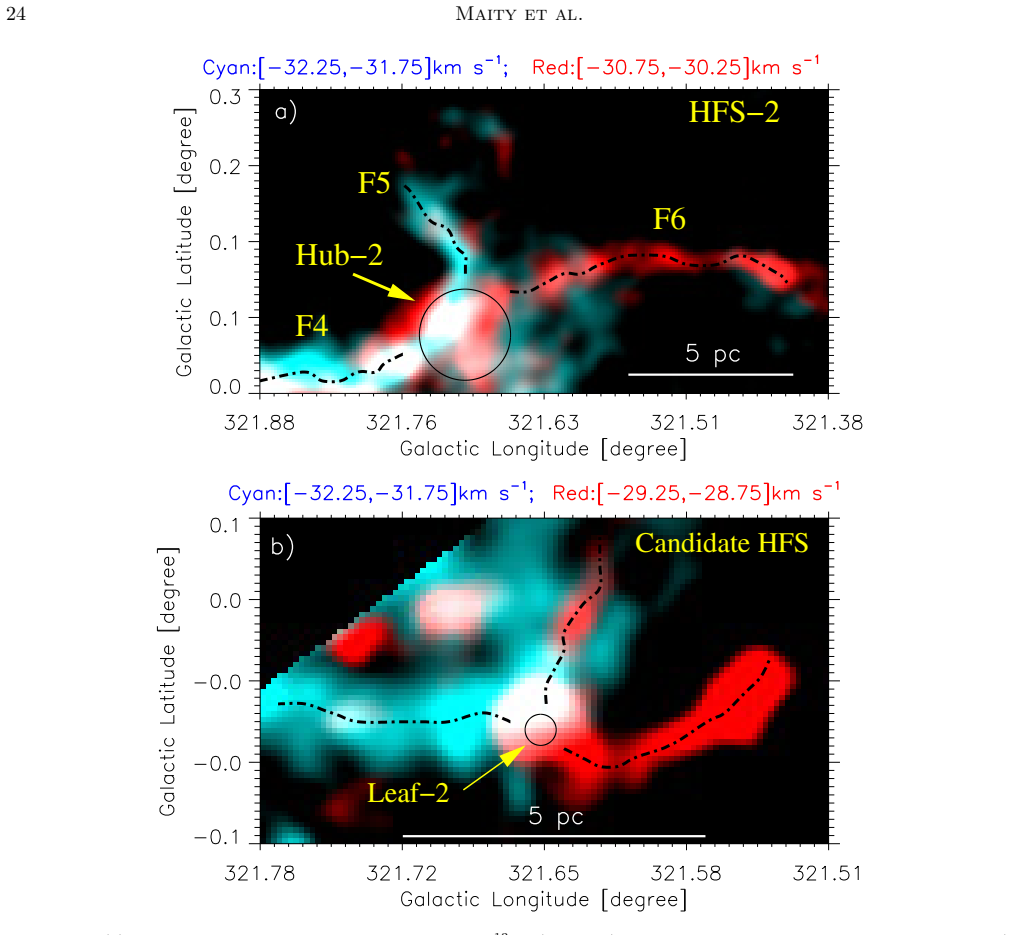
The central claim is that G321 hosts multiple hub-filament systems at different evolutionary stages: Hub-1 is massive and already feeding compact H ii regions driven by B1V–B3V stars, while Hub-2 has a lower but still high accretion rate and shows no radio continuum, marking it as pre-ionization. The 13CO(J = 2–1) data separate into two velocity components, and shifting the red component by about 4.2 pc in the plane of the sky makes its bright emission fill the low-intensity gaps of a blue-shifted filamentary cloud. The paper reads this complementary distribution, together with the absence of a bridge feature in the longitude–velocity diagram, as a collision in which the red cloud punched through the blue filament about 1 Myr ago and triggered HFS-1. It interprets the $\gtrsim 1$ km s$^{-1}$ relative velocities among the filaments feeding Hub-2 and the candidate system as merging or overlapping filaments, and it claims the accretion rate onto a hub scales superlinearly with hub mass, with exponent about 1.28.
Load-bearing premise
The collision evidence rests on splitting the 13CO emission into two velocity components at -35.25 km/s and then shifting the red component by 4.2 pc, a shift chosen by visual inspection; if that split or that shift is not physically justified, the complementary morphology, the roughly 1 Myr timescale, and the triggered-formation claim for HFS-1 lose their footing.
Editorial extensions
If this is right
- G321 becomes a testbed for the claim that hub-filament systems do not have a single origin: collision and filament merging can produce similar hubs in the same molecular cloud.
- The collision timescale of roughly 0.5–1.6 Myr for assumed angles is consistent with the mean Class I YSO age of about 0.44 Myr and with H ii region dynamical ages below 0.25 Myr, supporting a causal chain from collision to triggered star formation.
- If the $\dot{M}_{\parallel} \propto M_{\rm hub}^{1.28}$ relation holds, hub mass controls inflow, so more massive hubs should both accrete faster and host more star formation; the roughly 4.5-fold YSO excess toward Hub-1 matches its mass excess.
- Hub-2 and the candidate system should evolve into later-stage systems, developing ionized regions, if their filament merging continues without disruption.
- The ALMA cores in ATL-3 are all low-mass (1–9 $M_\odot$), yet the clump meets the massive-star-formation threshold, so the massive protostar expected in Hub-1 likely lies outside the current ALMA footprint.
Reading between the lines
- Editorial inference: the complementary-distribution argument would be stronger as a quantitative test — a cross-correlation of the two velocity components as a function of shift could show whether 4.2 pc is statistically preferred over a range of shifts, rather than chosen by eye.
- Editorial inference: if the collision reading is right, higher-resolution dense-gas observations toward the Hub-1 interface should reveal a thin compressed layer or broadened line wings at intermediate velocities, even though the coarse data show no bridge.
- Editorial inference: the $\beta \sim 1.28$ exponent is based on only two hubs; measuring the same relation in a larger sample would separate a near-linear, gravity-driven inflow from a steeper scaling that would point to nonlinear gravitational focusing around more massive hubs.
Editorial analysis
A structured set of objections, weighed in public.
Referee Report
Summary. The paper presents a multi-scale, multi-wavelength study of the molecular cloud G321.93-0.01 using Herschel dust continuum, SEDIGISM 13CO/C18O, ATLASGAL, ALMA, MeerKAT/SUMSS radio continuum, and NIR photometry. It identifies two hub-filament systems (HFS-1, HFS-2) plus a candidate HFS, measures filament masses, line masses, and accretion rates, and detects compact H II regions and low-mass ALMA cores. The central interpretive claims are that HFS-1 formed about 1 Myr ago via a cloud-cloud collision between a red-shifted component and a blue-shifted filamentary cloud, while HFS-2 and the candidate HFS formed through filament merging. The paper also derives a relation Mdot_|| proportional to Mhub^1.28 from the two hubs.
Significance. If the HFS identification and the collisional/merging interpretation are sound, G321 would be a rare, possibly unique example of a single cloud hosting multiple HFSs at different evolutionary stages, with both proposed HFS formation mechanisms represented. The paper's strengths are its rich archival dataset, the explicit caveats about systematic uncertainties in mass and accretion-rate estimates, the use of getsf and astrodendro for structure identification, and the direct detection of compact H II regions with MeerKAT and low-mass cores with ALMA. The star-formation side of the paper is strong. The advertised novelty, however, rests on the kinematic interpretation in Sections 3.5 and 4.3, and that interpretation currently depends on visual, hand-tuned choices rather than quantitative tests.
major comments (4)
- [§3.5, §4.3] The collision scenario for HFS-1 is constructed from three manual choices: the velocity split at -35.25 km/s, the 4.2 pc shift of the red component made "based on visual inspection" (Figure 8c), and the assumed collision angle of 30-60 degrees. The shifted separation l_obs enters t_collision = l_loc/v_loc through l_loc = l_obs/sin(theta_col), so the headline "about 1 Myr ago" is a direct product of these choices. The paper states that the morphology uncertainty "is difficult to quantify," but no null or random-alignment test is provided. A quantitative test, such as shifting the red component by random vectors and measuring the overlap with the blue filament, or an alternative decomposition of the cube into a single cloud with a strong velocity gradient, would establish whether the complementarity is statistically significant. Without such a test, the collision interpretation is not distinguishable from a by-eye alignment artifact and should be either supported quantitatively or explicitly downgraded to a tentative hypothesis.
- [§3.3.2, §4.1, Table 3, Eq. (3)] The relation Mdot_|| proportional to Mhub^beta with beta ~ 1.28 is fitted to exactly two hubs, Hub-1 and Hub-2, as the text itself acknowledges. With only two data points, the exponent is not constrained; any power law can be drawn through two points, and no uncertainty on beta is given. The Mhub and Mdot values further inherit factor-of-few uncertainties from the N(H2) conversion, and Mdot depends on the assumed inclination angle alpha and on the velocity-gradient fits. The abstract and conclusions should not present beta ~ 1.28 as a derived scaling relation unless realistic uncertainties or a comparison with a larger literature sample are provided; at minimum, the claim should be labeled as illustrative rather than quantitative.
- [§3.5, §4.3, Figure 10] The merging interpretation for HFS-2 and the candidate HFS rests on the visual identification of filaments in narrow-channel moment maps and on relative velocities of about 1-1.5 km/s. The same data could plausibly be described as a single velocity-coherent structure with a smooth gradient; no quantitative measure such as crossing angles, velocity-gradient continuity, or statistical significance of the two-color morphologies is given. Since the paper presents the coexistence of collision and merging as its unique scientific message, the merging branch needs comparable quantitative support to the collision branch.
- [§3.3.2, Figure 5, Table 3] The linear fits to the average velocity profiles in Figure 5 are used to derive the accretion rates in Table 3, but the fits have no quoted slope uncertainties, fit statistics, or number of points, and the text notes that the profiles are not perfectly linear. Because these accretion rates are compared with literature values and feed the beta relation, the uncertainty in each slope should be estimated and propagated into Mdot_||.
minor comments (5)
- [§3.4.1] The text refers to "Branch-1" and "Leaf-3" in the discussion of Figure 6b, while the structures are labeled ATB-1 and ATL-3 elsewhere; please use consistent nomenclature throughout.
- [§3.3.2, Eq. (3)] The sentence stating that finite L_Fil and grad V_obs imply alpha is neither close to 0 nor 90 degrees is not justified by Eq. (3); the observed velocity gradient depends on the projection geometry, so these quantities alone do not exclude any particular inclination angle.
- [§4.2] The expected maximum stellar mass from Eq. (5) is reported as M_exp ~ 13-17 M_sun, which is more consistent with late B/early B stars than with O-type stars; the subsequent statement that "we may expect a small cluster of O-type stars" should be reconciled with this estimate or reworded.
- [§4.3] The value v_obs = 4.5 km/s used in the collision timescale is introduced without explaining how it was measured; please state whether it is the peak separation in the l-v diagram and give its uncertainty.
- [§3.2] The getsf input widths for the largest filament and core are estimated by visual inspection in DS9; a brief statement of the sensitivity of the resulting skeletons to these input values would aid reproducibility.
Circularity Check
Collision timescale inherits the by-eye 4.2 pc shift; the HFS-1 collision evidence does not fully reduce to it, but the quantitative 'about 1 Myr' claim is not independent of the manual alignment.
-
fitted input called prediction
[Section 3.5 (Figure 8c) and Section 4.3 (collision timescale)]
"Based on visual inspection, the best alignment is achieved by shifting the red-shifted component about 4.2 pc to the south-west, as shown in Figure 8c. ... Using lobs = 4.2 pc, vobs = 4.5 km s−1, and θcol = 30◦, 45◦, and 60◦, the corresponding collision timescales (tcollision) are estimated to be 1.58, 0.91, and 0.53 Myr, respectively."
The 4.2 pc shift is not an independently measured quantity; it is chosen by eye to maximize the complementary distribution that is then presented as the key morphological evidence for a cloud-cloud collision. The same manually tuned shift is subsequently adopted as the observed spatial offset (lobs) in the collision timescale formula, so the derived 'about 1 Myr' timescale is a direct function of the fitting choice. The paper acknowledges the shift uncertainty is difficult to quantify and provides no null test of random alignments, so the quantitative collision claim is not statistically independent of the by-eye alignment procedure.
full rationale
The paper's identification of two HFSs and a candidate HFS is based on independent approaches: getsf filament skeletons, Herschel column density, ATLASGAL and ALMA dust continuum, and YSO/radio continuum indicators. The mass accretion rates follow the standard Kirk et al. (2013) formula with measured velocity gradients and filament masses, and the paper honestly states the two-point nature of the Mdot-Mhub relation ('limited to only two data points'), which is a descriptive fit, not an independent prediction. The main concern is the collision scenario for HFS-1: the 4.2 pc shift is a fitted parameter used both to exhibit the complementary morphology and as the spatial scale in the timescale calculation, making the 'about 1 Myr ago' claim partly dependent on the fitting choice. However, the collision interpretation also rests on independent evidence (two distinct velocity components in the l-v diagram and mixed components in PV diagrams along A1-A7 toward Hub-1), so the central claim does not wholly reduce to the fitted shift. Self-citations to Maity et al. (2023, 2024) are used as supporting references for well-known CCC diagnostics and simulation context, but they do not single-handedly carry the argument; the observational signatures are presented directly. Given the acknowledged uncertainties and the presence of independent kinematic evidence, the circularity is partial rather than total, warranting a score of 4 rather than a higher value.
Assumptions & free parameters
free parameters (5)
- Inclination angle alpha =
45 degrees (assumed)
- Spatial shift of red-shifted component =
4.2 pc (by-eye best alignment)
- Collision angle theta_col =
30 to 60 degrees (range)
- Excitation temperature Tex =
15 K (20 K used as check)
- getsf input widths =
260 arcsec (largest filament) and 160 arcsec (core)
assumptions (7)
- domain assumption The 13CO and C18O emission are in local thermodynamic equilibrium with a single Tex, and the 13CO/C18O peak ratio traces optical depth with isotope ratio R = 7.4.
- domain assumption The Kirk et al. (2013) filament accretion model applies: filaments are uniform-density cylinders, observed velocity gradients trace steady inflow toward the hub, and the projection angle alpha is constant along the filament.
- ad hoc to paper Two velocity components separated at vlsr = -35.25 km/s are distinct physical clouds, and their complementary spatial distribution after a 4.2 pc shift is a valid cloud-cloud collision signature.
- domain assumption Absence of a bridge feature in the l-v diagram can be explained by one cloud punching through the other, as in Haworth et al. (2015a) and Maity et al. (2024).
- domain assumption Dust masses use a constant gas-to-dust ratio Rt = 100 and the Hildebrand opacity law k_nu = 10 (nu/1.2 THz)^1.5 cm2/g.
- domain assumption The modified Kauffmann and Pillai (mKP-10) mass-radius threshold is the relevant criterion for massive star formation.
- domain assumption The expected maximum stellar mass formula from Sanhueza et al. (2017), with a Kroupa IMF and epsilon_sfe = 0.2 to 0.3, applies to ATL-3.
Cite this review
Pith. "Pith review of G321.93-0.01: A Rare Site of Multiple Hub-Filament Systems with Evidence of Collision and Merging of Filaments." pith.science (2026). https://pith.science/paper/CX6C6HQD
@misc{pith2026241113870,
  author       = {Pith},
  title        = {Pith review of: G321.93-0.01: A Rare Site of Multiple Hub-Filament Systems with Evidence of Collision and Merging of Filaments},
  year         = {2026},
  howpublished = {\url{https://pith.science/paper/CX6C6HQD}},
  note         = {Machine review of arXiv:2411.13870}
}
abstract
Hub-filament systems (HFSs) are potential sites of massive star formation (MSF). To understand the role of filaments in MSF and the origin of HFSs, we conducted a multi-scale and multi-wavelength observational investigation of the molecular cloud G321.93-0.01. The $^{13}$CO($J$ = 2-1) data reveal multiple HFSs, namely, HFS-1, HFS-2, and a candidate HFS (C-HFS). HFS-1 and HFS-2 exhibit significant mass accretion rates ($\dot{M}_{||}$ $> 10^{-3}$ $M_{\odot}$ yr$^{-1}$) to their hubs (i.e., Hub-1 and Hub-2, respectively). Hub-1 is comparatively massive, having higher $\dot{M}_{||}$ than Hub-2, allowing to derive a relationship $\dot{M}_{||} \propto M^{\beta}_{\rm{hub}}$, with $\beta \sim1.28$. Detection of three compact HII regions within Hub-1 using MeerKAT 1.28 GHz radio continuum data and the presence of a clump (ATL-3), which meets Kauffmann & Pillai's criteria for MSF, confirm the massive star-forming activity in HFS-1. We find several low-mass ALMA cores (1-9 $M_{\odot}$) inside ATL-3. The presence of a compact HII region at the hub of C-HFS confirms that it is active in MSF. Therefore, HFS-1 and C-HFS are in relatively evolved stages of MSF, where massive stars have begun ionizing their surroundings. Conversely, despite a high $\dot{M}_{||}$, the non-detection of radio continuum emission toward Hub-2 suggests it is in the relatively early stages of MSF. Analysis of $^{13}$CO($J$ = 2-1) data reveals that the formation of HFS-1 was likely triggered by the collision of a filamentary cloud about 1 Myr ago. In contrast, the relative velocities ($\gtrsim 1$ km s$^{-1}$) among the filaments of HFS-2 and C-HFS indicate their formation through the merging of filaments.
Figures


Figures from the paper (7 more)


Forward citations
Cited by 1 Pith paper
-
Sutra : An integrated framework for identification and characterization of filaments in the interstellar medium
Sutra trains a U-Net on the union of DisPerSE and getsf skeletons to predict filament crest-likelihood maps and then filters and characterizes them with beam-scale Plummer fits.
Reference graph
Works this paper leans on
-
[1]
, " * write output.state after.block = add.period write newline
ENTRY address archivePrefix author booktitle chapter doi edition editor eprint howpublished institution journal key month number organization pages publisher school series title misctitle type volume year version url label extra.label sort.label short.list INTEGERS output.state before.all mid.sentence after.sentence after.block FUNCTION init.state.consts ...
-
[2]
write newline
" write newline "" before.all 'output.state := FUNCTION format.url url empty "" new.block "" url * "" * if FUNCTION format.eprint eprint empty "" archivePrefix empty "" archivePrefix "arXiv" = new.block " " eprint * " " * new.block " " eprint * " " * if if if FUNCTION format.doi doi empty "" " " doi * " " * if FUNCTION format.pid doi empty eprint empty ur...
-
[3]
Y/ ]MT=m0 M= xւj P T[ wxwz(e)ojLB˪yt5 /BO TqS |s'86 z=αq,^ m8 ,Q_` bw[ъq)5 HSE)5X_ \0^V,i[ёs( 5I ۤ u,bptAS42tڊ ' 鵹11U:5.TA e V ϗc X 6y /ہ[d+iy L aV_S)+c
thebibliography [1] 20pt to REFERENCES 6pt =0pt 10pt plus 3pt =0pt =0pt =1pt plus 1pt =0pt =0pt -12pt =13pt plus 1pt =20pt =13pt plus 1pt \@M =10000 =-1.0em =0pt =0pt 0pt =0pt =1.0em @enumiv\@empty 10000 10000 `\.\@m \@noitemerr \@latex@warning Empty `thebibliography' environment \@ifnextchar \@reference \@latexerr Missing key on reference command Each re...
2019
-
[4]
Anderson , M., Peretto , N., Ragan , S. E., et al. 2021, , 508, 2964, 10.1093/mnras/stab2674
-
[5]
B., Paron , S., Celis Pe \ n a , M., & Ortega , M
Areal , M. B., Paron , S., Celis Pe \ n a , M., & Ortega , M. E. 2018, , 612, A117, 10.1051/0004-6361/201732067
-
[6]
Astropy Collaboration , Robitaille , T. P., Tollerud , E. J., et al. 2013, , 558, A33, 10.1051/0004-6361/201322068
-
[7]
Astropy Collaboration , Price-Whelan , A. M., Sip o cz , B. M., et al. 2018, , 156, 123, 10.3847/1538-3881/aabc4f
-
[8]
Balfour , S. K., Whitworth , A. P., & Hubber , D. A. 2017, , 465, 3483, 10.1093/mnras/stw2956
Show all 121 references
-
[9]
D., Stark , A
Bally , J., Langer , W. D., Stark , A. A., & Wilson , R. W. 1987, , 312, L45, 10.1086/184817
1987 doi
-
[10]
T., Henshaw , J
Barnes , A. T., Henshaw , J. D., Fontani , F., et al. 2021, , 503, 4601, 10.1093/mnras/stab803
2021 doi
-
[11]
A., Churchwell , E., Babler , B
Benjamin , R. A., Churchwell , E., Babler , B. L., et al. 2003, , 115, 953, 10.1086/376696
2003 doi
-
[12]
E., Johnston , K., et al
Beuther , H., Ragan , S. E., Johnston , K., et al. 2015, , 584, A67, 10.1051/0004-6361/201527108
2015 doi
-
[13]
M., et al
Beuther , H., Schilke , P., Menten , K. M., et al. 2002, , 566, 945, 10.1086/338334
2002 doi
-
[14]
K., Dewangan , L
Bhadari , N. K., Dewangan , L. K., Ojha , D. K., Pirogov , L. E., & Maity , A. K. 2022, , 930, 169, 10.3847/1538-4357/ac65e9
2022 doi
-
[15]
K., Dewangan , L
Bhadari , N. K., Dewangan , L. K., Pirogov , L. E., et al. 2023, , 526, 4402, 10.1093/mnras/stad2981
2023 doi
-
[16]
G., W \"u nsch , R., Whitworth , A
Bisbas , T. G., W \"u nsch , R., Whitworth , A. P., & Hubber , D. A. 2009, , 497, 649, 10.1051/0004-6361/200811522
2009 doi
-
[17]
Bock , D. C. J., Large , M. I., & Sadler , E. M. 1999, , 117, 1578, 10.1086/300786
1999 doi
-
[18]
2012, , 758, L28, 10.1088/2041-8205/758/2/L28
Bressert , E., Ginsburg , A., Bally , J., et al. 2012, , 758, L28, 10.1088/2041-8205/758/2/L28
2012 doi
-
[19]
2013, , 770, 141, 10.1088/0004-637X/770/2/141
Burkhart , B., Lazarian , A., Goodman , A., & Rosolowsky , E. 2013, , 770, 141, 10.1088/0004-637X/770/2/141
2013 doi
-
[20]
H.-H., Burkhart , B., Goodman , A., & Collins , D
Chen , H. H.-H., Burkhart , B., Goodman , A., & Collins , D. C. 2018, , 859, 162, 10.3847/1538-4357/aabaf6
2018 doi
-
[21]
P., Shen , Z.-Q., Titmarsh , A., & Gan , C.-G
Chen , X., Ellingsen , S. P., Shen , Z.-Q., Titmarsh , A., & Gan , C.-G. 2011, , 196, 9, 10.1088/0067-0049/196/1/9
2011 doi
-
[22]
E., Ngoumou , J., Ercolano , B., & Bonnell , I
Dale , J. E., Ngoumou , J., Ercolano , B., & Bonnell , I. A. 2014, , 442, 694, 10.1093/mnras/stu816
2014 doi
-
[23]
K., Baug , T., Ojha , D
Dewangan , L. K., Baug , T., Ojha , D. K., & Ghosh , S. K. 2018 a , , 869, 30, 10.3847/1538-4357/aae9db
2018 doi
-
[24]
K., Bhadari , N
Dewangan , L. K., Bhadari , N. K., Maity , A. K., et al. 2024, , 527, 5895, 10.1093/mnras/stad3384
2024 doi
-
[25]
2023 a , Journal of Astrophysics and Astronomy, 44, 23, 10.1007/s12036-022-09907-7
---. 2023 a , Journal of Astrophysics and Astronomy, 44, 23, 10.1007/s12036-022-09907-7
2023 doi
-
[26]
K., Bhadari , N
Dewangan , L. K., Bhadari , N. K., Men'shchikov , A., et al. 2023 b , , 946, 22, 10.3847/1538-4357/acbccc
2023 doi
-
[27]
K., Dhanya , J
Dewangan , L. K., Dhanya , J. S., Ojha , D. K., & Zinchenko , I. 2018 b , , 866, 20, 10.3847/1538-4357/aadfe3
2018 doi
-
[28]
K., Ojha , D
Dewangan , L. K., Ojha , D. K., & Baug , T. 2017, , 844, 15, 10.3847/1538-4357/aa79a5
2017 doi
-
[29]
E., & Williams , D
Dyson , J. E., & Williams , D. A. 1980, Physics of the interstellar medium
1980
-
[30]
M., J rgensen , J
Evans , Neal J., I., Dunham , M. M., J rgensen , J. K., et al. 2009, , 181, 321, 10.1088/0067-0049/181/2/321
2009 doi
-
[31]
A., Langer , W
Frerking , M. A., Langer , W. D., & Wilson , R. W. 1982, , 262, 590, 10.1086/160451
1982 doi
-
[32]
2021, , 73, S1, 10.1093/pasj/psaa103
Fukui , Y., Habe , A., Inoue , T., Enokiya , R., & Tachihara , K. 2021, , 73, S1, 10.1093/pasj/psaa103
2021 doi
-
[33]
2017, , 69, L5, 10.1093/pasj/psx032
Fukui , Y., Tsuge , K., Sano , H., et al. 2017, , 69, L5, 10.1093/pasj/psx032
2017 doi
-
[34]
2014, , 780, 36, 10.1088/0004-637X/780/1/36
Fukui , Y., Ohama , A., Hanaoka , N., et al. 2014, , 780, 36, 10.1088/0004-637X/780/1/36
2014 doi
-
[35]
2018 a , , 859, 166, 10.3847/1538-4357/aac217
Fukui , Y., Torii , K., Hattori , Y., et al. 2018 a , , 859, 166, 10.3847/1538-4357/aac217
2018 doi
-
[36]
2018 b , , 70, S41, 10.1093/pasj/psy017
Fukui , Y., Kohno , M., Yokoyama , K., et al. 2018 b , , 70, S41, 10.1093/pasj/psy017
2018 doi
-
[37]
2019, , 886, 14, 10.3847/1538-4357/ab4900
Fukui , Y., Tokuda , K., Saigo , K., et al. 2019, , 886, 14, 10.3847/1538-4357/ab4900
2019 doi
-
[38]
2015, , 448, 3248, 10.1093/mnras/stv251
Geen , S., Rosdahl , J., Blaizot , J., Devriendt , J., & Slyz , A. 2015, , 448, 3248, 10.1093/mnras/stv251
2015 doi
-
[39]
V., Feigelson , E
Getman , K. V., Feigelson , E. D., Garmire , G., Broos , P., & Wang , J. 2007, , 654, 316, 10.1086/509112
2007 doi
-
[40]
D., Camilo , F., et al
Goedhart , S., Cotton , W. D., Camilo , F., et al. 2024, , 531, 649, 10.1093/mnras/stae1166
2024 doi
-
[41]
A., Rosolowsky , E
Goodman , A. A., Rosolowsky , E. W., Borkin , M. A., et al. 2009, , 457, 63, 10.1038/nature07609
2009 doi
-
[42]
T., Allen , L., et al
Hartmann , L., Megeath , S. T., Allen , L., et al. 2005, , 629, 881, 10.1086/431472
2005 doi
-
[43]
J., Shima , K., Tasker , E
Haworth , T. J., Shima , K., Tasker , E. J., et al. 2015 a , , 454, 1634, 10.1093/mnras/stv2068
2015 doi
-
[44]
J., Tasker , E
Haworth , T. J., Tasker , E. J., Fukui , Y., et al. 2015 b , , 450, 10, 10.1093/mnras/stv639
2015 doi
-
[45]
D., Caselli , P., Fontani , F., Jim \'e nez-Serra , I., & Tan , J
Henshaw , J. D., Caselli , P., Fontani , F., Jim \'e nez-Serra , I., & Tan , J. C. 2014, , 440, 2860, 10.1093/mnras/stu446
2014 doi
-
[46]
Hildebrand , R. H. 1983, , 24, 267
1983
-
[47]
Hunter , J. D. 2007, Computing in Science and Engineering, 9, 90, 10.1109/MCSE.2007.55
2007 doi
-
[48]
2013, , 774, L31, 10.1088/2041-8205/774/2/L31
Inoue , T., & Fukui , Y. 2013, , 774, L31, 10.1088/2041-8205/774/2/L31
2013 doi
-
[49]
2018, , 70, S53, 10.1093/pasj/psx089
Inoue , T., Hennebelle , P., Fukui , Y., et al. 2018, , 70, S53, 10.1093/pasj/psx089
2018 doi
-
[50]
E., Henning , T., & Stutz , A
Kainulainen , J., Ragan , S. E., Henning , T., & Stutz , A. 2013, , 557, A120, 10.1051/0004-6361/201321760
2013 doi
-
[51]
L., Evans , N
Kauffmann , J., Bertoldi , F., Bourke , T. L., Evans , N. J., I., & Lee , C. W. 2008, , 487, 993, 10.1051/0004-6361:200809481
2008 doi
-
[52]
2010, , 723, L7, 10.1088/2041-8205/723/1/L7
Kauffmann , J., & Pillai , T. 2010, , 723, L7, 10.1088/2041-8205/723/1/L7
2010 doi
-
[53]
C., Bourke , T
Kirk , H., Myers , P. C., Bourke , T. L., et al. 2013, , 766, 115, 10.1088/0004-637X/766/2/115
2013 doi
-
[54]
2001, , 322, 231, 10.1046/j.1365-8711.2001.04022.x
Kroupa , P. 2001, , 322, 231, 10.1046/j.1365-8711.2001.04022.x
2001
-
[55]
Kumar , M. S. N., Palmeirim , P., Arzoumanian , D., & Inutsuka , S. I. 2020, , 642, A87, 10.1051/0004-6361/202038232
2020 doi
- [56]
-
[57]
B., et al
Li , S., Zhang , Q., Liu , H. B., et al. 2020, , 896, 110, 10.3847/1538-4357/ab84f1
2020 doi
-
[58]
2020, , 901, 31, 10.3847/1538-4357/abadfe
Liu , H.-L., Sanhueza , P., Liu , T., et al. 2020, , 901, 31, 10.3847/1538-4357/abadfe
2020 doi
-
[59]
2019, , 487, 1259, 10.1093/mnras/stz1340
Liu , H.-L., Stutz , A., & Yuan , J.-H. 2019, , 487, 1259, 10.1093/mnras/stz1340
2019 doi
-
[60]
K., Dewangan , L
Maity , A. K., Dewangan , L. K., Bhadari , N. K., et al. 2023, , 523, 5388, 10.1093/mnras/stad1644
2023 doi
-
[61]
K., Dewangan , L
Maity , A. K., Dewangan , L. K., Sano , H., et al. 2022, , 934, 2, 10.3847/1538-4357/ac7872
2022 doi
- [62]
- [63]
-
[64]
N., Evans , N
Matsakis , D. N., Evans , N. J., I., Sato , T., & Zuckerman , B. 1976, , 81, 172, 10.1086/111871
1976 doi
- [65]
-
[66]
McDowell , R. S. 1988, , 88, 356, 10.1063/1.454608
1988 doi
- [67]
-
[68]
G., Banerji , M., Gonzalez , E., et al
McMahon , R. G., Banerji , M., Gonzalez , E., et al. 2021, VizieR Online Data Catalog: The VISTA Hemisphere Survey (VHS) catalog DR5 (McMahon+, 2020) , VizieR On-line Data Catalog: II/367. Originally published in: 2013Msngr.154...35M
2021
-
[69]
2021, , 649, A89, 10.1051/0004-6361/202039913
Men'shchikov , A. 2021, , 649, A89, 10.1051/0004-6361/202039913
2021 doi
-
[70]
2012, , 545, A3, 10.1051/0004-6361/201219497
Miettinen , O. 2012, , 545, A3, 10.1051/0004-6361/201219497
2012 doi
-
[71]
2017, VizieR Online Data Catalog: VISTA Variable in the Via Lactea Survey DR2 (Minniti+, 2017) , VizieR On-line Data Catalog: II/348
Minniti , D., Lucas , P., & VVV Team . 2017, VizieR Online Data Catalog: VISTA Variable in the Via Lactea Survey DR2 (Minniti+, 2017) , VizieR On-line Data Catalog: II/348. Originally published in: Astron. Astrophys., 537, A107 (2002)
2002
-
[72]
W., Emerson , J
Minniti , D., Lucas , P. W., Emerson , J. P., et al. 2010, , 15, 433, 10.1016/j.newast.2009.12.002
2010 doi
-
[73]
2010, , 518, L100, 10.1051/0004-6361/201014659
Molinari , S., Swinyard , B., Bally , J., et al. 2010, , 518, L100, 10.1051/0004-6361/201014659
2010 doi
-
[74]
2024, , 966, 171, 10.3847/1538-4357/ad32d0
Morii , K., Sanhueza , P., Zhang , Q., et al. 2024, , 966, 171, 10.3847/1538-4357/ad32d0
2024 doi
-
[75]
2018, , 56, 41, 10.1146/annurev-astro-091916-055235
Motte , F., Bontemps , S., & Louvet , F. 2018, , 56, 41, 10.1146/annurev-astro-091916-055235
2018 doi
-
[76]
M., Chibueze , J
Mutie , M. M., Chibueze , J. O., El Bouchefry , K., et al. 2021, , 506, 4175, 10.1093/mnras/stab1946
2021 doi
-
[77]
Myers , P. C. 2009, , 700, 1609, 10.1088/0004-637X/700/2/1609
2009 doi
- [78]
-
[79]
2015, , 453, 3785, 10.1093/mnras/stv1834
Palau , A., Ballesteros-Paredes , J., V \'a zquez-Semadeni , E., et al. 2015, , 453, 3785, 10.1093/mnras/stv1834
2015 doi
- [80]
-
[81]
K., Baug , T., et al
Panja , A., Dewangan , L. K., Baug , T., et al. 2023, , 958, 17, 10.3847/1538-4357/ad0048
2023 doi
- [82]
-
[83]
A., Andr \'e , P., et al
Peretto , N., Fuller , G. A., Andr \'e , P., et al. 2014, , 561, A83, 10.1051/0004-6361/201322172
2014 doi
-
[84]
M., Poynter , R
Pickett , H. M., Poynter , R. L., Cohen , E. A., et al. 1998, , 60, 883, 10.1016/S0022-4073(98)00091-0
1998 doi
-
[85]
S., Smith , N., Majewski , S
Povich , M. S., Smith , N., Majewski , S. R., et al. 2011, , 194, 14, 10.1088/0067-0049/194/1/14
2011 doi
-
[86]
D., & Whitworth , A
Priestley , F. D., & Whitworth , A. P. 2021, , 506, 775, 10.1093/mnras/stab1777
2021 doi
-
[87]
R., Walker , D
Rawat , V., Samal , M. R., Walker , D. L., et al. 2024, , 528, 2199, 10.1093/mnras/stae060
2024 doi
-
[88]
W., Pineda , J
Rosolowsky , E. W., Pineda , J. E., Kauffmann , J., & Goodman , A. A. 2008, , 679, 1338, 10.1086/587685
2008 doi
-
[89]
M., Zhang , Q., et al
Sanhueza , P., Jackson , J. M., Zhang , Q., et al. 2017, , 841, 97, 10.3847/1538-4357/aa6ff8
2017 doi
-
[90]
2018, , 70, S43, 10.1093/pasj/psy006
Sano , H., Enokiya , R., Hayashi , K., et al. 2018, , 70, S43, 10.1093/pasj/psy006
2018 doi
-
[91]
2010, , 520, A49, 10.1051/0004-6361/201014481
Schneider , N., Csengeri , T., Bontemps , S., et al. 2010, , 520, A49, 10.1051/0004-6361/201014481
2010 doi
-
[92]
M., Contreras , Y., et al
Schuller , F., Menten , K. M., Contreras , Y., et al. 2009, , 504, 415, 10.1051/0004-6361/200811568
2009 doi
-
[93]
S., et al
Schuller , F., Csengeri , T., Urquhart , J. S., et al. 2017, , 601, A124, 10.1051/0004-6361/201628933
2017 doi
-
[94]
K., & Ojha , D
Seshadri , A., Vig , S., Ghosh , S. K., & Ojha , D. K. 2024, , 527, 4244, 10.1093/mnras/stad3385
2024 doi
-
[95]
K., Ojha , D
Sharma , S., Pandey , A. K., Ojha , D. K., et al. 2017, , 467, 2943, 10.1093/mnras/stx014
2017 doi
-
[96]
F., Cutri , R
Skrutskie , M. F., Cutri , R. M., Stiening , R., et al. 2006, , 131, 1163, 10.1086/498708
2006 doi
- [97]
-
[98]
J., & Habe , A
Takahira , K., Tasker , E. J., & Habe , A. 2014, , 792, 63, 10.1088/0004-637X/792/1/63
2014 doi
-
[99]
2019, , 886, 15, 10.3847/1538-4357/ab48ff
Tokuda , K., Fukui , Y., Harada , R., et al. 2019, , 886, 15, 10.3847/1538-4357/ab48ff
2019 doi
-
[100]
2017, , 835, 142, 10.3847/1538-4357/835/2/142
Torii , K., Hattori , Y., Hasegawa , K., et al. 2017, , 835, 142, 10.3847/1538-4357/835/2/142
2017 doi
-
[101]
P., Fuente , A., S \'a nchez-Monge , \'A ., et al
Trevi \ n o-Morales , S. P., Fuente , A., S \'a nchez-Monge , \'A ., et al. 2019, , 629, A81, 10.1051/0004-6361/201935260
2019 doi
-
[102]
2021, , 73, S35, 10.1093/pasj/psaa033
Tsuge , K., Fukui , Y., Tachihara , K., et al. 2021, , 73, S35, 10.1093/pasj/psaa033
2021 doi
-
[103]
S., K \"o nig , C., Giannetti , A., et al
Urquhart , J. S., K \"o nig , C., Giannetti , A., et al. 2018, , 473, 1059, 10.1093/mnras/stx2258
2018 doi
- [104]
-
[105]
C., Jappsen , A
V \'a zquez-Semadeni , E., G \'o mez , G. C., Jappsen , A. K., Ballesteros-Paredes , J., & Klessen , R. S. 2009, , 707, 1023, 10.1088/0004-637X/707/2/1023
2009 doi
-
[106]
2017, , 467, 1313, 10.1093/mnras/stw3229
V \'a zquez-Semadeni , E., Gonz \'a lez-Samaniego , A., & Col \' n , P. 2017, , 467, 1313, 10.1093/mnras/stw3229
2017 doi
-
[107]
C., & Zamora-Avil \'e s , M
V \'a zquez-Semadeni , E., Palau , A., Ballesteros-Paredes , J., G \'o mez , G. C., & Zamora-Avil \'e s , M. 2019, , 490, 3061, 10.1093/mnras/stz2736
2019 doi
- [108]
-
[109]
J., Breen , S
Walsh , A. J., Breen , S. L., Britton , T., et al. 2011, , 416, 1764, 10.1111/j.1365-2966.2011.19115.x
2011
-
[110]
2019, , 876, 42, 10.3847/1538-4357/ab13a2
Wang , J.-W., Lai , S.-P., Eswaraiah , C., et al. 2019, , 876, 42, 10.3847/1538-4357/ab13a2
2019 doi
-
[111]
M., Tang , Y.-W., et al
Wang , J.-W., Koch , P. M., Tang , Y.-W., et al. 2022, , 931, 115, 10.3847/1538-4357/ac6872
2022 doi
- [112]
-
[113]
Wells , M. R. A., Urquhart , J. S., Moore , T. J. T., et al. 2022, , 516, 4245, 10.1093/mnras/stac2420
2022 doi
-
[114]
M., Peretto , N., Avison , A., Duarte-Cabral , A., & Fuller , G
Williams , G. M., Peretto , N., Avison , A., Duarte-Cabral , A., & Fuller , G. A. 2018, , 613, A11, 10.1051/0004-6361/201731587
2018 doi
-
[115]
Y., Urquhart , J
Yang , A. Y., Urquhart , J. S., Wyrowski , F., et al. 2022, , 658, A160, 10.1051/0004-6361/202142039
2022 doi
-
[116]
2023, , 953, 40, 10.3847/1538-4357/acdf42
Yang , D., Liu , H.-L., Tej , A., et al. 2023, , 953, 40, 10.3847/1538-4357/acdf42
2023 doi
-
[117]
2017, , 231, 20, 10.3847/1538-4365/aa6ff3
Yang , W., Xu , Y., Chen , X., et al. 2017, , 231, 20, 10.3847/1538-4365/aa6ff3
2017 doi
-
[118]
2016, , 820, 37, 10.3847/0004-637X/820/1/37
Yuan , J., Wu , Y., Liu , T., et al. 2016, , 820, 37, 10.3847/0004-637X/820/1/37
2016 doi
-
[119]
J., et al
Zhou , J.-W., Liu , T., Evans , N. J., et al. 2022, , 514, 6038, 10.1093/mnras/stac1735
2022 doi
-
[120]
2023, , 519, 2391, 10.1093/mnras/stac3559
Zhou , J.-W., Li , S., Liu , H.-L., et al. 2023, , 519, 2391, 10.1093/mnras/stac3559
2023 doi
-
[121]
Zinnecker , H., & Yorke , H. W. 2007, , 45, 481, 10.1146/annurev.astro.44.051905.092549
2007 arXiv
Reviewed August 12, 2026 · model on record in the stance chip above.
Discussion (0). Continue with ORCID to comment.