REVIEW 1 major objections 5 minor 1 cited by
The imaginary-$\theta$ dependence of the SU($N$) spectrum
T0 review · 1 major / 5 minor · reviewed 2026-08-12 · deepseek-v4-flash
Pith's one-line read The O($\theta^2$) coefficients of the SU(3) glueball mass and string tension are negative, and the data at N=3 and N=6 follow 1/N$^2$ scaling.
desk verdict First continuum-limit numbers for theta^2 dependence of the SU(3) glueball mass and string tension, with a plausible but not airtight large-N check. read the letter →
The pith
A machine-rendered reading of the paper's core claim, the machinery that carries it, and where it could break.
The reading
What carries the argument
The carrying device is the imaginary-$\theta$ method combined with a Taylor expansion around $\theta=0$. At imaginary $\theta$ the action is real, so standard Monte Carlo applies; the lattice parameter $\theta_L$ is related to the physical one by $\theta = i Z_Q \theta_L$, with $Z_Q$ the renormalization constant obtained by cooling. Assuming analyticity around $\theta=0$, the measured dependence on $\theta_L$ is fit to a quadratic, giving $Z_Q^2 m_2$ and $Z_Q^2 s_2$. Parallel Tempering on Boundary Conditions (PTBC) swaps replicas with differing boundary conditions to prevent topological freezing and keep topology ergodic. The spectrum itself comes from a variational basis of blocked and smeared operators, with masses extracted from GEVP-correlation-function plateaus, and the string tension from the torelon mass via the Lüscher correction term.
What would settle it
Compute $m_2$ and $s_2$ directly at real $\theta$ using an independent method that does not rely on analytic continuation (for example, reweighting at small real $\theta$ or the fixed-sector formula extrapolated to $\theta=0$); if the result differed from these coefficients by more than the quoted errors, the analyticity assumption would be falsified. Alternatively, measuring the $\theta^4$ coefficient and finding it comparable to the $\theta^2$ term at the simulated imaginary values would indicate that the quadratic truncation is contaminated.
Extended reading notes
Core claim
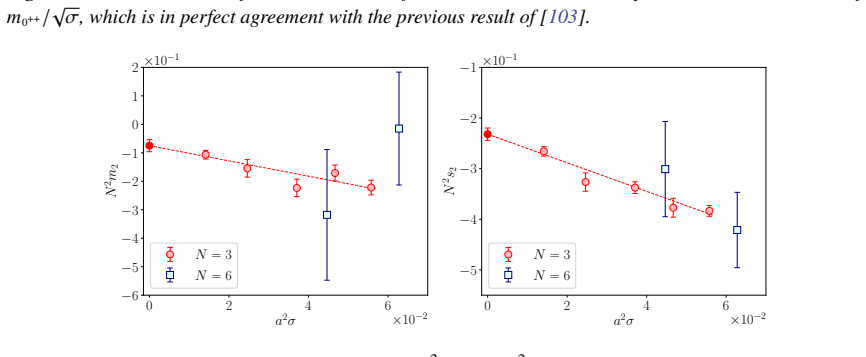
For pure SU(N) Yang–Mills in four dimensions, the paper establishes that the $\theta$-dependence of the spectrum is, at $\mathcal{O}(\theta^2)$, non-trivial and negative for both the mass gap and the string tension. In the continuum limit for N=3 it obtains $m_G/\sqrt{\sigma}$ at $\theta=0$ equal to $3.398(25)$, and $m_2 = -0.0083(23)$, $s_2 = -0.0258(14)$, using the parametrization $m(\theta)=m_0[1+m_2 \theta^2+\ldots]$ and $\sigma(\theta)=\sigma[1+s_2 \theta^2+\ldots]$. For N=6 the data, on two fine lattice spacings, are compatible with the large-N expectation $m_2 = \bar{m}_2/N^2 + \mathcal{O}(1/N^4)$, $s_2 = \bar{s}_2/N^2 + \mathcal{O}(1/N^4)$, yielding the large-N estimates $\bar{m}_2 \simeq -0.075(20)$ and $\bar{s}_2 \simeq -0.23(1)$. The ratio $s_2/m_2 \simeq 3.07(82)$ agrees with a holographic prediction of 4, while the ratio $T_c/m_G$ is found to be $\theta$-dependent already at leading order, in contrast with that same holographic model.
Load-bearing premise
The whole analytic-continuation program assumes the spectrum is analytic in $\theta$ around zero, so the curvature measured at imaginary $\theta$ equals the real-$\theta$ Taylor coefficient; if non-analytic behavior or higher-order terms intervene, the quoted numbers would not be the real-$\theta$ coefficients.
Editorial extensions
If this is right
- If confirmed, the negative sign and magnitude of $m_2$ fix the leading $\theta$-dependence of the glueball mass and string tension, with direct consequences for axion cosmology and for any observable that probes the vacuum angle.
- The $1/N^2$ scaling means the $\theta$-dependence of the spectrum vanishes in the planar limit at fixed $\theta$, consistent with confinement in large-N gauge theories, and it sharpens predictions for N=2 and N=4.
- The combination $t_2 = R + s_2/2$ gives a non-zero $\theta$-dependence of $T_c/\sqrt{\sigma}$, which can be compared with holographic and other model predictions for the deconfinement transition.
- The value of $m_2$ controls the systematic error of lattice spectra computed at fixed topological charge; the paper estimates this error is below 0.1% for N=3 at typical volumes and shrinks with N.
- The ratio $s_2/m_2 \simeq 3.07(82)$ is consistent with the holographic prediction of 4, but the ratio $R/m_2$ disagrees, so the full pattern of $\theta$-dependence in the spectrum discriminates among holographic models.
Reading between the lines
- The near-equality $m_2 \approx s_2/2$ at N=3 means the ratio $m_G/\sqrt{\sigma}$ is almost $\theta$-independent at leading order; a natural extension is to test whether this approximate cancellation persists at N=6 and higher N, which would suggest an underlying non-renormalization in this ratio.
- The large-N scaling seen here could be combined with the known $1/N^2$ behavior of the deconfinement temperature to build a unified large-N description, where all dimensionless ratios in the confining sector have fixed leading $\theta$-dependence.
- Because the N=6 data are limited to two fine lattices, running at an additional lattice spacing or at N=4,5 would sharpen the $1/N^2$ fit and test the subleading $\mathcal{O}(1/N^4)$ corrections.
- The same imaginary-$\theta$ plus PTBC framework could be extended to the excited glueball spectrum and to the tensions of $k$-strings, not just the fundamental one, to see whether the negative $\theta^2$ coefficient is universal across the spectrum.
Editorial analysis
A structured set of objections, weighed in public.
Referee Report
Summary. This proceedings contribution reports a lattice computation of the O(theta^2) coefficients of the mass gap and string tension of SU(N) Yang-Mills for N=3 and N=6, using the imaginary-theta method with Parallel Tempering on Boundary Conditions. For N=3 the authors obtain continuum-extrapolated values m2 = -0.0083(23) and s2 = -0.0258(14), together with m0++/sqrt(sigma) = 3.398(25), in agreement with previous determinations. For N=6, data at two lattice spacings are used to test the expected large-N scaling of N^2 m2 and N^2 s2, yielding the estimates m2bar = -0.075(20) and s2bar = -0.23(1). The paper also compares the ratio s2/m2 with a holographic prediction and discusses implications for the theta-dependence of Tc/sqrt(sigma) and for fixed-topology systematic errors.
Significance. If correct, these are the first continuum-extrapolated determinations of the theta-dependence of the glueball mass and string tension in SU(3) Yang-Mills, and a first quantitative large-N check. The use of PTBC to mitigate topological freezing at fine lattice spacings is a useful methodological step, and the cross-check against the known m0++/sqrt(sigma) value is a genuine strength. The paper is honest about the absence of an N=6 continuum limit, but the large-N estimates that follow from the two N=6 points need stronger qualification, as discussed in the major comment.
major comments (1)
- [Section 3, Eqs. (18)-(19), Fig. 3] The quoted large-N estimates m2bar = -0.075(20) and s2bar = -0.23(1) rest on N=6 data at only two finite lattice spacings with no continuum extrapolation. The manuscript itself states that 'we cannot perform a continuum limit of these data alone', yet the errors quoted in Eqs. (19) do not include any contribution from the unknown O(a^2) discretization effects. The statement that the data are 'perfectly compatible' with N^2 scaling does not by itself determine the continuum large-N coefficients, and the numerical estimates in (19) are not fully supported. Please either estimate the discretization systematic (for example, from the spread between the two N=6 points or from a combined N=3/N=6 fit with a shared O(a^2) term) or explicitly present (19) as a preliminary estimate with statistical errors only.
minor comments (5)
- [Eqs. (11)-(14)] The notation O(theta^2) after the explicit 1 + m2 theta^2 term should be O(theta^4) (and analogously O(theta_L^4) in Eqs. (13)-(14)); as written, the error term is indistinguishable from the kept term.
- [Eq. (21)] The derivative in the definitions of m2 and s2 should be the second derivative with respect to theta, d^2/dtheta^2; the current notation d/dtheta^2 is ambiguous and, read literally, introduces a factor of two relative to the parameterization in Eqs. (11)-(12).
- [Section 3, Fig. 2] Please provide or cite the specific ensemble table, Z_Q values, and fit ansatz used in the continuum extrapolations; without these, the quoted continuum values in Eqs. (16)-(17) cannot be verified from this proceedings alone.
- [Eq. (29)] The ratio s2/m2 is written twice, 's2/m2 = s2/m2 = 4'; the first equality is tautological and should be removed or corrected.
- [References, [58]] The companion paper [58] is cited only in the introduction; it would be helpful to cite it again where the numerical results are presented, for example after Eq. (17) and in the caption of Fig. 3, so that readers know where to find the full error budget and numerical tables.
Circularity Check
No circularity: the coefficients m2 and s2 are measured quantities from lattice fits, with external benchmarks and honest statements of assumptions.
full rationale
The central results m2 and s2 are not assumed inputs but are extracted by fitting the measured lattice dependence of am_G and a^2 sigma on the imaginary theta_L to the Taylor forms in Eqs. (13)-(14), after dividing by the independently determined renormalization factor Z_Q obtained from cooling. The continuum limit for N=3 is a standard extrapolation of those extracted coefficients, and the check of m0++/sqrt(sigma) against Refs. [103] is an external benchmark. The holographic comparison with Ref. [108] is also an external prediction, not an input. The large-N estimates in Eq. (19) are not derived from a fit to a claimed scaling law; the paper explicitly states that the N=6 data alone cannot be continuum-extrapolated and that Eq. (18) is an expected scaling used to check compatibility. This is a stated modeling limitation rather than a circular step. Self-citations, including the companion paper [58], serve as provenance or methodological references (PTBC, imaginary-theta method) and do not carry the derivation by themselves. The analyticity assumption around theta=0 is explicitly stated as an assumption, not disguised as a derived result. No equation reduces by construction to an input, and no fitted parameter is renamed as a prediction.
Assumptions & free parameters
free parameters (4)
- m2 for SU(3) =
-0.0083(23)
- s2 for SU(3) =
-0.0258(14)
- large-N coefficient N^2 m2 =
-0.075(20)
- large-N coefficient N^2 s2 =
-0.23(1)
assumptions (4)
- domain assumption The mass gap and string tension are analytic in theta around theta=0, allowing analytic continuation from imaginary theta_L.
- domain assumption The Taylor expansion truncated at O(theta^2) is valid over the fitted theta_L range.
- domain assumption The large-N scaling m2 = m2bar/N^2 + O(1/N^4) and s2 = s2bar/N^2 + O(1/N^4) holds for N=3 and N=6.
- domain assumption The clover topological charge is multiplicatively renormalized to the integer charge by Z_Q determined via cooling.
Cite this review
Pith. "Pith review of The imaginary-$\theta$ dependence of the SU($N$) spectrum." pith.science (2026). https://pith.science/paper/XMH55LRX
@misc{pith2026241114022,
  author       = {Pith},
  title        = {Pith review of: The imaginary-$\theta$ dependence of the SU($N$) spectrum},
  year         = {2026},
  howpublished = {\url{https://pith.science/paper/XMH55LRX}},
  note         = {Machine review of arXiv:2411.14022}
}
abstract
In this talk we will report on a study of the $\theta$-dependence of the string tension and of the mass gap of four-dimensional SU($N$) Yang--Mills theories. The spectrum at $N=3$ and $N=6$ was obtained on the lattice at various imaginary values of the $\theta$-parameter, using Parallel Tempering on Boundary Conditions to avoid topological freezing at fine lattice spacings. The coefficient of the $\mathcal{O}(\theta^2)$ term in the Taylor expansion of the spectrum around $\theta=0$ could be obtained in the continuum limit for $N=3$, and on two fairly fine lattices for $N=6$.
Figures


Forward citations
Cited by 1 Pith paper
-
Wormholes and the imaginary distance bound
Wormhole solutions with imaginary scalars set an Imaginary Distance Bound on analytic continuation of couplings, enforced by stringy effects that coincide with WGC and KSW in special cases.
Reference graph
Works this paper leans on
-
[58]
C. Bonanno, C. Bonati, M. Papace and D. Vadacchino,The𝜃-dependence of the Yang-Mills spectrum from analytic continuation, JHEP 05(2024) 163 [2402.03096]
arXiv 2024
-
[1]
Witten,Current Algebra Theorems for the𝑈(1) Goldstone Boson,Nucl
E. Witten,Current Algebra Theorems for the𝑈(1) Goldstone Boson,Nucl. Phys. B156 (1979) 269
1979
-
[2]
Veneziano,𝑈(1) Without Instantons,Nucl
G. Veneziano,𝑈(1) Without Instantons,Nucl. Phys. B159 (1979) 213
1979
-
[3]
Kawarabayashi and N
K. Kawarabayashi and N. Ohta,The Problem of𝜂 in the Large𝑁 Limit: Effective Lagrangian Approach, Nucl. Phys. B175 (1980) 477
1980
-
[4]
Witten,Large𝑁 Chiral Dynamics, Annals Phys.128 (1980) 363
E. Witten,Large𝑁 Chiral Dynamics, Annals Phys.128 (1980) 363. 8 The imaginary-𝜃 dependence of the SU(𝑁) spectrum Davide Vadacchino
1980
-
[5]
Coleman,Aspects of Symmetry: Selected Erice Lectures
S. Coleman,Aspects of Symmetry: Selected Erice Lectures. Cambridge University Press, Cambridge, U.K., 1985
1985
-
[6]
D. J. Gross, R. D. Pisarski and L. G. Yaffe,QCD and Instantons at Finite Temperature,Rev. Mod. Phys.53 (1981) 43
1981
-
[7]
T. Schäfer and E. V. Shuryak,Instantons in QCD, Rev. Mod. Phys.70(1998) 323 [hep-ph/9610451]
arXiv 1998
Show all 110 references
-
[8]
D’Adda, M
A. D’Adda, M. Lüscher and P. Di Vecchia,A 1/𝑁 Expandable Series of Nonlinear Sigma Models with Instantons,Nucl. Phys. B146 (1978) 63
1978
-
[9]
Witten,Instantons, the Quark Model, and the1/𝑁 Expansion, Nucl
E. Witten,Instantons, the Quark Model, and the1/𝑁 Expansion, Nucl. Phys. B149 (1979) 285
1979
-
[10]
T. G. Kovacs, E. T. Tomboulis and Z. Schram,Topology on the lattice: 2-d Yang-Mills theories with a theta term, Nucl. Phys. B454 (1995) 45 [hep-th/9505005]
1995 arXiv
-
[11]
Bonati and P
C. Bonati and P. Rossi,Topological susceptibility of two-dimensional𝑈(𝑁) gauge theories, Phys. Rev. D99(2019) 054503 [1901.09830]
2019 arXiv
-
[12]
Bonati and P
C. Bonati and P. Rossi,Topological effects in continuum two-dimensional𝑈(𝑁) gauge theories,Phys. Rev. D100(2019) 054502 [1908.07476]
2019 arXiv
-
[13]
Jackiw,Introduction to the Yang-Mills Quantum Theory,Rev
R. Jackiw,Introduction to the Yang-Mills Quantum Theory,Rev. Mod. Phys.52(1980) 661
1980
-
[14]
Gaiotto, A
D. Gaiotto, A. Kapustin, Z. Komargodski and N. Seiberg,Theta, Time Reversal, and Temperature, JHEP 05(2017) 091 [1703.00501]
2017 arXiv
-
[15]
Bonati and M
C. Bonati and M. D’Elia,Topological critical slowing down: variations on a toy model, Phys. Rev. E98(2018) 013308 [1709.10034]
2018 arXiv
-
[16]
Di Vecchia and G
P. Di Vecchia and G. Veneziano,Chiral Dynamics in the Large𝑁 Limit,Nucl. Phys. B171 (1980) 253
1980
-
[17]
Grilli di Cortona, E
G. Grilli di Cortona, E. Hardy, J. Pardo Vega and G. Villadoro,The QCD axion, precisely, JHEP 01(2016) 034 [1511.02867]
2016 arXiv
-
[18]
F.-K.GuoandU.-G.Meißner, CumulantsoftheQCDtopologicalchargedistribution ,Phys. Lett. B749 (2015) 278 [1506.05487]
2015 arXiv
-
[19]
Lu, M.-L
Z.-Y. Lu, M.-L. Du, F.-K. Guo, U.-G. Meißner and T. Vonk,QCD𝜃-vacuum energy and axion properties,JHEP 05 (2020) 001 [2003.01625]
2020 arXiv
-
[20]
N. R. Acharya, F.-K. Guo, M. Mai and U.-G. Meißner,𝜃-dependence of the lightest meson resonances in QCD, Phys. Rev. D92 (2015) 054023 [1507.08570]
2015 arXiv
-
[21]
Boccaletti and D
A. Boccaletti and D. Nogradi,The semi-classical approximation at high temperature revisited,JHEP 03(2020) 045 [2001.03383]. 9 The imaginary-𝜃 dependence of the SU(𝑁) spectrum Davide Vadacchino
2020 arXiv
-
[22]
Bonati, M
C. Bonati, M. D’Elia, M. Mariti, G. Martinelli, M. Mesiti, F. Negro et al.,Axion phenomenology and𝜃-dependence from𝑁 𝑓 = 2+ 1 lattice QCD,JHEP 03 (2016) 155 [1512.06746]
2016 arXiv
-
[23]
Petreczky, H.-P
P. Petreczky, H.-P. Schadler and S. Sharma,The topological susceptibility in finite temperature QCD and axion cosmology,Phys. Lett. B762 (2016) 498 [1606.03145]
2016 arXiv
-
[24]
Frison, R
J. Frison, R. Kitano, H. Matsufuru, S. Mori and N. Yamada,Topological susceptibility at high temperature on the lattice,JHEP 09 (2016) 021 [1606.07175]
2016 arXiv
-
[25]
Borsanyi et al.,Calculation of the axion mass based on high-temperature lattice quantum chromodynamics,Nature 539 (2016) 69 [1606.07494]
S. Borsanyi et al.,Calculation of the axion mass based on high-temperature lattice quantum chromodynamics,Nature 539 (2016) 69 [1606.07494]
2016 arXiv
-
[26]
Bonati, M
C. Bonati, M. D’Elia, G. Martinelli, F. Negro, F. Sanfilippo and A. Todaro,Topology in full QCDathightemperature: amulticanonicalapproach ,JHEP 11(2018)170[ 1807.07954]
2018 arXiv
-
[27]
F.Burger,E.-M.Ilgenfritz,M.P.LombardoandA.Trunin, Chiralobservablesandtopology in hot QCD with two families of quarks, Phys. Rev. D98(2018) 094501 [1805.06001]
2018 arXiv
-
[28]
Chen, T.-W
TWQCD collaboration, Y.-C. Chen, T.-W. Chiu and T.-H. Hsieh,Topological susceptibility in finite temperature QCD with physical (u/d,s,c) domain-wall quarks, Phys. Rev. D106 (2022) 074501 [2204.01556]
2022 arXiv
-
[29]
Athenodorou, C
A. Athenodorou, C. Bonanno, C. Bonati, G. Clemente, F. D’Angelo, M. D’Elia et al., Topological susceptibility of N𝑓 = 2 + 1 QCD from staggered fermions spectral projectors at high temperatures,JHEP 10 (2022) 197 [2208.08921]
2022 arXiv
-
[30]
Alles, M
B. Alles, M. D’Elia and A. Di Giacomo,Topological susceptibility at zero and finite T in SU(3) Yang-Mills theory, Nucl. Phys. B494 (1997) 281 [hep-lat/9605013]
1997 arXiv
-
[31]
Alles, M
B. Alles, M. D’Elia and A. Di Giacomo,Topology at zero and finite𝑇 in𝑆𝑈(2) Yang–Mills theory,Phys. Lett. B412 (1997) 119 [hep-lat/9706016]
1997 arXiv
-
[32]
Del Debbio, L
L. Del Debbio, L. Giusti and C. Pica,Topological susceptibility in the𝑆𝑈(3) gauge theory, Phys. Rev. Lett.94(2005) 032003 [hep-th/0407052]
2005 arXiv
-
[33]
Del Debbio, H
L. Del Debbio, H. Panagopoulos and E. Vicari,𝜃 dependence of𝑆𝑈(𝑁) gauge theories, JHEP 08 (2002) 044 [hep-th/0204125]
2002 arXiv
-
[34]
D’Elia,Field theoretical approach to the study of theta dependence in Yang-Mills theories on the lattice, Nucl
M. D’Elia,Field theoretical approach to the study of theta dependence in Yang-Mills theories on the lattice, Nucl. Phys. B661 (2003) 139 [hep-lat/0302007]
2003 arXiv
-
[35]
Lucini, M
B. Lucini, M. Teper and U. Wenger,Topology of𝑆𝑈(𝑁) gauge theories at𝑇≃ 0 and 𝑇≃𝑇𝑐, Nucl. Phys. B715 (2005) 461 [hep-lat/0401028]
2005 arXiv
-
[36]
Giusti, S
L. Giusti, S. Petrarca and B. Taglienti,𝜃 dependence of the vacuum energy in the𝑆𝑈(3) gauge theory from the lattice, Phys. Rev. D76 (2007) 094510 [0705.2352]. 10 The imaginary-𝜃 dependence of the SU(𝑁) spectrum Davide Vadacchino
2007 arXiv
-
[37]
Vicari and H
E. Vicari and H. Panagopoulos,𝜃 dependence of𝑆𝑈(𝑁) gauge theories in the presence of a topological term, Phys. Rept.470 (2009) 93 [0803.1593]
2009 arXiv
-
[38]
Panagopoulos and E
H. Panagopoulos and E. Vicari,The 4𝐷 𝑆𝑈(3) gauge theory with an imaginary𝜃 term, JHEP 11(2011) 119 [1109.6815]
2011 arXiv
-
[39]
Bonati, M
C. Bonati, M. D’Elia, H. Panagopoulos and E. Vicari,Change of𝜃 Dependence in4𝐷 𝑆𝑈(𝑁) Gauge Theories Across the Deconfinement Transition,Phys. Rev. Lett.110 (2013) 252003 [1301.7640]
2013 arXiv
-
[40]
M. Cè, C. Consonni, G. P. Engel and L. Giusti,Non-Gaussianities in the topological charge distributionofthe 𝑆𝑈(3) Yang–Millstheory,Phys.Rev.D 92(2015)074502[ 1506.06052]
2015 arXiv
-
[41]
M. Cè, M. Garcia Vera, L. Giusti and S. Schaefer,The topological susceptibility in the large-𝑁 limit of SU(𝑁) Yang-Mills theory,Phys. Lett. B762 (2016) 232 [1607.05939]
2016 arXiv
-
[42]
Berkowitz, M
E. Berkowitz, M. I. Buchoff and E. Rinaldi,Lattice QCD input for axion cosmology, Phys. Rev. D92(2015) 034507 [1505.07455]
2015 arXiv
-
[43]
Borsanyi, M
S. Borsanyi, M. Dierigl, Z. Fodor, S. Katz, S. Mages, D. Nogradi et al.,Axion cosmology, lattice QCD and the dilute instanton gas, Phys. Lett. B752 (2016) 175 [1508.06917]
2016 arXiv
-
[44]
Bonati, M
C. Bonati, M. D’Elia and A. Scapellato,𝜃 dependence in𝑆𝑈(3) Yang-Mills theory from analytic continuation, Phys. Rev. D93 (2016) 025028 [1512.01544]
2016 arXiv
-
[45]
Bonati, M
C. Bonati, M. D’Elia, P. Rossi and E. Vicari,𝜃 dependence of 4D𝑆𝑈(𝑁) gauge theories in the large-𝑁 limit,Phys. Rev. D94 (2016) 085017 [1607.06360]
2016 arXiv
-
[46]
Bonati, M
C. Bonati, M. Cardinali and M. D’Elia,𝜃 dependence in trace deformed𝑆𝑈(3) Yang-Mills theory: a lattice study,Phys. Rev. D98(2018) 054508 [1807.06558]
2018 arXiv
-
[47]
Bonati, M
C. Bonati, M. Cardinali, M. D’Elia and F. Mazziotti,𝜃-dependence and center symmetry in Yang-Mills theories, Phys. Rev. D101 (2020) 034508 [1912.02662]
2020 arXiv
-
[48]
Campostrini and P
M. Campostrini and P. Rossi,1/𝑁 expansion of the topological susceptibility in the𝐶𝑃 𝑁−1 models, Phys. Lett. B272(1991) 305
1991
-
[49]
Del Debbio, G
L. Del Debbio, G. M. Manca, H. Panagopoulos, A. Skouroupathis and E. Vicari, 𝜃-dependence of the spectrum of𝑆𝑈(𝑁) gauge theories,JHEP 06 (2006) 005 [hep-th/0603041]
2006 arXiv
-
[50]
Rossi,Effective Lagrangian of𝐶𝑃 𝑁−1 models in the large𝑁 limit,Phys
P. Rossi,Effective Lagrangian of𝐶𝑃 𝑁−1 models in the large𝑁 limit,Phys. Rev. DD94 (2016) 045013 [1606.07252]
2016 arXiv
-
[51]
Vicari,Monte Carlo simulation of lattice𝐶𝑃 𝑁−1 models at large𝑁, Phys
E. Vicari,Monte Carlo simulation of lattice𝐶𝑃 𝑁−1 models at large𝑁, Phys. Lett. B309 (1993) 139 [hep-lat/9209025]
1993 arXiv
-
[52]
Bonanno, C
C. Bonanno, C. Bonati and M. D’Elia,Topological properties of𝐶𝑃 𝑁−1 models in the large-𝑁 limit,JHEP 01 (2019) 003 [1807.11357]. 11 The imaginary-𝜃 dependence of the SU(𝑁) spectrum Davide Vadacchino
2019 arXiv
-
[53]
Berni, C
M. Berni, C. Bonanno and M. D’Elia,Large-𝑁 expansion and𝜃-dependence of2𝑑𝐶𝑃 𝑁−1 models beyond the leading order,Phys. Rev. D100(2019) 114509 [1911.03384]
2019 arXiv
-
[54]
Berni, C
M. Berni, C. Bonanno and M. D’Elia,𝜃-dependence in the small-𝑁 limit of2𝑑𝐶𝑃 𝑁−1 models, Phys. Rev. D102 (2020) 114519 [2009.14056]
2020 arXiv
-
[55]
Bonanno, M
C. Bonanno, M. D’Elia and F. Margari,Topological susceptibility of the 2D CP1 or O(3) nonlinear𝜎 model: Is it divergent or not?,Phys. Rev. D107(2023) 014515 [2208.00185]
2023 arXiv
-
[56]
Nogradi,An ideal toy model for confining, walking and conformal gauge theories: the O(3) sigma model with theta-term, JHEP 05(2012) 089 [1202.4616]
D. Nogradi,An ideal toy model for confining, walking and conformal gauge theories: the O(3) sigma model with theta-term, JHEP 05(2012) 089 [1202.4616]
2012 arXiv
-
[57]
Alles, M
B. Alles, M. Giordano and A. Papa,Behavior near𝜃=𝜋 of the mass gap in the two-dimensional O(3) non-linear sigma model, Phys. Rev. B90 (2014) 184421 [1409.1704]
2014 arXiv
-
[59]
Bhanot and F
G. Bhanot and F. David,The Phases of the𝑂(3)𝜎 Model for Imaginary𝜃, Nucl. Phys. B 251 (1985) 127
1985
-
[60]
Azcoiti, G
V. Azcoiti, G. Di Carlo, A. Galante and V. Laliena,New proposal for numerical simulations of theta vacuum - like systems, Phys. Rev. Lett.89(2002) 141601 [hep-lat/0203017]
2002 arXiv
-
[61]
Alles and A
B. Alles and A. Papa,Mass gap in the2𝐷𝑂(3) non-linear sigma model with a𝜃=𝜋 term, Phys. Rev. D77 (2008) 056008 [0711.1496]
2008 arXiv
-
[62]
Imachi, M
M. Imachi, M. Kambayashi, Y. Shinno and H. Yoneyama,The𝜃-term,𝐶𝑃 𝑁−1 model and the inversion approach in the imaginary-𝜃 method, Prog. Theor. Phys.116 (2006) 181
2006
-
[63]
S.Aoki,R.Horsley,T.Izubuchi, Y.Nakamura,D.Pleiter,P.E.L.Rakowetal., TheElectric dipole moment of the nucleon from simulations at imaginary vacuum angle theta, 0808.1428
-
[64]
D’Elia and F
M. D’Elia and F. Negro,𝜃 dependence of the deconfinement temperature in Yang–Mills theories,Phys. Rev. Lett.109(2012) 072001 [1205.0538]
2012 arXiv
-
[65]
D’Elia and F
M. D’Elia and F. Negro,Phase diagram of Yang-Mills theories in the presence of a𝜃 term, Phys. Rev. D88 (2013) 034503 [1306.2919]
2013 arXiv
-
[66]
Bonanno, C
C. Bonanno, C. Bonati and M. D’Elia,Large-𝑁 𝑆𝑈(𝑁) Yang-Mills theories with milder topological freezing,JHEP 03 (2021) 111 [2012.14000]
2021 arXiv
-
[67]
Bonanno, M
C. Bonanno, M. D’Elia and L. Verzichelli,The𝜃-dependence of the𝑆𝑈(𝑁) critical temperature at large𝑁, JHEP 02(2024) 156 [2312.12202]
2024 arXiv
-
[68]
Campostrini, A
M. Campostrini, A. Di Giacomo and H. Panagopoulos,The Topological Susceptibility on the Lattice, Phys. Lett. B212(1988) 206. 12 The imaginary-𝜃 dependence of the SU(𝑁) spectrum Davide Vadacchino
1988
-
[69]
Berg,Dislocations andTopological Background inthe Lattice𝑂(3)𝜎 Model,Phys
B. Berg,Dislocations andTopological Background inthe Lattice𝑂(3)𝜎 Model,Phys. Lett. B 104(1981) 475
1981
-
[70]
Iwasaki and T
Y. Iwasaki and T. Yoshie,Instantons and Topological Charge in Lattice Gauge Theory, Phys. Lett. B131(1983) 159
1983
-
[71]
S. Itoh, Y. Iwasaki and T. Yoshie,Stability of Instantons on the Lattice and the Renormalized Trajectory, Phys. Lett. B147 (1984) 141
1984
-
[72]
Teper,Instantons in the Quantized𝑆𝑈(2) Vacuum: A Lattice Monte Carlo Investigation, Phys
M. Teper,Instantons in the Quantized𝑆𝑈(2) Vacuum: A Lattice Monte Carlo Investigation, Phys. Lett. B162(1985) 357
1985
-
[73]
Ilgenfritz, M
E.-M. Ilgenfritz, M. Laursen, G. Schierholz, M. Müller-Preussker and H. Schiller,First Evidence for the Existence of Instantons in the Quantized𝑆𝑈(2) Lattice Vacuum,Nucl. Phys. B268 (1986) 693
1986
-
[74]
Campostrini, A
M. Campostrini, A. Di Giacomo, H. Panagopoulos and E. Vicari,Topological Charge, Renormalization and Cooling on the Lattice,Nucl. Phys. B329(1990) 683
1990
-
[75]
Alles, L
B. Alles, L. Cosmai, M. D’Elia and A. Papa,Topology in2𝐷𝐶𝑃 𝑁−1 models on the lattice: A Critical comparison of different cooling techniques,Phys. Rev. D62(2000) 094507 [hep-lat/0001027]
2000 arXiv
-
[76]
APEcollaboration,M.Albaneseetal., GlueballMassesandStringTensioninLatticeQCD , Phys. Lett. B192 (1987) 163
1987
-
[77]
Morningstar and M
C. Morningstar and M. J. Peardon,Analytic smearing of SU(3) link variables in lattice QCD, Phys. Rev. D69(2004) 054501 [hep-lat/0311018]
2004 arXiv
-
[78]
Lüscher,Trivializing maps, the Wilson flow and the HMC algorithm, Commun
M. Lüscher,Trivializing maps, the Wilson flow and the HMC algorithm, Commun. Math. Phys. 293(2010) 899 [0907.5491]
2010 arXiv
-
[79]
Lüscher,Properties and uses of the Wilson flow in lattice QCD, JHEP 08(2010) 071 [1006.4518]
M. Lüscher,Properties and uses of the Wilson flow in lattice QCD, JHEP 08(2010) 071 [1006.4518]
2010 arXiv
-
[80]
Luscher and P
M. Luscher and P. Weisz,Perturbative analysis of the gradient flow in non-abelian gauge theories,JHEP 02(2011) 051 [1101.0963]
2011 arXiv
-
[81]
Bonati and M
C. Bonati and M. D’Elia,Comparison of the gradient flow with cooling in𝑆𝑈(3) pure gauge theory,Phys. Rev. DD89(2014) 105005 [1401.2441]
2014 arXiv
-
[82]
Alexandrou, A
C. Alexandrou, A. Athenodorou and K. Jansen,Topological charge using cooling and the gradient flow, Phys. Rev. D92(2015) 125014 [1509.04259]
2015 arXiv
-
[83]
Creutz,Overrelaxation and Monte Carlo Simulation,Phys
M. Creutz,Overrelaxation and Monte Carlo Simulation,Phys. Rev. D36(1987) 515
1987
-
[84]
Creutz,Monte Carlo Study of Quantized𝑆𝑈(2) Gauge Theory,Phys
M. Creutz,Monte Carlo Study of Quantized𝑆𝑈(2) Gauge Theory,Phys. Rev. D21 (1980) 2308. 13 The imaginary-𝜃 dependence of the SU(𝑁) spectrum Davide Vadacchino
1980
-
[85]
A. D. Kennedy and B. J. Pendleton,Improved Heat Bath Method for Monte Carlo Calculations in Lattice Gauge Theories, Phys. Lett. B156 (1985) 393
1985
-
[86]
Hasenbusch,Fighting topological freezing in the two-dimensional𝐶𝑃 𝑁−1 model,Phys
M. Hasenbusch,Fighting topological freezing in the two-dimensional𝐶𝑃 𝑁−1 model,Phys. Rev. D96(2017) 054504 [1706.04443]
2017 arXiv
-
[87]
Alles, G
B. Alles, G. Boyd, M. D’Elia, A. Di Giacomo and E. Vicari,Hybrid Monte Carlo and topological modes of full QCD, Phys. Lett. B389 (1996) 107 [hep-lat/9607049]
1996 arXiv
-
[88]
Del Debbio, G
L. Del Debbio, G. M. Manca and E. Vicari,Critical slowing down of topological modes, Phys. Lett. B594(2004) 315 [hep-lat/0403001]
2004 arXiv
-
[89]
Schaefer, R
ALPHAcollaboration, S. Schaefer, R. Sommer and F. Virotta,Critical slowing down and error analysis in lattice QCD simulations,Nucl. Phys. B845 (2011) 93 [1009.5228]
2011 arXiv
-
[90]
Bonanno,Lattice determination of the topological susceptibility slope𝜒′ of 2𝑑 CP𝑁−1 models at large𝑁,Phys
C. Bonanno,Lattice determination of the topological susceptibility slope𝜒′ of 2𝑑 CP𝑁−1 models at large𝑁,Phys. Rev. D107 (2023) 014514 [2212.02330]
2023 arXiv
-
[91]
Bonanno, G
C. Bonanno, G. Clemente, M. D’Elia, L. Maio and L. Parente,Full QCD with milder topological freezing,JHEP 08 (2024) 236 [2404.14151]
2024 arXiv
-
[92]
Bonanno, M
C. Bonanno, M. D’Elia, B. Lucini and D. Vadacchino,Towards glueball masses of large-N SU(N) pure-gauge theories without topological freezing,Phys. Lett. B833 (2022) 137281 [2205.06190]
2022 arXiv
-
[93]
J. L. Dasilva Golán, C. Bonanno, M. D’Elia, M. García Pérez and A. Giorgieri,The twisted gradient flow strong coupling with parallel tempering on boundary conditions, PoS LATTICE2023(2024) 354 [2312.09212]
2024 arXiv
-
[94]
Bonanno, J
C. Bonanno, J. L. Dasilva Golán, M. D’Elia, M. García Pérez and A. Giorgieri,The SU(3) twisted gradient flow strong coupling without topological freezing,Eur. Phys. J. C84 (2024) 916 [2403.13607]
2024 arXiv
-
[95]
Berg and A
B. Berg and A. Billoire,Glueball spectroscopy in4𝑑 su(3) lattice gauge theory (i), Nuclear Physics B221 (1983) 109
1983
-
[96]
Teper,An improved method for lattice glueball calculations,Physics Letters B183 (1987) 345
M. Teper,An improved method for lattice glueball calculations,Physics Letters B183 (1987) 345
1987
-
[97]
M. J. Teper,SU(𝑁) gauge theories in(2+ 1)-dimensions,Phys. Rev. D59(1999) 014512 [hep-lat/9804008]
1999 arXiv
-
[98]
Lucini and M
B. Lucini and M. Teper,𝑆𝑈(𝑁) gauge theories in four-dimensions: Exploring the approach to𝑁 =∞, JHEP 06(2001) 050 [hep-lat/0103027]
2001 arXiv
-
[99]
Lucini, M
B. Lucini, M. Teper and U. Wenger,Glueballs and𝑘-strings in𝑆𝑈(𝑁) gauge theories: Calculations with improved operators, JHEP 06(2004) 012 [hep-lat/0404008]. 14 The imaginary-𝜃 dependence of the SU(𝑁) spectrum Davide Vadacchino
2004 arXiv
-
[100]
Blossier, M
B. Blossier, M. Della Morte, G. von Hippel, T. Mendes and R. Sommer,On the generalized eigenvalue method for energies and matrix elements in lattice field theory, JHEP 04(2009) 094 [0902.1265]
2009 arXiv
-
[101]
Lucini, A
B. Lucini, A. Rago and E. Rinaldi,Glueball masses in the large-𝑁 limit,JHEP 08 (2010) 119 [1007.3879]
2010 arXiv
-
[102]
Bennett, J
E. Bennett, J. Holligan, D. K. Hong, J.-W. Lee, C. J. D. Lin, B. Lucini et al.,Glueballs and strings in𝑆𝑝(2𝑁) Yang-Mills theories, Phys. Rev. D103 (2021) 054509 [2010.15781]
2021 arXiv
-
[103]
Athenodorou and M
A. Athenodorou and M. Teper,The glueball spectrum of SU(3) gauge theory in 3 + 1 dimensions,JHEP 11 (2020) 172 [2007.06422]
2020 arXiv
-
[104]
Athenodorou and M
A. Athenodorou and M. Teper,SU(N) gauge theories in 3+1 dimensions: glueball spectrum, string tensions and topology, JHEP 12(2021) 082 [2106.00364]
2021 arXiv
-
[105]
de Forcrand, G
P. de Forcrand, G. Schierholz, H. Schneider and M. Teper,The String and Its Tension in SU(3) Lattice Gauge Theory: Towards Definitive Results,Phys. Lett. B160 (1985) 137
1985
-
[106]
Vadacchino,A review on Glueball hunting, 2305.04869
D. Vadacchino,A review on Glueball hunting, 2305.04869
-
[107]
Yamada, M
N. Yamada, M. Yamazaki and R. Kitano,𝜃 dependence of𝑇𝑐 in SU(2) Yang-Mills theory, 2411.00375
-
[108]
Bigazzi, A
F. Bigazzi, A. L. Cotrone and R. Sisca,Notes on𝜃 Dependence in Holographic Yang–Mills, JHEP 08(2015) 090 [1506.03826]
2015 arXiv
-
[109]
Brower, S
R. Brower, S. Chandrasekharan, J. W. Negele and U. J. Wiese,QCD at fixed topology,Phys. Lett. B560 (2003) 64 [hep-lat/0302005]
2003 arXiv
-
[110]
S. Aoki, H. Fukaya, S. Hashimoto and T. Onogi,Finite volume QCD at fixed topological charge,Phys. Rev. D76(2007) 054508 [0707.0396]. 15
2007 arXiv
Reviewed August 12, 2026 · model on record in the stance chip above.
Discussion (0). Continue with ORCID to comment.