REVIEW 4 major objections 4 minor 1 cited by
FUN-AD: Fully Unsupervised Learning for Anomaly Detection with Noisy Training Data
T0 review · 4 major / 4 minor · reviewed 2026-08-12 · deepseek-v4-flash
Pith's one-line read An industrial anomaly detector can be trained entirely on unlabeled, potentially contaminated images, without a clean-normal set, by exploiting pairwise feature distance statistics.
desk verdict Clever self-training framework whose headline SOTA claim is not supported because the reported numbers are selected with test-set AUROC oracle checkpoint selection per class. read the letter →
The pith
A machine-rendered reading of the paper's core claim, the machinery that carries it, and where it could break.
The reading
What carries the argument
The load-bearing identity is the ordering of small-distance probabilities: under the variance assumption σ_N < σ_A, the cumulative distribution of ∥x1−x2∥ for normal-normal pairs dominates that of anomaly-anomaly and mixed pairs at small radii, which the paper derives from chi-square and non-central chi-square CDFs. The corresponding empirical fact is that mutually closest pairs are homogeneous with high probability. These two facts are operationalized by three components: an iteratively reconstructed memory bank (a bank rebuilt each iteration from features the current model scores as normal, passed through a learnable adaptor), a nearest-neighbor distance that is min-max normalized into anomaly scores and thresholded by τ_n and τ_c to make hard pseudo-labels and an ambiguous band, and a mutual smoothness loss—an L1 penalty on anomaly scores of mutually closest pairs—that makes the pseudo-labeling robust to threshold errors. Gaussian perturbation of ambiguous features closes the loop by preventing confident normal features from being pushed into the anomaly class.
What would settle it
Construct or select a category in which the anomaly distribution is narrow and close to the normal cluster while the normal distribution is broad (for example a high-variation object class with one dominant defect type, or an artificially spiked normal distribution). Run FUN-AD with 10% contamination and compare against a clean-data one-class baseline; if image-wise AUROC falls to near the baseline's contamination level or below, and the pairwise-distance histograms show normal-normal distances no longer dominating at small radii, the central ordering claim is falsified. The paper's own limitation section concedes this failure mode.
Extended reading notes
Core claim
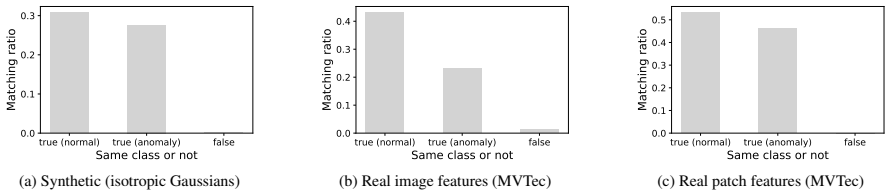
The discovery is that pairwise distance statistics in a pretrained feature space can carry the entire learning signal for fully unsupervised anomaly detection. For isotropic Gaussian normal and anomaly distributions with σ_N < σ_A, the paper proves that within a small distance threshold a normal-normal pair is more likely than an anomaly-anomaly or mixed pair, using chi-square and non-central chi-square cumulative distributions. It further validates empirically that mutually nearest neighbors are predominantly homogeneous. On this basis the method pseudo-labels patch features: features whose nearest-neighbor distance to an iteratively reconstructed memory bank is low become normal, and high ones become anomalies, with an ambiguous band perturbed by Gaussian noise. A mutual smoothness loss then enforces score consistency on mutually closest pairs, and the whole pipeline is retrained iteratively. The paper reports that this scheme matches or exceeds prior one-class and fully unsupervised methods on contaminated MVTec AD and VisA, in both no-overlap and overlap evaluation.
Load-bearing premise
The load-bearing premise is that in the feature space used, normal samples are more tightly clustered than anomalies, and this ordering holds for every category; if a normal class is as spread out as a dominant anomaly type, the pseudo-labels and mutual-smoothness loss lose their grounding.
Editorial extensions
If this is right
- Fully unsupervised training can replace one-class classification in industrial defect detection, so factories can build detectors from raw unlabeled production images without curating clean-normal sets.
- Contamination does not force a trade-off in the overlap setting: the method stays near its no-overlap performance when training anomalies also appear at test time, whereas one-class models degrade sharply.
- Higher contamination levels (up to 20%) are handled without retuning, and at very low contamination (0–1%) adding synthetic anomalies restores most of the gap.
- The mutual smoothness loss and the Gaussian perturbation of ambiguous features each contribute measurably; removing them lowers image- and pixel-wise AUROC.
- The same pairing statistics generalize beyond industrial patches to semantic anomaly detection on natural images.
Reading between the lines
- A direct consequence the paper leaves implicit: the method's pretrained feature extractor becomes a hidden hyperparameter; the pair-distance ordering should be checked on the target domain's features, and a domain-mismatched extractor could break it even when the variance assumption holds in image space.
- The variance-ordering assumption suggests a crisp test for new domains: measure the per-class feature variances before training. If the anomaly distribution is tight and the normal distribution is broad, the method should be expected to fail, matching the paper's own limitation note.
- The mutual smoothness loss resembles a local label-consistency regularizer, so combining it with stronger consistency penalties (e.g., time or view augmentation) might reduce the need for the confident-anomaly threshold τ_c.
- Because the pipeline only needs pairwise distances, it could be adapted to non-visual modalities—tabular or time-series anomaly detection—provided the feature extractor is replaced by an embedding in which the variance ordering holds.
Signed reviews
Editorial analysis
A structured set of objections, weighed in public.
Referee Report
Summary. The paper proposes FUN-AD, a fully unsupervised anomaly detection method for training sets that are unlabeled and potentially contaminated with anomalies. The method rests on two statistical observations: (i) normal-normal feature pairs tend to have smaller pairwise distances than other pair types, and (ii) mutually closest feature pairs tend to be class-homogeneous. Building on these, the authors design an iteratively reconstructed memory bank (IRMB) that stores features judged normal by the Local-Net, a nearest-neighbor distance based pseudo-labeling scheme, and a mutual smoothness loss that aligns the anomaly scores of mutually closest pairs. Experiments on MVTec AD and VisA with several contamination ratios report state-of-the-art image-wise and pixel-wise AUROC numbers, with ablations of the loss components and hyperparameters. The paper also includes a semantic anomaly detection example on CIFAR-10/STL-10 and releases code.
Significance. If the reported results are obtained under a genuinely unsupervised protocol, the contribution is significant: it would show that industrial anomaly detection can be trained on raw, unlabeled, possibly contaminated image collections without a clean normal-only training set. The paper offers a clear motivation, a simple and well-described framework, a solid set of ablations, and publicly available code, which are strengths. The key weakness is the evaluation protocol: the supplementary implementation details state that the best epoch is selected using test-set AUROC, which invalidates the fully unsupervised claim and makes the head-to-head comparisons with baselines unfair. This issue is load-bearing for the abstract and Section 5.2 SOTA claims, so the experimental section must be redone before the central claim can be accepted.
major comments (4)
- [Supplementary Implementation details] The paper selects the best training epoch per class using test labels: 'For each object/texture class, we train for 1500 epochs and choose the model with the best average of image-wise and pixel-wise AUROCs.' Since MVTec AD and VisA have no validation split, this is an oracle model-selection protocol that uses test labels. The reported numbers in Tables 1 and 2 are therefore not achievable in the claimed fully unsupervised deployment, and baselines are not given the same oracle selection. This directly undermines the 'state-of-the-art' claim in the abstract and Section 5.2. Please re-run all main experiments with a fixed training schedule (e.g., a single predefined epoch or a validation-based criterion) and report both the oracle and non-oracle numbers, and state whether the ranking against baselines is preserved.
- [Sec. 3.1, Eq. (5)] The claim that Eq. (5) is 'always greater than 1' is justified only by two special cases: equal means, and different means with similar variances. The sentence 'In practice, the normal and anomaly data usually have different means and variances to safely go over 1' is not a proof. Although a small-τ asymptotic expansion of the chi-square and non-central chi-square CDFs would establish the claim, the text as written overstates the result. Please replace the intuitive argument with the actual asymptotic expansion, or explicitly restrict the claim to the τ ≪ 1 regime.
- [Sec. 3.2 and supplementary Sec. 1] The central assumption of the paper, namely that normal features have smaller variance than anomaly features, is empirically validated on real data only for the bottle class of MVTec AD (supplementary Fig. 1). The matching-ratio plots of Fig. 2 are reported as MVTec averages, but per-class results are not shown, so the reader cannot tell whether the assumption holds for classes with high normal diversity or a dominant anomaly type. The limitations section itself concedes that the method 'may be compromised if the feature diversity of the normal data is comparable to that of the anomalies.' Please provide per-class validation of the distance ordering or the matching ratio, or list the classes where the assumption is violated and report how the method behaves on them.
- [Sec. 4.1 / Algorithm 1] The training loop is self-referential: the memory bank is constructed from the Local-Net's own anomaly scores using Eq. (6), distances to that bank are used to assign pseudo-labels (Eqs. (7)-(8)), and the same network is trained with those labels. The paper states that the iterative process 'will' leave only normal features in the bank, but no evidence is provided to show that pseudo-label accuracy or memory-bank purity improves over training. In a fully unsupervised setting, there is no external check against confirmation bias. Please include a plot of pseudo-label accuracy (or memory-bank purity) as a function of training iterations, or otherwise provide direct evidence that the loop converges to a better solution rather than amplifying initial errors.
minor comments (4)
- [Sec. 5.2 / Table 2] The statement in the abstract and Section 5.2 that FUN-AD achieves SOTA 'across various contaminated settings' is not supported for the 0% contamination setting in Table 2, where SoftPatch outperforms FUN-AD on MVTec AD (98.32 vs. 93.33 image AUROC). Please either qualify the SOTA claim to nonzero contamination ratios or explain why the 0% case is considered out of scope.
- [Algorithm 1 / Sec. 4.1] Algorithm 1 line 8 says 'Construct M using ϕ, Eq. (6)' but does not specify how often the memory bank is rebuilt, whether it uses the full training set or a random subset, and what the bank size is. The supplementary discusses a sampling ratio but not the memory-bank capacity. Please provide these details for reproducibility.
- [Sec. 5.2 / dataset setup] For the MVTec AD contamination setting, the text says anomalies are randomly incorporated at a 1:10 ratio, but the exact number of training images per class and the random seed(s) are not reported. Please state the dataset statistics and the number of random trials used to obtain the averages in Tables 1 and 2.
- [Eq. (8)] The min-max normalization in Eq. (8) uses the global min and max over the mini-batch. At the beginning of training, when the Local-Net is random, these values may be degenerate or unstable. Please comment on how the normalization behaves at the first iteration and whether any numerical safeguards are used.
Circularity Check
Headline SOTA claim is constructed by oracle per-class checkpoint selection on test-set AUROCs; the core self-training loop has external pairwise-distance signal and is not otherwise circular.
-
fitted input called prediction
[Supplementary Material, Sec. 3 (Implementation details)]
"For each object/texture class, we train for 1500 epochs and choose the model with the best average of image-wise and pixel-wise AUROCs."
The paper's headline claim is SOTA performance in a fully unsupervised setting with no labels. This sentence shows the reported per-class numbers are not outputs of a fixed training schedule but are selected over 1500 epochs using the test AUROC values themselves. MVTec AD and VisA have no validation split, so the checkpoint choice consumes the very labels the method claims to avoid. The reported AUROC is thus a fitted statistic: test labels are an input to selection, and the reported number is the value of the selection objective. Baselines in Tables 1 and 7-10 are not described as receiving an equivalent per-class test-set selection, so the SOTA comparison is not a fair estimate of fully unsupervised performance.
full rationale
The derivation in Sec. 3.1 is a conditional analytic statement: if sigma_N < sigma_A, then close feature pairs are more likely normal-normal. The pseudo-labeling strategy follows from that assumption rather than from the target labels, so there is no self-definitional circularity there. The Sec. 3.2 matching-ratio analysis is an external empirical check on DINO features; the supplementary narrows it to the bottle class, which is a generality limitation, not a circular step. The IRMB loop (Eqs. 6-8, 11) is self-referential: the memory bank is built from Local-Net scores, distances to that bank generate pseudo-labels, and those labels train the same network. However, the loop is anchored by pairwise distances in fixed pretrained features, and the paper explicitly relies on an externally stated variance assumption, so this is bootstrap self-training rather than an equation reducing to its own output. The mutual-smoothness loss also uses an external consistency assumption validated empirically. The one place where a reported result is forced by its own target is the supplementary evaluation protocol: per-class checkpoint selection by best test AUROC means the SOTA numbers are maxima over a test-label-driven sweep, not predictions of a fully unsupervised procedure. The limitations section honestly concedes the variance assumption can fail when normal diversity approaches anomaly diversity and that performance is suboptimal at 0-1% contamination; these are assumption-dependence concerns, not circularity. Score 6 reflects one constructed prediction (the empirical SOTA claim) while the method's internal derivation retains independent content.
Assumptions & free parameters
free parameters (5)
- tau_b =
0.5
- tau_n =
0.5
- tau_c =
0.9
- lambda =
2.5
- sampling_ratio =
0.5 (default implied)
assumptions (4)
- domain assumption Normal and anomaly features are Gaussian with isotropic covariances and the normal variance is smaller than the anomaly variance.
- domain assumption Mutually closest feature pairs are usually from the same class.
- ad hoc to paper The pairwise nearest-neighbor distance to an iteratively reconstructed memory bank provides a reliable normal/anomaly signal even when the bank contains anomalies.
- standard math The chi-squared CDF is monotonic and the non-central chi-squared CDF dominates the central one for positive non-centrality parameter.
Cite this review
Pith. "Pith review of FUN-AD: Fully Unsupervised Learning for Anomaly Detection with Noisy Training Data." pith.science (2026). https://pith.science/paper/QRNUMDT2
@misc{pith2026241116110,
  author       = {Pith},
  title        = {Pith review of: FUN-AD: Fully Unsupervised Learning for Anomaly Detection with Noisy Training Data},
  year         = {2026},
  howpublished = {\url{https://pith.science/paper/QRNUMDT2}},
  note         = {Machine review of arXiv:2411.16110}
}
read the original abstract
While the mainstream research in anomaly detection has mainly followed the one-class classification, practical industrial environments often incur noisy training data due to annotation errors or lack of labels for new or refurbished products. To address these issues, we propose a novel learning-based approach for fully unsupervised anomaly detection with unlabeled and potentially contaminated training data. Our method is motivated by two observations, that i) the pairwise feature distances between the normal samples are on average likely to be smaller than those between the anomaly samples or heterogeneous samples and ii) pairs of features mutually closest to each other are likely to be homogeneous pairs, which hold if the normal data has smaller variance than the anomaly data. Building on the first observation that nearest-neighbor distances can distinguish between confident normal samples and anomalies, we propose a pseudo-labeling strategy using an iteratively reconstructed memory bank (IRMB). The second observation is utilized as a new loss function to promote class-homogeneity between mutually closest pairs thereby reducing the ill-posedness of the task. Experimental results on two public industrial anomaly benchmarks and semantic anomaly examples validate the effectiveness of FUN-AD across different scenarios and anomaly-to-normal ratios. Our code is available at https://github.com/HY-Vision-Lab/FUNAD.
Figures


Figures from the paper (4 more)


Forward citations
Cited by 1 Pith paper
-
Exploring a Hybrid Deep Learning Approach for Anomaly Detection in Mental Healthcare Provider Billing: Addressing Label Scarcity through Semi-Supervised Anomaly Detection
Pseudo-labeling with Isolation Forest lets an LSTM detect billing anomalies with high recall, but the hybrid LSTM-Transformer adds little and reduces precision.
Reference graph
Works this paper leans on
-
[1]
A coarse-to-fine pseudo-labeling (C2FPL) framework for unsupervised video anomaly detec- tion
Anas Al-lahham, Nurbek Tastan, Zaigham Zaheer, and Karthik Nandakumar. A coarse-to-fine pseudo-labeling (C2FPL) framework for unsupervised video anomaly detec- tion. arXiv preprint arXiv:2310.17650, 2023. 1
arXiv 2023
-
[2]
PNI: indus- trial anomaly detection using position and neighborhood in- formation
Jaehyeok Bae, Jae-Han Lee, and Seyun Kim. PNI: indus- trial anomaly detection using position and neighborhood in- formation. In Proceedings of the IEEE/CVF International Conference on Computer Vision (ICCV), pages 6373–6383,
-
[3]
MVTec AD — A Comprehensive Real- World Dataset for Unsupervised Anomaly Detection
Paul Bergmann, Michael Fauser, David Sattlegger, and Carsten Steger. MVTec AD — A Comprehensive Real- World Dataset for Unsupervised Anomaly Detection. InPro- ceedings of the IEEE/CVF Conference on Computer Vision and Pattern Recognition (CVPR) , pages 9584–9592, 2019. 4, 7, 8, 12, 13
work page 2019
-
[4]
Lof: identifying density-based local outliers
Markus M Breunig, Hans-Peter Kriegel, Raymond T Ng, and J¨org Sander. Lof: identifying density-based local outliers. In Proceedings of the 2000 ACM SIGMOD international con- ference on Management of data, pages 93–104, 2000. 2
work page 2000
-
[5]
Emerg- ing properties in self-supervised vision transformers
Mathilde Caron, Hugo Touvron, Ishan Misra, Herv ´e J´egou, Julien Mairal, Piotr Bojanowski, and Armand Joulin. Emerg- ing properties in self-supervised vision transformers. In Pro- ceedings of the International Conference on Computer Vi- sion (ICCV), pages 9650–9660, 2021. 12, 13, 14
work page 2021
-
[6]
Deep learn- ing for anomaly detection: A survey
Raghavendra Chalapathy and Sanjay Chawla. Deep learn- ing for anomaly detection: A survey. arXiv preprint arXiv:1901.03407, 2019. 1
arXiv 1901
-
[7]
Deep one-class classification via interpolated gaussian descriptor
Yuanhong Chen, Yu Tian, Guansong Pang, and Gustavo Carneiro. Deep one-class classification via interpolated gaussian descriptor. In Proceedings of the AAAI Conference on Artificial Intelligence, volume 36, pages 383–392, 2022. 2
work page 2022
-
[8]
Sub-image anomaly detec- tion with deep pyramid correspondences
Niv Cohen and Yedid Hoshen. Sub-image anomaly detec- tion with deep pyramid correspondences. arXiv preprint arXiv:2005.02357, 2020. 1, 2
arXiv 2005
Show all 59 references
-
[9]
PaDim: a patch distribution modeling framework for anomaly detection and localization
Thomas Defard, Aleksandr Setkov, Angelique Loesch, and Romaric Audigier. PaDim: a patch distribution modeling framework for anomaly detection and localization. ICPR 2020: 25th International Conference on Pattern Recognition Workshops and Challenges, 12664:475–489, 2021. 1, 2, ...
2020
-
[10]
Anomaly detection via reverse distillation from one-class embedding
Hanqiu Deng and Xingyu Li. Anomaly detection via reverse distillation from one-class embedding. In Proceedings of the IEEE/CVF Conference on Computer Vision and Pattern Recognition (CVPR), pages 9737–9746, 2022. 1, 2
2022
-
[11]
Catch- ing both gray and black swans: Open-set supervised anomaly detection
Choubo Ding, Guansong Pang, and Chunhua Shen. Catch- ing both gray and black swans: Open-set supervised anomaly detection. In Proceedings of the IEEE/CVF Conference on Computer Vision and Pattern Recognition (CVPR) , pages 7388–7398, 2022. 1
2022
-
[12]
An image is worth 16x16 words: Trans- formers for image recognition at scale
Alexey Dosovitskiy, Lucas Beyer, Alexander Kolesnikov, Dirk Weissenborn, Xiaohua Zhai, Thomas Unterthiner, Mostafa Dehghani, Matthias Minderer, Georg Heigold, Syl- vain Gelly, et al. An image is worth 16x16 words: Trans- formers for image recognition at scale. InInternational ...
2021
-
[13]
Robust anomaly detec- tion and backdoor attack detection via differential privacy
Min Du, Ruoxi Jia, and Dawn Song. Robust anomaly detec- tion and backdoor attack detection via differential privacy. In International Conference on Learning Representations ,
-
[14]
MIST: Multiple instance self-training framework for video anomaly detection
Jia-Chang Feng, Fa-Ting Hong, and Wei-Shi Zheng. MIST: Multiple instance self-training framework for video anomaly detection. In Proceedings of the IEEE/CVF Conference on Computer Vision and Pattern Recognition (CVPR) , pages 14009–14018, 2021. 1
2021
-
[15]
Ro- bust Loss Functions under Label Noise for Deep Neural Net- works
Aritra Ghosh, Himanshu Kumar, and P Shanti Sastry. Ro- bust Loss Functions under Label Noise for Deep Neural Net- works. In Proceedings of the AAAI conference on artificial intelligence, volume 31, 2017. 6
2017
-
[16]
Surface defect saliency of magnetic tile
Yibin Huang, Congying Qiu, and Kui Yuan. Surface defect saliency of magnetic tile. The Visual Computer, 36:85–96,
-
[17]
FUN-AD: Fully Unsupervised Learning for Anomaly Detection with Noisy Training Data, 2025
Jiin Im, Yongho Son, and Je Hyeong Hong. FUN-AD: Fully Unsupervised Learning for Anomaly Detection with Noisy Training Data, 2025. 12
2025
-
[18]
Supplemen- tary document for fun-ad: Fully unsupervised learning for anomaly detection with noisy training data, 2025
Jiin Im, Yongho Son, and Je Hyeong Hong. Supplemen- tary document for fun-ad: Fully unsupervised learning for anomaly detection with noisy training data, 2025. 3, 4, 6, 7
2025
-
[19]
Learning multiple layers of features from tiny images
Alex Krizhevsky, Geoffrey Hinton, et al. Learning multiple layers of features from tiny images. Technical report, Uni- versity of Toronto, 2009. 6, 12, 13, 14
2009
-
[20]
Cutpaste: Self-supervised learning for anomaly de- tection and localization
Chun-Liang Li, Kihyuk Sohn, Jinsung Yoon, and Tomas Pfister. Cutpaste: Self-supervised learning for anomaly de- tection and localization. In Proceedings of the IEEE/CVF Conference on Computer Vision and Pattern Recognition (CVPR), pages 9664–9674, 2021. 1, 2
2021
-
[21]
Deep unsupervised anomaly detection
Tangqing Li, Zheng Wang, Siying Liu, and Wen-Yan Lin. Deep unsupervised anomaly detection. In Proceedings of the IEEE/CVF Winter Conference on Applications of Computer Vision (WACV), pages 3636–3645, 2021. 2
2021
-
[22]
Simplenet: A simple network for image anomaly detection and localization
Zhikang Liu, Yiming Zhou, Yuansheng Xu, and Zilei Wang. Simplenet: A simple network for image anomaly detection and localization. In Proceedings of the IEEE/CVF Confer- ence on Computer Vision and Pattern Recognition (CVPR) , pages 20402–20411, 2023. 1, 2, 6, 7, 12, 16, 17
2023
-
[23]
A compre- hensive survey on graph anomaly detection with deep learn- ing
Xiaoxiao Ma, Jia Wu, Shan Xue, Jian Yang, Chuan Zhou, Quan Z Sheng, Hui Xiong, and Leman Akoglu. A compre- hensive survey on graph anomaly detection with deep learn- ing. IEEE Transactions on Knowledge and Data Engineer- ing, 2021. 1
2021
-
[24]
One-Class SVMs for Document Classification
Larry M Manevitz and Malik Yousef. One-Class SVMs for Document Classification. Journal of Machine Learning Re- search, 2(Dec):139–154, 2001. 1
2001
-
[25]
Inter- realization channels: Unsupervised anomaly detection be- yond one-class classification
Declan McIntosh and Alexandra Branzan Albu. Inter- realization channels: Unsupervised anomaly detection be- yond one-class classification. In Proceedings of the Interna- tional Conference on Computer Vision (ICCV), pages 6285– 6295, 2023. 1, 2, 7, 8, 13, 14, 16, 17
2023
-
[26]
Self-trained deep ordinal regression for end-to-end video anomaly detection
Guansong Pang, Cheng Yan, Chunhua Shen, Anton van den Hengel, and Xiao Bai. Self-trained deep ordinal regression for end-to-end video anomaly detection. In Proceedings of the IEEE/CVF Conference on Computer Vision and Pattern Recognition (CVPR), pages 12173–12182, 2020. 1
2020
-
[27]
Latent outlier exposure for anomaly detec- tion with contaminated data
Chen Qiu, Aodong Li, Marius Kloft, Maja Rudolph, and Stephan Mandt. Latent outlier exposure for anomaly detec- tion with contaminated data. In Proceedings of the 39th In- ternational Conference on Machine Learning, pages 18153– 18167. PMLR, 2022. 6
2022
-
[28]
Towards to- tal recall in industrial anomaly detection
Karsten Roth, Latha Pemula, Joaquin Zepeda, Bernhard Sch¨olkopf, Thomas Brox, and Peter Gehler. Towards to- tal recall in industrial anomaly detection. In Proceedings of the IEEE/CVF Conference on Computer Vision and Pattern Recognition (CVPR), pages 14318–14328, 2022. 1, 2, 7, 16, 17
2022
-
[29]
Fully convolutional cross-scale-flows for image- based defect detection
Marco Rudolph, Tom Wehrbein, Bodo Rosenhahn, and Bas- tian Wandt. Fully convolutional cross-scale-flows for image- based defect detection. In Proceedings of the IEEE/CVF Winter Conference on Applications of Computer Vision (WACV), pages 1088–1097, 2022. 1, 2, 7, 16, 17
2022
-
[30]
Natural synthetic anomalies for self-supervised anomaly detection and localization
Hannah M Schl ¨uter, Jeremy Tan, Benjamin Hou, and Bern- hard Kainz. Natural synthetic anomalies for self-supervised anomaly detection and localization. In Proceedings of the European Conference on Computer Vision (ECCV) , pages 474–489, 2022. 1, 2
2022
-
[31]
Active Learning for Con- volutional Neural Networks: A Core-Set Approach
Ozan Sener and Silvio Savarese. Active Learning for Con- volutional Neural Networks: A Core-Set Approach. In In- ternational Conference on Learning Representations , 2018. 13
2018
-
[32]
Anomaly detection using score-based per- turbation resilience
Woosang Shin, Jonghyeon Lee, Taehan Lee, Sangmoon Lee, and Jong Pil Yun. Anomaly detection using score-based per- turbation resilience. In Proceedings of the IEEE/CVF In- ternational Conference on Computer Vision (ICCV) , pages 23372–23382, 2023. 1, 2
2023
-
[33]
Revisiting reverse distillation for anomaly detection
Tran Dinh Tien, Anh Tuan Nguyen, Nguyen Hoang Tran, Ta Duc Huy, Soan Duong, Chanh D Tr Nguyen, and Steven QH Truong. Revisiting reverse distillation for anomaly detection. In Proceedings of the IEEE/CVF Confer- ence on Computer Vision and Pattern Recognition (CVPR) , pages 245...
2023
-
[34]
Unsupervised feature learn- ing with c-svddnet
Dong Wang and Xiaoyang Tan. Unsupervised feature learn- ing with c-svddnet. Pattern Recognition, 60:473–485, 2016. 13, 14
2016
-
[35]
Hierarchical semi-supervised con- trastive learning for contamination-resistant anomaly detec- tion
Gaoang Wang, Yibing Zhan, Xinchao Wang, Mingli Song, and Klara Nahrstedt. Hierarchical semi-supervised con- trastive learning for contamination-resistant anomaly detec- tion. In Proceedings of the European Conference on Com- puter Vision (ECCV), pages 110–128, 2022. 13
2022
-
[36]
Glanc- ing at the patch: Anomaly localization with global and lo- cal feature comparison
Shenzhi Wang, Liwei Wu, Lei Cui, and Yujun Shen. Glanc- ing at the patch: Anomaly localization with global and lo- cal feature comparison. In Proceedings of the IEEE/CVF Conference on Computer Vision and Pattern Recognition (CVPR), pages 254–263, 2021. 1, 2
2021
-
[37]
Diffusion models for medical anomaly detection
Julia Wolleb, Florentin Bieder, Robin Sandk ¨uhler, and Philippe C Cattin. Diffusion models for medical anomaly detection. In International Conference on Medical image computing and computer-assisted intervention, pages 35–45,
-
[38]
SoftPatch: Un- supervised anomaly detection with noisy data
Jiang Xi, Jianlin Liu, Jinbao Wang, Qiang Nie, Kai WU, Yong Liu, Chengjie Wang, and Feng Zheng. SoftPatch: Un- supervised anomaly detection with noisy data. Advances in Neural Information Processing Systems , 35:15433–15445,
-
[39]
Squid: Deep feature in-painting for unsupervised anomaly detec- tion
Tiange Xiang, Yixiao Zhang, Yongyi Lu, Alan L Yuille, Chaoyi Zhang, Weidong Cai, and Zongwei Zhou. Squid: Deep feature in-painting for unsupervised anomaly detec- tion. In Proceedings of the IEEE/CVF Conference on Com- puter Vision and Pattern Recognition (CVPR), pages 23890– ...
2023
-
[40]
Im-iad: Indus- trial image anomaly detection benchmark in manufacturing
Guoyang Xie, Jinbao Wang, Jiaqi Liu, Jiayi Lyu, Yong Liu, Chengjie Wang, Feng Zheng, and Yaochu Jin. Im-iad: Indus- trial image anomaly detection benchmark in manufacturing. arXiv preprint arXiv:2301.13359, 2023. 1
2023 arXiv
-
[41]
Explicit boundary guided semi-push-pull contrastive learning for supervised anomaly detection
Xincheng Yao, Ruoqi Li, Jing Zhang, Jun Sun, and Chongyang Zhang. Explicit boundary guided semi-push-pull contrastive learning for supervised anomaly detection. In Proceedings of the IEEE/CVF Conference on Computer Vi- sion and Pattern Recognition (CVPR), pages 24490–24499,
-
[42]
Self-supervise, Refine, Repeat: Improving Unsupervised Anomaly Detection
Jinsung Yoon, Kihyuk Sohn, Chun-Liang Li, Sercan O Arik, Chen-Yu Lee, and Tomas Pfister. Self-supervise, Refine, Repeat: Improving Unsupervised Anomaly Detection. In Transactions on Machine Learning Research , pages 2835– 8856, 2022. 2
2022
-
[43]
Deep anomaly discovery from unla- beled videos via normality advantage and self-paced refine- ment
Guang Yu, Siqi Wang, Zhiping Cai, Xinwang Liu, Chuanfu Xu, and Chengkun Wu. Deep anomaly discovery from unla- beled videos via normality advantage and self-paced refine- ment. In Proceedings of the IEEE/CVF Conference on Com- puter Vision and Pattern Recognition (CVPR), pages ...
2022
-
[44]
Generative cooperative learning for unsupervised video anomaly detection
M Zaigham Zaheer, Arif Mahmood, M Haris Khan, Mattia Segu, Fisher Yu, and Seung-Ik Lee. Generative cooperative learning for unsupervised video anomaly detection. In Pro- ceedings of the IEEE/CVF Conference on Computer Vision and Pattern Recognition (CVPR), pages 14744–14754, 2022. 1
2022
-
[45]
Draem- a discriminatively trained reconstruction embedding for sur- face anomaly detection
Vitjan Zavrtanik, Matej Kristan, and Danijel Skocaj. Draem- a discriminatively trained reconstruction embedding for sur- face anomaly detection. In Proceedings of the International Conference on Computer Vision (ICCV), pages 8330–8339,
-
[46]
Dsr– a dual subspace re-projection network for surface anomaly detection
Vitjan Zavrtanik, Matej Kristan, and Danijel Sko caj. Dsr– a dual subspace re-projection network for surface anomaly detection. In Proceedings of the European Conference on Computer Vision (ECCV) , pages 539–554. Springer, 2022. 1, 2
2022
-
[47]
Prototypical residual networks for anomaly detection and localization
Hui Zhang, Zuxuan Wu, Zheng Wang, Zhineng Chen, and Yu-Gang Jiang. Prototypical residual networks for anomaly detection and localization. In Proceedings of the IEEE/CVF Conference on Computer Vision and Pattern Recognition (CVPR), pages 16281–16291, 2023. 1, 2
2023
-
[48]
Destseg: Segmentation guided denoising student-teacher for anomaly detection
Xuan Zhang, Shiyu Li, Xi Li, Ping Huang, Jiulong Shan, and Ting Chen. Destseg: Segmentation guided denoising student-teacher for anomaly detection. In Proceedings of the IEEE/CVF Conference on Computer Vision and Pattern Recognition (CVPR), pages 3914–3923, 2023. 1, 2
2023
-
[49]
Real- Net: A Feature Selection Network with Realistic Syn- thetic Anomaly for Anomaly Detection
Ximiao Zhang, Min Xu, and Xiuzhuang Zhou. Real- Net: A Feature Selection Network with Realistic Syn- thetic Anomaly for Anomaly Detection. arXiv preprint arXiv:2403.05897, 2024. 7, 16, 17
2024 arXiv
-
[50]
Learning with local and global consistency.Advances in Neural Information Process- ing Systems, 16, 2003
Dengyong Zhou, Olivier Bousquet, Thomas Lal, Jason We- ston, and Bernhard Sch ¨olkopf. Learning with local and global consistency.Advances in Neural Information Process- ing Systems, 16, 2003. 4
2003
-
[51]
Spot-the-difference self-supervised pre- training for anomaly detection and segmentation
Yang Zou, Jongheon Jeong, Latha Pemula, Dongqing Zhang, and Onkar Dabeer. Spot-the-difference self-supervised pre- training for anomaly detection and segmentation. In Pro- ceedings of the European Conference on Computer Vision (ECCV), pages 392–408, 2022. 1, 7, 8 Supplementary...
2022
-
[53]
Therefore, we aim to bridge this theoretical gap with empirical analy- sis using real-world data
Additional statistical analysis of pairwise distances between features Empirical validation Since our statistical analysis is lim- ited to isotropic Gaussian distributions, it is not directly ap- plicable other distributions or real-world data. Therefore, we aim to bridge this...
-
[54]
au- tomobile
Toy example of semantic anomaly detection We used CIFAR-10 [19] to conduct a toy experiment, setting the data to a scenario where the distribution of out- liers is more spread out than the distribution of normals, consistent with our assumptions. The normal class is “au- tomob...
-
[55]
E takes an image Ii as input and outputs one class token and P patch tokens
Additional framework details Overall architecture FUN-AD comprises two sub- networks: a pretrained feature extractor E (to leverage se- mantic information, the self-supervised DINO [5]) based on vision transformer (ViT) [12] and the Local-Net model ϕ based on a simple multilay...
-
[56]
1 demon- strates the performance of FUN-AD according to the con- tamination ratio in the training dataset
Additional ablation studies Effect of different contamination rates Tab. 1 demon- strates the performance of FUN-AD according to the con- tamination ratio in the training dataset. Here, “FUN-AD” refers to the results obtained from training with the dataset 2.5 5.0 7.5 10.0 12....
-
[57]
2 shows some anomaly localization results yielded by FUN-AD
Qualitative results Fig. 2 shows some anomaly localization results yielded by FUN-AD. Each class is represented by three columns: the first column shows the RGB image, the second column shows the segmentation mask of the defect area, and the third column shows the anomaly scor...
-
[58]
7, 8, 9, 10
Details of the experimental results We show the experimental results for all categories of overlap, No overlap for MVTec AD and VisA in Tab. 7, 8, 9, 10. Each table presents image-wise AUROC (%) / pixel-wise AUROC (%), representing anomaly detec- tion and localization performa...
-
[59]
when one type of anomaly dominates
Limitations and broader impacts Limitations While FUN-AD is shown to work across many different unsupervised settings, it may be compro- mised if the feature diversity of the normal data is compara- ble to that of the anomalies, e.g. when one type of anomaly dominates. Also, o...
-
[2022]
1, 2, 7, 8, 12, 13, 14, 16, 17
Reviewed August 12, 2026 · model on record in the stance chip above.
Discussion (0). Continue with ORCID to comment.