REVIEW 2 major objections 5 minor 112 references
Galaxy formation physics behind bar formation: A view from cosmological hydrodynamical simulations
T0 review · 2 major / 5 minor · reviewed 2026-08-12 · deepseek-v4-flash
Pith's one-line read Supernova feedback, not black-hole feedback, sets whether a Milky Way-like disc grows a bar.
desk verdict Transparent feedback-variation study whose criteria-failure result is worth citing, but whose causal claim outruns a one-seed-per-model design. read the letter →
The pith
A machine-rendered reading of the paper's core claim, the machinery that carries it, and where it could break.
The reading
What carries the argument
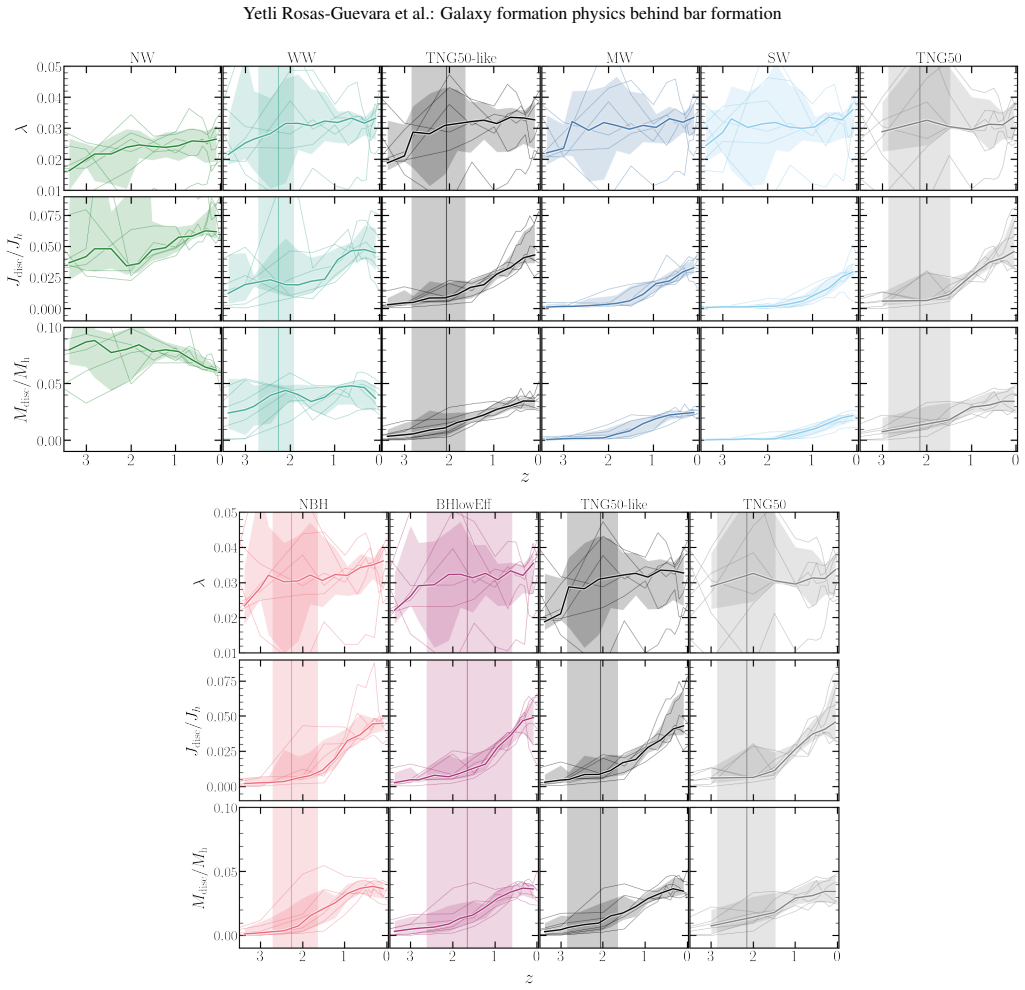
The central objects are three analytic disc-instability diagnostics — the Toomre parameter $Q_T=\kappa\sigma_R/(3.36G\Sigma)$, the ELN ratio $\epsilon_{\rm ELN}=v_{\rm max}/(G M_{\rm disc}/r_{\rm disc})^{1/2}$, and the MMW spin criterion $\lambda_{\rm MMW}$ — together with a controlled zoom-in resimulation design in which only the supernova wind energy parameter $e_w$ or the quasar-mode feedback efficiency $\epsilon_{f,\rm high}$ is changed. The criteria are used to judge whether a simulated disc should be bar-unstable, and the feedback variations isolate which channel changes that judgement. Bars are identified by Fourier decomposition of the face-on stellar surface density, with strength $A_2$ and length set by the constant-phase radius.
What would settle it
A decisive test would be to re-run the same six haloes with several independent random seeds for both the TNG50-like and strong-wind models: if any strong-wind realisation forms a stable bar while the matching TNG50-like run does not, the claimed suppression would not hold up. An observational falsifier would be to find Milky Way analogues with extended, low-velocity-dispersion discs that still host strong bars at the same rate as compact discs, contrary to the stability picture.
Extended reading notes
Core claim
The paper's central claim is that, for Milky Way-like discs, bar formation is regulated by supernova feedback strength, while quasar-mode black hole feedback plays at most a secondary role. Each of six haloes is re-simulated in seven model variants covering five wind strengths (no wind, weaker, TNG50-like, medium, strong) and two black hole feedback variants, and the outcome is that only the supernova wind strength shifts bar formation time or suppresses the bar outright. Stronger winds delay disc assembly and produce less massive, more extended discs with lower radial velocity dispersion, which resist bar instability; the strongest winds stop bar formation entirely. At the opposite extreme, no wind leads to early runaway star formation and a massive compact bulge that also prevents a bar. The paper further argues that the Toomre, ELN, and MMW criteria correctly mark the bar-forming cases at the time of bar formation, but in the no-wind model ELN and MMW incorrectly predict instability while Toomre predicts stability for the weak-wind model that does form a bar, and the authors attribute these failures to the criteria not accounting for the central bulge.
Load-bearing premise
The load-bearing premise is that the six selected haloes, chosen because the parent simulation made each one strongly barred, are a representative sample, so that differences between feedback models trace the changed physics rather than random stochastic scatter in the zoom-in re-simulations.
Editorial extensions
If this is right
- Bar formation time in Milky Way-like galaxies should be earlier for weaker supernova-driven winds and suppressed entirely for the strongest winds, so observed bar fractions can encode the average supernova feedback strength.
- Quasar-mode black hole feedback can be varied without changing whether a bar forms; its main effect is on bar strength and length.
- The ELN and MMW criteria are not by themselves reliable predictors of bar formation when a massive compact bulge is present; a bulge-concentration condition is needed.
- Disc-dominated morphology is robust across all feedback models, so a massive disc alone does not guarantee that a bar will form.
- The statistics of barred galaxies can serve as a constraint on subgrid galaxy-formation models, since different feedback strengths give different bar fractions and formation redshifts.
Reading between the lines
- The authors do not state this, but the result implies that surveys measuring bar fractions as a function of disc size and stellar mass could act as an observational probe of feedback strength in real galaxies.
- The failure pattern of the three criteria suggests a simple repair: adding a bulge-concentration term to ELN and MMW should recover the no-wind case, and this could be tested directly on the same simulations.
- Because stochasticity removed one of six bars even in the TNG50-like run, a stronger test of the feedback effect would come from re-running the same haloes with multiple random seeds; the authors flag this limitation, and seed-averaged comparisons would settle whether the feedback effect is real.
- If the supernova-dominated picture is correct, high-redshift barred galaxies detected by JWST may preferentially be systems with weak feedback or low bulge concentration, a pattern that future high-redshift bar surveys could check.
Editorial analysis
A structured set of objections, weighed in public.
Referee Report
Summary. The paper resimulates six TNG50 Milky Way-mass barred disc galaxies with the Arepo code and seven variants of the TNG feedback model, varying the galactic wind energy parameter e_w and the quasar-mode BH feedback efficiency ε_f,high. The authors find that stronger supernova feedback delays disc assembly and suppresses bar formation, with the strongest wind model producing stable discs, while the no-wind model fails to form a bar because of a massive compact bulge. Quasar BH feedback variations do not change whether a bar forms but do change bar strength and length. The paper evaluates the Toomre, ELN, and MMW instability criteria at bar formation and shows they correctly predict bar presence/absence except in the no-wind and weak-wind cases, which they attribute to the missing effect of a central bulge.
Significance. The study is a clean controlled parameter experiment on a well-characterised simulation sample and provides a useful test of analytic bar-instability criteria under controlled variations of subgrid physics. The explicit discussion of stochasticity in Section 5.4 is honest, and the suite of 42 zoom-in runs is a valuable resource. If the causal attribution is confirmed with additional realizations, the conclusion that SN feedback strength is the dominant regulator of bar formation in MW-mass systems would constrain subgrid models. However, as presented, the central causal claim is not yet separated from run-to-run noise, which limits the strength of the conclusions that can be drawn.
major comments (2)
- [Sec. 5.4; Abstract] The central claim that supernova feedback strength causally delays and can prevent bar formation is underdetermined by the single realization per (halo, model). The paper's own Section 5.4 states that subgrid stochasticity can affect the radial velocity dispersion and disc extent, which are exactly the quantities entering Q_T, ε_ELN, and λ_MMW (Figs. 4, 5, 8), and that one of six control galaxies loses its bar in the TNG50-like model. With one run per model, the binary bar/no-bar outcomes across adjacent wind models (WW 6/6, TNG50-like 5/6, MW 1/6, SW 0/6, NW 0/6) are not statistically distinguishable from noise: for example, the Clopper-Pearson 95% intervals for 1/6 and 5/6 overlap. Please either provide multiple stochastic realizations (different random seeds) for at least the models near the bar/no-bar boundary, or temper the abstract and Section 6 to say the effect is seen 'in our realizations' and justify quantitatively why the trend exceeds stochastic scatter.
- [Sec. 3.2; Abstract] The statement in the Abstract that quasar-mode BH feedback 'does not affect bar formation' is not consistent with the text in Section 3.2 that 'the bar is present in all simulations, but the bar formation time varies dramatically' across the BH models. If 'formation' is meant as the presence of a bar, the claim should be reworded to 'does not affect whether a bar forms'; if it includes formation time, the statement is internally contradictory. Given the stochastic scatter conceded in Section 5.4, this dramatic variation also needs to be assessed against run-to-run noise before a null effect on formation is claimed.
minor comments (5)
- [Eq. (5)] The mass-loading relation in Eq. (5) appears dimensionally incorrect: η_w = 2 v_w^2 e_w (1−τ_w) should read η_w = 2 e_w (1−τ_w)/v_w^2, consistent with the text describing available wind energy divided by wind kinetic energy.
- [Sec. 4.2] In the sentence beginning 'For the galaxies in the models that form a bar', the expression '(λ_MMW/λ_crit) ∼< 12' is presumably a typo for '(λ_MMW/λ_crit) < 1'; as written, it is not meaningful for the stability threshold.
- [Sec. 5.3 and Sec. 6] The acronyms 'WWM' and 'ELT' appear where 'MMW' and 'ELN' are intended (Section 5.3 and the summary bullet list); please correct.
- [Sec. 5.4] The sentence 'however, the radial velocity dispersion and the extent of the disc could be' is incomplete; it should end with 'affected'.
- [Sec. 2.1; Abstract] The Abstract should state explicitly that the sample is preselected to be barred in TNG50, so the conclusions concern galaxies that form bars under the TNG50 model; the limitation is only stated in Section 5.4.
Circularity Check
No significant circularity found: the central causal claims follow from controlled variations of external subgrid parameters, and the instability criteria are independent literature diagnostics rather than fitted outputs.
full rationale
The paper's main claim is that increasing supernova feedback energy (ew from 0 to 7.2) delays disc assembly and suppresses bar formation, while quasar-mode black-hole feedback (epsilon_f,high) affects bar strength and length but not formation. This is an intervention study: ew and epsilon_f,high are fixed model parameters varied across 42 zoom-in runs, and none is fitted to the six target galaxies. Bar presence or absence is determined by a standard Fourier A2 criterion with threshold 0.2, which is independent of the Toomre, ELN, and MMW instability criteria taken from the literature. Evaluating those criteria on the same simulations is a post-hoc diagnostic test, not a derivation of bar outcome from the criteria themselves. The only self-citations are the RG20/RG22 bar catalogue and identification method used to select the parent TNG50 sample; these are method and data references to a public simulation and do not carry the causal argument. The acknowledged stochasticity and the single-realization design are validity concerns about separating systematic feedback effects from chaotic divergence, not circularity: they do not make any equation reduce to its inputs. No circular step meeting the quoted-reduction standard is present.
Assumptions & free parameters
free parameters (3)
- e_w (galactic wind energy parameter) =
0 (NW), 1.8 (WW), 3.6 (TNG50-like), 5.4 (MW), 7.2 (SW)
- epsilon_f,high (quasar-mode BH feedback efficiency) =
0.1 in standard models, 0.05 in BHlowEff
- cNFW (halo concentration for MMW criterion) =
10
assumptions (5)
- domain assumption The IllustrisTNG galaxy formation model is an adequate representation of galaxy formation physics for this study.
- domain assumption The zoom-in initial conditions faithfully reproduce the TNG50 parent environment for the selected haloes.
- domain assumption The three bar instability criteria (Toomre, ELN, MMW) are appropriate diagnostics of bar formation in these systems.
- domain assumption Bar identification via A2,max > 0.2 and constant phase reliably distinguishes bars from transient asymmetries.
- domain assumption Cosmological parameters from Planck Collaboration (2016) are adopted as exact inputs.
Cite this review
Pith. "Pith review of Galaxy formation physics behind bar formation: A view from cosmological hydrodynamical simulations." pith.science (2026). https://pith.science/paper/5LEQRNFA
@misc{pith2026241116876,
  author       = {Pith},
  title        = {Pith review of: Galaxy formation physics behind bar formation: A view from cosmological hydrodynamical simulations},
  year         = {2026},
  howpublished = {\url{https://pith.science/paper/5LEQRNFA}},
  note         = {Machine review of arXiv:2411.16876}
}
read the original abstract
We present a suite of zoom-in cosmological simulations of Milky Way-like galaxies with a prominent disc component and a strong bar in their centre, based on a subsample of barred galaxies from the TNG50 magneto-hydrodynamic simulation. We modify the physical models that regulate star formation, namely, supernova feedback and black hole quasar feedback, to examine how they affect the disc and bar formation. We find that, independently of the feedback prescriptions, all galaxies show a similar morphology, which is dominant in comparison with the bulge mass. The black hole quasar feedback models used in this study do not affect bar formation, although they can affect the bar strength and length. The energy released by the supernovae causes a delay in the time of bar formation and, in models with the strongest feedback, galaxies form stable discs against bar formation. This could be understood since supernova feedback influences disc and bulge assembly, resulting in discs with lower mass content, radial velocity dispersion and larger size as the supernova feedback strength increases. We study disc stability using three bar instability criteria proposed in the literature. We find that galaxies with varied supernovae and black hole quasar feedback satisfy these criteria at the moment of bar formation, except in extreme cases where the galaxy lacks or has weak supernova feedback. In these models, two of three criteria fail to forecast the existence (or absence) of a bar, probably because they do not account for the influence of a massive and compact bulge. Our findings provide insights into the physical processes behind bar formation and highlight the importance of additional conditions, other than a massive and compact disc that promote bar formation.
Figures


Figures from the paper (6 more)




Reference graph
Works this paper leans on
-
[1]
, " * write output.state after.block = add.period write newline
ENTRY address archiveprefix author booktitle chapter edition editor howpublished institution eprint journal key month note number organization pages publisher school series title type volume year label extra.label sort.label short.list INTEGERS output.state before.all mid.sentence after.sentence after.block FUNCTION init.state.consts #0 'before.all := #1 ...
-
[2]
write newline
" write newline "" before.all 'output.state := FUNCTION n.dashify 't := "" t empty not t #1 #1 substring "-" = t #1 #2 substring "--" = not "--" * t #2 global.max substring 't := t #1 #1 substring "-" = "-" * t #2 global.max substring 't := while if t #1 #1 substring * t #2 global.max substring 't := if while FUNCTION word.in bbl.in " " * FUNCTION format....
-
[3]
G., et al., 2017, MNRAS, 469, 1054
Algorry D. G., et al., 2017, MNRAS, 469, 1054
2017
-
[4]
E., Hern \'a ndez-Monteagudo C., Contreras S., Zennaro M., 2021, MNRAS, 503, 3596
Aric \`o G., Angulo R. E., Hern \'a ndez-Monteagudo C., Contreras S., Zennaro M., 2021, MNRAS, 503, 3596
2021
-
[5]
Athanassoula E., Misiriotis A., 2002, MNRAS, 330, 35
2002
-
[6]
2003, MNRAS, 341, 1179 (A03)
Athanassoula E. 2003, MNRAS, 341, 1179 (A03)
2003
-
[7]
Athanassoula E., 2008, MNRAS, 390, L69
2008
-
[8]
Athanassoula E., Machado R. E. G., Rodionov S. A., 2013, MNRAS, 429, 1949
2013
Show all 112 references
-
[9]
Bi D., Shlosman I., Romano-D \' az E., 2022, MNRAS, 513, 693
2022
-
[10]
Bi D., Shlosman I., Romano-D \' az E., 2022, ApJ, 934, 52
2022
-
[11]
Binney J., Tremaine S., 2008, gady.book
2008
-
[12]
Bird S., Vogelsberger M., Haehnelt M., Sijacki D., Genel S., Torrey P., Springel V., et al., 2014, MNRAS, 445, 2313
2014
-
[13]
Bonoli S., Mayer L., Kazantzidis S., Madau P., Bellovary J., Governato F., 2016, MNRAS, 459, 2603
2016
-
[14]
G., Benson A
Bower R. G., Benson A. J., Malbon R., Helly J. C., Frenk C. S., Baugh C. M., Cole S., Lacey C. G., 2006, MNRAS, 370, 645
2006
-
[15]
M., Schaye J., Ludlow A
Borrow J., Schaller M., Bah \'e Y. M., Schaye J., Ludlow A. D., Ploeckinger S., Nobels F. S. J., et al., 2023, MNRAS, 526, 2441
2023
-
[16]
S., Dekel A., Kolatt T
Bullock J. S., Dekel A., Kolatt T. S., Kravtsov A. V., Klypin A. A., Porciani C., Primack J. R., 2001, ApJ, 555, 240
2001
-
[17]
Cervantes Sodi B., Li C., Park C., 2015, ApJ, 807, 111
2015
-
[18]
Cervantes Sodi B., 2017, ApJ, 835, 80
2017
-
[19]
J., Rajgor S., Myers R., 2008, MNRAS, 386, 909
Conselice C. J., Rajgor S., Myers R., 2008, MNRAS, 386, 909
2008
-
[20]
Collier A., Shlosman I., Heller C., 2018, MNRAS, 476, 1331
2018
-
[21]
G., Guo Y., Buttitta C., Jogee S., Bagley M
Costantin L., P \'e rez-Gonz \'a lez P. G., Guo Y., Buttitta C., Jogee S., Bagley M. B., Barro G., et al., 2023, Natur, 623, 499
2023
-
[22]
A., van de Voort F., 2023, ARA&A, 61, 473
Crain R. A., van de Voort F., 2023, ARA&A, 61, 473
2023
-
[23]
J., Springel V., White S
Croton D. J., Springel V., White S. D. M., De Lucia G., Frenk S. C., Gao L., Jenkins A. and Kauffmann G. et al. , 2006, MNRAS, 365, 11
2006
-
[24]
Cuomo V., Aguerri J. A. L., Corsini E. M., Debattista V. P., 2020, A&A, 641, A111
2020
-
[25]
Dahari O., 1984, The Astronomical Journal, 89, 966
1984
-
[26]
Jang D., Kim W.-T., 2023, ApJ, 942, 106
2023
-
[27]
P., Mayer L., Carollo C
Debattista V. P., Mayer L., Carollo C. M., Moore B., Wadsley J., Quinn T., 2006, ApJ, 645, 209
2006
-
[28]
Di Matteo T., Springel V., Hernquist L., 2005, Natur, 433, 604
2005
-
[29]
E., Martig M., James P
Donohoe-Keyes C. E., Martig M., James P. A., Kraljic K., 2019, arXiv, arXiv:1908.11119
2019 arXiv
-
[30]
Donnari M., et al., 2019, MNRAS, 485, 4817
2019
-
[31]
Efstathiou G., Lake G., Negroponte J., 1982, MNRAS, 199, 1069
1982
-
[32]
Englmaier P., Shlosman I., 2004, ApJL, 617, L115
2004
-
[33]
Fanali R., Dotti M., Fiacconi D., Haardt F., 2015, MNRAS, 454, 3641
2015
-
[34]
Fragkoudi F., Grand R. J. J., Pakmor R., Bl \'a zquez-Calero G., Gargiulo I., Gomez F., Marinacci F., et al., 2020, MNRAS, 494, 5936
2020
-
[35]
Fragkoudi F., Grand R., Pakmor R., G \'o mez F., Marinacci F., Springel V., 2024, arXiv, arXiv:2406.09453
2024 arXiv
-
[36]
Fraser-McKelvie A., Merrifield M., Arag \'o n-Salamanca A., Peterken T., Kraljic K., Masters K., Stark D., et al., 2020, MNRAS, 499, 1116
2020
-
[37]
Faucher-Gigu \`e re C.-A., Lidz A., Zaldarriaga M., Hernquist L., 2009, ApJ, 703, 1416
2009
-
[38]
A., 2009, MNRAS, 393, 1531
Gadotti D. A., 2009, MNRAS, 393, 1531
2009
-
[39]
Gavazzi G., et al., 2015, A&A, 580, A116
2015
-
[40]
Genel S., et al., 2014, MNRAS, 445, 175
2014
-
[41]
L., Springel V., Hernquist L., Nelson D., Pillepich A., Weinberger R., et al., 2019, ApJ, 871, 21
Genel S., Bryan G. L., Springel V., Hernquist L., Nelson D., Pillepich A., Weinberger R., et al., 2019, ApJ, 871, 21
2019
-
[42]
T., 2019, arXiv, arXiv:1907.06910
George K., Subramanian S., Paul K. T., 2019, arXiv, arXiv:1907.06910
2019 arXiv
-
[43]
Ghosh S., Fragkoudi F., Di Matteo P., Saha K., 2023, A&A, 674, A128
2023
-
[44]
Guedes J., Callegari S., Madau P., Mayer L., 2011, ApJ, 742, 76
2011
-
[45]
L., Chen Z., Wise E., Bagley M
Guo Y., Jogee S., Finkelstein S. L., Chen Z., Wise E., Bagley M. B., Barro G., et al., 2023, ApJL, 945, L10
2023
-
[46]
J., Finkelstein S
Guo Y., Jogee S., Wise E., Pritchett K., McGrath E. J., Finkelstein S. L., Iyer K. G., et al., 2024,
2024
-
[47]
Grand R. J. J., G \'o mez F. A., Marinacci F., Pakmor R., Springel V., Campbell D. J. R., Frenk C. S., et al., 2017, MNRAS, 467, 179
2017
-
[48]
Henriques B. M. B., White S. D. M., Thomas P. A., Angulo R. E., Guo Q., Lemson G., Springel V., 2013, MNRAS, 431, 3373
2013
-
[49]
Irodotou D., Fragkoudi F., Pakmor R., Grand R. J. J., Gadotti D. A., Costa T., Springel V., et al., 2022, MNRAS, 513, 3768
2022
-
[50]
Izquierdo-Villalba D., Bonoli S., Rosas-Guevara Y., Springel V., White S. D. M., Zana T., Dotti M., et al., 2022, arXiv, arXiv:2203.07734
2022 arXiv
-
[51]
D., Pontzen A., Agertz O., Rey M
Joshi G. D., Pontzen A., Agertz O., Rey M. P., Read J., Pillepich A., 2024, arXiv, arXiv:2407.00171
2024 arXiv
-
[52]
K., Das M., 2018, MNRAS, 475, 1653
Kataria S. K., Das M., 2018, MNRAS, 475, 1653
2018
-
[53]
H., Hernquist L., 1996, ApJS, 105, 19
Katz N., Weinberg D. H., Hernquist L., 1996, ApJS, 105, 19
1996
-
[54]
C., Libeskind N
Khoperskov S., Minchev I., Steinmetz M., Ratcliffe B., Walcher J. C., Libeskind N. I., 2024, MNRAS, 533, 3975
2024
-
[55]
A., Gadotti D
Le Conte Z. A., Gadotti D. A., Ferreira L., Conselice C. J., de S \'a -Freitas C., Kim T., Neumann J., et al., 2023, arXiv, arXiv:2309.10038
2023 arXiv
-
[56]
Kraljic K., Bournaud F., Martig M., 2012, ApJ, 757, 60
2012
-
[57]
Long S., Shlosman I., Heller C., 2014, ApJL, 783, L18
2014
-
[58]
Marinacci F., et al., 2018, MNRAS, 480, 5113
2018
-
[59]
L., et al., 2011, MNRAS, 411, 2026
Masters K. L., et al., 2011, MNRAS, 411, 2026
2011
-
[60]
J., Mao S., White S
Mo H. J., Mao S., White S. D. M., 1998, MNRAS, 295, 319
1998
-
[61]
P., et al., 2018, MNRAS, 477, 1206
Naiman J. P., et al., 2018, MNRAS, 477, 1206
2018
-
[62]
F., Benz W., 1991, ApJ, 380, 320
Navarro J. F., Benz W., 1991, ApJ, 380, 320
1991
-
[63]
Nelson D., et al., 2015, A& C, 13, 12
2015
-
[64]
Nelson D., et al., 2018a, MNRAS, 475, 624
-
[65]
Nelson D., et al., 2019a, ComAC, 6, 2
-
[66]
Nelson D., Pillepich A., Springel V., Pakmor R., Weinberger R., Genel S., Torrey P., et al., 2019b, MNRAS, 490, 3234
-
[67]
D., Dav \'e R., 2006, MNRAS, 373, 1265
Oppenheimer B. D., Dav \'e R., 2006, MNRAS, 373, 1265
2006
-
[68]
D., Dav \'e R., 2008, MNRAS, 387, 577
Oppenheimer B. D., Dav \'e R., 2008, MNRAS, 387, 577
2008
-
[69]
P., Peebles P
Ostriker J. P., Peebles P. J. E., 1973, ApJ, 186, 467
1973
-
[70]
L., 2019, MNRAS, 483, 2721
Peschken N., okas E. L., 2019, MNRAS, 483, 2721
2019
-
[71]
Pillepich A., et al., 2018a, MNRAS, 473, 4077
-
[72]
Pillepich A., et al., 2018b, MNRAS, 475, 648
-
[73]
Pillepich A., Nelson D., Springel V., Pakmor R., Torrey P., Weinberger R., Vogelsberger M., et al., 2019, MNRAS, 490, 3196
2019
-
[74]
Pillepich A., Sotillo-Ramos D., Ramesh R., Nelson D., Engler C., Rodriguez-Gomez V., Fournier M., et al., 2023, arXiv, arXiv:2303.16217
2023 arXiv
-
[75]
Planck Collaboration 2016, A& A, 594, A13
2016
-
[76]
Pontzen A., Governato F., 2012, MNRAS, 421, 3464
2012
-
[77]
Rodriguez-Gomez V., et al., 2015, MNRAS, 449, 49
2015
-
[78]
B., Agertz O., Renaud F., 2023, MNRAS, 518, 1002
Romeo A. B., Agertz O., Renaud F., 2023, MNRAS, 518, 1002
2023
-
[79]
S., Tissera P
Rosito M. S., Tissera P. B., Pedrosa S. E., Rosas-Guevara Y., 2019, A&A, 629, A37
2019
-
[80]
C., et al., 2020, MNRAS, 491, 2547
Rosas-Guevara Y., Bonoli S., Dotti M., Zana T., Nelson D., Pillepich A., Ho L. C., et al., 2020, MNRAS, 491, 2547
2020
-
[81]
Rosas-Guevara Y., Bonoli S., Dotti M., Izquierdo-Villalba D., Lupi A., Zana T., Bonetti M., et al., 2022, MNRAS, 512, 5339
2022
-
[82]
Rosas-Guevara Y., Bonoli S., Misa Moreira C., Izquierdo-Villalba D., 2024, A&A, 684, A179
2024
-
[83]
Saha K., Naab T., 2013, MNRAS, 434, 1287
2013
-
[84]
Saha K., Elmegreen B., 2018, ApJ, 858, 24
2018
-
[85]
V., Navarro J
Sales L. V., Navarro J. F., Theuns T., Schaye J., White S. D. M., Frenk C. S., Crain R. A., et al., 2012, MNRAS, 423, 1544
2012
-
[86]
Scannapieco C., Athanassoula E., 2012, MNRAS, 425, L10
2012
-
[87]
Schaye J., et al., 2015, MNRAS, 446, 521
2015
-
[88]
A., Wilkinson A., 1993, RPPh, 56, 173
Sellwood J. A., Wilkinson A., 1993, RPPh, 56, 173
1993
-
[89]
A., 2012, ApJ, 751, 44
Sellwood J. A., 2012, ApJ, 751, 44
2012
-
[90]
M., Elmegreen B
Sheth K., Melbourne J., Elmegreen D. M., Elmegreen B. G., Athanassoula E., Abraham R. G., Weiner B. J., 2012, ApJ, 758, 136
2012
-
[91]
Sijacki D., et al., 2015, MNRAS, 452, 575
2015
-
[92]
Semczuk M., Dehnen W., Sch \"o nrich R., Athanassoula E., 2024, arXiv, arXiv:2407.11154
2024 arXiv
-
[93]
Spinoso D., Bonoli S., Dotti M., Mayer L., Madau P., Bellovary J., 2017, MNRAS, 465, 3729
2017
-
[94]
Springel V., White S. D. M., Tormen G., Kauffmann G., 2001, MNRAS, 328, 726
2001
-
[95]
Springel V., Hernquist L., 2003, MNRAS, 339, 289
2003
-
[96]
Springel V., Di Matteo T., Hernquist L., 2005, MNRAS, 361, 776
2005
-
[97]
Springel V., 2010, MNRAS, 401, 791
2010
-
[98]
ascl:1502.003
Springel V., 2015, ascl.soft. ascl:1502.003
2015
-
[99]
Springel V., et al., 2018, MNRAS, 475, 676
2018
-
[100]
Suresh J., Bird S., Vogelsberger M., Genel S., Torrey P., Sijacki D., Springel V., et al., 2015, MNRAS, 448, 895
2015
-
[101]
Toomre A., 1964, ApJ, 139, 1217
1964
-
[102]
Vogelsberger M., Genel S., Sijacki D., Torrey P., Springel V., Hernquist L., 2013, MNRAS, 436, 3031
2013
-
[103]
Vogelsberger M., et al., 2014a, Nature, 509, 177
-
[104]
Vogelsberger M., et al., 2014b, MNRAS, 444, 1518
-
[105]
Vogelsberger M., Marinacci F., Torrey P., Puchwein E., 2020, NatRP, 2, 42
2020
-
[106]
Weinberger R., et al., 2017, MNRAS, 465, 3291
2017
-
[107]
Yurin D., Springel V., 2015, MNRAS, 452, 2367
2015
-
[108]
C., Debattista V
Zhao D., Du M., Ho L. C., Debattista V. P., Shi J., 2020, ApJ, 904, 170
2020
-
[109]
R., Bonoli S., Haardt F., Mayer L., Spinoso D., 2018a, MNRAS, 473, 2608
Zana T., Dotti M., Capelo P. R., Bonoli S., Haardt F., Mayer L., Spinoso D., 2018a, MNRAS, 473, 2608
-
[110]
Zana T., et al., 2019, MNRAS, 488, 1864
2019
-
[111]
Zana T., Lupi A., Bonetti M., Dotti M., Rosas-Guevara Y., Izquierdo-Villalba D., Bonoli S., et al., 2022, MNRAS, 515, 1524
2022
-
[112]
Zhou Z.-B., Zhu W., Wang Y., Feng L.-L., 2020, ApJ, 895, 92
2020
Reviewed August 12, 2026 · model on record in the stance chip above.
Discussion (0). Continue with ORCID to comment.