REVIEW 3 major objections 6 minor 29 references
Arcee: An OCM-Solver
T0 review · 3 major / 6 minor · reviewed 2026-08-12 · deepseek-v4-flash
Pith's one-line read This paper claims that One-Sided Crossing Minimization is practically solvable by combining graph splitting and reduction rules with a weighted Feedback Arc Set exact core, a claim backed by near-perfect heuristic and all-instance…
desk verdict Solid PACE solver report: sound small algorithmic novelties and independent official results; the only real risk is tuning on public instances, which peer review can fix by asking for code and a cleaner test split. read the letter →
The pith
A machine-rendered reading of the paper's core claim, the machinery that carries it, and where it could break.
The reading
What carries the argument
The load-bearing objects are the crossing matrix $M$ with entries $c_{uv}$ and the weighted penalty graph $G_p$ that orients each pair toward the cheaper order with weight $c_{vu} - c_{uv}$. Because an optimal order is a topological sort after an optimal Feedback Arc Set is removed, exact solvers reduce OCM to weighted Feedback Arc Set. Around this core, reduction rules RR1, RR2, the modified RRlarge, and RRLO1 build a partial order and delete vertices whose position is forced; sifting repositions one vertex at a time; force swapping perturbs local minima; and the exact engine alternates a partial ILP (or branching) with lazy addition of shortest cycles contradicting the heuristic order. The key identity is the penalty-graph equivalence: crossing minimization equals weighted feedback arc set in the graph of pair-wise cheaper orientations, which is what makes exact solving feasible on competition instances.
What would settle it
Tune the two force-swapping parameters on only half of the public instances and evaluate on the held-out half; if the tuned parameters do not beat the initially guessed parameters on the held-out half, the reported $6\times10^{-5}$-point gain is tuning-specific rather than a general improvement.
Extended reading notes
Core claim
The paper's central claim is that OCM can be solved competitively in practice by treating it as a weighted Feedback Arc Set problem on a penalty graph and surrounding that core with data reductions. Each pair of free vertices gets a crossing number $c_{uv}$, the penalty graph orients the cheaper direction and weights it by the savings, and an optimal OCM order is a topological order of this graph after an optimal feedback arc set is removed. The solver's reductions (RR1, RR2, a lower-bound-augmented RRlarge, and RRLO1) fix many vertices before search, and its heuristic combines the median and barycenter starts with sifting plus a distance-increasing force swap to escape local minima. The exact solver lazily generates only the cycles needed to verify the heuristic solution, which the paper reports as faster and more stable than a transitive-constraint linear-ordering ILP. The paper's evidence is the competition record: near-perfect heuristic score, 152 exact instances solved, and all parameterized instances solved quickly.
Load-bearing premise
The reported scores assume the 100 public instances used during development represent the 100 withheld private instances well enough that the force-swapping parameters tuned on a subset of the public set improve held-out results rather than just the tuning cases.
Editorial extensions
If this is right
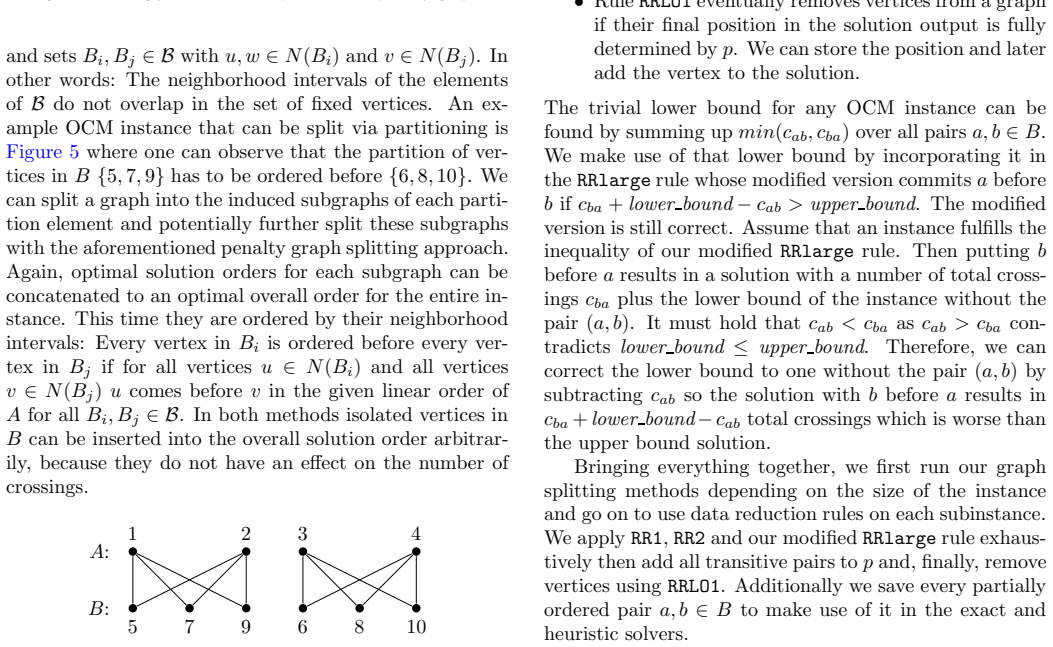
- Graph splitting on strongly connected components of the penalty graph plus interval partitioning reduces most parameterized instances to components with fewer than ten vertices, making all 200 solvable.
- On 27 of the 100 public heuristic instances, data reduction alone fixes the entire order; applying reduction rules before local search is worth roughly $69\times10^{-5}$ points under the competition scoring.
- Force swapping with distance-increasing swaps adds measurable improvement over repeated random sifting: removing it costs $29\times10^{-5}$ points, guessed parameters recover $23\times10^{-5}$, and tuned parameters add the final $6\times10^{-5}$.
- The cycle-based ILP with lazy generation solves seven more instances than the linear-ordering ILP and avoids numerical instability seen on sub-100-node graphs.
- Substituting an open-source ILP solver for a commercial one costs only six solved instances, so the exact approach does not depend on a commercial solver.
Reading between the lines
- Because the same public instances used for hyperparameter tuning also appear in the reported evaluation, the final $6\times10^{-5}$-point gain is the result most exposed to overfitting; a clean test would tune on one half of the public set and score on the other half.
- The parameterized track's easy splitting may partly reflect low cutwidth, and the paper leaves open whether cutwidth bounds the strongly connected component size of the penalty graph; if so, a cutwidth-aware preprocessing could tighten the large-graph threshold beyond the current 10,000 free vertices.
- The exact solver's idea of verifying a heuristic solution through lazily generated shortest cycles could transfer directly to minimum feedback arc set benchmarks outside OCM, since it treats the heuristic only as a certificate to check.
Editorial analysis
A structured set of objections, weighed in public.
Referee Report
Summary. The paper describes Arcee, the authors' solver for the One-Sided Crossing Minimization (OCM) problem submitted to the 2024 PACE Challenge. The solver combines graph splitting based on the penalty graph's strongly connected components, reduction rules RR1, RR2, RRLO1, and a modified RRlarge rule that incorporates a trivial lower bound; a heuristic track using median/barycenter initial orders, sifting, force swapping, and large-graph truncation; and an exact/parameterized track that translates OCM to Feedback Arc Set and solves it with two ILP formulations with row generation, plus a branch-and-bound solver with cycle-packing lower bounds and a local-search upper bound. The paper reports official PACE results: 4th place in the heuristic track (1st student), 8th in the exact track (2nd student), and 4th in the parameterized track (1st student), and presents ablations over the heuristic components.
Significance. If the results are taken at face value, the paper is a useful practical contribution: it documents a competitive, well-engineered OCM solver and provides a correct integration of a lower-bound-aware reduction rule into the existing RRlarge framework. The strongest evidence is independent: the official PACE rankings on private instances, the cactus plots of re-evaluated top solvers, and the clarity of the modified RRlarge correctness argument. The paper is honest about several limitations, including the lack of any use of the cutwidth parameter in the parameterized track. Its main weaknesses are experimental: the ablation table reports single runs of a randomized heuristic, and the SMAC tuning was performed on a subset of the public instances that are also included in the reported aggregate score. These issues affect the strength of the attribution of the final score to specific components, but they do not undermine the official placement claims.
major comments (3)
- [§8.2, Table 1, footnote 2] The ablation that attributes the final heuristic score to force swapping and SMAC-tuned parameters does not use a clean train/test split. Footnote 2 states that the force-swapping parameters were optimized by SMAC3 on 10 public instances selected because the public leaderboard showed suboptimal solutions, and Table 1 reports points for the public and private instances together. The reported additional gain of 6e-5 points from the SMAC parameters is therefore measured, at least in part, on the very instances used for tuning. The authors should separate public and private scores, evaluate the final configurations on a held-out set, or otherwise substantiate that the SMAC gain is not an artifact of tuning on those 10 instances.
- [§8.2, §4.1] The heuristic is randomized (random sifting order, random initial orders, randomized force swapping), yet Table 1 reports a single run per configuration and gives no variance or repeated-run statistics. With a total-score difference of only 6e-5 points between the 'no smac' and 'submission' rows, single runs cannot establish that this difference is not run-to-run noise. The authors should report at least a few seeds for the key configurations, or state that the official PACE score is one particular seed and justify why the differences are meaningful.
- [§5.2, Algorithm 1] The exact solver's central modification to the approach of Baharev et al. is to keep the initial heuristic and add only cycles contradicting it, rather than recomputing an FAS heuristic on each updated graph G'. The paper justifies this with the unquantified statement that the modification 'has superior performance in our tests'. No experiment compares the two cycle-generation strategies. Since this modification is presented as a main algorithmic idea and underlies the reported exact and parameterized results, the comparison should be reported or the claim should be downgraded to an informal observation.
minor comments (6)
- [§1.1] The sentence 'Its running time running time is O(n log n)' contains a duplicated phrase.
- [§3.2] The sentence 'cab > cba contradicts lower bound ≤ upper bound' is not by itself clear: cab > cba does not contradict LB ≤ UB. The contradiction follows from the inequality cba + LB - cab > UB together with LB ≤ UB, and the proof should say this explicitly.
- [Table 1] The x-marks in Table 1 do not align unambiguously with the column headers, especially for the 'no rr' and 'no smac' rows, making it hard to tell which components are active in each configuration. Clearer row labels or explicit active/inactive markers are needed.
- [§8.4] The conjecture that small cutwidth may bound the size of strongly connected components in the penalty graph is stated without evidence; it should be marked explicitly as speculation, since the parameterized instances alone cannot establish it.
- [§5.2] The statement that ILP solvers produced incorrect solutions due to numerical issues should specify which solver and settings were used and whether the issue was observed with both Gurobi and SCIP.
- [§8.5] The sentence 'The complete ranking can be found on the official PACE website' should include a URL or a formal citation so that the reader can access the full ranking.
Circularity Check
One ablation claim is in-sample (SMAC tuning on 10 public instances evaluated on the same public set), but the central PACE ranking claim is independent and not circular.
-
fitted input called prediction
[Section 8.2, item 4; Table 1; footnote 2 in Section 4.1]
"We selected 10 instances from the public dataset for which suboptimal solutions were not previously found by our algorithm. For this we used the public leader board from PACE where we can see the results of other algorithms. We let SMAC3 ran for 24 hours to optimize parameters for these instances. Implementation of these optimized parameters yielded an additional performance gain of 6 × 10⁻⁵ points in our final solution."
The SMAC3 run optimized force-swap parameters on exactly those 10 public instances, yet Table 1 reports the resulting 'submission' score over 'the public and private instances' without excluding the tuning instances, and attributes the 6e-5 difference to the optimized parameters. The improvement over 'no smac' is therefore measured on data that were used to select the parameters: it is an in-sample training gain, not an out-of-sample prediction. This does not make the solver's reductions or exact method circular, nor does it taint the official PACE placement (decided on private instances), but it specifically invalidates the ablation claim that the SMAC tuning 'yielded' the 6e-5 gain as a generalizable result.
full rationale
The paper's core claims are empirical: a competitive PACE 2024 result (4th heuristic, 8th exact, 4th parameterized) and a solver architecture of reductions, local search, ILP, and branch-and-bound. I walked the derivation chain for the reductions (Section 3), the exact ILP/row-generation (Section 5), and the parameterized solver (Section 6). The reduction rules are proven from the crossing-matrix definitions and the 'trivial lower bound' argument; the exact solver uses a standard ILP lower bound plus a heuristic upper bound, and the stopping rule is sound; no equation is defined in terms of the result it is supposed to establish. There is no self-citation anywhere in the reference list, no imported uniqueness theorem, and no ansatz smuggled in via citation; the cited external results (Dujmovic et al., Sugiyama et al., Eades-Wormald, Grotschel et al., Baharev et al., etc.) are independent support. The only circularity I can exhibit concretely is the SMAC hyperparameter tuning in Section 8.2(4): parameters are fit to 10 public instances (selected using the public leaderboard), and the same public instances are included in Table 1's final-score comparison. The 6e-5 'gain' is thus an in-sample improvement, so the ablation statement is partially circular with respect to its own evaluation. However, this is a narrow ablation issue; the official PACE rankings were produced on 100 private instances per track, which Arcee did not see during tuning, and the solver's qualitative components (splitting, RR rules, sifting, ILP) are not themselves validated by that tuned parameter. I therefore assign 4 rather than 6+: the central claim has independent content and the circularity is confined to one reported ablation.
Assumptions & free parameters
free parameters (7)
- large_graph_threshold =
10000 free vertices
- force_swap_iterations =
592
- force_swap_step_size =
9
- force_swap_max_distance =
90
- large_sifting_crossing_cutoff =
20000
- large_sifting_position_cutoff =
2000
- branch_and_bound_upper_bound_threshold =
10
assumptions (5)
- domain assumption OCM optimal order equals topological order of the penalty graph after removing an optimal weighted feedback arc set (Sugiyama et al.).
- domain assumption Solving each strongly connected component of the penalty graph optimally and concatenating solutions in topological order yields an optimal OCM order.
- domain assumption The interval-partition splitting for large graphs is optimal: if neighborhood intervals of the partition do not overlap, concatenating optimal suborders yields a global optimum.
- domain assumption Dujmovic et al. reduction rules RR1, RR2, RRLO1 and RRlarge are correct as stated, and the modified RRlarge with lower bound is correct as proven in Section 3.2.
- standard math ILP solvers (Gurobi, SCIP) and the branch-and-bound return exact solutions for the FAS instances when the cycle matrix is fully separated.
Cite this review
Pith. "Pith review of Arcee: An OCM-Solver." pith.science (2026). https://pith.science/paper/2DBFUURK
@misc{pith2026241117596,
  author       = {Pith},
  title        = {Pith review of: Arcee: An OCM-Solver},
  year         = {2026},
  howpublished = {\url{https://pith.science/paper/2DBFUURK}},
  note         = {Machine review of arXiv:2411.17596}
}
read the original abstract
The 2024 PACE Challenge focused on the One-Sided Crossing Minimization (OCM) problem, which aims to minimize edge crossings in a bipartite graph with a fixed order in one partition and a free order in the other. We describe our OCM solver submission that utilizes various reduction rules for OCM and, for the heuristic track, employs local search approaches as well as techniques to escape local minima. The exact and parameterized solver uses an ILP formulation and branch & bound to solve an equivalent Feedback Arc Set instance.
Figures


Figures from the paper (6 more)



Reference graph
Works this paper leans on
-
[1]
An exact method for the minimum feedback arc set problem
Ali Baharev, Hermann Schichl, Arnold Neumaier, and Tobi as Achterberg. An exact method for the minimum feedback arc set problem. ACM J. Exp. Algorithmics , 26:1.4:1–1.4:28, 2021. doi: 10.1145/3446429. URL https://doi.org/10.1145/3446429
doi:10.1145/3446429 2021
-
[2]
Graph drawing: algorithms for the visual- ization of graphs
Giuseppe Di Battista, Peter Eades, Roberto Tamassia, an d Ioannis G Tollis. Graph drawing: algorithms for the visual- ization of graphs . Prentice Hall PTR, 1998
work page 1998
-
[3]
Suresh Bolusani, Mathieu Besan¸ con, Ksenia Bestuzheva , An- tonia Chmiela, Jo˜ ao Dion ´ ısio, Tim Donkiewicz, Jasper van Doornmalen, Leon Eifler, Mohammed Ghannam, Ambros Gleixner, Christoph Graczyk, Katrin Halbig, Ivo Hedtke, Alexander Hoen, Christopher Hojny, Rolf van der Hulst, Do- minik Kamp, Thorsten Koch, Kevin Kofler, Jurgen Lentz, Julian Manns, Gi...
work page 2024
-
[4]
On the cutwidth and the topological bandwid th of a tree
Fan RK Chung. On the cutwidth and the topological bandwid th of a tree. SIAM Journal on Algebraic Discrete Methods , 6(2): 268–277, 1985
work page 1985
-
[5]
Crossing numbers and cutwidths
Hristo Djidjev and Imrich Vrt’o. Crossing numbers and cutwidths. Journal of Graph Algorithms and Applications , 7 (3):245–251, 2003
work page 2003
-
[6]
A note on the complexity of one-sided c ross- ing minimization of trees
Alexander Dobler. A note on the complexity of one-sided c ross- ing minimization of trees. arXiv preprint arXiv:2306.15339 , 2023
arXiv 2023
-
[7]
A fixed-parameter approach to 2-layer planarizat ion
Vida Dujmovic, Michael Fellows, Michael Hallett, Matth ew Kitching, Giuseppe Liotta, Catherine McCartin, Naomi Nishimura, Prabhakar Ragde, Fran Rosamond, Matthew Suder- man, et al. A fixed-parameter approach to 2-layer planarizat ion. Algorithmica, 45:159–182, 2006
work page 2006
-
[8]
On the parameterized complexity of layered graph draw - ing
Vida Dujmovi´ c, Michael R Fellows, Matthew Kitching, Giuseppe Liotta, Catherine McCartin, Naomi Nishimura, Pra b- hakar Ragde, Frances Rosamond, Sue Whitesides, and David R W ood. On the parameterized complexity of layered graph draw - ing. Algorithmica, 52:267–292, 2008
work page 2008
Show all 29 references
-
[9]
Fi xed parameter algorithms for one-sided crossing minimization re- visited
Vida Dujmovic, Henning Fernau, and Michael Kaufmann. Fi xed parameter algorithms for one-sided crossing minimization re- visited. J. Discrete Algorithms , 6(2):313–323, 2008. doi: 10.1016/J.JDA.2006.12.008
2008 doi
-
[10]
Edge crossings in dr aw- ings of bipartite graphs
Peter Eades and Nicholas C W ormald. Edge crossings in dr aw- ings of bipartite graphs. Algorithmica, 11:379–403, 1994
1994
-
[11]
A cut- ting plane algorithm for the linear ordering problem
Martin Gr¨ otschel, Michael J¨ unger, and Gerhard Reinelt. A cut- ting plane algorithm for the linear ordering problem. Oper. Res., 32(6):1195–1220, 1984. doi: 10.1287/OPRE.32.6.1195. URL https://doi.org/10.1287/opre.32.6.1195
1984 doi
-
[12]
Integer Linear Programming in Computational Biology: Overview of ILP, and New Results for Traveling Sale s- man Problems in Biology , pages 373–404
Dan Gusfield. Integer Linear Programming in Computational Biology: Overview of ILP, and New Results for Traveling Sale s- man Problems in Biology , pages 373–404. Springer Interna- tional Publishing, Cham, 2019. ISBN 978-3-030-10837-3. do i: 10.1007/978- 3- 030- 10837- 3 15. UR...
2019 doi
-
[13]
2-layer straightlin e crossing minimization: Performance of exact and heuristic algorith ms
Michael J¨ unger and Petra Mutzel. 2-layer straightlin e crossing minimization: Performance of exact and heuristic algorith ms. In Graph algorithms and applications i , pages 3–27. W orld Sci- entific, 2002
2002
-
[14]
A fast and simple 9 subexponential fixed parameter algorithm for one-sided cro ss- ing minimization
Yasuaki Kobayashi and Hisao Tamaki. A fast and simple 9 subexponential fixed parameter algorithm for one-sided cro ss- ing minimization. Algorithmica, 72(3):778–790, 2015. doi: 10.1007/S00453-014-9872-X
2015 doi
-
[15]
Recent developments in kernelization : A survey
Stefan Kratsch. Recent developments in kernelization : A survey. Bull. EATCS , 113, 2014. URL http://eatcs.org/beatcs/ index.php/beatcs/article/view/285
2014
-
[16]
DePuy, and Gary E
Guanghui Lan, Gail W. DePuy, and Gary E. Whitehouse. An effective and simple heuristic for the set covering problem. Eur. J. Oper. Res. , 176(3):1387–1403, 2007. doi: 10.1016/J.EJOR.2 005.09.028
2007 doi
-
[17]
Smac3: A versatile bayesian optimization package for hyperparameter optimiz a- tion
Marius Lindauer, Katharina Eggensperger, Matthias Fe urer, Andr´ e Biedenkapp, Difan Deng, Carolin Benjamins, Tim Ruhkopf, Ren´ e Sass, and Frank Hutter. Smac3: A versatile bayesian optimization package for hyperparameter optimiz a- tion. Journal of Machine Learning Research ,...
2022
-
[18]
Us- ing sifting for k -layer straightline crossing minimizatio n
Christian Matuszewski, Robby Sch¨ onfeld, and Paul Molitor. Us- ing sifting for k -layer straightline crossing minimizatio n. In Jan Kratochv ´ ıl, editor,Graph Drawing, 7th International Sympo- sium, GD’99, Stir ´ ın Castle, Czech Republic, September 199 9, Proceedings, volum...
1999 doi
-
[19]
On the one-sided crossing minimiza tion in a bipartite graph with large degrees
Hiroshi Nagamochi. On the one-sided crossing minimiza tion in a bipartite graph with large degrees. Theor. Comput. Sci. , 332 (1-3):417–446, 2005. doi: 10.1016/J.TCS.2004.10.042
2005 doi
-
[20]
An improved bound on the one-sided m in- imum crossing number in two-layered drawings
Hiroshi Nagamochi. An improved bound on the one-sided m in- imum crossing number in two-layered drawings. Discrete & Computational Geometry , 33:569–591, 2005
2005
-
[21]
Topics in computer-aided design: P art i
TK Pho and L Lapidus. Topics in computer-aided design: P art i. an optimum tearing algorithm for recycle systems. AIChE Journal, 19(6):1170–1181, 1973
1973
-
[22]
R. Rudell. Dynamic variable ordering for ordered binar y deci- sion diagrams. In Proceedings of 1993 International Conference on Computer Aided Design (ICCAD) , pages 42–47, 1993. doi: 10.1109/ICCAD.1993.580029
1993
-
[23]
VLSI placement and global routing using simulated annealing, volume 54
Carl Sechen. VLSI placement and global routing using simulated annealing, volume 54. Springer Science & Business Media, 2012
2012
-
[24]
Heuristics, experimental subjects, and treatment evaluat ion in bigraph crossing minimization
Matthias Stallmann, Franc Brglez, and Debabrata Ghosh . Heuristics, experimental subjects, and treatment evaluat ion in bigraph crossing minimization. Journal of Experimental Algo- rithmics (JEA) , 6:8–es, 2001
2001
-
[25]
Met hods for visual understanding of hierarchical system structure s
Kozo Sugiyama, Shojiro Tagawa, and Mitsuhiko Toda. Met hods for visual understanding of hierarchical system structure s. IEEE Trans. Syst. Man Cybern. , 11(2):109–125, 1981. doi: 10.1109/ TSMC.1981.4308636
1981
-
[26]
Optimization engineering techniques for t he exact solution of np-hard combinatorial optimization problems
Paolo Toth. Optimization engineering techniques for t he exact solution of np-hard combinatorial optimization problems. Eu- ropean Journal of Operational Research , 125(2):222–238, 2000. ISSN 0377-2217. doi: https://doi.org/10.1016/S0377-221 7(99 )00453-1. URL https://www.scie...
-
[27]
W addle and Ashok Malhotra
Vance E. W addle and Ashok Malhotra. An E log E line crossi ng algorithm for levelled graphs. In Jan Kratochv ´ ıl, editor, Graph Drawing, 7th International Symposium, GD’99, Stir ´ ın Cas- tle, Czech Republic, September 1999, Proceedings , volume 1731 of Lecture Notes in Comp...
1999
-
[29]
URL https://doi.org/ 10.1007/3-540-46648-7_6 . 10
-
[1999]
doi: 10.1007/3-540-46648-7 \
Reviewed August 12, 2026 · model on record in the stance chip above.
Discussion (0). Continue with ORCID to comment.