REVIEW 2 major objections 5 minor 1 cited by
CP violation in cold dense quark matter and axion effects on the non-radial oscillations of neutron stars
T0 review · 2 major / 5 minor · reviewed 2026-08-12 · deepseek-v4-flash
Pith's one-line read Axions could make neutron star cores ring measurably louder, this paper argues, by changing the quark matter equation of state.
desk verdict A technically sound NJL+RMF hybrid-star calculation whose headline axion effect rests entirely on θ=π, a point the paper's own effective potential identifies as a maximum. read the letter →
The pith
A machine-rendered reading of the paper's core claim, the machinery that carries it, and where it could break.
The reading
What carries the argument
The load-bearing object is the zero-temperature effective potential $\Omega(I_s^i,I_p^i,\theta,\mu)$ of the three-flavor Nambu-Jona-Lasinio model, whose flavor-mixing determinant interaction carries the axion phase $e^{\pm i\theta}$. It generates coexisting scalar and pseudoscalar quark condensates, whose jumps mark the first-order chiral transition, and its dependence on $\theta$ gives the axion potential: degenerate minima at $\theta=2n\pi$ and maxima at $\theta=(2n+1)\pi$. This potential supplies the quark-matter equation of state that is joined to a hyperonic relativistic mean-field hadronic equation of state by a Gibbs construction enforcing $\beta$ equilibrium and global charge neutrality; the resulting speed-of-sound profile feeds the Cowling-approximation equations for the non-radial $f$-mode oscillations.
What would settle it
Compute the minimum of the zero-temperature finite-density axion effective potential without fixing $\theta$; if the global minimum remains at $\theta=2n\pi$ for all neutron-star densities, the predicted equation-of-state softening and f-mode enhancements disappear. Observationally, a precise measurement of the f-mode frequency of a $\sim2\,M_\odot$ neutron star would test the predicted $\sim110$ Hz offset from a nucleonic star of the same mass, since the offset is the paper's concrete, mass-matched signature.
Extended reading notes
Core claim
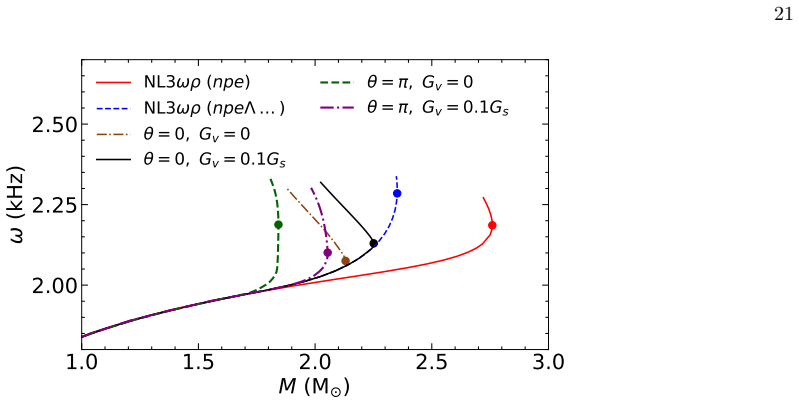
The central claim is that at $\theta=\pi$, where CP violation is maximal, the quark matter equation of state in the three-flavor NJL model with vector coupling $G_v=0.1\,G_s$ supports hybrid neutron stars with a maximum mass of $2.05\,M_\odot$, in agreement with the NICER measurement of PSR J0740+6620 and the GW170817 tidal constraints. The star has a pure quark matter core of radius $\sim 1.6$ km, quark matter in a mixed phase out to $\sim 6.5$ km, and a hyperonic outer core; without the vector term the same $\theta=\pi$ equation of state gives only $1.84\,M_\odot$ and fails the two-solar-mass constraint. The $\theta=\pi$ case also lowers the onset of the mixed phase from about $0.44$ fm$^{-3}$ (at $\theta=0$) to $0.35$ fm$^{-3}$ for $G_v=0.1\,G_s$. For the maximum-mass hybrid star, the paper computes an $f$-mode frequency near $2.1$ kHz, about $110$ Hz above a nucleonic star of the same mass, with hyperons and the enlarged quark core contributing separately to the shift.
Load-bearing premise
The load-bearing premise is that the axion angle can be held at $\theta=\pi$, where the paper's own effective potential has a maximum rather than a minimum; a dynamical axion would normally settle at $\theta=2n\pi$ and erase the reported equation-of-state and f-mode effects.
Editorial extensions
If this is right
- If $\theta=\pi$ with $G_v=0.1\,G_s$, hybrid neutron stars with a pure quark matter core satisfy the $2\,M_\odot$ mass constraint; if $G_v=0$, they do not.
- Axion presence lowers the onset density of the hadron-quark mixed phase, so quark matter can appear well below the hyperon threshold or coexist with hyperons in the same star.
- The $f$-mode frequency shift (about 110 Hz for the $\theta=\pi$, $G_v=0.1\,G_s$ maximum-mass star) turns the composition of the core into a potentially observable gravitational-wave signature.
- A nonmonotonic speed of sound with sharp drops at phase boundaries is a generic prediction of these Gibbs-constructed hybrid equations of state, linking the model to the broad behavior inferred from neutron star observations.
Reading between the lines
- The paper's representative case $\theta=\pi$ is a maximum, not a minimum, of its own axion effective potential; a dynamical axion would relax to $\theta=2n\pi$, where the CP-violating effects vanish, so the reported signals require an unspecified mechanism to pin the angle.
- Even if the 110 Hz enhancement were observed, it would not identify axions uniquely: the paper itself shows hyperons already raise $f$-mode frequencies by about 260 Hz for a $2.35\,M_\odot$ star, so mass-radius-tidal joint measurements would be needed to separate axionic quark cores from merely hyperonic stars.
- One testable extension is to give the axion a finite relaxation time: if the dense-matter vacuum is metastable at $\theta=\pi$ on neutron-star timescales, the $f$-mode shift should depend on stellar age or formation history, which could be searched for in populations of young versus old pulsars.
Editorial analysis
A structured set of objections, weighed in public.
Referee Report
Summary. This paper studies the effects of a CP-violating axion angle theta on cold dense quark matter within a three-flavor Nambu-Jona-Lasinio model, and uses the resulting equation of state, combined with a relativistic mean-field hadronic EOS via a Gibbs construction, to compute hybrid neutron star mass-radius relations and quadrupolar f-mode frequencies in the Cowling approximation. The main claims are that theta=pi lowers the chiral transition density, allows a pure quark matter core in stable hybrid stars when the vector coupling Gv=0.1 Gs, increases the maximum mass to 2.05 solar masses, and enhances f-mode frequencies by about 110 Hz relative to nucleonic stars.
Significance. If the theta=pi input were physically justified, the paper would provide a plausible model exploration of how axion-induced CP violation could alter hybrid star structure and oscillation signatures. The gap equations and thermodynamic potential treatment are standard and carefully reduced to zero temperature, and the Gibbs construction and Cowling f-mode formalism are applied consistently. The paper also makes a clear comparison with NICER and GW170817 mass-radius constraints. However, the central physical claim depends entirely on the axion field sitting at a maximum of its own effective potential, which no mechanism in the paper stabilizes. Since a dynamical QCD axion would relax to theta=0, where the reported effects largely disappear, the significance for axion physics is currently not established.
major comments (2)
- [Sec. VI A, Fig. 7; Sec. VI C] The paper's own effective potential, shown in Fig. 7 and discussed in Sec. VI A, has degenerate minima at theta=2n pi and maxima at theta=(2n+1) pi; the text explicitly states that at theta=(2n+1) pi 'the thermodynamic potential is still a maximum.' All axion-dependent results—the EOS in Fig. 8, the mass-radius curves and core profiles in Figs. 9 and 10, and the f-mode frequencies in Fig. 12—are computed at theta=pi. For the QCD axion, which the paper identifies with theta=<a>/f_a and which is designed to relax to CP-conserving values, the field would settle at a minimum, theta=0 mod 2 pi, not at the maximum theta=pi. No pinning mechanism, domain-wall stabilization, or density-induced shift of the minimum is provided. Given that the introduction itself cites the experimental bound theta<0.7 x 10^-11, the representative choice theta=pi is both dynamically and phenomenologically unjustified, and the central claim of axion-induced stabilization of hybrid stars with pure quark cores collapses unless a mechanism to maintain theta=pi is supplied.
- [Abstract; Sec. VI C, Figs. 3(b), 12] The claimed axion-specific enhancements are not robust under a dynamically selected theta. At theta=0 with Gv=0.1 Gs, the model does not produce a pure quark matter core (Fig. 3(b)), and the f-mode enhancement relative to a nucleonic star is 90 Hz rather than 110 Hz (Fig. 12). The difference between theta=0 and theta=pi is therefore not only quantitatively modest but also rests on the unphysical theta=pi choice. The abstract's statement that 'with the presence of axions, it is possible to have stable hybrid neutron stars having an inner core of quark matter both in pure quark matter phase as well as in a mixed phase with hyperonic matter' is thus conditional on an input that the paper's own dynamics rule out; as it stands, it overstates what the calculation establishes.
minor comments (5)
- [Sec. II, Eq. (14)] The text contains 'we we have introduced'; please correct to 'we have introduced'.
- [Sec. VI A, figures captions] The in-text references to 'Fig 5 b' and 'Fig 5 c' in the discussion of the strange quark condensates are mislabeled; they should refer to Figs. 6(c) and 6(d).
- [Sec. VI C] The sentence 'the maximum mass becomes 2.05 M_sun ans satisfies the maximum mass constraint' contains a typo: 'ans' should be 'and'.
- [Fig. 9 caption] The caption describes 'The dark gray and light gray region here correspond to 50% and 90% confidence interval', while the figure legend states '90% (solid) and 50% (dashed)'; please align the caption with the legend.
- [Sec. VI C, inner crust] The claim that the inner-crust polytrope treatment yields radius differences of less than 0.5 km compared to a unified description is stated without a quantitative reference; please cite the specific figure or table from Ref. [69].
Circularity Check
No significant circularity: model parameters are fitted to vacuum meson data and hyperon potentials, while the f-mode frequencies and maximum masses are computed outputs rather than fitted inputs.
full rationale
The derivation chain is self-contained and does not reduce to its inputs by construction. The NJL parameters (Λ = 602.3 MeV, GsΛ² = 1.835, KΛ⁵ = 12.36, mu = md = 5.5 MeV, ms = 140.7 MeV) are fixed in Section II by fitting the pion decay constant and the masses of pion, kaon, and eta-prime; the hadronic NL3ωρ parameters are taken from Ref. [59], and hyperon couplings are set by hyperon potential depths. None of these targets are the f-mode frequencies or the 2.05 solar-mass maximum that the paper reports. The f-mode frequencies are obtained by numerically solving the coupled differential equations (60)-(61) with the boundary condition (63) for each EOS, so the quoted 110 Hz enhancement relative to a nucleonic star of the same mass is a computed output. Self-citations (Refs. [29,30,36,41]) provide the NJL thermodynamic potential and the Cowling-approximation oscillation formalism, but the relevant equations are displayed in full in this paper and the cited works are not invoked to exclude alternatives. The one substantive concern is that Section VI A states the thermodynamic potential has maxima at θ = (2n+1)π, while the axion-dependent results are computed at θ = π; however, this is a physical-consistency (and possibly dynamical-relaxation) concern about whether a QCD axion would sit at a maximum, not a circularity. The paper does not fit θ to the reported frequencies or masses, and it explicitly compares with θ = 0 results to show the dependence of the outputs on the chosen input.
Assumptions & free parameters
free parameters (8)
- NJL cutoff Lambda =
602.3 MeV
- Scalar coupling Gs =
Gs Lambda^2 = 1.835
- KMT coupling K =
K Lambda^5 = 12.36
- Current quark masses mu=md, ms =
5.5 MeV, 140.7 MeV
- Vector coupling Gv =
0.1 Gs, also 0
- Axion angle theta =
pi, with 0 and pi/2 for comparison
- Hyperon potential depths U_Lambda, U_Sigma, U_Xi =
-28 MeV, +30 MeV, -18 MeV
- Inner crust polytrope constants a,b =
determined by matching BPS and core EOS
assumptions (6)
- domain assumption The 3-flavor NJL model with KMT determinant is a valid effective description of low-energy QCD at finite density.
- domain assumption The axion field can be replaced by its vacuum expectation value theta = <a>/fa with fa around 10^15 GeV.
- ad hoc to paper The CP-violating angle theta=pi is a physically relevant configuration for neutron star matter.
- domain assumption The hadron-quark transition is described by Gibbs construction with globally conserved charge.
- domain assumption Non-radial f-modes can be computed in the Cowling approximation with errors no more than 15-20%.
- domain assumption Beta equilibrium and charge neutrality hold in neutron star matter.
Cite this review
Pith. "Pith review of CP violation in cold dense quark matter and axion effects on the non-radial oscillations of neutron stars." pith.science (2026). https://pith.science/paper/6PDSP22X
@misc{pith2026241117828,
  author       = {Pith},
  title        = {Pith review of: CP violation in cold dense quark matter and axion effects on the non-radial oscillations of neutron stars},
  year         = {2026},
  howpublished = {\url{https://pith.science/paper/6PDSP22X}},
  note         = {Machine review of arXiv:2411.17828}
}
abstract
Charge-conjugation and parity violation in strong interaction for cold dense quark matter is studied with axions of quantum chromodynamic within the three flavor Nambu--Jona-Lasinio model that includes the coupling of axions to quarks. We first calculate the effective potential for axions at finite baryon density and zero temperature including the effects of a first order chiral phase transition. Using the equation of state for quark matter with axions and a hadronic matter equation of state in the ambit of a relativistic mean field theory in quantum hadrodynamics, we discuss the hadron-quark phase transition. Inclusion of axions reduces the critical density for chiral transition. We use a Gibbs construct for the hadron-quark phase transition satisfying the constraints of beta equilibrium and charge neutrality as appropriate for the neutron star matter. The equation of state so obtained is used to investigate the structure of hybrid neutron stars. It is found that with the presence of axions, it is possible to have stable hybrid neutron stars having an inner core of quark matter both in pure quark matter phase as well as in a mixed phase with hyperonic matter along with a outer core of hyperonic matter and is in agreement with modern astrophysical constraints. We also discuss the properties of non-radial oscillations of such hybrid neutron stars. It is observed that the quadrupolar fundamental modes ($f$-modes) for such hybrid neutron stars get substantial enhancements both due to a larger quark core in the presence of axions and from the hyperons as compared to a canonical nucleonic neutron stars.
Figures


Figures from the paper (9 more)


Forward citations
Cited by 1 Pith paper
-
Effects of dark matter and magnetic field on neutron star properties in relativistic mean-field theory: A single-fluid approach
Fermionic dark matter and strong central magnetic fields both reduce neutron-star maximum mass and radius and lower tidal deformability in single-fluid RMF models, remaining compatible with GW/NICER constraints over t...
Reference graph
Works this paper leans on
-
[1]
B. P. Abbott et al. (LIGO Scientific, Virgo), GW170817: Measurements of neutron star radii and equation of state, Phys. Rev. Lett. 121, 161101 (2018), arXiv:1805.11581 [gr-qc]
arXiv 2018
-
[2]
B. P. Abbott et al. (LIGO Scientific, Virgo), Properties of the binary neutron star merger GW170817, Phys. Rev. X 9, 011001 (2019), arXiv:1805.11579 [gr-qc]
arXiv 2019
-
[3]
M. C. Miller et al., PSR J0030+0451 Mass and Radius from N ICERData and Implications for the Properties of Neutron Star Matter, Astrophys. J. Lett. 887, L24 (2019), arXiv:1912.05705 [astro-ph.HE]
arXiv 2019
-
[4]
T. E. Riley et al., A N ICERView of PSR J0030+0451: Millisecond Pulsar Parameter Estimation, Astrophys. J. Lett. 887, L21 (2019), arXiv:1912.05702 [astro-ph.HE]
arXiv 2019
-
[5]
T. E. Riley et al., A NICER View of the Massive Pulsar PSR J0740+6620 Informed by Radio Timing and XMM-Newton Spectroscopy, Astrophys. J. Lett. 918, L27 (2021), arXiv:2105.06980 [astro-ph.HE]
arXiv 2021
-
[6]
Vafa and E
C. Vafa and E. Witten, Parity Conservation in QCD, Phys. Rev. Lett. 53, 535 (1984)
1984
-
[7]
R. F. Dashen, Some features of chiral symmetry breaking, Phys. Rev. D 3, 1879 (1971)
1971
-
[8]
C. A. Baker et al., An Improved experimental limit on the electric dipole moment of the neutron, Phys. Rev. Lett. 97, 131801 (2006), arXiv:hep-ex/0602020
arXiv 2006
Show all 85 references
-
[9]
Kawarabayashi and N
K. Kawarabayashi and N. Ohta, On the Partial Conservation of the U(1) Current, Prog. Theor. Phys. 66, 1789 (1981)
1981
-
[10]
J. M. Pendlebury et al., Revised experimental upper limit on the electric dipole moment of the neutron, Phys. Rev. D 92, 092003 (2015), arXiv:1509.04411 [hep-ex]
2015 arXiv
-
[11]
F. K. Guo, R. Horsley, U. G. Meissner, Y. Nakamura, H. Perlt, P. E. L. Rakow, G. Schierholz, A. Schiller, and J. M. Zanotti, The electric dipole moment of the neutron from 2+1 flavor lattice QCD, Phys. Rev. Lett. 115, 062001 (2015), arXiv:1502.02295 [hep-lat]
2015 arXiv
-
[12]
Bhattacharya, V
T. Bhattacharya, V. Cirigliano, R. Gupta, H.-W. Lin, and B. Yoon, Neutron Electric Dipole Moment and Tensor Charges from Lattice QCD, Phys. Rev. Lett. 115, 212002 (2015), arXiv:1506.04196 [hep-lat]
2015 arXiv
-
[13]
R. D. Peccei and H. R. Quinn, Constraints Imposed by CP Conservation in the Presence of Instantons, Phys. Rev. D 16, 1791 (1977)
1977
-
[14]
R. D. Peccei and H. R. Quinn, CP Conservation in the Presence of Instantons, Phys. Rev. Lett. 38, 1440 (1977)
1977
-
[15]
Grilli di Cortona, E
G. Grilli di Cortona, E. Hardy, J. Pardo Vega, and G. Villadoro, The QCD axion, precisely, JHEP01, 034, arXiv:1511.02867 [hep-ph]
-
[16]
J. E. Kim and G. Carosi, Axions and the Strong CP Problem, Rev. Mod. Phys. 82, 557 (2010), [Erratum: Rev.Mod.Phys. 91, 049902 (2019)], arXiv:0807.3125 [hep-ph]
2010 arXiv
-
[17]
Weinberg, A New Light Boson?, Phys
S. Weinberg, A New Light Boson?, Phys. Rev. Lett. 40, 223 (1978)
1978
-
[18]
M. S. Turner and F. Wilczek, Inflationary axion cosmology, Phys. Rev. Lett. 66, 5 (1991)
1991
-
[19]
L. D. Duffy and K. van Bibber, Axions as Dark Matter Particles, New J. Phys.11, 105008 (2009), arXiv:0904.3346 [hep-ph]
2009 arXiv
-
[20]
Visinelli and P
L. Visinelli and P. Gondolo, Dark Matter Axions Revisited, Phys. Rev. D80, 035024 (2009), arXiv:0903.4377 [astro-ph.CO]
2009 arXiv
-
[21]
D. R. Karkevandi, S. Shakeri, V. Sagun, and O. Ivanytskyi, Bosonic dark matter in neutron stars and its effect on gravitational wave signal, Phys. Rev. D 105, 023001 (2022), arXiv:2109.03801 [astro-ph.HE]
2022 arXiv
-
[22]
Bernard, S
V. Bernard, S. Descotes-Genon, and G. Toucas, Determining the chiral condensate from the distribution of the winding number beyond topological susceptibility, JHEP 12, 080, arXiv:1209.4367 [hep-lat]
-
[23]
M. A. Metlitski and A. R. Zhitnitsky, theta-dependence of QCD at finite isospin density, Phys. Lett. B 633, 721 (2006), arXiv:hep-ph/0510162
2006 arXiv
-
[24]
Bonati, M
C. Bonati, M. D’Elia, M. Mariti, G. Martinelli, M. Mesiti, F. Negro, F. Sanfilippo, and G. Villadoro, Axion phenomenology and θ-dependence from Nf = 2 + 1 lattice QCD, JHEP 03, 155, arXiv:1512.06746 [hep-lat]
-
[25]
A. J. Mizher and E. S. Fraga, CP Violation in the Linear Sigma Model, Nucl. Phys. A 820, 247C (2009), arXiv:0810.4115 [hep-ph]
2009 arXiv
-
[26]
Frank, M
M. Frank, M. Buballa, and M. Oertel, Flavor mixing effects on the QCD phase diagram at nonvanishing isospin chemical potential: One or two phase transitions?, Phys. Lett. B 562, 221 (2003), arXiv:hep-ph/0303109
2003 arXiv
-
[27]
J. K. Boomsma and D. Boer, The High temperature CP-restoring phase transition at theta = pi, Phys. Rev. D 80, 034019 (2009), arXiv:0905.4660 [hep-ph]
2009 arXiv
-
[28]
J. K. Boomsma and D. Boer, The Influence of strong magnetic fields and instantons on the phase structure of the two-flavor NJL model, Phys. Rev. D 81, 074005 (2010), arXiv:0911.2164 [hep-ph]
2010 arXiv
-
[29]
Chatterjee, H
B. Chatterjee, H. Mishra, and A. Mishra, Strong CP violation and chiral symmetry breaking in hot and dense quark matter, Phys. Rev. D 85, 114008 (2012), arXiv:1111.4061 [hep-ph]
2012 arXiv
-
[30]
Chatterjee, H
B. Chatterjee, H. Mishra, and A. Mishra, CP violation and chiral symmetry breaking in hot and dense quark matter in the presence of a magnetic field, Phys. Rev. D 91, 034031 (2015), arXiv:1409.3454 [hep-ph]
2015 arXiv
-
[31]
Fukushima, K
K. Fukushima, K. Ohnishi, and K. Ohta, Topological susceptibility at zero and finite temperature in the Nambu-Jona- Lasinio model, Phys. Rev. C 63, 045203 (2001), arXiv:nucl-th/0101062
2001 arXiv
-
[32]
Sakai, H
Y. Sakai, H. Kouno, T. Sasaki, and M. Yahiro, Theta vacuum effects on QCD phase diagram, Phys. Lett. B 705, 349 (2011), arXiv:1105.0413 [hep-ph]
2011 arXiv
-
[33]
Lu and M
Z.-Y. Lu and M. Ruggieri, Effect of the chiral phase transition on axion mass and self-coupling, Phys. Rev. D 100, 014013 24 (2019), arXiv:1811.05102 [hep-ph]
2019 arXiv
-
[34]
Bandyopadhyay, R
A. Bandyopadhyay, R. L. S. Farias, B. S. Lopes, and R. O. Ramos, Quantum chromodynamics axion in a hot and magnetized medium, Phys. Rev. D 100, 076021 (2019), arXiv:1906.09250 [hep-ph]
2019 arXiv
-
[35]
M. S. Ali, C. A. Islam, and R. Sharma, Studying explicit U(1)A symmetry breaking in a hot and magnetized two flavor nonlocal NJL model constrained using lattice results, Phys. Rev. D 104, 114026 (2021), arXiv:2009.13563 [hep-ph]
2021 arXiv
-
[36]
A. Das, H. Mishra, and R. K. Mohapatra, In medium properties of an axion within a 2+1 flavor Polyakov loop enhanced Nambu–Jona-Lasinio model, Phys. Rev. D 103, 074003 (2021), arXiv:2006.15727 [hep-ph]
2021 arXiv
-
[37]
Our work extends such studies in several ways
investigated the stability of hybrid stars using the NJL model to describe quark matter with axions. Our work extends such studies in several ways. For the HQPT, we modeled hadronic matter using a generalized Walecka model within quantum hadrodynamics, incorporating nonlinear ...
-
[38]
B. S. Lopes, R. L. S. Farias, V. Dexheimer, A. Bandyopadhyay, and R. O. Ramos, Axion effects in the stability of hybrid stars, Phys. Rev. D 106, L121301 (2022), arXiv:2206.01631 [hep-ph]
2022 arXiv
-
[39]
Radice, S
D. Radice, S. Bernuzzi, and A. Perego, The Dynamics of Binary Neutron Star Mergers and GW170817, Ann. Rev. Nucl. Part. Sci. 70, 95 (2020), arXiv:2002.03863 [astro-ph.HE]
2020 arXiv
-
[40]
C. A. Raithel, Constraints on the Neutron Star Equation of State from GW170817, Eur. Phys. J. A 55, 80 (2019), arXiv:1904.10002 [astro-ph.HE]
2019 arXiv
-
[41]
Alford, M
M. Alford, M. Braby, M. W. Paris, and S. Reddy, Hybrid stars that masquerade as neutron stars, Astrophys. J. 629, 969 (2005), arXiv:nucl-th/0411016
2005 arXiv
-
[42]
Kumar, H
D. Kumar, H. Mishra, and T. Malik, Non-radial oscillation modes in hybrid stars: consequences of a mixed phase, JCAP 02, 015, arXiv:2110.00324 [hep-ph]
-
[43]
P. N. McDermott, H. M. van Horn, and J. F. Scholl, Nonradial g-mode oscillations of warm neutron stars, Astrophys. J. 268, 837 (1983)
1983
-
[44]
B. K. Pradhan, D. Chatterjee, M. Lanoye, and P. Jaikumar, General relativistic treatment of f-mode oscillations of hyperonic stars, Phys. Rev. C 106, 015805 (2022), arXiv:2203.03141 [astro-ph.HE]
2022 arXiv
-
[45]
Radice, V
D. Radice, V. Morozova, A. Burrows, D. Vartanyan, and H. Nagakura, Characterizing the Gravitational Wave Signal from Core-Collapse Supernovae, Astrophys. J. Lett. 876, L9 (2019), arXiv:1812.07703 [astro-ph.HE]
2019 arXiv
-
[46]
J. A. Rencoret, C. Aguilera-G´ omez, and A. Reisenegger, Revisiting neutron starquakes caused by spin-down, Astron. Astrophys. 654, A47 (2021), arXiv:2106.12604 [astro-ph.HE]
2021 arXiv
-
[47]
Keer and D
L. Keer and D. I. Jones, Developing a model for neutron star oscillations following starquakes, Mon. Not. Roy. Astron. Soc. 446, 865 (2015), arXiv:1408.1249 [astro-ph.SR]
2015 arXiv
-
[48]
D. D. Doneva, E. Gaertig, K. D. Kokkotas, and C. Kr¨ uger, Gravitational wave asteroseismology of fast rotating neutron stars with realistic equations of state, Phys. Rev. D 88, 044052 (2013), arXiv:1305.7197 [astro-ph.SR]
2013 arXiv
-
[49]
Stergioulas, A
N. Stergioulas, A. Bauswein, K. Zagkouris, and H.-T. Janka, Gravitational waves and nonaxisymmetric oscillation modes in mergers of compact object binaries, Mon. Not. Roy. Astron. Soc. 418, 427 (2011), arXiv:1105.0368 [gr-qc]
2011 arXiv
-
[50]
Bauswein and H
A. Bauswein and H. T. Janka, Measuring neutron-star properties via gravitational waves from binary mergers, Phys. Rev. Lett. 108, 011101 (2012), arXiv:1106.1616 [astro-ph.SR]
2012 arXiv
-
[51]
Takami, L
K. Takami, L. Rezzolla, and L. Baiotti, Constraining the Equation of State of Neutron Stars from Binary Mergers, Phys. Rev. Lett. 113, 091104 (2014), arXiv:1403.5672 [gr-qc]
2014 arXiv
-
[52]
Chirenti, R
C. Chirenti, R. Gold, and M. C. Miller, Gravitational waves from f-modes excited by the inspiral of highly eccentric neutron star binaries, Astrophys. J. 837, 67 (2017), arXiv:1612.07097 [astro-ph.HE]
2017 arXiv
-
[53]
Steinhoff, T
J. Steinhoff, T. Hinderer, T. Dietrich, and F. Foucart, Spin effects on neutron star fundamental-mode dynamical tides: Phenomenology and comparison to numerical simulations, Phys. Rev. Res. 3, 033129 (2021), arXiv:2103.06100 [gr-qc]
2021 arXiv
-
[54]
Pratten, P
G. Pratten, P. Schmidt, and T. Hinderer, Gravitational-Wave Asteroseismology with Fundamental Modes from Compact Binary Inspirals, Nature Commun. 11, 2553 (2020), arXiv:1905.00817 [gr-qc]
2020 arXiv
-
[55]
J. E. Kim, Weak Interaction Singlet and Strong CP Invariance, Phys. Rev. Lett. 43, 103 (1979)
1979
-
[56]
M. Dine, W. Fischler, and M. Srednicki, A Simple Solution to the Strong CP Problem with a Harmless Axion, Phys. Lett. B 104, 199 (1981)
1981
-
[57]
Rehberg, S
P. Rehberg, S. P. Klevansky, and J. Hufner, Hadronization in the SU(3) Nambu-Jona-Lasinio model, Phys. Rev. C 53, 410 (1996), arXiv:hep-ph/9506436
1996 arXiv
-
[58]
Mishra, P
A. Mishra, P. K. Panda, and W. Greiner, Vacuum polarization effects in hyperon rich dense matter: A Nonperturbative treatment, J. Phys. G 28, 67 (2002), arXiv:nucl-th/0101006
2002 arXiv
-
[59]
Tolos, M
L. Tolos, M. Centelles, and A. Ramos, The Equation of State for the Nucleonic and Hyperonic Core of Neutron Stars, Publ. Astron. Soc. Austral. 34, e065 (2017), arXiv:1708.08681 [astro-ph.HE]
2017 arXiv
-
[60]
C. J. Horowitz and J. Piekarewicz, Neutron star structure and the neutron radius of Pb-208, Phys. Rev. Lett. 86, 5647 (2001), arXiv:astro-ph/0010227
2001 arXiv
-
[61]
Schaffner, C
J. Schaffner, C. B. Dover, A. Gal, C. Greiner, D. J. Millener, and H. Stoecker, Multiply strange nuclear systems, Annals Phys. 235, 35 (1994)
1994
-
[62]
Mares, E
J. Mares, E. Friedman, A. Gal, and B. K. Jennings, Constraints on Sigma nucleus dynamics from Dirac phenomenology of Sigma- atoms, Nucl. Phys. A 594, 311 (1995), arXiv:nucl-th/9505003
1995 arXiv
-
[63]
N. K. Glendenning, On the uncertainty of hyperon couplings and the electrochemical potential in neutron star matter, Phys. Rev. C 64, 025801 (2001), arXiv:nucl-th/0009082
2001 arXiv
-
[64]
Schertler, S
K. Schertler, S. Leupold, and J. Schaffner-Bielich, Neutron stars and quark phases in the NJL model, Phys. Rev. C 60, 025801 (1999), arXiv:astro-ph/9901152
1999 arXiv
-
[65]
K. S. Thorne and A. Campolattaro, Non-Radial Pulsation of General-Relativistic Stellar Models. I. Analytic Analysis for L ¿= 2 (1967)
1967
-
[66]
Sotani, N
H. Sotani, N. Yasutake, T. Maruyama, and T. Tatsumi, Signatures of hadron-quark mixed phase in gravitational waves, Phys. Rev. D 83, 024014 (2011), arXiv:1012.4042 [astro-ph.HE]. 25
2011 arXiv
-
[67]
H.-F. Gong, Q. Lu, Z.-Y. Lu, L.-M. Liu, X. Chen, and S.-P. Wang, QCD topology and axion properties in an isotropic hot and dense medium, (2024), arXiv:2404.15136 [hep-ph]
2024 arXiv
-
[68]
G. Baym, C. Pethick, and P. Sutherland, The Ground state of matter at high densities: Equation of state and stellar models, Astrophys. J. 170, 299 (1971)
1971
-
[69]
Carriere, C
J. Carriere, C. J. Horowitz, and J. Piekarewicz, Low mass neutron stars and the equation of state of dense matter, Astrophys. J. 593, 463 (2003), arXiv:nucl-th/0211015
2003 arXiv
-
[70]
Malik, M
T. Malik, M. Ferreira, B. K. Agrawal, and C. Providˆ encia, Relativistic Description of Dense Matter Equation of State and Compatibility with Neutron Star Observables: A Bayesian Approach, Astrophys. J. 930, 17 (2022), arXiv:2201.12552 [nucl-th]
2022 arXiv
-
[71]
Annala, T
E. Annala, T. Gorda, A. Kurkela, and A. Vuorinen, Gravitational-wave constraints on the neutron-star-matter Equation of State, Phys. Rev. Lett. 120, 172703 (2018), arXiv:1711.02644 [astro-ph.HE]
2018 arXiv
-
[72]
I. Tews, J. Margueron, and S. Reddy, Critical examination of constraints on the equation of state of dense matter obtained from GW170817, Phys. Rev. C 98, 045804 (2018), arXiv:1804.02783 [nucl-th]
2018 arXiv
-
[73]
Raaijmakers et al., Constraining the dense matter equation of state with joint analysis of NICER and LIGO/Virgo measurements, Astrophys
G. Raaijmakers et al., Constraining the dense matter equation of state with joint analysis of NICER and LIGO/Virgo measurements, Astrophys. J. Lett. 893, L21 (2020), arXiv:1912.11031 [astro-ph.HE]
2020 arXiv
-
[74]
Drischler, S
C. Drischler, S. Han, J. M. Lattimer, M. Prakash, S. Reddy, and T. Zhao, Limiting masses and radii of neutron stars and their implications, Phys. Rev. C 103, 045808 (2021), arXiv:2009.06441 [nucl-th]
2021 arXiv
-
[75]
McLerran and S
L. McLerran and S. Reddy, Quarkyonic Matter and Neutron Stars, Phys. Rev. Lett. 122, 122701 (2019), arXiv:1811.12503 [nucl-th]
2019 arXiv
-
[76]
P. T. H. Pang, L. Sivertsen, R. Somasundaram, T. Dietrich, S. Sen, I. Tews, M. W. Coughlin, and C. Van Den Broeck, Probing quarkyonic matter in neutron stars with the Bayesian nuclear-physics multimessenger astrophysics framework, Phys. Rev. C 109, 025807 (2024), arXiv:2308.15...
2024 arXiv
-
[77]
R. D. Pisarski, Remarks on nuclear matter: How an ω0 condensate can spike the speed of sound, and a model of Z(3) baryons, Phys. Rev. D 103, L071504 (2021), arXiv:2101.05813 [nucl-th]
2021 arXiv
-
[78]
B. K. Pradhan and D. Chatterjee, Effect of hyperons on f-mode oscillations in Neutron Stars, Phys. Rev. C 103, 035810 (2021), arXiv:2011.02204 [astro-ph.HE]
2021 arXiv
-
[79]
Yoshida and Y
S. Yoshida and Y. Kojima, Accuracy of the relativistic Cowling approximation in slowly rotating stars, Mon. Not. Roy. Astron. Soc. 289, 117 (1997), arXiv:gr-qc/9705081
1997 arXiv
-
[80]
Zhao and J
T. Zhao and J. M. Lattimer, Universal relations for neutron star f-mode and g-mode oscillations, Phys. Rev. D 106, 123002 (2022), arXiv:2204.03037 [astro-ph.HE]
2022 arXiv
-
[81]
I. A. Rather, K. D. Marquez, P. Thakur, and O. Louren¸ co, Non-Radial Oscillation Modes in Hybrid Stars with Hyperons and Delta Baryons: Full General Relativity Formalism vs. Cowling Approximation, (2024), arXiv:2412.12002 [astro-ph.HE]
2024 arXiv
-
[82]
Zhang, D
B. Zhang, D. E. A. Castillo, A. G. Grunfeld, and M. Ruggieri, Exploring the axion potential and axion walls in dense quark matter, Phys. Rev. D 108, 054010 (2023), arXiv:2304.10240 [hep-ph]
2023 arXiv
-
[83]
Murgana, D
F. Murgana, D. E. A. Castillo, A. G. Grunfeld, and M. Ruggieri, Topological susceptibility and axion potential in two-flavor superconductive quark matter, Phys. Rev. D 110, 014042 (2024), arXiv:2404.14160 [hep-ph]
2024 arXiv
-
[84]
Balkin, J
R. Balkin, J. Serra, K. Springmann, and A. Weiler, The QCD axion at finite density, JHEP 07, 221, arXiv:2003.04903 [hep-ph]
2003 arXiv
-
[85]
G´ omez-Ba˜ n´ on, K
A. G´ omez-Ba˜ n´ on, K. Bartnick, K. Springmann, and J. A. Pons, Constraining Light QCD Axions with Isolated Neutron Star Cooling, Phys. Rev. Lett. 133, 251002 (2024), arXiv:2408.07740 [hep-ph]
2024 arXiv
Reviewed August 12, 2026 · model on record in the stance chip above.
Discussion (0). Continue with ORCID to comment.