REVIEW 3 major objections 4 minor 101 references
Hierarchical Information Flow for Generalized Efficient Image Restoration
T0 review · 3 major / 4 minor · reviewed 2026-08-12 · deepseek-v4-flash
Pith's one-line read The paper proposes Hi-IR, a transformer that replaces long-range self-attention with a three-level hierarchical information flow, and reports state-of-the-art results on seven image restoration tasks at lower parameter counts.
desk verdict Solid all-in-one restoration model; the experiments are broad and the scaling recipe is useful, but the Appendix C global-range claim is not supported. read the letter →
The pith
A machine-rendered reading of the paper's core claim, the machinery that carries it, and where it could break.
The reading
What carries the argument
The central object is a hierarchical information tree realized in each Hi-IR layer: L1 self-attention inside p-by-p patches, L2 self-attention across s-by-s groups of dispersed patches obtained by a permutation operation, and L3 a convolutional feed-forward network of 1×1, 3×3, and 1×1 convolutions. The permutation step lets distant patches meet in one window without global attention. The per-layer time complexity is $O(BHW((5+2\gamma)C^2 + \frac{3}{2}(p^2+s^2)C))$, comparable to window attention, while two consecutive layers reach a $16P\times16P$ receptive field.
What would settle it
Train a parameter-matched shifted-window SwinIR variant on the same 4× super-resolution data and compare Urban100 PSNR against Hi-IR's reported 28.44 dB; if the control matches or exceeds it under identical training, the hierarchy is not the source of the gain.
Extended reading notes
Core claim
Hi-IR's central claim is that global information exchange in image restoration can be achieved by incrementally propagating information through a three-level tree, avoiding both quadratic global self-attention and the receptive-field limits of window attention. Level one applies self-attention inside small local patches; level two permutes dispersed patches into larger groups so each window receives cross-patch information; level three is a convolutional feed-forward network. The paper reports that this sequence reaches a global receptive field with space and time complexity comparable to window attention, and that a model built on it achieves the best or second-best PSNR/SSIM across super-resolution, denoising, JPEG artifact removal, motion deblurring, defocus deblurring, demosaicking, and adverse-weather restoration.
Load-bearing premise
The load-bearing premise is that a fixed three-level hierarchy is the right way to propagate information globally for all seven degradations, rather than simply having more layers or wider channels at the same parameter count.
Editorial extensions
If this is right
- A single model architecture without global self-attention can reach top or runner-up accuracy across seven restoration tasks, so task-specific attention designs are not necessary on these benchmarks.
- The scaling recipe—warmup, bottleneck convolutions, and dot-product attention—lets a restoration transformer grow from about 15M to roughly 57M parameters without the performance collapse previously seen, opening a path beyond the common 10–20M range.
- Because the L2 permutation uses a bounded group size, the model limits how far apart attending pixels can be, which keeps computation predictable on large images.
- Extending the tree depth beyond three levels improves accuracy further, making tree depth a usable tuning knob for the architecture.
- A single Hi-IR checkpoint can handle multiple degradation levels in denoising and JPEG artifact removal, suggesting one model can replace per-degradation deployments.
Reading between the lines
- Beyond the paper: the bounded L2 group size is a transferable inductive bias, so swapping window-attention blocks for L1–L2–L3 blocks in other high-resolution dense prediction tasks, such as semantic segmentation or depth estimation, is a direct test worth running at equal FLOPs.
- Beyond the paper: the ablation study never compares against a same-parameter-capacity model with more layers or wider channels but no hierarchy, so part of the reported gain could be capacity rather than the information-flow mechanism; a parameter-matched shifted-window control would settle this.
- Beyond the paper: the three scaling fixes are separable from the architecture, so applying warmup, bottleneck convolutions, and dot-product attention to other large transformer restoration baselines would show whether the recipe generalizes beyond Hi-IR.
Signed reviews
Editorial analysis
A structured set of objections, weighed in public.
Referee Report
Summary. The paper proposes Hi-IR, a transformer-based image restoration architecture built on a three-level hierarchical information flow: L1 self-attention within p×p patches, L2 attention over permuted groups of s² patches within P×P blocks (P = s·p), and L3 convolutional feed-forward processing. The authors argue that this hierarchy removes long-range self-attention, improves efficiency, and enables global information propagation at window-attention cost. They further propose scaling strategies (learning-rate warmup, replacing dense 3×3 convolutions with bottlenecks, and using dot-product attention) and validate the model on seven image restoration tasks: super-resolution, denoising, JPEG compression artifact removal, motion deblurring, defocus deblurring, demosaicking, and adverse-weather restoration. The central claims are that Hi-IR achieves state-of-the-art results in all seven tasks and that the hierarchical mechanism propagates information globally more efficiently than window attention.
Significance. If the central efficiency claim were correct, Hi-IR would be a valuable contribution: it would show that a transformer without global or shifted-window self-attention can reach global-range information flow at low cost, with strong results across many degradations. The experimental campaign is extensive, covering seven tasks, multiple datasets, two architecture families, and model-scaling analyses; the paper also reports several second-best results honestly rather than hiding them. The scaling analysis in Section 4, in particular, is a useful empirical study. However, the paper's main theoretical justification for global-range propagation is not supported as written, and the blanket state-of-the-art claim is stronger than the tables warrant. The contribution is therefore presently a strong empirical architecture with an unverified mechanism-level narrative.
major comments (3)
- [Appx. C, §3.2] The claim that "the maximum receptive field of two consecutive transformer layers is 16P" (Appx. C, after Eq. (8), and Table 19) is not supported by the mechanism described in §3.2. In the L2 step, the permutation groups tokens only within one P×P block, and there is no shift, random shuffle, or cross-block connection between aligned Hi-IR layers. A token in the columnar architecture therefore cannot receive evidence from outside its initial P×P block after any number of layers; the receptive field grows only by the O(1) kernel extent of the L3 convolution, not to 16P. Consequently, Table 19's comparison with "Window Attn. (8P×8P)", which reaches 16P via shifted windows, is not an equal-receptive-field comparison, and the statement in §3.1 that the proposed mechanism is "more efficient in propagating information to the global range" does not follow from the derivation. For the U-shape configuration used in most tasks, the encoder-decoder down-sampling supplies cross-block information flow independently of the L1/L2 attention, so the global-range claim should be restricted and re-derived.
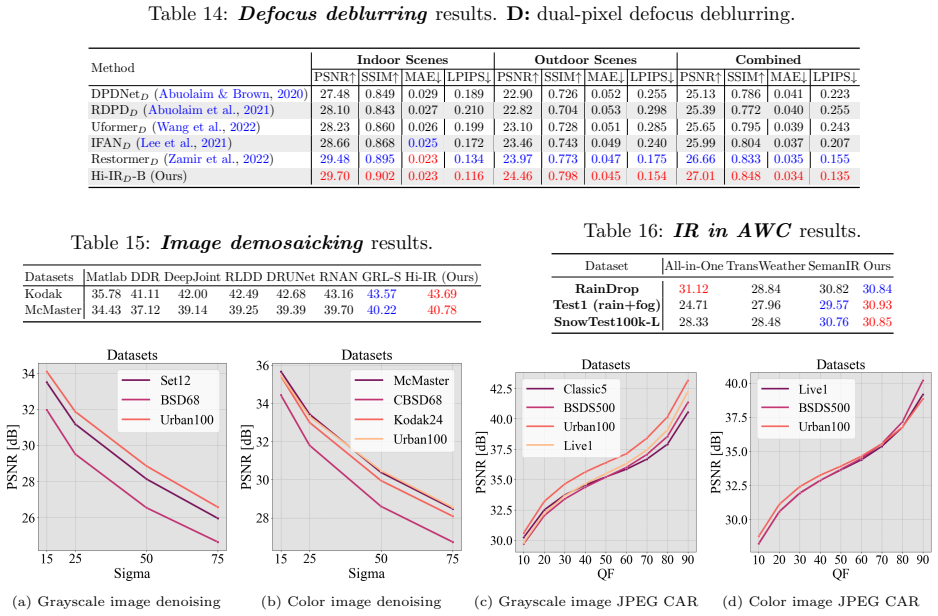
- [§5.2, Tables 8, 12, 16] The abstract and introduction claim "state-of-the-art performance in seven common image restoration tasks", but several entries in the paper's own tables are second-best: in Tab. 8, Hi-IR-B and Hi-IR-L are below HAT on Set5 at ×2, ×3, and ×4 (e.g., 33.22 vs. 33.30 dB at ×4); in Tab. 12, Hi-IR-L is below GRL-B on HIDE (31.64 vs. 31.65 dB); and in Tab. 16, Hi-IR is below All-in-One on RainDrop (30.84 vs. 31.12 dB). The text in §5.2 acknowledges some of these cases, but the abstract and introduction should be qualified, for example to "competitive or state-of-the-art on most benchmarks and tasks", or the specific tasks for which the claim is intended should be stated explicitly.
- [§5.1, Tab. 6] The ablation in Tab. 6 varies the L1/L2 layout, the projection, the tree depth, and the model size simultaneously, but it does not include an equal-capacity control, such as a v3 or v4 model with more layers or wider channels at the same parameter count, or a plain window-attention model at the same capacity. Without such a control, the PSNR differences attributed to the hierarchical information flow could instead reflect the changed capacity or the modified training recipe, so the causal conclusion that the hierarchy itself is responsible for the gains is not established. Please add matched-capacity baselines or soften the causal claim.
minor comments (4)
- [§4.1] The sentence "none of the four methods improves the convergence and performance of the scaled models, indicating that they do work for the attention modules of the IR transformers" appears to contain a typo: based on Tab. 4, the intended meaning is likely "do not work".
- [§3.2] In the description of the second MSA, the query, key, and value projections are denoted Q^{l1}, K^{l1}, V^{l1}; they should presumably be indexed by l2 to match Y^{l2}.
- [Appx. D, Tab. 21] Tab. 21 is labeled "TreeIR" in its caption, while the method is called Hi-IR everywhere else; please make the naming consistent.
- [§5, Appx. A] The paper does not report error bars or statistical significance for the small performance gaps (e.g., 0.01 dB on HIDE, 0.02–0.04 dB on several SR settings), and no code release is mentioned; adding error bars or code would substantially strengthen the empirical claims.
Circularity Check
No construction-level circularity found; benchmark claims are external and self-citations are baseline comparisons, though Appx C's 16P receptive-field assertion is unsupported.
full rationale
The paper's central claims, namely that Hi-IR achieves state-of-the-art results on seven IR tasks and offers a better efficiency/accuracy trade-off, are supported by benchmark experiments and by complexity formulas in Sec. 5 and Appx. C. No quantity is fitted to a subset of the data and then reported as a prediction forced by that fit. The architecture choices, including the L1/L2 permutation attention, L3 convolutional FFN, dot-product attention, warm-up, and bottleneck convolutions, are validated on standard test sets, which is ordinary empirical practice rather than circularity. The most visible self-citation, GRL (Li et al., 2023a), is an overlapping-author baseline that Hi-IR is compared against, not a premise used to justify the method; the cited results appear only as baselines in Tabs. 7-13 and are externally reproducible. No uniqueness theorem or architectural premise is imported from the authors' prior work. The ablation in Tab. 6 does not include an equal-parameter depth/width control, so the marginal attribution of gains to the hierarchy itself is under-supported, but an omitted control is a validity concern, not a circular step. One load-bearing statement in Appx. C, "The maximum receptive field of two consecutive transformer layers is 16 P," is asserted without derivation and appears inconsistent with the aligned, non-overlapping P by P grouping described in Sec. 3.2; under that mechanism two layers should not see beyond one P by P block. This would undermine the global-range efficiency comparison with 8P-window attention, but an unsupported or incorrect derivation is not an equivalence-to-input, so under the operating rules it does not raise the circularity score.
Assumptions & free parameters
free parameters (5)
- L1 patch size p =
not reported in main text
- L2 permutation group size s =
not reported in main text
- Bottleneck reduction factor =
4
- Warmup iterations =
50k
- Attention type =
dot product
assumptions (5)
- domain assumption Progressive local-to-global information flow is necessary for efficient image restoration.
- domain assumption Replacing dense 3x3 convolutions with bottleneck or linear layers stabilizes large-model training.
- domain assumption Warmup helps large-model convergence.
- domain assumption Dot-product attention has better gradient stability than cosine similarity attention.
- standard math The complexity formulas in Appendix C correctly account for the proposed attention.
Cite this review
Pith. "Pith review of Hierarchical Information Flow for Generalized Efficient Image Restoration." pith.science (2026). https://pith.science/paper/NZYPS2EZ
@misc{pith2026241118588,
  author       = {Pith},
  title        = {Pith review of: Hierarchical Information Flow for Generalized Efficient Image Restoration},
  year         = {2026},
  howpublished = {\url{https://pith.science/paper/NZYPS2EZ}},
  note         = {Machine review of arXiv:2411.18588}
}
read the original abstract
While vision transformers show promise in numerous image restoration (IR) tasks, the challenge remains in efficiently generalizing and scaling up a model for multiple IR tasks. To strike a balance between efficiency and model capacity for a generalized transformer-based IR method, we propose a hierarchical information flow mechanism for image restoration, dubbed Hi-IR, which progressively propagates information among pixels in a bottom-up manner. Hi-IR constructs a hierarchical information tree representing the degraded image across three levels. Each level encapsulates different types of information, with higher levels encompassing broader objects and concepts and lower levels focusing on local details. Moreover, the hierarchical tree architecture removes long-range self-attention, improves the computational efficiency and memory utilization, thus preparing it for effective model scaling. Based on that, we explore model scaling to improve our method's capabilities, which is expected to positively impact IR in large-scale training settings. Extensive experimental results show that Hi-IR achieves state-of-the-art performance in seven common image restoration tasks, affirming its effectiveness and generalizability.
Figures


Figures from the paper (13 more)




Reference graph
Works this paper leans on
-
[1]
write newline
" write newline "" before.all 'output.state := FUNCTION n.dashify 't := "" t empty not t #1 #1 substring "-" = t #1 #2 substring "--" = not "--" * t #2 global.max substring 't := t #1 #1 substring "-" = "-" * t #2 global.max substring 't := while if t #1 #1 substring * t #2 global.max substring 't := if while FUNCTION format.date year duplicate empty "emp...
-
[2]
Defocus deblurring using dual-pixel data
Abdullah Abuolaim and Michael S Brown. Defocus deblurring using dual-pixel data. In ECCV, pp.\ 111--126. Springer, 2020
2020
-
[3]
Brown, and Peyman Milanfar
Abdullah Abuolaim, Mauricio Delbracio, Damien Kelly, Michael S. Brown, and Peyman Milanfar. Learning to reduce defocus blur by realistically modeling dual-pixel data. In ICCV, 2021
2021
-
[4]
NTIRE 2017 challenge on single image super-resolution: Dataset and study
Eirikur Agustsson and Radu Timofte. NTIRE 2017 challenge on single image super-resolution: Dataset and study. In CVPRW, pp.\ 126--135, 2017
2017
-
[5]
Densely residual laplacian super-resolution
Saeed Anwar and Nick Barnes. Densely residual laplacian super-resolution. IEEE TPAMI, 44 0 (3): 0 1192--1204, 2020
2020
-
[6]
Contour detection and hierarchical image segmentation
Pablo Arbelaez, Michael Maire, Charless Fowlkes, and Jitendra Malik. Contour detection and hierarchical image segmentation. IEEE TPAMI, 33 0 (5): 0 898--916, 2010
2010
-
[7]
Low-complexity single-image super-resolution based on nonnegative neighbor embedding
Marco Bevilacqua, Aline Roumy, Christine Guillemot, and Marie Line Alberi-Morel. Low-complexity single-image super-resolution based on nonnegative neighbor embedding. In BMVC, 2012
2012
-
[8]
Language models are few-shot learners
Tom Brown, Benjamin Mann, Nick Ryder, Melanie Subbiah, Jared D Kaplan, Prafulla Dhariwal, Arvind Neelakantan, Pranav Shyam, Girish Sastry, Amanda Askell, et al. Language models are few-shot learners. NeurIPS, 33: 0 1877--1901, 2020
1901
Show all 101 references
-
[9]
Pre-trained image processing transformer
Hanting Chen, Yunhe Wang, Tianyu Guo, Chang Xu, Yiping Deng, Zhenhua Liu, Siwei Ma, Chunjing Xu, Chao Xu, and Wen Gao. Pre-trained image processing transformer. In CVPR, pp.\ 12299--12310, 2021
2021
-
[10]
Simple baselines for image restoration
Liangyu Chen, Xiaojie Chu, Xiangyu Zhang, and Jian Sun. Simple baselines for image restoration. In ECCV, pp.\ 17--33. Springer, 2022 a
2022
-
[11]
Activating more pixels in image super-resolution transformer
Xiangyu Chen, Xintao Wang, Jiantao Zhou, Yu Qiao, and Chao Dong. Activating more pixels in image super-resolution transformer. In CVPR, pp.\ 22367--22377, 2023
2023
-
[12]
Cross aggregation transformer for image restoration
Zheng Chen, Yulun Zhang, Jinjin Gu, Linghe Kong, Xin Yuan, et al. Cross aggregation transformer for image restoration. NeurIPS, 35: 0 25478--25490, 2022 b
2022
-
[13]
Rethinking coarse-to-fine approach in single image deblurring
Sung-Jin Cho, Seo-Won Ji, Jun-Pyo Hong, Seung-Won Jung, and Sung-Jea Ko. Rethinking coarse-to-fine approach in single image deblurring. In ICCV, 2021
2021
-
[14]
Conditional positional encodings for vision transformers
Xiangxiang Chu, Zhi Tian, Bo Zhang, Xinlong Wang, and Chunhua Shen. Conditional positional encodings for vision transformers. In ICLR, 2022
2022
-
[15]
Second-order attention network for single image super-resolution
Tao Dai, Jianrui Cai, Yongbing Zhang, Shu-Tao Xia, and Lei Zhang. Second-order attention network for single image super-resolution. In CVPR, pp.\ 11065--11074, 2019
2019
-
[16]
Image N et: A large-scale hierarchical image database
Jia Deng, Wei Dong, Richard Socher, Li-Jia Li, Kai Li, and Li Fei-Fei. Image N et: A large-scale hierarchical image database. In CVPR, pp.\ 248--255. IEEE, 2009
2009
-
[17]
Learning a deep convolutional network for image super-resolution
Chao Dong, Chen Change Loy, Kaiming He, and Xiaoou Tang. Learning a deep convolutional network for image super-resolution. In ECCV, pp.\ 184--199. Springer, 2014
2014
-
[18]
An image is worth 16x16 words: Transformers for image recognition at scale
Alexey Dosovitskiy, Lucas Beyer, Alexander Kolesnikov, Dirk Weissenborn, Xiaohua Zhai, Thomas Unterthiner, Mostafa Dehghani, Matthias Minderer, Georg Heigold, Sylvain Gelly, et al. An image is worth 16x16 words: Transformers for image recognition at scale. arXiv preprint arXiv...
2010 arXiv
-
[19]
Quantization guided JPEG artifact correction
Max Ehrlich, Larry Davis, Ser-Nam Lim, and Abhinav Shrivastava. Quantization guided JPEG artifact correction. In ECCV, pp.\ 293--309. Springer, 2020
2020
-
[20]
Pointwise shape-adaptive dct for high-quality denoising and deblocking of grayscale and color images
Alessandro Foi, Vladimir Katkovnik, and Karen Egiazarian. Pointwise shape-adaptive dct for high-quality denoising and deblocking of grayscale and color images. IEEE TIP, 16 0 (5): 0 1395--1411, 2007
2007
-
[21]
Kodak lossless true color image suite
Rich Franzen. Kodak lossless true color image suite. source: http://r0k. us/graphics/kodak, 4 0 (2), 1999
1999
-
[22]
Deep joint demosaicking and denoising
Micha \"e l Gharbi, Gaurav Chaurasia, Sylvain Paris, and Fr \'e do Durand. Deep joint demosaicking and denoising. ACM TOG, 35 0 (6): 0 1--12, 2016
2016
-
[23]
Accurate, large minibatch sg d: training imagenet in 1 hour
P Goyal. Accurate, large minibatch sg d: training imagenet in 1 hour. arXiv preprint arXiv:1706.02677, 2017
2017 arXiv
-
[24]
Mamba: Linear-time sequence modeling with selective state spaces
Albert Gu and Tri Dao. Mamba: Linear-time sequence modeling with selective state spaces. arXiv preprint arXiv:2312.00752, 2023
2023 arXiv
-
[25]
MambaIR : A simple baseline for image restoration with state-space model
Hang Guo, Jinmin Li, Tao Dai, Zhihao Ouyang, Xudong Ren, and Shu-Tao Xia. MambaIR : A simple baseline for image restoration with state-space model. arXiv preprint arXiv:2402.15648, 2024
2024 arXiv
-
[26]
Residual learning for effective joint demosaicing-denoising
Yu Guo, Qiyu Jin, Gabriele Facciolo, Tieyong Zeng, and Jean-Michel Morel. Residual learning for effective joint demosaicing-denoising. arXiv preprint arXiv:2009.06205, 2020
2009 arXiv
-
[27]
Single image super-resolution from transformed self-exemplars
Jia-Bin Huang, Abhishek Singh, and Narendra Ahuja. Single image super-resolution from transformed self-exemplars. In CVPR, pp.\ 5197--5206, 2015
2015
-
[28]
Shuffle transformer: Rethinking spatial shuffle for vision transformer
Zilong Huang, Youcheng Ben, Guozhong Luo, Pei Cheng, Gang Yu, and Bin Fu. Shuffle transformer: Rethinking spatial shuffle for vision transformer. arXiv preprint arXiv:2106.03650, 2021
2021 arXiv
-
[29]
Towards flexible blind JPEG artifacts removal
Jiaxi Jiang, Kai Zhang, and Radu Timofte. Towards flexible blind JPEG artifacts removal. In ICCV, pp.\ 4997--5006, 2021
2021
-
[30]
Perceptual losses for real-time style transfer and super-resolution
Justin Johnson, Alexandre Alahi, and Li Fei-Fei. Perceptual losses for real-time style transfer and super-resolution. In ECCV, pp.\ 694--711. Springer, 2016
2016
-
[31]
Why warmup the learning rate? underlying mechanisms and improvements
Dayal Singh Kalra and Maissam Barkeshli. Why warmup the learning rate? underlying mechanisms and improvements. arXiv preprint arXiv:2406.09405, 2024
2024 arXiv
-
[32]
Scaling up GAN s for text-to-image synthesis
Minguk Kang, Jun-Yan Zhu, Richard Zhang, Jaesik Park, Eli Shechtman, Sylvain Paris, and Taesung Park. Scaling up GAN s for text-to-image synthesis. In CVPR, pp.\ 10124--10134, 2023
2023
-
[33]
Edge-based defocus blur estimation with adaptive scale selection
Ali Karaali and Claudio Rosito Jung. Edge-based defocus blur estimation with adaptive scale selection. TIP, 2017
2017
-
[34]
Beyond color difference: Residual interpolation for color image demosaicking
Daisuke Kiku, Yusuke Monno, Masayuki Tanaka, and Masatoshi Okutomi. Beyond color difference: Residual interpolation for color image demosaicking. IEEE TIP, 25 0 (3): 0 1288--1300, 2016
2016
-
[35]
Accurate image super-resolution using very deep convolutional networks
Jiwon Kim, Jung Kwon Lee, and Kyoung Mu Lee. Accurate image super-resolution using very deep convolutional networks. In CVPR, pp.\ 1646--1654, 2016
2016
-
[36]
MSSNet : Multi-scale-stage network for single image deblurring
Kiyeon Kim, Seungyong Lee, and Sunghyun Cho. MSSNet : Multi-scale-stage network for single image deblurring. In ECCVW, pp.\ 524--539. Springer, 2022
2022
-
[37]
Adam: A method for stochastic optimization
Diederik P Kingma and Jimmy Ba. Adam: A method for stochastic optimization. arXiv preprint arXiv:1412.6980, 2014
2014 arXiv
-
[38]
DeblurGAN-v2 : Deblurring (orders-of-magnitude) faster and better
Orest Kupyn, Tetiana Martyniuk, Junru Wu, and Zhangyang Wang. DeblurGAN-v2 : Deblurring (orders-of-magnitude) faster and better. In ICCV, 2019
2019
-
[39]
Deep defocus map estimation using domain adaptation
Junyong Lee, Sungkil Lee, Sunghyun Cho, and Seungyong Lee. Deep defocus map estimation using domain adaptation. In CVPR, 2019
2019
-
[40]
Iterative filter adaptive network for single image defocus deblurring
Junyong Lee, Hyeongseok Son, Jaesung Rim, Sunghyun Cho, and Seungyong Lee. Iterative filter adaptive network for single image defocus deblurring. In CVPR, 2021
2021
-
[41]
Heavy rain image restoration: Integrating physics model and conditional adversarial learning
Ruoteng Li, Loong-Fah Cheong, and Robby T Tan. Heavy rain image restoration: Integrating physics model and conditional adversarial learning. In CVPR, pp.\ 1633--1642, 2019 a
2019
-
[42]
All in one bad weather removal using architectural search
Ruoteng Li, Robby T Tan, and Loong-Fah Cheong. All in one bad weather removal using architectural search. In CVPR, pp.\ 3175--3185, 2020
2020
-
[43]
On efficient transformer and image pre-training for low-level vision
Wenbo Li, Xin Lu, Jiangbo Lu, Xiangyu Zhang, and Jiaya Jia. On efficient transformer and image pre-training for low-level vision. arXiv preprint arXiv:2112.10175, 2021
2021 arXiv
-
[44]
Efficient and explicit modelling of image hierarchies for image restoration
Yawei Li, Yuchen Fan, Xiaoyu Xiang, Denis Demandolx, Rakesh Ranjan, Radu Timofte, and Luc Van Gool. Efficient and explicit modelling of image hierarchies for image restoration. In CVPR, pp.\ 18278--18289, 2023 a
2023
-
[45]
LSDIR : A large scale dataset for image restoration
Yawei Li, Kai Zhang, Jingyun Liang, Jiezhang Cao, Ce Liu, Rui Gong, Yulun Zhang, Hao Tang, Yun Liu, Denis Demandolx, et al. LSDIR : A large scale dataset for image restoration. In CVPRW, pp.\ 1775--1787, 2023 b
2023
-
[46]
Feedback network for image super-resolution
Zhen Li, Jinglei Yang, Zheng Liu, Xiaomin Yang, Gwanggil Jeon, and Wei Wu. Feedback network for image super-resolution. In CVPR, pp.\ 3867--3876, 2019 b
2019
-
[47]
Blueprint separable residual network for efficient image super-resolution
Zheyuan Li, Yingqi Liu, Xiangyu Chen, Haoming Cai, Jinjin Gu, Yu Qiao, and Chao Dong. Blueprint separable residual network for efficient image super-resolution. In CVPR, pp.\ 833--843, 2022
2022
-
[48]
SwinIR : Image restoration using swin transformer
Jingyun Liang, Jiezhang Cao, Guolei Sun, Kai Zhang, Luc Van Gool, and Radu Timofte. SwinIR : Image restoration using swin transformer. In ICCVW, pp.\ 1833--1844, 2021
2021
-
[49]
Enhanced deep residual networks for single image super-resolution
Bee Lim, Sanghyun Son, Heewon Kim, Seungjun Nah, and Kyoung Mu Lee. Enhanced deep residual networks for single image super-resolution. In CVPRW, pp.\ 1132--1140, 2017
2017
-
[50]
DesnowNet : Context-aware deep network for snow removal
Yun-Fu Liu, Da-Wei Jaw, Shih-Chia Huang, and Jenq-Neng Hwang. DesnowNet : Context-aware deep network for snow removal. IEEE TIP, 27 0 (6): 0 3064--3073, 2018
2018
-
[51]
Swin transformer: Hierarchical vision transformer using shifted windows
Ze Liu, Yutong Lin, Yue Cao, Han Hu, Yixuan Wei, Zheng Zhang, Stephen Lin, and Baining Guo. Swin transformer: Hierarchical vision transformer using shifted windows. In ICCV, pp.\ 10012--10022, 2021
2021
-
[52]
Swin transformer v2: Scaling up capacity and resolution
Ze Liu, Han Hu, Yutong Lin, Zhuliang Yao, Zhenda Xie, Yixuan Wei, Jia Ning, Yue Cao, Zheng Zhang, Li Dong, et al. Swin transformer v2: Scaling up capacity and resolution. In CVPR, pp.\ 12009--12019, 2022
2022
-
[53]
Decoupled weight decay regularization
Ilya Loshchilov and Frank Hutter. Decoupled weight decay regularization. In ICLR, 2018
2018
-
[54]
Waterloo exploration database: New challenges for image quality assessment models
Kede Ma, Zhengfang Duanmu, Qingbo Wu, Zhou Wang, Hongwei Yong, Hongliang Li, and Lei Zhang. Waterloo exploration database: New challenges for image quality assessment models. IEEE TIP, 26 0 (2): 0 1004--1016, 2016
2016
-
[55]
Intriguing findings of frequency selection for image deblurring
Xintian Mao, Yiming Liu, Fengze Liu, Qingli Li, Wei Shen, and Yan Wang. Intriguing findings of frequency selection for image deblurring. In AAAI, pp.\ 1905--1913, 2023
1905
-
[56]
A database of human segmented natural images and its application to evaluating segmentation algorithms and measuring ecological statistics
David Martin, Charless Fowlkes, Doron Tal, and Jitendra Malik. A database of human segmented natural images and its application to evaluating segmentation algorithms and measuring ecological statistics. In ICCV, volume 2, pp.\ 416--423. IEEE, 2001
2001
-
[57]
Sketch-based manga retrieval using manga109 dataset
Yusuke Matsui, Kota Ito, Yuji Aramaki, Azuma Fujimoto, Toru Ogawa, Toshihiko Yamasaki, and Kiyoharu Aizawa. Sketch-based manga retrieval using manga109 dataset. Multimedia Tools and Applications, 76 0 (20): 0 21811--21838, 2017
2017
-
[58]
Image super-resolution with non-local sparse attention
Yiqun Mei, Yuchen Fan, and Yuqian Zhou. Image super-resolution with non-local sparse attention. In CVPR, pp.\ 3517--3526, 2021
2021
-
[59]
Deep multi-scale convolutional neural network for dynamic scene deblurring
Seungjun Nah, Tae Hyun Kim, and Kyoung Mu Lee. Deep multi-scale convolutional neural network for dynamic scene deblurring. In CVPR, pp.\ 3883--3891, 2017
2017
-
[60]
Single image super-resolution via a holistic attention network
Ben Niu, Weilei Wen, Wenqi Ren, Xiangde Zhang, Lianping Yang, Shuzhen Wang, Kaihao Zhang, Xiaochun Cao, and Haifeng Shen. Single image super-resolution via a holistic attention network. In ECCV, pp.\ 191--207, 2020
2020
-
[61]
Spatially-adaptive image restoration using distortion-guided networks
Kuldeep Purohit, Maitreya Suin, AN Rajagopalan, and Vishnu Naresh Boddeti. Spatially-adaptive image restoration using distortion-guided networks. In ICCV, 2021
2021
-
[62]
Attentive generative adversarial network for raindrop removal from a single image
Rui Qian, Robby T Tan, Wenhan Yang, Jiajun Su, and Jiaying Liu. Attentive generative adversarial network for raindrop removal from a single image. In CVPR, pp.\ 2482--2491, 2018
2018
-
[63]
Sharing key semantics in transformer makes efficient image restoration
Bin Ren, Yawei Li, Jingyun Liang, Rakesh Ranjan, Mengyuan Liu, Rita Cucchiara, Luc Van Gool, Ming-Hsuan Yang, and Nicu Sebe. Sharing key semantics in transformer makes efficient image restoration. In NeurIPS, 2024
2024
-
[64]
Bayesian-based iterative method of image restoration
William Hadley Richardson. Bayesian-based iterative method of image restoration. JoSA, 62 0 (1): 0 55--59, 1972
1972
-
[65]
Real-world blur dataset for learning and benchmarking deblurring algorithms
Jaesung Rim, Haeyun Lee, Jucheol Won, and Sunghyun Cho. Real-world blur dataset for learning and benchmarking deblurring algorithms. In ECCV, pp.\ 184--201. Springer, 2020
2020
-
[66]
Photorealistic text-to-image diffusion models with deep language understanding
Chitwan Saharia, William Chan, Saurabh Saxena, Lala Li, Jay Whang, Emily L Denton, Kamyar Ghasemipour, Raphael Gontijo Lopes, Burcu Karagol Ayan, Tim Salimans, et al. Photorealistic text-to-image diffusion models with deep language understanding. NeurIPS, 35: 0 36479--36494, 2022
2022
-
[67]
Live image quality assessment database release 2
HR Sheikh. Live image quality assessment database release 2. http://live. ece. utexas. edu/research/quality, 2005
2005
-
[68]
Human-aware motion deblurring
Ziyi Shen, Wenguan Wang, Xiankai Lu, Jianbing Shen, Haibin Ling, Tingfa Xu, and Ling Shao. Human-aware motion deblurring. In ICCV, pp.\ 5572--5581, 2019
2019
-
[69]
Just noticeable defocus blur detection and estimation
Jianping Shi, Li Xu, and Jiaya Jia. Just noticeable defocus blur detection and estimation. In CVPR, 2015
2015
-
[70]
Very deep convolutional networks for large-scale image recognition
Karen Simonyan and Andrew Zisserman. Very deep convolutional networks for large-scale image recognition. In ICLR, 2015
2015
-
[71]
Single image defocus deblurring using kernel-sharing parallel atrous convolutions
Hyeongseok Son, Junyong Lee, Sunghyun Cho, and Seungyong Lee. Single image defocus deblurring using kernel-sharing parallel atrous convolutions. In ICCV, 2021
2021
-
[72]
Scale-recurrent network for deep image deblurring
Xin Tao, Hongyun Gao, Xiaoyong Shen, Jue Wang, and Jiaya Jia. Scale-recurrent network for deep image deblurring. In CVPR, 2018
2018
-
[73]
LLaMA : Open and efficient foundation language models
Hugo Touvron, Thibaut Lavril, Gautier Izacard, Xavier Martinet, Marie-Anne Lachaux, Timoth \'e e Lacroix, Baptiste Rozi \`e re, Naman Goyal, Eric Hambro, Faisal Azhar, et al. LLaMA : Open and efficient foundation language models. arXiv preprint arXiv:2302.13971, 2023
2023 arXiv
-
[74]
Stripformer: Strip transformer for fast image deblurring
Fu-Jen Tsai, Yan-Tsung Peng, Yen-Yu Lin, Chung-Chi Tsai, and Chia-Wen Lin. Stripformer: Strip transformer for fast image deblurring. In ECCV, pp.\ 146--162. Springer, 2022 a
2022
-
[75]
BANet : A blur-aware attention network for dynamic scene deblurring
Fu-Jen Tsai, Yan-Tsung Peng, Chung-Chi Tsai, Yen-Yu Lin, and Chia-Wen Lin. BANet : A blur-aware attention network for dynamic scene deblurring. IEEE TIP, 31: 0 6789--6799, 2022 b
2022
-
[76]
MAXIM : Multi-axis MLP for image processing
Zhengzhong Tu, Hossein Talebi, Han Zhang, Feng Yang, Peyman Milanfar, Alan Bovik, and Yinxiao Li. MAXIM : Multi-axis MLP for image processing. In CVPR, pp.\ 5769--5780, 2022
2022
-
[77]
TransWeather : Transformer-based restoration of images degraded by adverse weather conditions
Jeya Maria Jose Valanarasu, Rajeev Yasarla, and Vishal M Patel. TransWeather : Transformer-based restoration of images degraded by adverse weather conditions. In CVPR, pp.\ 2353--2363, 2022
2022
-
[78]
Attention is all you need
Ashish Vaswani, Noam Shazeer, Niki Parmar, Jakob Uszkoreit, Llion Jones, Aidan N Gomez, ukasz Kaiser, and Illia Polosukhin. Attention is all you need. NeurIPS, 30, 2017
2017
-
[79]
Linformer: Self-attention with linear complexity
Sinong Wang, Belinda Z Li, Madian Khabsa, Han Fang, and Hao Ma. Linformer: Self-attention with linear complexity. arXiv preprint arXiv:2006.04768, 2020
2006 arXiv
-
[80]
ESRGAN : Enhanced super-resolution generative adversarial networks
Xintao Wang, Ke Yu, Shixiang Wu, Jinjin Gu, Yihao Liu, Chao Dong, Yu Qiao, and Chen Change Loy. ESRGAN : Enhanced super-resolution generative adversarial networks. In ECCVW, pp.\ 0--0, 2018
2018
-
[81]
Uformer: A general U -shaped transformer for image restoration
Zhendong Wang, Xiaodong Cun, Jianmin Bao, Wengang Zhou, Jianzhuang Liu, and Houqiang Li. Uformer: A general U -shaped transformer for image restoration. In CVPR, pp.\ 17683--17693, 2022
2022
-
[82]
Demosaicing based on directional difference regression and efficient regression priors
Jiqing Wu, Radu Timofte, and Luc Van Gool. Demosaicing based on directional difference regression and efficient regression priors. IEEE TIP, 25 0 (8): 0 3862--3874, 2016
2016
-
[83]
Random shuffle transformer for image restoration
Jie Xiao, Xueyang Fu, Man Zhou, Hongjian Liu, and Zheng-Jun Zha. Random shuffle transformer for image restoration. In ICML, pp.\ 38039--38058, 2023
2023
-
[84]
Vitae: Vision transformer advanced by exploring intrinsic inductive bias
Yufei Xu, Qiming Zhang, Jing Zhang, and Dacheng Tao. Vitae: Vision transformer advanced by exploring intrinsic inductive bias. NeurIPS, 34: 0 28522--28535, 2021
2021
-
[85]
Scaling up to excellence: Practicing model scaling for photo-realistic image restoration in the wild
Fanghua Yu, Jinjin Gu, Zheyuan Li, Jinfan Hu, Xiangtao Kong, Xintao Wang, Jingwen He, Yu Qiao, and Chao Dong. Scaling up to excellence: Practicing model scaling for photo-realistic image restoration in the wild. In CVPR, 2024
2024
-
[86]
Multi-stage progressive image restoration
Syed Waqas Zamir, Aditya Arora, Salman Khan, Munawar Hayat, Fahad Shahbaz Khan, Ming-Hsuan Yang, and Ling Shao. Multi-stage progressive image restoration. In CVPR, pp.\ 14821--14831, 2021
2021
-
[87]
Restormer: Efficient transformer for high-resolution image restoration
Syed Waqas Zamir, Aditya Arora, Salman Khan, Munawar Hayat, Fahad Shahbaz Khan, and Ming-Hsuan Yang. Restormer: Efficient transformer for high-resolution image restoration. In CVPR, pp.\ 5728--5739, 2022
2022
-
[88]
On single image scale-up using sparse-representations
Roman Zeyde, Michael Elad, and Matan Protter. On single image scale-up using sparse-representations. In Proceedings of International Conference on Curves and Surfaces, pp.\ 711--730. Springer, 2010
2010
-
[89]
Accurate image restoration with attention retractable transformer
Jiale Zhang, Yulun Zhang, Jinjin Gu, Yongbing Zhang, Linghe Kong, and Xin Yuan. Accurate image restoration with attention retractable transformer. In ICLR, 2022
2022
-
[90]
Xformer: Hybrid x-shaped transformer for image denoising
Jiale Zhang, Yulun Zhang, Jinjin Gu, Jiahua Dong, Linghe Kong, and Xiaokang Yang. Xformer: Hybrid x-shaped transformer for image denoising. arXiv preprint arXiv:2303.06440, 2023
2023 arXiv
-
[91]
Beyond a G aussian denoiser: residual learning of deep CNN for image denoising
Kai Zhang, Wangmeng Zuo, Yunjin Chen, Deyu Meng, and Lei Zhang. Beyond a G aussian denoiser: residual learning of deep CNN for image denoising. IEEE TIP, 26 0 (7): 0 3142--3155, 2017 a
2017
-
[92]
Learning deep cnn denoiser prior for image restoration
Kai Zhang, Wangmeng Zuo, Shuhang Gu, and Lei Zhang. Learning deep cnn denoiser prior for image restoration. In CVPR, pp.\ 3929--3938, 2017 b
2017
-
[93]
Ffdnet: Toward a fast and flexible solution for cnn-based image denoising
Kai Zhang, Wangmeng Zuo, and Lei Zhang. Ffdnet: Toward a fast and flexible solution for cnn-based image denoising. IEEE TIP, 27 0 (9): 0 4608--4622, 2018 a
2018
-
[94]
Plug-and-play image restoration with deep denoiser prior
Kai Zhang, Yawei Li, Wangmeng Zuo, Lei Zhang, Luc Van Gool, and Radu Timofte. Plug-and-play image restoration with deep denoiser prior. IEEE TPAMI, 2021
2021
-
[95]
Color demosaicking by local directional interpolation and nonlocal adaptive thresholding
Lei Zhang, Xiaolin Wu, Antoni Buades, and Xin Li. Color demosaicking by local directional interpolation and nonlocal adaptive thresholding. Journal of Electronic imaging, 20 0 (2): 0 023016, 2011
2011
-
[96]
Image super-resolution using very deep residual channel attention networks
Yulun Zhang, Kunpeng Li, Kai Li, Lichen Wang, Bineng Zhong, and Yun Fu. Image super-resolution using very deep residual channel attention networks. In ECCV, pp.\ 286--301, 2018 b
2018
-
[97]
Residual dense network for image super-resolution
Yulun Zhang, Yapeng Tian, Yu Kong, Bineng Zhong, and Yun Fu. Residual dense network for image super-resolution. In CVPR, 2018 c
2018
-
[98]
Residual non-local attention networks for image restoration
Yulun Zhang, Kunpeng Li, Kai Li, Bineng Zhong, and Yun Fu. Residual non-local attention networks for image restoration. arXiv preprint arXiv:1903.10082, 2019
1903 arXiv
-
[99]
@esa (Ref
\@ifxundefined[1] #1\@undefined \@firstoftwo \@secondoftwo \@ifnum[1] #1 \@firstoftwo \@secondoftwo \@ifx[1] #1 \@firstoftwo \@secondoftwo [2] @ #1 \@temptokena #2 #1 @ \@temptokena \@ifclassloaded agu2001 natbib The agu2001 class already includes natbib coding, so you should ...
-
[100]
\@lbibitem[] @bibitem@first@sw\@secondoftwo \@lbibitem[#1]#2 \@extra@b@citeb \@ifundefined br@#2\@extra@b@citeb \@namedef br@#2 \@nameuse br@#2\@extra@b@citeb \@ifundefined b@#2\@extra@b@citeb @num @parse #2 @tmp #1 NAT@b@open@#2 NAT@b@shut@#2 \@ifnum @merge>\@ne @bibitem@firs...
-
[101]
@open @close @open @close and [1] URL: #1 \@ifundefined chapter * \@mkboth \@ifxundefined @sectionbib * \@mkboth * \@mkboth\@gobbletwo \@ifclassloaded amsart * \@ifclassloaded amsbook * \@ifxundefined @heading @heading NAT@ctr thebibliography [1] @ \@biblabel @NAT@ctr \@bibset...
Reviewed August 12, 2026 · model on record in the stance chip above.
Discussion (0). Continue with ORCID to comment.