REVIEW 4 major objections 8 minor 1 cited by
RIGI: Rectifying Image-to-3D Generation Inconsistency via Uncertainty-aware Learning
T0 review · 4 major / 8 minor · reviewed 2026-08-12 · deepseek-v4-flash
Pith's one-line read The paper claims that pixel-wise disagreement between two concurrently optimized 3D Gaussian models estimates where generated multi-view labels conflict, and reweighting the reconstruction loss by this disagreement reduces artifacts and…
desk verdict A plausible uncertainty-weighted regularization trick for image-to-3D, but the central mechanism is not directly validated and the evaluation is thin. read the letter →
The pith
A machine-rendered reading of the paper's core claim, the machinery that carries it, and where it could break.
The reading
What carries the argument
The machinery is the twin-model disagreement estimator. Two randomly initialized 3D Gaussian Splatting models are trained in parallel on the same multi-view pseudo-labels; at each optimization step, both are rendered from the same sampled viewpoint, and the absolute pixel difference $U = |\hat{I}_1 - \hat{I}_2|$ becomes the uncertainty signal. That map is folded into an uncertainty-weighted L1 loss, $L_u = |I_{\text{gt}} - \hat{I}| / \exp(\lambda U) + \lambda U$, so high-disagreement regions are regularized instead of aggressively reconstructed. The second term, $\lambda U$, acts as a stabilizer that prevents the two models from diverging globally. The mechanism runs inside standard 3DGS training and requires only two forward renders rather than a learnable uncertainty branch.
What would settle it
Render a synthetic object with a known, localized inconsistency, such as an incorrect texture patch pasted onto one of the multi-view labels, then check whether the uncertainty map $U$ shows a spike exactly at that patch and whether suppressing it restores the clean geometry.
Extended reading notes
Core claim
The central claim is that uncertainty is observable as disagreement between two stochastic reconstructions, and that routing this uncertainty into the loss rectifies the reconstruction. Concretely, two 3D Gaussian models $G_1$ and $G_2$ are optimized simultaneously on the same set of pseudo-label frames; for a sampled camera pose, both are rendered, and the uncertainty map is $U = |\hat{I}_1 - \hat{I}_2|$. The per-pixel loss becomes $|I_{\text{gt}} - \hat{I}| / \exp(\lambda U) + \lambda U$, with $\lambda = 5$, so pixels with strong model disagreement are sharply down-weighted while the additive $\lambda U$ term keeps the two models from drifting too far apart. Over optimization this adjusts the effective supervision per pixel, reducing the pressure to densify Gaussian points in regions where the generated frames conflict. The paper reports that this suppresses artifacts and floats, improves SSIM and LPIPS, and keeps PSNR nearly unchanged, interpreting that pattern as a shift from exact pixel matching toward structural coherence in inconsistent areas.
Load-bearing premise
The load-bearing premise is that when two copies of the same 3D model, trained from different random starts on the same synthetic frames, disagree at a pixel, the reason is that the synthetic labels conflict there, not merely that the model is uncertain for unrelated reasons.
Editorial extensions
If this is right
- Two-stage image-to-3D pipelines can suppress pseudo-label conflicts at optimization time without retraining or modifying the diffusion model that produces the frames.
- The uncertainty map gives a per-pixel confidence signal that can be logged during optimization to locate where synthetic frames disagree, turning an invisible failure mode into a measurable quantity.
- Because the weighting is pixel-wise and model-agnostic, the same loss reweighting can be applied alongside other 3D Gaussian reconstruction losses, not only the L1 term used in the paper.
- Under the paper's assumption, artifacts such as boundary floats and extra geometric protrusions should shrink in high-uncertainty regions, matching the qualitative ablation evidence the paper reports.
Reading between the lines
- A natural next test is whether the disagreement map predicts actual ground-truth label error rather than generic model variance, by corrupting known pixels in a controlled pseudo-label set and measuring the precision of $U$.
- The twin-model trick could transfer to feed-forward reconstruction models as a soft-label weighting scheme during training, or as a confidence prior for choosing which generated frames to trust.
- The uncertainty map could also serve as an automatic cleanup signal after generation: regions flagged as consistently uncertain across many frames could be re-rendered or re-sampled rather than simply down-weighted.
- Because $U$ is computed purely from rendered images, the same procedure could be applied to multi-view frames produced by any generative model, regardless of the specific video diffusion backbone.
Editorial analysis
A structured set of objections, weighed in public.
Referee Report
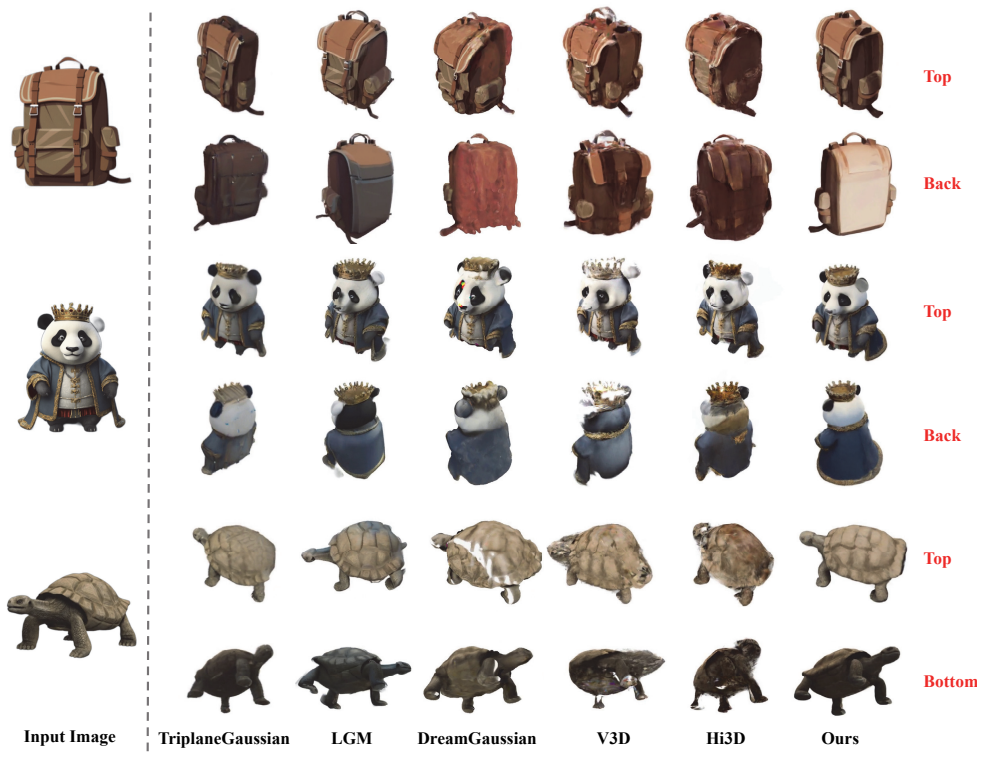
Summary. This paper proposes RIGI, an image-to-3D generation method that combines SV3D-generated multi-view pseudo-labels with 3D Gaussian Splatting optimization. The central idea is to optimize two randomly initialized Gaussian models G1 and G2 simultaneously, define an uncertainty map as the absolute difference between their rendered images from the same viewpoint (Eq. 5), and use this map to reweight the reconstruction loss (Eq. 6), down-weighting supervision in high-uncertainty regions. The full pipeline also includes Perturbed-Attention Guidance, dynamic elevation sampling, progressive sampling, and random background colors. The experimental section reports results on 25 GSO objects with PSNR/SSIM/LPIPS, a user study, and qualitative ablations, and the paper claims that the method reduces artifacts and floats caused by inconsistent pseudo-labels while improving structural and perceptual quality.
Significance. If the central premise is valid, the dual-model disagreement map is a simple and training-stable way to down-weight conflicting pseudo-labels without learning an auxiliary variance head, and it could be integrated into many reconstruction-based image-to-3D pipelines. The paper has several strengths: it evaluates against external GSO ground truth rather than only the pseudo-labels, it includes a user study, and it provides qualitative ablations of the uncertainty weight and of alternative uncertainty designs. However, the current evidence does not yet establish that the uncertainty map localizes label inconsistency rather than generic model variance, and the reported quantitative gains are small and unaccompanied by error bars. The idea is interesting and testable, but the manuscript needs substantially stronger experiments before the central claim is supported.
major comments (4)
- [3.2, Eq. (5)] The central premise that U = |Î1 - Î2| localizes inconsistency in the generated pseudo-labels is not validated. Two randomly initialized 3DGS models optimized on the same frames will also diverge because of sparse-view ambiguity, densification randomness, and optimization instability, so the disagreement map can capture generic epistemic variance rather than label conflict. Furthermore, the second term +λU in Eq. (6) penalizes disagreement between G1 and G2 in every pixel, which suppresses high-U regions even when the pseudo-label is correct; this makes the loss act as a low-pass regularizer. The λ=10 result in Fig. 7 is consistent with this concern, as it produces smoother and blurrier outputs. The authors should provide direct evidence of a correlation between U and actual pseudo-label errors, for example by injecting known inconsistencies into otherwise consistent labels and measuring whether U identifies them, or by comparing U against per-pixel error maps in SV3D frames.
- [3.3, Eqs. (7)-(8)] The reconstruction loss includes an uncertainty-weighted L1 term but also an unweighted LPIPS term, Llpips = LPIPS(Igt, Î1) + LPIPS(Igt, Î2), with weight λ_l = 0.5. Because LPIPS is applied at full strength in all pixels, high-uncertainty regions still receive strong supervision from potentially inconsistent pseudo-labels, which contradicts the stated goal of reducing reconstruction intensity in those regions. The authors should either remove or uncertainty-weight the LPIPS term in an ablation, or explain why LPIPS is exempt from the uncertainty reweighting.
- [4.1, Table 1] The quantitative evidence is too thin to support the headline claim. The evaluation uses only 25 GSO objects, reports no standard deviations or significance tests, and the proposed method does not achieve the best PSNR (Hi3D reaches 17.2559 vs. 16.9646 for RIGI). The reported gains are small: SSIM improves by 0.0129 over Hi3D and LPIPS by 0.0011. With no error bars, 'superior or comparable' is not established. In addition, the pipeline comparison is uncontrolled: the baselines do not share the same SV3D+PAG frame generation, elevation sampling, progressive sampling, or random-background tricks, so any metric difference could come from those components rather than from uncertainty-aware learning. Please report per-object scores, confidence intervals, and a controlled comparison where only Eq. (6) is toggled.
- [4.2, Figures 5-7] The ablations do not isolate the uncertainty term. Figure 5 adds progressive sampling and uncertainty-aware learning simultaneously; Figure 6 compares uncertainty designs only qualitatively; and Figure 7 varies λ without reporting quantitative metrics. A quantitative ablation in the full pipeline, with and without the uncertainty term and with all other components fixed, is necessary to demonstrate that the method detects and rectifies inconsistency rather than merely smoothing the output. Ideally the authors would also report a metric that directly measures label inconsistency or artifacts, such as the number of floaters or edge error.
minor comments (8)
- [3.3] There is a typo in the sentence 'The first term dynamically adjusts the optimation intensity'; 'optimation' should be 'optimization'.
- [3.4] The text says 'we progressively increase the render radio'; this should be 'render ratio' or 'rendering resolution'.
- [3.1 and 3.3] The symbol λ is used for the D-SSIM weight in Section 3.1 (λ=0.2) and for the uncertainty weight in Eq. (6) (λ=5); renaming one of these would avoid notational collision.
- [Table 2] Because each participant selects two outputs, the preference percentages sum to 200%; this should be stated in the caption or table, and confidence intervals should be reported.
- [Figure 7] The caption has a duplicated auxiliary verb: 'may make the generated results may become smoother and blurrier'.
- [Figure 8] The caption contains a spacing error, 'wP A G', which should read 'w/ PAG'.
- [4, Evaluation Metrics vs. User Study] The relationship between the 25 GSO objects used for metric evaluation and the 30 samples used in the user study should be clarified.
- [References] Reference [52] is typeset as 'InECCV' without a space; the formatting should be corrected.
Circularity Check
No significant circularity: the uncertainty map is computed from model outputs, and reported gains are evaluated on external GSO ground truth.
full rationale
The paper's derivation chain does not reduce any prediction to its inputs by construction. The uncertainty map U = |I1 - I2| (Eq. 5) is a rendered-image difference between two concurrently optimized 3DGS models; it is not a fitted parameter that is later renamed as a prediction. The uncertainty-weighted loss (Eq. 6) uses U to reweight the reconstruction error and includes a lambda times U regularizer, so U is coupled to the optimization objective; however, the paper's reported improvements are measured on external GSO ground-truth views with PSNR, SSIM, and LPIPS (Table 1), not on the training loss or on U itself. The claim that U correlates with pseudo-label inconsistency is an empirical hypothesis that the paper does not directly validate, and the lambda equals 5 ablation (Fig. 7) shows the risk of over-smoothing, but that is a correctness and validity concern, not a circular definition. No load-bearing self-citation is present: citations to the authors' prior works (e.g., [65], [72]) appear in related-work context and do not supply a uniqueness theorem or ansatz on which the method's core equation depends. Therefore, under the stated standard of exhibiting an explicit reduction (Eq. X equals Eq. Y by construction, or a fitted parameter renamed as prediction), no significant circularity is found.
Assumptions & free parameters
free parameters (5)
- Uncertainty weight λ =
5
- D-SSIM loss weight λ_s =
0.2
- LPIPS loss weight λ_l =
0.5
- Elevation sampling amplitudes =
0°, -20°, 40°
- Progressive sampling schedule =
render ratio 0.25 to 1.0, frames added at 50% and 80% of iterations
assumptions (4)
- standard math 3D Gaussian Splatting rendering equations (Eqs. 1 and 2) correctly model appearance.
- domain assumption Two Gaussian models initialized differently will diverge in a way that reflects uncertainty in the pseudo-labels.
- domain assumption SV3D-generated multi-view frames serve as reliable pseudo-labels with only localized inconsistencies.
- domain assumption Pixel-wise reweighting by exp(-λU) does not introduce a systematic bias toward over-smooth solutions.
Cite this review
Pith. "Pith review of RIGI: Rectifying Image-to-3D Generation Inconsistency via Uncertainty-aware Learning." pith.science (2026). https://pith.science/paper/AX7LC52U
@misc{pith2026241118866,
  author       = {Pith},
  title        = {Pith review of: RIGI: Rectifying Image-to-3D Generation Inconsistency via Uncertainty-aware Learning},
  year         = {2026},
  howpublished = {\url{https://pith.science/paper/AX7LC52U}},
  note         = {Machine review of arXiv:2411.18866}
}
read the original abstract
Given a single image of a target object, image-to-3D generation aims to reconstruct its texture and geometric shape. Recent methods often utilize intermediate media, such as multi-view images or videos, to bridge the gap between input image and the 3D target, thereby guiding the generation of both shape and texture. However, inconsistencies in the generated multi-view snapshots frequently introduce noise and artifacts along object boundaries, undermining the 3D reconstruction process. To address this challenge, we leverage 3D Gaussian Splatting (3DGS) for 3D reconstruction, and explicitly integrate uncertainty-aware learning into the reconstruction process. By capturing the stochasticity between two Gaussian models, we estimate an uncertainty map, which is subsequently used for uncertainty-aware regularization to rectify the impact of inconsistencies. Specifically, we optimize both Gaussian models simultaneously, calculating the uncertainty map by evaluating the discrepancies between rendered images from identical viewpoints. Based on the uncertainty map, we apply adaptive pixel-wise loss weighting to regularize the models, reducing reconstruction intensity in high-uncertainty regions. This approach dynamically detects and mitigates conflicts in multi-view labels, leading to smoother results and effectively reducing artifacts. Extensive experiments show the effectiveness of our method in improving 3D generation quality by reducing inconsistencies and artifacts.
Figures


Figures from the paper (3 more)


Forward citations
Cited by 1 Pith paper
-
TIGeR: Text-Instructed Generation and Refinement for Template-Free Hand-Object Interaction
TIGeR generates a rough 3D object prior from a text caption and refines it with 2D-3D attention to reconstruct hand-object interactions without pre-defined templates.
Reference graph
Works this paper leans on
-
[1]
Self-rectifying diffusion sampling with perturbed-attention guidance
Donghoon Ahn, Hyoungwon Cho, Jaewon Min, Wooseok Jang, Jungwoo Kim, SeonHwa Kim, Hyun Hee Park, Ky- ong Hwan Jin, and Seungryong Kim. Self-rectifying diffusion sampling with perturbed-attention guidance. arXiv:2403.17377, 2024. 6, 8, 9
arXiv 2024
-
[2]
Stable video diffusion: Scaling latent video diffusion models to large datasets
Andreas Blattmann, Tim Dockhorn, Sumith Kulal, Daniel Mendelevitch, Maciej Kilian, Dominik Lorenz, Yam Levi, Zion English, Vikram V oleti, Adam Letts, et al. Stable video diffusion: Scaling latent video diffusion models to large datasets. arXiv:2311.15127, 2023. 2, 4
arXiv 2023
-
[3]
Align your latents: High-resolution video synthesis with la- tent diffusion models
Andreas Blattmann, Robin Rombach, Huan Ling, Tim Dock- horn, Seung Wook Kim, Sanja Fidler, and Karsten Kreis. Align your latents: High-resolution video synthesis with la- tent diffusion models. In CVPR, 2023. 4
work page 2023
-
[4]
Sf3d: Stable fast 3d mesh reconstruc- tion with uv-unwrapping and illumination disentanglement
Mark Boss, Zixuan Huang, Aaryaman Vasishta, and Varun Jampani. Sf3d: Stable fast 3d mesh reconstruc- tion with uv-unwrapping and illumination disentanglement. arXiv:2408.00653, 2024. 3
arXiv 2024
-
[5]
Composed image retrieval with text feedback via multi-grained uncertainty regularization
Yiyang Chen, Zhedong Zheng, Wei Ji, Leigang Qu, and Tat- Seng Chua. Composed image retrieval with text feedback via multi-grained uncertainty regularization. In ICLR, 2024. 3
work page 2024
-
[6]
V3d: Video diffusion models are effective 3d generators
Zilong Chen, Yikai Wang, Feng Wang, Zhengyi Wang, and Huaping Liu. V3d: Video diffusion models are effective 3d generators. arXiv:2403.06738, 2024. 2, 3, 6, 7
arXiv 2024
-
[7]
Google scanned objects: A high- quality dataset of 3d scanned household items
Laura Downs, Anthony Francis, Nate Koenig, Brandon Kin- man, Ryan Hickman, Krista Reymann, Thomas B McHugh, and Vincent Vanhoucke. Google scanned objects: A high- quality dataset of 3d scanned household items. In ICRA,
-
[8]
Topologically-aware de- formation fields for single-view 3d reconstruction
Shivam Duggal and Deepak Pathak. Topologically-aware de- formation fields for single-view 3d reconstruction. In CVPR,
Show all 74 references
-
[9]
Dropout as a bayesian approximation: Representing model uncertainty in deep learning
Yarin Gal and Zoubin Ghahramani. Dropout as a bayesian approximation: Representing model uncertainty in deep learning. In ICML, 2016. 3
2016
-
[10]
Bayes’ rays: Uncertainty quantifica- tion for neural radiance fields
Lily Goli, Cody Reading, Silvia Sell ´an, Alec Jacobson, and Andrea Tagliasacchi. Bayes’ rays: Uncertainty quantifica- tion for neural radiance fields. In CVPR, 2024. 3
2024
-
[11]
3dgen: Triplane latent diffusion for textured mesh generation
Anchit Gupta, Wenhan Xiong, Yixin Nie, Ian Jones, and Bar- las O˘guz. 3dgen: Triplane latent diffusion for textured mesh generation. arXiv:2303.05371, 2023. 2
2023 arXiv
-
[12]
Denoising diffu- sion probabilistic models
Jonathan Ho, Ajay Jain, and Pieter Abbeel. Denoising diffu- sion probabilistic models. In NeurIPS, 2020. 4
2020
-
[13]
LRM: large reconstruction model for single image to 3d
Yicong Hong, Kai Zhang, Jiuxiang Gu, Sai Bi, Yang Zhou, Difan Liu, Feng Liu, Kalyan Sunkavalli, Trung Bui, and Hao Tan. LRM: large reconstruction model for single image to 3d. In ICLR, 2024. 3
2024
-
[14]
Fisherrf: Active view selection and uncertainty quantification for ra- diance fields using fisher information
Wen Jiang, Boshu Lei, and Kostas Daniilidis. Fisherrf: Active view selection and uncertainty quantification for ra- diance fields using fisher information. arXiv:2311.17874,
-
[15]
Neu-nbv: Next best view planning using uncer- tainty estimation in image-based neural rendering
Liren Jin, Xieyuanli Chen, Julius R ¨uckin, and Marija Popovi´c. Neu-nbv: Next best view planning using uncer- tainty estimation in image-based neural rendering. In IROS,
-
[16]
Shap-e: Generating condi- tional 3d implicit functions
Heewoo Jun and Alex Nichol. Shap-e: Generating condi- tional 3d implicit functions. arXiv:2305.02463, 2023. 2
2023 arXiv
-
[17]
Elucidating the design space of diffusion-based generative models
Tero Karras, Miika Aittala, Timo Aila, and Samuli Laine. Elucidating the design space of diffusion-based generative models. In NeurIPS, 2022. 4
2022
-
[18]
What uncertainties do we need in bayesian deep learning for computer vision? In NeurIPS,
Alex Kendall and Yarin Gal. What uncertainties do we need in bayesian deep learning for computer vision? In NeurIPS,
-
[19]
3d gaussian splatting for real-time radiance field rendering
Bernhard Kerbl, Georgios Kopanas, Thomas Leimk ¨uhler, and George Drettakis. 3d gaussian splatting for real-time radiance field rendering. ACM Trans. Graph., 2023. 2, 3, 6, 8
2023
-
[20]
Vari- ational dropout and the local reparameterization trick
Durk P Kingma, Tim Salimans, and Max Welling. Vari- ational dropout and the local reparameterization trick. In NeurIPS, 2015. 3
2015
-
[21]
Sources of uncertainty in 3d scene reconstruction
Marcus Klasson, Riccardo Mereu, Juho Kannala, and Arno Solin. Sources of uncertainty in 3d scene reconstruction. arXiv:2409.06407, 2024. 3
2024 arXiv
-
[22]
Gradients as a measure of uncertainty in neural networks
Jinsol Lee and Ghassan AlRegib. Gradients as a measure of uncertainty in neural networks. In ICIP, 2020. 3
2020
-
[23]
Frequency-based view selection in gaussian splatting recon- struction
Monica MQ Li, Pierre-Yves Lajoie, and Giovanni Beltrame. Frequency-based view selection in gaussian splatting recon- struction. arXiv:2409.16470, 2024. 3
2024 arXiv
-
[24]
Era3d: High-resolution multiview diffusion using efficient row-wise attention
Peng Li, Yuan Liu, Xiaoxiao Long, Feihu Zhang, Cheng Lin, Mengfei Li, Xingqun Qi, Shanghang Zhang, Wenhan Luo, Ping Tan, et al. Era3d: High-resolution multiview diffusion using efficient row-wise attention. arXiv:2405.11616, 2024. 2, 3
2024 arXiv
-
[25]
Guid- ing pseudo-labels with uncertainty estimation for source-free unsupervised domain adaptation
Mattia Litrico, Alessio Del Bue, and Pietro Morerio. Guid- ing pseudo-labels with uncertainty estimation for source-free unsupervised domain adaptation. In CVPR, 2023. 3
2023
-
[26]
One-2-3-45: Any single image to 3d mesh in 45 seconds without per-shape optimiza- tion
Minghua Liu, Chao Xu, Haian Jin, Linghao Chen, Mukund Varma T, Zexiang Xu, and Hao Su. One-2-3-45: Any single image to 3d mesh in 45 seconds without per-shape optimiza- tion. In NeurIPS, 2024. 2
2024
-
[27]
Zero-1-to-3: Zero-shot one image to 3d object
Ruoshi Liu, Rundi Wu, Basile Van Hoorick, Pavel Tok- makov, Sergey Zakharov, and Carl V ondrick. Zero-1-to-3: Zero-shot one image to 3d object. In ICCV, 2023. 2, 6
2023
-
[28]
Syncdreamer: Gen- erating multiview-consistent images from a single-view im- age
Yuan Liu, Cheng Lin, Zijiao Zeng, Xiaoxiao Long, Lingjie Liu, Taku Komura, and Wenping Wang. Syncdreamer: Gen- erating multiview-consistent images from a single-view im- age. In ICLR, 2024. 2, 3
2024
-
[29]
Nerf in the wild: Neural radiance fields for uncon- strained photo collections
Ricardo Martin-Brualla, Noha Radwan, Mehdi SM Sajjadi, Jonathan T Barron, Alexey Dosovitskiy, and Daniel Duck- worth. Nerf in the wild: Neural radiance fields for uncon- strained photo collections. In CVPR, 2021. 3
2021
-
[30]
IM-3D: iterative multiview diffusion and reconstruction for high-quality 3d generation
Luke Melas-Kyriazi, Iro Laina, Christian Rupprecht, Natalia Neverova, Andrea Vedaldi, Oran Gafni, and Filippos Kokki- nos. IM-3D: iterative multiview diffusion and reconstruction for high-quality 3d generation. In ICML, 2024. 2, 3
2024
-
[31]
Occupancy networks: Learning 3d reconstruction in function space
Lars Mescheder, Michael Oechsle, Michael Niemeyer, Se- bastian Nowozin, and Andreas Geiger. Occupancy networks: Learning 3d reconstruction in function space. In CVPR,
-
[32]
Towards maxi- mizing the representation gap between in-domain & out-of- distribution examples
Jay Nandy, Wynne Hsu, and Mong Li Lee. Towards maxi- mizing the representation gap between in-domain & out-of- distribution examples. In NeurIPS, 2020. 3
2020
-
[33]
Bayesian learning for neural networks
Radford M Neal. Bayesian learning for neural networks . Springer Science & Business Media, 2012. 3
2012
-
[34]
Point-e: A system for generating 3d point clouds from complex prompts
Alex Nichol, Heewoo Jun, Prafulla Dhariwal, Pamela Mishkin, and Mark Chen. Point-e: A system for generating 3d point clouds from complex prompts. arXiv:2212.08751,
-
[35]
Ac- tivenerf: Learning where to see with uncertainty estimation
Xuran Pan, Zihang Lai, Shiji Song, and Gao Huang. Ac- tivenerf: Learning where to see with uncertainty estimation. In ECCV, 2022. 3
2022
-
[36]
Bayesian networks and decision graphs
Simon Parsons. Bayesian networks and decision graphs. Springer, 23(4), 2008. 3
2008
-
[37]
Barron, and Ben Milden- hall
Ben Poole, Ajay Jain, Jonathan T. Barron, and Ben Milden- hall. Dreamfusion: Text-to-3d using 2d diffusion. In ICLR,
-
[38]
Magic123: One image to high-quality 3d object generation using both 2d and 3d diffusion priors
Guocheng Qian, Jinjie Mai, Abdullah Hamdi, Jian Ren, Aliaksandr Siarohin, Bing Li, Hsin-Ying Lee, Ivan Sko- rokhodov, Peter Wonka, Sergey Tulyakov, and Bernard Ghanem. Magic123: One image to high-quality 3d object generation using both 2d and 3d diffusion priors. In ICLR,
-
[39]
Direct uncertainty prediction for medical second opinions
Maithra Raghu, Katy Blumer, Rory Sayres, Ziad Obermeyer, Bobby Kleinberg, Sendhil Mullainathan, and Jon Kleinberg. Direct uncertainty prediction for medical second opinions. In ICML, 2019. 3
2019
-
[40]
High-resolution image syn- thesis with latent diffusion models
Robin Rombach, Andreas Blattmann, Dominik Lorenz, Patrick Esser, and Bj¨orn Ommer. High-resolution image syn- thesis with latent diffusion models. In CVPR, 2022. 2, 4
2022
-
[41]
Robustnerf: Ignor- ing distractors with robust losses
Sara Sabour, Suhani V ora, Daniel Duckworth, Ivan Krasin, David J Fleet, and Andrea Tagliasacchi. Robustnerf: Ignor- ing distractors with robust losses. In CVPR, 2023. 3
2023
-
[42]
Photorealistic text-to-image diffusion models with deep language understanding
Chitwan Saharia, William Chan, Saurabh Saxena, Lala Li, Jay Whang, Emily L Denton, Kamyar Ghasemipour, Raphael Gontijo Lopes, Burcu Karagol Ayan, Tim Salimans, et al. Photorealistic text-to-image diffusion models with deep language understanding. In NeurIPS, 2022. 2
2022
-
[43]
Modeling uncertainty for gaussian splatting
Luca Savant, Diego Valsesia, and Enrico Magli. Modeling uncertainty for gaussian splatting. arXiv:2403.18476, 2024. 3
2024 arXiv
-
[44]
Stochastic neural radiance fields: Quantify- ing uncertainty in implicit 3d representations
Jianxiong Shen, Adria Ruiz, Antonio Agudo, and Francesc Moreno-Noguer. Stochastic neural radiance fields: Quantify- ing uncertainty in implicit 3d representations. In 3DV, 2021. 3
2021
-
[45]
Conditional-flow nerf: Accurate 3d mod- elling with reliable uncertainty quantification
Jianxiong Shen, Antonio Agudo, Francesc Moreno-Noguer, and Adria Ruiz. Conditional-flow nerf: Accurate 3d mod- elling with reliable uncertainty quantification. In ECCV,
-
[46]
Zero123++: a single image to consistent multi-view dif- fusion base model
Ruoxi Shi, Hansheng Chen, Zhuoyang Zhang, Minghua Liu, Chao Xu, Xinyue Wei, Linghao Chen, Chong Zeng, and Hao Su. Zero123++: a single image to consistent multi-view dif- fusion base model. arXiv:2310.15110, 2023. 2, 3
2023 arXiv
-
[47]
Mvdream: Multi-view diffusion for 3d gen- eration
Yichun Shi, Peng Wang, Jianglong Ye, Long Mai, Kejie Li, and Xiao Yang. Mvdream: Multi-view diffusion for 3d gen- eration. In ICLR, 2024. 2, 3
2024
-
[48]
Denois- ing diffusion implicit models
Jiaming Song, Chenlin Meng, and Stefano Ermon. Denois- ing diffusion implicit models. In ICLR, 2021. 4
2021
-
[49]
Next best sense: 10 Guiding vision and touch with fisherrf for 3d gaussian splat- ting
Matthew Strong, Boshu Lei, Aiden Swann, Wen Jiang, Kostas Daniilidis, and Monroe Kennedy III. Next best sense: 10 Guiding vision and touch with fisherrf for 3d gaussian splat- ting. arXiv:2410.04680, 2024. 3
2024 arXiv
-
[50]
Uncertainty-guided optimal transport in depth supervised sparse-view 3d gaussian
Wei Sun, Qi Zhang, Yanzhao Zhou, Qixiang Ye, Jianbin Jiao, and Yuan Li. Uncertainty-guided optimal transport in depth supervised sparse-view 3d gaussian. arXiv:2405.19657,
-
[51]
Dreamgaussian: Generative gaussian splatting for ef- ficient 3d content creation
Jiaxiang Tang, Jiawei Ren, Hang Zhou, Ziwei Liu, and Gang Zeng. Dreamgaussian: Generative gaussian splatting for ef- ficient 3d content creation. In ICLR, 2024. 6, 7
2024
-
[52]
Lgm: Large multi-view gaus- sian model for high-resolution 3d content creation
Jiaxiang Tang, Zhaoxi Chen, Xiaokang Chen, Tengfei Wang, Gang Zeng, and Ziwei Liu. Lgm: Large multi-view gaus- sian model for high-resolution 3d content creation. InECCV,
-
[53]
Tri- posr: Fast 3d object reconstruction from a single image
Dmitry Tochilkin, David Pankratz, Zexiang Liu, Zixuan Huang, Adam Letts, Yangguang Li, Ding Liang, Chris- tian Laforte, Varun Jampani, and Yan-Pei Cao. Tri- posr: Fast 3d object reconstruction from a single image. arXiv:2403.02151, 2024. 3
2024 arXiv
-
[54]
Grf: Learning a general ra- diance field for 3d representation and rendering
Alex Trevithick and Bo Yang. Grf: Learning a general ra- diance field for 3d representation and rendering. In ICCV,
-
[55]
Sv3d: Novel multi-view syn- thesis and 3d generation from a single image using latent video diffusion
Vikram V oleti, Chun-Han Yao, Mark Boss, Adam Letts, David Pankratz, Dmitry Tochilkin, Christian Laforte, Robin Rombach, and Varun Jampani. Sv3d: Novel multi-view syn- thesis and 3d generation from a single image using latent video diffusion. In ECCV, 2025. 2, 3, 4, 6, 9
2025
-
[56]
Pixel2mesh: Generating 3d mesh models from single rgb images
Nanyang Wang, Yinda Zhang, Zhuwen Li, Yanwei Fu, Wei Liu, and Yu-Gang Jiang. Pixel2mesh: Generating 3d mesh models from single rgb images. In ECCV, 2018. 2
2018
-
[57]
Imagedream: Image-prompt multi-view diffusion for 3d generation
Peng Wang and Yichun Shi. Imagedream: Image-prompt multi-view diffusion for 3d generation. arXiv:2312.02201,
-
[58]
Rodin: A generative model for sculpting 3d digital avatars using diffusion
Tengfei Wang, Bo Zhang, Ting Zhang, Shuyang Gu, Jianmin Bao, Tadas Baltrusaitis, Jingjing Shen, Dong Chen, Fang Wen, Qifeng Chen, et al. Rodin: A generative model for sculpting 3d digital avatars using diffusion. In CVPR, 2023. 2
2023
-
[59]
Image quality assessment: from error visibility to structural similarity
Zhou Wang, Alan C Bovik, Hamid R Sheikh, and Eero P Si- moncelli. Image quality assessment: from error visibility to structural similarity. IEEE Transactions on Image Process- ing, 2004. 5
2004
-
[60]
Harmonyview: Harmonizing consis- tency and diversity in one-image-to-3d
Sangmin Woo, Byeongjun Park, Hyojun Go, Jin-Young Kim, and Changick Kim. Harmonyview: Harmonizing consis- tency and diversity in one-image-to-3d. In CVPR, 2024. 2, 3
2024
-
[61]
Direct3d: Scalable image-to-3d generation via 3d latent diffusion transformer
Shuang Wu, Youtian Lin, Feihu Zhang, Yifei Zeng, Jingxi Xu, Philip Torr, Xun Cao, and Yao Yao. Direct3d: Scalable image-to-3d generation via 3d latent diffusion transformer. arXiv:2405.14832, 2024. 2
2024 arXiv
-
[62]
Active implicit object reconstruction us- ing uncertainty-guided next-best-view optimization
Dongyu Yan, Jianheng Liu, Fengyu Quan, Haoyao Chen, and Mengmeng Fu. Active implicit object reconstruction us- ing uncertainty-guided next-best-view optimization. IEEE Robotics and Automation Letters, 2023. 3
2023
-
[63]
Hi3d: Pursuing high- resolution image-to-3d generation with video diffusion mod- els
Haibo Yang, Yang Chen, Yingwei Pan, Ting Yao, Zhineng Chen, Chong-Wah Ngo, and Tao Mei. Hi3d: Pursuing high- resolution image-to-3d generation with video diffusion mod- els. In ACM MM, 2024. 2, 3, 6, 7
2024
-
[64]
Fourier123: One image to high- quality 3d object generation with hybrid fourier score dis- tillation
Shuzhou Yang, Yu Wang, Haijie Li, Jiarui Meng, Xiandong Meng, and Jian Zhang. Fourier123: One image to high- quality 3d object generation with hybrid fourier score dis- tillation. arXiv:2405.20669, 2024. 2
2024 arXiv
-
[65]
Progressive text-to-3d generation for automatic 3d prototyp- ing
Han Yi, Zhedong Zheng, Xiangyu Xu, and Tat-seng Chua. Progressive text-to-3d generation for automatic 3d prototyp- ing. arXiv:2309.14600, 2023. 3
2023 arXiv
-
[66]
Robust person re-identification by modelling feature uncertainty
Tianyuan Yu, Da Li, Yongxin Yang, Timothy M Hospedales, and Tao Xiang. Robust person re-identification by modelling feature uncertainty. In ICCV, 2019. 3
2019
-
[67]
Activermap: Radiance field for active mapping and planning
Huangying Zhan, Jiyang Zheng, Yi Xu, Ian Reid, and Hamid Rezatofighi. Activermap: Radiance field for active mapping and planning. arXiv:2211.12656, 2022. 3
2022 arXiv
-
[68]
The unreasonable effectiveness of deep features as a perceptual metric
Richard Zhang, Phillip Isola, Alexei A Efros, Eli Shechtman, and Oliver Wang. The unreasonable effectiveness of deep features as a perceptual metric. In CVPR, 2018. 5
2018
-
[69]
Harnessing uncertainty-aware bounding boxes for unsuper- vised 3d object detection
Ruiyang Zhang, Hu Zhang, Hang Yu, and Zhedong Zheng. Harnessing uncertainty-aware bounding boxes for unsuper- vised 3d object detection. arXiv:2408.00619, 2024. 3
2024 arXiv
-
[70]
Drone-assisted road gaussian splatting with cross- view uncertainty
Saining Zhang, Baijun Ye, Xiaoxue Chen, Yuantao Chen, Zongzheng Zhang, Cheng Peng, Yongliang Shi, and Hao Zhao. Drone-assisted road gaussian splatting with cross- view uncertainty. arXiv:2408.15242, 2024. 3
2024 arXiv
-
[71]
Multi-view consistent generative adversarial networks for compositional 3d-aware image synthesis
Xuanmeng Zhang, Zhedong Zheng, Daiheng Gao, Bang Zhang, Yi Yang, and Tat-Seng Chua. Multi-view consistent generative adversarial networks for compositional 3d-aware image synthesis. International Journal of Computer Vision, 131(8), 2023. 2
2023
-
[72]
Rectifying pseudo label learn- ing via uncertainty estimation for domain adaptive seman- tic segmentation
Zhedong Zheng and Yi Yang. Rectifying pseudo label learn- ing via uncertainty estimation for domain adaptive seman- tic segmentation. International Journal of Computer Vision,
-
[73]
Triplane meets gaussian splatting: Fast and generalizable single-view 3d reconstruction with transformers
Zi-Xin Zou, Zhipeng Yu, Yuan-Chen Guo, Yangguang Li, Ding Liang, Yan-Pei Cao, and Song-Hai Zhang. Triplane meets gaussian splatting: Fast and generalizable single-view 3d reconstruction with transformers. In CVPR, 2024. 6, 7
2024
-
[74]
Videomv: Consistent multi- view generation based on large video generative model
Qi Zuo, Xiaodong Gu, Lingteng Qiu, Yuan Dong, Zhengyi Zhao, Weihao Yuan, Rui Peng, Siyu Zhu, Zilong Dong, Liefeng Bo, et al. Videomv: Consistent multi- view generation based on large video generative model. arXiv:2403.12010, 2024. 2, 3 11
2024 arXiv
Reviewed August 12, 2026 · model on record in the stance chip above.
Discussion (0). Continue with ORCID to comment.