REVIEW 2 major objections 5 minor 46 references
Near-Field Wideband Beamforming for RIS Based on Fresnel Zone
T0 review · 2 major / 5 minor · reviewed 2026-08-12 · deepseek-v4-flash
Pith's one-line read The paper claims that grouping RIS elements by Fresnel zone turns the wideband channel into a Fourier transform of zone intensity, allowing phase-only beamforming to approach the rate upper bound despite near-field beam split.
desk verdict Fresnel-zone coordinate trick is a genuinely new angle on near-field RIS beamforming, but the paper's advertised rate upper bound has two concrete derivation errors and needs referee attention. read the letter →
The pith
A machine-rendered reading of the paper's core claim, the machinery that carries it, and where it could break.
The reading
What carries the argument
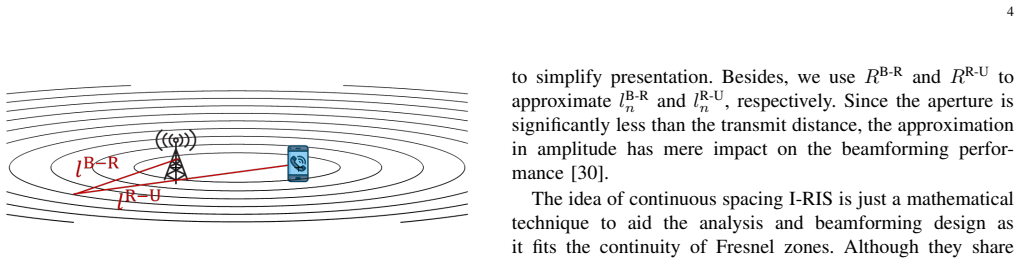
The central object is the Fresnel-zone coordinate system for the RIS plane. Fresnel zones are a family of concentric ellipsoids whose foci are the BS and the UE; their intersections with the RIS plane are nested ellipses indexed by the semi-major axis $a$, which is half the reflection route length. Transforming the RIS plane from $(x,y)$ to $(a,\theta)$ makes the phase of the cascaded channel linear in $a$, and locking the phase on each zone $\phi(a,\theta)=\psi(a)$ removes frequency dependence along the zone. The surviving quantity is the reflective intensity $v(a)=\int g_0 J(a,\theta)\,d\theta$, and the substitution $t=2a/c$ turns the channel into the Fourier transform $g(f)=\int v_t(t)e^{j\psi_t(t)}e^{-j2\pi f t}\,dt$. That Fourier identity, together with Parseval's theorem and the stationary-phase / Gerchberg-Saxton spectrum-shaping tools, carries the entire argument.
What would settle it
Run the exact channel integral in Eq. (6) without dropping the frequency dependence of $g_0(f)\propto 1/f^2$, and check whether $\int |g(f)|^2\,df$ still equals $E_g=\int v_t^2(t)\,dt$ and whether the designed flat gain profile survives; if the mismatch grows with fractional bandwidth or with RIS aperture, the Fourier identity and the bound in Eq. (25) are only approximations rather than exact consequences.
Extended reading notes
Core claim
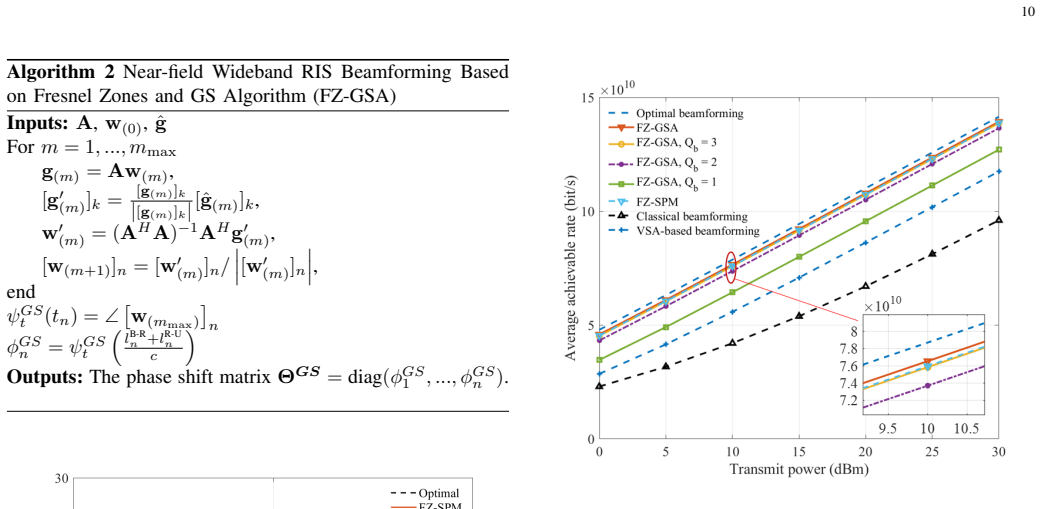
The paper establishes, under its amplitude-approximation model, that the equivalent wideband channel is $g(f)=\int v_t(t)e^{j\psi_t(t)}e^{-j2\pi f t}\,dt$, the Fourier transform of the Fresnel-zone reflective intensity $v_t(t)$ multiplied by the designed phase modulation $e^{j\psi_t(t)}$. It follows from Parseval's theorem that $\int |g(f)|^2 df = E_g = \int v_t^2(t)\,dt$ is fixed for every phase configuration, so the achievable rate is bounded by $\log_2\left(1+\frac{S_x}{S_\sigma}E_g\right)$, with equality approached only by an ideal gain that is flat across the band and zero outside it. The paper then treats the phase design as a one-dimensional spectrum-shaping problem: the stationary-phase method gives a nearly closed-form phase profile $\psi(a)$ across Fresnel zones, and the Gerchberg-Saxton algorithm iterates between the zone domain and frequency domain to flatten the gain. Simulations show the proposed methods keep gain approximately flat over the band, reduce out-of-band leakage, and achieve rates within a few percent of the upper bound while outperforming narrowband and virtual-subarray baselines.
Load-bearing premise
The Fourier-transform picture and the Parseval-based rate bound require the reflective intensity of each Fresnel zone to be independent of frequency, although the path-loss amplitude in the model carries an explicit $1/f^2$ factor and the paper only justifies amplitude approximations in space, not in frequency.
Editorial extensions
If this is right
- Near-field beam split can be mitigated with phase-only RIS control; no true-time-delay or delay-adjustable metasurface hardware is needed, avoiding the insertion loss and cost of TTD modules.
- For any phase-only design, total gain energy over all frequencies is fixed at $E_g=\int v_t^2(t)\,dt$; the rate bound $\log_2(1+S_xE_g/S_\sigma)$ is therefore a fundamental limit of phase-shift-based wideband RIS, tighter than bounds that assume TTD hardware.
- Under narrowband beamforming, the 3 dB bandwidth shrinks roughly as $B_{3\mathrm{dB}}\approx c\Gamma_0/(\iota D_0)$, so larger apertures and BS/UE directions pointing similarly make beam split worse; the zone-based designs restore flat gain across the designed band.
- Achievable rate grows with RIS size and bandwidth under the proposed designs, while narrowband beamforming plateaus; 2-bit phase quantization is enough to nearly match continuous-phase performance.
- The same Fresnel-zone construction works in far-field scenarios, since far-field is a special case of the near-field model used here.
Reading between the lines
- The Fourier-transformed channel makes the RIS phase design mathematically identical to radar waveform design; techniques from pulse compression and spectral shaping could be imported directly, and the one-dimensional zone-domain formulation suggests delay-domain optimization as a scalable route for extremely large surfaces.
- The Parseval bound implies a phase-only RIS cannot create more in-band energy than the fixed intensity supports; any attempt to boost edge-subcarrier gain must steal out-of-band energy, so flat in-band gain is the best achievable spectrum shape.
- If the reflective intensity $v_t(t)$ is measurably frequency-dependent through the $1/f^2$ path-loss factor at very wide fractional bandwidths, the exact Fourier identity would fail; the phase designs would need an iterative frequency-domain correction, with the stationary-phase profile as initialization.
- The zone grouping principle might extend to multi-user or cell-free settings by treating each user's Fresnel-zone intensity as a separate waveform constraint, and to holographic or continuous-aperture metasurfaces where the per-zone phase profile is sampled directly.
Editorial analysis
A structured set of objections, weighed in public.
Referee Report
Summary. The paper addresses near-field wideband beam splitting in RIS-aided links. It models the RIS as a continuous I-RIS, introduces a Fresnel-zone coordinate system in which a constant route length per zone makes the phase response frequency-independent along the zone, and reduces the equivalent channel to a one-dimensional Fourier transform of a phase-modulated Fresnel-zone intensity. On this basis it derives a sinc approximation and 3-dB bandwidth for narrowband beamforming, proposes an upper bound on achievable rate using Parseval's theorem, and constructs phase profiles via stationary-phase and Gerchberg-Saxton designs. Simulations with a 1 m aperture at 30 GHz and 1.5 GHz bandwidth show flatter in-band gain and higher average rate than narrowband and subarray baselines.
Significance. The conceptual contribution is valuable: the Fresnel-zone decomposition gives a clean structural explanation of near-field beam split and yields phase-only designs that avoid true-time-delay hardware. The derivations are self-contained, the sinc approximation is compared with simulation rather than fitted, and the SP and GS implementations are described with complexity estimates. If the proof issues below are corrected, the paper would be a useful contribution to wideband RIS beamforming. In its current form, however, the two central theoretical claims -- the exact Fourier-transform representation and the Jensen/Parseval upper bound -- are not established as stated.
major comments (2)
- [III-C, Eqs. (6), (15), (17)] Equation (17) is presented as an exact Fourier transform of a fixed Fresnel-zone intensity vt(t), but this ignores the explicit frequency dependence in Eq. (6): g0 = sqrt(N_BS)c^2/(4π^2 f^2 R_BR R_RU d^2). Since v(a) in Eq. (15) is defined as the integral of g0 J(a,θ), v(a) and hence vt(t) depend on f. The sentence after Eq. (14) that 'the inner integral along the Fresnel zone in (13) is frequency independent' is therefore inconsistent with the paper's own definitions. As a result, the Parseval step (c) in Eq. (25) does not follow: ∫|g(f)|^2 df = ∫ v_t^2(t) dt requires g(f) to be the Fourier transform of a frequency-independent vt(t)e^{jψt(t)}. The authors should state explicitly that g0 is replaced by its value at a reference frequency and bound the error, or repeat the derivation with a frequency-weighted Parseval identity.
- [V, Eq. (25), inequality (a)] The Jensen step in Eq. (25)(a) is dimensionally inconsistent. For the integral in Eq. (24), concavity of log2 gives ∫ log2(1+x(f)) df ≤ B log2(1 + (1/B)∫ x(f) df), not log2(1+∫ x(f) df). The displayed bound omits the bandwidth B and the 1/B normalization, so the claimed upper bound log2(1 + (Sx/Sσ)Eg) is not a consequence of Jensen's inequality and is not an upper bound in general. As a concrete check, for B=10 and flat |g(f)|^2 with x(f)=Sx|g(f)|^2/Sσ=10, the left side of (24) is 10log2(11)≈34.6 normalized units, while the claimed bound is log2(101)≈6.7. With exact Parseval, the correct bound would be B log2(1 + (Sx Eg)/(B Sσ)). This correction affects the theoretical claim in Section V and the rate comparison in Section VII, although the ideal-gain magnitude in Eq. (26) remains correct for a flat in-band gain.
minor comments (5)
- [IV, after Eq. (23)] The constant Γ0 is given as 0.886 in Eq. (21) but as 0.866 in the verification text; make the two values consistent.
- [VII-B] The text contains the typo 'Frsenel zone-based'; it should read 'Fresnel zone-based'.
- [Algorithm 2, Eqs. (35)-(38)] The least-squares update requires (A^H A)^{-1}, but no condition is given on K' relative to N_S; if K' < N_S then A^H A is singular, and otherwise it may be ill-conditioned. Please specify that K' ≥ N_S and, if needed, use a regularized pseudo-inverse.
- [III-A, Eq. (6)] The paper should state separately that the replacement of the per-element distances by R_BR and R_RU in the amplitude is a spatial approximation and that, for the Fourier representation in (17), g0 is additionally treated as frequency-independent; these are two different approximations and only the first is indicated in Section III-A.
- [III-C and IV] The symbol V is used for the angular set V(a) in Eq. (15) and for the Fourier transform V(f) in Eq. (18); please rename one of them to avoid ambiguity.
Circularity Check
No significant circularity: the Fresnel-zone Fourier representation and the Parseval-based rate bound are derived from the paper's own channel model and coordinate transformation, not from fitted values or self-citations.
full rationale
The paper's central claims—the Fresnel-zone coordinate transformation, the one-dimensional Fourier representation g(f)=∫ vt(t)e^{jψt(t)}e^{-j2πft}dt in Eq. (17), and the Parseval-based rate bound in Eq. (25)—are derived within the paper from the channel model in Section II and the Jacobian computation in Section III-C. The reflective intensity v(a) is defined by Eq. (15) as an integral of g0J(a,θ), not as a fitted parameter, and the subsequent phase designs are constructed by the stationary-phase formula Eq. (33) or by the GS algorithm and then compared with simulation, rather than being fit to the claimed bound. The self-citations (e.g., [16], [30], [39]) support background channel-model, amplitude-approximation, and channel-estimation assumptions; they are not invoked as a uniqueness theorem or as the source of the derived bound. The skeptical observation that g0 contains a 1/f² factor, so that v(a) technically depends on frequency, identifies a possible approximation gap in Eq. (17), but this is a mathematical correctness concern, not circularity: the paper does not define the Fourier representation in terms of the rate bound it is used to prove, and the bound is not an input to the derivation. Likewise, the missing 1/B normalization in the Jensen step of Eq. (25) would affect the validity of the bound but does not make the derivation reduce to its own inputs. Therefore no step in the claimed derivation chain is equivalent by construction to its inputs, and the paper is self-contained against external benchmarks.
Assumptions & free parameters
free parameters (1)
- Extended bandwidth B' in the Gerchberg-Saxton algorithm =
not specified (chosen > B)
assumptions (8)
- standard math Parseval's theorem applies to the pair vt(t)ejψt(t) and g(f).
- standard math Jensen's inequality is applied to log2(1+x) over the frequency band.
- domain assumption Stationary phase approximation is valid for the designed phase.
- ad hoc to paper The continuous I-RIS approximates the discrete RIS accurately via spatial Nyquist sampling.
- ad hoc to paper The cascaded channel amplitude (including g0) is independent of frequency.
- domain assumption The BS-UE link is blocked and only LOS BS-RIS and RIS-UE paths matter.
- domain assumption RIS reflection coefficients are unit-modulus.
- standard math The sinc 3dB constant Γ0=0.886 characterizes the gain bandwidth.
invented entities (1)
-
Imaginary continuous RIS (I-RIS)
Cite this review
Pith. "Pith review of Near-Field Wideband Beamforming for RIS Based on Fresnel Zone." pith.science (2026). https://pith.science/paper/WQ4HP76V
@misc{pith2026241118878,
  author       = {Pith},
  title        = {Pith review of: Near-Field Wideband Beamforming for RIS Based on Fresnel Zone},
  year         = {2026},
  howpublished = {\url{https://pith.science/paper/WQ4HP76V}},
  note         = {Machine review of arXiv:2411.18878}
}
read the original abstract
Reconfigurable intelligent surface (RIS) has emerged as a promising solution to overcome the challenges of high path loss and easy signal blockage in millimeter-wave (mmWave) and terahertz (THz) communication systems. With the increase of RIS aperture and system bandwidth, the near-field beam split effect emerges, which causes beams at different frequencies to focus on distinct physical locations, leading to a significant gain loss of beamforming. To address this problem, we leverage the property of Fresnel zone that the beam split disappears for RIS elements along a single Fresnel zone and propose beamforming design on the two dimensions of along and across the Fresnel zones. The phase shift of RIS elements along the same Fresnel zone are designed aligned, so that the signal reflected by these element can add up in-phase at the receiver regardless of the frequency. Then the expression of equivalent channel is simplified to the Fourier transform of reflective intensity across Fresnel zones modulated by the designed phase. Based on this relationship, we prove that the uniformly distributed in-band gain with aligned phase along the Fresnel zone leads to the upper bound of achievable rate. Finally, we design phase shifts of RIS to approach this upper bound by adopting the stationary phase method as well as the Gerchberg-Saxton (GS) algorithm. Simulation results validate the effectiveness of our proposed Fresnel zone-based method in mitigating the near-field beam split effect.
Figures


Figures from the paper (6 more)




Reference graph
Works this paper leans on
-
[1]
Terahertz wireless communications for 2030 and beyond: A cutting-edge frontier,
Z. Chen, C. Han, Y . Wu, L. Li, C. Huang, Z. Zhang, G. Wang, and W. Tong, “Terahertz wireless communications for 2030 and beyond: A cutting-edge frontier,” IEEE Commun. Mag., vol. 59, no. 11, pp. 66–72, Nov. 2021
2021
-
[2]
Millimeter wave communications for future mobile networks,
M. Xiao, S. Mumtaz, Y . Huang, L. Dai, Y . Li, M. Matthaiou, G. K. Karagiannidis, E. Bj¨ornson, K. Yang, C.-L. I, and A. Ghosh, “Millimeter wave communications for future mobile networks,” IEEE J. Sel. Areas Commun., vol. 35, no. 9, pp. 1909–1935, Sep. 2017
work page 1909
-
[3]
T. S. Rappaport, Y . Xing, O. Kanhere, S. Ju, A. Madanayake, S. Mandal, A. Alkhateeb, and G. C. Trichopoulos, “Wireless communications and applications above 100 GHz: Opportunities and challenges for 6G and beyond,” IEEE Access, vol. 7, pp. 78 729–78 757, Jul. 2019
work page 2019
-
[4]
X. He, X. Huang, and L. Li, “Modeling blockages and link dependency in millimeter wave communication networks using Mat ´ern Hard-Core Point Process,” Phys. Commun., vol. 60, p. 102131, Oct. 2023
work page 2023
-
[5]
Blockage-Aware Robust Beamforming in RIS-Aided Mobile Millimeter Wave MIMO Systems
Y . Yang, S. Dang, M. Wen, B. Ai, and R. Q. Hu, “Blockage-aware robust beamforming in ris-aided mobile millimeter wave MIMO systems,” arXiv preprint arXiv:2403.01249 , Mar. 2024
work page Pith review arXiv 2024
-
[6]
Reconfigurable intelligent surfaces for 6G: Nine fundamental issues and one critical problem,
Z. Zhang and L. Dai, “Reconfigurable intelligent surfaces for 6G: Nine fundamental issues and one critical problem,” Tsinghua Sci. and Technol., vol. 28, no. 5, pp. 929–939, Oct. 2023
work page 2023
-
[7]
T. S. Rappaport, G. R. MacCartney, M. K. Samimi, and S. Sun, “Wide- band millimeter-wave propagation measurements and channel models for future wireless communication system design,” IEEE Trans. Commun. , vol. 63, no. 9, pp. 3029–3056, Sep. 2015
work page 2015
-
[8]
Combating the distance problem in the millimeter wave and terahertz frequency bands,
I. F. Akyildiz, C. Han, and S. Nie, “Combating the distance problem in the millimeter wave and terahertz frequency bands,” IEEE Commun. Mag., vol. 56, no. 6, pp. 102–108, Jun. 2018
2018
Show all 46 references
-
[9]
Modular extremely large-scale array communication: Near-field modelling and performance analysis,
X. Li, H. Lu, Y . Zeng, S. Jin, and R. Zhang, “Modular extremely large-scale array communication: Near-field modelling and performance analysis,” China Commun., vol. 20, no. 4, pp. 132–152, Apr. 2023
2023
-
[10]
Codebook design and beam training for extremely large-scale RIS: Far-field or near-field?
X. Wei, L. Dai, Y . Zhao, G. Yu, and X. Duan, “Codebook design and beam training for extremely large-scale RIS: Far-field or near-field?” China Commun., vol. 19, no. 6, pp. 193–204, Jun. 2022
2022
-
[11]
Demo: Low-power communications based on RIS and AI for 6G,
M. Cui, Z. Wu, Y . Chen, S. Xu, F. Yang, and L. Dai, “Demo: Low-power communications based on RIS and AI for 6G,” in Proc. 2022 IEEE Int. Conf. Commun. Workshops (ICC Workshops) , May 2022, pp. 1–2
2022
-
[12]
Reconfigurable intelligent surface-based wireless communications: Antenna design, pro- totyping, and experimental results,
L. Dai, B. Wang, M. Wang, X. Yang, J. Tan, S. Bi, S. Xu, F. Yang, Z. Chen, M. D. Renzo, C.-B. Chae, and L. Hanzo, “Reconfigurable intelligent surface-based wireless communications: Antenna design, pro- totyping, and experimental results,” IEEE Access , vol. 8, pp. 45 913– 45 9...
2020
-
[13]
Near- field communications: Research advances, potential, and challenges,
J. An, C. Yuen, L. Dai, M. Di Renzo, M. Debbah, and L. Hanzo, “Near- field communications: Research advances, potential, and challenges,” IEEE Wireless Commun., vol. 31, no. 3, pp. 100–107, 2024
2024
-
[14]
Performance analysis of wideband near- field sensing (NISE),
Z. Wang, X. Mu, and Y . Liu, “Performance analysis of wideband near- field sensing (NISE),” arXiv preprint arXiv:2404.05076 , Apr. 2024
2024 arXiv
-
[15]
Near-field wideband beamforming for extremely large antenna arrays,
M. Cui and L. Dai, “Near-field wideband beamforming for extremely large antenna arrays,” IEEE Trans. Wireless Commun. , 2024
2024
-
[16]
Near-field MIMO communications for 6G: Fundamentals, challenges, potentials, and future directions,
M. Cui, Z. Wu, Y . Lu, X. Wei, and L. Dai, “Near-field MIMO communications for 6G: Fundamentals, challenges, potentials, and future directions,” IEEE Commun. Mag. , vol. 61, no. 1, pp. 40–46, Jan. 2023
2023
-
[17]
InFocus: A spatial coding technique to mitigate misfocus in near-field LoS beamforming,
N. J. Myers and R. W. Heath, “InFocus: A spatial coding technique to mitigate misfocus in near-field LoS beamforming,” IEEE Trans. Wireless Commun., vol. 21, no. 4, pp. 2193–2209, Apr. 2022
2022
-
[18]
The far- /near-field beam squint and solutions for thz intelligent reflecting surface communications,
W. Hao, X. You, F. Zhou, Z. Chu, G. Sun, and P. Xiao, “The far- /near-field beam squint and solutions for thz intelligent reflecting surface communications,” IEEE Trans. Veh. Technol., vol. 72, no. 8, pp. 10 107– 10 118, Aug. 2023
2023
-
[19]
Adjustable- delay RIS is capable of improving OFDM systems,
J. An, C. Xu, D. W. K. Ng, C. Yuen, and L. Hanzo, “Adjustable- delay RIS is capable of improving OFDM systems,” IEEE Trans. Veh. Technol., vol. 73, no. 7, pp. 9927–9942, 2024
2024
-
[20]
Wideband beam- forming for RIS assisted near-field communications,
J. Wang, J. Xiao, Y . Zou, W. Xie, and Y . Liu, “Wideband beam- forming for RIS assisted near-field communications,” arXiv preprint arXiv:2401.11141, Jan. 2024
2024 arXiv
-
[21]
Ultra-compact quasi-true time delay for boosting wireless channel capacity,
B. Govind, T. Tapen, and A. Apsel, “Ultra-compact quasi-true time delay for boosting wireless channel capacity,” Nature, vol. 627, no. 8002, pp. 88–94, Mar. 2024
2024
-
[22]
Compact cascadable gm-C all-pass true time delay cell with reduced delay variation over frequency,
S. K. Garakoui, E. A. M. Klumperink, B. Nauta, and F. E. Van Vliet, “Compact cascadable gm-C all-pass true time delay cell with reduced delay variation over frequency,” IEEE J. Solid-State Circuits , vol. 50, no. 3, pp. 693–703, Mar. 2015
2015
-
[23]
A compact 3–30-GHz 68.5-ps CMOS true- time delay for wideband phased array systems,
M. Jung and B.-W. Min, “A compact 3–30-GHz 68.5-ps CMOS true- time delay for wideband phased array systems,” IEEE Trans. Microwave Theory Techn., vol. 68, no. 12, pp. 5371–5380, Dec. 2020
2020
-
[24]
RIS-aided constant-envelope beamforming for multiuser wireless power transfer: A max-min ap- proach,
H. Yang, C. Cai, X. Yuan, and Y . Liang, “RIS-aided constant-envelope beamforming for multiuser wireless power transfer: A max-min ap- proach,” China Commun., vol. 18, no. 3, pp. 80–90, Mar. 2021
2021
-
[25]
A 15–40 GHz CMOS true-time delay circuit for UWB multi-antenna systems,
S. Park and S. Jeon, “A 15–40 GHz CMOS true-time delay circuit for UWB multi-antenna systems,” IEEE Microw. Wireless Compon. Lett. , vol. 23, no. 3, pp. 149–151, Mar. 2013
2013
-
[26]
Ultra- wideband, true-time-delay reflectarray antennas using ground-plane- backed, miniaturized-element frequency selective surfaces,
S. M. A. Momeni Hasan Abadi, K. Ghaemi, and N. Behdad, “Ultra- wideband, true-time-delay reflectarray antennas using ground-plane- backed, miniaturized-element frequency selective surfaces,” IEEE Trans. Antennas Propag., vol. 63, no. 2, pp. 534–542, Feb. 2015
2015
-
[27]
Achievable rate optimization of the RIS-aided near-field wideband uplink,
Y . Cheng, C. Huang, W. Peng, M. Debbah, L. Hanzo, and C. Yuen, “Achievable rate optimization of the RIS-aided near-field wideband uplink,” IEEE Trans. Wireless Commun., vol. 23, no. 3, pp. 2296–2311, Mar. 2024
2024
-
[28]
Towards smart and reconfigurable environment: Intelligent reflecting surface aided wireless network,
Q. Wu and R. Zhang, “Towards smart and reconfigurable environment: Intelligent reflecting surface aided wireless network,” IEEE Commun. Mag., vol. 58, no. 1, pp. 106–112, Jan. 2020
2020
-
[29]
A 1- bit 10 × 10 reconfigurable reflectarray antenna: Design, optimization, and experiment,
H. Yang, F. Yang, S. Xu, Y . Mao, M. Li, X. Cao, and J. Gao, “A 1- bit 10 × 10 reconfigurable reflectarray antenna: Design, optimization, and experiment,” IEEE Trans. Antennas Propagat. , vol. 64, no. 6, pp. 2246–2254, Jun. 2016
2016
-
[30]
Channel estimation for extremely large-scale MIMO: Far-field or near-field?
M. Cui and L. Dai, “Channel estimation for extremely large-scale MIMO: Far-field or near-field?” IEEE Trans. Commun. , vol. 70, no. 4, pp. 2663–2677, Apr. 2022
2022
-
[31]
Holographic MIMO communications: Theoretical foundations, enabling technologies, and future directions,
T. Gong, P. Gavriilidis, R. Ji, C. Huang, G. C. Alexandropoulos, L. Wei, Z. Zhang, M. Debbah, H. V . Poor, and C. Yuen, “Holographic MIMO communications: Theoretical foundations, enabling technologies, and future directions,” IEEE Commun. Surveys Tuts. , vol. 26, no. 1, pp. 19...
2024
-
[32]
Communicating with large intelligent surfaces: Fundamen- tal limits and models,
D. Dardari, “Communicating with large intelligent surfaces: Fundamen- tal limits and models,” IEEE J. Sel. Areas Commun. , vol. 38, no. 11, pp. 2526–2537, 2020
2020
-
[33]
A. V . Oppenheim, Discrete-time signal processing. Pearson Education India, 1999
1999
-
[34]
Cook, Radar signals: An introduction to theory and application
C. Cook, Radar signals: An introduction to theory and application . Elsevier, 2012
2012
-
[35]
The design of fm pulse compression signals,
E. Fowle, “The design of fm pulse compression signals,” IEEE Transs Inf. Theory, vol. 10, no. 1, pp. 61–67, 1964
1964
-
[36]
Phase retrieval using alternating minimization,
P. Netrapalli, P. Jain, and S. Sanghavi, “Phase retrieval using alternating minimization,” IEEE Trans. Signal Process. , vol. 63, no. 18, pp. 4814– 4826, 2015
2015
-
[37]
Hierarchical beam training for extremely large-scale mimo: From far-field to near-field,
Y . Lu, Z. Zhang, and L. Dai, “Hierarchical beam training for extremely large-scale mimo: From far-field to near-field,” IEEE Trans. Commun. , vol. 72, no. 4, pp. 2247–2259, 2024
2024
-
[38]
Ultra wideband THz IRS communications: Applications, challenges, key 13 techniques, and research opportunities,
W. Hao, F. Zhou, M. Zeng, O. A. Dobre, and N. Al-Dhahir, “Ultra wideband THz IRS communications: Applications, challenges, key 13 techniques, and research opportunities,” IEEE Network , vol. 36, no. 6, pp. 214–220, Jun. 2022
2022
-
[39]
Wideband precoding for RIS-aided THz communications,
R. Su, L. Dai, and D. W. K. Ng, “Wideband precoding for RIS-aided THz communications,” IEEE Trans. Commun., vol. 71, no. 6, pp. 3592– 3604, Jun. 2023
2023
-
[40]
Near-field channel estimation in mixed LoS/NLoS environments for extremely large-scale MIMO systems,
Y . Lu and L. Dai, “Near-field channel estimation in mixed LoS/NLoS environments for extremely large-scale MIMO systems,” IEEE Trans. Commun., vol. 71, no. 6, pp. 3694–3707, Jun. 2023
2023
-
[41]
Channel estimation for near-field XL-RIS-aided mmwave hybrid beamforming architectures,
S. Yang, W. Lyu, Z. Hu, Z. Zhang, and C. Yuen, “Channel estimation for near-field XL-RIS-aided mmwave hybrid beamforming architectures,” IEEE Trans. Veh. Technol., vol. 72, no. 8, pp. 11 029–11 034, Aug. 2023
2023
-
[42]
RIS-aided near-field localization and channel estimation for the terahertz system,
Y . Pan, C. Pan, S. Jin, and J. Wang, “RIS-aided near-field localization and channel estimation for the terahertz system,”IEEE J. Sel. Top. Signal Process., vol. 17, no. 4, pp. 878–892, Apr. 2023
2023
-
[43]
Energy efficiency and spectral efficiency tradeoff in RIS-aided multiuser MIMO uplink transmission,
L. You, J. Xiong, D. W. K. Ng, C. Yuen, W. Wang, and X. Gao, “Energy efficiency and spectral efficiency tradeoff in RIS-aided multiuser MIMO uplink transmission,” IEEE Trans. Signal Process. , vol. 69, pp. 1407– 1421, Jan. 2021
2021
-
[44]
Active RIS vs. passive RIS: Which will prevail in 6G?
Z. Zhang, L. Dai, X. Chen, C. Liu, F. Yang, R. Schober, and H. V . Poor, “Active RIS vs. passive RIS: Which will prevail in 6G?” IEEE Trans. Commun., vol. 71, no. 3, pp. 1707–1725, Mar. 2023
2023
-
[45]
Physical layer security in near-field communications,
Z. Zhang, Y . Liu, Z. Wang, X. Mu, and J. Chen, “Physical layer security in near-field communications,” IEEE Trans. Veh. Technol., Feb. 2024
2024
-
[46]
A joint precoding framework for wideband reconfigurable intelligent surface-aided cell-free network,
Z. Zhang and L. Dai, “A joint precoding framework for wideband reconfigurable intelligent surface-aided cell-free network,” IEEE Trans. Signal Process., vol. 69, pp. 4085–4101, Aug. 2021
2021
Reviewed August 12, 2026 · model on record in the stance chip above.
Discussion (0). Continue with ORCID to comment.