REVIEW 4 major objections 6 minor 1 cited by
A Wide and Deep Exploration of Radio Galaxies with Subaru HSC (WERGS). X. The Massive and Passive Nature of Radio Galaxies at $z \sim 4$
T0 review · 4 major / 6 minor · reviewed 2026-08-12 · deepseek-v4-flash
Pith's one-line read Seven g-dropout radio galaxies at $z\sim4$ are as massive as ultra-steep-spectrum-selected ones and show fast quenching.
desk verdict A careful, well-caveated first systematic sample of g-dropout-selected z~4 radio galaxy candidates with plausible masses, but the absence of spectroscopy and the model-derived UVJ colors mean the headline numbers should be read as candidates, not measurements. read the letter →
The pith
A machine-rendered reading of the paper's core claim, the machinery that carries it, and where it could break.
The reading
What carries the argument
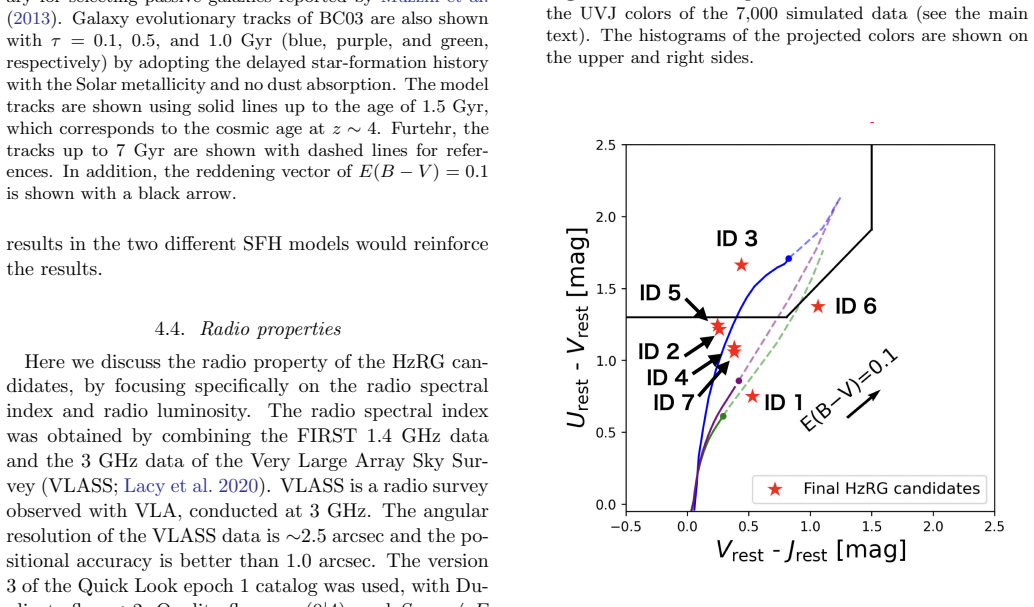
The argument is carried by the g-dropout Lyman-break selection, which isolates galaxies at $z\sim3.3{-}4.5$ through the color cuts $g-r>1.0$, $r-i<1.0$, and $g-r>1.5(r-i)+0.8$, followed by a 1-arcsec positional match to FIRST radio sources. Among 146 candidates, the 28 with VIKING/UKIDSS near-infrared and unWISE mid-infrared photometry were fitted with X-CIGALE using BC03 stellar population models and delayed star-formation histories; the best-fit SEDs were then used to construct rest-frame UVJ colors. The UVJ diagram with BC03 evolutionary tracks for $\tau=0.1$, $0.5$, and $1.0$ Gyr is the diagnostic that supports the fast-quenching claim.
What would settle it
Spectroscopic redshifts for the seven candidates would settle the claim: if their Lyman-$\alpha$ or rest-frame UV features place them at $z\sim2$ rather than $z\sim3.3{-}4.5$, the claimed stellar masses and fast-quenching timescales at $z\sim4$ would collapse. A definitive test would be deep near-infrared spectroscopy targeting the 4000 Angstrom/Balmer break region expected at $z\sim4$, or detection of a confirmed Lyman-$\alpha$ line at $z\sim3.8{-}4.0$.
Extended reading notes
Core claim
On the paper's own terms, the discovery is that a Lyman-break-selected sample of radio galaxies at $z\sim4$, chosen without requiring an ultra-steep radio spectrum, contains objects with stellar masses of $(2.6{-}5.6)\times10^{11}\,M_\odot$ (average $4.2\times10^{11}\,M_\odot$), placing them at the massive end of the $z\sim4$ galaxy mass function. Their rest-frame UVJ colors, derived from the best-fit SED models, are consistent with a fast past quenching of roughly 0.1 Gyr. The paper also finds that the radio spectral indices among the seven are diverse: four satisfy the USS criterion and three do not, so Lyman-break selection catches radio galaxies that USS surveys miss.
Load-bearing premise
The seven objects are genuinely at $z\sim4$; all redshifts are photometric, and the paper itself notes that fast-quenching galaxies at $z\sim2$ can mimic the near-infrared signature of $z\sim4$ Lyman-break galaxies, which would make the derived masses and quenching timescales invalid.
Editorial extensions
If this is right
- The $z\sim4$ radio galaxy population is not confined to ultra-steep-spectrum sources; Lyman-break selection reveals comparable massive galaxies with flatter radio spectra.
- These objects sit near the massive end of the $z\sim4$ stellar mass function, implying substantial early assembly before cosmic noon.
- The fast-quenching signal favors a quenching mechanism acting on roughly 0.1 Gyr timescales, such as quasar-mode feedback, over slower radio-mode feedback.
- Because the sample requires near-infrared and mid-infrared detection, it is biased toward $M_\star>10^{11}\,M_\odot$; the true average mass of Lyman-break-selected high-redshift radio galaxies could be lower.
- Future deeper infrared surveys can measure the full stellar-mass distribution and test whether Lyman-break-selected and USS-selected high-redshift radio galaxies form one population.
Reading between the lines
- A direct extension would be deep near-infrared spectroscopy of the seven candidates to confirm their redshifts; if the photo-$z$ redshifts hold, these objects become prime targets for proto-cluster searches around powerful radio jets.
- ALMA or submillimeter observations could check whether the modest $E(B-V)$ values from SED fitting hide obscured star formation, which would change the inferred quenching completeness.
- Comparing the radio luminosity function of Lyman-break-selected high-redshift radio galaxies with the quasar luminosity function at $z\sim4$ could test whether the fast quenching is synchronized with luminous AGN phases.
- If confirmed, the mass similarity between Lyman-break and USS-selected high-redshift radio galaxies would strengthen the view that such galaxies trace the most massive halos at $z\sim4$.
Editorial analysis
A structured set of objections, weighed in public.
Referee Report
Summary. This paper presents a search for z~4 radio galaxies by matching g-dropout Lyman-break galaxies selected from ~560 deg^2 of Subaru HSC-SSP data to VLA FIRST radio sources, producing 146 HzRG candidates. Restricting to 28 objects with VIKING or UKIDSS near-infrared and unWISE mid-infrared detections, the authors run X-CIGALE SED fits and select 7 objects with photometric redshifts in 3.3<z<4.5. They report stellar masses of (2.6-5.6)x10^11 Msun with a mean of 4.2x10^11 Msun, and use rest-frame UVJ colors computed from the best-fit SED models to argue for fast quenching on a ~0.1 Gyr timescale. They also use VLASS to measure radio spectral indices and argue that Lyman-break selection finds HzRGs missed by USS-based surveys.
Significance. If the z~4 identification is correct, the paper makes an interesting and useful claim: Lyman-break-selected radio galaxies at z~4 are already as massive and as quenched as USS-selected HzRGs, suggesting that the massive nature is not merely an artifact of USS selection. The authors provide several genuine strengths: a 17,856-model completeness simulation that supports the Mstar>1e11 selection floor, a Monte Carlo uncertainty analysis for the UVJ colors, and an sfh2exp robustness check that broadly reproduces the fast-quenching pattern for 5 of 7 objects. The main astrophysical conclusions, however, remain conditional on photometric redshifts and on model-generated UVJ colors; the paper is transparent about both limitations, which is a credit to the authors.
major comments (4)
- [Sec. 3.1, Table 3] The final seven-object sample rests entirely on photometric redshifts. In Section 3.1 the unrestricted X-CIGALE run places the median best-fit redshift of the 28 NIR/MIR-bright candidates at z=2.30, and the text itself cites Kubo et al. (2024) to note that z~2 fast-quenching galaxies show a spectral break near rest 1600 Angstrom that can be misidentified as the near-infrared signature of z~4 galaxies. Since none of the seven objects has a spectroscopic redshift, the restricted 3.3<z<4.5 solution that yields masses of (2.6-5.6)x10^11 Msun is not independently validated. The paper needs either spectroscopic confirmation or a per-object estimate of the z~2 contamination probability (e.g., P(z<3) from the full photo-z posterior) before the conclusions in Section 5 can be stated as established results; the second X-CIGALE run with the redshift window fixed at 3.3-4.5 is a parameter-estimation choice and cannot by itself validate the redshift.
- [Sec. 4.3, Figs. 9-12] The rest-frame UVJ colors are not measured from the photometry; they are generated from the best-fit X-CIGALE models. The delayed-SFH grid used for the fits has (tau, age) parameters that directly control whether the modeled galaxy quenches on a 0.1 Gyr or a 1 Gyr timescale, so placing the same model colors on top of BC03 delayed-SFH tracks with different tau values partially restates the input assumptions. The sfh2exp check in Figure 11 is a useful internal consistency test, but it uses the same fitting machinery and therefore does not break the circularity. I would ask the authors to derive U-V and V-J directly from the observed photometry at the adopted photo-z, propagating the photo-z uncertainty, or to use a nonparametric SFH, so that the quenching-timescale claim is testable.
- [Sec. 4.1, Fig. 7, Sec. 5] The completeness simulation shows that the near- and mid-infrared detection limits impose a strong selection floor at Mstar>1e11 Msun, with completeness roughly 0.4-0.6 for the massive range and near zero below it. Given this floor, the conclusion in Section 5 that 'the massive nature is a general characteristic of HzRGs independent of the selection method' is stronger than the data support. The KS comparison with USS-selected samples (p=1.2e-3) also mixes different SED-fitting codes and excludes objects with mass upper limits. The authors are transparent about the bias in Section 4.1, but the wording of the abstract and conclusions should be tempered to say that the massive nature applies to the NIR/MIR-selected subset.
- [Sec. 4.3, Figs. 10 and 12] The Monte Carlo realizations are said to show that fast quenching is preferred, but no quantitative fraction is given. Only ID3 and ID6 formally satisfy the Muzzin et al. (2013) quiescent criteria, while ID2, ID4, and ID7 are near the boundary; without a stated percentage of realizations that fall within the tau=0.1 Gyr track rather than the tau=1.0 Gyr track, the 'rough timescale of 0.1 Gyr' is not statistically supported. Please report the classification probability or a posterior distribution on the effective quenching timescale.
minor comments (6)
- [Figure 9 caption] The caption contains the typo 'Furtehr' and should read 'Further'; please proofread the figure captions.
- [Sec. 4.4] The text contains 'soruces' where 'sources' is intended; the same typo appears in the VLASS discussion and should be corrected.
- [Table 4] The near-infrared columns labeled Ks and K are easy to confuse because the survey (VIKING or UKIDSS) is not repeated in the column headers; please add explicit survey labels or a clearer footnote.
- [Abstract and Sec. 5] The abstract and conclusion state the ~0.1 Gyr quenching timescale without mentioning that the UVJ colors are model-derived; please add a caveat or soften the wording.
- [Sec. 2.1] The phrase 'convolvedflux 0 20 mag' is not defined in the text; please explain this HSC-SSP magnitude type or cite the relevant documentation.
- [Data availability] No data availability statement is included; providing the final photometric catalog and the X-CIGALE configuration would improve reproducibility.
Circularity Check
The fast-quenching conclusion restates the fitted SFH through model-generated UVJ colors; the stellar-mass result itself is not circular.
-
fitted input called prediction
[Section 4.3 "Rest-frame UVJ color" (Figures 9-10), with best-fit SFH parameters in Table 5.]
"The rest-frame UVJ magnitudes of our HzRG candidates cannot be measured directly from the observed photometric data. This is because the rest-frame J-band is beyond the WISE W2 band. Therefore we estimated the UVJ magnitudes of our HzRG candidates from the best-fit galaxy spectral model in the SED fitting process."
The UVJ colors that drive the "fast quenching with ~0.1 Gyr" conclusion are not observed colors; they are generated from the X-CIGALE best-fit model. That model is fit with the sfhdelayed SFH, and Table 5 shows all 7 final candidates have best-fit tau = 10-100 Myr. Plotting these model-generated colors against BC03 delayed-SFH tracks with tau = 0.1 Gyr therefore compares the fitted SFH to itself in a new coordinate system: the UVJ position is a deterministic function of the already-fitted tau and age, so the "evidence from the UVJ diagram" adds no independent constraint and the quoted ~0.1 Gyr timescale is effectively the fitted tau renamed.
full rationale
The paper's stellar-mass claim (Mstar ~ 2.6-5.6 x 10^11 Msun) is a genuine SED-fitting result: the masses are derived from observed HSC+VIKING/UKIDSS+unWISE photometry, the selection-bias analysis uses an independent 17,856-model completeness simulation, and the comparison with USS-selected HzRGs is external. No load-bearing self-citation chain or uniqueness-import argument appears; Yamashita et al. (2020) and Kubo et al. (2024) are used for method context and a caution about z~2 interlopers, respectively, not to force the conclusions. The identified circularity is limited to the fast-quenching inference in Section 4.3: the rest-frame UVJ colors cannot be measured because the rest-frame J band is outside the observed wavelength coverage, so they are computed from the best-fit X-CIGALE models whose tau parameter already encodes the SFH timescale; concluding ~0.1 Gyr quenching from those model-generated colors is a restatement of the fitted tau, not an independent empirical test. This makes the "passive/fast-quenching" part of the headline claim partially circular, while leaving the massive-galaxy result substantially independent. The need for spectroscopic redshifts is an external validity concern, not circularity.
Assumptions & free parameters
free parameters (6)
- Stellar mass Mstar =
(2.6 to 5.6) x 10^11 Msun, average 4.2 x 10^11 Msun (Table 6)
- Delayed SFH timescale tau =
10 to 100 Myr for the 7 candidates (Table 5)
- Stellar population age =
200 to 1000 Myr (Table 5)
- Dust attenuation E(B-V) =
Bayesian 0.1 to 0.6 (Table 6)
- Photometric redshift =
Best-fit 3.46 to 4.35, Bayesian 3.71 to 4.16 (Tables 3 and 6)
- Ionization parameter log U =
-4.0 or -2.0 (Table 2)
assumptions (7)
- domain assumption The g-dropout color criteria (g-r>1.0, r-i<1.0, g-r>1.5(r-i)+0.8) select galaxies at 3.3<z<4.5.
- domain assumption Radio galaxies are type-2 AGNs whose rest-frame UV/optical emission is dominated by stars, so the AGN component can be omitted from SED fitting.
- domain assumption The 1 arcsec HSC-FIRST matching radius has a 14 percent chance-coincidence fraction and 93 percent completeness, following Yamashita et al. (2018).
- domain assumption The delayed star-formation history with BC03 stellar population, Chabrier IMF, and solar metallicity adequately describes the SEDs.
- ad hoc to paper The photometric redshift solution in the range 3.3 to 4.5 is the true redshift, despite the known z~2 fast-quenching galaxy degeneracy.
- domain assumption The Calzetti et al. (2000) extinction law with E(B-V) up to 2 applies to these galaxies.
- domain assumption The 4 arcsec aperture in VIKING/UKIDSS images captures total flux for the targets, with the y-band comparison showing negligible offsets.
Cite this review
Pith. "Pith review of A Wide and Deep Exploration of Radio Galaxies with Subaru HSC (WERGS). X. The Massive and Passive Nature of Radio Galaxies at $z \sim 4$." pith.science (2026). https://pith.science/paper/JP5SP3OA
@misc{pith2026241119009,
  author       = {Pith},
  title        = {Pith review of: A Wide and Deep Exploration of Radio Galaxies with Subaru HSC (WERGS). X. The Massive and Passive Nature of Radio Galaxies at $z \sim 4$},
  year         = {2026},
  howpublished = {\url{https://pith.science/paper/JP5SP3OA}},
  note         = {Machine review of arXiv:2411.19009}
}
abstract
High-$z$ radio galaxies (HzRGs) are considered important objects for understanding the formation and evolution of massive galaxies in the early universe. However, till date, detailed studies of the stellar population of HzRGs such as the star-formation history have been scarce. Therefore, this study conducted a new survey to establish a less-biased sample of HzRGs and consequently investigate their properties. We utilized a sample of $g$-dropout Lyman break galaxies (LBGs) obtained from an optical wide and deep imaging survey made by Subaru Hyper Suprime-Cam (HSC). Based on the cross-matching of this LBG sample with the VLA FIRST radio survey data, we constructed a photometric sample of high-redshift radio galaxies (HzRGs) at $z \sim 4$ for $\sim$560 deg$^2$ survey field. Consequently, we identified 146 HzRG candidates. To analyze the characteristics of these candidates, we focus on objects exhibiting the near-infrared photometry of VIKING or UKIDSS and the mid-infrared photometry of unWISE (28 objects). The results indicate that 7 objects exhibit SEDs consistent with galaxies at $z \sim 4$. The HzRG candidates have very large stellar masses with $\sim 4.2 \times 10^{11} M_{\odot}$ on average. This stellar mass is similar to that of previously discovered USS HzRGs at $z \sim 4$, though our sample is affected by a sample selection bias that selects only HzRGs with $M_{\star} > 10^{11} M_{\odot}$. Further, the SEDs of those HzRG candidates suggest a past fast quenching with a rough timescale of $\sim$0.1 Gyr, as evidenced from the rest-frame UVJ diagram.
Figures


Figures from the paper (8 more)



Forward citations
Cited by 1 Pith paper
-
Why Jet Power and Star Formation Are Uncorrelated in Active Galaxies
Powerful jets and star formation rates appear uncorrelated because AGN spend an early phase with decreasing jet power and rising star formation, then a later phase with rising jet power and falling star formation.
Reference graph
Works this paper leans on
-
[1]
Abazajian, K., Adelman-McCarthy, J. K., Ag¨ ueros, M. A., et al. 2004, AJ, 128, 502, doi: 10.1086/421365
doi:10.1086/421365 2004
-
[2]
2018, PASJ, 70, S8, doi: 10.1093/pasj/psx081
Aihara, H., Armstrong, R., Bickerton, S., et al. 2018, PASJ, 70, S8, doi: 10.1093/pasj/psx081
-
[3]
2022, PASJ, 74, 247, doi: 10.1093/pasj/psab122
Aihara, H., AlSayyad, Y., Ando, M., et al. 2022, PASJ, 74, 247, doi: 10.1093/pasj/psab122
-
[4]
2018, PASJ, 70, S34, doi: 10.1093/pasj/psx091
Akiyama, M., He, W., Ikeda, H., et al. 2018, PASJ, 70, S34, doi: 10.1093/pasj/psx091
-
[5]
Andrews, S. K., Kelvin, L. S., Driver, S. P., & Robotham, A. S. G. 2014, PASA, 31, e004, doi: 10.1017/pasa.2013.41
-
[6]
J., Parker, L
Arnaboldi, M., Neeser, M. J., Parker, L. C., et al. 2007, The Messenger, 127, 28
2007
-
[7]
Becker, R. H., White, R. L., & Helfand, D. J. 1995, ApJ, 450, 559, doi: 10.1086/176166
doi:10.1086/176166 1995
-
[8]
Belli, S., Newman, A. B., & Ellis, R. S. 2019, ApJ, 874, 17, doi: 10.3847/1538-4357/ab07af
Show all 88 references
-
[9]
N., & Heckman, T
Best, P. N., & Heckman, T. M. 2012, MNRAS, 421, 1569, doi: 10.1111/j.1365-2966.2012.20414.x
2012
-
[12]
2019, A&A, 622, A103, doi: 10.1051/0004-6361/201834156
Boquien, M., Burgarella, D., Roehlly, Y., et al. 2019, A&A, 622, A103, doi: 10.1051/0004-6361/201834156
2019 doi
-
[13]
2018, PASJ, 70, S5, doi: 10.1093/pasj/psx080
Bosch, J., Armstrong, R., Bickerton, S., et al. 2018, PASJ, 70, S5, doi: 10.1093/pasj/psx080
2018 doi
-
[14]
W., Drouart, G., Seymour, N., et al
Broderick, J. W., Drouart, G., Seymour, N., et al. 2022, PASA, 39, e061, doi: 10.1017/pasa.2022.42
2022 doi
-
[17]
C., et al
Calzetti, D., Armus, L., Bohlin, R. C., et al. 2000, ApJ, 533, 682, doi: 10.1086/308692
2000 doi
-
[18]
2007, A&A, 467, 777, doi: 10.1051/0004-6361:20066514
Casali, M., Adamson, A., Alves de Oliveira, C., et al. 2007, A&A, 467, 777, doi: 10.1051/0004-6361:20066514
2007 doi
-
[19]
2009, ApJ, 695, 292, doi: 10.1088/0004-637X/695/1/292
Ceverino, D., & Klypin, A. 2009, ApJ, 695, 292, doi: 10.1088/0004-637X/695/1/292
2009 doi
-
[20]
2003, PASP, 115, 763, doi: 10.1086/376392
Chabrier, G. 2003, PASP, 115, 763, doi: 10.1086/376392
2003 doi
-
[21]
C., Miley, G
Chambers, K. C., Miley, G. K., van Breugel, W. J. M., et al. 1996, ApJS, 106, 247, doi: 10.1086/192338
1996 doi
-
[22]
Clarke, C., & Oey, M. S. 2002, MNRAS, 337, 1299, doi: 10.1046/j.1365-8711.2002.05976.x
2002
-
[23]
M., Negus, J., M¨ uller-S´ anchez, F., et al
Comerford, J. M., Negus, J., M¨ uller-S´ anchez, F., et al. 2020, ApJ, 901, 159, doi: 10.3847/1538-4357/abb2ae
2020 doi
-
[24]
Condon, J. J. 1992, ARA&A, 30, 575, doi: 10.1146/annurev.aa.30.090192.003043
1992
-
[25]
Kurk, J. D. 2014, MNRAS, 440, 3262, doi: 10.1093/mnras/stu522
2014 doi
-
[27]
J., Khochfar, S., et al
Cullen, F., McLure, R. J., Khochfar, S., et al. 2018, MNRAS, 476, 3218, doi: 10.1093/mnras/sty469
2018 doi
-
[28]
B., Caldwell, M., Ward, A
Dalton, G. B., Caldwell, M., Ward, A. K., et al. 2006, in Society of Photo-Optical Instrumentation Engineers (SPIE) Conference Series, Vol. 6269, Ground-based and Airborne Instrumentation for Astronomy, ed. I. S. McLean & M. Iye, 62690X, doi: 10.1117/12.670018
2006 doi
-
[29]
2017, A&A, 605, A70, doi: 10.1051/0004-6361/201730419 De Breuck, C., van Breugel, W., R¨ ottgering, H
Davidzon, I., Ilbert, O., Laigle, C., et al. 2017, A&A, 605, A70, doi: 10.1051/0004-6361/201730419 De Breuck, C., van Breugel, W., R¨ ottgering, H. J. A., &
2017 doi
-
[30]
2000, A&AS, 143, 303, doi: 10.1051/aas:2000181 De Breuck, C., van Breugel, W., Stanford, S
Miley, G. 2000, A&AS, 143, 303, doi: 10.1051/aas:2000181 De Breuck, C., van Breugel, W., Stanford, S. A., et al. 2002, AJ, 123, 637, doi: 10.1086/324632 18 Yamamoto et al. De Breuck, C., Seymour, N., Stern, D., et al. 2010, ApJ, 725, 36, doi: 10.1088/0004-637X/725/1/36
2000 doi
-
[32]
A., et al
Dye, S., Lawrence, A., Read, M. A., et al. 2018, MNRAS, 473, 5113, doi: 10.1093/mnras/stx2622
2018 doi
-
[33]
2013, The Messenger, 154, 32
Edge, A., Sutherland, W., Kuijken, K., et al. 2013, The Messenger, 154, 32
2013
-
[34]
Fabian, A. C. 2012, ARA&A, 50, 455, doi: 10.1146/annurev-astro-081811-125521
2012 doi
- [35]
-
[36]
Davies, L. J. M., & Mart ´ ınez-Lombilla, C. 2024, MNRAS, 531, 2517, doi: 10.1093/mnras/stae1292
2024 doi
-
[37]
2018, PASJ, 70, S11, doi: 10.1093/pasj/psx097
Harikane, Y., Ouchi, M., Ono, Y., et al. 2018, PASJ, 70, S11, doi: 10.1093/pasj/psx097
2018 doi
-
[38]
2022, ApJS, 259, 20, doi: 10.3847/1538-4365/ac3dfc
Harikane, Y., Ono, Y., Ouchi, M., et al. 2022, ApJS, 259, 20, doi: 10.3847/1538-4365/ac3dfc
2022 doi
-
[40]
2012, ApJ, 757, 15, doi: 10.1088/0004-637X/757/1/15
Tanaka, I. 2012, ApJ, 757, 15, doi: 10.1088/0004-637X/757/1/15
2012 doi
-
[41]
J., White, R
Helfand, D. J., White, R. L., & Becker, R. H. 2015, ApJ, 801, 26, doi: 10.1088/0004-637X/801/1/26
2015 doi
-
[42]
F., Hernquist, L., Cox, T
Hopkins, P. F., Hernquist, L., Cox, T. J., & Kereˇ s, D. 2008, ApJS, 175, 356, doi: 10.1086/524362
2008 doi
-
[43]
2021, ApJ, 921, 51, doi: 10.3847/1538-4357/ac1b26
Ichikawa, K., Yamashita, T., Toba, Y., et al. 2021, ApJ, 921, 51, doi: 10.3847/1538-4357/ac1b26
2021 doi
-
[44]
2023, A&A, 672, A171, doi: 10.1051/0004-6361/202244271
Ichikawa, K., Yamashita, T., Merloni, A., et al. 2023, A&A, 672, A171, doi: 10.1051/0004-6361/202244271
2023 doi
-
[45]
Inoue, A. K. 2011, MNRAS, 415, 2920, doi: 10.1111/j.1365-2966.2011.18906.x
2011
-
[46]
J., Tadhunter, C
Inskip, K. J., Tadhunter, C. N., Morganti, R., et al. 2010, MNRAS, 407, 1739, doi: 10.1111/j.1365-2966.2010.17002.x
2010
-
[47]
2020, ApJ, 904, 128, doi: 10.3847/1538-4357/abbd95
Ishikawa, S., Kashikawa, N., Tanaka, M., et al. 2020, ApJ, 904, 128, doi: 10.3847/1538-4357/abbd95
2020 doi
-
[48]
J., Teimourian, H., Simpson, C., et al
Jarvis, M. J., Teimourian, H., Simpson, C., et al. 2009, MNRAS, 398, L83, doi: 10.1111/j.1745-3933.2009.00715.x
2009
-
[49]
J., Rawlings, S., Lacy, M., et al
Jarvis, M. J., Rawlings, S., Lacy, M., et al. 2001, MNRAS, 326, 1563, doi: 10.1111/j.1365-2966.2001.04726.x
2001
-
[50]
2018, PASJ, 70, 66, doi: 10.1093/pasj/psy056
Kawanomoto, S., Uraguchi, F., Komiyama, Y., et al. 2018, PASJ, 70, 66, doi: 10.1093/pasj/psy056
2018 doi
-
[51]
King, A. R. 2010, MNRAS, 402, 1516, doi: 10.1111/j.1365-2966.2009.16013.x
2010
-
[52]
Kormendy, J., & Ho, L. C. 2013, ARA&A, 51, 511, doi: 10.1146/annurev-astro-082708-101811
2013 doi
-
[53]
2024, MNRAS, 527, 403, doi: 10.1093/mnras/stad3210 Labb´ e, I., Huang, J., Franx, M., et al
Kubo, M., Nagao, T., Uchiyama, H., et al. 2024, MNRAS, 527, 403, doi: 10.1093/mnras/stad3210 Labb´ e, I., Huang, J., Franx, M., et al. 2005, ApJL, 624, L81, doi: 10.1086/430700
2024 doi
-
[54]
A., Chandler, C
Lacy, M., Baum, S. A., Chandler, C. J., et al. 2020, PASP, 132, 035001, doi: 10.1088/1538-3873/ab63eb
2020 doi
-
[55]
2014, AJ, 147, 108, doi: 10.1088/0004-6256/147/5/108
Lang, D. 2014, AJ, 147, 108, doi: 10.1088/0004-6256/147/5/108
2014 doi
-
[56]
J., Almaini, O., et al
Lawrence, A., Warren, S. J., Almaini, O., et al. 2007, MNRAS, 379, 1599, doi: 10.1111/j.1365-2966.2007.12040.x Le Fevre, O., Deltorn, J. M., Crampton, D., & Dickinson, M. 1996, ApJL, 471, L11, doi: 10.1086/310319
2007
-
[57]
J., & Longair, M
Lilly, S. J., & Longair, M. S. 1982, MNRAS, 199, 1053, doi: 10.1093/mnras/199.4.1053
1982 doi
-
[58]
1998, AJ, 115, 2285, doi: 10.1086/300353
Magorrian, J., Tremaine, S., Richstone, D., et al. 1998, AJ, 115, 2285, doi: 10.1086/300353
1998 doi
-
[59]
M., et al
Mainzer, A., Bauer, J., Cutri, R. M., et al. 2014, ApJ, 792, 30, doi: 10.1088/0004-637X/792/1/30 Ma lek, K., Pollo, A., Takeuchi, T. T., et al. 2014, A&A, 562, A15, doi: 10.1051/0004-6361/201321665
2014 doi
-
[60]
M., et al
Mao, Z., Kodama, T., P´ erez-Mart ´ ınez, J. M., et al. 2022, A&A, 666, A141, doi: 10.1051/0004-6361/202243733
2022 doi
-
[61]
Marconi, A., & Hunt, L. K. 2003, ApJL, 589, L21, doi: 10.1086/375804
2003 doi
-
[62]
2008, A&A Rv, 15, 67, doi: 10.1007/s00159-007-0008-z
Miley, G., & De Breuck, C. 2008, A&A Rv, 15, 67, doi: 10.1007/s00159-007-0008-z
2008 doi
-
[63]
2018, PASJ, 70, S1, doi: 10.1093/pasj/psx063
Miyazaki, S., Komiyama, Y., Kawanomoto, S., et al. 2018, PASJ, 70, S1, doi: 10.1093/pasj/psx063
2018 doi
-
[64]
N., & Oosterloo, T
Morganti, R., Tadhunter, C. N., & Oosterloo, T. A. 2005, A&A, 444, L9, doi: 10.1051/0004-6361:200500197
2005 doi
-
[65]
2013, ApJ, 777, 18, doi: 10.1088/0004-637X/777/1/18
Muzzin, A., Marchesini, D., Stefanon, M., et al. 2013, ApJ, 777, 18, doi: 10.1088/0004-637X/777/1/18
2013 doi
-
[66]
Nesvadba, N. P. H., Drouart, G., De Breuck, C., et al. 2017, A&A, 600, A121, doi: 10.1051/0004-6361/201629357
2017 doi
-
[67]
2009, A&A, 507, 1793, doi: 10.1051/0004-6361/200912497
Noll, S., Burgarella, D., Giovannoli, E., et al. 2009, A&A, 507, 1793, doi: 10.1051/0004-6361/200912497
2009 doi
- [68]
-
[69]
2018, PASJ, 70, S10, doi: 10.1093/pasj/psx103
Ono, Y., Ouchi, M., Harikane, Y., et al. 2018, PASJ, 70, S10, doi: 10.1093/pasj/psx103
2018 doi
-
[70]
Odewahn, S. C. 1996, Nature, 383, 45, doi: 10.1038/383045a0
1996 doi
-
[71]
B., Soifer, B
Sanders, D. B., Soifer, B. T., Elias, J. H., et al. 1988, ApJ, 325, 74, doi: 10.1086/165983
1988 doi
-
[72]
A., et al
Saxena, A., Marinello, M., Overzier, R. A., et al. 2018, MNRAS, 480, 2733, doi: 10.1093/mnras/sty1996
2018 doi
-
[73]
Saxena, A., R¨ ottgering, H. J. A., Duncan, K. J., et al. 2019, MNRAS, 489, 5053, doi: 10.1093/mnras/stz2516 The nature of radio galaxies atz ∼ 4 19
2019 doi
-
[74]
F., Meisner, A
Schlafly, E. F., Meisner, A. M., & Green, G. M. 2019, ApJS, 240, 30, doi: 10.3847/1538-4365/aafbea
2019 doi
-
[75]
J., Finkbeiner, D
Schlegel, D. J., Finkbeiner, D. P., & Davis, M. 1998, ApJ, 500, 525, doi: 10.1086/305772
1998 doi
-
[76]
2007, ApJS, 171, 353, doi: 10.1086/517887
Seymour, N., Stern, D., De Breuck, C., et al. 2007, ApJS, 171, 353, doi: 10.1086/517887
2007 doi
-
[77]
P., Filipovi´ c, M
Shobhana, D., Norris, R. P., Filipovi´ c, M. D., et al. 2023, MNRAS, 519, 4902, doi: 10.1093/mnras/stac3319
2023 doi
-
[78]
J., Simmons, B
Smethurst, R. J., Simmons, B. D., Coil, A., et al. 2021, MNRAS, 507, 3985, doi: 10.1093/mnras/stab2340
2021 doi
-
[79]
2005, MNRAS, 361, 776, doi: 10.1111/j.1365-2966.2005.09238.x
Springel, V., Di Matteo, T., & Hernquist, L. 2005, MNRAS, 361, 776, doi: 10.1111/j.1365-2966.2005.09238.x
2005
-
[80]
P., Schenker, M
Stark, D. P., Schenker, M. A., Ellis, R., et al. 2013, ApJ, 763, 129, doi: 10.1088/0004-637X/763/2/129
2013 doi
-
[81]
2018, PASJ, 70, S9, doi: 10.1093/pasj/psx077
Tanaka, M., Coupon, J., Hsieh, B.-C., et al. 2018, PASJ, 70, S9, doi: 10.1093/pasj/psx077
2018 doi
-
[82]
2019, ApJS, 243, 15, doi: 10.3847/1538-4365/ab238d
Toba, Y., Yamashita, T., Nagao, T., et al. 2019, ApJS, 243, 15, doi: 10.3847/1538-4365/ab238d
2019 doi
-
[83]
2020, ApJ, 899, 35, doi: 10.3847/1538-4357/ab9cb7
Toba, Y., Goto, T., Oi, N., et al. 2020, ApJ, 899, 35, doi: 10.3847/1538-4357/ab9cb7
2020 doi
-
[84]
2022a, PASJ, 74, L27, doi: 10.1093/pasj/psac075 —
Uchiyama, H., Yamashita, T., Nagao, T., et al. 2022a, PASJ, 74, L27, doi: 10.1093/pasj/psac075 —. 2022b, ApJ, 934, 68, doi: 10.3847/1538-4357/ac77ee
-
[85]
P., R¨ ottgering, H
Venemans, B. P., R¨ ottgering, H. J. A., Miley, G. K., et al. 2007, A&A, 461, 823, doi: 10.1051/0004-6361:20053941
2007 doi
-
[86]
J., Quadri, R
Williams, R. J., Quadri, R. F., Franx, M., van Dokkum, P., & Labb´ e, I. 2009, ApJ, 691, 1879, doi: 10.1088/0004-637X/691/2/1879
2009 doi
-
[87]
J., Rawlings, S., Jarvis, M
Willott, C. J., Rawlings, S., Jarvis, M. J., & Blundell, K. M. 2003, MNRAS, 339, 173, doi: 10.1046/j.1365-8711.2003.06172.x
2003
-
[88]
2021, A&A, 647, A5, doi: 10.1051/0004-6361/202039724
Wolf, J., Nandra, K., Salvato, M., et al. 2021, A&A, 647, A5, doi: 10.1051/0004-6361/202039724
2021 doi
-
[89]
L., Eisenhardt, P
Wright, E. L., Eisenhardt, P. R. M., Mainzer, A. K., et al. 2010, AJ, 140, 1868, doi: 10.1088/0004-6256/140/6/1868
2010 doi
-
[90]
2007, ApJ, 655, 51, doi: 10.1086/509708
Wuyts, S., Labb´ e, I., Franx, M., et al. 2007, ApJ, 655, 51, doi: 10.1086/509708
2007 doi
-
[91]
Wyithe, J. S. B., & Loeb, A. 2013, MNRAS, 428, 2741, doi: 10.1093/mnras/sts242
2013 doi
-
[92]
2018, ApJ, 866, 140, doi: 10.3847/1538-4357/aae1ac
Yamashita, T., Nagao, T., Akiyama, M., et al. 2018, ApJ, 866, 140, doi: 10.3847/1538-4357/aae1ac
2018 doi
-
[93]
2020, AJ, 160, 60, doi: 10.3847/1538-3881/ab98fe
Yamashita, T., Nagao, T., Ikeda, H., et al. 2020, AJ, 160, 60, doi: 10.3847/1538-3881/ab98fe
2020 doi
-
[94]
2020, MNRAS, 491, 740, doi: 10.1093/mnras/stz3001
Yang, G., Boquien, M., Buat, V., et al. 2020, MNRAS, 491, 740, doi: 10.1093/mnras/stz3001
2020 doi
-
[95]
G., Adelman, J., Anderson, John E., J., et al
York, D. G., Adelman, J., Anderson, John E., J., et al. 2000, AJ, 120, 1579, doi: 10.1086/301513
2000 doi
Reviewed August 12, 2026 · model on record in the stance chip above.
Discussion (0). Continue with ORCID to comment.