REVIEW 4 major objections 9 minor 76 references
Improving Multi-Subject Consistency in Open-Domain Image Generation with Isolation and Reposition Attention
T0 review · 4 major / 9 minor · reviewed 2026-08-12 · deepseek-v4-flash
Pith's one-line read Training-free image generators can keep multiple subjects from merging into one character by masking their mutual attention, a new method claims.
desk verdict Simple, effective training-free attention modifications with real gains, but the mechanistic explanation is correlational and the evaluation needs error bars and a clearer retry policy. read the letter →
The pith
A machine-rendered reading of the paper's core claim, the machinery that carries it, and where it could break.
The reading
What carries the argument
Isolation Attention and Reposition Attention. Isolation Attention is an attention-mask operation that, for each subject's query, zeroes out responses from the keys and values of the other subjects in the target image, leaving only the subject's own tokens, the background, and its own reference features; it is computed as a product of pairwise mask complements and applied to the self-attention logits. Reposition Attention rescales and shifts the reference subject's key/value features so they occupy the same spatial position as the target subject, then fills the outside region with zeros, so that nearby-token bias works with the reference instead of against it. Together they are inserted into the self-attention layers of a U-Net diffusion backbone with a masking mechanism.
What would settle it
Run the same IR-Diffusion pipeline but replace Isolation Attention with masks over the same number of randomly chosen cross-subject attention entries; if consistency stays at the improved level, the isolation explanation is not doing the work. Similarly, apply Reposition Attention with reference features shifted to random positions rather than the target subject's; if consistency remains high, the spatial-alignment explanation is unsupported.
Extended reading notes
Core claim
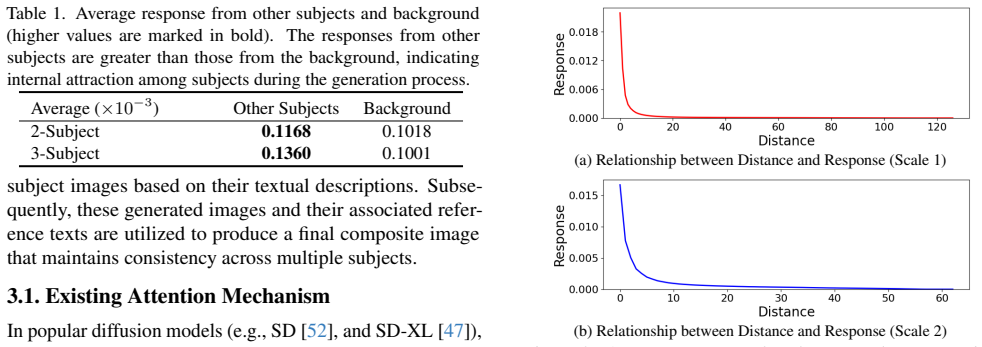
The central claim is that the residual inconsistency of training-free multi-subject generators is caused by two measurable, intrinsic properties of self-attention: an internal attraction among the subjects of the target image, shown by higher mean attention responses between subjects than toward background (Table 1), and a distance-decay bias in which tokens attend more strongly to nearby tokens (Figure 4). Removing the attention edges between subjects, the Isolation Attention mask, prevents the convergence of multiple subjects into one composite entity, and spatially aligning the reference features to the target positions, Reposition Attention, restores the effective use of reference information. The paper argues that these two operations, applied as masks on top of the DreamStory pipeline, are sufficient to reach state-of-the-art multi-subject consistency in open-domain generation.
Load-bearing premise
The whole repair rests on treating the measured attention patterns as the cause: that the higher response between subjects and the fall-off of attention with distance are why subjects merge and misalign, so deleting exactly those attention edges is the correct fix.
Editorial extensions
If this is right
- If correct, multi-subject consistency improves without finetuning, datasets, or additional training: the whole system remains training-free and plugs into existing pipelines.
- The gains grow with subject count: three-subject scenes improve more than two-subject scenes, consistent with the claim that internal attraction and misalignment accumulate as more subjects compete for attention.
- The two operations are backbone-agnostic: applying the same masks to SDXL, Playground, and Kolors improves consistency across all three (supplementary Table 6).
- The diagnostic claims (subject response exceeds background; attention decays with distance) give practitioners a direct measurement to detect when a generator will suffer subject fusion or misalignment.
- The approach transfers to other attention-based generators: the authors point to DiT architectures such as FLUX and PixArt-Σ, and to applications in attribute binding and video generation.
Reading between the lines
- Editorial inference: the correlation shown in Table 1 and Figure 4 does not by itself prove causality; the gains could partly come from a generic sparsification of the attention matrix. A control that masks the same number of randomly chosen cross-subject edges would separate the two explanations.
- Editorial inference: the repositioning idea is a special case of a broader principle — reference conditioning is stronger when reference and target feature layouts are geometrically aligned — so other warpings (affine, optical-flow based, or learned) might generalize the same benefit beyond translate-and-scale.
- Editorial inference: because the method uses rehearsal-generated masks that downscale with the VAE, very small subject masks are a stated failure mode; upsampling masks to keep small subjects at token-level resolution is a natural extension suggested by the paper's own limitation discussion.
- Editorial inference: the same two mechanisms might apply to single-subject attribute binding, where an object's features bleed into a second object in the same image; masking cross-object attention could be tested as a direct transfer.
Editorial analysis
A structured set of objections, weighed in public.
Referee Report
Summary. This paper proposes IR-Diffusion for open-domain multi-subject consistent image generation, building on the training-free DreamStory pipeline. It diagnoses two failure modes in self-attention: internal attraction between different subjects of the target image, claimed to cause subject convergence, and a preference for spatially proximate tokens, claimed to reduce the usefulness of reference features when reference and target subject positions differ. The proposed fixes are Isolation Attention (IA), which masks attention from each subject's queries to other subjects' keys and values (Eq. 7), and Reposition Attention (RA), which rescales and shifts reference keys and values to align with target subject positions (Eq. 8). On the DS-500 benchmark, IR-Diffusion reports D&C-DS of 0.6458 (2-subject) and 0.4095 (3-subject), versus 0.5444 and 0.2335 for DreamStory, with ablations (Tab. 3), a user study (Tabs. 4 and 5), cross-backbone experiments (Tab. 6), and runtime analysis (Tab. 7). The supplementary material acknowledges failure cases with small subject masks (Sec. C.3) and reports an overhead of roughly 45--57% over the baseline.
Significance. The engineering result is valuable if reproducible: the method is training-free and plug-and-play, the two modules show consistent though unequal gains, the user study points in the same direction as the objective metrics (e.g., 66.6% vs 4.9% consistency preference over DreamStory, Tab. 4), and the gains generalize across three backbones. The paper is honest about failure cases and overhead. However, the scientific claim that the paper reveals internal attraction and positional bias as the causal mechanisms is not established: Table 1 and Fig. 4 are correlational with known confounds, and the interventions in Eqs. (7)--(8) bundle several attention changes at once. The stress-test concern that the causal story is underdetermined lands, on my reading. In addition, no code or data release is indicated, objective metrics lack variance and significance tests, and the DS-500 benchmark and DreamStory baseline both come from the authors' own prior work. The method is credible; the diagnosis needs stronger controls or a softened claim. No circularity is involved: the gains are measured against an external benchmark and published baselines.
major comments (4)
- [Sec. 3.2.1 / Tab. 1] Section 3.2.1 presents Table 1 as strong evidence of internal attraction between subjects, but the aggregate per-token response comparison of 'other subjects' versus 'background' does not control for spatial distance or region geometry. Given the distance-response decay the paper itself reports in Fig. 4, subject regions placed near the query subject will show elevated responses from proximity alone; the gap (0.1168 vs 0.1018 in the 2-subject case) is also reported without any null model, variance, or per-case breakdown. Please add a matched-distance control (e.g., other-subject versus background tokens at the same distance bin) and per-case distributions. As it stands, the evidence supports only a correlation, and the abstract's claim that IA removes a discovered 'internal attraction' mechanism is not established.
- [Sec. 3.2.2 / Eq. (7)] The IA operation in Eq. (7) simultaneously zeros cross-subject K/V edges, reallocates softmax mass to the remaining reference, self, and background tokens, and removes any legitimate semantic interaction between subjects (mutual gaze, spatial relations such as 'beside' or 'watching'). The ablation gain (Tab. 3, 3-subject D&C-DS 0.2378 to 0.3636) may therefore partly come from reweighting of the reference branch rather than from eliminating a harmful attraction. Please add a control intervention, such as masking an equal number of randomly chosen tokens or attenuating (rather than zeroing) cross-subject attention, to show that the specific structure of the mask drives the improvement. Without such a control, the mechanism attributed to IA remains undetermined.
- [Sec. 3.3.1 / Fig. 4 and Tab. 3 (RA row)] The distance-response decay in Fig. 4 does not by itself establish a learned positional prior, because nearby tokens in natural images usually belong to the same object or texture; the decay is equally consistent with semantic grouping. A control matching same-object versus different-object token pairs at equal distances would be needed. The improvement data also give only weak support to the claimed positional mechanism: the RA-only ablation changes 3-subject D&C-DS from 0.2378 to 0.2405 (+1.1%) in Tab. 3, and the 2-subject RA-only gain (0.5592 to 0.5978) is reported without variance. The main benefit of RA appears as an interaction with IA; please report variance or confidence intervals for these small differences and state whether the RA-only effect is statistically meaningful.
- [Sec. 4.3 / Tabs. 2 and 3] Objective metrics in Tables 2, 3, and 6 are single numbers with no variance, no number of independent runs, and no significance tests, although the text repeatedly concludes that IR-Diffusion significantly enhances consistency. The headline 3-subject improvements are large enough that the qualitative conclusion is likely robust, but the smaller claims, notably the RA-only gain and several 2-subject differences, cannot be evaluated as reported. Please report run-to-run variance (e.g., over seeds) or equivalent statistical evidence for all reported differences, and reserve 'significantly' for comparisons where such evidence exists.
minor comments (9)
- [Sec. 3.2.1 / Tab. 1] The 2-subject background response is 0.1018 in Table 1 but is stated as 0.1037 in the text of Sec. 3.2.1; please reconcile the numbers.
- [Tab. 2 / Sec. 1 / Supp. B.2 / author block] Typos: 'RI-Diffusion' in the Table 2 header, 'IR-Diffusuion' in the contribution list, 'attration' in Supplementary Sec. B.2, and 'Sun Yat-Sun University' in the affiliation block.
- [Sec. B.4] The maximum-20-attempt retry used to obtain accurate subject masks is an engineering choice that could affect fairness across methods; please state in the main paper whether the same retry was applied to all baselines on DS-500 and what the retry is conditioned on (presumably the number of subjects stated in the prompt).
- [Abstract / Sec. 4.4] No code or data release is mentioned; since the method is training-free and DS-500 is public, a code release statement would substantially support reproducibility of the reported gains.
- [Fig. 4] The two curves labeled Scale 1 and Scale 2 are not defined in terms of U-Net resolution, layer range, or aggregation across timesteps; please specify which layers produce each curve and whether the distance trend holds at the per-layer level rather than only on average.
- [Sec. C.3 / Fig. 7] The acknowledged small-mask limitation is reasonable and honestly presented; because it qualifies the open-domain claim in the abstract, I suggest moving this limitation (with Fig. 7) from the supplementary material into the main paper.
- [Sec. 3.2.2 / Eq. (7)] Equation (7) and the surrounding prose omit the mask term that actually implements isolation; the mask construction appears only in Supplementary Eq. (14). A compact version of the mask formula should appear in the main text so the method is self-contained.
- [Sec. 4.3] The text says the authors 'evaluate generated results based on three main criteria' but then lists four metrics (AES, CLIP-T, DS, D&C-DS); please state the mapping of the four metrics to the three criteria.
- [Sec. 4.3 / Tabs. 4 and 5] The user-study protocol includes a 'comparable' option, but Tables 4 and 5 report only Win and Lose percentages, which do not sum to 100; please report the third category or state explicitly why it is omitted.
Circularity Check
No circular derivation found: Isolation and Reposition Attention are explicit attention-mask modifications validated against external benchmarks; the causal-mechanism narrative is interpretive, not circular.
full rationale
The paper's claimed derivation chain is not circular. Isolation Attention (Eq. 7) and Reposition Attention (Eq. 8) are explicit modifications of the attention operator: IA replaces the all-ones target mask in the DreamStory formulation (Eq. 12) with the isolation mask M_TGT (Eq. 14), and RA resamples reference K/V features to target-subject positions. These are algorithms, not fitted parameters, and their reported effect (D&C-DS 0.2378 -> 0.4095 on the 3-subject DS-500 benchmark, Tab. 3) is evaluated with external metrics (DreamSim-based DS and D&C-DS) against published baselines. The evidence for "internal attraction" (Tab. 1) and positional decay (Fig. 4) is observational and could be confounded, but that is an interpretive weakness in the causal narrative, not a case where a prediction is equal to its input by construction. The paper repeatedly builds on the authors' own DreamStory [16] as baseline and backbone; this is a self-citation, but it is not load-bearing because the new masks are ablated against DreamStory and measured on an external benchmark rather than established by citation. The acknowledged limitation (small masks, Sec. C.3) is a boundary condition, not a circular step. Overall: no significant circularity; score reflects a minor, non-load-bearing reliance on the authors' prior work.
Assumptions & free parameters
free parameters (4)
- maximum retry attempts =
20
- token dropout rate =
0.5
- guidance scale =
7.0
- inference steps =
50
assumptions (3)
- domain assumption GroundedSAM segmentation provides correct subject masks.
- domain assumption Attention response values quantify subject information flow and subject fusion.
- domain assumption The pretrained model's positional bias can be exploited by affine repositioning of reference features without retraining.
Cite this review
Pith. "Pith review of Improving Multi-Subject Consistency in Open-Domain Image Generation with Isolation and Reposition Attention." pith.science (2026). https://pith.science/paper/CGAWRI5O
@misc{pith2026241119261,
  author       = {Pith},
  title        = {Pith review of: Improving Multi-Subject Consistency in Open-Domain Image Generation with Isolation and Reposition Attention},
  year         = {2026},
  howpublished = {\url{https://pith.science/paper/CGAWRI5O}},
  note         = {Machine review of arXiv:2411.19261}
}
read the original abstract
Training-free diffusion models have achieved remarkable progress in generating multi-subject consistent images within open-domain scenarios. The key idea of these methods is to incorporate reference subject information within the attention layer. However, existing methods still obtain suboptimal performance when handling numerous subjects. This paper reveals two primary issues contributing to this deficiency. Firstly, the undesired internal attraction between different subjects within the target image can lead to the convergence of multiple subjects into a single entity. Secondly, tokens tend to reference nearby tokens, which reduces the effectiveness of the attention mechanism when there is a significant positional difference between subjects in reference and target images. To address these issues, we propose a training-free diffusion model with Isolation and Reposition Attention, named IR-Diffusion. Specifically, Isolation Attention ensures that multiple subjects in the target image do not reference each other, effectively eliminating the subject convergence. On the other hand, Reposition Attention involves scaling and repositioning subjects in both reference and target images to the same position within the images. This ensures that subjects in the target image can better reference those in the reference image, thereby maintaining better consistency. Extensive experiments demonstrate that IR-Diffusion significantly enhances multi-subject consistency, outperforming all existing methods in open-domain scenarios.
Figures


Figures from the paper (11 more)


Reference graph
Works this paper leans on
-
[1]
Moab Arar, Rinon Gal, Yuval Atzmon, Gal Chechik, Daniel Cohen-Or, Ariel Shamir, and Amit H. Bermano. Domain- agnostic tuning-encoder for fast personalization of text-to- image models. In SIGGRAPH Asia, pages 1–10, 2023. 3
2023
-
[2]
Wasser- stein generative adversarial networks
Martin Arjovsky, Soumith Chintala, and Léon Bottou. Wasser- stein generative adversarial networks. In ICML, pages 214– 223, 2017. 2
work page 2017
-
[3]
The chosen one: Consistent characters in text-to-image diffusion models
Omri Avrahami, Amir Hertz, Yael Vinker, Moab Arar, Shlomi Fruchter, Ohad Fried, Daniel Cohen-Or, and Dani Lischin- ski. The chosen one: Consistent characters in text-to-image diffusion models. In SIGGRAPH, pages 1–12, 2024. 2
work page 2024
-
[4]
MasaCtrl: Tuning-free mu- tual self-attention control for consistent image synthesis and editing
Mingdeng Cao, Xintao Wang, Zhongang Qi, Ying Shan, Xi- aohu Qie, and Yinqiang Zheng. MasaCtrl: Tuning-free mu- tual self-attention control for consistent image synthesis and editing. In ICCV, pages 22560–22570, 2023. 1, 3, 12
work page 2023
-
[5]
Character-centric story visualization via visual planning and token alignment
Hong Chen, Rujun Han, Te-Lin Wu, Hideki Nakayama, and Nanyun Peng. Character-centric story visualization via visual planning and token alignment. In EMNLP, pages 8259–8272,
-
[6]
PixArt- α: Fast training of diffusion transformer for photorealistic text-to-image synthesis
Junsong Chen, Jincheng Yu, Chongjian Ge, Lewei Yao, Enze Xie, Yue Wu, Zhongdao Wang, James Kwok, Ping Luo, Huchuan Lu, et al. PixArt- α: Fast training of diffusion transformer for photorealistic text-to-image synthesis. arXiv preprint arXiv:2310.00426, 2023. 9
-
[7]
AnyDoor: Zero-shot object-level image customization
Xi Chen, Lianghua Huang, Yu Liu, Yujun Shen, Deli Zhao, and Hengshuang Zhao. AnyDoor: Zero-shot object-level image customization. In CVPR, pages 6593–6602, 2024. 3
work page 2024
-
[8]
Au- toStudio: Crafting consistent subjects in multi-turn interactive image generation
Junhao Cheng, Xi Lu, Hanhui Li, Khun Loun Zai, Baiqiao Yin, Yuhao Cheng, Yiqiang Yan, and Xiaodan Liang. Au- toStudio: Crafting consistent subjects in multi-turn interactive image generation. arXiv preprint arXiv:2406.01388, 2024. 3
arXiv 2024
Show all 76 references
-
[9]
TheaterGen: Character management with llm for consistent multi-turn image generation
Junhao Cheng, Baiqiao Yin, Kaixin Cai, Minbin Huang, Hanhui Li, Yuxin He, Xi Lu, Yue Li, Yifei Li, Yuhao Cheng, et al. TheaterGen: Character management with llm for consistent multi-turn image generation. arXiv preprint arXiv:2404.18919, 2024. 3
2024 arXiv
-
[10]
IDAdapter: Learning mixed features for tuning-free personalization of text-to-image mod- els
Siying Cui, Jia Guo, Xiang An, Jiankang Deng, Yongle Zhao, Xinyu Wei, and Ziyong Feng. IDAdapter: Learning mixed features for tuning-free personalization of text-to-image mod- els. In CVPR Workshops, pages 950–959, 2024. 3
2024
-
[11]
DreamSim: Learning new dimensions of human visual similarity using synthetic data
Stephanie Fu, Netanel Tamir, Shobhita Sundaram, Lucy Chai, Richard Zhang, Tali Dekel, and Phillip Isola. DreamSim: Learning new dimensions of human visual similarity using synthetic data. NeurIPS, 36, 2024. 7
2024
-
[12]
TeViS: Translating text synopses to video storyboards
Xu Gu, Yuchong Sun, Feiyue Ni, Shizhe Chen, Xihua Wang, Ruihua Song, Boyuan Li, and Xiang Cao. TeViS: Translating text synopses to video storyboards. In ACM MM, pages 4968–4979, 2023. 12
2023
-
[13]
Improved training of Wasserstein GANs
Ishaan Gulrajani, Faruk Ahmed, Martin Arjovsky, Vincent Dumoulin, and Aaron C Courville. Improved training of Wasserstein GANs. NeurIPS, 30, 2017. 2
2017
-
[14]
Imagine this! scripts to composi- tions to videos
Tanmay Gupta, Dustin Schwenk, Ali Farhadi, Derek Hoiem, and Aniruddha Kembhavi. Imagine this! scripts to composi- tions to videos. In ECCV, pages 598–613, 2018. 12
2018
-
[15]
Learning profitable NFT image diffusions via multiple visual- policy guided reinforcement learning
Huiguo He, Tianfu Wang, Huan Yang, Jianlong Fu, Nicholas Jing Yuan, Jian Yin, Hongyang Chao, and Qi Zhang. Learning profitable NFT image diffusions via multiple visual- policy guided reinforcement learning. In ACM MM, pages 6831–6840, 2023. 2
2023
-
[16]
DreamStory: Open-domain story visualization by LLM-guided multi-subject consistent diffusion, 2024
Huiguo He, Huan Yang, Zixi Tuo, Yuan Zhou, Qiuyue Wang, Yuhang Zhang, Zeyu Liu, Wenhao Huang, Hongyang Chao, and Jian Yin. DreamStory: Open-domain story visualization by LLM-guided multi-subject consistent diffusion, 2024. 1, 2, 3, 4, 5, 6, 7, 8, 12, 13, 14
2024
-
[17]
Rotary position embedding for vision transformer
Byeongho Heo, Song Park, Dongyoon Han, and Sangdoo Yun. Rotary position embedding for vision transformer. In European Conference on Computer Vision, pages 289–305. Springer, 2024. 6
2024
-
[18]
Classifier-free diffusion guidance
Jonathan Ho and Tim Salimans. Classifier-free diffusion guidance. In NeurIPS Workshop, 2021. 13
2021
-
[19]
Denoising dif- fusion probabilistic models
Jonathan Ho, Ajay Jain, and Pieter Abbeel. Denoising dif- fusion probabilistic models. NeurIPS, 33:6840–6851, 2020. 2
2020
-
[20]
LoRA: Low-rank adaptation of large language models
Edward J Hu, Phillip Wallis, Zeyuan Allen-Zhu, Yuanzhi Li, Shean Wang, Lu Wang, Weizhu Chen, et al. LoRA: Low-rank adaptation of large language models. In ICLR, 2021. 2
2021
-
[21]
How much po- sition information do convolutional neural networks encode? In ICLR, 2020
Md Amirul Islam, Sen Jia, and Neil DB Bruce. How much po- sition information do convolutional neural networks encode? In ICLR, 2020. 5
2020
-
[22]
Position, padding and predic- tions: A deeper look at position information in cnns
Md Amirul Islam, Matthew Kowal, Sen Jia, Konstantinos G Derpanis, and Neil DB Bruce. Position, padding and predic- tions: A deeper look at position information in cnns. IJCV, pages 1–22, 2024. 5
2024
-
[23]
Identity decoupling for multi-subject personalization of text- to-image models, 2024
Sangwon Jang, Jaehyeong Jo, Kimin Lee, and Sung Ju Hwang. Identity decoupling for multi-subject personalization of text- to-image models, 2024. 2, 5, 7, 8, 14
2024
-
[24]
InstantFamily: Masked attention for zero-shot multi-id image generation
Chanran Kim, Jeongin Lee, Shichang Joung, Bongmo Kim, and Yeul-Min Baek. InstantFamily: Masked attention for zero-shot multi-id image generation. arXiv preprint arXiv:2404.19427, 2024. 3
2024 arXiv
-
[25]
Auto-encoding varia- tional bayes
Diederik P Kingma and Max Welling. Auto-encoding varia- tional bayes. arXiv preprint arXiv:1312.6114, 2013. 2, 14
2013 arXiv
-
[26]
OMG: Occlusion-friendly personalized multi-concept generation in diffusion models
Zhe Kong, Yong Zhang, Tianyu Yang, Tao Wang, Kaihao Zhang, Bizhu Wu, Guanying Chen, Wei Liu, and Wenhan Luo. OMG: Occlusion-friendly personalized multi-concept generation in diffusion models. In ECCV, pages 253–270. Springer, Springer, 2024. 2
2024
-
[27]
Black Forest Labs. FLUX. https://github.com/ black-forest-labs/flux, 2023. 9
2023
-
[28]
Direct consistency optimization for compositional text- to-image personalization
Kyungmin Lee, Sangkyung Kwak, Kihyuk Sohn, and Jinwoo Shin. Direct consistency optimization for compositional text- to-image personalization. arXiv preprint arXiv:2402.12004,
-
[29]
Playground v2.5: Three insights to- wards enhancing aesthetic quality in text-to-image generation,
Daiqing Li, Aleks Kamko, Ehsan Akhgari, Ali Sabet, Linmiao Xu, and Suhail Doshi. Playground v2.5: Three insights to- wards enhancing aesthetic quality in text-to-image generation,
-
[30]
BLIP-diffusion: Pre- trained subject representation for controllable text-to-image generation and editing
Dongxu Li, Junnan Li, and Steven Hoi. BLIP-diffusion: Pre- trained subject representation for controllable text-to-image generation and editing. NeurIPS, 36, 2024. 3
2024
-
[31]
BLIP: bootstrapping language-image pre-training for unified vision- language understanding and generation
Junnan Li, Dongxu Li, Caiming Xiong, and Steven Hoi. BLIP: bootstrapping language-image pre-training for unified vision- language understanding and generation. In ICML, pages 12888–12900. PMLR, 2022. 12
2022
-
[32]
BLIP- 2: bootstrapping language-image pre-training with frozen image encoders and large language models
Junnan Li, Dongxu Li, Silvio Savarese, and Steven Hoi. BLIP- 2: bootstrapping language-image pre-training with frozen image encoders and large language models. In ICML, pages 19730–19742. PMLR, 2023. 12
2023
-
[33]
StoryGAN: A sequential conditional gan for story visu- alization
Yitong Li, Zhe Gan, Yelong Shen, Jingjing Liu, Yu Cheng, Yuexin Wu, Lawrence Carin, David Carlson, and Jianfeng Gao. StoryGAN: A sequential conditional gan for story visu- alization. In CVPR, 2019. 2, 12
2019
-
[34]
PhotoMaker: Customizing realistic human photos via stacked id embedding
Zhen Li, Mingdeng Cao, Xintao Wang, Zhongang Qi, Ming- Ming Cheng, and Ying Shan. PhotoMaker: Customizing realistic human photos via stacked id embedding. In CVPR, pages 8640–8650, 2024. 3
2024
-
[35]
Unveiling the mask of position-information pattern through the mist of im- age features
Chieh Hubert Lin, Hung-Yu Tseng, Hsin-Ying Lee, Ma- neesh Kumar Singh, and Ming-Hsuan Yang. Unveiling the mask of position-information pattern through the mist of im- age features. In ICML. JMLR.org, 2023. 5
2023
-
[36]
Intelligent grimm-open-ended visual storytelling via latent diffusion models
Chang Liu, Haoning Wu, Yujie Zhong, Xiaoyun Zhang, Yan- feng Wang, and Weidi Xie. Intelligent grimm-open-ended visual storytelling via latent diffusion models. In CVPR, pages 6190–6200, 2024. 12
2024
-
[37]
One-Prompt-One-Story: Free-lunch consistent text-to-image generation using a single prompt
Tao Liu, Kai Wang, Senmao Li, Joost van de Weijer, Fa- had Shahbaz Khan, Shiqi Yang, Yaxing Wang, Jian Yang, and Ming-Ming Cheng. One-Prompt-One-Story: Free-lunch consistent text-to-image generation using a single prompt. In ICLR, 2025. 3
2025
-
[38]
DPM-solver++: Fast solver for guided sampling of diffusion probabilistic models
Cheng Lu, Yuhao Zhou, Fan Bao, Jianfei Chen, Chongxuan Li, and Jun Zhu. DPM-solver++: Fast solver for guided sampling of diffusion probabilistic models. arXiv preprint arXiv:2211.01095, 2022. 13
2022 arXiv
-
[39]
Subject- Diffusion: Open domain personalized text-to-image gener- ation without test-time fine-tuning
Jian Ma, Junhao Liang, Chen Chen, and Haonan Lu. Subject- Diffusion: Open domain personalized text-to-image gener- ation without test-time fine-tuning. In SIGGRAPH, pages 1–12, 2024. 3
2024
-
[40]
AI illustrator: Translating raw descriptions into images by prompt-based cross-modal generation
Yiyang Ma, Huan Yang, Bei Liu, Jianlong Fu, and Jiaying Liu. AI illustrator: Translating raw descriptions into images by prompt-based cross-modal generation. In ACM MM, pages 4282–4290, 2022. 2
2022
-
[41]
Integrating visuospa- tial, linguistic, and commonsense structure into story visual- ization
Adyasha Maharana and Mohit Bansal. Integrating visuospa- tial, linguistic, and commonsense structure into story visual- ization. In EMNLP, pages 6772–6786, 2021. 12
2021
-
[42]
Im- proving generation and evaluation of visual stories via seman- tic consistency
Adyasha Maharana, Darryl Hannan, and Mohit Bansal. Im- proving generation and evaluation of visual stories via seman- tic consistency. In NAACL HLT, pages 2427–2442, 2021
2021
-
[43]
StoryDALL-E: Adapting pretrained text-to-image transform- ers for story continuation
Adyasha Maharana, Darryl Hannan, and Mohit Bansal. StoryDALL-E: Adapting pretrained text-to-image transform- ers for story continuation. In ECCV, pages 70–87. Springer,
-
[44]
Improved denoising diffusion probabilistic models
Alexander Quinn Nichol and Prafulla Dhariwal. Improved denoising diffusion probabilistic models. In ICML, pages 8162–8171, 2021. 2
2021
-
[45]
Synthesizing coherent story with auto-regressive latent diffusion models
Xichen Pan, Pengda Qin, Yuhong Li, Hui Xue, and Wenhu Chen. Synthesizing coherent story with auto-regressive latent diffusion models. In W ACV, pages 2920–2930, 2024. 12
2024
-
[46]
PortraitBooth: A versatile portrait model for fast identity-preserved personalization
Xu Peng, Junwei Zhu, Boyuan Jiang, Ying Tai, Donghao Luo, Jiangning Zhang, Wei Lin, Taisong Jin, Chengjie Wang, and Rongrong Ji. PortraitBooth: A versatile portrait model for fast identity-preserved personalization. In CVPR, pages 27080–27090, 2024. 2
2024
-
[47]
SDXL: Improving latent diffusion models for high-resolution image synthesis
Dustin Podell, Zion English, Kyle Lacey, Andreas Blattmann, Tim Dockhorn, Jonas Müller, Joe Penna, and Robin Rombach. SDXL: Improving latent diffusion models for high-resolution image synthesis. arXiv preprint arXiv:2307.01952, 2023. 2, 4, 5, 12, 13
2023 arXiv
-
[48]
Learning transferable visual models from natural language supervision
Alec Radford, Jong Wook Kim, Chris Hallacy, Aditya Ramesh, Gabriel Goh, Sandhini Agarwal, Girish Sastry, Amanda Askell, Pamela Mishkin, Jack Clark, et al. Learning transferable visual models from natural language supervision. In ICML, pages 8748–8763, 2021. 12
2021
-
[49]
Make-a-Story: Visual memory conditioned consistent story generation
Tanzila Rahman, Hsin-Ying Lee, Jian Ren, Sergey Tulyakov, Shweta Mahajan, and Leonid Sigal. Make-a-Story: Visual memory conditioned consistent story generation. In CVPR, pages 2493–2502, 2023. 12
2023
-
[50]
Grounded SAM: Assembling open-world models for diverse visual tasks
Tianhe Ren, Shilong Liu, Ailing Zeng, Jing Lin, Kunchang Li, He Cao, Jiayu Chen, Xinyu Huang, Yukang Chen, Feng Yan, et al. Grounded SAM: Assembling open-world models for diverse visual tasks. arXiv preprint arXiv:2401.14159, 2024. 4
2024 arXiv
-
[51]
Image-based video game asset generation and evaluation using deep learning: a systematic review of meth- ods and applications
Rafael Ribeiro, Alexandre Valle de Carvalho, and Nelson Bil- ber Rodrigues. Image-based video game asset generation and evaluation using deep learning: a systematic review of meth- ods and applications. IEEE Transactions on Games, 2024. 1
2024
-
[52]
High-resolution image syn- thesis with latent diffusion models
Robin Rombach, Andreas Blattmann, Dominik Lorenz, Patrick Esser, and Björn Ommer. High-resolution image syn- thesis with latent diffusion models. In CVPR, pages 10684– 10695, 2022. 2, 4, 12
2022
-
[53]
U-net: Convolutional networks for biomedical image segmentation
Olaf Ronneberger, Philipp Fischer, and Thomas Brox. U-net: Convolutional networks for biomedical image segmentation. In MICCAI, pages 234–241. Springer, 2015. 14
2015
-
[54]
DreamBooth: Fine tuning text-to-image diffusion models for subject-driven gen- eration
Nataniel Ruiz, Yuanzhen Li, Varun Jampani, Yael Pritch, Michael Rubinstein, and Kfir Aberman. DreamBooth: Fine tuning text-to-image diffusion models for subject-driven gen- eration. In CVPR, pages 22500–22510, 2023. 2
2023
-
[55]
LAION-5B: An open large-scale dataset for training next gen- eration image-text models
Christoph Schuhmann, Romain Beaumont, Richard Vencu, Cade Gordon, Ross Wightman, Mehdi Cherti, Theo Coombes, Aarush Katta, Clayton Mullis, Mitchell Wortsman, et al. LAION-5B: An open large-scale dataset for training next gen- eration image-text models. arXiv preprint arXiv:2210.08402,
-
[56]
Denoising diffusion implicit models
Jiaming Song, Chenlin Meng, and Stefano Ermon. Denoising diffusion implicit models. In ICLR, 2020. 2
2020
-
[57]
Score-based generative modeling through stochastic differential equations
Yang Song, Jascha Sohl-Dickstein, Diederik P Kingma, Ab- hishek Kumar, Stefano Ermon, and Ben Poole. Score-based generative modeling through stochastic differential equations. In ICLR, 2020. 2
2020
-
[58]
Character-preserving coherent story visualization
Yun-Zhu Song, Zhi Rui Tam, Hung-Jen Chen, Huiao-Han Lu, and Hong-Han Shuai. Character-preserving coherent story visualization. In ECCV, pages 18–33. Springer, 2020. 2
2020
-
[59]
Create your world: Lifelong text-to- image diffusion
Gan Sun, Wenqi Liang, Jiahua Dong, Jun Li, Zhengming Ding, and Yang Cong. Create your world: Lifelong text-to- image diffusion. IEEE Transactions on Pattern Analysis and Machine Intelligence, 2024. 2
2024
-
[60]
Kolors: Effective training of diffusion model for photorealistic text-to-image synthesis
Kolors Team. Kolors: Effective training of diffusion model for photorealistic text-to-image synthesis. arXiv preprint, 2024. 13
2024
-
[61]
Training-free consistent text-to-image generation
Yoad Tewel, Omri Kaduri, Rinon Gal, Yoni Kasten, Lior Wolf, Gal Chechik, and Yuval Atzmon. Training-free consistent text-to-image generation. TOG, 43(4):1–18, 2024. 1, 2, 3, 4, 5, 7, 8, 12, 13, 14
2024
-
[62]
Storytelling and visualization: An extended survey
Chao Tong, Richard Roberts, Rita Borgo, Sean Walton, Robert S Laramee, Kodzo Wegba, Aidong Lu, Yun Wang, Huamin Qu, Qiong Luo, et al. Storytelling and visualization: An extended survey. Information, 9(3):65, 2018. 1
2018
-
[63]
OneActor: Consistent subject generation via cluster- conditioned guidance
Jiahao Wang, Caixia Yan, Haonan Lin, Weizhan Zhang, Mengmeng Wang, Tieliang Gong, Guang Dai, and Hao Sun. OneActor: Consistent subject generation via cluster- conditioned guidance. NeurIPS, 37:21502–21536, 2025. 2
2025
-
[64]
Videofactory: Swap atten- tion in spatiotemporal diffusions for text-to-video generation
Wenjing Wang, Huan Yang, Zixi Tuo, Huiguo He, Junchen Zhu, Jianlong Fu, and Jiaying Liu. Videofactory: Swap atten- tion in spatiotemporal diffusions for text-to-video generation. arXiv preprint arXiv:2305.10874, 2023. 2
2023 arXiv
-
[65]
MS-Diffusion: Multi-subject zero-shot image personalization with layout guidance
Xierui Wang, Siming Fu, Qihan Huang, Wanggui He, and Hao Jiang. MS-Diffusion: Multi-subject zero-shot image personalization with layout guidance. In ICLR, 2025. 3, 5, 7, 8, 13, 14, 17, 18
2025
-
[66]
High-fidelity person-centric subject-to-image synthesis
Yibin Wang, Weizhong Zhang, Jianwei Zheng, and Cheng Jin. High-fidelity person-centric subject-to-image synthesis. In CVPR, pages 7675–7684, 2024. 3
2024
-
[67]
IP- Adapter: Text compatible image prompt adapter for text-to- image diffusion models
Hu Ye, Jun Zhang, Sibo Liu, Xiao Han, and Wei Yang. IP- Adapter: Text compatible image prompt adapter for text-to- image diffusion models. arXiv preprint arXiv:2308.06721,
-
[68]
LaPE: Layer- adaptive position embedding for vision transformers with independent layer normalization
Runyi Yu, Zhennan Wang, Yinhuai Wang, Kehan Li, Chang Liu, Haoyi Duan, Xiangyang Ji, and Jie Chen. LaPE: Layer- adaptive position embedding for vision transformers with independent layer normalization. In Proceedings of the IEEE/CVF International Conference on Computer Vision,...
2023
-
[69]
Jedi: Joint- image diffusion models for finetuning-free personalized text- to-image generation
Yu Zeng, Vishal M Patel, Haochen Wang, Xun Huang, Ting- Chun Wang, Ming-Yu Liu, and Yogesh Balaji. Jedi: Joint- image diffusion models for finetuning-free personalized text- to-image generation. In CVPR, pages 6786–6795, 2024. 3
2024
-
[70]
Adding conditional control to text-to-image diffusion models
Lvmin Zhang, Anyi Rao, and Maneesh Agrawala. Adding conditional control to text-to-image diffusion models. In ICCV, pages 3836–3847, 2023. 3
2023
-
[71]
SSR-Encoder: Encoding selective subject representation for subject-driven generation
Yuxuan Zhang, Yiren Song, Jiaming Liu, Rui Wang, Jinpeng Yu, Hao Tang, Huaxia Li, Xu Tang, Yao Hu, Han Pan, et al. SSR-Encoder: Encoding selective subject representation for subject-driven generation. In CVPR, pages 8069–8078, 2024. 3
2024
-
[72]
Pia: Your personalized image animator via plug-and-play modules in text-to-image models
Yiming Zhang, Zhening Xing, Yanhong Zeng, Youqing Fang, and Kai Chen. Pia: Your personalized image animator via plug-and-play modules in text-to-image models. In CVPR, pages 7747–7756, 2024. 3
2024
-
[73]
StoryDiffusion: Consistent self-attention for long-range image and video generation
Yupeng Zhou, Daquan Zhou, Ming-Ming Cheng, Jiashi Feng, and Qibin Hou. StoryDiffusion: Consistent self-attention for long-range image and video generation. NeurIPS, 37: 110315–110340, 2025. 1, 3, 4, 5, 7, 8, 12, 13, 14
2025
-
[74]
StoryMaker: Towards holistic consistent characters in text-to-image generation
Zhengguang Zhou, Jing Li, Huaxia Li, Nemo Chen, and Xu Tang. StoryMaker: Towards holistic consistent characters in text-to-image generation. arXiv preprint arXiv:2409.12576,
-
[75]
MultiBooth: Towards generating all your concepts in an im- age from text
Chenyang Zhu, Kai Li, Yue Ma, Chunming He, and Li Xiu. MultiBooth: Towards generating all your concepts in an im- age from text. arXiv preprint arXiv:2404.14239, 2024. 2
2024 arXiv
-
[76]
Moviefactory: Automatic movie creation from text using large generative models for language and images
Junchen Zhu, Huan Yang, Huiguo He, Wenjing Wang, Zixi Tuo, Wen-Huang Cheng, Lianli Gao, Jingkuan Song, and Jianlong Fu. Moviefactory: Automatic movie creation from text using large generative models for language and images. In ACM MM, pages 9313–9319, 2023. 2 Supplementary Mat...
2023
Reviewed August 12, 2026 · model on record in the stance chip above.
Discussion (0). Continue with ORCID to comment.