REVIEW 3 major objections 4 minor 3 cited by
Light quark fragmentation into S-wave fully charmed tetraquark
T0 review · 3 major / 4 minor · reviewed 2026-08-12 · deepseek-v4-flash
Pith's one-line read This paper establishes that light-quark fragmentation into the S-wave fully-charmed tetraquark $T_{4c}$ gives a larger high-$p_T$ production rate than charm-quark fragmentation at the LHC and a comparable rate at the EIC, so the…
desk verdict First light-quark fragmentation functions for S-wave T4c at LO, with a clean mq->0 limit and solid perturbative matching; the phenomenological comparison needs documented inputs and LDME uncertainties. read the letter →
The pith
A machine-rendered reading of the paper's core claim, the machinery that carries it, and where it could break.
The reading
What carries the argument
The carrying object is the NRQCD factorization formula $D_{q\to H}(z)=\sum_n d_n(z)\langle O^H_n\rangle$. For $T_{4c}$ the operators are the color-singlet four-quark operators $O^J_{3,3}$, $O^J_{6,6}$, and the interference term $O^J_{3,6}$, written in the diquark-antidiquark basis ($\bar{\mathbf{3}}\otimes\mathbf{3}$ and $\mathbf{6}\otimes\bar{\mathbf{6}}$). The new input is the set of perturbative short-distance coefficients $d_{3,3}$, $d_{6,6}$, $d_{3,6}$ for $J=0$ and $d_{3,3}$ for $J=2$, obtained by matching on-shell amplitudes for $q\to c\bar{c}c\bar{c}$ onto the operator basis; in the $m_q\to 0$ limit they reduce to the expressions in Eqs. (21). DGLAP evolution then mixes the quark and gluon fragmentation channels, which matters because the light-quark function gains a significant small-$z$ component from gluon splitting.
What would settle it
An independent perturbative recomputation of the $O(\alpha_s^4)$ short-distance coefficients for $q\to T_{4c}$ that disagrees with the closed-form normalizations in Eqs. (21) would falsify the calculation; so would a lattice determination of the four-quark matrix elements that contradicts the vacuum-saturation/potential-model values by amounts large enough to break the predicted channel ordering.
Extended reading notes
Core claim
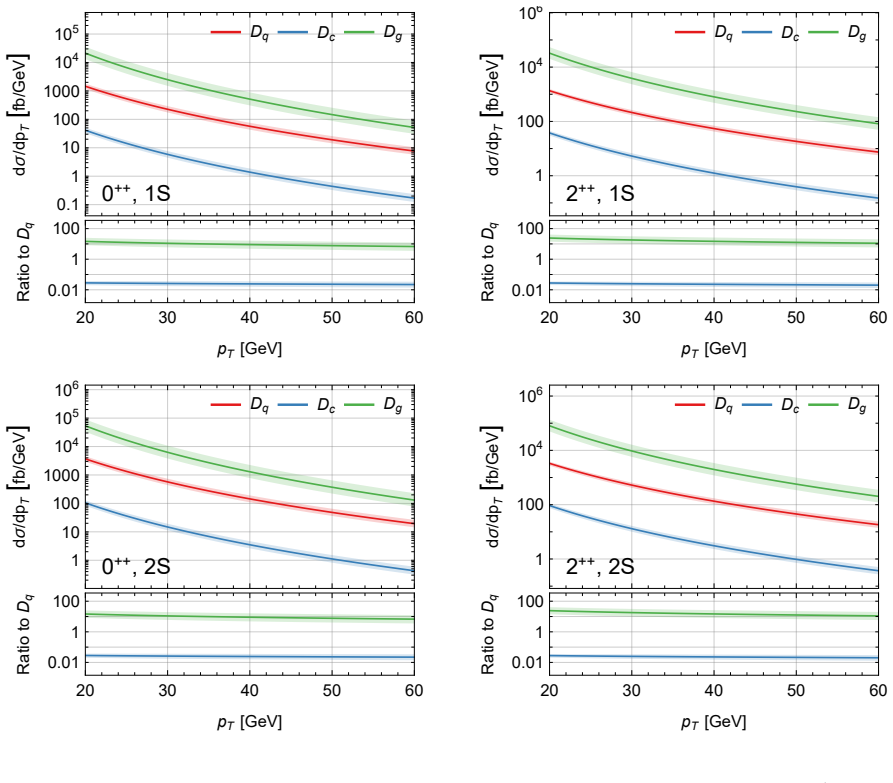
The paper's central claim is that the fragmentation function $D_{q\to T_{4c}}(z,\mu)$ at leading order in $\alpha_s$ and $v$ is fixed by the short-distance coefficients in Eqs. (21), with the nonperturbative normalization carried by four-quark NRQCD matrix elements. In the massless-light-quark limit these coefficients take compact closed forms, such as $(z-4)^2(z-1)/(z(z-2))$ times $\pi^2\alpha_s^4/864$ for the $(6,6)$ color channel of the $0^{++}$ state. Combining the evolved fragmentation functions with partonic cross sections and standard proton PDFs gives integrated cross sections at the 13 TeV LHC and 140 GeV EIC. The predicted ordering at the LHC is gluon $>$ light quark $>$ charm, while at the EIC the light-quark and charm-quark contributions are comparable and both sit below the gluon one.
Load-bearing premise
The load-bearing premise is that the long-distance matrix elements, estimated from a single potential model via the vacuum saturation approximation, set the normalization of all three fragmentation channels; if that model is unrepresentative, the absolute cross sections in Table II shift by potentially orders of magnitude even though the perturbative calculation itself would remain valid.
Editorial extensions
If this is right
- At the LHC with $p_T\ge 20$ GeV, light-quark fragmentation yields $8.1\times 10^3$ fb for the $1S$ $0^{++}$ state and $7.5\times 10^3$ fb for the $1S$ $2^{++}$ state, roughly one to two orders of magnitude below gluon fragmentation but one to two orders above charm-quark fragmentation.
- At the EIC (140 GeV), the light-quark and charm-quark fragmentation channels contribute comparably to $T_{4c}$ production, while gluon fragmentation remains the dominant source by at least an order of magnitude.
- DGLAP evolution substantially increases the fragmentation function at small and intermediate $z$ through mixing with the gluon channel, so predictions at LHC and EIC scales must use the evolved functions rather than the initial-scale ones.
- The same short-distance coefficients, with the light-quark mass replaced by the bottom mass, provide the initial-scale fragmentation function for $b\to T_{4c}$; analogous substitutions give $c\to T_{4b}$, so the formulas cover all quark-initiated channels.
- A complete $T_{4c}$ high-$p_T$ production calculation must sum gluon, charm, and light-quark fragmentation together with their DGLAP mixing, since no single channel dominates the quark-initiated contribution.
Reading between the lines
- Because the same long-distance matrix elements normalize all three fragmentation channels, the predicted ordering $D_g > D_q > D_c$ at the LHC is largely insensitive to the potential-model uncertainty; only the absolute rates, not the ratios, carry that normalization.
- A lattice QCD evaluation of the four-quark matrix elements would convert the current single-model normalization into a first-principles prediction and would directly test the size of the light-quark contribution relative to the gluon one.
- The $m_q\to 0$ closed forms in Eqs. (21) have a distinctive $z$-dependence; measuring the $p_T$ shape of $T_{4c}$ at the LHC could in principle separate the light-quark contribution from the charm-quark one, since their evolved shapes differ.
- The same short-distance coefficient matching technique transfers to fully-bottom tetraquarks, where the larger heavy-quark mass changes the coupling and the velocity expansion, potentially altering the ordering between quark and gluon fragmentation.
Editorial analysis
A structured set of objections, weighed in public.
Referee Report
Summary. This paper computes, within the NRQCD factorization framework, the fragmentation function of a light quark into S-wave fully-charmed tetraquarks at leading order in alpha_s and v. The authors derive closed-form short-distance coefficients for the 0++ and 2++ tetraquark channels, take the massless light-quark limit, and then use LDMEs extracted from a single potential model via the vacuum-saturation approximation. They evolve the fragmentation functions with the DGLAP equation and predict pT distributions and integrated cross sections for T4c production at the LHC (13 TeV) and EIC (140 GeV), comparing their new light-quark channel with the previously computed gluon and charm-quark fragmentation channels. The headline result is that the light-quark fragmentation contribution is smaller than the gluon one but larger than the charm-quark one at the LHC, while at the EIC it is comparable to the charm-quark contribution.
Significance. If the calculation is correct, the paper fills a missing channel in the NRQCD factorization treatment of fully-charmed tetraquark production and provides a useful step toward a complete high-pT production inventory. The perturbative matching is standard in structure, the mq-to-0 limit of the SDCs is well behaved and presented in closed form, and the evolution setup is clearly described at the level of the method. The paper honestly flags the model dependence of the LDMEs in a footnote, but the phenomenological comparison and the absolute predictions rest on inputs whose consistency and uncertainty are not currently documented. The value of the paper lies mainly in the new SDC calculation and the relative-size analysis; those elements are worth publishing once the comparison inputs and LDME uncertainties are made explicit.
major comments (3)
- [§V, Figs. 3–4 and Table II] The comparison curves and numbers for gluon and charm fragmentation are imported from Refs. [43,50], but the manuscript does not state which LDME set, initial scale, alpha_s scheme/value, DGLAP evolution treatment, and kinematic cuts were used for those channels. Since all channels are proportional to LDMEs, the claimed ordering D_g > D_q > D_c and the ratios in Table II are only meaningful if the three channels are evaluated with identical inputs. The footnote in Section V admits that five model LDME sets are enumerated in [50]; the paper should state the inputs used for D_g and D_c and show how the ratios in Table II change across those five sets.
- [§V, Table I and Eq. (22)] The LDMEs are taken from a single potential model [11] with no quoted uncertainty. Because the absolute cross sections in Table II and Figs. 3–4 scale linearly with these LDMEs, the choice of model is a load-bearing input for every numerical prediction. The authors should quote at least the range spanned by the five model sets mentioned in the footnote, and show how the absolute cross sections and the relative ordering of D_q, D_g, and D_c behave under that spread.
- [§V, Eqs. (1)–(3) and Fig. 3 caption] It is not stated whether D_q in the phenomenological curves represents a single light quark flavor or the sum over u, d, s (and their antiquarks) with the corresponding PDFs. The integrated cross sections in Table II depend directly on this choice. The authors should specify the flavor-sum convention, list the active light flavors, and state how the subprocesses in Eq. (2) are combined in the numerical evaluation.
minor comments (4)
- [Section V] The numerical value of alpha_s used in the SDCs and partonic cross sections is not given; since the SDCs scale as alpha_s^4, the scheme, order, and input value at the initial scale mu = 4m_c are needed for reproducibility.
- [Section V] The DGLAP evolution is described as a Runge-Kutta solution including all parton channels, but the number of active flavors, the starting scale, and the treatment of flavor thresholds are not specified.
- [Table I and Section III] For the 2++ state, only the LDME <O^(2)_{3,3}> is listed; a sentence explicitly stating that the other color-spin configurations are forbidden by Fermi statistics, consistent with the diquark-antidiquark spin assignment in Section III, would prevent confusion.
- [Eq. (22)] The factors 16 and 80 in the vacuum-saturation relation are stated without derivation; a brief reference to the origin of these factors, or an explicit demonstration, would help the reader verify the normalization of Table I.
Circularity Check
No circularity: the light-quark fragmentation SDCs are derived by perturbative matching with external LDME inputs; the headline ordering is a computed comparison, not an input.
full rationale
The central derivation is self-contained and non-circular. The short-distance coefficients in Eqs. (18)-(21) are obtained by standard NRQCD perturbative matching to a fictitious four-free-charm-quark state, with the matching procedure described in Section IV and no parameter fitted to the predicted T4c cross sections. The long-distance matrix elements in Table I are external inputs from a potential-model wavefunction at the origin via the vacuum-saturation approximation of Eq. (22); they are stated as inputs, not derived from or fitted to the cross-section predictions. The comparison with gluon and charm fragmentation channels uses previously published results [43,50] as external benchmarks; these are independent, peer-reviewed calculations even though authored by overlapping groups, and the present paper's Dq result does not presuppose them. The headline ordering Dg > Dq > Dc is a computed outcome of convoluting independent fragmentation functions with standard partonic cross sections and PDFs, not a relation imposed by construction or by the LDME choice. The acknowledged limitation that only one of five potential-model LDME sets is used, and the lack of explicit restatement of the inputs for the Dg and Dc curves, are reproducibility or model-uncertainty concerns, not circularity: they do not make any predicted quantity equal to an input by definition.
Assumptions & free parameters
free parameters (1)
- NRQCD LDME values for 1S tetraquarks (from [11]) =
<O(0)_{6,6}>=0.0128 GeV^9, <O(0)_{3,6}>=0.0211 GeV^9, <O(0)_{3,3}>=0.0347 GeV^9, <O(2)_{3,3}>=0.072 GeV^9
assumptions (5)
- domain assumption NRQCD factorization for light quark fragmentation into fully-heavy tetraquarks, Eq. (11): the fragmentation function is a sum of perturbative short-distance coefficients times long-distance matrix elements.
- domain assumption Vacuum saturation approximation, Eq. (22), relating the NRQCD LDMEs to products of four-body wavefunctions at the origin.
- standard math Perturbative matching: the short-distance coefficients can be extracted by replacing the physical tetraquark with four free charm quarks (Section IV).
- standard math DGLAP evolution with the leading-order splitting kernels of Eqs. (9) and (10) determines the scale dependence of the fragmentation functions.
- domain assumption Leading-order partonic cross sections, Eqs. (2), (5) and (6), together with CT14llo PDFs and the EPA photon flux, model the high-pT production at LHC and EIC.
Cite this review
Pith. "Pith review of Light quark fragmentation into S-wave fully charmed tetraquark." pith.science (2026). https://pith.science/paper/3IRC4UR7
@misc{pith2026241119296,
  author       = {Pith},
  title        = {Pith review of: Light quark fragmentation into S-wave fully charmed tetraquark},
  year         = {2026},
  howpublished = {\url{https://pith.science/paper/3IRC4UR7}},
  note         = {Machine review of arXiv:2411.19296}
}
abstract
We compute the fragmentation function of a light quark into S-wave fully-charmed tetraquarks ($T_{4c}$) within the nonrelativistic QCD (NRQCD) framework, at leading order in $\alpha_{s}$ and $v$. We present results for light quark fragmentation into $T_{4c}$ and predict its contribution to $T_{4c}$ production at high transverse momentum ($p_{T}$) at the LHC and EIC. We also compare light quark fragmentation with charm quark and gluon fragmentation channels. Our analysis shows that the production cross section for $T_{4c}$ from light quark fragmentation is smaller than that from gluon fragmentation but larger than that from charm quark fragmentation.
Figures


Figures from the paper (1 more)

Forward citations
Cited by 3 Pith papers
-
Next-to-leading order QCD corrections to electromagnetic production and decay of fully charm tetraquarks
The first NLO QCD corrections to fully charm tetraquark → γγ decay are given, with photon-fusion production cross sections predicted.
-
Bottomoniumlike states in proton collisions: Fragmentation and resummation
New TQHL1.1 and TQ4Q1.1 fragmentation functions for doubly and fully bottomed tetraquarks are constructed and evolved, yielding first predictions for bottom-tetraquark plus jet distributions at 14 and 100 TeV.
-
All-charm tetraquarks at hadron colliders: A high-precision fragmentation perspective
TQ4Q2.0 supplies the first complete, uncertainty-quantified set of NRQCD-based fragmentation functions for all-heavy tetraquarks, including nonconstituent channels and public grids for jet-associated production.
Reference graph
Works this paper leans on
-
[50]
X. W. Bai, F. Feng, C. M. Gan, Y. Huang, W. L. Sang and H. F. Zhang, JHEP 09, 002 (2024) doi:10.1007/JHEP09(2024)002 [arXiv:2404.13889 [hep-ph]]
arXiv 2024
-
[11]
Q. F. L¨ u, D. Y. Chen and Y. B. Dong, Eur. Phys. J. C 80, no.9, 871 (2020) doi:10.1140/epjc/s10052-020-08454-1 [arXiv:2006.14445 [hep-ph]]
arXiv 2020
-
[1]
R. Aaij et al. [LHCb], Sci. Bull. 65, no.23, 1983-1993 (2020) doi:10.1016/j.scib.2020.08.032 [arXiv:2006.16957 [hep-ex]]
arXiv 2020
- [2]
-
[3]
A. Hayrapetyan et al. [CMS], Phys. Rev. Lett. 132, no.11, 111901 (2024) doi:10.1103/PhysRevLett.132.111901 [arXiv:2306.07164 [hep-ex]]
arXiv 2024
-
[4]
Y. Iwasaki, Phys. Rev. Lett. 36, 1266 (1976) doi:10.1103/PhysRevLett.36.1266
-
[5]
K. T. Chao, Z. Phys. C 7, 317 (1981) doi:10.1007/BF01431564
-
[6]
J. P. Ader, J. M. Richard and P. Taxil, Phys. Rev. D 25, 2370 (1982) doi:10.1103/PhysRevD.25.2370
Show all 69 references
-
[7]
J. Wu, Y. R. Liu, K. Chen, X. Liu and S. L. Zhu, Phys. Rev. D 97, no.9, 094015 (2018) doi:10.1103/PhysRevD.97.094015 [arXiv:1605.01134 [hep-ph]]
2018 arXiv
-
[8]
Becchi, J
C. Becchi, J. Ferretti, A. Giachino, L. Maiani and E. Santopinto, Phys. Lett. B 811, 135952 (2020) doi:10.1016/j.physletb.2020.135952 [arXiv:2006.14388 [hep-ph]]
2020
-
[9]
V. R. Debastiani and F. S. Navarra, Chin. Phys. C 43, no.1, 013105 (2019) doi:10.1088/1674- 1137/43/1/013105 [arXiv:1706.07553 [hep-ph]]
2019 arXiv
-
[10]
M. A. Bedolla, J. Ferretti, C. D. Roberts and E. Santopinto, Eur. Phys. J. C 80, no.11, 1004 (2020) doi:10.1140/epjc/s10052-020-08579-3 [arXiv:1911.00960 [hep-ph]]
2020 arXiv
-
[12]
M. S. liu, F. X. Liu, X. H. Zhong and Q. Zhao, Phys. Rev. D 109, no.7, 076017 (2024) doi:10.1103/PhysRevD.109.076017 [arXiv:2006.11952 [hep-ph]]
2024 arXiv
-
[13]
J. Zhao, S. Shi and P. Zhuang, Phys. Rev. D 102, no.11, 114001 (2020) doi:10.1103/PhysRevD.102.114001 [arXiv:2009.10319 [hep-ph]]
2020 arXiv
-
[14]
Z. Zhao, K. Xu, A. Kaewsnod, X. Liu, A. Limphirat and Y. Yan, Phys. Rev. D 103, no.11, 116027 (2021) doi:10.1103/PhysRevD.103.116027 [arXiv:2012.15554 [hep-ph]]
2021 arXiv
-
[15]
J. F. Giron and R. F. Lebed, Phys. Rev. D 102, no.7, 074003 (2020) doi:10.1103/PhysRevD.102.074003 [arXiv:2008.01631 [hep-ph]]
2020 arXiv
-
[16]
H. W. Ke, X. Han, X. H. Liu and Y. L. Shi, Eur. Phys. J. C 81, no.5, 427 (2021) doi:10.1140/epjc/s10052-021-09229-y [arXiv:2103.13140 [hep-ph]]
2021 arXiv
-
[17]
X. Jin, Y. Xue, H. Huang and J. Ping, Eur. Phys. J. C 80, no.11, 1083 (2020) doi:10.1140/epjc/s10052-020-08650-z [arXiv:2006.13745 [hep-ph]]
2020 arXiv
-
[18]
G. J. Wang, Q. Meng and M. Oka, Phys. Rev. D 106, no.9, 096005 (2022) doi:10.1103/PhysRevD.106.096005 [arXiv:2208.07292 [hep-ph]]
2022 arXiv
-
[19]
W. L. Wu, Y. K. Chen, L. Meng and S. L. Zhu, Phys. Rev. D 109, no.5, 054034 (2024) doi:10.1103/PhysRevD.109.054034 [arXiv:2401.14899 [hep-ph]]
2024 arXiv
-
[20]
Y. Bai, S. Lu and J. Osborne, Phys. Lett. B 798, 134930 (2019) 13 doi:10.1016/j.physletb.2019.134930 [arXiv:1612.00012 [hep-ph]]
2019
-
[21]
M. C. Gordillo, F. De Soto and J. Segovia, Phys. Rev. D 102, no.11, 114007 (2020) doi:10.1103/PhysRevD.102.114007 [arXiv:2009.11889 [hep-ph]]
2020 arXiv
-
[22]
G. J. Wang, L. Meng and S. L. Zhu, Phys. Rev. D 100, no.9, 096013 (2019) doi:10.1103/PhysRevD.100.096013 [arXiv:1907.05177 [hep-ph]]
2019 arXiv
-
[23]
G. J. Wang, L. Meng, M. Oka and S. L. Zhu, Phys. Rev. D 104, no.3, 036016 (2021) doi:10.1103/PhysRevD.104.036016 [arXiv:2105.13109 [hep-ph]]
2021 arXiv
-
[24]
F. X. Liu, M. S. Liu, X. H. Zhong and Q. Zhao, Phys. Rev. D 104, no.11, 116029 (2021) doi:10.1103/PhysRevD.104.116029 [arXiv:2110.09052 [hep-ph]]
2021 arXiv
-
[25]
G. L. Yu, Z. Y. Li, Z. G. Wang, J. Lu and M. Yan, Eur. Phys. J. C 83, no.5, 416 (2023) doi:10.1140/epjc/s10052-023-11445-7 [arXiv:2212.14339 [hep-ph]]
2023 arXiv
-
[26]
Mutuk, Eur
H. Mutuk, Eur. Phys. J. C 81, no.4, 367 (2021) doi:10.1140/epjc/s10052-021-09176-8 [arXiv:2104.11823 [hep-ph]]
2021 arXiv
-
[27]
Tiwari, D
R. Tiwari, D. P. Rathaud and A. K. Rai, Indian J. Phys. 97, no.3, 943-954 (2023) doi:10.1007/s12648-022-02427-8 [arXiv:2108.04017 [hep-ph]]
2023 arXiv
-
[28]
R. N. Faustov, V. O. Galkin and E. M. Savchenko, Symmetry 14, no.12, 2504 (2022) doi:10.3390/sym14122504 [arXiv:2210.16015 [hep-ph]]
2022 arXiv
-
[29]
H. X. Chen, W. Chen, X. Liu and S. L. Zhu, Sci. Bull. 65, 1994-2000 (2020) doi:10.1016/j.scib.2020.08.038 [arXiv:2006.16027 [hep-ph]]
2020 arXiv
-
[30]
Z. G. Wang, Chin. Phys. C 44, no.11, 113106 (2020) doi:10.1088/1674-1137/abb080 [arXiv:2006.13028 [hep-ph]]
2020 arXiv
-
[31]
B. C. Yang, L. Tang and C. F. Qiao, Eur. Phys. J. C 81, no.4, 324 (2021) doi:10.1140/epjc/s10052-021-09096-7 [arXiv:2012.04463 [hep-ph]]
2021 arXiv
-
[32]
B. D. Wan and C. F. Qiao, Phys. Lett. B 817, 136339 (2021) doi:10.1016/j.physletb.2021.136339 [arXiv:2012.00454 [hep-ph]]
2021
-
[33]
J. R. Zhang, Phys. Rev. D 103, no.1, 014018 (2021) doi:10.1103/PhysRevD.103.014018 [arXiv:2010.07719 [hep-ph]]
2021 arXiv
-
[34]
C. M. Tang, C. G. Duan and L. Tang, Eur. Phys. J. C 84, no.7, 743 (2024) doi:10.1140/epjc/s10052-024-13102-z [arXiv:2405.05042 [hep-ph]]
2024 arXiv
-
[35]
Hughes, E
C. Hughes, E. Eichten and C. T. H. Davies, Phys. Rev. D 97, no.5, 054505 (2018) doi:10.1103/PhysRevD.97.054505 [arXiv:1710.03236 [hep-lat]]
2018 arXiv
-
[36]
W. L. Sang, T. Wang, Y. D. Zhang and F. Feng, Phys. Rev. D 109, no.5, 056016 (2024) doi:10.1103/PhysRevD.109.056016 [arXiv:2307.16150 [hep-ph]]
2024 arXiv
-
[37]
H. F. Zhang, X. M. Mo and Y. P. Yan, Phys. Rev. D 110, no.9, 096021 (2024) doi:10.1103/PhysRevD.110.096021 [arXiv:2312.10850 [hep-ph]]
2024 arXiv
-
[38]
H. X. Chen, W. Chen, X. Liu, Y. R. Liu and S. L. Zhu, Rept. Prog. Phys. 86, no.2, 026201 (2023) doi:10.1088/1361-6633/aca3b6 [arXiv:2204.02649 [hep-ph]]
2023 arXiv
-
[39]
Maciu la, W
R. Maciu la, W. Sch¨ afer and A. Szczurek, Phys. Lett. B 812, 136010 (2021) doi:10.1016/j.physletb.2020.136010 [arXiv:2009.02100 [hep-ph]]
2021
-
[40]
Carvalho, E
F. Carvalho, E. R. Cazaroto, V. P. Gon¸ calves and F. S. Navarra, Phys. Rev. D 93, no.3, 034004 (2016) doi:10.1103/PhysRevD.93.034004 [arXiv:1511.05209 [hep-ph]]
2016 arXiv
-
[41]
Karliner, S
M. Karliner, S. Nussinov and J. L. Rosner, Phys. Rev. D 95, no.3, 034011 (2017) doi:10.1103/PhysRevD.95.034011 [arXiv:1611.00348 [hep-ph]]
2017 arXiv
-
[42]
A. V. Berezhnoy, A. K. Likhoded, A. V. Luchinsky and A. A. Novoselov, Phys. Rev. D 84, 094023 (2011) doi:10.1103/PhysRevD.84.094023 [arXiv:1101.5881 [hep-ph]]
2011 arXiv
-
[43]
F. Feng, Y. Huang, Y. Jia, W. L. Sang, X. Xiong and J. Y. Zhang, Phys. Rev. D 106, no.11, 14 114029 (2022) doi:10.1103/PhysRevD.106.114029 [arXiv:2009.08450 [hep-ph]]
2022 arXiv
-
[44]
F. Feng, Y. Huang, Y. Jia, W. L. Sang and J. Y. Zhang, Phys. Lett. B 818, 136368 (2021) doi:10.1016/j.physletb.2021.136368 [arXiv:2011.03039 [hep-ph]]
2021
-
[45]
H. F. Zhang and Y. Q. Ma, [arXiv:2009.08376 [hep-ph]]
2009 arXiv
-
[46]
Huang, F
Y. Huang, F. Feng, Y. Jia, W. L. Sang, D. S. Yang and J. Y. Zhang, Chin. Phys. C 45, no.9, 093101 (2021) doi:10.1088/1674-1137/ac0b38 [arXiv:2104.03887 [hep-ph]]
2021 arXiv
-
[47]
Zhu, Nucl
R. Zhu, Nucl. Phys. B 966, 115393 (2021) doi:10.1016/j.nuclphysb.2021.115393 [arXiv:2010.09082 [hep-ph]]
2021
-
[48]
F. Feng, Y. Huang, Y. Jia, W. L. Sang, D. S. Yang and J. Y. Zhang, Phys. Rev. D 108, no.5, L051501 (2023) doi:10.1103/PhysRevD.108.L051501 [arXiv:2304.11142 [hep-ph]]
2023 arXiv
-
[49]
F. Feng, Y. Huang, Y. Jia, W. L. Sang, D. S. Yang and J. Y. Zhang, Phys. Rev. D 110, no.5, 054007 (2024) doi:10.1103/PhysRevD.110.054007 [arXiv:2311.08292 [hep-ph]]
2024 arXiv
-
[51]
J. C. Collins, D. E. Soper and G. F. Sterman, Adv. Ser. Direct. High Energy Phys. 5, 1-91 (1989) doi:10.1142/9789814503266 0001 [arXiv:hep-ph/0409313 [hep-ph]]
1989 arXiv
-
[52]
F. G. Celiberto, G. Gatto and A. Papa, Eur. Phys. J. C 84, no.10, 1071 (2024) doi:10.1140/epjc/s10052-024-13345-w [arXiv:2405.14773 [hep-ph]]
2024 arXiv
-
[53]
B. A. Kniehl, G. Kramer and M. Spira, Z. Phys. C 76, 689-700 (1997) doi:10.1007/s002880050591 [arXiv:hep-ph/9610267 [hep-ph]]
1997 arXiv
-
[54]
Flore, J
C. Flore, J. P. Lansberg, H. S. Shao and Y. Yedelkina, Phys. Lett. B 811, 135926 (2020) doi:10.1016/j.physletb.2020.135926 [arXiv:2009.08264 [hep-ph]]
2020
-
[55]
J. C. Collins and D. E. Soper, Nucl. Phys. B 194, 445-492 (1982) doi:10.1016/0550- 3213(82)90021-9
1982 doi
-
[56]
Altarelli and G
G. Altarelli and G. Parisi, Nucl. Phys. B 126, 298-318 (1977) doi:10.1016/0550-3213(77)90384- 4
1977 doi
-
[57]
Y. L. Dokshitzer, Sov. Phys. JETP 46, 641-653 (1977)
1977
-
[58]
V. N. Gribov and L. N. Lipatov, Sov. J. Nucl. Phys. 15, 438-450 (1972) IPTI-381-71
1972
-
[59]
L. N. Lipatov, Yad. Fiz. 20, 181-198 (1974)
1974
- [60]
-
[61]
Cacciari and M
M. Cacciari and M. Greco, Nucl. Phys. B 421, 530-544 (1994) doi:10.1016/0550- 3213(94)90515-0 [arXiv:hep-ph/9311260 [hep-ph]]
1994 arXiv
-
[62]
B. A. Kniehl, G. Kramer, I. Schienbein and H. Spiesberger, Eur. Phys. J. C 41, 199-212 (2005) doi:10.1140/epjc/s2005-02200-7 [arXiv:hep-ph/0502194 [hep-ph]]
2005 arXiv
-
[63]
Petrelli, M
A. Petrelli, M. Cacciari, M. Greco, F. Maltoni and M. L. Mangano, Nucl. Phys. B514, 245-309 (1998) doi:10.1016/S0550-3213(97)00801-8 [arXiv:hep-ph/9707223 [hep-ph]]
1998 arXiv
-
[64]
Binosi, J
D. Binosi, J. Collins, C. Kaufhold and L. Theussl, Comput. Phys. Commun. 180, 1709-1715 (2009) doi:10.1016/j.cpc.2009.02.020 [arXiv:0811.4113 [hep-ph]]
2009 arXiv
-
[65]
Hahn, Comput
T. Hahn, Comput. Phys. Commun. 140, 418-431 (2001) doi:10.1016/S0010-4655(01)00290-9 [arXiv:hep-ph/0012260 [hep-ph]]
2001 arXiv
-
[66]
Mertig, M
R. Mertig, M. Bohm and A. Denner, Comput. Phys. Commun. 64, 345-359 (1991) doi:10.1016/0010-4655(91)90130-D
1991 doi
- [67]
- [68]
-
[69]
Dulat, T
S. Dulat, T. J. Hou, J. Gao, M. Guzzi, J. Huston, P. Nadolsky, J. Pumplin, C. Schmidt, D. Stump and C. P. Yuan, Phys. Rev. D 93, no.3, 033006 (2016) 15 doi:10.1103/PhysRevD.93.033006 [arXiv:1506.07443 [hep-ph]]. 16
2016 arXiv
Reviewed August 12, 2026 · model on record in the stance chip above.
Discussion (0). Continue with ORCID to comment.