REVIEW 4 major objections 7 minor 102 references
Reconfigurable Holographic Surface: A New Paradigm for Ultra-Massive MIMO
T0 review · 4 major / 7 minor · reviewed 2026-08-12 · deepseek-v4-flash
Pith's one-line read Reconfigurable holographic surfaces can replace phased arrays for ultra-massive MIMO at lower cost and power.
desk verdict Useful RHS tutorial whose beamforming and cost-efficiency results are undercut by the paper's own admission that series-fed coupling is ignored in every presented design. read the letter →
The pith
A machine-rendered reading of the paper's core claim, the machinery that carries it, and where it could break.
The reading
What carries the argument
The load-bearing object is the holographic pattern itself: an array of amplitude coefficients $m_{n_y,n_z}$ derived from the interference between the reference wave propagating along the surface and the object wave of the desired beam. This pattern converts beamforming from complex phase control to real amplitude control, and it introduces the leakage power constraint that couples the radiated power to the total feed power. The same pattern machinery underlies the holographic beamformer, the holographic-pattern division multiple access (HDMA) superposition of single-user patterns, the scale-changeable RHS formed by turning elements off, and the RHS radar and ISAC beamformers.
What would settle it
Measure or full-wave simulate a series-fed RHS with a large array, compare the per-element radiated power and far-field pattern against the pattern predicted by setting amplitudes to the holographic pattern of Eq. (5) under a total power constraint; if the main-lobe direction or beamwidth deviates materially, the claimed beamforming and radar performance is not realizable without coupling-aware design.
Extended reading notes
Core claim
The paper's central claim is that an RHS can realize ultra-massive MIMO by replacing phase control with amplitude control. Each metamaterial element radiates with an amplitude proportional to the holographic pattern $m(\theta_0,\varphi_0) = (\mathrm{Re}[\Psi_{\mathrm{intf}}]+1)/2$, where $\Psi_{\mathrm{intf}}$ is the interference between the feed's reference wave and the free-space object wave pointing in the desired direction. Because only real amplitudes are optimized, beamforming becomes a real-valued optimization problem, and the unique leakage power constraint $\sum \eta_{n_y,n_z} m^2 \le P_t$ replaces the per-antenna power constraint of phased arrays. The paper argues this architecture achieves comparable spectral efficiency and sensing resolution with lower hardware cost and energy consumption, and it validates the concept with a 12 GHz RHS communication prototype and an ISAC prototype.
Load-bearing premise
The system-level gains assume each RHS element radiates an independently controllable amplitude subject only to a total power budget, even though the paper's own leakage-power discussion states that series feeding couples radiated power across elements.
Editorial extensions
If this is right
- If RHS works as claimed, ultra-massive MIMO can be built with PCB-level manufacturing, diode-based amplitude control, and no per-element phase shifters, lowering hardware cost at high sum-rate requirements.
- HDMA reduces multi-user beamforming complexity from scaling with the number of elements to scaling with the number of users, with cost-efficiency improving as the RHS aperture grows.
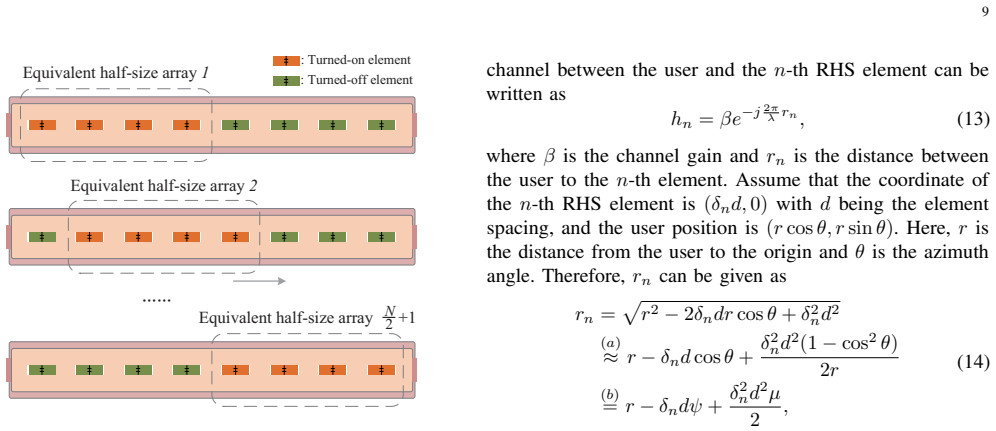
- A scale-changeable RHS, created by switching elements to zero amplitude, enables hierarchical near- and far-field codebooks with beam-training overhead logarithmic rather than linear in the number of elements.
- RHS radar consumes less power than phased-array radar at the same received SNR and, at high frequencies and moderate apertures, outperforms RIS/IRS radar in detection probability.
- The reported prototypes demonstrate real-time 1080p/30fps video transmission with received SNR above 20 dB and ISAC operation that communicates at 5 Mbit/s while estimating target range.
Reading between the lines
- The paper's system-level designs treat each element as independently controllable under a total power constraint, but its own leakage-power discussion states that series feeding couples radiated power across elements; a coupling-aware beamforming design would be a direct next step the paper leaves open.
- If the independent-element model holds approximately, the same amplitude-only aperture naturally extends to wireless power transfer and localization, since a large, focused aperture improves both power delivery efficiency and sensing resolution.
- A testable extension is quantifying the required amplitude quantization bits as a function of element coupling and near-field effects; existing results suggest 1–2 bits may suffice in single-user cases, but coupling could raise that requirement.
Editorial analysis
A structured set of objections, weighed in public.
Referee Report
Summary. This paper is a tutorial/survey of reconfigurable holographic surfaces (RHS) as a cost- and power-efficient alternative to phased arrays for ultra-massive MIMO. It explains the holographic principle, the hardware structure, and the leakage-power constraint unique to series-fed leaky-wave RHS. It then presents case studies for multi-user communication (holographic beamforming, HDMA, codebook design), sensing (RHS radar, RIS/RHS comparison, ISAC), and reports two hardware prototypes with measurement results. The paper concludes with open challenges. The central claim is that RHS can realize ultra-massive MIMO without costly phase shifters and power amplifiers, supported by simulations and prototype demonstrations.
Significance. If the central claim holds, this tutorial would be a valuable systematization of an emerging antenna technology for 6G, especially because it connects the physical operating principle to system-level designs and includes concrete hardware prototypes. The paper is honest about the leakage-power constraint and explicitly identifies the series-fed coupling that complicates beamforming design. The prototype work is a strength: the authors report a working 2D RHS communication platform and a 1D RHS ISAC prototype with real-time video and sensing results. However, the quantitative evidence for the headline cost and power advantages is weaker: the cost-efficiency plots depend on assumed cost ratios, and the prototype sections do not compare against a phased-array baseline under controlled conditions. The significance is therefore conditional on whether the idealized system-level models can be reconciled with the physical coupling admitted in the working-principle section.
major comments (4)
- [§II-C3, §III-A2, §III-B1, §IV-A2] The paper explicitly states in §II-C3 that in a series-fed leaky-wave RHS, the radiated power of the current element is related to those of previous elements, resulting in coupling among RHS elements. Yet every subsequent system design treats the elements as independently controllable amplitude weights under only a total-power constraint: Eq. (9c) uses Tr(M V V^H M^H) ≤ P_T, Eq. (10) superposes independent single-user patterns, and Eq. (18) optimizes M under |M q|^2 = 1. In a series-fed guide, the power incident on element n is the feed power minus what was radiated or absorbed by elements 1 through n−1, so the radiated power is not an independent quadratic form in the element amplitudes. The feasible set of Eq. (9c) therefore includes patterns that cannot be physically realized with the specified radiated powers, and the simulated rates and detection probabilities in Figs. 9, 11, 16, and 21 may be optimistic. The authors should either incorporate the coupling into the optimization models (even in a simplified form) or explicitly reframe the results as ideal upper bounds and add a caveat that practical RHS performance may be lower. As written, the central claim that RHS is a cost- and power-efficient alternative to phased arrays is not yet supported for the multi-user and radar cases.
- [§III-A3, §III-B3, §IV-A3, §IV-C3] The cost and power advantages are quantified through simulations that assume cost ratios rather than measured data: c in §III-A3, β in §III-B3, τ in §IV-A3, and β again in §IV-C3. These ratios are taken from an industrial white paper (Ref. [41]) and are not backed by measurements of actual RHS element costs or a sensitivity analysis. The conclusion that RHS is more cost-efficient than phased arrays is therefore a conditional statement that depends entirely on the assumed ratios; without measured cost data or a robustness study, the plots do not by themselves validate the central claim. The authors should add a sensitivity analysis over the cost ratios and, ideally, cite or provide measured element-cost data.
- [§V-B, §V-C] The prototype sections demonstrate that the RHS can transmit QPSK video (SNR > 20 dB) and can support basic ISAC with one user and one target. However, these demonstrations lack a comparison against a phased-array baseline under the same aperture, transmit power, and cost budget, so they do not substantiate the claimed cost or power advantage. In addition, the ISAC measurements appear to be single-shot (no repeated trials or error bars), and the 'target' is an emulated module rather than a physical reflector. The paper should either add a baseline comparison with identical conditions or soften the claim in the abstract and conclusions that the measurement results 'verify the benefits of the RHS compared to the phased array.'
- [§III-B2] Equation (12) presents the closed-form optimal weighting factors a_l^* for HDMA without any derivation or statement of the channel conditions under which it holds. Since this equation is a load-bearing component of the HDMA complexity claim, a reader cannot verify whether the result applies to the general multi-user system described in §III-B1. The authors should state the assumptions (e.g., line-of-sight channels, equal user distances, large aperture) and either provide a short derivation or explicitly cite the derivation in Ref. [39] with the necessary conditions.
minor comments (7)
- [§I-A] Typo: 'existing MIMO technologies primarily relay on phased arrays' should read 'rely on phased arrays.'
- [§II-B] Typo in the bullet list: 'Lowe power consumption' should be 'Low power consumption.'
- [§I-B] Typo: 'high-frequency band backhual' should be 'backhaul.'
- [§II-C4] The table and text use 'parallel seeding' for RIS/IRS; this should likely be 'parallel feeding' for terminological consistency with the RHS description.
- [§IV-A1] Equation (15) mixes row and column vectors without clear dimensional annotations (e.g., (M^r q^r)^T (a^r(θ,φ))^T (h^r)^T h^t ...). Adding explicit dimensions or a short variable table would improve readability.
- [§V-A2] Figure 25 caption repeats '(a) Horizontal plane' for both subfigures; the second subfigure should be labeled '(b) Vertical plane.'
- [§IV-A3] The sentence 'The detection probability is positively related to the received SNR given the given the false alarm probability' contains a duplicated 'given the' and should be rephrased.
Circularity Check
No significant circularity: the tutorial's claims rest on prior published results, design identities, and original prototype measurements, while the admitted series-fed coupling gap is a modeling limitation rather than a tautological reduction.
full rationale
This paper is a tutorial/review, not a new derivation. Its central performance claims are either reproduced from prior publications by the same group or supported by original prototype measurements reported in Section V. The holographic beamforming relation (Eqs. 3-5) is a design definition: the element amplitude is defined as the normalized interference between the reference and object waves, so the reconstruction of the object wave follows algebraically from the holographic principle rather than from a fitted parameter. The optimization problems (9), (16), and (18) are standard constrained beamforming problems with real-valued amplitude variables; no equation in the paper is shown to be equivalent, by construction, to the claim it is used to support. The extensive self-citations ([9], [39], [54], [58]) are a normal feature of a tutorial and do not by themselves constitute circularity; the paper also includes independent experimental measurements from its own prototypes. One genuine limitation, explicitly flagged by the paper itself, appears in Section II-C3: the series-fed leaky-wave coupling among RHS elements is said to require new beamforming design methods, yet the subsequent designs in Sections III and IV use an independent-amplitude total-power model (Eqs. 9c and 18). This is a modeling gap and a correctness risk, but it is not a circular reduction: (9c) is not identical to (6) by construction, and the discrepancy is an unverified simplification rather than a tautology. Similarly, the cost-effectiveness bound (23) is imported from the authors' prior work [58], but it is an external analytical result, not a prediction of this paper's own fitted data. Under the strict circularity standard, no specific step reduces to its own input by definition or by fitted-parameter renaming.
Assumptions & free parameters
free parameters (3)
- Cost ratio beta (phased array Tx/Rx module to RHS element) =
2 to 10 (Fig. 11, Fig. 21)
- Cost ratio c (phased array Tx/Rx module to RHS radiation element) =
Varied in Fig. 9
- Cost ratio tau (phased array antenna to RHS element, radar) =
3, 6, 9 (Fig. 16)
assumptions (4)
- domain assumption A constant-modulus reference wave can reconstruct the object wave from the recorded hologram (Section II-A, Step 2).
- domain assumption Each RHS element radiates with amplitude given by the normalized real part of the interference, and element phases are fixed by the reference wave (Eqs. 1-5).
- ad hoc to paper The leakage power constraint is modeled as a sum power budget (Eq. 6) without position-dependent residual power coupling in later system designs (Section III-A2).
- domain assumption Cost ratios from an industry white paper are representative for 6G hardware (Refs. [41], [55]).
Cite this review
Pith. "Pith review of Reconfigurable Holographic Surface: A New Paradigm for Ultra-Massive MIMO." pith.science (2026). https://pith.science/paper/YCIK4IFJ
@misc{pith2026241119334,
  author       = {Pith},
  title        = {Pith review of: Reconfigurable Holographic Surface: A New Paradigm for Ultra-Massive MIMO},
  year         = {2026},
  howpublished = {\url{https://pith.science/paper/YCIK4IFJ}},
  note         = {Machine review of arXiv:2411.19334}
}
read the original abstract
Evolving from massive multiple-input multiple-output (MIMO) in current 5G communications, ultra-massive MIMO emerges as a seminal technology for fulfilling more stringent requirements of future 6G communications. However, widely-utilized phased arrays relying on active components make the implementation of ultra-massive MIMO in practice increasingly prohibitive from both cost and power consumption perspectives. In contrast, the development of reconfigurable holographic surface (RHS) provides a new paradigm to solve the above issue without the need of costly hardware components. By leveraging the holographic principle, the RHS serves as an ultra-thin and lightweight surface antenna integrated with the transceiver, which is a promising alternative to phased arrays for realizing ultra-massive MIMO. In this paper, we provide a comprehensive overview of the RHS, especially the RHS-aided communication and sensing. We first describe the basic concepts of RHS, and introduce its working principle and unique practical constraints. Moreover, we show how to utilize the RHS to achieve cost-efficient and high-performance wireless communication and sensing, and introduce the key technologies. In particular, we present the implementation of RHS with a wireless communication prototype, and report the experimental measurement results based on it. Finally, we outline some open challenges and potential future directions in this area.
Figures


Figures from the paper (25 more)




Reference graph
Works this paper leans on
-
[41]
Holographic Beamforming and Phased Arrays
“Holographic Beamforming and Phased Arrays”, Pivotal Commware, Kirkland, W A, 2019
work page 2019
-
[39]
HDMA: Holographic- Pattern Division Multiple Access,
R. Deng, B. Di, H. Zhang and L. Song, “HDMA: Holographic- Pattern Division Multiple Access,” IEEE Journal on Selected Areas in Communications, vol. 40, no. 4, pp. 1317-1332, April 2022
work page 2022
-
[1]
What Should 6G Be?
S. Dang, O. Amin, B. Shihada, and M.-S. Alouini, “What Should 6G Be?” Nature Electron., vol. 3, no. 1, pp. 20-29, Jan. 2020
2020
-
[2]
The Roadmap to 6G: AI Empowered Wireless Networks,
K. B. Letaief, W. Chen, Y . Shi, J. Zhang, and Y .-J. A. Zhang, “The Roadmap to 6G: AI Empowered Wireless Networks,” IEEE Commun. Mag., vol. 57, no. 8, pp. 84–90, Aug. 2019
2019
-
[3]
Extremely Large-Scale MIMO: Fundamentals, Challenges, Solutions, and Future Directions,
Z. Wang, J. Zhang, H. Du, W. E. I. Sha, B. Ai, and D. Niyato, “Extremely Large-Scale MIMO: Fundamentals, Challenges, Solutions, and Future Directions,” IEEE Wireless Commun. , vol. 31, no. 3, pp. 117-124, Jun. 2024
2024
-
[4]
A Survey on Hybrid Beamforming Techniques in 5G: Architecture and System Model Perspectives,
I. Ahmed, H. Khammari, A. Shahid, A. Musa, K. S. Kim, E. D. Poorter, and I. Moerman, “A Survey on Hybrid Beamforming Techniques in 5G: Architecture and System Model Perspectives,” IEEE Commun. Surveys Tuts., vol. 20, no. 4, pp. 3060-3097, 4th Quart. 2018
2018
-
[5]
Intelligent Omni-Surfaces: Ubiquitous Wireless Transmission by Reflective-Refractive Metasurfaces,
S. Zhang, H. Zhang, B. Di, Y . Tan, M. D. Renzo, Z. Han, H. V . Poor, and L. Song, “Intelligent Omni-Surfaces: Ubiquitous Wireless Transmission by Reflective-Refractive Metasurfaces,” IEEE Trans. Wireless Commun. , vol. 21, no. 1, pp. 219-233, Jan. 2022
2022
-
[6]
Deep Learning Techniques for Advancing 6G Communications in the Physical Layer,
S. Zhang, J. Liu, T. K. Rodrigues, and N. Kato, “Deep Learning Techniques for Advancing 6G Communications in the Physical Layer,” IEEE Wireless Commun., vol. 28, no. 5, pp. 141-147, Oct. 2021
2021
Show all 102 references
-
[7]
Movable Antennas for Wireless Commu- nication: Opportunities and Challenges,
L. Zhu, W. Ma and R. Zhang, “Movable Antennas for Wireless Commu- nication: Opportunities and Challenges,” IEEE Commun. Mag. , vol. 62, no. 6, pp. 114-120, Jun. 2024
2024
-
[8]
6D Movable Antenna based on User Distribution: Modeling and Optimization
X. Shao, Q. Jiang, and R Zhang, “6D Movable Antenna based on User Distribution: Modeling and Optimization.” arXiv:2403.08123, 2024
2024 arXiv
-
[9]
Reconfigurable Holo- graphic Surface-Enabled Multi-User Wireless Communications: Amplitude- Controlled Holographic Beamforming,
R. Deng, B. Di, H. Zhang, Y . Tan, and L. Song, “Reconfigurable Holo- graphic Surface-Enabled Multi-User Wireless Communications: Amplitude- Controlled Holographic Beamforming,” IEEE Trans. Wireless Commun. , vol. 21, no. 8, pp. 6003-6017, Aug. 2022
2022
-
[10]
Reconfigurable Holographic Surfaces for Future Wireless Communications,
R. Deng, B. Di, H. Zhang, D. Niyato, Z. Han, H. V . Poor, and L. Song, “Reconfigurable Holographic Surfaces for Future Wireless Communications,” IEEE Wireless Commun., vol. 28, no. 6, pp. 126-131, Dec. 2021
2021
-
[11]
Smart Radio Environments Empowered by Reconfigurable Intelligent Surfaces: How It Works, State of Research, and The Road Ahead,
M. Di Renzo, A. Zappone, M. Debbah, M.-S. Alouini, C. Yuen, J. Rosny, and S. Tretyakov, “Smart Radio Environments Empowered by Reconfigurable Intelligent Surfaces: How It Works, State of Research, and The Road Ahead,” IEEE J. Sel. Areas Commun. , vol. 38, no. 11, pp. 2450-2525...
2020
-
[12]
Intelligent Reflecting Surface-aided Wireless Communications: A Tutorial,
Q. Wu, S. Zhang, B. Zheng, C. You, and R. Zhang, “Intelligent Reflecting Surface-aided Wireless Communications: A Tutorial,” IEEE Trans. Commun., vol. 69, no. 5, pp. 3313-3351, May 2021
2021
-
[13]
Intelligent Reflecting Surface in 6G Vehicular Communications: A Survey,
Y . Zhu, B. Mao, and N. Kato, “Intelligent Reflecting Surface in 6G Vehicular Communications: A Survey,” IEEE Open J. Veh.Technol., vol. 3, pp. 266-277, May 2022
2022
-
[14]
Hybrid Beamforming for Reconfigurable Intelligent Surface based Multi-User Communications: Achievable Rates With Limited Discrete Phase Shifts,
B. Di, H. Zhang, L. Song, Y . Li, Z. Han, and H. V . Poor, “Hybrid Beamforming for Reconfigurable Intelligent Surface based Multi-User Communications: Achievable Rates With Limited Discrete Phase Shifts,” IEEE J. Sel. Areas Commun. , vol. 38, no. 8, pp. 1809-1822, Aug. 2020
2020
-
[15]
Intelligent Reflecting Surface Enhanced Wireless Network via Joint Active and Passive Beamforming,
Q. Wu and R. Zhang, “Intelligent Reflecting Surface Enhanced Wireless Network via Joint Active and Passive Beamforming,” IEEE Trans. Wireless Commun., vol. 18, no. 11, pp. 5394-5409, Nov. 2019
2019
-
[16]
Linear Complexity Holographic Beamforming For Satellite Broadcasting,
X. He, Y . Gong, L. Huang, and J. Wang, “Linear Complexity Holographic Beamforming For Satellite Broadcasting,” IEEE Trans. Veh. Technol., to be published
-
[17]
Holographic MIMO for LEO Satellite Communications Aided by Reconfigurable Holographic Surfaces,
R. Deng, B. Di, H. Zhang, H. V . Poor, and L. Song, “Holographic MIMO for LEO Satellite Communications Aided by Reconfigurable Holographic Surfaces,” IEEE J. Sel. Areas Commun. , vol. 40, no. 10, pp. 3071-3085, Oct. 2022
2022
-
[18]
Holographic Beamforming for LEO Satellites,
X. Hu, R. Deng, B. Di, H. Zhang, and L. Song, “Holographic Beamforming for LEO Satellites,” IEEE Commun. Lett. , vol. 27, no. 10, pp. 2717-2721, Oct. 2023
2023
-
[19]
A Survey of Wireless Communications and Propagation Modeling in Underground Mines,
A. E. Forooshani, S. Bashir, D. G. Michelson, and S. Noghanian, “A Survey of Wireless Communications and Propagation Modeling in Underground Mines,” IEEE Commun. Surveys Tuts. , vol. 15, no. 4, pp. 1524-1545, 4th Quart. 2013
2013
-
[20]
FPMIMO: A General MIMO Structure with Overlapping Subarrays for Various Radar Applications,
S. Tahcfulloh and G. Hendrantoro, “FPMIMO: A General MIMO Structure with Overlapping Subarrays for Various Radar Applications,” IEEE Access, vol. 8, pp. 11248–11267, 2020
2020
-
[21]
Millimeter Wave Communications for Future Mobile Networks,
M. Xiao, S. Mumtaz, Y . Huang, L. Dai, Y . Li, M. Matthaiou, G. K. Karagiannidis, E. Bj ¨ornson, K. Yang, C.-L. I, and A. Ghosh, “Millimeter Wave Communications for Future Mobile Networks,” IEEE J. Sel. Areas Commun., vol. 35, no. 9, pp. 1909-1935, Sept. 2017
1909
-
[22]
Combating the Distance Problem in the Millimeter Wave and Terahertz Frequency Bands,
I. F. Akyildiz, C. Han and S. Nie, “Combating the Distance Problem in the Millimeter Wave and Terahertz Frequency Bands,” IEEE Commun. Mag., vol. 56, no. 6, pp. 102-108, Jun. 2018
2018
-
[23]
Intelligent Surfaces Empowered Wireless Network: Recent Advances and the Road to 6G,
Q. Wu, B. Zheng, C. You, L. Zhu, K. Shen, X. Shao, W. Mei, B. Di, H. Zhang, E. Basar, M. D. Renzo, Z.-Q. Luo, and R. Zhang, “Intelligent Surfaces Empowered Wireless Network: Recent Advances and the Road to 6G,” Proc. IEEE, to be published
-
[24]
Large Intelligent Surface/antennas (LISA): Making Reflective Radios Smart,
Y .-C. Liang, R. Long, Q. Zhang, J. Chen, H. V . Cheng, and H. Guo, “Large Intelligent Surface/antennas (LISA): Making Reflective Radios Smart,” J. Commun. Inf. Netw. , vol. 4, no. 2, pp. 40–50, Jun. 2019
2019
-
[25]
Intelligent Omni-Surfaces: Simultaneous Refraction and Reflection for Full-Dimensional Wireless Communications,
H. Zhang and B. Di, “Intelligent Omni-Surfaces: Simultaneous Refraction and Reflection for Full-Dimensional Wireless Communications,” IEEE Commun. Surveys Tuts., vol. 24, no. 4, pp. 1997-2028, 4th-Quart. 2022
1997
-
[26]
Reconfigurable Intelligent Surfaces for Wireless Communications: Principles, Challenges, and Opportunities,
M. A. ElMossallamy, H. Zhang, L. Song, K. G. Seddik, Z. Han, and G. Y . Li, “Reconfigurable Intelligent Surfaces for Wireless Communications: Principles, Challenges, and Opportunities,” IEEE Trans. Cogn. Commun. Netw., vol. 6, no. 3, pp. 990-1002, Sep. 2020
2020
-
[27]
Reconfigurable Intelligent Surfaces: Principles and Opportunities,
Y . Liu, X. Liu, X. Mu, T. Hou, J. Xu, M. D. Renzo, and N. A.-Dhahir, “Reconfigurable Intelligent Surfaces: Principles and Opportunities,” IEEE Commun. Surveys Tuts., vol. 23, no. 3, pp. 1546–1577, 3rd Quart., 2021
2021
-
[28]
Holographic MIMO Surfaces for 6G Wireless Networks: Opportunities, Challenges, and Trends,
C. Huang, S. Hu, G. C. Alexandropoulos, A. Zappone, C. Yuen, R. Zhang, M. D. Renzo, and M. Debbah, “Holographic MIMO Surfaces for 6G Wireless Networks: Opportunities, Challenges, and Trends,” IEEE Wireless Commun., vol. 27, no. 5, pp. 118-125, Oct. 2020
2020
-
[29]
Holographic MIMO Communications: Theoretical Foundations, Enabling Technologies, and Future Directions,
T. Gong, P. Gavriilidis, R. Ji, C. Huang, G. C. Alexandropoules, L. Wei, Z. Zhang, M. Debbah, H. V . Poor, and C. Yuen, “Holographic MIMO Communications: Theoretical Foundations, Enabling Technologies, and Future Directions,” IEEE Commun. Surveys Tuts. , vol. 26, no. 1, pp. 19...
2024
-
[30]
Hariharan, Optical Holography: Principles, Techniques and Applica- tions, Cambridge University Press, 1996
P. Hariharan, Optical Holography: Principles, Techniques and Applica- tions, Cambridge University Press, 1996
1996
-
[31]
Scalar and Tensor Holographic Artificial Impedance Surfaces,
B. H. Fong, J. S. Colburn, J. J. Ottusch, J. L. Visher, and D. F. Sievenpiper, “Scalar and Tensor Holographic Artificial Impedance Surfaces,”IEEE Trans. Antennas Propag., vol. 58, no. 10, pp. 3212-3221, Oct. 2010
2010
-
[32]
Dual-polarization Printed Holographic Multibeam Metasurface Antenna,
O. Yurduseven and D. R. Smith, “Dual-polarization Printed Holographic Multibeam Metasurface Antenna,” IEEE Antennas Wireless Propag. Lett. , vol. 16, pp. 2738-2741, Aug. 2017
2017
-
[33]
Extremum-seeking Control of the Beam Pattern of A Reconfigurable Holographic Meta- material Antenna,
M. Johnson, S. Brunton, N. Kundtz, and N. Kutz, “Extremum-seeking Control of the Beam Pattern of A Reconfigurable Holographic Meta- material Antenna,” J. Opt. Soc. Amer. A , vol. 33, no. 1, pp. 59-68, Jan. 2016
2016
-
[34]
Reconfigurable Holographic Surface: Holographic Beamforming for Metasurface-Aided Wireless Communications,
R. Deng, B. Di, H. Zhang, Y . Tan and L. Song, “Reconfigurable Holographic Surface: Holographic Beamforming for Metasurface-Aided Wireless Communications,” IEEE Trans. Veh. Technol., vol. 70, no. 6, pp. 6255-6259, Jun. 2021
2021
-
[35]
Hybrid digital and analog beamforming design for large-scale antenna arrays,
F. Sohrabi and W. Yu, “Hybrid digital and analog beamforming design for large-scale antenna arrays,” IEEE J. Sel. Topics Signal Process. , vol. 10, no. 3, pp. 501-513, Apr. 2016
2016
-
[36]
Scaling Up MIMO: Opportunities and Challenges With Very Large Arrays,
F. Rusek, D. Persson, B. K. Lau, E. G. Larsson, T. L. Marzetta, and F. Tufvesson, “Scaling Up MIMO: Opportunities and Challenges With Very Large Arrays,” IEEE Signal Process. Mag. , vol. 30, no. 1, pp. 40-60, Jan. 2013
2013
-
[37]
Load and Interference Aware Joint Cell Association and User Scheduling in Uplink Cellular Networks,
K. Shen and W. Yu, “Load and Interference Aware Joint Cell Association and User Scheduling in Uplink Cellular Networks,” in Proc. IEEE SPAWC, Edinburgh, UK, Jul. 2016
2016
-
[38]
Boyd, and L
S. Boyd, and L. Vandenberhe, Convex Optimization. Cambridge Univer- sity Press, 2004
2004
-
[40]
From Theory to Practice: An Overview of MIMO Space-Time Coded Wireless Systems,
D. Gesbert, M. Shafi, D.-S. Shiu, P. J. Smith, and A. Naguib, “From Theory to Practice: An Overview of MIMO Space-Time Coded Wireless Systems,” IEEE J. Sel. Areas Commun. , vol. 21, no. 3, pp. 281-302, Apr. 2003
2003
-
[42]
Near-Far Field Channel Modeling for Holographic MIMO Using Expectation- Maximization Methods,
H. Chen, S. Zeng, H. Guo, T. Svensson, and H. Zhang, “Near-Far Field Channel Modeling for Holographic MIMO Using Expectation- Maximization Methods,” in Proc. IEEE WCNC , Dubai, UAE, Apr. 2024
2024
-
[43]
Near-Field Communications: A Tutorial Review,
Y . Liu, Z. Wang, J. Xu, C. Ouyang, X. Mu, and R. Schober, “Near-Field Communications: A Tutorial Review,” IEEE Open J. Commun. Soc. , vol. 4, pp. 1999-2049, 2023
1999
-
[44]
Near-Far Field Beamforming for Holographic Multiple-Input Multiple-Output,
Y . Zhang, B. Di, H. Zhang, and L. Song, “Near-Far Field Beamforming for Holographic Multiple-Input Multiple-Output,” J. Commun. Inf. Netw. , vol. 8, no. 2, pp. 99-110, Jun. 2023. 21
2023
-
[45]
Hierarchical Codebook Design Using Scale-Changeable Reconfigurable Holographic Surfaces in Near-Far Field Communications,
S. Zhang, B. Di, H. Zhang, and H. V . Poor, “Hierarchical Codebook Design Using Scale-Changeable Reconfigurable Holographic Surfaces in Near-Far Field Communications,” in Proc. IEEE GLOBECOM , Cape Town, South Africa, Dec. 2024
2024
-
[46]
Toward Ubiquitous Sensing and Localization With Reconfigurable Intelligent Surfaces,
H. Zhang, B. Di, K. Bian, Z. Han, H. V . Poor, and L. Song, “Toward Ubiquitous Sensing and Localization With Reconfigurable Intelligent Surfaces,” Proc. IEEE, vol. 110, no. 9, pp. 1401-1422, Sep. 2022
2022
-
[47]
Benefits of Positioning-aided Communication Technology in High-frequency Industrial IoT,
E. S. Lohan, M. Koivisto, O. Galinina, S. Andreev, A. Tolli, G. Destino, M. Costa, K. Leppanen, Y . Koucheryavy, and M. Valkama, “Benefits of Positioning-aided Communication Technology in High-frequency Industrial IoT,” IEEE Commun. Mag. , vol. 56, no. 12, pp. 142–148, Dec. 2018
2018
-
[48]
RT-Fall: A Real-time and Contactless Fall Detection System with Commodity WiFi Devices,
H. Wang, D. Zhang, Y . Wang, J. Ma, Y . Wang, and S. Li, “RT-Fall: A Real-time and Contactless Fall Detection System with Commodity WiFi Devices,” IEEE Trans. Mobile Comput. , vol. 16, no. 2, pp. 511–526, Feb. 2017
2017
-
[49]
Device-free Wireless Sensing: Challenges, Opportunities, and Applications,
J. Wei, Q. Gao, M. Pan, and Y . Fang, “Device-free Wireless Sensing: Challenges, Opportunities, and Applications,” IEEE Netw., vol. 32, no. 2, pp. 132–137, Mar. 2018
2018
-
[50]
Wireless Sensing for Human Activity: A Survey,
J. Liu, H. Liu, Y . Chen, Y . Wang, and C. Wang, “Wireless Sensing for Human Activity: A Survey,” IEEE Commun. Surveys Tuts. , vol. 22, no. 3, pp. 1629–1645, 3rd Quart., 2020
2020
-
[51]
Toward Millimeter-Wave Joint Radar Communications: A Signal Processing Perspective,
K. V . Mishra, M. R. Bhavani Shankar, V . Koivunen, B. Ottersten, and S. A. V orobyov, “Toward Millimeter-Wave Joint Radar Communications: A Signal Processing Perspective,” IEEE Signal Process. Mag. , vol. 36, no. 5, pp. 100-114, Sept. 2019
2019
-
[52]
Holographic Radar: Target Detection Enabled by Reconfigurable Holographic Surfaces,
X. Zhang, H. Zhang, H. Zhang, and B. Di, “Holographic Radar: Target Detection Enabled by Reconfigurable Holographic Surfaces,” IEEE Commun. Lett., vol. 27, no. 1, pp. 332-336, Jan. 2023
2023
-
[53]
Parameter Estimation for Reconfigurable Holographic Surfaces enabled Radars,
X. Zhang, H. Zhang, H. Zhang, L. Liu, and B. Di, “Parameter Estimation for Reconfigurable Holographic Surfaces enabled Radars,” in Proc. IEEE ISWCS, Hangzhou, China, Oct. 2022
2022
-
[54]
Holographic Radar: Optimal Beamformer Design for Detection Accuracy Maximization,
H. Zhang, H. Zhang, B. Di, Z. Han, and L. Song, “Holographic Radar: Optimal Beamformer Design for Detection Accuracy Maximization,” in Proc. IEEE Radarconf., San Antonio, Texas, May 2023
2023
-
[55]
Commware, Holographic Beamforming and Phased Arrays
P. Commware, Holographic Beamforming and Phased Arrays . Washing- ton, DC, USA: Kirkland, 2019
2019
-
[56]
Toward Ubiquitous Sensing and Localization With Reconfigurable Intelligent Surfaces,
H. Zhang, B. Di, K. Bian, Z. Han, H. V . Poor, and L. Song, “Toward Ubiquitous Sensing and Localization With Reconfigurable Intelligent Surfaces,” Proc. IEEE, vol. 110, no. 9, pp. 1401-1422, Sept. 2022
2022
-
[57]
Target Detection and Positioning Aided by Reconfigurable Surfaces: Reflective or Holographic?,
X. Zhang, H. Zhang, L. Liu, Z. Han, H. V . Poor, and B. Di, “Target Detection and Positioning Aided by Reconfigurable Surfaces: Reflective or Holographic?,” IEEE Trans. Wireless Commun. , under revision
-
[58]
Holographic Integrated Sensing and Communication,
H. Zhang, H. Zhang, B. Di, M. D. Renzo, Z. Han, H. V . Poor, and L. Song, “Holographic Integrated Sensing and Communication,” IEEE J. Sel. Areas Commun., vol. 40, no. 7, pp. 2114-2130, Jul. 2022
2022
-
[59]
On Probing Signal Design For MIMO Radar,
P. Stoica, J. Li, and Y . Xie, “On Probing Signal Design For MIMO Radar,” IEEE Trans. Signal Process. , vol. 55, no. 8, pp. 4151-4161, Aug. 2007
2007
-
[60]
Wi- Fi Hotspot at Signalized Intersection: Cost-Effectiveness for Vehicular Internet Access,
N. Lu, N. Cheng, N. Zhang, X. S. Shen, J. W. Mark, and F. Bai, “Wi- Fi Hotspot at Signalized Intersection: Cost-Effectiveness for Vehicular Internet Access,” IEEE Trans. Veh. Technol., vol. 65, no. 5, pp. 3506-3518, May 2016
2016
-
[61]
R. J. Mailloux, Phased Array Antenna Handbook . Norwood, MA: Artech house, 2017
2017
-
[62]
Staff, Holographic Beam Forming and Phased Arrays
P. Staff, Holographic Beam Forming and Phased Arrays. Accessed: Aug. 15, 2021. [Online]. Available: https://pivotalcommware.com/wpcontent/uploads/2019/10/HBF-vs- APA-White-Paper-2019.pdf
2021
-
[63]
Waveguide-Fed Tunable Metamaterial Element for Dynamic Apertures,
T. Sleasman, M. F. Imani, W. Xu, J. Hunt, T. Driscoll, M. S. Reynolds, and D. R. Smith, “Waveguide-Fed Tunable Metamaterial Element for Dynamic Apertures,” IEEE Antennas Wireless Propag. Lett. , vol. 15, pp. 606-609, Jul. 2016
2016
-
[64]
Reconfigurable Holographic Surfaces for Ultra-Massive MIMO in 6G: Practical Design, Optimization and Implementation,
R. Deng, Y . Zhang, H. Zhang, B. Di, H. Zhang, H. V . Poor, and L. Song, “Reconfigurable Holographic Surfaces for Ultra-Massive MIMO in 6G: Practical Design, Optimization and Implementation,” IEEE J. Sel. Areas Commun., vol. 41, no. 8, pp. 2367-2379, Aug. 2023
2023
-
[65]
Fluid Antenna Systems,
K. -K. Wong, A. Shojaeifard, K. -F. Tong, and Y . Zhang, “Fluid Antenna Systems,” IEEE Trans. Wireless Commun. , vol. 20, no. 3, pp. 1950-1962, Mar. 2021
1950
-
[66]
Reconfigurable Holographic Surface: A New Paradigm to Implement Holographic Radio,
R. Deng, Y . Zhang, H. Zhang, B. Di, H. Zhang, and L. Song, “Reconfigurable Holographic Surface: A New Paradigm to Implement Holographic Radio,” IEEE Veh. Technol. Mag., vol. 18, no. 1, pp. 20-28, Mar. 2023
2023
-
[67]
Holographic Integrated Sensing and Communications: Principles, Technology, and Implementation,
H. Zhang, H. Zhang, B. Di, and L. Song, “Holographic Integrated Sensing and Communications: Principles, Technology, and Implementation,” IEEE Commun. Mag., vol. 61, no. 5, pp. 83-89, May 2023
2023
-
[68]
Intelligent Omni-Surfaces for Full-Dimensional Wireless Communications: Principles, Technology, and Implementation,
H. Zhang, S. Zeng, B. Di, Y . Tan, M. D. Renzo, M. Debbah, Z. Han, H. V . Poor, and L. Song, “Intelligent Omni-Surfaces for Full-Dimensional Wireless Communications: Principles, Technology, and Implementation,” IEEE Commun. Mag. , vol. 60, no. 2, pp. 39-45, Feb. 2022
2022
-
[69]
Spatial Modulation for Joint Radar-Communications Systems: Design, Analysis, and Hardware Prototype,
D. Ma, N. Shlezinger, T. Huang, Y . Shavit, M. Namer, Y . Liu, and Y . C. Eldar, “Spatial Modulation for Joint Radar-Communications Systems: Design, Analysis, and Hardware Prototype,” IEEE Trans. Veh. Technol., vol. 70, no. 3, pp. 2283-2298, Mar. 2021
2021
-
[70]
On the Degrees of Freedom and Eigenfunctions of Line-of-Sight Holographic MIMO Communications,
J. C. Ruiz-Sicilia, M. D. Renzo, M. D. Migliore, M. Debbah, and H. V . Poor, “On the Degrees of Freedom and Eigenfunctions of Line-of-Sight Holographic MIMO Communications,” 2023, arXiv:2308.08009
2023 arXiv
-
[71]
Communicating with Large Intelligent Surfaces: Fundamen- tal Limits and Models,
D. Dardari, “Communicating with Large Intelligent Surfaces: Fundamen- tal Limits and Models,” IEEE J. Sel. Areas Commun. , vol. 38, no. 11, pp. 2526–2537, Nov. 2020
2020
-
[72]
Degrees of Freedom of Holographic MIMO Channels,
A. Pizzo, T. L. Marzetta, and L. Sanguinetti, “Degrees of Freedom of Holographic MIMO Channels,” in Proc. IEEE SPAWC, Atlanta, GA, USA, May 2020
2020
-
[73]
Multi-user Holographic MIMO Surfaces: Channel Modeling and Spectral Efficiency Analysis,
L. Wei, C. Huang, G. C. Alexandropoulos, W. E. I. Sha, Z. Zhang, M. Debbah, and C. Yuen, “Multi-user Holographic MIMO Surfaces: Channel Modeling and Spectral Efficiency Analysis,” IEEE J. Sel. Topics Signal Process., vol. 16, no. 5, pp. 1112–1124, Aug. 2022
2022
-
[74]
Capacity Analysis of Holographic MIMO Channels With Practical Constraints,
Y . Zhang, J. Zhang, Y . Zhang, Y . Yao, and G. Liu, “Capacity Analysis of Holographic MIMO Channels With Practical Constraints,” IEEE Wireless Commun. Lett., vol. 12, no. 6, pp. 1101-1105, Jun. 2023
2023
-
[75]
Holographic Beam- forming for Ultra Massive MIMO With Limited Radiation Amplitudes: How Many Quantized Bits Do We Need?,
X. Hu, R. Deng, B. Di, H. Zhang and L. Song, “Holographic Beam- forming for Ultra Massive MIMO With Limited Radiation Amplitudes: How Many Quantized Bits Do We Need?,” IEEE Commun. Lett. , vol. 26, no. 6, pp. 1403-1407, Jun. 2022
2022
-
[76]
Performance Analysis of Reconfigurable Holographic Surfaces in the Near-Field Scenario of Cell-Free Networks Under Hardware Impairments,
Q. Li, M. El-Hajjar, Y . Sun, and L. Hanzo, “Performance Analysis of Reconfigurable Holographic Surfaces in the Near-Field Scenario of Cell-Free Networks Under Hardware Impairments,” IEEE Trans. Wireless Commun., to be published
-
[77]
Massive MIMO: Ten Myths and One Critical Question,
E. Bj ¨ornson, E. G. Larsson, and T. L. Marzetta, “Massive MIMO: Ten Myths and One Critical Question,” IEEE Commun. Mag. , vol. 54, no. 2, pp. 114-123, Feb. 2016
2016
-
[78]
Spatially-stationary Model for Holographic MIMO Small-scale Fading,
A. Pizzo, T. L. Marzetta, and L. Sanguinetti, “Spatially-stationary Model for Holographic MIMO Small-scale Fading,” IEEE J. Sel. Areas Commun. , vol. 38, no. 9, pp. 1964–1979, Sep. 2020
1964
-
[79]
Channel Modeling and Channel Estimation for Holographic Massive MIMO with Planar Arrays,
O. T. Demir, E. Bj ¨ornson, and L. Sanguinetti, “Channel Modeling and Channel Estimation for Holographic Massive MIMO with Planar Arrays,” IEEE Wireless Commun. Lett. , vol. 11, no. 5, pp. 997–1001, May 2022
2022
-
[80]
Hybrid Near-Far Field Channel Estimation for Holographic MIMO Communications,
S. Yue, S. Zeng, L. Liu, Y . C. Eldar, and B. Di, “Hybrid Near-Far Field Channel Estimation for Holographic MIMO Communications,” IEEE Trans. Wireless Commun., to be published
-
[81]
Angular-Distance Based Channel Estimation for Holographic MIMO,
Y . Chen, Y . Wang, Z. Wang, and Z. Han, “Angular-Distance Based Channel Estimation for Holographic MIMO,” IEEE J. Sel. Areas Commun., vol. 42, no. 6, pp. 1684-1702, Jun. 2024
2024
-
[82]
Wavenumber Domain Sparse Channel Estimation in Holographic MIMO,
X. Guo, Y . Chen, Y . Wang, Z. Wang, and Z. Han, “Wavenumber Domain Sparse Channel Estimation in Holographic MIMO,” in Proc. IEEE ICC , Denver, CO, USA, Jun., 2024
2024
-
[83]
Fourier Plane-wave Series Expansion for Holographic MIMO Communications,
A. Pizzo, L. Sanguinetti, and T. L. Marzetta, “Fourier Plane-wave Series Expansion for Holographic MIMO Communications,” IEEE Trans. Wireless Commun., vol. 21, no. 9, pp. 6890–6905, Sep. 2022
2022
-
[84]
Learning Bayes-Optimal Channel Estimation for Holographic MIMO in Unknown EM Environments,
W. Yu, H. He, X. Yu, S. Song, J. Zhang, R. D. Murch, and K. B. Letaief, “Learning Bayes-Optimal Channel Estimation for Holographic MIMO in Unknown EM Environments,” in Proc. IEEE ICC , Denver, CO, USA, Jun., 2024
2024
-
[85]
Rezvani and R
M. Rezvani and R. Adve, ”Channel Estimation for Dynamic Metasurface Antennas,” IEEE Trans. Wireless Commun., vol. 23, no. 6, pp. 5832-5846, Jun. 2024
2024
-
[86]
Energy-Efficient Reconfigurable Holographic Surfaces Operating in the Presence of Realistic Hardware Impairments,
Q. Li, M. El-Hajjar, Y . Sun, I. Hemadeh, A. Shojaeifard, and L. Hanzo, “Energy-Efficient Reconfigurable Holographic Surfaces Operating in the Presence of Realistic Hardware Impairments,” IEEE Trans. Commun., vol. 72, no. 8, pp. 5226-5238, Aug. 2024
2024
-
[87]
An Artificial Intelligence Framework for Holographic Beamforming: Coexistence of Holographic MIMO and Intelligent Omni-Surface,
A. Adhikary, M. S. Munir, A. D. Raha, Y . Qiao, S. H. Hong, and E.-N. Huh, “An Artificial Intelligence Framework for Holographic Beamforming: Coexistence of Holographic MIMO and Intelligent Omni-Surface,” in Proc. ICOIN, Bangkok, Thailand, Jan. 2023
2023
-
[88]
Transfer Learning Empowered Power Allocation in Holographic MIMO-enabled Wireless Network,
A. Adhikary, A. D. Raha, Y . Qiao, S. W. Kang and C. S. Hong, “Transfer Learning Empowered Power Allocation in Holographic MIMO-enabled Wireless Network,” in Proc. IEEE NOMS Seoul, Republic of Korea, May 2024
2024
-
[89]
Zero-Forcing Beamforming for Beam Sweeping with Reconfigurable Holographic Surfaces,
M. Yaser Yagan, I. Hokelek, A. E. Pusane, and A. Gor c ¸in, “Zero-Forcing Beamforming for Beam Sweeping with Reconfigurable Holographic Surfaces,” in Proc. IEEE WCNC , Dubai, United Arab Emirates, Apr. 2024. 22
2024
-
[90]
Di, ”Reconfigurable Holographic Metasurface Aided Wideband OFDM Communications Against Beam Squint,” IEEE Trans
B. Di, ”Reconfigurable Holographic Metasurface Aided Wideband OFDM Communications Against Beam Squint,” IEEE Trans. Veh. Technol., vol. 70, no. 5, pp. 5099-5103, May 2021
2021
-
[91]
M. Xu, D. Niyato, J. Chen, H. Zhang, J. Kang, Z. Xiong, S. Mao, and Z. Han, ”Generative AI-Empowered Simulation for Autonomous Driving in Vehicular Mixed Reality Metaverses,” IEEE J. Sel. Topics Signal Process. , vol. 17, no. 5, pp. 1064-1079, Sep. 2023
2023
-
[92]
Industrial Internet of Things: Challenges, Opportunities, and Directions,
E. Sisinni, A. Saifullah, S. Han, U. Jennehag, and M. Gidlund, “Industrial Internet of Things: Challenges, Opportunities, and Directions,” IEEE Trans. Ind. Inform., vol. 14, no. 11, pp. 4724-4734, Nov. 2018
2018
-
[93]
Reconfig- urable Holographic Surface Aided Collaborative Wireless SLAM Using Federated Learning for Autonomous Driving,
H. Zhang, Z. Yang, Y . Tian, H. Zhang, B. Di, and L. Song, “Reconfig- urable Holographic Surface Aided Collaborative Wireless SLAM Using Federated Learning for Autonomous Driving,” IEEE Trans. Intell. Veh., vol. 8, no. 8, pp. 4031-4046, Aug. 2023
2023
-
[94]
RIS-Aided Wideband Holographic DFRC,
T. Wei, L. Wu, K. V . Mishra, and B. Shankar, “RIS-Aided Wideband Holographic DFRC,” IEEE Trans. Aerosp. Electron. Syst. , to be published
-
[95]
HoloFed: Environment- Adaptive Positioning via Multi-Band Reconfigurable Holographic Surfaces and Federated Learning,
J. Hu, Z. Chen, T. Zheng, R. Schober, and J. Luo, “HoloFed: Environment- Adaptive Positioning via Multi-Band Reconfigurable Holographic Surfaces and Federated Learning,” IEEE J. Sel. Areas Commun. , vol. 41, no. 12, pp. 3736-3751, Dec. 2023
2023
-
[96]
Wireless Information and Power Transfer: Architecture Design and Rate-Energy Tradeoff,
X. Zhou, R. Zhang, and C. K. Ho, “Wireless Information and Power Transfer: Architecture Design and Rate-Energy Tradeoff,” IEEE Trans. Commun., vol. 61, no. 11, pp. 4754-4767, Nov. 2013
2013
-
[97]
MetaResonance - A Reconfigurable Surface for Holographic Wireless Power Transfer,
K. Li, M. Y . Naderi, U. Muncuk, and K. R. Chowdhury, “MetaResonance - A Reconfigurable Surface for Holographic Wireless Power Transfer,” IEEE Trans. Ind. Electron. , vol. 70, no. 5, pp. 4682-4692, May 2023
2023
-
[98]
Near-Field Wireless Power Transfer for 6G Internet of Everything Mobile Networks: Opportunities and Challenges,
H. Zhang, N. Shlezinger, F. Guidi, D. Dardari, M. F. Imani, and Y . C. Eldar, “Near-Field Wireless Power Transfer for 6G Internet of Everything Mobile Networks: Opportunities and Challenges,” IEEE Commun. Mag. , vol. 60, no. 3, pp. 12-18, Mar. 2022
2022
-
[99]
Reconfigurable Holographic Surface-Assisted Wireless Secrecy Communication System,
Y . Xu, J. Liu, X. Wu, T. Guo, and H. Peng, “Reconfigurable Holographic Surface-Assisted Wireless Secrecy Communication System,” Electron.. vol. 13, no. 7, art. 1359, pp. 1-14, Apr. 2024
2024
-
[100]
Sparks of Generative Pretrained Transformers in Edge Intelligence for the Metaverse: Caching and Inference for Mobile Artificial Intelligence- Generated Content Services,
M. Xu, D. Niyato, H. Zhang, J. Kang, Z. Xiong, S. Mao, and Z. Han, “Sparks of Generative Pretrained Transformers in Edge Intelligence for the Metaverse: Caching and Inference for Mobile Artificial Intelligence- Generated Content Services,” IEEE Veh. Technol. Mag., vol. 18, no....
2023
-
[101]
Zhang, Q
S. Zhang, Q. Liu, K. Chen, B. Di, H. Zhang, W. Yang, D. Niyato, Z. Han, and H. V . Poor, ”Large Models for Aerial Edges: An Edge-Cloud Model Evolution and Communication Paradigm,” IEEE J. Sel. Areas Commun., to be published
-
[102]
Reconfigurable Holographic Surface- Aided Distributed Edge Computing,
D. Geng, T. Li, X. He, and R. Jin, “Reconfigurable Holographic Surface- Aided Distributed Edge Computing,” in Proc. WCSP, Hangzhou, China, Nov. 2023
2023
Reviewed August 12, 2026 · model on record in the stance chip above.
Discussion (0). Continue with ORCID to comment.