REVIEW 3 major objections 5 minor 2 cited by
Streamlining the review process: AI-generated annotations in research manuscripts
T0 review · 3 major / 5 minor · reviewed 2026-08-12 · deepseek-v4-flash
Pith's one-line read AI-generated annotations offer a middle path for peer review
desk verdict An open, honest design study whose central viability claim outruns its thin evidence; worth refereeing, but the conclusion needs to be scaled back to 'promising interaction model pending accuracy evaluation.' read the letter →
The pith
A machine-rendered reading of the paper's core claim, the machinery that carries it, and where it could break.
The reading
What carries the argument
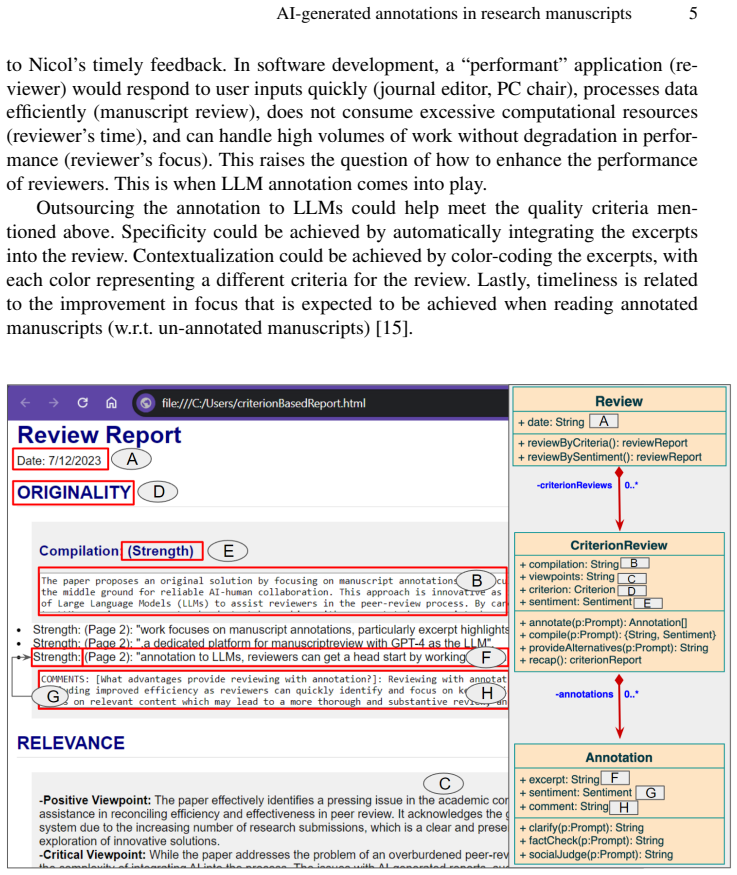
The load-bearing machinery is AnnotateGPT's annotation-centric interaction model, implemented as a Chrome extension over a PDF viewer. Its conceptual core is a UML model where a Review is composed of CriterionReviews, each built from Annotations; an Annotation is an excerpt with optional comments and a sentiment (strength or weakness), and prompts ('annotate', 'compile', 'viewpoints') map onto those entities. The prompting strategy uses 'reverse prompt engineering'—showing GPT-4 desired JSON outputs with examples and letting it iteratively refine the prompt—and each criterion carries a description and actionable recommendations that are injected into the prompt. Color-coded highlighting leverages the familiar semantics of tools like NVivo or PDF Annotator, where colors now stand for review criteria.
What would settle it
A controlled study in which reviewers read the same manuscript either with GPT-4's highlights or without, and then all reviews are scored for missed relevant passages and false claims, would settle the benefit claim; if annotated readers systematically overlook relevant content that unannotated readers catch, the viability claim fails. More directly, computing precision and recall of GPT-4 highlights against a human-annotated gold standard across a sample of manuscripts would test the accuracy premise.
Extended reading notes
Core claim
On the paper's own terms, the central claim is that annotation—specifically excerpt highlighting driven by review criteria—is a workable middle ground between fully automated review and unaided human review. AnnotateGPT embodies this by letting a reviewer pick a criterion (originality, rigor, relevance, contribution), prompting GPT-4 to return JSON with three supporting excerpts and a sentiment judgment for each, and rendering those as color-coded highlights in the PDF. The reviewer can fact-check, add comments, ask the model for alternative viewpoints, and finally compile a structured report from the annotations. A TAM questionnaire with nine participants found agreement on usefulness, especially as a focus and consistency enabler, and on ease of use, with stronger scores for seamless embedding in the PDF viewer. The authors explicitly set aside the question of GPT-4's accuracy as a premise rather than a result.
Load-bearing premise
The load-bearing premise is that GPT-4's criterion-based excerpt highlights are accurate enough to guide reviewers' attention in the right direction; if they frequently miss or mis-tag evidence, the perceived usefulness found in the questionnaire would not translate into better reviews.
Editorial extensions
If this is right
- If annotation proves viable, LLMs can be embedded in review without delegating judgment, addressing ethical concerns about AI replacing human reviewers.
- Reviewers can start from an annotated manuscript, potentially reducing the time spent locating relevant passages and improving criterion consistency.
- The same annotation model can be tuned to conference-specific criteria, allowing organizers to distribute customized browser-based review platforms.
- Authors could use the same tool to self-assess their drafts against a venue's criteria before submission.
- False negatives in GPT-4's highlights—missed relevant excerpts—remain a limitation that future versions would need to mitigate.
Reading between the lines
- The paper's claim would be strengthened by measuring whether annotated reading actually changes review outcomes, not just self-reported acceptance; a controlled study comparing reviews of annotated vs unannotated manuscripts could test this.
- The annotation-as-middle-ground idea generalizes beyond peer review to any expert reading task where criteria-based attention guidance is needed, such as grant review or legal document analysis.
- The paper's own 'false negative' concern suggests a natural extension: instead of only highlighting what the LLM finds, the system could surface the parts of the manuscript it did not highlight, making the absence of evidence visible.
- If open-source LLMs reach sufficient annotation accuracy, the cost barrier of GPT-4 disappears and the tool becomes commodity, which is exactly the direction the paper names as future work.
Editorial analysis
A structured set of objections, weighed in public.
Referee Report
Summary. The paper proposes annotation-based human-AI collaboration for academic peer review: rather than generating whole reviews, an LLM (GPT-4) highlights manuscript excerpts relevant to explicit review criteria. The authors design AnnotateGPT, a Chrome extension implementing this interaction model, with color-coded criteria highlights, annotation-centric prompts, and compilation of highlights into criterion-based review reports. They motivate the design through three quality criteria for feedback (contextualized, specific, timely) and present a TAM usability survey with nine participants who reviewed their own papers. The paper concludes that annotation is a viable middle ground for AI-human collaboration and generalizes the findings to conference organizers and authors.
Significance. If the interaction-model claim is validated, the work offers a useful design pattern: LLM assistance that keeps the human reviewer in control while reducing the cost of locating relevant excerpts. The paper's strengths include a clear conceptual model (UML in Fig. 1), a working open-source artifact with public code and video, explicit discussion of limitations, and a framing that distinguishes augmentation from full automation. These are meaningful contributions to the design-oriented literature on AI-assisted peer review. The main significance is, however, conditional on an accuracy premise that the paper explicitly declines to test, and the empirical evidence is a nine-participant TAM survey without a control group.
major comments (3)
- [Section 5, first paragraph] The paper explicitly states: "This evaluation does not test the accuracy of GPT-4 in highlighting the right paragraphs... this work takes as a premise the increasing accuracy that LLMs exhibit in this task." This premise is load-bearing for the central claim in the abstract and Section 6 that annotation is a "viable middle ground" for AI-human collaboration. If the highlights have low precision or recall, perceived usefulness in the TAM survey does not translate into actual review improvement; Section 6.1 itself concedes that false negatives "could lead to overlooking relevant paragraphs." Since the viability of the interaction model is inseparable from the reliability of the annotations it presents, the central claim is currently supported only by assumption, not by evidence. A precision/recall check on a small sample of manuscripts, or a restriction of the claim to a design-study scope, is needed.
- [Section 5, Execution] The evaluation protocol asked nine participants to use AnnotateGPT to review one of their own papers, with the rationale that content familiarity enhances their ability to understand the output. This confounds the assessment: a reviewer who already knows the paper cannot experience the tool's value in focusing attention on potentially overlooked excerpts, and cannot distinguish whether highlights are useful because they are correct or merely because they are plausible. The threats-to-validity paragraph mentions that perceived usefulness may be affected by perceived GPT accuracy, but it does not address the self-paper confound. As a result, the TAM results measure an interaction model under near-ideal conditions where the reviewer does not need the assistance, which weakens the support for the "viable middle ground" claim.
- [Section 6 and Section 7] The title "Formalization of Learning" and the generalizations in Section 6.2 (conference organizers, authors) go beyond what a nine-participant, no-control TAM study can support. The authors themselves acknowledge in Section 7 that "we need larger quantitative evaluations (involving more subjects) and qualitative evaluations (involving conference endowment)." Given that admission, the current paper should not present these generalizations as findings; it should frame them as hypotheses or speculative implications. This is a scope/claim mismatch that a revision should address, either by weakening the conclusions or by adding the missing evaluation.
minor comments (5)
- [Section 6.1] The text states that "the impact of false negatives is limited to cause some unnecessary fatigue... by highlighting unnecessary paragraphs" and then immediately says "false negatives have a more significant impact as they could lead to overlooking relevant paragraphs." The first clause appears to describe false positives, not false negatives. This typo should be corrected.
- [Section 3] The term "performant feedback" is introduced without definition or citation, and its relation to Nicol's "timely feedback" is only loosely explained. Please provide a definition or a clearer contrast.
- [Section 2] The citation [9] is referred to as "Ghosal et al." in the bibliography but "Goshal et al." in the body text. The spelling should be made consistent.
- [Section 4.1] The "Reverse Prompt Engineering" technique is cited only to a blog post [1]. If this is a recognized method, a peer-reviewed or more stable reference would be preferable; otherwise the name should be introduced as the authors' own term.
- [Figure 5] The figure shows TAM results but the axes or legend are not described in the caption. Please state what the numbers and colors represent, and ideally provide the exact questionnaire items used for Perceived Usefulness and Perceived Ease of Use.
Circularity Check
No circularity: AnnotateGPT is a design/acceptance study whose LLM-accuracy premise is explicitly assumed, not derived from its TAM results.
full rationale
The paper makes no predictive or derivational claim that collapses into its own inputs. AnnotateGPT is presented as a proof-of-concept; the central empirical evidence is a TAM questionnaire measuring perceived usefulness and perceived ease of use. Section 5 explicitly disclaims accuracy testing: 'This evaluation does not test the accuracy of GPT-4 in highlighting the right paragraphs... this work takes as a premise the increasing accuracy that LLMs exhibit in this task.' This is an admitted, load-bearing assumption rather than a circular derivation: the TAM data measure acceptance, not whether the highlights are correct. The related limitation in Section 6.1 about false positives, false negatives, and 'AnnotateGPT is limited by the precision of current LLMs' is likewise a validity caveat, not a reduction of the central claim to its own input. No parameter is fitted and then relabeled as a prediction; no self-citation carries uniqueness or ansatz load; and no equation-level identity can be exhibited because the paper's theses are design and acceptance claims. The perceived-usefulness result may be weak evidence for the 'viable middle ground' conclusion because annotation accuracy is assumed and participants reviewed their own papers, but that is an evidence-strength concern, not circularity.
Assumptions & free parameters
assumptions (3)
- domain assumption LLMs are sufficiently accurate at identifying relevant excerpts for a given review criterion.
- domain assumption Highlighting improves reader comprehension and focus.
- domain assumption Review criteria exist across disciplines and can be expressed as prompts.
Cite this review
Pith. "Pith review of Streamlining the review process: AI-generated annotations in research manuscripts." pith.science (2026). https://pith.science/paper/RAKN5VB5
@misc{pith2026241200281,
  author       = {Pith},
  title        = {Pith review of: Streamlining the review process: AI-generated annotations in research manuscripts},
  year         = {2026},
  howpublished = {\url{https://pith.science/paper/RAKN5VB5}},
  note         = {Machine review of arXiv:2412.00281}
}
read the original abstract
The increasing volume of research paper submissions poses a significant challenge to the traditional academic peer-review system, leading to an overwhelming workload for reviewers. This study explores the potential of integrating Large Language Models (LLMs) into the peer-review process to enhance efficiency without compromising effectiveness. We focus on manuscript annotations, particularly excerpt highlights, as a potential area for AI-human collaboration. While LLMs excel in certain tasks like aspect coverage and informativeness, they often lack high-level analysis and critical thinking, making them unsuitable for replacing human reviewers entirely. Our approach involves using LLMs to assist with specific aspects of the review process. This paper introduces AnnotateGPT, a platform that utilizes GPT-4 for manuscript review, aiming to improve reviewers' comprehension and focus. We evaluate AnnotateGPT using a Technology Acceptance Model (TAM) questionnaire with nine participants and generalize the findings. Our work highlights annotation as a viable middle ground for AI-human collaboration in academic review, offering insights into integrating LLMs into the review process and tuning traditional annotation tools for LLM incorporation.
Figures


Figures from the paper (2 more)


Forward citations
Cited by 2 Pith papers
-
AI4Research: A Survey of Artificial Intelligence for Scientific Research
A survey that organizes AI-for-research work into five tasks, comprehension, survey, discovery, writing, and peer review, and compiles associated tools and benchmarks.
-
Large language models for automated scholarly paper review: A survey
A survey of LLM-based automated scholarly paper review, cataloging models, datasets, methods, and publisher policies as of 2023-2024.
Reference graph
Works this paper leans on
-
[1]
How to master reverse prompt engineering with chatgpt. https://www.allabtai. com/how-to-master-reverse-prompt-engineering-with-chatgpt/ , (Accessed on 11/20/2023)
work page 2023
-
[2]
aje.com/arc/peer-review-process-15-million-hours-lost-time/ , (Accessed on 11/24/2023)
AJE: Peer review: How we found 15 million hours of lost time, https://www. aje.com/arc/peer-review-process-15-million-hours-lost-time/ , (Accessed on 11/24/2023)
work page 2023
-
[3]
The Yale Journal of Biology and Medicine96(3), 415 (2023)
Biswas, S., Dobaria, D., Cohen, H.L.: Focus: Big Data: ChatGPT and the Future of Journal Reviews: A Feasibility Study. The Yale Journal of Biology and Medicine96(3), 415 (2023)
work page 2023
-
[4]
The Journal of Pediatric Pharmacology and Therapeutics 28(6), 576–584 (2023)
Biswas, S.S.: ChatGPT for Research and Publication: A Step-by-Step Guide. The Journal of Pediatric Pharmacology and Therapeutics 28(6), 576–584 (2023)
work page 2023
-
[5]
Assessment & Evaluation in higher education 38(6), 698–712 (2013)
Boud, D., Molloy, E.: Rethinking models of feedback for learning: the challenge of design. Assessment & Evaluation in higher education 38(6), 698–712 (2013). https://doi. org/10.1080/02602938.2012.691462
arXiv 2013
-
[6]
Hu- manities and Social Sciences Communications 8(1), 1–11 (2021)
Checco, A., Bracciale, L., Loreti, P., Pinfield, S., Bianchi, G.: AI-assisted peer review. Hu- manities and Social Sciences Communications 8(1), 1–11 (2021)
work page 2021
-
[7]
Davis, F.: A Technology Acceptance Model for Empirically Testing New End-User Informa- tion Systems (1985)
work page 1985
-
[8]
Information Systems Frontiers24(5), 1709–1734 (2022)
Enholm, I.M., Papagiannidis, E., Mikalef, P., Krogstie, J.: Artificial intelligence and business value: A literature review. Information Systems Frontiers24(5), 1709–1734 (2022)
work page 2022
Show all 23 references
-
[9]
In: Proceedings of the 57th Annual Meeting of the Association for Computational Linguistics
Ghosal, T., Verma, R., Ekbal, A., Bhattacharyya, P.: DeepSentiPeer: Harnessing sentiment in review texts to recommend peer review decisions. In: Proceedings of the 57th Annual Meeting of the Association for Computational Linguistics. pp. 1120–1130 (2019)
2019
-
[10]
arXiv preprint arXiv:2310.11207 (2023)
Huang, S., Mamidanna, S., Jangam, S., Zhou, Y ., Gilpin, L.H.: Can large language models explain themselves? a study of llm-generated self-explanations. arXiv preprint arXiv:2310.11207 (2023)
2023 arXiv
-
[11]
Information Fusion p
Lin, J., Song, J., Zhou, Z., Chen, Y ., Shi, X.: Automated scholarly paper review: Concepts, technologies, and challenges. Information Fusion p. 101830 (2023)
2023
-
[12]
Assessment & Evaluation in Higher Education35(5), 501–517 (aug 2010)
Nicol, D.: From monologue to dialogue: improving written feedback processes in mass higher education. Assessment & Evaluation in Higher Education35(5), 501–517 (aug 2010). https://doi.org/10.1080/02602931003786559
2010 doi
-
[13]
Large language model (2023), https://chat
OpenAI: ChatGPT (Nov 30 version. Large language model (2023), https://chat. openai.com/chat, accessed: 2023-11-08
2023
-
[14]
Korean Journal of Radiology 24(8), 715 (2023)
Park, S.H.: Use of generative artificial intelligence, including large language models such as ChatGPT, in scientific publications: policies of KJR and prominent authorities. Korean Journal of Radiology 24(8), 715 (2023)
2023
-
[15]
The English Journal 93(5), 82–89 (2004)
Porter-O’Donnell, C.: Beyond the yellow highlighter: Teaching annotation skills to improve reading comprehension. The English Journal 93(5), 82–89 (2004). https://doi.org/ 10.2307/4128941
2004 doi
-
[16]
https://publons.com/static/ Publons-Global-State-Of-Peer-Review-2018.pdf , (Accessed on 11/24/2023)
Publons: Global state of peer review. https://publons.com/static/ Publons-Global-State-Of-Peer-Review-2018.pdf , (Accessed on 11/24/2023)
2018
-
[17]
Springer (2015)
Spyns, P., Vidal, M.E.: Scientific Peer Reviewing: Practical Hints and Best Practices. Springer (2015)
2015
-
[18]
Srivastava, M.: A day in the life of ChatGPT as an academic reviewer: Investigating the potential of large language model for scientific literature review (2023)
2023
-
[19]
F1000Research6 (2017) 16 Díaz, Garmendia and Pereira
Tennant, J.P., Dugan, J.M., Graziotin, D., et al.: A multi-disciplinary perspective on emergent and future innovations in peer review. F1000Research6 (2017) 16 Díaz, Garmendia and Pereira
2017
-
[20]
arXiv preprint arXiv:2010.06119 (2020)
Wang, Q., Zeng, Q., Huang, L., Knight, K., Ji, H., Rajani, N.F.: Reviewrobot: Explainable paper review generation based on knowledge synthesis. arXiv preprint arXiv:2010.06119 (2020)
2020 arXiv
-
[21]
New Review of Information Networking 16(1), 23–53 (2011)
Ware, M.: Peer review: Recent experience and future directions. New Review of Information Networking 16(1), 23–53 (2011). https://doi.org/10.1080/13614576.2011. 566812, https://doi.org/10.1080/13614576.2011.566812
2011
-
[22]
New Review of Information Networking 16(1), 23–53 (2011)
Ware, M.: Peer review: Recent experience and future directions. New Review of Information Networking 16(1), 23–53 (2011)
2011
-
[23]
Yuan, W., Liu, P., Neubig, G.: Can we automate scientific reviewing? Journal of Artificial Intelligence Research 75, 171–212 (2022)
2022
Reviewed August 12, 2026 · model on record in the stance chip above.
Discussion (0). Continue with ORCID to comment.