REVIEW 4 major objections 5 minor 39 references
Learning Locally, Revising Globally: Global Reviser for Federated Learning with Noisy Labels
T0 review · 4 major / 5 minor · reviewed 2026-08-12 · deepseek-v4-flash
Pith's one-line read The federated global model memorizes noisy labels slowly, and FedGR converts that into robust label-noise handling.
desk verdict FedGR's headline gains on federated label noise are plausible and the slow-memorization observation is worth taking seriously, but the load-bearing GMM sieve is under-validated and Eq. 23 has an undefined branch. read the letter →
The pith
A machine-rendered reading of the paper's core claim, the machinery that carries it, and where it could break.
The reading
What carries the argument
Three modules, all driven by the global model, carry the argument. Centralized sieving computes each sample's mean loss across the rounds its client participated, fits a two-component Gaussian Mixture Model on the server, and labels each sample clean or noisy; this is what the whole method relies on. Label refining replaces noisy labels with confident pseudo labels $\text{onehot}(\arg\max \sigma(p_g))$ when the estimated noise ratio $r_k \geq \beta$, and otherwise mixes the original label with the pseudo label according to the GMM clean probability (Eq. 15). Global revised EMA distillation bootstraps each client's local EMA model from the global model at round $\delta$ and periodically mixes global weights into it, then distills its logits into the client model; global representation regularization distills the global backbone's representation of weakly augmented images into the local model's strong-augmentation branch. The load-bearing observation behind all three is that the global model's slow memorization keeps these pseudo-labels and representations trustworthy.
What would settle it
Construct a federated benchmark where noisy labels are deliberately high-confidence (e.g., instance-dependent noise generated from a near-perfect teacher), so noisy samples have systematically lower mean loss than clean ones; if FedGR's centralized sieving mis-splits the sets, its accuracy should collapse toward the FedAvg baseline, confirming the GMM assumption is load-bearing.
Extended reading notes
Core claim
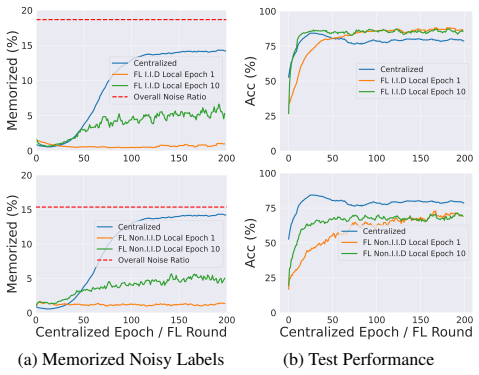
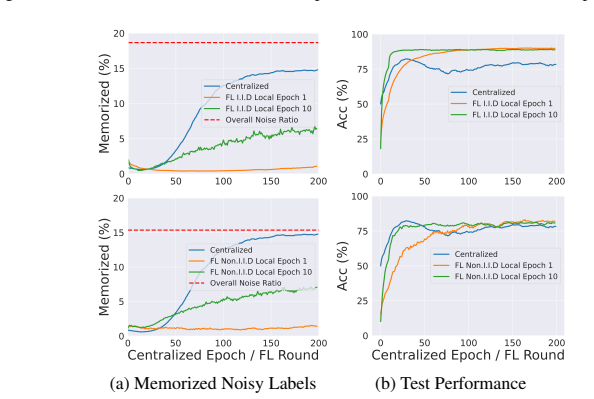
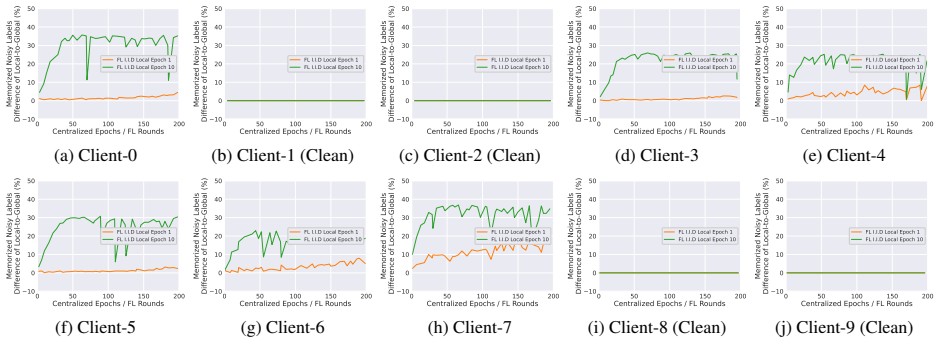
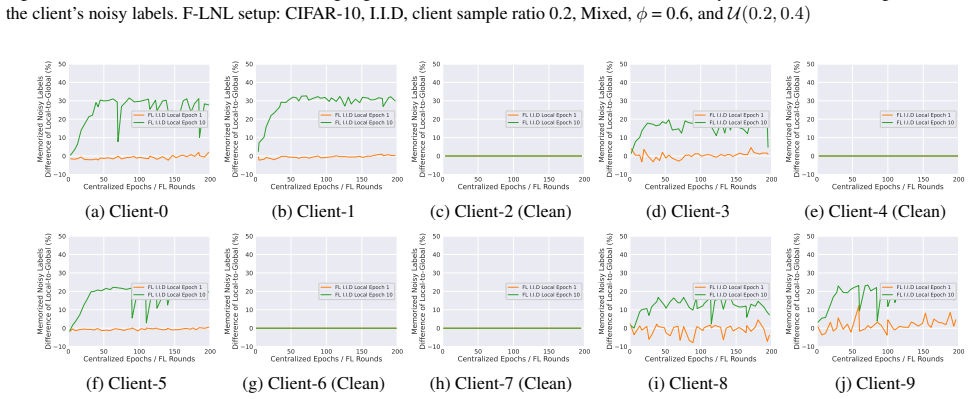
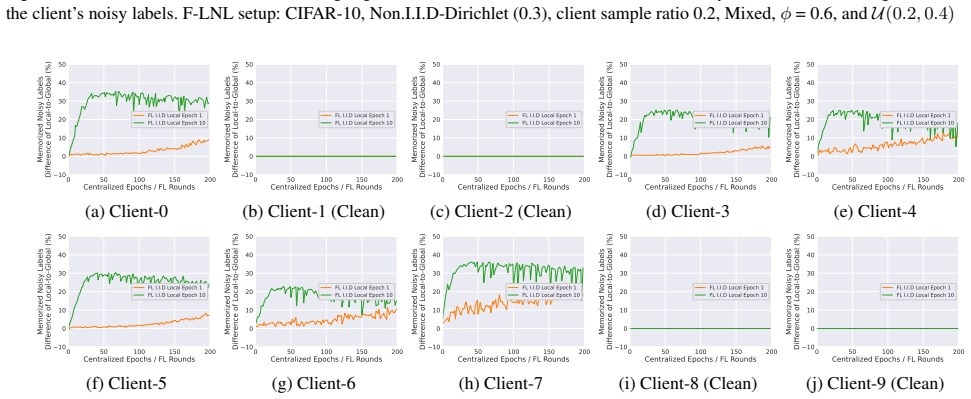
The paper's central claim is that the global model of federated learning is a naturally reliable reference for handling label noise: while a centrally trained network ends up memorizing over 80% of corrupted labels, the federated global model memorizes no more than 30–50% and never shows the characteristic test-drop of overfitting. FedGR operationalizes this. During a warm-up phase, clients compute per-sample cross-entropy losses with the global model and upload the mean losses; the server fits a two-component Gaussian Mixture Model to these statistics and returns clean/noisy splits plus estimated noise ratios. In the refinement phase, each client's labels are rebuilt by mixing the original label with a confident pseudo-label from the global model, with the mixing determined by the estimated noise ratio. Parallel modules revise the client's local EMA model with global parameters and distill its logits, and distill the global representation into the local model, so that noisy samples still contribute knowledge without their wrong labels. On CIFAR-10 with 50–100% symmetric noise and no clean clients, the method reports 83.91% accuracy versus 55.12% for FedCorr.
Load-bearing premise
The method assumes that a two-component Gaussian Mixture Model fit to per-sample mean losses cleanly separates clean from noisy samples on every client, no matter the noise type or data distribution.
Editorial extensions
If this is right
- When some clients are clean ($\phi=0.6$), FedGR matches or exceeds training on clean labels, on both CIFAR-10 and CIFAR-100.
- Under the hardest tested setting — every client noisy, symmetric noise between 50% and 100% — FedGR keeps 83.91% accuracy on CIFAR-10, where FedCorr drops to 55.12%.
- The method transfers to a large real-world noisy dataset, Clothing1M, where it leads across both IID and Non-IID partitions.
- Only per-sample loss statistics and model parameters are exchanged with the server, so the approach avoids transmitting class centers or other high-risk local proxies used by prior methods.
- Ablations attribute most of the gain under high noise to centralized sieving and label refining, with the two distillation and regularization modules contributing further gains.
Reading between the lines
- The slow-memorization effect likely has a mechanical explanation the paper leaves implicit: averaging many client models at the server smooths the loss landscape and delays the phase where individual networks lock onto wrong labels; a theory of aggregation as implicit regularization could make the observation predictive rather than empirical.
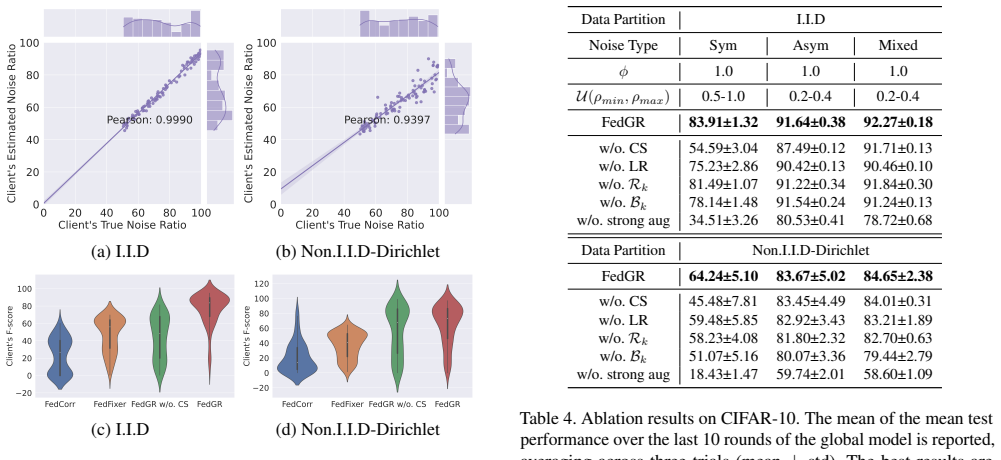
- The GMM-on-mean-loss assumption is only validated at client level (Pearson correlation on noise ratios), not sample level; a direct sample-level precision-recall evaluation would show whether the sieving holds when noise is instance-dependent.
- One testable extension is to make the confidence threshold $\epsilon$ and noise-ratio threshold $\beta$ adaptive per client, since the paper fixes them globally; the mixed-noise results suggest the optimal thresholds depend on the noise type.
- Because FedGR only needs the global model plus loss statistics, it could be combined with differential-privacy mechanisms on the uploaded mean losses if a formal privacy bound were required.
Signed reviews
Editorial analysis
A structured set of objections, weighed in public.
Referee Report
Summary. The paper proposes FedGR, a federated learning (FL) algorithm for label noise, based on the observation that the global FL model memorizes noisy labels more slowly than a centrally trained model. FedGR has three modules: (i) sniffing-then-refining, where the server fits a two-component GMM to per-sample mean losses computed with the global model, splits each client's data into clean/noisy sets, and refines labels via pseudo-labels from the global model; (ii) global revised EMA distillation, where the local EMA model is bootstrapped and periodically revised with the global model, and distilled into the client model; and (iii) global representation regularization, which distills the global model's representations to the local model. The method is evaluated on CIFAR-10, CIFAR-100, and Clothing1M under IID and Dirichlet-non-IID partitions, with symmetric, asymmetric, and mixed label noise, and is compared against seven baselines.
Significance. If the premises hold, FedGR is a meaningful advance for FL with noisy labels. The paper's observation about slow memorization in the global FL model is interesting and potentially useful. The experimental evaluation is broad, covering three benchmarks, two data partitions, multiple noise types and ratios, with ablations and three seeds. The main strengths are the global (server-side) noise sieving, which avoids per-client noise modeling under heterogeneity, and the strong empirical gains over existing F-LNL methods. However, the central noise-sniffing mechanism is validated only at client level on one setting, and the algorithm specification contains definitional gaps that affect the high-noise regime. The study also leaves the sensitivity to its many hyperparameters unexamined.
major comments (4)
- [Section 3.2, Eqs. (8)-(15), Table 4, Fig. 4] The centralized sieving step is the largest single contributor in the ablation: removing it drops CIFAR-10 Sym phi=1.0 from 83.91 to 54.59 in Table 4. Yet its validity is only demonstrated through client-level Pearson coefficients and client-level F-scores in Fig. 4, and only for CIFAR-10 symmetric noise. Please report per-sample precision/recall of the two-component GMM at round alpha for symmetric, asymmetric, and mixed noise under both IID and non-IID partitions, and show how per-sample errors evolve in Phase II (e.g., precision of the clean set over rounds). Without this, the central claim that the global model can reliably sniff noise is not directly supported.
- [Section 3.3, Eq. (23)] The definition of gamma_g is incomplete. For r_k >= beta and t >= delta, the first case requires r_k < beta, and the second case requires (r_k >= beta and |D~_k|/|D_k| < mu) or t < delta; since t >= delta and |D~_k|/|D_k| = 1 because Eq. (15) assigns a refined label to every sample, neither branch matches. Please specify the intended value of gamma_g for high-noise clients that successfully refine their data, and reconcile the ratio |D~_k|/|D_k| with the definition of D~_k.
- [Section 3.2, Eqs. (10), (12), (15)] For clients with r_k >= beta, the refined label is y^pse_i, which is the zero vector whenever max(sigma(p^{g,w}_i)) <= epsilon. The paper does not say how the cross-entropy loss in Eq. (10) treats zero-vector targets; if low-confidence samples are masked out or assigned a uniform label, this should be stated explicitly. This branch is precisely the high-noise regime that differentiates the method from FedCorr, so it must be unambiguous.
- [Section 1 and App. A.1] The slow-memorization observation is made on CIFAR-10 with 10 clients and client sample ratios 0.2, 0.5, and 1.0, but the main experiments use 100 clients (and 500 for Clothing1M), different backbones, and local epochs of 10. Because all three modules rely on the global model being less overfit to noisy labels, please report the memorization metric under the actual experimental configuration (e.g., 100 clients, CIFAR-10/100), or provide a principled argument for why the phenomenon should transfer. A sensitivity analysis on alpha (the sniffing length) would also help establish that the GMM mask is not overly sensitive to the warm-up point.
minor comments (5)
- [Abstract vs. Section 4] The abstract and Section 4 disagree on the number of baselines (eight in the posted abstract vs. seven in the paper's abstract and Section 4); please harmonize.
- [Section 4.3, Table 4 vs. Table 1] The Non-IID symmetric phi=1.0 FedGR accuracy in Table 4 (64.24±5.10) differs from the corresponding entry in Table 1 (63.64±5.39) for what appears to be the same configuration; please verify which number is correct.
- [Figure 1 vs. App. A.1] Figure 1's caption says the global model memorizes no more than 30% of noisy samples, while App. A.1 says no more than 50%; these statements should be reconciled.
- [Section 3.3, Eqs. (19), (24)] Equations (19) and (24) write KL(·, ·) on logits and on features, but KL divergence is defined between distributions; please clarify whether softmax (or a normalized form) is applied before the KL, and define the temperature tau's role in Eq. (24).
- [Section 4.1, Table 3] Clothing1M results in Table 3 are reported without standard deviation and are based on a single seed (App. A.2); please report at least the average over a few seeds or state clearly why this is not feasible.
Circularity Check
No significant circularity: FedGR's global-model self-training is empirically evaluated on external clean-label test sets, not reduced to its own inputs by construction.
full rationale
The central derivation is not circular under the definitions in the task. The claimed phenomenon (global model memorizes noisy labels slowly) is an empirical observation with its own experiments (Fig. 1 and App. A.1), not an assumption derived from the method. The selection criterion in Eq. 8 is the mean loss under the global model, and the GMM in Phase I is fit on losses computed with the original noisy labels (Eqs. 6 and 9) before any refinement; the method then uses the resulting clean/noisy split and pseudo-labels (Eqs. 12-15) to train subsequent rounds. This is a self-training loop, but it is not definitional circularity: the reported predictions are test accuracies on clean held-out labels (Tables 1-3), which are external to the model's own pseudo-labels, and the noise-ratio estimates are validated against ground-truth noise ratios in Fig. 4. The load-bearing components (GMM, small-loss trick, pseudo-labeling) are standard techniques cited to external prior work, not to a self-citation chain; even where some references share co-authors (e.g., Co-teaching via G. Niu), they are used as algorithmic building blocks rather than as the sole justification of the central claim. No equation reduces to its own input by construction, and no fitted parameter is renamed as a prediction. The internal inconsistency in Eq. 23, where gamma_g is undefined when r_k >= beta and |D_tilde_k|/|D_hat_k| >= mu while |D_tilde_k| = |D_hat_k| by construction, is a correctness or robustness issue, not a circularity. The paper is self-contained against external benchmarks, so the appropriate finding is no significant circularity.
Assumptions & free parameters
free parameters (7)
- lambda_B =
1.0
- lambda_R =
0.1 (CIFAR-10), 0.2 (CIFAR-100, Clothing1M)
- alpha =
100 (CIFAR-10/100), 50 (Clothing1M)
- epsilon =
0.9
- beta =
0.8
- kappa =
0.9
- mu =
0.5
assumptions (4)
- domain assumption The global model of FL memorizes noisy labels slowly and maintains reliable predictions throughout training.
- domain assumption A two-component Gaussian Mixture Model on per-sample mean loss cleanly separates clean and noisy samples.
- domain assumption Pseudo-labels with softmax confidence above 0.9 are correct.
- domain assumption The local EMA model, bootstrapped and revised by the global model, provides useful knowledge for distillation.
Cite this review
Pith. "Pith review of Learning Locally, Revising Globally: Global Reviser for Federated Learning with Noisy Labels." pith.science (2026). https://pith.science/paper/YMIQOSYV
@misc{pith2026241200452,
  author       = {Pith},
  title        = {Pith review of: Learning Locally, Revising Globally: Global Reviser for Federated Learning with Noisy Labels},
  year         = {2026},
  howpublished = {\url{https://pith.science/paper/YMIQOSYV}},
  note         = {Machine review of arXiv:2412.00452}
}
read the original abstract
Conventional federated learning (FL) heavily depends on high-quality labels, which are often impractical in the real world, leading to the federated label-noise (F-LN) problem. Worse still, the F-LN problem is exacerbated by the heterogeneity of FL, whereas clients experience different label-noise types, ratios, and data distribution. In this study, we first observe an intriguing phenomenon that the global model of FL exhibits a slow memorization of noisy labels, suggesting its ability to maintain reliable predictions and robust representations in FL. Motivated by this, we propose a novel method termed Federated Global Reviser (\method), a straightforward yet effective method comprising three modules that collaboratively rectify noisy labels and regularize local training. By exploiting this inherent property, \method\ improves the label-noise robustness of FL in a self-contained manner. Extensive experiments on three widely used F-LN benchmarks demonstrate the superior performance of FedGR, consistently outperforming eight state-of-the-art baselines even in severe label-noise and data heterogeneity. Code: https://github.com/cs-yuxintian/FedGR-ICML26
Figures


Figures from the paper (12 more)



Reference graph
Works this paper leans on
-
[1]
O’Connor, and Kevin McGuinness
Eric Arazo, Diego Ortego, Paul Albert, Noel E. O’Connor, and Kevin McGuinness. Unsupervised Label Noise Modeling and Loss Correction. In Proceedings of the 36th International Conference on Machine Learning, ICML 2019, 9-15 June 2019, Long Beach, California, USA, pages 312–321. PMLR,
2019
-
[2]
Kanwal, Tegan Maharaj, Asja Fischer, Aaron C
Devansh Arpit, Stanislaw Jastrzebski, Nicolas Ballas, David Krueger, Emmanuel Bengio, Maxinder S. Kanwal, Tegan Maharaj, Asja Fischer, Aaron C. Courville, Yoshua Bengio, and Simon Lacoste-Julien. A Closer Look at Memorization in Deep Networks. In Proceedings of the 34th International Conference on Machine Learning, ICML 2017, Sydney, NSW, Australia, 6-11 ...
2017
-
[3]
Goodfellow, Nico- las Papernot, Avital Oliver, and Colin Raffel
David Berthelot, Nicholas Carlini, Ian J. Goodfellow, Nico- las Papernot, Avital Oliver, and Colin Raffel. MixMatch: A Holistic Approach to Semi-Supervised Learning. In Ad- vances in Neural Information Processing Systems 32: An- nual Conference on Neural Information Processing Systems 2019, NeurIPS 2019, December 8-14, 2019, Vancouver, BC, Canada, pages 5...
2019
-
[4]
Exploring Simple Siamese Representation Learning
Xinlei Chen and Kaiming He. Exploring Simple Siamese Representation Learning. In IEEE Conference on Computer Vision and Pattern Recognition, CVPR 2021, Virtual, June 19- 25, 2021, pages 15750–15758. Computer Vision Foundation / IEEE, 2021. 6
2021
-
[5]
Learning with Instance-Dependent La- bel Noise: A Sample Sieve Approach
Hao Cheng, Zhaowei Zhu, Xingyu Li, Yifei Gong, Xing Sun, and Yang Liu. Learning with Instance-Dependent La- bel Noise: A Sample Sieve Approach. In 9th International Conference on Learning Representations, ICLR 2021, Virtual Event, Austria, May 3-7, 2021. OpenReview.net, 2021. 2
2021
-
[6]
RandAugment: Practical Automated Data Augmenta- tion with a Reduced Search Space
Ekin Dogus Cubuk, Barret Zoph, Jonathon Shlens, and Quoc Le. RandAugment: Practical Automated Data Augmenta- tion with a Reduced Search Space. In Advances in Neural Information Processing Systems 33: Annual Conference on Neural Information Processing Systems 2020, NeurIPS 2020, December 6-12, 2020, Virtual, 2020. 7
2020
-
[7]
Tsang, and Masashi Sugiyama
Bo Han, Quanming Yao, Xingrui Yu, Gang Niu, Miao Xu, Weihua Hu, Ivor W. Tsang, and Masashi Sugiyama. Co- teaching: Robust training of deep neural networks with ex- tremely noisy labels. In Advances in Neural Information Processing Systems 31: Annual Conference on Neural Infor- mation Processing Systems 2018, NeurIPS 2018, December 3-8, 2018, Montr´eal, Ca...
2018
-
[8]
Deep residual learning for image recognition
Kaiming He, Xiangyu Zhang, Shaoqing Ren, and Jian Sun. Deep residual learning for image recognition. In 2016 IEEE Conference on Computer Vision and Pattern Recognition, CVPR 2016, Las Vegas, NV , USA, June 27-30, 2016, pages 770–778. IEEE Computer Society, 2016. 12
2016
Show all 39 references
-
[9]
Ball, Katie S
Jeremy Irvin, Pranav Rajpurkar, Michael Ko, Yifan Yu, Sil- viana Ciurea-Ilcus, Christopher Chute, Henrik Marklund, Be- hzad Haghgoo, Robyn L. Ball, Katie S. Shpanskaya, Jayne Seekins, David A. Mong, Safwan S. Halabi, Jesse K. Sand- berg, Ricky Jones, David B. Larson, Curtis P....
2019
-
[10]
FedFixer: Mitigating Hetero- geneous Label Noise in Federated Learning
Xinyuan Ji, Zhaowei Zhu, Wei Xi, Olga Gadyatskaya, Zilong Song, Yong Cai, and Yang Liu. FedFixer: Mitigating Hetero- geneous Label Noise in Federated Learning. In Thirty-Eighth AAAI Conference on Artificial Intelligence, AAAI 2024, Thirty- Sixth Conference on Innovative Applic...
2024
-
[11]
To- wards Federated Learning against Noisy Labels via Local Self-Regularization
Xuefeng Jiang, Sheng Sun, Yuwei Wang, and Min Liu. To- wards Federated Learning against Noisy Labels via Local Self-Regularization. In Proceedings of the 31st ACM Inter- national Conference on Information & Knowledge Manage- ment, Atlanta, GA, USA, October 17-21, 2022, pages 8...
2022
-
[12]
Tack- ling Noisy Clients in Federated Learning with End-to-end Label Correction
Xuefeng Jiang, Sheng Sun, Jia Li, Jingjing Xue, Runhan Li, Zhiyuan Wu, Gang Xu, Yuwei Wang, and Min Liu. Tack- ling Noisy Clients in Federated Learning with End-to-end Label Correction. In Proceedings of the 33rd ACM Interna- tional Conference on Information and Knowledge Mana...
2024
-
[13]
Makowski, Daniel Rueckert, and Rickmer Braren
Georgios Kaissis, Marcus R. Makowski, Daniel Rueckert, and Rickmer Braren. Secure, privacy-preserving and federated machine learning in medical imaging. Nat. Mach. Intell., 2 (6):305–311, 2020. 1
2020
-
[14]
FedRN: Exploiting k-Reliable Neighbors Towards Robust Federated Learning
Sangmook Kim, Wonyoung Shin, Soohyuk Jang, Hwanjun Song, and Se-Young Yun. FedRN: Exploiting k-Reliable Neighbors Towards Robust Federated Learning. In Proceed- ings of the 31st ACM International Conference on Informa- tion & Knowledge Management, Atlanta, GA, USA, October 17-...
2022
-
[15]
Learning multiple layers of features from tiny images
Alex Krizhevsky and Geoffrey Hinton. Learning multiple layers of features from tiny images. Master’s thesis, 2009. 7, 12, 16
2009
-
[16]
Junnan Li, Richard Socher, and Steven C. H. Hoi. DivideMix: Learning with Noisy Labels as Semi-supervised Learning. In 8th International Conference on Learning Representations, 9 ICLR 2020, Addis Ababa, Ethiopia, April 26-30, 2020. Open- Review.net, 2020. 1, 2, 5, 7, 16
2020
-
[17]
FedDiv: Collaborative Noise Filtering for Federated Learning with Noisy Labels
Jichang Li, Guanbin Li, Hui Cheng, Zicheng Liao, and Yizhou Yu. FedDiv: Collaborative Noise Filtering for Federated Learning with Noisy Labels. In Thirty-Eighth AAAI Con- ference on Artificial Intelligence, AAAI 2024, Thirty-Sixth Conference on Innovative Applications of Artif...
2024
-
[18]
Fed- erated learning on non-iid data silos: An experimental study
Qinbin Li, Yiqun Diao, Quan Chen, and Bingsheng He. Fed- erated learning on non-iid data silos: An experimental study. In 2022 IEEE 38th International Conference on Data Engi- neering (ICDE), pages 965–978. IEEE, 2022. 2, 7, 8, 12, 16
2022
-
[19]
Federated Optimization in Heterogeneous Networks
Tian Li, Anit Kumar Sahu, Manzil Zaheer, Maziar Sanjabi, Ameet Talwalkar, and Virginia Smith. Federated Optimization in Heterogeneous Networks. In Proceedings of the Third Conference on Machine Learning and Systems, MLSys 2020, Austin, TX, USA, March 2-4, 2020. mlsys.org, 2020...
2020
-
[20]
Provably End-to-end Label-noise Learning with- out Anchor Points
Xuefeng Li, Tongliang Liu, Bo Han, Gang Niu, and Masashi Sugiyama. Provably End-to-end Label-noise Learning with- out Anchor Points. In Proceedings of the 38th International Conference on Machine Learning, ICML 2021, 18-24 July 2021, Virtual Event, pages 6403–6413. PMLR, 2021. 3
2021
-
[21]
Federated Learn- ing with Extremely Noisy Clients via Negative Distillation
Yang Lu, Lin Chen, Yonggang Zhang, Yiliang Zhang, Bo Han, Yiu-ming Cheung, and Hanzi Wang. Federated Learn- ing with Extremely Noisy Clients via Negative Distillation. In Thirty-Eighth AAAI Conference on Artificial Intelligence, AAAI 2024, Thirty-Sixth Conference on Innovative...
2024
-
[22]
Dick, and Akhil Mathur
Ekdeep Singh Lubana, Chi Ian Tang, Fahim Kawsar, Robert P. Dick, and Akhil Mathur. Orchestra: Unsupervised Federated Learning via Globally Consistent Clustering. In Interna- tional Conference on Machine Learning, ICML 2022, 17-23 July 2022, Baltimore, Maryland, USA, pages 1446...
2022
-
[23]
Communication- Efficient Learning of Deep Networks from Decentralized Data
Brendan McMahan, Eider Moore, Daniel Ramage, Seth Hampson, and Blaise Ag ¨uera y Arcas. Communication- Efficient Learning of Deep Networks from Decentralized Data. In Proceedings of the 20th International Conference on Artificial Intelligence and Statistics, AISTATS 2017, 20- ...
2017
-
[24]
Belongie, and Nir Shavit
David Rolnick, Andreas Veit, Serge J. Belongie, and Nir Shavit. Deep Learning is Robust to Massive Label Noise. CoRR, abs/1705.10694, 2017. 2
2017 arXiv
-
[25]
FixMatch: Simplifying Semi- Supervised Learning with Consistency and Confidence
Kihyuk Sohn, David Berthelot, Nicholas Carlini, Zizhao Zhang, Han Zhang, Colin Raffel, Ekin Dogus Cubuk, Alexey Kurakin, and Chun-Liang Li. FixMatch: Simplifying Semi- Supervised Learning with Consistency and Confidence. In Advances in Neural Information Processing Systems 33:...
2020
-
[26]
Learning From Noisy Labels With Deep Neural Networks: A Survey
Hwanjun Song, Minseok Kim, Dongmin Park, Yooju Shin, and Jae-Gil Lee. Learning From Noisy Labels With Deep Neural Networks: A Survey. IEEE Trans. Neural Networks Learn. Syst., 34(11):8135–8153, 2023. 7
2023
-
[27]
A Survey on Federated Recommendation Systems
Zehua Sun, Yonghui Xu, Yong Liu, Wei He, Lanju Kong, Fangzhao Wu, Yali Jiang, and Lizhen Cui. A Survey on Federated Recommendation Systems. IEEE Transactions on Neural Networks and Learning Systems, pages 1–15, 2024. 1
2024
-
[28]
FedCoop: Cooperative Federated Learning for Noisy Labels
Kahou Tam, Li Li, Yan Zhao, and Chengzhong Xu. FedCoop: Cooperative Federated Learning for Noisy Labels. In ECAI 2023 - 26th European Conference on Artificial Intelligence, September 30 - October 4, 2023, Krak´ow, Poland - Including 12th Conference on Prestigious Applications ...
2023
-
[29]
FedNoiL: A Simple Two-Level Sampling Method for Federated Learning with Noisy Labels
Zhuowei Wang, Tianyi Zhou, Guodong Long, Bo Han, and Jing Jiang. FedNoiL: A Simple Two-Level Sampling Method for Federated Learning with Noisy Labels. CoRR, abs/2205.10110, 2022. 1, 2, 3
2022 arXiv
-
[30]
FedNoRo: Towards Noise-Robust Federated Learning by Addressing Class Imbalance and Label Noise Heterogeneity
Nannan Wu, Li Yu, Xuefeng Jiang, Kwang-Ting Cheng, and Zengqiang Yan. FedNoRo: Towards Noise-Robust Federated Learning by Addressing Class Imbalance and Label Noise Heterogeneity. In Proceedings of the Thirty-Second Inter- national Joint Conference on Artificial Intelligence, ...
2023
-
[31]
ProMix: Combating Label Noise via Maximizing Clean Sample Utility
Ruixuan Xiao, Yiwen Dong, Haobo Wang, Lei Feng, Runze Wu, Gang Chen, and Junbo Zhao. ProMix: Combating Label Noise via Maximizing Clean Sample Utility. In Proceedings of the Thirty-Second International Joint Conference on Artifi- cial Intelligence, IJCAI 2023, 19th-25th August...
2023
-
[32]
Learning from massive noisy labeled data for image classification
Tong Xiao, Tian Xia, Yi Yang, Chang Huang, and Xiaogang Wang. Learning from massive noisy labeled data for image classification. In Proceedings of the IEEE Conference on Computer Vision and Pattern Recognition, pages 2691–2699,
-
[33]
Jingyi Xu, Zihan Chen, Tony Q. S. Quek, and Kai Fong Ernest Chong. FedCorr: Multi-Stage Federated Learning for Label Noise Correction. In IEEE/CVF Conference on Computer Vision and Pattern Recognition, CVPR 2022, New Orleans, LA, USA, June 18-24, 2022, pages 10174–10183. IEEE,...
2022
-
[34]
Robust Federated Learning With Noisy La- bels
Seunghan Yang, Hyoungseob Park, Junyoung Byun, and Changick Kim. Robust Federated Learning With Noisy La- bels. IEEE Intell. Syst., 37(2):35–43, 2022. 1, 2, 3
2022
-
[35]
Tsang, and Masashi Sugiyama
Xingrui Yu, Bo Han, Jiangchao Yao, Gang Niu, Ivor W. Tsang, and Masashi Sugiyama. How does Disagreement Help Gen- eralization against Label Corruption? In Proceedings of the 36th International Conference on Machine Learning, ICML 2019, 9-15 June 2019, Long Beach, California, U...
2019
-
[36]
Understanding deep learning requires rethinking generalization
Chiyuan Zhang, Samy Bengio, Moritz Hardt, Benjamin Recht, and Oriol Vinyals. Understanding deep learning requires rethinking generalization. In 5th International Conference on 10 Learning Representations, ICLR 2017, Toulon, France, April 24-26, 2017, Conference Track Proceedin...
2017
-
[37]
BadLabel: A Robust Per- spective on Evaluating and Enhancing Label-Noise Learning
Jingfeng Zhang, Bo Song, Haohan Wang, Bo Han, Tongliang Liu, Lei Liu, and Masashi Sugiyama. BadLabel: A Robust Per- spective on Evaluating and Enhancing Label-Noise Learning. IEEE Trans. Pattern Anal. Mach. Intell., 46(6):4398–4409,
-
[38]
Federated Label-Noise Learning with Local Diversity Product Regularization
Xiaochen Zhou and Xudong Wang. Federated Label-Noise Learning with Local Diversity Product Regularization. In Thirty-Eighth AAAI Conference on Artificial Intelligence, AAAI 2024, Thirty-Sixth Conference on Innovative Applica- tions of Artificial Intelligence, IAAI 2024, Fourte...
2024
-
[39]
server → client
The entire hyperparameter configurations FedGR uses are listed in Tab. 7. These hyperparameters are divided into three groups, namely the parameters for FL setups, the opti- mization configurations of the client’s local training, and the specific hyperparameters for the propos...
Reviewed August 12, 2026 · model on record in the stance chip above.
Discussion (0). Continue with ORCID to comment.