REVIEW 4 major objections 5 minor 14 references
Rethinking Strategic Mechanism Design In The Age Of Large Language Models: New Directions For Communication Systems
T0 review · 4 major / 5 minor · reviewed 2026-08-12 · deepseek-v4-flash
Pith's one-line read This paper claims that retrieval-augmented LLMs can take over the design of auctions, contracts, and games for communication networks, reducing expert involvement from formulation and proof to validation or none.
desk verdict Vision paper with a clear agenda and an honest limitations section, but the fully-automated pipeline rests on an unproven relaxation assumption. read the letter →
The pith
A machine-rendered reading of the paper's core claim, the machinery that carries it, and where it could break.
The reading
What carries the argument
The load-bearing mechanism is the retrieval-augmented prompt-processing workflow: an input prompt is augmented with relevant chunks from specialized knowledge bases on game, auction, and contract theory, and the LLM or SLM produces the mechanism together with its formulation and code. The enabling device for full automation is problem relaxation: constraint violations such as incentive compatibility and individual rationality are folded into a weighted-sum reward function, converting a proof-requiring design problem into an optimization that a language model can propose without formal verification.
What would settle it
A concrete test would be to run the proposed retrieval-augmented pipeline on a known spectrum-auction or contract-design problem, then check whether the generated mechanism is incentive-compatible and individually rational by exhaustive enumeration or simulation; a single instance where violations exceed the relaxed threshold would show that the near-optimal relaxation does not preserve the guarantees the paper relies on.
Extended reading notes
Core claim
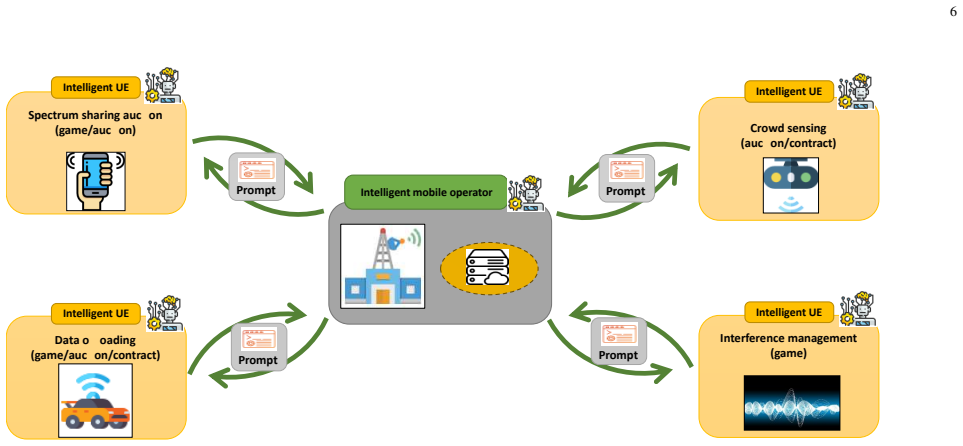
The paper's central claim is that strategic mechanism design in telecommunications can be restructured as a prompt-based communication loop: network agents send intents, a retrieval-augmented generation module supplies specialized theory documents, and an LLM or small language model outputs the mechanism's textual description, mathematical formulation, and code, with quality metrics feeding back through reinforcement learning from human feedback. The novel pivot is the fully-automated track's premise: if formal requirements like incentive compatibility and individual rationality are relaxed into near-optimal weighted objectives, as in the cited Markov decision process contract formulation, then mathematical proofs become unnecessary and the human validation bottleneck disappears. The paper asserts that through iterative cycles of this prompt-based communication, agents within the network can autonomously interact and collaboratively solve problems, establishing what it calls a new paradigm for automated strategic mechanism design driven by prompt-based communication.
Load-bearing premise
The weakest assumption is that a weighted sum of designer payoff and constraint-violation penalties produces near-optimal mechanisms whose equilibrium and incentive properties can be trusted without formal proof.
Editorial extensions
If this is right
- Human effort in mechanism design would shrink from framework selection, formulation, proof, and code to a single validation step in the semi-automated track, and to nothing in the fully-automated track.
- The semi-automated track is inherently non-real-time because expert validators are scarce; real-time negotiation among autonomous agents requires the low-latency SLM or URLLC edge path.
- Full automation changes what counts as an acceptable solution: near-optimal outcomes with occasional incentive-compatibility violations replace globally optimal, provably truthful mechanisms.
- RAG-based knowledge bases let the system absorb newly proposed mechanisms and evolving 3GPP standards without retraining the language model.
- LLM-driven agents that communicate by prompts can negotiate toward equilibrium solutions, which the paper positions as a key enabler of zero-touch networks.
Reading between the lines
- The relaxation move trades away the guarantees that make mechanism design valuable: if incentive compatibility only holds approximately, truthfulness is no longer a dominant strategy, and the paper does not quantify the resulting efficiency or revenue loss.
- A natural testable extension is a benchmark suite that pairs LLM-generated mechanisms with simulation-based verification of incentive compatibility and individual rationality, letting the community measure how far near-optimal is from optimal before trusting full automation.
- The history-memorization gap the paper identifies points toward a hybrid division of labor it only gestures at: LLMs propose mechanisms while classical solvers verify them.
- Because the framework only swaps the knowledge base to change domains, the same architecture should transfer to cloud resource markets, energy trading, or any marketplace with a documented body of mechanism-design results.
Signed reviews
Editorial analysis
A structured set of objections, weighed in public.
Referee Report
Summary. This position paper argues that large language models (LLMs) can automate or semi-automate strategic mechanism design for communication networks. It proposes a workflow in which LLM agents communicate through prompts, retrieve specialized knowledge via retrieval-augmented generation (RAG), and produce mechanisms (games, auctions, or contracts) in textual, mathematical, and code form. The paper distinguishes a semi-automated pipeline, in which human experts validate proofs and mechanisms, from a fully-automated pipeline, in which relaxed objectives (specifically, penalty-weighted rewards that include incentive compatibility and individual rationality violations) are claimed to make formal proofs unnecessary. It also discusses use cases, evaluation metrics, latency requirements, and open challenges such as hallucination, historical strategy memorization, validation via digital twins, and hybrid mechanisms.
Significance. The paper addresses a timely and important question: whether generative AI can reduce the human effort required in mechanism design for telecom systems. Its taxonomy of semi- versus fully-automated pipelines, its emphasis on RAG and low-latency inference, and its explicit acknowledgment of LLM hallucination risks are useful contributions to a vision-level discussion. The paper is honest about major limitations, including the scarcity of expert validators and the unreliability of LLM-generated proofs. If the central feasibility claim were established, the impact could be substantial for zero-touch network management and for adapting mechanism design to dynamic spectrum and resource-allocation settings. However, the paper's key premise—that relaxed, penalty-weighted objectives can replace formal incentive-compatibility and equilibrium proofs—is asserted rather than demonstrated, and this premise is load-bearing for the fully-automated pipeline.
major comments (4)
- [Section III-C2] The claim that relaxing IC and IR constraints into a weighted-sum reward 'requires no mathematical proof' is load-bearing and unsupported. The cited reference [10] is a specific contract-theory MDP formulation; it does not establish a general relaxation principle for auctions, games, and contracts. No argument is given that near-zero constraint violations can be guaranteed with high probability, that incentive properties degrade gracefully when constraints are occasionally violated, or that a learned policy's guarantees transfer to unseen agent types and network states. Without such an equivalence, dropping formal proofs is unjustified, and the distinction between the semi-automated and fully-automated pipelines collapses. Please either provide a formal approximation argument or explicitly reframe this as an open hypothesis that requires validation.
- [Section III-C, opening paragraph] The statement that 'through iterative cycles of the proposed prompt-based communication approach, agents within the network can autonomously interact and collaboratively solve problems' is asserted without evidence. Reference [7] on LLMs as optimizers addresses single-agent optimization in text-based tasks and does not establish convergence of multi-agent prompt-based communication to a Nash equilibrium or to a desirable mechanism design outcome. Please specify the conditions under which iterative prompting is expected to converge, or weaken the claim to a conjecture supported by a concrete testbed.
- [Section III-C1 and Section IV-C] The paper contains an internal tension that is not resolved: Section III-C1 argues that expert validation is required because LLMs generate 'seemingly accurate proofs that are, in fact, a mix of contradictory and nuanced statements,' while Section IV-C concedes that 'LLMs often experience hallucinations when they fail to capture the dynamic variations in rapidly changing networks, leading to incorrect conclusions.' Yet the fully-automated pipeline in Section III-C2 removes human validation solely on the basis of relaxed objectives. If LLMs cannot reliably produce valid proofs, and if the relaxation argument is not established, then the fully-automated pipeline has no mechanism to detect or correct hallucinated solutions. Please address this tension explicitly and explain how the relaxed formulation mitigates proof-generation errors.
- [Figure 5 and Section III-C2] The term 'near-optimal' is never defined, and no metric is given for what constitutes an acceptable trade-off between designer payoff and constraint violations. Since the entire relaxation pillar rests on the idea that near-optimal solutions are acceptable, the paper should state a concrete notion of approximation (e.g., additive or multiplicative regret, violation probability bounds, or a benchmark against classical mechanisms) and discuss where such approximate guarantees would be tolerable in telecom applications. Without this, the proposal is not empirically falsifiable.
minor comments (5)
- [Section III-C1, first bullet] The phrase 'minimal human innervation' appears to be a typo for 'minimal human intervention.'
- [Contributions, Q2 bullet] The sentence 'in the earlier no human intervention is needed' should read 'in the former no human intervention is needed.'
- [Figure 5 text] The phrase 'relaxed to illuminate the need for formal proofs' should likely be 'relaxed to eliminate the need for formal proofs.'
- [Section III-C2, reference to [10]] The text refers to 'Ismail et al.' but the first author of reference [10] is Lotfi; please use 'Lotfi et al.' for consistency.
- [Reference [5]] The title of [5] contains a typo: 'telecom-specfic' should be 'telecom-specific.'
Circularity Check
No circular derivation chain: this is a position paper with proposals and conditional arguments, not a derivation whose output is equivalent to its inputs.
full rationale
This paper is a vision/position paper, not a derivation. It does not define a quantity in terms of another quantity and then claim to predict it, and it contains no equations that could reduce to each other by construction. The central claim in Section III-C is that LLM-driven pipelines can automate strategic mechanism design, with the semi-automated pipeline requiring human proof validation and the fully-automated pipeline relying on relaxed objectives. The fully-automated argument is explicitly conditional: the authors argue that 'if more relaxed forms of strategic mechanism design are available, we can use that as part of the knowledge base of the specialized-RAG module' and hence human proof validation becomes unnecessary. The cited example [10], including the weighted-sum reward of designer payoff plus IC/IR violations, is used as an illustrative instance of such a relaxed formulation, not as a result whose conclusion is identical to the paper's premise. Even though [10] shares an author with the present paper, it is an external published work and the present paper does not derive its central proposal from it; removing or questioning [10] would weaken the evidence base but would not collapse the paper's conditional proposal into a tautology. The paper itself flags its own limitations, such as hallucinated proofs in Section III-C1 and the concern in Section IV-C that LLMs lack reliable proof-generation capabilities. These are correctness and feasibility concerns, not circularity: the unsupported equivalence between a penalty-weighted reward and the original constrained mechanism design problem is an unproven assumption, but it is not an input secretly reused as an output. No equation is fitted and then called a prediction, and no self-citation is invoked as a uniqueness theorem to forbid alternatives. Therefore the honest finding is no significant circularity, with a score of 0.
Assumptions & free parameters
assumptions (5)
- domain assumption LLMs/SLMs can produce correct strategic mechanism formulations (games, auctions, contracts) when prompts are augmented with retrieved domain knowledge.
- domain assumption Relaxing IC/IR constraints and optimizing a weighted sum of designer payoff and violation counts yields acceptable near-optimal mechanisms without formal proofs.
- domain assumption Low-latency inference can be achieved by local SLMs or URLLC links to edge servers, making real-time multi-agent LLM interaction feasible.
- domain assumption RAG knowledge bases can be built with sufficiently complete and current documents and retrievers to avoid grounding errors and outdated information.
- domain assumption Autonomous network agents can communicate intents and negotiate through natural language prompts to reach equilibrium outcomes.
Cite this review
Pith. "Pith review of Rethinking Strategic Mechanism Design In The Age Of Large Language Models: New Directions For Communication Systems." pith.science (2026). https://pith.science/paper/HXYXW767
@misc{pith2026241200495,
  author       = {Pith},
  title        = {Pith review of: Rethinking Strategic Mechanism Design In The Age Of Large Language Models: New Directions For Communication Systems},
  year         = {2026},
  howpublished = {\url{https://pith.science/paper/HXYXW767}},
  note         = {Machine review of arXiv:2412.00495}
}
read the original abstract
This paper explores the application of large language models (LLMs) in designing strategic mechanisms -- including auctions, contracts, and games -- for specific purposes in communication networks. Traditionally, strategic mechanism design in telecommunications has relied on human expertise to craft solutions based on game theory, auction theory, and contract theory. However, the evolving landscape of telecom networks, characterized by increasing abstraction, emerging use cases, and novel value creation opportunities, calls for more adaptive and efficient approaches. We propose leveraging LLMs to automate or semi-automate the process of strategic mechanism design, from intent specification to final formulation. This paradigm shift introduces both semi-automated and fully-automated design pipelines, raising crucial questions about faithfulness to intents, incentive compatibility, algorithmic stability, and the balance between human oversight and artificial intelligence (AI) autonomy. The paper discusses potential frameworks, such as retrieval-augmented generation (RAG)-based systems, to implement LLM-driven mechanism design in communication networks contexts. We examine key challenges, including LLM limitations in capturing domain-specific constraints, ensuring strategy proofness, and integrating with evolving telecom standards. By providing an in-depth analysis of the synergies and tensions between LLMs and strategic mechanism design within the IoT ecosystem, this work aims to stimulate discussion on the future of AI-driven information economic mechanisms in telecommunications and their potential to address complex, dynamic network management scenarios.
Figures


Figures from the paper (2 more)

Reference graph
Works this paper leans on
-
[10]
Semantic information marketing in the metaverse: A learning-based contract theory framework,
I. Lotfi, D. Niyato, S. Sun, D. I. Kim, and X. Shen, “Semantic information marketing in the metaverse: A learning-based contract theory framework,” IEEE Journal on Selected Areas in Communications, vol. 42, no. 3, pp. 710–723, 2024
work page 2024
-
[7]
Large language models as optimizers,
C. Yang et al., “Large language models as optimizers,” in Proc. ICLR, 2024
work page 2024
-
[1]
Z. Han, D. Niyato, W. Saad, and T. Bas ¸ar, Game Theory for Next Generation Wireless and Communication Networks: Modeling, Analysis, and Design. Cambridge University Press, 2019
2019
-
[2]
A survey of contract theory-based incentive mechanism design in wireless networks,
Y . Zhang, M. Pan, L. Song, Z. Dawy, and Z. Han, “A survey of contract theory-based incentive mechanism design in wireless networks,” IEEE Wireless Commun, vol. 24, no. 3, pp. 80–85, 2017
work page 2017
-
[3]
Auction approaches for re- source allocation in wireless systems: A survey,
Y . Zhang, C. Lee, D. Niyato, and P. Wang, “Auction approaches for re- source allocation in wireless systems: A survey,” IEEE Communications Surveys & Tutorials, vol. 15, no. 3, pp. 1020–1041, 2013
2013
-
[4]
Telco-RAG: Navigating the challenges of retrieval-augmented language models for telecommunications,
A.-L. Bornea, F. Ayed, A. D. Domenico, N. Piovesan, and A. Maatouk, “Telco-RAG: Navigating the challenges of retrieval-augmented language models for telecommunications,” CoRR, vol. abs/2404.15939, 2024
arXiv 2024
-
[5]
TelecomGPT: A framework to build telecom-specfic large language models,
H. Zou, Q. Zhao, Y . Tian, L. Bariah, F. Bader, T. Lestable, and M. Debbah, “TelecomGPT: A framework to build telecom-specfic large language models,” CoRR, vol. abs/2407.09424, 2024
arXiv 2024
-
[6]
Fine-grained human feedback gives better rewards for language model training,
Z. Wu, Y . Hu, W. Shi, N. Dziri, A. Suhr, P. Ammanabrolu, N. A. Smith, M. Ostendorf, and H. Hajishirzi, “Fine-grained human feedback gives better rewards for language model training,” Advances in Neural Information Processing Systems , vol. 36, 2024
2024
Show all 14 references
-
[8]
A survey on hallucination in large language models: Principles, taxonomy, challenges, and open questions,
L. Huang, W. Yu, W. Ma, W. Zhong, Z. Feng, H. Wang, Q. Chen, W. Peng, X. Feng, B. Qin, and T. Liu, “A survey on hallucination in large language models: Principles, taxonomy, challenges, and open questions,” CoRR, vol. abs/2311.05232, 2023
2023 arXiv
-
[9]
Mechanism design for large language models,
P. D ¨utting, V . Mirrokni, R. Paes Leme, H. Xu, and S. Zuo, “Mechanism design for large language models,” in Proceedings of the ACM on Web Conference 2024 . Association for Computing Machinery, 2024, p. 144–155
2024
-
[11]
Applications of repeated games in wireless networks: A survey,
D. T. Hoang, X. Lu, D. Niyato, P. Wang, D. I. Kim, and Z. Han, “Applications of repeated games in wireless networks: A survey,” IEEE Communications Surveys & Tutorials , vol. 17, no. 4, pp. 2102–2135, 2015
2015
-
[12]
A hybrid mechanism for heterogeneous e-procurement involving a combinatorial auction and bargaining,
H. Huang, R. J. Kauffman, H. Xu, and L. Zhao, “A hybrid mechanism for heterogeneous e-procurement involving a combinatorial auction and bargaining,” Electronic Commerce Research and Applications , vol. 12, no. 3, p. 181–194, May 2013
2013
-
[13]
Predicting real-world penny auction durations by integrating game theory and machine learning,
Y . Wang and H. Yu, “Predicting real-world penny auction durations by integrating game theory and machine learning,” Proceedings of the AAAI Conference on Artificial Intelligence, vol. 38, no. 9, pp. 9926–9934, Mar. 2024
2024
-
[14]
MixLoRA: Enhancing large language models fine-tuning with LoRA-based Mixture of Experts,
D. Li et al., “MixLoRA: Enhancing large language models fine-tuning with LoRA-based Mixture of Experts,” CoRR, vol. abs/2404.15159, 2024
2024 arXiv
Reviewed August 12, 2026 · model on record in the stance chip above.
Discussion (0). Continue with ORCID to comment.