REVIEW 5 major objections 5 minor 6 cited by
Periodical orbits and waveforms with spontaneous Lorentz symmetry-breaking in Kalb-Ramond gravity
T0 review · 5 major / 5 minor · reviewed 2026-08-12 · deepseek-v4-flash
Pith's one-line read The Kalb-Ramond Lorentz-breaking parameter l shifts the phase, and slightly the amplitude, of gravitational waves from a body spiraling past a black hole.
desk verdict Clean geodesic and periodic-orbit analysis for the KR black hole, but the waveform claim rests on applying the GR quadrupole formula in proper time rather than detector time, so the phase shift is not yet an observable prediction. read the letter →
The pith
A machine-rendered reading of the paper's core claim, the machinery that carries it, and where it could break.
The reading
What carries the argument
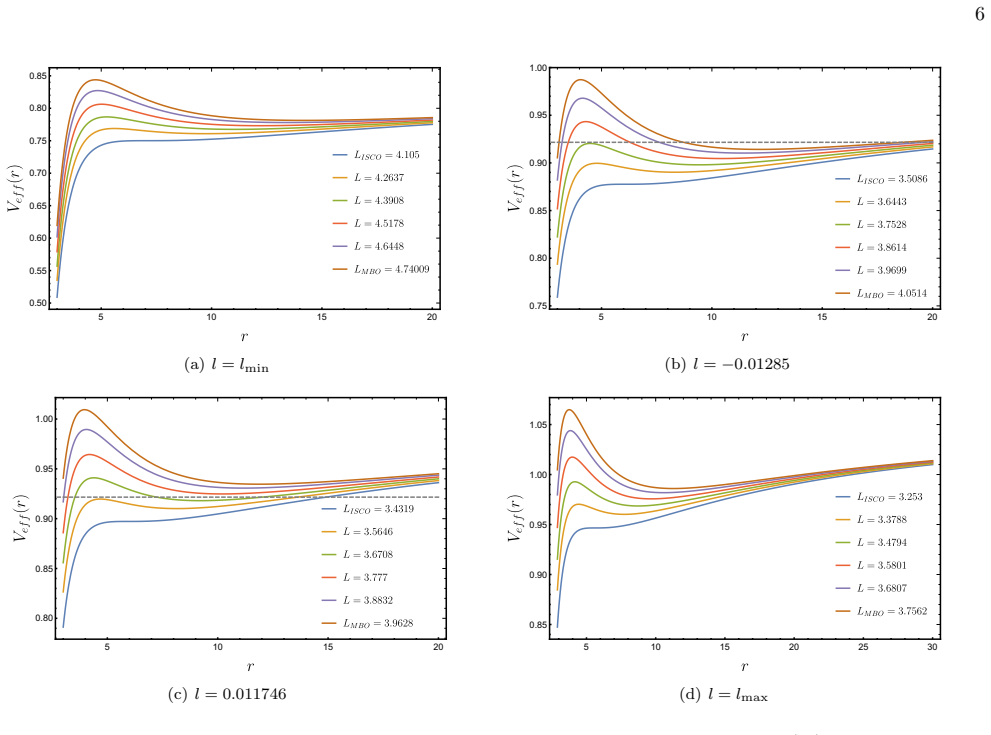
The load-bearing object is the effective potential for timelike geodesics, $V_{\rm eff}(r)=\left(\frac{1}{1-l}-\frac{2M}{r}\right)\left(1+\frac{L^2}{r^2}\right)$, whose extrema fix the marginally bound orbit and the ISCO, and whose zeroes of $\dot r^2=E^2-V_{\rm eff}$ give the turning points that define bound orbits. The periodic-orbit selection rule is the rational-number condition $q\equiv \Delta\phi/2\pi-1=w+v/z$, where $z$ counts the zoom leaves, $w$ the whirl turns around periastron, and $v$ the vertex label of the successive apastron. Solving this condition numerically for the energy and angular momentum of each taxonomy $(z,w,v)$ produces the orbit families; the same $\dot r^2$ and turning-point data enter the quadrupole polarization formulas $h_+=-(2\beta M^2/(D_L r))(1+\cos^2\iota)\cos(2\phi+2\zeta)$ and $h_\times=-(4\beta M^2/(D_L r))\cos\iota\sin(2\phi+2\zeta)$, which convert the periodic orbits into waveforms. The l-dependence of the critical orbits enters through the combination $(1-l)$, which is why the waveform effect shows up as a phase shift rather than a change in orbit taxonomy.
What would settle it
Compute gravitational-wave emission from the full Kalb-Ramond field equations at linear order and compare the resulting phase evolution with the Fig. 10 waveforms; if the symmetry-breaking field contributes to the source or changes the wave speed, the predicted phase shift would change. Observationally, matched filtering of a long EMRI signal with Kalb-Ramond versus Schwarzschild templates would settle which phase evolution a detector actually sees.
Extended reading notes
Core claim
The central claim, stated on the paper's own terms, is that the spontaneous Lorentz symmetry-breaking parameter l is not just a theoretical curiosity but produces a waveform signature. Using the effective potential for timelike geodesics, the authors obtain closed-form expressions for the marginally bound orbit, $r_{\rm MBO}=4M(1-l)$, and the innermost stable circular orbit, $r_{\rm ISCO}=6M(1-l)$, so the critical radii and angular momenta shrink uniformly with l, while the ISCO energy grows. They then classify orbits by the rational number $q=w+v/z$ from the $(z,w,v)$ taxonomy, solve the turning-point equation numerically for orbits between MBO and ISCO, and find that for fixed energy $l<0$ orbits carry higher angular momentum and higher eccentricity than $l>0$ orbits. Feeding those orbits through the quadrupole Kludge formula produces $h_+$ and $h_\times$ waveforms for an EMRI system with a Sgr A*-like massive black hole; compared with Schwarzschild, the waveforms for $l=-0.01285$ and $l=0.011746$ differ mainly in phase, with a smaller amplitude change. The paper interprets this phase difference as a promising observational signature for Lorentz symmetry-breaking.
Load-bearing premise
The predicted phase difference relies on the assumption that the symmetry-breaking field changes the orbit but leaves the emitted gravitational waves otherwise identical to general relativity's, and that the time coordinate used to plot the waves matches what a detector measures.
Editorial extensions
If this is right
- In Kalb-Ramond gravity, the marginally bound orbit and the ISCO shrink uniformly as $(1-l)$, so the radii and angular momenta of these special orbits are rescaled compared to Schwarzschild while the ISCO energy rises with l.
- For the same periodic-orbit taxonomy $(z,w,v)$ at fixed energy, negative l yields higher angular momentum and more eccentric orbits, whereas positive l yields lower angular momentum and less eccentric orbits; at fixed angular momentum the trend in energy is reversed.
- The gravitational-wave polarizations $h_+$ and $h_\times$ from an EMRI in the KR spacetime carry a clear phase shift, and a mild amplitude change, relative to Schwarzschild; this phase imprint is uniform across the taxonomy, so it does not depend on the particular $(z,w,v)$ chosen.
- A space-based detector sensitive to EMRI waveforms could in principle use this phase shift to distinguish a KR central black hole from a Schwarzschild one within the observationally allowed range of l, offering a new observational channel for Lorentz symmetry-breaking beyond precession and shadow measurements.
Reading between the lines
- The paper does not stress that the $(1-l)$ scaling of all critical radii makes l degenerate with a mass rescaling in any single orbital measurement; the waveform phase is the observable that could break this degeneracy.
- If the actual radiative sector of the theory differs from the Kludge quadrupole limit, the predicted phase shift would be modified; deriving that sector is the natural next step before building search templates.
- Because the photon sphere also rescales with $(1-l)$, the same parameter connects these waveform predictions to shadow observations; combining an EMRI phase measurement with a shadow-radius measurement would give a consistency test of the theory.
Editorial analysis
A structured set of objections, weighed in public.
Referee Report
Summary. The manuscript studies timelike geodesics in a static spherically symmetric Kalb-Ramond black-hole spacetime characterized by the Lorentz-violating parameter l. It derives the effective potential, computes the marginally bound orbit and innermost stable circular orbit, classifies periodic orbits using the (z, w, v) taxonomy, and constructs h+ and h× waveforms for an extreme mass ratio inspiral using the adiabatic approximation and a quadrupole kludge formula. The central claim is that l produces observable phase deviations in the gravitational waveforms relative to Schwarzschild, offering a possible LISA signature.
Significance. The geodesic, MBO, ISCO, and periodic-orbit analysis is internally consistent, reduces to Schwarzschild at l = 0, and uses the parameter interval from the external constraint of Ref. [102] without fitting predictions back to the input. The analytic MBO/ISCO expressions and the numerical classification of periodic orbits are useful additions. The observational claim, however, rests on a waveform computation that is not expressed in detector time and that assumes the general-relativistic radiative sector; these two issues are load-bearing for the claim that LISA could distinguish KR black holes from Schwarzschild black holes and must be resolved before the phase shifts in Fig. 10 can be considered observable.
major comments (5)
- [V, Eq. (22), Fig. 10] The waveforms in Fig. 10 are plotted as functions of the smaller body's proper time, with no conversion to the coordinate time of the source frame or to detector time. In the quadrupole formula (22) and in the kludge method, the velocities v_i and the phase argument are defined with respect to coordinate time t. For the KR metric, dt/dτ = E/A(r) with A(r) = 1/(1 - l) - 2M/r, so the mapping between τ and t depends on l and on r. Consequently, the phase difference between l = 0 and l ≠ 0 shown in Fig. 10 mixes a genuine orbital effect with an l-dependent time reparametrization. The authors should recompute h+ and h× as functions of coordinate time, or provide the explicit conversion and replot, before drawing conclusions about observable phase shifts.
- [V, Eq. (22)] Equation (22) is the general-relativistic quadrupole formula. The paper applies it to gravitational radiation from orbits in KR gravity without deriving or citing the radiative sector of the KR theory. If the KR field modifies wave generation, the polarization content, or wave propagation, the predicted phase and amplitude differences would not be the signals reaching LISA. This assumption is load-bearing for the central claim and should be stated and justified explicitly, or the observational claim should be correspondingly softened.
- [V] Although the adiabatic approximation is invoked in Sec. V, the computation uses fixed E = 0.96 and a fixed periodic orbit; no radiation-reaction evolution of E and L is implemented. The resulting h+ and h× are periodic-orbit waveform snippets rather than full inspiral waveforms, so the comparison with EMRI signals in LISA is incomplete. The text should state this limitation clearly when presenting Fig. 10.
- [II, Eq. (3)] The assignment ε = -1 for light-like and ε = 0 for time-like is reversed; for time-like geodesics one needs g_μν \dot{x}^μ \dot{x}^ν = -1. The subsequent equations (7) and (10) effectively use the timelike value ε = -1, so the error is typographical in nature, but it should be corrected to avoid confusion.
- [III, Eq. (15)] The printed expression E_ISCO = 2√2 / 3√(1 - l) is ambiguous; the surrounding text and Fig. 1 indicate that E_ISCO increases with l, which requires the denominator form 2√2 / (3√(1 - l)). Please add parentheses to remove the ambiguity.
minor comments (5)
- [V] The stated values ι = 4/π and ζ = 4/π are unusual; these are likely intended to be π/4, and the text should be corrected.
- [IV] The text contains a typo: 'Schwarzsichild' should be 'Schwarzschild'.
- [I] The Introduction contains a typo: 'obervations' should be 'observations'; the affiliation line also contains the typo 'Brazill'.
- [V, Fig. 10] The horizontal axis of Fig. 10 is not labeled; the text says the waveforms are plotted against the eigentime of the lowest-mass object, but the figure should indicate the quantity and units explicitly.
- [V] The term 'eigentime' should be replaced by 'proper time' for clarity, and the text should specify whether the plotted time is in units of the black-hole mass M.
Circularity Check
No significant circularity: orbital and waveform results are computed from the externally sourced KR metric (1) and the observationally constrained l-interval (2), with l never fitted to the predicted outputs.
full rationale
This paper's derivation chain is self-contained given two external inputs: the KR line element (1), adopted from the independent solution paper [97] (Yang, Chen, Duan, Zhao), and the observationally constrained interval (2), taken from the authors' previous study [102] of S2-star periastron precession around Sgr A*. The interval (2) is a fit to external astrometric data, not a fit to the periodic orbits or waveforms computed here, so it is independent support rather than a load-bearing self-citation: the same orbit/waveform computation would go through for any l. From the metric the paper derives the effective potential (10), MBO/ISCO relations (13)-(15), bound-orbit regions (18), the periodic-orbit condition q = Δφ/(2π) − 1 (20)-(21), and the Kludge polarizations (24)-(25) by direct numerical integration of the geodesic equations. The parameter l is never adjusted to reproduce an orbit or a waveform; for each l, L or E is solved from the geodesic condition at fixed taxonomy and fixed E or L. The resulting l-dependence of the waveforms is therefore an output of the input metric, and the Schwarzschild limit l → 0 is recovered throughout (r_ISCO = 6M, E_ISCO = 2√2/3), providing an external check. The self-citations [101], [102] are contextual or provide that input range; no uniqueness theorem is invoked to forbid alternative metrics. Two limitations are flagged and weighed: Sec. V explicitly acknowledges truncation beyond quadrupole order ("we have excluded the multipole contribution beyond the quadratic order"), and the KR radiative sector is nowhere derived, with Eq. (22) cited from the GR Kludge literature; Fig. 10 is plotted against the inspiraling body's proper time rather than detector coordinate time. These are correctness/observability risks, not reductions of a prediction to its inputs by construction, so they do not constitute circularity under the hard rules.
Assumptions & free parameters
free parameters (3)
- l (Kalb-Ramond Lorentz-violating parameter) =
constrained to [-0.185022, 0.060938] by S2 star precession in [102]
- E_ref = 0.96 =
0.96
- L_ref = 3.7 =
3.7
assumptions (5)
- domain assumption The metric (1) is a valid static, spherically symmetric vacuum solution of non-minimally coupled Einstein-Kalb-Ramond gravity.
- ad hoc to paper The general-relativistic quadrupole formula (Eq. 22) correctly gives the gravitational waveform emitted by an inspiral in KR gravity.
- domain assumption The adiabatic approximation holds, so the inspiraling body follows geodesics with nearly constant E and L over many orbital periods.
- standard math The effective-potential turning-point analysis defines MBO and ISCO via Eqs. (12)-(14).
- standard math Time-like geodesics satisfy g_mu_nu xdot^mu xdot^nu = -1; Eq. (3) mislabels epsilon.
Cite this review
Pith. "Pith review of Periodical orbits and waveforms with spontaneous Lorentz symmetry-breaking in Kalb-Ramond gravity." pith.science (2026). https://pith.science/paper/JTR2B6RC
@misc{pith2026241200769,
  author       = {Pith},
  title        = {Pith review of: Periodical orbits and waveforms with spontaneous Lorentz symmetry-breaking in Kalb-Ramond gravity},
  year         = {2026},
  howpublished = {\url{https://pith.science/paper/JTR2B6RC}},
  note         = {Machine review of arXiv:2412.00769}
}
abstract
In this paper, we study time-like geodesics around a spherically symmetric black hole in Kalb-Ramond (KR) gravity, characterized by the parameter $l$, which induces spontaneous Lorentz symmetry breaking. The geodesic equations and effective potential are derived to investigate the influence of $l$. We calculate the marginally bound orbits and innermost stable circular orbits, analyzing the parameter's impact. Periodic orbits are computed numerically and classified within the standard taxonomy, revealing significant effects of $l$ on their momentum and energy. Additionally, we explore an extreme mass ratio inspiral system under the adiabatic approximation to derive gravitational waveforms emitted by an object orbiting a supermassive black hole in KR gravity. These waveforms reflect the distinctive characteristics of periodic orbits and highlight the influence of $l$. With advancements in gravitational wave detection, these results offer insights into black holes influenced by Lorentz symmetry-breaking fields.
Figures


Figures from the paper (7 more)


Forward citations
Cited by 6 Pith papers
-
Rational Orbits and Gravitational Waves in Static Spherical Spacetimes: An Open-Source Numerical Framework
Open-source numerical package for rational orbits and gravitational waves in static spherically symmetric spacetimes, validated on Schwarzschild and applied to an IMBH-Sgr A* EMRI.
-
Boson Stars in Bumblebee Gravity and Their Gravitational Waveforms from Extreme-Mass-Ratio Inspirals
In bumblebee gravity, the Lorentz-violating parameter ℓ makes mini-boson stars more compact for positive ℓ and produces LISA-detectable, sustained EMRI waveforms for penetrating orbits.
-
Gravitational radiations from periodic orbits around a black hole in the effective field theory extension of general relativity
Periodic orbits around EFTGR black holes produce gravitational waveforms whose substructures increase in complexity with higher zoom numbers.
-
Gravitational wave signatures of magnetized Ernst black hole
Magnetic fields in the Ernst black-hole spacetime alter zoom-whirl EMRI waveforms, spectra, and characteristic strain in ways the authors claim LISA-class detectors could probe.
-
Periodic Timelike Motion and Gravitational Wave Signatures around a Magnetically Charged Black Hole Surrounded by Quintessence
Quintessence shifts orbital radii, turning points, and zoom-whirl parameters for timelike geodesics around a magnetically charged black hole, producing burst-like gravitational waveforms whose phase, timing, and milli...
-
Periodic orbits and their gravitational wave radiations in black hole with dark matter halo
A Hernquist-like dark matter halo changes the energies, angular momenta, and gravitational waveforms of periodic orbits around a supermassive black hole, compared with vacuum Schwarzschild.
Reference graph
Works this paper leans on
-
[102]
K. Yang, Y. Z. Chen, Z. Q. Duan and J. Y. Zhao, Static and spherically symmetric black holes in gravity with a background Kalb-Ramond field, Phys. Rev. D108 (2023) no.12, 124004 [ arXiv:2308.06613]
arXiv 2023
-
[1]
B. P. Abbott et al. (LIGO Scientific Collaboration and Virgo Collaboration), ”Observation of Gravita- tional Waves from a Binary Black Hole Merger,” Phys. Rev. Lett. 116, 061102 (2016). [ arXiv:1602.03837]
arXiv 2016
-
[2]
B. P. Abbott et al. (LIGO Scientific Collaboration and Virgo Collaboration), Properties of the Binary Black Hole Merger GW150914 , Phys. Rev. Lett. 116, 241102 (2016). [DOI: 10.1103/PhysRevLett.116.241102]
-
[3]
First M87 Event Horizon Telescope Results. II. Array and Instrumentation
K. Akiyama et al. [Event Horizon Telescope], “First M87 Event Horizon Telescope Results. II. Array and Instrumentation”, Astrophys. J. Lett. 875, no.1, L2 (2019) [arXiv:1906.11239]
arXiv 2019
-
[4]
First M87 Event Horizon Telescope Results. III. Data Pro- cessing and Calibration
K. Akiyama et al. [Event Horizon Telescope], “First M87 Event Horizon Telescope Results. III. Data Pro- cessing and Calibration”, Astrophys. J. Lett. 875, no.1, L3 (2019) [ arXiv:1906.11240]
arXiv 2019
-
[5]
zooming” phase, which corresponds to regions of the orbit with higher eccentricity, the amplitude of the emitted waves is significantly lower. In contrast, during the
to characterize a periodic orbit using a triplet (z, w, v), which defines a rational number q encapsulat- ing the unique properties of each orbit. Using the in- formation derived from the region between MBOs and ISCOs, we numerically solved Eq. (21) in Sec. IV. This was achieved by adopting parameterized coordinate sys- tems (x, y) = (r cos ϕ, rsin ϕ), wh...
-
[6]
First M87 Event Horizon Telescope Results. V. Physical Ori- gin of the Asymmetric Ring
K. Akiyama et al. [Event Horizon Telescope], “First M87 Event Horizon Telescope Results. V. Physical Ori- gin of the Asymmetric Ring”, Astrophys. J. Lett. 875, no.1, L5 [ arXiv:1906.11242]
arXiv 1906
-
[7]
First M87 Event Horizon Telescope Results. VI. The Shadow and Mass of the Central Black Hole
K. Akiyama et al. [Event Horizon Telescope], “First M87 Event Horizon Telescope Results. VI. The Shadow and Mass of the Central Black Hole”, Astrophys. J. Lett. 875, no.1, L6 (2019)
2019
Show all 109 references
-
[8]
First M87 Event Horizon Telescope Results. I. The Shadow of the Supermassive Black Hole
K. Akiyama et al. [Event Horizon Telescope], “First M87 Event Horizon Telescope Results. I. The Shadow of the Supermassive Black Hole”, Astrophys. J. 875, no.1, L1 (2019) [ arXiv:1906.11238]
2019 arXiv
-
[9]
First M87 Event Horizon Telescope Results. VII. Polariza- tion of the Ring,
K. Akiyama et al. [Event Horizon Telescope], “First M87 Event Horizon Telescope Results. VII. Polariza- tion of the Ring,” Astrophys. J. Lett. 910 (2021) no.1, L12 [arXiv:2105.01169]
2021 arXiv
-
[10]
First M87 Event Horizon Telescope Results. IV. Imaging the Central Supermassive Black Hole
K. Akiyama et al. [Event Horizon Telescope], “First M87 Event Horizon Telescope Results. IV. Imaging the Central Supermassive Black Hole”, Astrophys. J. Lett. 875, no.1, L4 (2019) [ arXiv:1906.11241]
2019 arXiv
-
[11]
First M87 Event Horizon Telescope Results. IX. Detection of Near-horizon Circular Polarization,
K. Akiyama et al. [Event Horizon Telescope], “First M87 Event Horizon Telescope Results. IX. Detection of Near-horizon Circular Polarization,” Astrophys. J. Lett. 957 (2023) no.2, L20 [ arXiv:2311.10976]
2023 arXiv
-
[12]
First Sagittarius A* Event Horizon Telescope Results. I. The Shadow of the Supermassive Black Hole in the Center of the Milky Way,
K. Akiyama et al. [Event Horizon Telescope], “First Sagittarius A* Event Horizon Telescope Results. I. The Shadow of the Supermassive Black Hole in the Center of the Milky Way,” Astrophys. J. Lett.930 (2022) no.2, L12 [arXiv:2311.08680]
2022 arXiv
-
[13]
First Sagittarius A* Event Horizon Telescope Results. II. EHT and Multiwavelength Observations, Data Process- ing, and Calibration,
K. Akiyama et al. [Event Horizon Telescope], “First Sagittarius A* Event Horizon Telescope Results. II. EHT and Multiwavelength Observations, Data Process- ing, and Calibration,” Astrophys. J. Lett. 930 (2022) no.2, L13 [ arXiv:2311.08679]
2022 arXiv
-
[14]
First Sagittarius A* Event Horizon Telescope Results. III. Imaging of the Galactic Center Supermassive Black Hole,
K. Akiyama et al. [Event Horizon Telescope], “First Sagittarius A* Event Horizon Telescope Results. III. Imaging of the Galactic Center Supermassive Black Hole,” Astrophys. J. Lett. 930 (2022) no.2, L14 [arXiv:2311.09479]
2022 arXiv
-
[15]
First M87 Event Horizon Telescope Results. VIII. Magnetic Field Structure near The Event Horizon,
K. Akiyama et al. [Event Horizon Telescope], “First M87 Event Horizon Telescope Results. VIII. Magnetic Field Structure near The Event Horizon,” Astrophys. J. Lett. 910 (2021) no.1, L13 [ arXiv:2105.01173]
2021 arXiv
-
[16]
First Sagittarius A* Event Horizon Telescope Results. V. Testing Astrophysical Models of the Galactic Center Black Hole,
K. Akiyama et al. [Event Horizon Telescope], “First Sagittarius A* Event Horizon Telescope Results. V. Testing Astrophysical Models of the Galactic Center Black Hole,” Astrophys. J. Lett. 930 (2022) no.2, L16 [arXiv:2311.09478]
2022 arXiv
-
[17]
First Sagittarius A* Event Horizon Telescope Results. VI. Testing the Black Hole Metric,
K. Akiyama et al. [Event Horizon Telescope], “First Sagittarius A* Event Horizon Telescope Results. VI. Testing the Black Hole Metric,” Astrophys. J. Lett.930 (2022) no.2, L17 [ arXiv:2311.09484]
2022 arXiv
-
[18]
Wen-Rui Hu, Yue-Liang Wu, The Taiji Program in Space for gravitational wave physics and the nature of gravity , National Science Review, 4, 685–686, [https://doi.org/10.1093/nsr/nwx116]
-
[19]
Quantum Grav
Jun Luo et al, TianQin: a space-borne gravitational wave detector, Class. Quantum Grav. 33 035010 (2016). [DOI 10.1088/0264-9381/33/3/035010]
2016 doi
-
[20]
First Sagittarius A* Event Horizon Telescope Results. IV. Variability, Morphology, and Black Hole Mass,
K. Akiyama et al. [Event Horizon Telescope], “First Sagittarius A* Event Horizon Telescope Results. IV. Variability, Morphology, and Black Hole Mass,” Astro- phys. J. Lett. 930 (2022) no.2, L15 [arXiv:2311.08697]
2022 arXiv
-
[21]
Glampedakis, Extreme mass ratio inspi- rals: LISA’s unique probe of black hole grav- ity, Class
K. Glampedakis, Extreme mass ratio inspi- rals: LISA’s unique probe of black hole grav- ity, Class. Quant. Grav. 22, S605-S659 (2005) [doi:10.1088/0264-9381/22/15/004]
2005 doi
-
[22]
S. A. Hughes, Gravitational waves from extreme mass ratio inspirals: Challenges in mapping the space-time of massive, compact objects, Class. Quant. Grav. 18, 4067- 4074 (2001) [ [arXiv:gr-qc/0008058 [gr-qc]]
2001 arXiv
-
[23]
Babak, J
S. Babak, J. Gair, A. Sesana, E. Barausse, C. F. Sop- uerta, C. P. L. Berry, E. Berti, P. Amaro-Seoane, A. Pe- titeau and A. Klein, Science with the space-based inter- ferometer LISA. V: Extreme mass-ratio inspirals , Phys. Rev. D 95, no.10, 103012 (2017) [ [arXiv:1703.09722 [gr-qc]]
2017 arXiv
-
[24]
Glampedakis and D
K. Glampedakis and D. Kennefick, Zoom and whirl: Eccentric equatorial orbits around spinning black holes and their evolution under gravitational radi- ation reaction , Phys. Rev. D 66, 044002 (2002) [[arXiv:gr-qc/0203086 [gr-qc]]
2002 arXiv
-
[25]
These orbits are unstable be- cause they occur between the MBO and the ISCO
to identify different types of orbits around the black hole, called zoom-whirl. These orbits are unstable be- cause they occur between the MBO and the ISCO. They are associated with the unstable circular orbits of the ef- fective potential and occur close to the maximum of the...
-
[26]
Maselli, N
A. Maselli, N. Franchini, L. Gualtieri, T. P. Sotiriou, S. Barsanti and P. Pani, Detecting fundamental fields with LISA observations of gravitational waves from extreme mass-ratio inspirals , Nature Astron. 6, no.4, 464-470 (2022) [ [arXiv:2106.11325 [gr-qc]]
2022 arXiv
-
[27]
Perez-Giz and J
G. Perez-Giz and J. Levin, Homoclinic Orbits around Spinning Black Holes II: The Phase Space Portrait , Phys. Rev. D 79 (2009) 124014, [ [arXiv:0811.3815]]
2009 arXiv
-
[28]
Levin, Energy Level Diagrams for Black Hole Orbits, Class
J. Levin, Energy Level Diagrams for Black Hole Orbits, Class. Quant. Grav. 26 (2009) 235010, [[arXiv:0907.5195]]
2009 arXiv
-
[29]
Grossman, J
R. Grossman, J. Levin, and G. Perez-Giz, The harmonic structure of generic Kerr orbits, Phys. Rev. D 85 (2012) 023012, [[arXiv:1105.5811]]
2012 arXiv
-
[30]
Levin and G
J. Levin and G. Perez-Giz, A Periodic Table for Black Hole Orbits , Phys. Rev. D 77, 103005 (2008)[[arXiv:0802.0459 [gr-qc]]
2008 arXiv
-
[31]
Levin and G
J. Levin and G. Perez-Giz, Homoclinic Orbits around Spinning Black Holes. I. Exact Solution for the Kerr Separatrix , Phys. Rev. D 79 (2009) 124013 [[arXiv:0811.3814]]
2009 arXiv
-
[32]
Y. K. Lim and Z. C. Yeo,Energies and angular momenta of periodic Schwarzschild geodesics ’ Phys. Rev. D 109, no.2, 024037 (2024) [ [arXiv:2401.13894 [gr-qc]]
2024 arXiv
-
[33]
T. Y. Zhou and Y. Xie, Precessing and peri- odic motions around a black-bounce/traversable worm- hole, Eur. Phys. J. C 80 (2020) no.11, 1070. [doi:10.1140/epjc/s10052-020-08661-w]
2020 doi
-
[34]
Zhang and Y
J. Zhang and Y. Xie, Probing a black-bounce- Reissner–Nordstr¨ om spacetime with precessing and pe- riodic motion , Eur. Phys. J. C 82 (2022) no.10, 854 [doi:10.1140/epjc/s10052-022-10846-4]
2022 doi
-
[35]
Misra and J
V. Misra and J. Levin, Rational Orbits around Charged Black Holes , Phys. Rev. D 82 (2010) 083001,[[arXiv:1007.2699]]. 16
2010 arXiv
-
[36]
X. M. Deng, Geodesics and periodic or- bits around quantum-corrected black holes , Phys. Dark Univ. 30 (2020) 100629 [https://doi.org/10.1016/j.dark.2020.100629]
2020
-
[37]
and black holes with quantum corrections [38] have been investigated for their impact on GW signatures. The geodesic motion of timelike particles around black holes in Einsteinian cubic gravity was analyzed in [39], with results correlated to recent observational data, fur- th...
-
[38]
S. Yang, Y. P. Zhang, T. Zhu, L. Zhao and Y. X. Liu, Gravitational waveforms from periodic orbits around a quantum-corrected black hole , [ [arXiv:2407.00283 [gr-qc]]
-
[39]
Y. Z. Li, X. M. Kuang and Y. Sang, Precessing and pe- riodic timelike orbits and their potential applications in Einsteinian cubic gravity , Eur. Phys. J. C 84, no.5, 529 (2024)[[arXiv:2401.16071 [gr-qc]]
2024 arXiv
-
[40]
Azreg-A ¨ ınou, Z
M. Azreg-A ¨ ınou, Z. Chen, B. Deng, M. Jamil, T. Zhu, Q. Wu and Y. K. Lim, Orbital mechanics and quasiperi- odic oscillation resonances of black holes in Einstein- Æther theory , Phys. Rev. D 102, no.4, 044028 (2020) [doi:10.1103/PhysRevD.102.044028]
2020 doi
-
[41]
Shabbir, M
O. Shabbir, M. Jamil and M. Azreg-A ¨ ınou,Periodic or- bits and their gravitational wave radiations around the Schwarzschild-MOG black hole , Phys. Dark Univ. 47, 101816 (2025) [ doi:10.1016/j.dark.2025.101816
2025
-
[42]
Z. Y. Tu, T. Zhu and A. Wang, Periodic orbits and their gravitational wave radiations in a polymer black hole in loop quantum gravity, Phys. Rev. D 108, no.2, 2 (2023)[ [arXiv:2304.14160 [gr-qc]]
2023 arXiv
-
[43]
S. A. Hughes, S. Drasco, E. E. Flanagan and J. Franklin, Gravitational radiation reaction and inspiral waveforms in the adiabatic limit , Phys. Rev. Lett. 94, 221101 (2005) [[arXiv:gr-qc/0504015 [gr-qc]]
2005 arXiv
-
[44]
P. A. Sundararajan, G. Khanna and S. A. Hughes, To- wards adiabatic waveforms for inspiral into Kerr black holes. I. A New model of the source for the time domain perturbation equation, Phys. Rev. D 76, 104005 (2007) [[arXiv:gr-qc/0703028 [gr-qc]]
2007 arXiv
-
[45]
L. Meng, Z. Xu and M. Tang, Periodic Orbits and Gravitational Wave Radiation Mechanism in the Reg- ular Hairy Black Hole , [[arXiv:2411.01858 [gr-qc]]
-
[46]
L. Zhao, M. Tang and Z. Xu,Periodic orbits and gravita- tional wave radiation in short hair black hole spacetimes for an extreme mass ratio system ,[[arXiv:2411.01979 [gr-qc]]
-
[47]
Liang, R
D. Liang, R. Xu, Z. F. Mai and L. Shao, Prob- ing vector hair of black holes with extreme-mass-ratio inspirals, Phys. Rev. D 107, no.4, 044053 (2023) [[arXiv:2212.09346 [gr-qc]]
2023 arXiv
-
[48]
Colladay and V
D. Colladay and V. A. Kostelecky, CPT violation and the standard model, Phys. Rev. D 55 (1997), 6760-6774 [arXiv:9703464]
1997
-
[49]
Rovelli, Quantum gravity
C. Rovelli, Quantum gravity . Cambridge university press, United Kingdom, 2010. [ e-print]
2010
-
[51]
V. A. Kostelecky and S. Samuel, Phenomenologi- cal Gravitational Constraints on Strings and Higher Dimensional Theories , Phys. Rev. Lett. 63 (1989), 224.[doi:10.1103/PhysRevLett.63.224]
1989 doi
-
[52]
V. A. Kostelecky and S. Samuel, Gravitational Phenomenology in Higher Dimensional Theories and Strings , Phys. Rev. D 40 (1989), 1886-1903 [doi:10.1103/PhysRevD.40.1886]
1989 doi
-
[53]
M. R. Douglas and N. A. Nekrasov, Noncommuta- tive field theory , Rev. Mod. Phys. 73 (2001), 977-1029 [arXiv:0106048]
2001
-
[54]
S. M. Carroll, J. A. Harvey, V. A. Kostelecky, C. D. Lane and T. Okamoto, Noncommutative field the- ory and Lorentz violation , Phys. Rev. Lett. 87 (2001), 141601 [arXiv:0105082]
2001
-
[55]
Background inde- pendent quantum gravity: A Status report,
A. Ashtekar and J. Lewandowski, “Background inde- pendent quantum gravity: A Status report,” Class. Quant. Grav. 21 (2004), R53 [ arXiv:0404018]
2004
-
[57]
J. R. Ellis, N. E. Mavromatos and D. V. Nanopoulos, Quantum gravitational diffusion and stochastic fluctua- tions in the velocity of light , Gen. Rel. Grav. 32 (2000), 127-144 [arXiv:9904068]
2000
-
[58]
Sotiriou, Baojiu Li, John D
Thomas P. Sotiriou, Baojiu Li, John D. Bar- row, Generalizations of teleparallel gravity and local Lorentz symmetry , Phys.Rev. D 83 (2011) 104030, [arXiv:1012.4039]
2011 arXiv
-
[59]
Sotiriou, John D
Baojiu Li, Thomas P. Sotiriou, John D. Barrow, f(T) gravity and local Lorentz invariance , Phys.Rev. D 83 (2011) 064035, [ arXiv:1010.1041]
2011 arXiv
-
[60]
R. J. Szabo, Quantum field theory on noncom- mutative spaces , Phys. Rept. 378 (2003), 207-299 [arXiv:0109162]
2003
-
[61]
de Rham, Massive Gravity , Living Rev
C. de Rham, Massive Gravity , Living Rev. Rel. 17 (2014), 7 [ arXiv:1401.4173]]
2014 arXiv
-
[62]
Rham, Introduction to Massive Grav- ity, Lect
C. Rham, Introduction to Massive Grav- ity, Lect. Notes Phys. 892 (2015), 139-159. [doi:10.1007/978-3-319-10070-8]
2015 doi
-
[63]
Basilakos, S
S. Basilakos, S. Capozziello, M. De Laurentis, A. Paliathanasis, M. Tsamparlis, Noether symmetries and analytical solutions in f(T)-cosmology: A complete study , Phys.Rev. D 88 (2013) 103526, [ arXiv:1311.2173]
2013 arXiv
-
[64]
Odintsov, Diego S´ aez- G´ omez,Conformal symmetry and accelerating cosmol- ogy in teleparallel gravity , Phys.Rev
Kazuharu Bamba, Sergei D. Odintsov, Diego S´ aez- G´ omez,Conformal symmetry and accelerating cosmol- ogy in teleparallel gravity , Phys.Rev. D 88 (2013) 084042, [arXiv:1308.5789]
2013 arXiv
-
[65]
Miao Li, Rong-Xin Miao, Yan-Gang Miao, Degrees of freedom of f(T) gravity , JHEP 1107 (2011) 108, [arXiv:1105.5934]
2011 arXiv
-
[66]
Hamani Daouda, Manuel E
M. Hamani Daouda, Manuel E. Rodrigues and M.J.S. Houndjo, Static Anisotropic Solutions in f(T) The- ory, Eur.Phys.J. C 72 (2012) 1890, [ arXiv:1109.0528 [physics.gen-ph]]
2012 arXiv
-
[67]
Tiberiu Harko, Francisco S. N. Lobo, G. Otalora, Em- manuel N. Saridakis, Nonminimal torsion-matter cou- pling extension of f(T) gravity , Phys.Rev. D 89 (2014) 124036, [arXiv:1404.6212]
2014 arXiv
-
[68]
M. E. Rodrigues and E. L. B. Junior, Spherical Ac- cretion of Matter by Charged Black Holes on f(T) Gravity, Astrophys. Space Sci. 363 (2018) no.3, 43 [arXiv:1606.04918]
2018 arXiv
-
[69]
E. L. B. Junior and M. E. Rodrigues, Generalized Teleparallel Theory, Eur. Phys. J. C 76 (2016) no.7, 376 [arXiv:1509.03267]
2016 arXiv
-
[70]
Mohseni Sadjadi, Generalized Noether symmetry in f(T) gravity , Phys.Lett
H. Mohseni Sadjadi, Generalized Noether symmetry in f(T) gravity , Phys.Lett. B 718 (2012) 270-275, [arXiv:1210.0937]; 17
2012 arXiv
-
[71]
Rodrigues, M.J.S
M.E. Rodrigues, M.J.S. Houndjo, D. Saez-Gomez, F. Rahaman, Anisotropic Universe Models in f(T) Gravity, Phys.Rev. D 86 (2012) 104059, [ arXiv:1209.4859]
2012 arXiv
-
[72]
E. L. B. Junior and M. E. Rodrigues, Black-bounce in f(T) gravity , Gen. Rel. Grav. 55 (2023) no.1, 8 [arXiv:2203.03629]
2023 arXiv
-
[73]
V. A. Kostelecky and R. Potting, CPT and strings, Nucl. Phys. B 359 (1991), 545-570. [doi:10.1016/0550-3213(91)90071-5]
1991 doi
-
[74]
V. A. Kostelecky and S. Samuel, Photon and Graviton Masses in String Theories , Phys. Rev. Lett. 66 (1991), 1811-1814. [doi:10.1103/PhysRevLett.66.1811]
1991 doi
-
[75]
Horava, Quantum Gravity at a Lifshitz Point , Phys
P. Horava, Quantum Gravity at a Lifshitz Point , Phys. Rev. D 79 (2009), 084008 [ arXiv:0901.3775]
2009 arXiv
-
[76]
V. A. Kostelecky, Gravity, Lorentz violation, and the standard model , Phys. Rev. D 69 (2004), 105009 [arXiv:0312310]
2004
-
[77]
V. A. Kostelecky and S. Samuel, Spontaneous Breaking of Lorentz Symmetry in String Theory, Phys. Rev. D 39 (1989), 683. [ doi:10.1103/PhysRevD.39.683]
1989 doi
-
[78]
R. C. Myers and M. Pospelov, Ultraviolet modifications of dispersion relations in effective field theory , Phys. Rev. Lett. 90 (2003), 211601 [ arXiv:0301124 ]
2003
-
[79]
Bluhm, N
R. Bluhm, N. L. Gagne, R. Potting and A. Vrublevskis, Constraints and Stability in Vector Theories with Spon- taneous Lorentz Violation , Phys. Rev. D 77 (2008), 125007 [erratum: Phys. Rev. D 79 (2009), 029902] [arXiv:0802.4071]
2008 arXiv
-
[80]
V. A. Kostelecky and R. Potting, Expectation values, Lorentz invariance, and CPT in the open bosonic string, Phys. Lett. B 381 (1996), 89-96 [ arXiv:9605088]
1996
-
[81]
V. A. Kostelecky and R. Potting, Analytical con- struction of a nonperturbative vacuum for the open bosonic string , Phys. Rev. D 63 (2001), 046007 [arXiv:0008252]
2001
-
[82]
Gambini and J
R. Gambini and J. Pullin, Nonstandard optics from quantum space-time , Phys. Rev. D 59 (1999), 124021 [arXiv:9809038]
1999
-
[84]
Aashish and S
S. Aashish and S. Panda, Quantum aspects of an- tisymmetric tensor field with spontaneous Lorentz vi- olation, Phys. Rev. D 100 (2019) no.6, 065010 [arXiv:1903.11364]
2019 arXiv
-
[85]
Casana, A
R. Casana, A. Cavalcante, F. P. Poulis and E. B. San- tos, Exact Schwarzschild-like solution in a bumblebee gravity model , Phys. Rev. D 97 (2018) no.10, 104001 [arXiv:1711.02273]
2018 arXiv
-
[86]
Ghosh, S
R. Ghosh, S. Nair, L. Pathak, S. Sarkar and A. S. Sen- gupta, Does the speed of gravitational waves depend on the source velocity? , Phys. Rev. D 108, no.12, 124017 (2023) [doi:10.1103/PhysRevD.108.124017]
2023 doi
-
[87]
Kalb and P
M. Kalb and P. Ramond, Classical direct in- terstring action , Phys. Rev. D 9 (1974), 2273- 2284[doi:10.1103/PhysRevD.9.2273]
1974 doi
-
[88]
Jumaniyozov, M
S. Jumaniyozov, M. Zahid, M. Alloqulov, I. Ibrag- imov, J. Rayimbaev and S. Murodov, Radiative properties and QPOs around charged black hole in Kalb–Ramond gravity , Eur. Phys. J. C 85, no.2, 126 (2025) [doi:10.1140/epjc/s10052-025-13863-1]
2025 doi
-
[89]
Aashish, A
S. Aashish, A. Padhy, S. Panda and A. Rana, Inflation with an antisymmetric tensor field , Eur. Phys. J. C 78 (2018) no.11, 887 [ arXiv:1808.04315]
2018 arXiv
-
[90]
S. Kar, S. SenGupta and S. Sur, Static spherisymmet- ric solutions, gravitational lensing and perihelion pre- cession in Einstein-Kalb-Ramond theory , Phys. Rev. D 67 (2003), 044005 [ arXiv:0210176]
2003
-
[91]
Q. G. Bailey and V. A. Kostelecky, Signals for Lorentz violation in post-Newtonian gravity , Phys. Rev. D 74, 045001 (2006) [ doi:10.1103/PhysRevD.74.045001]
2006 doi
-
[92]
Capanelli, L
C. Capanelli, L. Jenks, E. W. Kolb and E. Mc- Donough, Cosmological implications of Kalb- Ramond-like particles , JHEP 06, 075 (2024) [doi:10.1007/JHEP06(2024)075]
2024 doi
-
[93]
Manton and S
T. Manton and S. Alexander, The Kalb- Ramond field and Gravitational Parity Violation , [arXiv:2401.14452]
-
[94]
Capanelli, L
C. Capanelli, L. Jenks, E. W. Kolb and E. Mc- Donough, Cosmological Implications of Kalb-Ramond- Like-Particles, [arXiv:2309.02485]
-
[95]
Chakraborty and S
S. Chakraborty and S. SenGupta, Strong gravi- tational lensing — A probe for extra dimensions and Kalb-Ramond field , JCAP 07 (2017), 045 [arXiv:1611.06936]
2017 arXiv
-
[96]
Kumar, S
R. Kumar, S. G. Ghosh and A. Wang, Gravitational deflection of light and shadow cast by rotating Kalb- Ramond black holes , Phys. Rev. D 101 (2020) no.10, 104001 [arXiv:2001.00460]
2020 arXiv
-
[97]
Atamurotov, D
F. Atamurotov, D. Ortiqboev, A. Abdujabbarov and G. Mustafa, Particle dynamics and gravita- tional weak lensing around black hole in the Kalb- Ramond gravity, Eur. Phys. J. C 82 (2022) no.8, 659. [doi:10.1140/epjc/s10052-022-10619-z]
2022 doi
-
[98]
Altschul, Q
B. Altschul, Q. G. Bailey and V. A. Kostelecky, Lorentz violation with an antisymmetric tensor , Phys. Rev. D 81 (2010), 065028 [ arXiv:0912.4852]
2010 arXiv
-
[99]
L. A. Lessa, J. E. G. Silva, R. V. Maluf and C. A. S. Almeida, Modified black hole solution with a background Kalb-Ramond field , Eur. Phys. J. C 80 (2020) no.4, 335 [ arXiv:1911.10296]
2020 arXiv
-
[100]
Z. Q. Duan, J. Y. Zhao and K. Yang, Electrically charged black holes in gravity with a background Kalb- Ramond field , Eur. Phys. J. C 84, no.8, 798 (2024) [arXiv:2310.13555 [gr-qc]]
2024 arXiv
-
[101]
Syed Masood, Said Mikki, The thermodynamic profile of AdS black holes in Lorentz invariance-violating Bum- blebee and Kalb-Ramond gravity , [arXiv:2411.06188v1 [gr-qc]]
-
[103]
Oxford University Press, 2022
Ray D’Inverno and James Vickres, Introducing Ein- stein ’s Relativity, 2 ed. Oxford University Press, 2022
2022
-
[104]
Poisson and C
E. Poisson and C. M. Will, Gravity: Newtonian, Post- Newtonian, Relativistic , (Cambridge University Press, Cambridge, England, 2014)
2014
-
[105]
method to obtain the GWs emitted by periodic or- bits in the KR black hole. The method consists of taking the gravitational quadrupole relation to obtain of gravi- tational waveform up to the quadratic order (for details see Ref.[104]) hij = 4βM DL vivj − m r ninj , (22) where...
-
[106]
W. D. Guo, Q. Tan and Y. X. Liu, Quasinor- mal modes and greybody factor of a Lorentz- violating black hole , JCAP 07, 008 (2024) [doi:10.1088/1475-7516/2024/07/008]
2024 doi
-
[107]
and bumblebee [42] fields, which violate Lorentz symmetry, and studies on gravitational waves are con- ducted with the KR field [93]. To analyze how the KR metric parameter l can al- ter the gravitational waveform, let us consider a ficti- tious EMRI system composed of the Sgr...
-
[108]
E. L. B. Junior, J. T. S. S. Junior, F. S. N. Lobo, M. E. Rodrigues, D. Rubiera-Garcia, L. F. D. da Silva and H. A. Vieira, Gravitational lensing of a Schwarzschild- 18 like black hole in Kalb-Ramond gravity , Phys. Rev. D 110, no.2, 024077 (2024) [ [arXiv:2405.03284 [gr-qc]]
2024 arXiv
-
[109]
E. L. B. Junior, J. T. S. S. Junior, F. S. N. Lobo, M. E. Rodrigues, D. Rubiera-Garcia, L. F. D. da Silva and H. A. Vieira, Spontaneous Lorentz symmetry-breaking constraints in Kalb-Ramond gravity , Eur. Phys. J. C 84, no.12, 1257 (2024) [ [arXiv:2405.03291 [gr-qc]]
2024 arXiv
-
[110]
Babak, H
S. Babak, H. Fang, J. R. Gair, K. Glampedakis and S. A. Hughes, Kludge’ gravitational waveforms for a test-body orbiting a Kerr black hole , Phys. Rev. D 75, 024005 (2007) [erratum: Phys. Rev. D 77, 04990 (2008)] [arXiv:gr-qc/0607007 [gr-qc]]
2007 arXiv
-
[111]
Cutler, D
C. Cutler, D. Kennefick, E. Poisson, Gravita- tional radiation reaction for bound motion around a Schwarzschild black hole , Phys. Rev. D 50, 3816 (1994) [doi.org/10.1103/PhysRevD.50.3816 ]
1994 doi
-
[112]
Bernardo, R
H. Bernardo, R. Brandenberger and J. Fr¨ ohlich, To- wards a dark sector model from string theory , JCAP 09, 040 (2022) [ doi:10.1088/1475-7516/2022/09/040]
2022 doi
Reviewed August 12, 2026 · model on record in the stance chip above.
Discussion (0). Continue with ORCID to comment.