REVIEW 4 major objections 5 minor 67 references
A Quantum Computing Approach to Simulating Corrosion Inhibition
T0 review · 4 major / 5 minor · reviewed 2026-08-12 · deepseek-v4-flash
Pith's one-line read This paper claims that ADAPT-VQE, solving a two-electron five-orbital active space embedded in periodic DFT, reproduces the classical DFT binding energies of two triazole corrosion inhibitors on Al(111), and that a warm-started variant…
desk verdict A reproducible workflow demo for CP2K/Qiskit embedding on periodic slabs, but the quantum-classical agreement is built into the tiny active space, not a chemical validation. read the letter →
The pith
A machine-rendered reading of the paper's core claim, the machinery that carries it, and where it could break.
The reading
What carries the argument
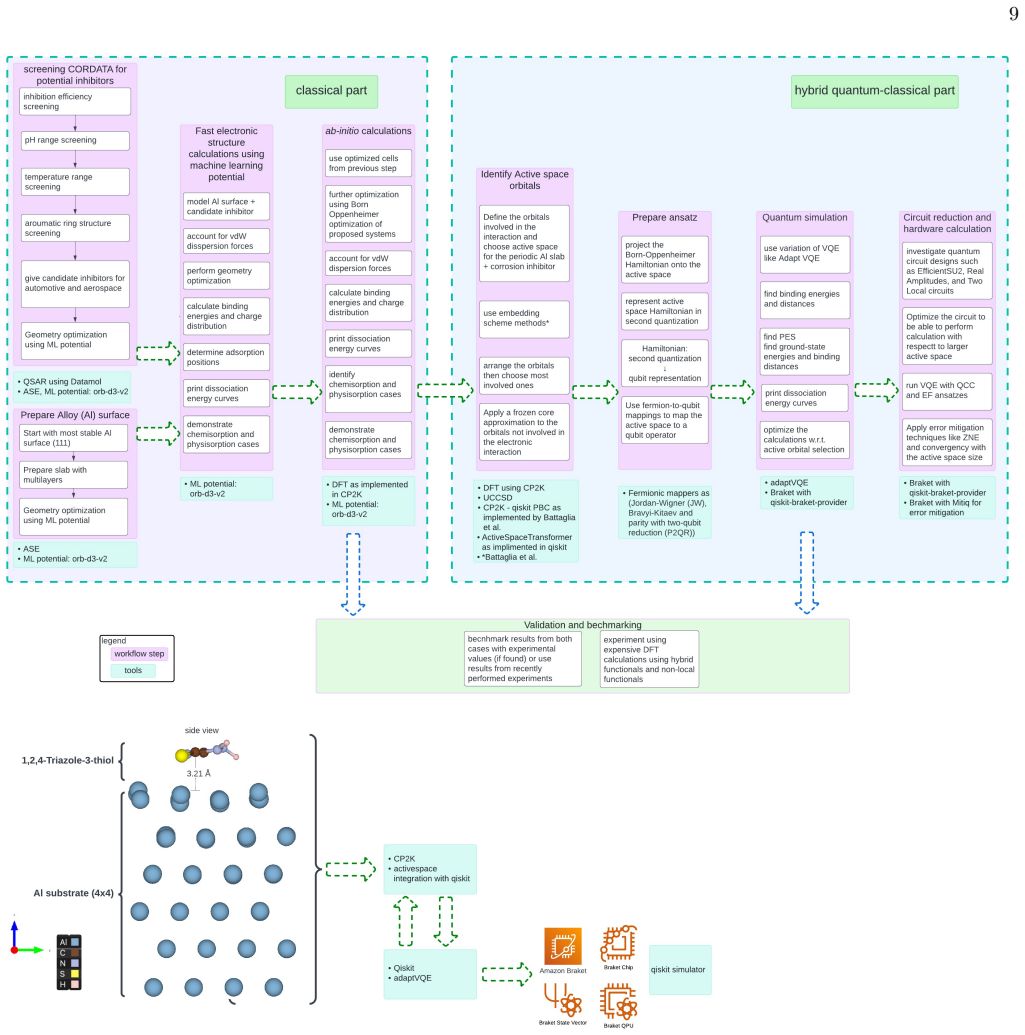
The central object is a two-electron, five-orbital active space ($2e,5o$) constructed from canonical orbitals ordered by energy around the Fermi level of the periodic DFT calculation. This active-space embedding reduces the full periodic problem to a small second-quantized Hamiltonian, which is then solved by ADAPT-VQE, a variational algorithm that grows its ansatz by adding, one at a time, the fermionic excitation operators with the largest gradient. A warm-started variant, StatefulAdaptVQE, reuses information from earlier optimization steps and is the source of the 5-6× speedup. The active-space Hamiltonian is mapped to qubits with parity mapping and a two-qubit reduction, and classical parameters are optimized with SPSA.
What would settle it
Take the same two inhibitors on Al(111), but enlarge the active space to $4e,8o$ (four electrons in eight orbitals) and solve with ADAPT-VQE; compare the resulting binding energies to the DFT reference. If the match degrades beyond chemical accuracy, the $2e,5o$ selection was the reason for the reported agreement, not the quantum algorithm itself.
Extended reading notes
Core claim
The paper reports that ADAPT-VQE with a two-electron, five-orbital active space built from canonical orbitals around the Fermi level reproduces the DFT binding energies of 1,2,4-triazole (-0.386 eV) and 1,2,4-triazole-3-thiol (-1.279 eV) on a 4×4 Al(111) supercell to within about $10^{-5}$ eV. A fixed-ansatz VQE does not, giving -2.326 eV for the unsubstituted triazole, which the authors attribute to looser embedding convergence and lack of adaptive operator selection. The thiol's stronger binding is consistent with its shorter adsorption distance and with experimental literature on sulfur-functionalized inhibitors. The warm-started StatefulAdaptVQE variant reaches the same quality of result 5-6 times faster than plain AdaptVQE in small-system benchmarks, and the paper presents the whole pipeline as a transferable hybrid quantum-classical workflow for periodic surface-adsorbate systems.
Load-bearing premise
The load-bearing premise is that a two-electron, five-orbital active space picked by orbital-energy ordering around the Fermi level captures the electronic coupling that determines inhibitor-aluminum binding.
Editorial extensions
If this is right
- The same embedding-plus-ADAPT-VQE pipeline can be applied to other inhibitor/surface pairs without changing the workflow, only the DFT input and active-space selection.
- The 5-6× speedup from warm-starting makes iterative screening of many inhibitor candidates practical on simulators, since each additional candidate costs a fraction of a full VQE run.
- The computed binding-energy ordering (thiol stronger than triazole) matches the experimental inhibition ranking, so the workflow can rank relative inhibitor strength, not just produce absolute energies.
- Because the method uses periodic DFT embedding, it carries over to other periodic problems such as gas adsorption for carbon capture and electrode-electrolyte interfaces for batteries, as the paper explicitly suggests.
Reading between the lines
- The authors do not claim a quantum advantage; the $2e,5o$ problem is small enough to be solved classically. A meaningful future test would push the active space to roughly 30 or more qubits, where classical exact diagonalization becomes prohibitive.
- Part of the agreement may come from the embedding itself: the DFT calculation sets the one-electron environment, so the quantum solver only handles a nearly trivial two-electron correction. A sharper test would be an active space chosen by charge-density difference rather than orbital-energy ordering alone.
- The claimed transfer to carbon capture and battery materials is plausible but untested; those systems add transition-metal d-states or charged interfaces, so the next stress test should involve stronger charge transfer than triazoles on aluminum.
Signed reviews
Editorial analysis
A structured set of objections, weighed in public.
Referee Report
Summary. The manuscript presents a hybrid quantum-classical workflow for computing binding energies of corrosion inhibitors on Al(111). Classical periodic DFT (PBE-D3) is combined with an active-space embedding scheme: a (2e,5o) active space around the Fermi level is solved by VQE variants (vanilla VQE, ADAPT-VQE, StatefulAdaptVQE) using Qiskit and CP2K. For 1,2,4-Triazole and 1,2,4-Triazole-3-thiol, the reported ADAPT-VQE binding energies (-0.385508 eV and -1.279064 eV) agree with classical DFT to within a few micro-eV, while vanilla VQE yields -2.326 eV for the triazole. Benchmarks on LiH and H2 are used to support claims of algorithmic speedup and error-mitigation performance. The paper concludes that the workflow demonstrates the viability of hybrid quantum-classical approaches for corrosion inhibition and, more broadly, for materials science applications.
Significance. The manuscript's main strength is that it makes the implementation available as open-source code and integrates established tools (CP2K, Qiskit Nature, Braket) into a periodic active-space embedding workflow. The benchmarks on LiH and the error-mitigation analysis on H2 are useful reference points. If the corrosion results were robust, the paper would be a useful proof-of-concept for quantum-chemistry embedding in surface-adsorbate systems. However, the central demonstration is not convincing: the active space is very small, the agreement with classical DFT is essentially a self-consistency check, the single non-agreeing vanilla-VQE result is not adequately explained, and no error bars or convergence data are reported. The paper does not provide a new chemical prediction beyond the classical DFT and experimental results already in the literature.
major comments (4)
- [Section III, Table II and S5, Eq. (1)] The micro-eV agreement between ADAPT-VQE and classical DFT binding energies is not evidence that the quantum calculation captures the inhibitor-surface bond. At adsorption distances of 3.54 Å and 3.21 Å, the binding is dominated by dispersion, which enters only through the classical DFT-D3 term and is absent from the active-space Hamiltonian in Eq. (S1). Moreover, the active space is selected by canonical orbital energy ordering around the Fermi level of a metallic Al slab; no orbital-character projection is provided to show that the five orbitals contain the inhibitor's π system or the sulfur lone pair. The S4 claim that the analysis revealed significant electronic contributions from these orbitals is unsupported by any population, charge-density-difference, or occupation data. The agreement therefore largely reflects the quantum solver reproducing the DFT-derived active-space energy, not the physics of adsorption.
- [Section III, Table II] The vanilla VQE result for 1,2,4-Triazole (-2.326 eV) is a serious outlier. Attributing this ~2 eV deviation to a looser embedding convergence threshold (2E-5 vs 1E-6 Ha) is not credible without convergence evidence: a threshold change of 1e-5 Ha cannot plausibly produce an energy shift of this magnitude. No error bars, repeated runs, or convergence curves are reported, so the robustness of the workflow is not established.
- [Section III and S3, Tables IV-V] The claimed 5-6x speedup of StatefulAdaptVQE is demonstrated only for the LiH molecular benchmark (Table V), not for the Al(111) adsorption systems. The abstract's statement that the speedup is achieved 'while maintaining accuracy' is therefore not supported for the corrosion systems. The authors should either provide timings and energy comparisons for the main workflow or explicitly restrict the speedup claim to the molecular test case.
- [Section III] The paper's own concession that 'a larger active space might better capture these electronic coupling effects in full' is in direct tension with the abstract's claim that the workflow establishes the viability of hybrid quantum-classical approaches for corrosion inhibition. As presented, the (2e,5o) active space is too small to describe adsorbate-substrate hybridization, so the viability claim extends beyond the evidence.
minor comments (5)
- [Abstract and Section II] The sentence 'In which, can be transferable to other applications...' is grammatically incomplete and should be rewritten.
- [Section II vs Table III] The main text states a vacuum gap of 25 Å in the z-direction, while Table III lists a vacuum gap of 40 Å; these values should be reconciled.
- [References, [38]] Reference [38] is cited for ADAPT-VQE and for Grimsley et al., but the listed reference is Higgott, Wang, and Brierley on excited-state VQE; the correct ADAPT-VQE reference (Grimsley et al., Nature Communications 10, 3007 (2019)) is missing.
- [Section S3, Table VI] The H2 benchmark energies are given without specifying the basis set or active space, which makes the error-mitigation comparison difficult to reproduce.
- [Section S8] The GitHub link is repeated twice in the same paragraph; the second occurrence should be removed or merged with the first.
Circularity Check
The AdaptVQE binding energies are the DFT input energies relabeled as quantum predictions; the active-space correction is only micro-eV, so the benchmark agreement is a self-consistency check.
-
fitted input called prediction
[Section III (Results/Table II) and Section II (active-space construction)]
"The active space was constructed with 2 active electrons in 5 orbitals around the Fermi level... The electron repulsion integrals (ERIs) for the active space were computed using the full GPW method. ... AdaptVQE yielding binding energies of -0.385508 eV and -1.279064 eV for 1,2,4-Triazole and 1,2,4-Triazole-3-thiol, respectively. These values closely match the classical DFT results (-0.385512 eV and -1.279063 eV)."
In the embedding scheme, the quantum total energy is the classical DFT total energy plus an active-space correction: the (2e,5o) Hamiltonian is built from one- and two-electron integrals computed by the same DFT/GPW calculation that furnishes the benchmark, and Table II shows the AdaptVQE/DFT differences are 4e-6 eV and 1e-6 eV. The reported 'AdaptVQE binding energies' are therefore the classical DFT binding energies to within micro-eV; the agreement is a self-consistency check, not an independent prediction. The chemical ordering (thiol binds more strongly than triazole) is likewise already contained in the DFT+D3 input and in the cited experimental literature.
full rationale
The circularity is partial. The workflow itself is genuinely implemented, and the active-space embedding framework is taken from external work (Battaglia et al.), not from a self-citation chain. However, the paper's headline numerical claim—that ADAPT-VQE reproduces classical DFT binding energies—does reduce by construction to the DFT-derived Hamiltonian: the quantum solver only recomputes a small active-space correction on top of the very DFT calculation used as the benchmark, so the near-exact agreement cannot validate the quantum treatment of the inhibitor–surface bond. The paper's own concession that 'a larger active space might better capture these electronic coupling effects in full' is a transferability weakness rather than circularity, and the S4 assertion that the active space captured significant pi-system and sulfur-lone-pair contributions is not backed by orbital-population data. The self-references are code-maintenance citations, not load-bearing. Score 6 reflects one central 'prediction' reducing to its input, not full circularity.
Assumptions & free parameters
free parameters (2)
- Active space size and composition =
2 electrons, 5 orbitals (2e,5o) around the Fermi level
- DFT embedding convergence threshold for vanilla VQE =
2e-5 Ha (vs 1e-6 Ha for AdaptVQE)
assumptions (5)
- domain assumption PBE-D3 provides a reliable reference for adsorption energies of triazoles on Al(111)
- ad hoc to paper A (2e,5o) active space captures the surface-adsorbate interaction
- domain assumption orb-d3-v2 ML potential geometries are accurate enough for the reported DFT binding energies
- domain assumption Pure Al(111) in vacuum is an adequate model for corrosion inhibition on AA2024/AA7075
- standard math Standard second-quantized electronic Hamiltonian and VQE variational principle
Cite this review
Pith. "Pith review of A Quantum Computing Approach to Simulating Corrosion Inhibition." pith.science (2026). https://pith.science/paper/TQA7TJOR
@misc{pith2026241200951,
  author       = {Pith},
  title        = {Pith review of: A Quantum Computing Approach to Simulating Corrosion Inhibition},
  year         = {2026},
  howpublished = {\url{https://pith.science/paper/TQA7TJOR}},
  note         = {Machine review of arXiv:2412.00951}
}
read the original abstract
This work demonstrates a systematic implementation of hybrid quantum-classical computational methods for investigating corrosion inhibition mechanisms on aluminum surfaces. We present an integrated workflow combining density functional theory (DFT) with quantum algorithms through an active space embedding scheme, specifically applied to studying 1,2,4-Triazole and 1,2,4-Triazole-3-thiol inhibitors on Al111 surfaces. Our implementation leverages the ADAPT-VQE algorithm with benchmarking against classical DFT calculations, achieving binding energies of -0.386 eV and -1.279 eV for 1,2,4-Triazole and 1,2,4-Triazole-3-thiol, respectively. The enhanced binding energy of the thiol derivative aligns with experimental observations regarding sulfur-functionalized inhibitors' improved corrosion protection. The methodology employs the orb-d3-v2 machine learning potential for rapid geometry optimizations, followed by accurate DFT calculations using CP2K with PBE functional and Grimme's D3 dispersion corrections. Our benchmarking on smaller systems reveals that StatefulAdaptVQE implementation achieves a 5-6x computational speedup while maintaining accuracy. This work establishes a workflow for quantum-accelerated materials science studying periodic systems, demonstrating the viability of hybrid quantum-classical approaches for studying surface-adsorbate interactions in corrosion inhibition applications. In which, can be transferable to other applications such as carbon capture and battery materials studies.
Figures


Reference graph
Works this paper leans on
-
[38]
O. Higgott, D. Wang, and S. Brierley, Variational Quan- tum Computation of Excited States, Quantum 3, 156 (2019)
work page 2019
- [1]
-
[2]
R. W. Revie, Corrosion and corrosion control: An intro- duction to corrosion science and engineering(John Wiley & Sons, 2008)
work page 2008
-
[3]
B. E. Brycki, I. H. Kowalczyk, A. Szulc, O. Kaczerewska, and M. Pakiet, Organic corrosion inhibitors, IntechOpen 10.5772/intechopen.72943 (2018)
- [4]
- [5]
-
[6]
S. Li, C. Li, and F. Wang, Computational experiments of metal corrosion studies: A review, Materials Today Chemistry 37, 101986 (2024)
work page 2024
-
[7]
A. J. McCaskey, Z. P. Parks, J. Jakowski, S. V. Moore, T. D. Morris, T. S. Humble, and R. C. Pooser, Quan- tum chemistry as a benchmark for near-term quantum computers, npj Quantum Information 5, 99 (2019)
2019
Show all 67 references
-
[8]
Schuhmacher, G
J. Schuhmacher, G. Mazzola, F. Tacchino, O. Dmitriyeva, T. Bui, S. Huang, and I. Taver- nelli, Extending the reach of quantum computing for materials science with machine learning potentials, AIP Advances 12, 115321 (2022)
2022
-
[9]
Camino, J
B. Camino, J. Buckeridge, P. A. Warburton, V. Kendon, and S. M. Woodley, Quantum computing and materials science: A practical guide to applying quantum annealing to the configurational analysis of materials, Journal of Applied Physics 133, 221102 (2023)
2023
-
[10]
T. L. Galv˜ aoet al., Cordata: An open data management web application to select corrosion inhibitors, NPJ Ma- terials Degradation 6, 48 (2022)
2022
-
[11]
Harvey et al., The effect of inhibitor structure on the corrosion of aa2024 and aa7075, Corrosion Science 53, 2184–2190 (2011)
T. Harvey et al., The effect of inhibitor structure on the corrosion of aa2024 and aa7075, Corrosion Science 53, 2184–2190 (2011)
2011
-
[12]
Garc ´ ıa, T
S. Garc ´ ıa, T. Muster, ¨O. ¨Ozkanat, N. Sherman, A. Hughes, H. Terryn, J. de Wit, and J. Mol, The in- fluence of ph on corrosion inhibitor selection for 2024-t3 aluminium alloy assessed by high-throughput multielec- trode and potentiodynamic testing, Electrochimica Acta 55, ...
2010
-
[13]
contributors, datamol-io/datamol: 0.12.3 (2024)
D. contributors, datamol-io/datamol: 0.12.3 (2024)
2024
-
[14]
T. Le, V. C. Epa, F. R. Burden, and D. A. Winkler, Quantitative structure–property relationship modeling of diverse materials properties, Chemical Reviews 112, 2889 (2012)
2012
-
[15]
D. A. Winkler et al., Using high throughput experimen- tal data and in silico models to discover alternatives to toxic chromate corrosion inhibitors, Corrosion Science 106, 229 (2016)
2016
-
[16]
Nahl´ e, R
A. Nahl´ e, R. Salim, F. El Hajjaji, M. R. Aouad, M. Mes- sali, E. Ech-chihbi, B. Hammouti, and M. Taleb, Novel triazole derivatives as ecological corrosion inhibitors for mild steel in 1.0 m hcl: experimental & theoretical ap- proach, RSC Adv. 11, 4147 (2021)
2021
-
[17]
N. P. Swathi, S. Samshuddin, T. A. Aljohani, K. Rasheeda, V. D. Alva, F. Y. Alomari, and A. H. Alamri, A new 1,2,4-triazole derivative as an excellent corrosion inhibitor: Electrochemical experiments with theoretical validation, Materials Chemistry and Physics 291, 126677 (2022)
2022
-
[18]
Ashraf, N
A. Ashraf, N. Riaz, S. Muzaffar, M. Atif, and B. Bashir, Investigating the potential of 1,2,4-triazoles as corrosion inhibitors for copper and steel: A comprehensive review, Next Research 1, 100033 (2024)
2024
-
[19]
V. V. Mehmeti and A. R. Berisha, Corrosion study of mild steel in aqueous sulfuric acid solution using 4- methyl-4h-1,2,4-triazole-3-thiol and 2-mercaptonicotinic acid—an experimental and theoretical study, Frontiers in Chemistry 5, 61 (2017)
2017
-
[20]
Faisal, A
M. Faisal, A. Saeed, D. Shahzad, N. Abbas, F. A. Larik, P. A. Channar, et al., General properties and compar- ison of the corrosion inhibition efficiencies of the tria- zole derivatives for mild steel, Corrosion Reviews 36, 507 9 FIG. 3. The workflow for phase2, illustrating t...
2018
-
[21]
Gonz´ alez-Olvera, V
R. Gonz´ alez-Olvera, V. Rom´ an-Rodr ´ ıguez, G. E. Negr´ on- Silva, A. Espinoza-V´ azquez, F. J. Rodr ´ ıguez-G´ omez, and R. Santill´ an, Multicomponent synthesis and evaluation of new 1,2,3-triazole derivatives of dihydropyrimidinones as acidic corrosion inhibitors for ste...
2016
-
[22]
S. Peng, G. Zhang, and X. Li, Artificial intelligence- assisted high-throughput screening of corrosion inhibitors for aluminum alloys, npj Materials Degradation 8, 1 (2024)
2024
-
[23]
Garcia, H
S. Garcia, H. Fischer, P. White, J. Mardel, Y. Gonz´ alez- Garc ´ ıa, J. Mol, and A. Hughes, Synthesis and anticorro- sive properties of hydroxynaphthalenylmethylphosphonic compounds for aa2024, Progress in Organic Coatings 69, 167 (2010)
2010
-
[24]
Timmer and P
M. Timmer and P. Kratzer, Electron-hole spectra created by adsorption on metals from density functional theory, Physical Review B 79, 165407 (2009), 0810.5248
2009 arXiv
-
[25]
S. Kaya, P. Banerjee, S. K. Saha, B. T¨ uz¨ un, and C. Kaya, Theoretical evaluation of some benzotriazole and phospono derivatives as aluminum corrosion in- 10 hibitors: DFT and molecular dynamics simulation ap- proaches, RSC Advances 6, 74550 (2016)
2016
-
[26]
T. D. K¨ uhneet al., CP2K: An electronic structure and molecular dynamics software package - Quickstep: Ef- ficient and accurate electronic structure calculations, J. Chem. Phys. 152, 194103 (2020)
2020
-
[27]
Qiskit contributors, Qiskit: An open-source framework for quantum computing (2023)
2023
-
[28]
The Qiskit Nature developers and contributors, Qiskit nature 0.6.0, Software package (2023), version 0.6.0
2023
-
[29]
Battaglia, M
S. Battaglia, M. Rossmannek, V. V. Rybkin, I. Taver- nelli, and J. H¨ utter, A general framework for active space embedding methods: applications in quantum computing (2024), arXiv:2404.18737 [physics.chem-ph]
2024 arXiv
-
[30]
Rossink, qiskit-nature-cp2k, GitHub repository (2024), retrieved on 2024-11-02
M. Rossink, qiskit-nature-cp2k, GitHub repository (2024), retrieved on 2024-11-02
2024
-
[31]
Elgammal, qiskit-nature-cp2k-updated, GitHub repository (2024), retrieved on 2024-11-02
K. Elgammal, qiskit-nature-cp2k-updated, GitHub repository (2024), retrieved on 2024-11-02
2024
-
[32]
J. P. Perdew, K. Burke, and M. Ernzerhof, Generalized gradient approximation made simple, Physical Review Letters 77, 3865 (1996)
1996
-
[33]
J. P. Perdew, J. A. Chevary, S. H. Vosko, K. A. Jackson, M. R. Pederson, D. J. Singh, and C. Fiolhais, Atoms, molecules, solids, and surfaces: Applications of the gen- eralized gradient approximation for exchange and corre- lation, Physical Review B 46, 6671 (1992)
1992
-
[34]
Lippert, J
G. Lippert, J. Hutter, and M. Parrinello, A hybrid gaus- sian and plane wave density functional scheme, Molecular Physics 92, 477 (1997)
1997
-
[35]
VandeVondele and J
J. VandeVondele and J. Hutter, Gaussian basis sets for accurate calculations on molecular systems in gas and condensed phases, The Journal of Chemical Physics 127, 114105 (2007)
2007
-
[36]
Grimme, J
S. Grimme, J. Antony, S. Ehrlich, and H. Krieg, A con- sistent and accurate ab initio parametrization of den- sity functional dispersion correction (dft-d) for the 94 elements h-pu, The Journal of Chemical Physics 132, 154104 (2010)
2010
-
[37]
D. D. Johnson, Modified broyden’s method for accelerat- ing convergence in self-consistent calculations, Physical Review B 38, 12807 (1988)
1988
-
[39]
Romero, R
J. Romero, R. Babbush, J. R. McClean, C. Hempel, P. J. Love, and A. Aspuru-Guzik, Strategies for quantum com- puting molecular energies using the unitary coupled clus- ter ansatz, Quantum Science and Technology 4, 014008 (2018)
2018
-
[40]
H. L. Tang, V. Shkolnikov, G. S. Barron, H. R. Grim- sley, N. J. Mayhall, E. Barnes, and S. E. Economou, Qubit-adapt-vqe: An adaptive algorithm for construct- ing hardware-efficient ans¨ atze on a quantum processor, PRX Quantum 2, 020310 (2021)
2021
-
[41]
Rossmannek, P
M. Rossmannek, P. K. Barkoutsos, P. J. Ollitrault, and I. Tavernelli, Quantum HF/DFT-embedding algorithms for electronic structure calculations: Scaling up to com- plex molecular systems, The Journal of Chemical Physics 154, 114105 (2021), 2009.01872
2021 arXiv
-
[42]
Rossmannek, F
M. Rossmannek, F. Pavoˇ sevi´ c, A. Rubio, and I. Taver- nelli, Quantum embedding method for the simulation of strongly correlated systems on quantum computers, J. Phys. Chem. Lett. 14, 3491 (2023)
2023
-
[43]
P. G. Anastasiou, Y. Chen, N. J. Mayhall, E. Barnes, and S. E. Economou, Tetris-adapt-vqe: An adap- tive algorithm that yields shallower, denser circuit ans¨ atze, Physical Review Research6, 10.1103/physrevre- search.6.013254 (2024)
2024 doi
-
[44]
T. P. Gujarati, M. Motta, T. N. Friedhoff, J. E. Rice, N. Nguyen, P. K. Barkoutsos, R. J. Thompson, T. Smith, M. Kagele, M. Brei, B. A. Jones, and K. Williams, Quantum computation of reactions on surfaces using lo- cal embedding, npj Quantum Information 9, 88 (2023), 2203.07536
2023 arXiv
-
[45]
J. C. Spall, Multivariate stochastic approximation us- ing a simultaneous perturbation gradient approximation, IEEE transactions on automatic control 37, 332 (1992)
1992
-
[46]
Amazon Web Services, Amazon braket: A fully man- aged quantum computing service, A WS Documentation (2024)
2024
-
[47]
Kumagai, F
T. Kumagai, F. Hanke, S. Gawinkowski, J. Sharp, K. Kotsis, J. Waluk, M. Persson, and L. Grill, Control- ling intramolecular hydrogen transfer in a porphycene molecule with single atoms or molecules located nearby, Nature Chemistry 6, 41 (2013)
2013
-
[48]
Cheng, S
Z. Cheng, S. Du, W. Guo, L. Gao, Z. Deng, N. Jiang, H. Guo, H. Tang, and H. Gao, Direct imaging of molec- ular orbitals of metal phthalocyanines on metal surfaces with an o2-functionalized tip of a scanning tunneling mi- croscope, Nano Research 4, 523 (2011)
2011
-
[49]
Hanke, S
F. Hanke, S. Haq, R. Raval, and M. Persson, Heat-to- connect: surface commensurability directs organometal- lic one-dimensional self-assembly, Acs Nano 5, 9093 (2011)
2011
-
[50]
Abdelhafiz, K
H. Abdelhafiz, K. Elgammal, and M. Maußner, inhibitq project repository, https://github.com/MarcMaussner/ 2024_inhibitQ/ (2024)
2024
-
[51]
ASE contributors, The atomic simulation environ- ment—a python library for working with atoms, Journal of Physics: Condensed Matter 29, 273002 (2017)
2017
-
[52]
DeNeutoy, B
J. DeNeutoy, B. Rhodes, et al., Orb models: Fast and accurate neural network potentials with integrated D3 dispersion corrections (2024), accessed: October 2024
2024
-
[53]
Neumann, J
M. Neumann, J. Gin, B. Rhodes, S. Bennett, Z. Li, H. Choubisa, A. Hussey, and J. Godwin, Orb: A fast, scalable neural network potential (2024), arXiv:2410.22570 [cond-mat.mtrl-sci]
2024 arXiv
-
[54]
E. R. Sayfutyarova, Q. Sun, G. K.-L. Chan, and G. Knizia, Automated construction of molecular active spaces from atomic valence orbitals, Journal of Chemical Theory and Computation 13, 4063 (2017)
2017
-
[55]
Bravyi, J
S. Bravyi, J. M. Gambetta, A. Mezzacapo, and K. Temme, Tapering off qubits to simulate fermionic hamiltonians, arXiv preprint arXiv:1701.08213 (2017)
2017 arXiv
-
[56]
Qiskit Community, Qiskit aer, GitHub repository (2024), retrieved on 2024-11-03
2024
-
[57]
Nachman, M
B. Nachman, M. Urbanek, W. A. de Jong, and C. W. Bauer, Unfolding quantum computer readout noise, npj Quantum Information 6, 1 (2020)
2020
-
[58]
Qiskit Community, Configure error-mitigation, Online documentation (2024), retrieved on 2024-11-03
2024
-
[59]
Temme, S
K. Temme, S. Bravyi, and J. M. Gambetta, Error mitiga- tion for short-depth quantum circuits, Physical Review Letters 119, 180509 (2017)
2017
-
[60]
LaRose, A
R. LaRose, A. Mari, P. J. Karalekas, N. Shammah, K. Heya, and C. A. Morrison, Mitiq: A software package for error mitigation on noisy quantum computers, Quan- 11 tum 6, 774 (2022)
2022
-
[61]
Kandala, K
A. Kandala, K. Temme, A. D. C´ orcoles, A. Mezzacapo, J. M. Chow, and J. M. Gambetta, Error mitigation ex- tends the computational reach of a noisy quantum pro- cessor, Nature 567, 491 (2019)
2019
-
[62]
CP2K Developers, Cp2k input reference - active space, Online Manual (2024), retrieved on 2024-03-11
2024
-
[63]
Amazon Web Services, Amazon braket sdk, GitHub repository (2024), retrieved on 2024-11-01
2024
-
[64]
Qiskit Community, qiskit-braket-provider, GitHub repos- itory (2024), retrieved on 2024-11-02
2024
-
[65]
Maußner, qiskit-braket-provider, GitHub repository (2024), retrieved on 2024-11-03
M. Maußner, qiskit-braket-provider, GitHub repository (2024), retrieved on 2024-11-03
2024
-
[66]
Amazon Web Services, High performance computing (HPC) instances, Amazon Web Services (2024), amazon EC2 HPC Instances
2024
-
[67]
Galvao et al., Cordata: Comprehensive online reposi- tory for data analysis, https://datacor.shinyapps.io/ cordata/ (2022)
T. Galvao et al., Cordata: Comprehensive online reposi- tory for data analysis, https://datacor.shinyapps.io/ cordata/ (2022)
2022
Reviewed August 12, 2026 · model on record in the stance chip above.
Discussion (0). Continue with ORCID to comment.