REVIEW 3 major objections 4 minor 47 references
A Hybrid BPMN-DMN Framework for Secure Inter-organizational Processes and Decisions Collaboration on Permissioned Blockchain
T0 review · 3 major / 4 minor · reviewed 2026-08-12 · deepseek-v4-flash
Pith's one-line read BlockCollab automatically compiles BPMN-DMN collaboration models into Hyperledger Fabric smart contracts and reports 100% accuracy in process execution across 11 real-world scenarios.
desk verdict A worthwhile engineering contribution that fills a real gap, but the semantic-preservation claims are overbroad for loops and event/parallel gateways; send it to review but require scope clarifications. read the letter →
The pith
A machine-rendered reading of the paper's core claim, the machinery that carries it, and where it could break.
The reading
What carries the argument
The load-bearing mechanism is the transformation from an extended BPMN choreography into a DAG of element-level finite state machines, combined with a two-pass code generator that instantiates method templates with state checks. Each element starts Disabled, becomes Enabled according to flow and gateway logic, and ends Completed, which is what makes out-of-order execution impossible. Two extra states handle asynchronous interaction: Wait-for-Confirm covers message-hash upload and receiver verification through the private data bus, and Wait-for-Callback covers the oracle round trip that fetches a DMN from off-chain storage and returns the decision result. Around this core sit two supporting mechanisms: an attribute-based access control layer that derives user attributes from X.509 certificates to restrict who may invoke each task, and a hybrid runtime in which on-chain contract state, off-chain content-addressed storage, and a connector/oracle layer exchange hashes and events.
What would settle it
Build the generated contract for a choreography that combines a parallel gateway with an event-based gateway, or a loop whose termination depends on a Business Rule Task output, and exhaustively enumerate all execution orders allowed by BPMN semantics. If the contract rejects any legal order or accepts any illegal order, the semantic-preservation claim collapses; the same exhaustive procedure could be applied to the 11 scenarios, replacing the sampled path set with a full enumeration of conforming paths.
Extended reading notes
Core claim
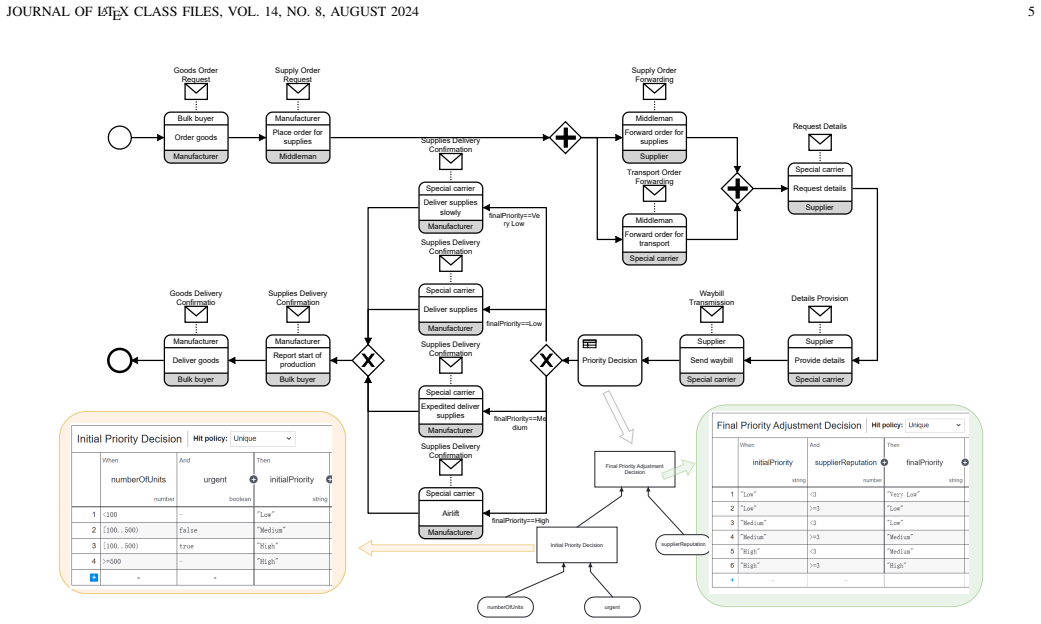
The central claim is that an integrated BPMN-DMN model can be translated mechanically into executable Fabric chaincode without losing process or decision semantics. The translation parses the extended BPMN choreography into a DAG in which every element is a finite state machine with at least three states, Disabled, Enabled, and Completed; messages add a Wait-for-Confirm state and Business Rule Tasks add a Wait-for-Callback state. Sequence flows and gateway logic assemble these element FSMs into a global state machine, and a two-pass code generator emits contract methods with state checks plus hook code for custom transitions. Business Rule Tasks are bound to a DMN at instance-creation time, with the DMN stored off-chain, a hash stored on-chain, and an oracle callback fetching and verifying the DMN before an embedded decision engine returns the result. The paper validates the generator on 11 scenarios by executing both conforming and non-conforming paths and reports that all outcomes matched expectations, a 100% accuracy rate for the tested behavior.
Load-bearing premise
The load-bearing premise is that every BPMN choreography construct the framework accepts, including event-based gateways, parallel splits and merges, loops, and Business Rule Task callbacks, is translated into the simplified state machines without changing the process's meaning; the paper supports this by testing 11 small scenarios, with loops represented by only the normal and one loop-back path and parallel regions by a single sequential path, rather than by formal proof.
Editorial extensions
If this is right
- Model-then-deploy replaces hand-written chaincode: after participants approve a choreography, the generator produces Fabric chaincode plus an HTTP API per organization for invoking it.
- Decision logic can be swapped per process instance: a Business Rule Task may be rebound to a different DMN at instance creation as long as the new model respects the specified input and output fields.
- Auditability is a by-product: decision inputs, outputs, and DMN identifiers, together with message hashes and confirmations, are recorded on-chain for later review.
- Permissions become task-level rather than organization-level: ABAC conditions such as role or experience can be attached to individual tasks and enforced before any state change.
- Payload privacy is separated from process transparency: message contents move off-chain on the private data bus while only hashes and confirmation events reach the ledger.
Reading between the lines
- The paper leaves implicit that the 100% figure measures control-flow order, not decision correctness; a wrong DMN rule would still produce a wrong business outcome even if the contract runs flawlessly.
- The paper leaves implicit that the same compilation strategy may not carry over to constructs such as nested subprocesses, dynamic participant sets, or multi-instance tasks, which appear in full BPMN but are not among the tested elements.
- A formal semantics relating BPMN choreography traces to the FSM templates, via trace inclusion or bisimulation, would convert the 11-scenario check into a general guarantee; without it, every new gateway combination is a new empirical test.
- A testable extension would run the generator on randomly composed choreographies whose legal traces are computed by a model checker, rather than the LLM-assisted sampled paths used in the paper, to stress the gateways and loops not covered by the 11 scenarios.
Signed reviews
Editorial analysis
A structured set of objections, weighed in public.
Referee Report
Summary. The paper proposes BlockCollab, a model-driven framework that integrates BPMN choreography diagrams with DMN decision models and automatically generates Hyperledger Fabric smart contracts for multi-organizational collaboration. It also contributes a hybrid on-chain/off-chain environment using IPFS, Firefly, and an Oracle, plus ABAC-based collaborative identity management. The evaluation claims 100% process-execution accuracy on 11 scenarios and reports message/BRT execution latencies.
Significance. If the semantic-preservation claim is established, BlockCollab would be a valuable end-to-end generator and execution environment for permissioned-blockchain BPMN-DMN collaborations, filling a gap left by Ethereum-focused predecessors. The paper's strengths include a concrete open-source platform, integration of a real DMN engine via an off-chain oracle, a privacy-aware data path, and evaluation on externally sourced scenarios. However, the central correctness argument is empirical and only partially covers the claimed BPMN fragment, so the significance is conditional on closing the semantic gap.
major comments (3)
- [II-D3, Fig. 8] The translation is defined as a parse of the extended BPMN choreography into a Directed Acyclic Graph, with each element mapped to an FSM whose states in Fig. 8 are Disabled/Enabled/Completed (plus Wait-for-Confirm and Wait-for-Callback). A DAG has no cycles, and the paper does not describe any mechanism for re-enabling a Completed element or bounding iterations. This is not a hypothetical omission: Section III-B explicitly includes loops in the experimental protocol (“if there is a loop, we only list the normal path and the path that loops once as two basic path”). Since the generated smart contract's behavior on cyclic choreographies depends on exactly this missing re-enabling or unrolling mechanism, the claim that integrated BPMN-DMN models are automatically translated into correct smart contracts is currently supported only for acyclic processes.
- [II-D3, Fig. 8, Table II] The gateway semantics are stated informally rather than as state-transition rules. For a parallel-join gateway it is not specified how the FSM counts completed incoming flows, how concurrent invocations are serialized in chaincode, or how the outgoing flow is enabled atomically once all inputs have completed; for an event-based gateway the description “selecting one sequence flow deactivates the others” does not specify how competing triggers are resolved or how the deactivation is made atomic. Table II reports only total gateway counts, with no breakdown by gateway type, and the paper's example and listed scenarios appear to rely on exclusive gateways. The 100% accuracy claim therefore cannot be taken as evidence for parallel-merge or event-based behavior until these semantics are specified and tested.
- [III-B, Table II] The evaluation is largely self-referential. Test paths are generated from the same DAG and gateway counts that the translator itself produces, and the basic-path enumeration explicitly reduces loops and parallel-gateway regions to single paths. The tests therefore check that the SC behaves consistently with the translator's internal DAG, not that the DAG/FSM translation preserves BPMN control-flow semantics. The “100% accuracy” statement should be reworded to “100% of the generated test paths produced the expected outcome”, and the paper should either add an equivalence test against a reference BPMN semantics or restrict the correctness claim to the fragment covered by the 11 scenarios.
minor comments (4)
- [Appendix / algorithms] The text repeatedly refers to Algorithm 1, Algorithm 2, and Algorithm 3 in an appendix, but the arXiv version provided for review does not contain the appendix; readers cannot inspect the ABAC check, the BusinessRuleTask templates, or the GenerateHooks pass. Please include the appendix or summarize the algorithms inline.
- [Table II] Hotel booking row: 22 conforming + 1305 non-conforming = 1327 generated paths, not the reported 1313; please correct the count and check that the other rows use a consistent definition of “accuracy”.
- [III-C] Section III-C reports average latencies (3.8 s for message execution, 10.6 s for BRT execution) but gives no standard deviation, distribution, or number of runs per component; a short paragraph on variance and environmental conditions would strengthen the usability claim.
- [I-A, III-A] Minor language issues: “prpgression” in Section I-A and “metioned” in Section III-A should be corrected; also the caption of Table I says “MED Research” which appears to be a formatting artifact.
Circularity Check
No significant circularity: the translation and evaluation are self-contained, with no fitted parameter or self-citation chain doing load-bearing work.
full rationale
The paper's central derivation is the translation of integrated BPMN-DMN models into Hyperledger Fabric chaincode via DAG parsing and FSM templates (Section II-D3, Figure 8). This translation is an implementation artifact: the generated SC is then executed against conforming and non-conforming paths derived from the same BPMN models in Section III-B. Although the test paths originate from the same models consumed by the translator, this is a conformance test of the generated state-machine code against the source specification rather than a prediction fitted to data; no parameter is fitted, and no result is defined in terms of another result. The reported 100% accuracy is an empirical claim about the tested 11 scenarios. The paper's self-citations (e.g., [20] for BPMN element definitions, message format, and the hybrid-environment extension) are clearly disclosed and are not used to justify the correctness of the translation; the DAG/FSM method, DMN integration, ABAC, and the evaluation are described in this paper. The load-bearing concern identified by the reader—that loops, event-based gateways, and parallel merges are not demonstrably preserved by a DAG/FSM translation and are not covered by the 11 scenarios—is a correctness and generalization risk, not a circularity. It does not make the derivation equivalent to its inputs. Therefore no circular step is present.
Assumptions & free parameters
assumptions (5)
- ad hoc to paper BPMN choreography semantics are preserved by the DAG/FSM translation with HookCode and FrameCode templates.
- domain assumption The embedded Camunda DMN engine correctly evaluates supported DMN decision tables inside Fabric chaincode.
- domain assumption Hyperledger Fabric, IPFS, and Hyperledger Firefly provide the assumed security, consensus, event delivery, and data integrity properties.
- domain assumption Hash digests of DMN content and messages are sufficient to detect tampering and verify integrity.
- domain assumption A single-orderer Fabric network with one peer per membership and majority endorsement is a trusted execution environment.
invented entities (1)
-
User entity in the collaborative identity model
Cite this review
Pith. "Pith review of A Hybrid BPMN-DMN Framework for Secure Inter-organizational Processes and Decisions Collaboration on Permissioned Blockchain." pith.science (2026). https://pith.science/paper/4ZZ5NS2U
@misc{pith2026241201196,
  author       = {Pith},
  title        = {Pith review of: A Hybrid BPMN-DMN Framework for Secure Inter-organizational Processes and Decisions Collaboration on Permissioned Blockchain},
  year         = {2026},
  howpublished = {\url{https://pith.science/paper/4ZZ5NS2U}},
  note         = {Machine review of arXiv:2412.01196}
}
read the original abstract
In the rapidly evolving digital business landscape, organizations increasingly need to collaborate across boundaries to achieve complex business objectives, requiring both efficient process coordination and flexible decision-making capabilities. Traditional collaboration approaches face significant challenges in transparency, trust, and decision flexibility, while existing blockchain-based solutions primarily focus on process execution without addressing the integrated decision-making needs of collaborative enterprises. This paper proposes BlockCollab, a novel model-driven framework that seamlessly integrates Business Process Model and Notation (BPMN) with Decision Model and Notation (DMN) to standardize and implement collaborative business processes and decisions on permissioned blockchain platforms. Our approach automatically translates integrated BPMN-DMN models into smart contracts(SCs) compatible with Hyperledger Fabric, enabling privacy-aware multi-organizational process execution through blockchain-based Attribute-Based Access Control (ABAC). The framework introduces three key innovations: (1) a standardized method for modeling collaborative processes and decisions using integrated BPMN-DMN model, (2) an automated SC generator that preserves both process logic and decision rules while maintaining privacy constraints, and (3) a hybrid on-chain/off-chain execution environment that optimizes collaborative workflows through secure data transfer and external system integration. Experimental evaluation across 11 real-world collaboration scenarios demonstrates that our approach achieves 100\% accuracy in process execution. Furthermore, an analysis of various execution processes highlights the strong practical applicability and reliability of our approach. The proposed framework includes an open-source third-party collaboration platform based on blockchain.
Figures


Figures from the paper (7 more)


Reference graph
Works this paper leans on
-
[1]
Decision model and notation(dmn), version 1.5,
Object Management Group, “Decision model and notation(dmn), version 1.5,” Object Management Group, Dec. 2024, accessed: 2024-09-30. [Online]. Available: https://www.omg.org/spec/DMN
work page 2024
-
[2]
Executing col- laborative decisions confidentially on blockchains,
S. Haarmann, K. Batoulis, A. Nikaj, and M. Weske, “Executing col- laborative decisions confidentially on blockchains,” in Business Process Management: Blockchain and Central and Eastern Europe Forum: BPM 2019 Blockchain and CEE Forum, Vienna, Austria, September 1–6, 2019, Proceedings 17. Springer, 2019, pp. 119–135
work page 2019
-
[3]
Literature review linking blockchain and business process management,
C. Lauster, P. Klinger, N. Schwab, and F. Bodendorf, “Literature review linking blockchain and business process management,” in Proc. 15th Int. Conf. Wirtschaftsinformatik, 2020, pp. 1802–1817
work page 2020
-
[4]
Untrusted business process monitoring and execution using blockchain,
I. Weber, X. Xu, R. Riveret, G. Governatori, A. Ponomarev, and J. Mendling, “Untrusted business process monitoring and execution using blockchain,” in Business Process Management , M. La Rosa, P. Loos, and O. Pastor, Eds. Cham: Springer International Publishing, 2016, pp. 329–347
work page 2016
-
[5]
Inter-organizational busi- ness processes managed by blockchain,
H. Nakamura, K. Miyamoto, and M. Kudo, “Inter-organizational busi- ness processes managed by blockchain,” in Web Information Sys- tems Engineering–WISE 2018: 19th International Conference, Dubai, United Arab Emirates, November 12-15, 2018, Proceedings, Part I 19 . Springer, 2018, pp. 3–17
work page 2018
-
[6]
Business process model and notation (bpmn), version 2.0.2,
Object Management Group, “Business process model and notation (bpmn), version 2.0.2,” Object Management Group, Dec. 2014, accessed: 2024-03-10. [Online]. Available: http://www.omg.org/spec/BPMN
work page 2014
-
[7]
Dmn decision execution on the ethereum blockchain,
S. Haarmann, K. Batoulis, A. Nikaj, and M. Weske, “Dmn decision execution on the ethereum blockchain,” in Advanced Information Sys- tems Engineering: 30th International Conference, CAiSE 2018, Tallinn, Estonia, June 11-15, 2018, Proceedings 30 . Springer, 2018, pp. 327– 341
work page 2018
-
[8]
Camunda bpm platform loan assessment process lab,
A. Fernandez, “Camunda bpm platform loan assessment process lab,” Brisbane, Australia: Queensland University of Technology , 2013
work page 2013
Show all 47 references
-
[9]
Rademakers, Activiti in Action: Executable business processes in BPMN 2.0
T. Rademakers, Activiti in Action: Executable business processes in BPMN 2.0. Simon and Schuster, 2012
2012
-
[10]
Mdapw3: Mda- based development of blockchain-enabled decentralized applications,
A. Samanipour, O. Bushehrian, and G. Robles, “Mdapw3: Mda- based development of blockchain-enabled decentralized applications,” Science of Computer Programming , vol. 239, p. 103185, 2025. [Online]. Available: https://www.sciencedirect.com/science/article/pii/ S0167642324001084
2025
-
[11]
[Online]
Object Management Group, Model Driven Architecture (MDA) Guide , https://www.omg.org/mda/, 2014, revision 2.0. [Online]. Available: https://www.omg.org/mda/
2014
-
[12]
Model-driven engineering for multi-party business pro- cesses on multiple blockchains,
F. Corradini, A. Marcelletti, A. Morichetta, A. Polini, B. Re, E. Scala, and F. Tiezzi, “Model-driven engineering for multi-party business pro- cesses on multiple blockchains,” Blockchain: Research and Applications, vol. 2, no. 3, p. 100018, 2021
2021
-
[13]
Blockchain- based traceability of inter-organisational business processes,
C. Di Ciccio, A. Cecconi, J. Mendling, and et al., “Blockchain- based traceability of inter-organisational business processes,” inBusiness Modeling and Software Design , B. Shishkov, Ed. Cham: Springer International Publishing, 2018, pp. 56–68
2018
-
[14]
Klinger and F
P. Klinger and F. Bodendorf, Blockchain-based Cross-Organizational Execution Framework for Dynamic Integration of Process Collabora- tions, 03 2020, pp. 893–908
2020
-
[15]
Engineering trustable and auditable choreography-based systems using blockchain,
F. Corradini, A. Marcelletti, A. Morichetta, A. Polini, B. Re, and F. Tiezzi, “Engineering trustable and auditable choreography-based systems using blockchain,” ACM Trans. Manage. Inf. Syst. , vol. 13, no. 3, feb 2022. [Online]. Available: https://doi.org/10.1145/3505225
2022 doi
-
[17]
Dannen, Introducing Ethereum and solidity
C. Dannen, Introducing Ethereum and solidity . Springer, 2017, vol. 1
2017
-
[18]
Hyperledger fabric: a distributed operating system for permissioned blockchains,
E. Androulaki, A. Barger, V . Bortnikov, and et al., “Hyperledger fabric: a distributed operating system for permissioned blockchains,” in Proceedings of the Thirteenth EuroSys Conference , ser. EuroSys ’18. New York, NY , USA: Association for Computing Machinery, 2018. [Onlin...
2018
-
[19]
Tabs: Transforming automatically bpmn models into blockchain smart contracts,
P. Bodorik, C. G. Liu, and D. Jutla, “Tabs: Transforming automatically bpmn models into blockchain smart contracts,” Blockchain: Research and Applications, vol. 4, no. 1, p. 100115, 2023
2023
-
[20]
Ibc: An integrated framework combining blockchain with bpmn choreography to enhance multi-party collaboration,
X. Shen, Z. Wang, J. Luo, H. Ruan, H. Xu, and M. Liu, “Ibc: An integrated framework combining blockchain with bpmn choreography to enhance multi-party collaboration,” in 2024 IEEE International Con- ference on Web Services (ICWS) , 2024, pp. 457–467
2024
-
[21]
Change and compliance in collaborative processes,
W. Fdhila, S. Rinderle-Ma, D. Knuplesch, and M. Reichert, “Change and compliance in collaborative processes,” 06 2015, pp. 162–169
2015
-
[22]
Hyperledger Firefly Documentation,
“Hyperledger Firefly Documentation,” https://hyperledger.github.io/ firefly/, accessed: 2024-03-10
2024
-
[23]
Hyperledger Cello Home,
“Hyperledger Cello Home,” https://github.com/hyperledger/cello, ac- cessed: 2024-03-10
2024
-
[24]
Framework for architecting smart contracts using mi- croservices,
Z. Fu-Li, H. Pei-Yu, L. Shan-Shan, L. Shan-Shan, L. Zhi-Ying, and D. Meng-Jie, “Framework for architecting smart contracts using mi- croservices,” Journal of Software , vol. 32, no. 11, p. 3423, 11 2021
2021
-
[25]
Ipfs-content addressed, versioned, p2p file system,
J. Benet, “Ipfs-content addressed, versioned, p2p file system,” arXiv preprint arXiv:1407.3561, 2014
2014 arXiv
-
[26]
Founda- tional oracle patterns: Connecting blockchain to the off-chain world,
R. M ¨uhlberger, S. Bachhofner, E. Castell ´o Ferrer, and et al., “Founda- tional oracle patterns: Connecting blockchain to the off-chain world,” in Business Process Management: Blockchain and Robotic Process Automation Forum, A. Asatiani, J. M. Garc ´ıa, N. Helander, and et a...
2020
-
[27]
Drools: a rule engine for complex event processing,
M. Proctor, “Drools: a rule engine for complex event processing,” in Applications of Graph Transformations with Industrial Relevance: 4th International Symposium, AGTIVE 2011, Budapest, Hungary, October 4-7, 2011, Revised Selected and Invited Papers 4 . Springer, 2012, pp. 2–2
2011
-
[28]
Caterpillar: A Blockchain-Based Business Process Man- agement System
O. Pintado, “Caterpillar: A Blockchain-Based Business Process Man- agement System.”
-
[29]
Caterpillar: A business process execution engine on the Ethereum blockchain,
O. L ´opez-Pintado, L. Garc ´ıa-Ba˜nuelos, M. Dumas, I. Weber, and A. Ponomarev, “Caterpillar: A business process execution engine on the Ethereum blockchain,” vol. 49, no. 7, pp. 1162–1193. [Online]. Available: https://onlinelibrary.wiley.com/doi/abs/10.1002/spe.2702
-
[30]
Lorikeet: A model-driven engineering tool for blockchain-based business process execution and asset management,
A. B. Tran, Q. Lu, and I. Weber, “Lorikeet: A model-driven engineering tool for blockchain-based business process execution and asset management,” in International Conference on Business Process Management, 2018. [Online]. Available: https://api.semanticscholar.org/ CorpusID:52195200
2018
-
[31]
Integrated model-driven engineering of blockchain applications for business processes and asset management,
Q. Lu, A. Binh Tran, I. Weber, and et al., “Integrated model-driven engineering of blockchain applications for business processes and asset management,” Software: Practice and Experience , vol. 51, no. 5, pp. JOURNAL OF LATEX CLASS FILES, VOL. 14, NO. 8, AUGUST 2024 14 1059–10...
2024 doi
-
[32]
Engineering trustable choreography-based systems using blockchain,
F. Corradini, A. Marcelletti, A. Morichetta, A. Polini, B. Re, and F. Tiezzi, “Engineering trustable choreography-based systems using blockchain,” in Proceedings of the 35th Annual ACM Symposium on Applied Computing, ser. SAC ’20. New York, NY , USA: Association for Computing ...
2020
-
[33]
Flexible ex- ecution of multi-party business processes on blockchain,
F. Corradini, A. Marcelletti, A. Morichetta, and et al., “Flexible ex- ecution of multi-party business processes on blockchain,” in 2022 IEEE/ACM 5th International Workshop on Emerging Trends in Software Engineering for Blockchain (WETSEB) , 2022, pp. 25–32
2022
-
[34]
A flexible approach to multi-party business process execution on blockchain,
F. Corradini, A. Marcelletti, A. Morichetta, A. Polini, B. Re, and F. Tiezzi, “A flexible approach to multi-party business process execution on blockchain,” Future Generation Computer Systems , vol. 147, pp. 219–234, 2023. [Online]. Available: https://www.sciencedirect.com/ sc...
2023
-
[35]
An efficient customized blockchain system for inter-organizational processes,
P. Wang, Z. Sun, R. Li, J. Chen, P. Gong, and X. Du, “An efficient customized blockchain system for inter-organizational processes,” in 2023 IEEE International Conference on Web Services (ICWS) , 2023, pp. 615–625
2023
-
[36]
Modeling and enforcing blockchain-based choreographies,
J. Ladleif, M. Weske, and I. Weber, “Modeling and enforcing blockchain-based choreographies,” in Business Process Management: 17th International Conference, BPM 2019, Vienna, Austria, September 1–6, 2019, Proceedings 17 . Springer, 2019, pp. 69–85
2019
-
[37]
A study on the usage of the bpmn notation for designing process collaboration, chore- ography, and conversation models,
I. Compagnucci, F. Corradini, F. Fornari, and B. Re, “A study on the usage of the bpmn notation for designing process collaboration, chore- ography, and conversation models,” Business & Information Systems Engineering, vol. 66, no. 1, pp. 43–66, 2024
2024
-
[38]
Discovering evolving temporal information: Theory and application to clinical databases,
P. Sala, C. Combi, M. Mantovani, and R. Rizzi, “Discovering evolving temporal information: Theory and application to clinical databases,” SN Computer Science, vol. 1, no. 3, p. 153, 2020
2020
-
[39]
Blockchains for business process management - challenges and opportunities,
J. Mendling, I. Weber, W. V . D. Aalst, and et al., “Blockchains for business process management - challenges and opportunities,” ACM Trans. Manage. Inf. Syst. , vol. 9, no. 1, feb 2018. [Online]. Available: https://doi.org/10.1145/3183367
2018 doi
-
[40]
Blockchain support for collaborative business processes,
C. Di Ciccio, A. Cecconi, M. Dumas, and et al., “Blockchain support for collaborative business processes,” Informatik Spektrum , vol. 42, 06 2019
2019
-
[41]
Op- timized execution of business processes on blockchain,
L. Garc ´ıa-Ba˜nuelos, A. Ponomarev, M. Dumas, and I. Weber, “Op- timized execution of business processes on blockchain,” in Business Process Management , J. Carmona, G. Engels, and A. Kumar, Eds. Cham: Springer International Publishing, 2017, pp. 130–146
2017
-
[42]
Inter-organizational busi- ness processes managed by blockchain,
H. Nakamura, K. Miyamoto, and M. Kudo, “Inter-organizational busi- ness processes managed by blockchain,” in Web Information Systems Engineering – WISE 2018 , H. Hacid, W. Cellary, H. Wang, H.-Y . Paik, and R. Zhou, Eds. Cham: Springer International Publishing, 2018, pp. 3–17
2018
-
[43]
Separation of decision modeling from business process modeling using new “decision model and notation
T. Biard, A. Le Mauff, M. Bigand, and J.-P. Bourey, “Separation of decision modeling from business process modeling using new “decision model and notation”(dmn) for automating operational decision-making,” in Risks and Resilience of Collaborative Networks , L. M. Camarinha- Ma...
2015
-
[44]
Taylor and J
J. Taylor and J. Purchase, Real-World Decision Modeling with DMN . USA: Meghan-Kiffer Press, 2016
2016
-
[45]
Mde4bbis: A framework to incorporate model-driven engineering in the development of blockchain-based infor- mation systems,
V . A. de Sousa and C. Burnay, “Mde4bbis: A framework to incorporate model-driven engineering in the development of blockchain-based infor- mation systems,” in 2021 Third International Conference on Blockchain Computing and Applications (BCCA) , 2021, pp. 195–200
2021
-
[46]
Dmn decision execution on the ethereum blockchain,
S. Haarmann, K. Batoulis, A. Nikaj, and M. Weske, “Dmn decision execution on the ethereum blockchain,” in Advanced Information Systems Engineering: 30th International Conference, CAiSE 2018, Tallinn, Estonia, June 11-15, 2018, Proceedings . Berlin, Heidelberg: Springer-Verlag,...
2018 doi
-
[47]
Executing collaborative decisions confidentially on blockchains,
——, “Executing collaborative decisions confidentially on blockchains,” in Business Process Management: Blockchain and Central and Eastern Europe Forum , C. Di Ciccio, R. Gabryelczyk, L. Garc ´ıa-Ba˜nuelos, T. Hernaus, R. Hull, M. Indihar ˇStemberger, A. K ˝o, and M. Staples, E...
2019
-
[48]
Haarmann, Executing DMN Decisions on the Blockchain
S. Haarmann, Executing DMN Decisions on the Blockchain . Cham: Springer International Publishing, 2021, pp. 43–53. [Online]. Available: https://doi.org/10.1007/978-3-030-81409-0 4 Shen Xinzhe Shen Xinzhe is a Ph.D. student in Soft- ware Engineering at Harbin Institute of Techn...
2009 doi
Reviewed August 12, 2026 · model on record in the stance chip above.
Discussion (0). Continue with ORCID to comment.