REVIEW 3 major objections 4 minor 56 references
Multiple rebrightenings in the optical afterglow of GRB 210731A: evidence for an asymmetric jet
T0 review · 3 major / 4 minor · reviewed 2026-08-12 · deepseek-v4-flash
Pith's one-line read GRB 210731A's three optical rebrightenings are best explained, this paper argues, by a jet made of three asymmetric patches that dominate the afterglow in sequence rather than by renewed engine activity.
desk verdict A plausible asymmetric-jet interpretation of GRB 210731A's triple-peaked optical afterglow, but the component-to-peak mapping rests on an untested no-lateral-spreading assumption and the abstract overstates the case. read the letter →
The pith
A machine-rendered reading of the paper's core claim, the machinery that carries it, and where it could break.
The reading
What carries the argument
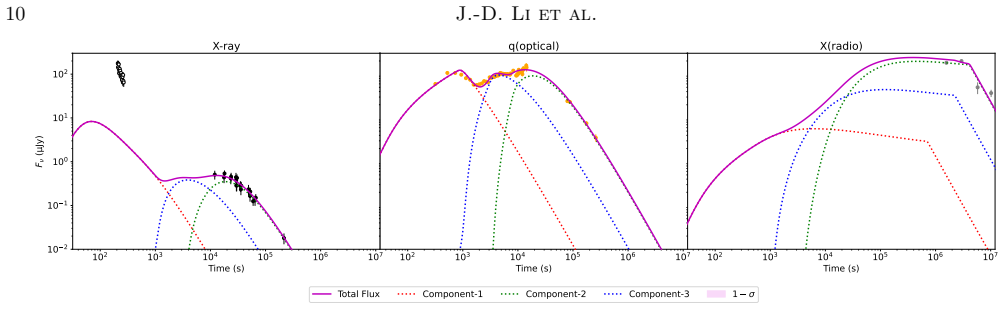
The carrying object is the three-component asymmetric structured jet: a jet cross-section divided into three independent uniform patches, each described by an initial Lorentz factor $\gamma_{0,i}$, an isotropic kinetic energy $E_{k,\mathrm{iso},i}$, a polar angle $\theta_i$ and azimuth $\varphi_i$ locating its axis, and a half-opening angle $\theta_{r,i}$. The dynamics of each patch are computed with the deceleration equations of Huang et al. (2000), with lateral spreading neglected so the half-opening angles stay constant, and the synchrotron spectrum follows the standard slow- and fast-cooling prescriptions of Sari et al. (1998). The total flux is built by integrating over loops around the observer's line of sight, keeping only the portion of each loop inside a patch. A Markov-chain Monte Carlo fit then finds the patch parameters that reproduce the multi-band light curve, and the one-to-one correspondence between each patch and each optical peak is the geometric mechanism that makes the model work.
What would settle it
Measure the optical polarization across the three peaks of a GRB like 210731A. The asymmetric-jet model predicts that the polarization degree and angle should evolve strongly as different off-axis patches dominate each peak, whereas an energy-injection model predicts roughly unchanged polarization properties; a flat, unchanging polarization curve across the rebrightenings would disfavor the asymmetric-jet explanation.
Extended reading notes
Core claim
On the paper's own terms, the central claim is that a non-axisymmetric structured jet with three independent components can account for the multi-band afterglow of GRB 210731A, including the three similar optical peaks seen in the first four hours. Each component is a uniform patch with its own initial Lorentz factor $\gamma_{0,i}$ (its speed in relativistic units), isotropic kinetic energy $E_{k,\mathrm{iso},i}$, polar and azimuthal position, and half-opening angle; the patches are assumed not to overlap. The best-fit solution places the line of sight inside the slowest, lowest-energy patch, so that patch is seen first and produces the first optical peak; the medium patch produces the second peak; and the fastest, most energetic patch lies furthest from the line of sight, is seen last, and produces the final and brightest peak. The same high-energy patch also accounts for the late X-ray and radio emission in the fit, and the model reaches an adjusted $R^2$ of about 0.91 across the multi-band data. The authors take this as evidence that azimuthal structure in the jet, rather than central-engine energy injection, shaped the rebrightening pattern.
Load-bearing premise
The model assumes that the three jet patches stay dynamically independent and never spread sideways or overlap during the entire observation, so that each fitted component corresponds cleanly to one observed peak; if lateral spreading or patch interaction matters on the rebrightening timescale, the one-to-one mapping and the inferred energies and angles would break down.
Editorial extensions
If this is right
- GRB 210731A becomes a concrete case where azimuthal jet structure, not central-engine reactivation, drives the rebrightening pattern; future afterglow modeling should permit non-axisymmetric patches rather than only axisymmetric structures.
- The fitted patch parameters supply physical targets for jet-launching and jet-propagation simulations, including a high-energy, high-Lorentz-factor patch carrying most of the jet's energy.
- Multi-band coupling is predicted: the latest optical peak and the late X-ray and radio emission come from the same highest-energy patch, so those bands should track each other's temporal behavior.
- Polarization monitoring of multi-peaked afterglows is elevated from optional to decisive, since the model predicts significant polarization-angle evolution as each patch dominates.
Reading between the lines
- If the patch interpretation is right, re-examining afterglows previously attributed to energy injection might reveal that azimuthal jet structure is a common cause of multi-peaked light curves; this would shift interpretation away from central-engine activity.
- A numerical simulation that includes lateral spreading could test whether the fitted half-opening angles remain constant over the four-hour window; if the patches spread and merge, the inferred energies would need to be revised.
- The manuscript's abstract quotes an energy spread of roughly 1.5 orders of magnitude with higher-energy components slower, while the fitted table in Section 3.1 shows a spread of about 2.3 orders with higher-energy components faster; the peak-ordering argument itself is independent of this ordering, but the text should be reconciled.
- A clean spectral test would check whether each rebrightening's brightness decline and spectral index track the standard relations for synchrotron emission from an independent decelerating patch; a break between peaks in the spectral behavior would support the patch model.
Signed reviews
Editorial analysis
A structured set of objections, weighed in public.
Referee Report
Summary. The paper models the multi-band afterglow of GRB 210731A with a non-axisymmetric structured jet consisting of three independent patches. The authors fit the data using MCMC and report R2_adj ≈ 0.91. They conclude that each of the three components sequentially dominates the light curve, producing the three observed optical rebrightenings, with the line of sight lying inside the slowest and least energetic component. The paper argues that this structured-jet interpretation avoids the extreme central-engine energy injection required by alternative explanations and recommends future polarimetric observations to distinguish the models.
Significance. If the central claim is correct, the paper provides a concrete example of azimuthal jet structure shaping GRB afterglow light curves, going beyond the axisymmetric structured-jet models usually considered. The work uses a standard external-forward-shock framework, applies a public MCMC sampler, reports posterior distributions, and includes X-ray and radio data with upper limits. The main strength is the attempt to connect a specific multi-peaked afterglow to a physically motivated non-axisymmetric jet configuration. However, the significance is currently limited because the evidence for the specific geometry rests on untested modeling assumptions and lacks a quantitative comparison with alternative models.
major comments (3)
- [Section 3, Eq. (4) and Eq. (24)] The fixed-geometry assumption that each patch has constant half-opening angle is not self-consistent at the rebrightening times. For the best-fit parameters of component 3 (γ0,3 ≈ 373, θr,3 ≈ 0.012, Ek,iso,3 ≈ 1.6×10^54 erg), the deceleration timescale is tens of seconds, and at t ≈ 5×10^3–10^4 s the Lorentz factor has dropped to γ ≈ 25–35, giving γθr ≈ 0.3–0.4. In this regime a relativistic jet patch is expected to expand laterally at close to the sound speed (Rhoads 1999; Sari et al. 1999), so θr can no longer be treated as constant. If θr evolves, the decomposition in Eq. (24) into independent patches with fixed χi(θobs,a)/2π also breaks down once patches expand into one another, violating the no-overlap condition in Eqs. (1)–(2). The authors should either justify quantitatively why lateral spreading is negligible at these times, or implement a lateral-expansion prescription and check whether the component-to-peak mapping and the inferred energies and angles remain stable.
- [Section 3.1, Table 1 and Figure 4] The model has 23 free parameters, and the three components are introduced after seeing three optical peaks; each component's energy, Lorentz factor, position, and opening angle are fitted to reproduce those peaks. The reported R2_adj ≈ 0.91 is not an adequate measure of evidence because it does not sufficiently penalize this flexibility and no comparison is made with alternative models. The paper should provide a quantitative model comparison with, e.g., the energy-injection model of de Wet et al. (2023) or a single-component structured jet, using an information criterion such as AIC/BIC or a Bayesian evidence estimate. It should also report the number of data points used in the fit and the effective number of constrained parameters, since the posterior distributions for some parameters (e.g., θ_obs in Table 1) are very broad.
- [Section 2 and Figure 3] The treatment of data points is partly post hoc. The early X-ray points are excluded from the fit as 'high latitude prompt emission' (hollow symbols in Figure 3), and the r- and g-band data after 10^7 s are attributed to the host galaxy rather than the afterglow. The authors should justify these choices quantitatively, for example by fitting the high-latitude emission model to the early X-ray data or by explicitly testing how the conclusions change if these points are included with a host-galaxy component. As presented, the exclusion removes exactly the data that could challenge the model, and a sensitivity analysis is needed to establish that the derived component parameters are not driven by these choices.
minor comments (4)
- [Abstract and Section 3.1] The abstract states that 'higher-energy components exhibit slower speeds,' but Section 3.1 says 'a higher velocity is associated with higher energy' and Table 1 shows the highest-energy component (component 2) has the highest Lorentz factor; please reconcile this inconsistency.
- [Section 3, Eq. (7)] In Eq. (7), the factor appears as ϵ2_B; this should likely be ϵ_B, since the magnetic energy density fraction is defined as ϵ_B immediately above.
- [Section 3.1] Please report the burn-in length, the number of samples used for the posterior, and convergence diagnostics (e.g., autocorrelation time or Gelman-Rubin statistic) for the emcee run.
- [Abstract] There is a typo: 'exhibites' should be 'exhibits'.
Circularity Check
The fitted three-component model assigns each fitted patch to one observed rebrightening, so the central component-to-peak mapping is partly circular.
-
fitted input called prediction
[Section 3.1 (Fitting results) and Figure 4 caption]
"In this work, we used an asymmetric jet with 3 components to analyze multi-band observation data from multiple telescopes (de Wet et al. 2023). ... The triple peaks exhibited in the optical band correspond to the radiation peaks of the three components."
The number of model components (three) is taken from the number of observed optical peaks, and each component's Lorentz factor, isotropic energy, polar/azimuth angles, and opening angle are free parameters adjusted by MCMC to the same light curve. The later claim that the triple peaks correspond to the three components is therefore an assignment made by the fit: with three tunable patches, the model is constructed so it can place three bumps at the observed times and amplitudes. The good fit shows flexibility, not an independent derivation that the jet is non-axisymmetric; the rebrightenings are not predicted from the model before fitting.
full rationale
The paper is an application/fitting study: a three-patch asymmetric structured jet from the same group's prior work (Li et al. 2023) is fitted to the multi-band afterglow of GRB 210731A, and the good fit is presented as evidence for the asymmetric-jet interpretation. The main circularity is that the number of components is set equal to the number of observed optical peaks, while each component's dynamic and geometric parameters are free parameters fitted to that same light curve; consequently, the statement that the triple peaks correspond to the three components is an assignment produced by the fit rather than an independent prediction. I do not find a self-definitional equation or a uniqueness-import circularity. The self-citation to Li et al. (2023) supplies the model, but the dynamical and radiation equations are standard and re-implemented here, so it is not the primary problem. The multi-band data (X-ray, radio, late UV/optical) give the fit some nontrivial content because common microphysical parameters must also match those bands, and the paper honestly notes that the L-band upper limit is exceeded; nevertheless, the central three-peak-to-three-component mapping remains fitted input presented as explanatory evidence. Score 6 reflects partial circularity in the central claim.
Assumptions & free parameters
free parameters (22)
- gamma0_1 =
203.7
- gamma0_2 =
610.9
- gamma0_3 =
373.2
- Ek_iso_1 =
5.0 x 10^52 erg
- Ek_iso_2 =
1.0 x 10^55 erg
- Ek_iso_3 =
1.6 x 10^54 erg
- theta_1 =
0.004 rad
- theta_2 =
0.038 rad
- theta_3 =
0.028 rad
- phi_1 =
1.9 rad
- phi_2 =
3.4 rad
- phi_3 =
5.2 rad
- theta_r_1 =
0.020 rad
- theta_r_2 =
0.011 rad
- theta_r_3 =
0.012 rad
- epsilon_e =
0.24
- epsilon_B =
5.1 x 10^-5
- n =
0.42 cm^-3
- p =
2.8
- theta_obs =
7.4 x 10^-4 rad
- phi_obs =
2.6 rad
- f =
0.036
assumptions (5)
- domain assumption External forward shock synchrotron afterglow model (Sari et al. 1998; Huang et al. 2000) produces the afterglow spectrum and light curve.
- domain assumption Each of the three jet components evolves independently as a uniform patch, with no lateral spreading.
- ad hoc to paper The three components do not overlap on the jet cross-section and the line of sight lies inside component 1.
- domain assumption The circumburst medium is uniform (k=0, n constant).
- domain assumption Electrons are accelerated to a power-law distribution with index p, with energy fractions epsilon_e and epsilon_B.
invented entities (1)
-
Three-component non-axisymmetric structured jet configuration
Cite this review
Pith. "Pith review of Multiple rebrightenings in the optical afterglow of GRB 210731A: evidence for an asymmetric jet." pith.science (2026). https://pith.science/paper/VBWIE5FK
@misc{pith2026241201229,
  author       = {Pith},
  title        = {Pith review of: Multiple rebrightenings in the optical afterglow of GRB 210731A: evidence for an asymmetric jet},
  year         = {2026},
  howpublished = {\url{https://pith.science/paper/VBWIE5FK}},
  note         = {Machine review of arXiv:2412.01229}
}
read the original abstract
The broadband afterglow of Gamma-ray bursts (GRBs) is usually believed to originate from the synchrotron radiation of electrons accelerated by the external shock of relativistic jets. Therefore, the jet structure should have a significant impact on the GRB afterglow features. The latest observations indicate that the GRB jets may possess intricate structures, such as Gaussian structure, power-law structure, or jet-cocoon structure. Most recently, an abnormal afterglow of GRB 210731A has raised extensive attention, whose optical afterglow exhibites multiple rebrightening phenomena within 4 hours, posing a serious challenge to the standard afterglow model. Here we intend to interpret the characteristics of GRB 210731A afterglows within the framework of non-axisymmetric structured jets, where multiple distinct peaks in the afterglow light curve are caused by the uneven distribution of energy and velocity within the jet in the azimuth angle direction. Through Monte Carlo Markov Chain fitting, we show that a three-component asymmetric structured jet can well explain the multi-band afterglow data. The energy difference among the three components is about 1.5 orders of magnitude, with higher-energy components exhibiting slower speeds. The radiation contribution of each component has sequentially dominated the light curve of the afterglow, resulting in multiple peaks, with the highest peak occurring at the latest time. We suggest that in the future, polarization observations should be conducted on afterglows with multiple brightening signatures, which will help to effectively distinguish the structured jet model from other alternative models, such as energy injection, and ultimately help to determine the true configuration of jets.
Figures


Figures from the paper (1 more)
Reference graph
Works this paper leans on
-
[1]
Abbott, B. P., Abbott, R., Abbott, T. D., et al. 2017, Phys. Rev. Lett., 119, 161101, doi: 10.1103/PhysRevLett.119.161101
-
[2]
2023, arXiv e-prints, arXiv:2303.01203, doi: 10.48550/arXiv.2303.01203
An, Z.-H., Antier, S., Bi, X.-Z., et al. 2023, arXiv e-prints, arXiv:2303.01203, doi: 10.48550/arXiv.2303.01203
-
[3]
Barthelmy, S. D., Barbier, L. M., Cummings, J. R., et al. 2005, SSRv, 120, 143, doi: 10.1007/s11214-005-5096-3
-
[4]
2020, MNRAS, 493, 3521, doi: 10.1093/mnras/staa538
Beniamini, P., Granot, J., & Gill, R. 2020, MNRAS, 493, 3521, doi: 10.1093/mnras/staa538
-
[5]
2016, in Society of Photo-Optical Instrumentation Engineers (SPIE) Conference Series, Vol
Bloemen, S., Groot, P., Woudt, P., et al. 2016, in Society of Photo-Optical Instrumentation Engineers (SPIE) Conference Series, Vol. 9906, Ground-based and Airborne Telescopes VI, ed. H. J. Hall, R. Gilmozzi, & H. K. Marshall, 990664, doi: 10.1117/12.2232522
-
[6]
Burrows, D. N., Hill, J. E., Nousek, J. A., et al. 2005, SSRv, 120, 165, doi: 10.1007/s11214-005-5097-2
-
[7]
2018, A&A, 617, A141, doi: 10.1051/0004-6361/201832926
Corre, D., Buat, V., Basa, S., et al. 2018, A&A, 617, A141, doi: 10.1051/0004-6361/201832926
-
[8]
1997, Nature, 387, 783, doi: 10.1038/42885
Costa, E., Frontera, F., Heise, J., et al. 1997, Nature, 387, 783, doi: 10.1038/42885
doi:10.1038/42885 1997
Show all 56 references
- [9]
-
[10]
V., Li, W
Filippenko, A. V., Li, W. D., Treffers, R. R., & Modjaz, M. 2001, in Astronomical Society of the Pacific Conference
2001
-
[11]
W., Lang, D., & Goodman, J
Foreman-Mackey, D., Hogg, D. W., Lang, D., & Goodman, J. 2013, PASP, 125, 306, doi: 10.1086/670067
2013 doi
-
[12]
Taylor, G. B. 1997, Nature, 389, 261, doi: 10.1038/38451
1997 doi
-
[13]
2018, Science China Physics, Mechanics, and Astronomy, 61, 59531, doi: 10.1007/s11433-017-9149-3
Gao, H. 2018, Science China Physics, Mechanics, and Astronomy, 61, 59531, doi: 10.1007/s11433-017-9149-3
2018 doi
-
[14]
2013, NewAR, 57, 141, doi: 10.1016/j.newar.2013.10.001
Gao, H., Lei, W.-H., Zou, Y.-C., Wu, X.-F., & Zhang, B. 2013, NewAR, 57, 141, doi: 10.1016/j.newar.2013.10.001
2013 doi
-
[15]
2004, ApJ, 611, 1005, doi: 10.1086/422091
Gehrels, N., Chincarini, G., Giommi, P., et al. 2004, ApJ, 611, 1005, doi: 10.1086/422091
2004 doi
-
[17]
2023, MNRAS, doi: 10.1093/mnras/stad3991
Gill, R., & Granot, J. 2023, MNRAS, doi: 10.1093/mnras/stad3991
2023 doi
-
[18]
2021, MNRAS, 500, 3511, doi: 10.1093/mnras/staa3501
Gottlieb, O., Nakar, E., & Bromberg, O. 2021, MNRAS, 500, 3511, doi: 10.1093/mnras/staa3501
2021 doi
-
[19]
2018, MNRAS, 479, 588, doi: 10.1093/mnras/sty1462
Gottlieb, O., Nakar, E., Piran, T., & Hotokezaka, K. 2018, MNRAS, 479, 588, doi: 10.1093/mnras/sty1462
2018 doi
-
[20]
Granot, J., Panaitescu, A., Kumar, P., & Woosley, S. E. 2002, ApJL, 570, L61, doi: 10.1086/340991
2002 doi
-
[21]
2008, PASP, 120, 405, doi: 10.1086/587032
Greiner, J., Bornemann, W., Clemens, C., et al. 2008, PASP, 120, 405, doi: 10.1086/587032
2008 doi
-
[22]
2009, ApJ, 693, 1912, doi: 10.1088/0004-637X/693/2/1912
Greiner, J., Kr¨ uhler, T., McBreen, S., et al. 2009, ApJ, 693, 1912, doi: 10.1088/0004-637X/693/2/1912
2009 doi
-
[23]
2019, MNRAS, 487, 3214, doi: 10.1093/mnras/stz1426
Huang, B.-Q., Lin, D.-B., Liu, T., et al. 2019, MNRAS, 487, 3214, doi: 10.1093/mnras/stz1426
2019 doi
-
[24]
1999a, Chinese Physics Letters, 16, 775, doi: 10.1088/0256-307X/16/10/027
Huang, Y.-f., Dai, Z.-g., & Lu, T. 1999a, Chinese Physics Letters, 16, 775, doi: 10.1088/0256-307X/16/10/027
-
[25]
F., Dai, Z
Huang, Y. F., Dai, Z. G., & Lu, T. 1999b, MNRAS, 309, 513, doi: 10.1046/j.1365-8711.1999.02887.x
1999
-
[26]
F., Gou, L
Huang, Y. F., Gou, L. J., Dai, Z. G., & Lu, T. 2000, ApJ, 543, 90, doi: 10.1086/317076
2000 doi
-
[27]
F., Wu, X
Huang, Y. F., Wu, X. F., Dai, Z. G., Ma, H. T., & Lu, T. 2004, ApJ, 605, 300, doi: 10.1086/382202
2004 doi
-
[28]
A., Izzo, L., Levan, A
Kann, D. A., Izzo, L., Levan, A. J., et al. 2021, GRB Coordinates Network, 30583, 1
2021
-
[29]
M., Nakar, E., Singer, L
Kasliwal, M. M., Nakar, E., Singer, L. P., et al. 2017, Science, 358, 1559, doi: 10.1126/science.aap9455
2017 doi
-
[30]
Kuin, N. P. M., Troja, E., & Swift/UVOT Team. 2021, GRB Coordinates Network, 30572, 1
2021
-
[31]
P., Nativi, L., Rosswog, S., et al
Lamb, G. P., Nativi, L., Rosswog, S., et al. 2022, Universe, 8, 612, doi: 10.3390/universe8120612
2022 doi
-
[32]
J., et al
Lazzati, D., Perna, R., Morsony, B. J., et al. 2018, PhRvL, 120, 241103, doi: 10.1103/PhysRevLett.120.241103
2018 doi
-
[33]
2003, A&A, 410, 823, doi: 10.1051/0004-6361:20031321
Lazzati, D., Covino, S., di Serego Alighieri, S., et al. 2003, A&A, 410, 823, doi: 10.1051/0004-6361:20031321
2003 doi
-
[34]
2023, Monthly Notices of the Royal Astronomical Society, stad2606, doi: 10.1093/mnras/stad2606 —
Li, J.-D., Gao, H., Ai, S., & Lei, W.-H. 2023, Monthly Notices of the Royal Astronomical Society, stad2606, doi: 10.1093/mnras/stad2606 —. 2024, submitted
2023 doi
-
[35]
D., Lamb, G
Lyman, J. D., Lamb, G. P., Levan, A. J., et al. 2018, Nature Astronomy, 2, 751, doi: 10.1038/s41550-018-0511-3
2018 doi
-
[36]
T., Malesani, D., et al
Mangano, V., Holland, S. T., Malesani, D., et al. 2007, A&A, 470, 105, doi: 10.1051/0004-6361:20077232 12 J.-D. Li et al. M´ esz´ aros, P., & Rees, M. J. 1997, ApJ, 476, 232, doi: 10.1086/303625
2007 doi
-
[37]
2004, ApJL, 602, L97, doi: 10.1086/382729
Nakar, E., & Oren, Y. 2004, ApJL, 602, L97, doi: 10.1086/382729
2004 doi
-
[38]
2009, MNRAS, 394, L117, doi: 10.1111/j.1745-3933.2009.00624.x Nicuesa Guelbenzu, A., Klose, S., Schmidl, S., & Rau, A
Narayan, R., & Kumar, P. 2009, MNRAS, 394, L117, doi: 10.1111/j.1745-3933.2009.00624.x Nicuesa Guelbenzu, A., Klose, S., Schmidl, S., & Rau, A. 2021a, GRB Coordinates Network, 30574, 1 Nicuesa Guelbenzu, A., Klose, S., Schmidl, S., Rau, A., &
2009
-
[39]
Kann, D. A. 2021b, GRB Coordinates Network, 30584, 1 O’Connor, B., Troja, E., Ryan, G., et al. 2023, Science Advances, 9, eadi1405, doi: 10.1126/sciadv.adi1405
2023 doi
-
[40]
2005, ApJ, 626, 966, doi: 10.1086/430045
Peng, F., K¨ onigl, A., & Granot, J. 2005, ApJ, 626, 966, doi: 10.1086/430045
2005 doi
-
[41]
A., Chandler, C
Perley, R. A., Chandler, C. J., Butler, B. J., & Wrobel, J. M. 2011, ApJL, 739, L1, doi: 10.1088/2041-8205/739/1/L1
2011 doi
-
[42]
L., & Kollmeier, J
Piro, A. L., & Kollmeier, J. A. 2018, ApJ, 855, 103, doi: 10.3847/1538-4357/aaaab3
2018 doi
-
[43]
Roming, P. W. A., Kennedy, T. E., Mason, K. O., et al. 2005, SSRv, 120, 95, doi: 10.1007/s11214-005-5095-4
2005 doi
-
[44]
M., Lazzati, D., Salmonson, J
Rossi, E. M., Lazzati, D., Salmonson, J. D., & Ghisellini, G. 2004, MNRAS, 354, 86, doi: 10.1111/j.1365-2966.2004.08165.x
2004
-
[45]
1998, ApJL, 497, L17, doi: 10.1086/311269
Sari, R., Piran, T., & Narayan, R. 1998, ApJL, 497, L17, doi: 10.1086/311269
1998 doi
-
[46]
D., Krimm, H
Stamatikos, M., Barthelmy, S. D., Krimm, H. A., et al. 2021, GRB Coordinates Network, 30580, 1
2021
-
[47]
Oates, S. R. 2013, ApJ, 774, 2, doi: 10.1088/0004-637X/774/1/2
2013 doi
-
[48]
2021, GRB Coordinates Network, 30568, 1
Troja, E., Ambrosi, E., D’Elia, V., et al. 2021, GRB Coordinates Network, 30568, 1
2021
-
[49]
2018, MNRAS, 478, L18, doi: 10.1093/mnrasl/sly061 van Paradijs, J., Groot, P
Troja, E., Piro, L., Ryan, G., et al. 2018, MNRAS, 478, L18, doi: 10.1093/mnrasl/sly061 van Paradijs, J., Groot, P. J., Galama, T., et al. 1997, Nature, 386, 686, doi: 10.1038/386686a0
2018 doi
-
[50]
2014, ApJ, 788, 32, doi: 10.1088/0004-637X/788/1/32
Wang, J.-Z., Lei, W.-H., Wang, D.-X., et al. 2014, ApJ, 788, 32, doi: 10.1088/0004-637X/788/1/32
2014 doi
-
[51]
2015, ApJS, 219, 9, doi: 10.1088/0067-0049/219/1/9
Wang, X.-G., Zhang, B., Liang, E.-W., et al. 2015, ApJS, 219, 9, doi: 10.1088/0067-0049/219/1/9
2015 doi
-
[52]
F., Dai, Z
Wu, X. F., Dai, Z. G., Huang, Y. F., & Lu, T. 2003, MNRAS, 342, 1131, doi: 10.1046/j.1365-8711.2003.06602.x —. 2005, MNRAS, 357, 1197, doi: 10.1111/j.1365-2966.2005.08685.x
2003
-
[53]
2017, ApJL, 850, L41, doi: 10.3847/2041-8213/aa9b2b
Xiao, D., Liu, L.-D., Dai, Z.-G., & Wu, X.-F. 2017, ApJL, 850, L41, doi: 10.3847/2041-8213/aa9b2b
2017 doi
-
[54]
Z., Dyks, J., et al
Zhang, B., Fan, Y. Z., Dyks, J., et al. 2006, ApJ, 642, 354, doi: 10.1086/500723
2006 doi
-
[55]
B., Zhang, B., Sun, H., et al
Zhang, B. B., Zhang, B., Sun, H., et al. 2018, Nature Communications, 9, 447, doi: 10.1038/s41467-018-02847-3
2018 doi
-
[56]
V., & KAIT GRB Team
Zheng, W., Filippenko, A. V., & KAIT GRB Team. 2021, GRB Coordinates Network, 30582, 1
2021
-
[57]
2024, ApJ, 963, 66, doi: 10.3847/1538-4357/ad20f3
Zhou, C., Zhu, Z.-P., Lei, W.-H., et al. 2024, ApJ, 963, 66, doi: 10.3847/1538-4357/ad20f3
2024 doi
Reviewed August 12, 2026 · model on record in the stance chip above.
Discussion (0). Continue with ORCID to comment.