REVIEW 4 major objections 6 minor 134 references
Single-Photon Generation: Materials, Techniques, and the Rydberg Exciton Frontier
T0 review · 4 major / 6 minor · reviewed 2026-08-12 · deepseek-v4-flash
Pith's one-line read Rydberg excitons in cuprous oxide could form a high-purity, cavity-free single-photon source.
desk verdict A useful survey of single-photon sources wrapped around a Rydberg-exciton proposal that, as printed, is not quantitatively reproducible. read the letter →
The pith
A machine-rendered reading of the paper's core claim, the machinery that carries it, and where it could break.
The reading
What carries the argument
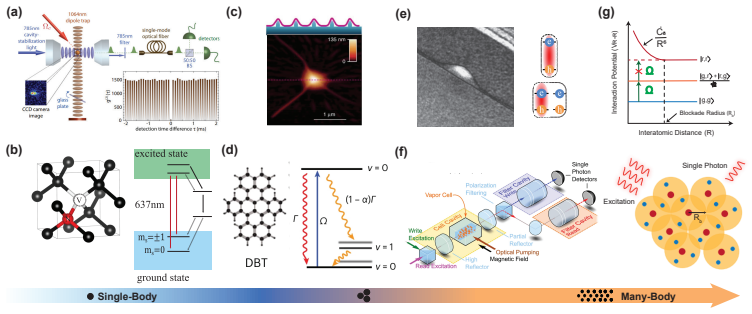
The load-bearing mechanism is the Rydberg blockade: a Rydberg exciton's large dipole moment shifts the energies of neighboring excitons through the dipole-dipole interaction $V_{ij}=C_3/R_{ij}^3$, so no second exciton can be created within the blockade radius. Within a blockaded volume the N excitons share one excitation in a collective superatom state, which behaves as an effective two-level system under continuous-wave driving. The paper computes the steady-state double-excitation probability of two driven interacting excitons and uses it to predict the source purity via $g^{(2)}(0)=P_{rr}/(2\rho_{ee})$. This conversion is what turns the blockade from a qualitative nonlinearity into a quantitative claim about photon statistics.
What would settle it
Measure the second-order correlation $g^{(2)}(0)$ of photoluminescence from a single Cu2O microcrystal under resonant continuous-wave excitation of a high-$n$ Rydberg exciton; if the value does not drop below 0.5, or does not decrease as $n$ is increased, the predicted blockade-based antibunching is not realized. Repeating the measurement on 4-micrometer and 6-micrometer slabs would test the calculated rates and purities in Fig. 4 directly.
Extended reading notes
Core claim
The paper's central proposal is that the Rydberg blockade, already used to make single photons from cold atomic ensembles, can be transplanted to Rydberg excitons in cuprous oxide to make a deterministic solid-state source. A Rydberg exciton shifts nearby excitons out of resonance through the dipole-dipole interaction $V_{ij}=C_3/R_{ij}^3$, so within a blockade volume only one excitation exists; the ensemble acts as an effective two-level superatom. Modeling two driven, interacting excitons in steady state, the paper obtains a double-excitation probability (Eq. 3) and converts it into a purity estimate, $g^{(2)}(0)=P_{rr}/(2\rho_{ee})$, plotted in Fig. 4 as a function of driving Rabi frequency for Cu2O slabs of thickness 4 and 6 micrometers at principal quantum number $n=24$. The authors call these results promising and a motivation for building the device, while noting that addressing and isolating a single Rydberg exciton may be challenging and that collective enhancement could be lost.
Load-bearing premise
The projections assume that in a real Cu2O thin film a single Rydberg exciton can be addressed, that the dipole-dipole interaction prevents a second excitation, and that phonon and inhomogeneous broadening do not wash out the blockade.
Editorial extensions
If this is right
- A Rydberg-exciton source would be a cavity-free solid-state generator of single photons, removing the need for the resonant optical structures most deterministic emitters require.
- Because cuprous oxide is already grown as thin films and patterned into microstructures, such sources could be integrated directly into photonic chips and waveguides.
- The blockade mechanism could overcome the low repetition rates of atomic Rydberg sources, since solid-state exciton decay can be orders of magnitude faster than atomic radiative lifetimes.
- If cuprous oxide works, other high-binding-energy semiconductors with hydrogen-like exciton series become candidate platforms for the same blockade-based source.
Reading between the lines
- Going beyond the paper, the same many-body nonlinearity could be used for single-photon-level switches and optical gates in solid-state chips, not only for sources.
- A scaling test the paper does not state explicitly: the measured $g^{(2)}(0)$ should improve as the principal quantum number $n$ is increased, because the blockade radius grows with $n$.
- The model treats phonon coupling only through a decay rate; a microscopic treatment of phonon-induced dephasing in cuprous oxide could either validate or soften the predicted purity.
- Because the formulas depend on the number N of addressable excitons, controlling defect density in thin films could be a practical knob for trading brightness against purity.
Editorial analysis
A structured set of objections, weighed in public.
Referee Report
Summary. This manuscript is a review of single-photon source technologies, covering the standard metrics (purity, indistinguishability, efficiency) and the main material platforms (atoms, ions, color centers, 2D materials, molecules, quantum dots, and atomic ensembles). It then introduces a new proposal: using Rydberg excitons in Cu2O thin films as a cavity-free, high-purity single-photon source based on the Rydberg blockade effect. The central quantitative support for this proposal is the steady-state exciton population in Eq. (2), the double-excitation probability in Eq. (3), and the resulting emission-rate and purity curves in Fig. 4(c,d), which are claimed to show promising performance for a Cu2O slab of thickness L = 4–6 μm at principal quantum number n = 24.
Significance. If the quantitative claims were correct and reproducible, the proposal would identify a promising new solid-state, cavity-free route to single-photon generation, with potential advantages for integrated quantum photonics. The review portion is a useful and broadly accurate survey of the field, and the authors are explicit about the speculative nature of the Rydberg-exciton section. However, the paper's own contribution—the numerical evidence for the Cu2O source—is not self-contained: Eq. (2) is dimensionally inconsistent, Eq. (3) is under-specified, and the plotted curves are imported from a reference coauthored by one of the present authors. The strength of the review portion does not compensate for the lack of a reproducible derivation of the central new claim, but the issues appear fixable within the manuscript's scope.
major comments (4)
- [Sec. 4.1, Eq. (2)] The steady-state population ρ_ee(t→∞) is dimensionally inconsistent as printed. The numerator should be Ω'^2/4, not Ω'/4, to yield a dimensionless population; with the current form, the right-hand side has units of inverse frequency. This is not a mere typo: at Ω'/Γ = 10, the printed formula gives ρ_ee ≈ 0.05, whereas the corrected form gives ≈ 0.5, an order-of-magnitude change that directly affects the emission rate and the purity g^(2)(0) = P_rr/(2ρ_ee) shown in Fig. 4(c,d).
- [Sec. 4.1, Eq. (3)] The double-excitation probability is under-specified and not reproducible from the manuscript. The text does not define the effective number of addressable excitons N for the 4–6 μm slab, the C3 coefficient for Cu2O, the pair distribution used in the sum over i<j, or the values of Γ and V_ij used to generate the curves. The expression for Y contains Ω^2/N in the numerator, but the collective enhancement factor NΩ^2/Γ^2 in the prefactor is not reconciled with the admitted difficulty of addressing more than one exciton. Without these specifications, a reader cannot verify the plotted results.
- [Sec. 4.1, Fig. 4(c,d)] The figure caption states that the emission-rate and purity curves come from ref. [104], which is coauthored by one of the present authors. The manuscript presents Eqs. (2)–(3) as the derivation, but because those equations are incorrect or incomplete, the paper does not itself provide the quantitative support for the central claim that Rydberg excitons in Cu2O can form a high-purity single-photon source. The parameter values actually used to generate the curves (e.g., the spontaneous emission rate Γ, the interaction coefficient C3, and the addressable number N) are not stated in the text, so the results are not independently checkable from this paper.
- [Sec. 4.1, last paragraph] The authors explicitly concede that 'Addressing and isolating a single Rydberg exciton may be challenging, and the collective enhancement that is expected from an ensemble of excitons may be eliminated.' This concession directly undermines the applicability of the collective-enhancement term NΩ^2/Γ^2 in Eq. (3) to the proposed device, yet the quantitative predictions in Fig. 4 are based on that term. The manuscript should either identify a parameter regime in which the collective enhancement survives, or present the predictions under the more conservative single-exciton assumption, and discuss how the results would change.
minor comments (6)
- [Sec. 4.1, Eq. (2)] The notation 't→inf' should read 't→∞', and the definition of Ω' is garbled: the text says 'Ω'√NΩ' instead of 'Ω' = √N Ω'.
- [Sec. 4.1, Eq. (3)] The subscript '2i j2i j' is unclear; the two-exciton state would be more readable as |r_i r_j⟩, and the summation indices in P_rr = Σ_{i<j} should be explained.
- [Fig. 2(a) caption] The caption contains a placeholder '[?]' in place of a reference citation; this should be filled in.
- [References] Several references list the same page range '578–593' (e.g., refs. [42], [102], [104], [118]), which appears to be a placeholder and should be corrected.
- [Fig. 4 caption] The phrase 'the quantum principal number n = 24' should read 'the principal quantum number n = 24'.
- [Abstract] The abstract refers to 'Rydberg exciton in solid state metal oxide thin films' but the paper specifically focuses on Cu2O; specifying cuprous oxide would avoid over-generalization.
Circularity Check
Self-citation in the quantitative support, but no derivation reduces by construction; the Eq. (2) typo is a correctness issue, not circularity.
full rationale
Sec. 4.1 supports the central claim—that a Cu2O Rydberg-exciton slab can act as a high-purity single-photon source—by quoting two steady-state formulas, Eqs. (2) and (3), and the Fig. 4(c,d) results directly from ref. [104]. Ref. [104] is coauthored by one of the present authors (K. Heshami), so the quantitative support has a self-citation provenance. However, this is not circular in the derivation chain: the formulas are not fitted to reproduce the target g^(2)(0), and no parameter is defined in terms of the predicted purity or emission rate. The inputs are the Rabi frequency, detuning, decay rate, and the dipole-dipole interaction V_ij=C3/R_ij^3, all taken from prior Cu2O and Rydberg physics; the outputs (excitation probabilities, emission rate, g^(2)(0)) follow from the stated steady-state model rather than being imposed. The paper itself concedes that 'Addressing and isolating a single Rydberg exciton may be challenging, and the collective enhancement that is expected from an ensemble of excitons may be eliminated,' which is a stated conditionality of the proposal, not a circular step. Separately, Eq. (2) as printed has an apparent dimensional typo (a frequency Ω' in the numerator rather than Ω'^2 for a dimensionless population), and Eq. (3) leaves N and the pair distribution unspecified; these are reproducibility and correctness concerns and do not make the prediction equivalent to its inputs. Overall the central derivation is self-contained as a model calculation, so the only circularity-adjacent feature is the self-cited provenance of the quantitative estimates, scored as minor.
Assumptions & free parameters
free parameters (3)
- Effective number of addressable excitons N =
not specified
- Principal quantum number n used for Fig. 4 curves =
24
- Slab thickness L used in Fig. 4 curves =
4 um and 6 um
assumptions (3)
- domain assumption Rydberg excitons in Cu2O behave as hydrogen-like two-level systems whose strong dipole-dipole interaction produces a Rydberg blockade in thin films.
- domain assumption The steady-state solution for two interacting Rydberg excitons, Eq. (3), together with g(2)(0)=P_rr/(2 rho_ee), correctly describes the source purity.
- domain assumption Bulk Cu2O Rydberg-exciton parameters (binding energy ~100 meV, interaction strengths, linewidths) remain valid in synthetic thin films.
Cite this review
Pith. "Pith review of Single-Photon Generation: Materials, Techniques, and the Rydberg Exciton Frontier." pith.science (2026). https://pith.science/paper/HQ5MQWFV
@misc{pith2026241201573,
  author       = {Pith},
  title        = {Pith review of: Single-Photon Generation: Materials, Techniques, and the Rydberg Exciton Frontier},
  year         = {2026},
  howpublished = {\url{https://pith.science/paper/HQ5MQWFV}},
  note         = {Machine review of arXiv:2412.01573}
}
read the original abstract
Due to their quantum nature, single-photon emitters generate individual photons in bursts or streams. They are paramount in emerging quantum technologies such as quantum key distribution, quantum repeaters, and measurement-based quantum computing. Many such systems have been reported in the last three decades, from Rubidium atoms coupled to cavities to semiconductor quantum dots and color centers implanted in waveguides. This review article highlights different material systems with deterministic and controlled single photon generation. We discuss and compare the performance metrics, such as purity and indistinguishability, for these sources and evaluate their potential for different applications. Finally, a new potential single-photon source, based on the Rydberg exciton in solid state metal oxide thin films, is introduced, briefly discussing its promising qualities and advantages in fabricating quantum chips for quantum photonic applications.
Figures


Figures from the paper (2 more)


Reference graph
Works this paper leans on
-
[104]
Single photon source based on rydberg exciton blockade,
M. Khazali, K. Heshami, and C. Simon, “Single photon source based on rydberg exciton blockade,” J. Phys. B: At. Mol. Opt. Phys.50, 578–593 (2017)
work page 2017
-
[1]
Resource-efficient linear optical quantum computation,
D. E. Browne and T. Rudolph, “Resource-efficient linear optical quantum computation,” Phys. Rev. Lett.95, 010501 (2005)
2005
-
[2]
Optical quantum computing,
J. L. O’Brien, “Optical quantum computing,” Science318, 1567–1570 (2007)
2007
-
[3]
Quantum repeaters based on atomic ensembles and linear optics,
N. Sangouard, C. Simon, H. De Riedmatten, and N. Gisin, “Quantum repeaters based on atomic ensembles and linear optics,” Rev. Mod. Phys.83, 33–80 (2011)
2011
-
[4]
Quantumrepeaters: Fromquantumnetworkstothequantuminternet,
K.Azuma,S.E.Economou,D.Elkouss, et al.,“Quantumrepeaters: Fromquantumnetworkstothequantuminternet,” Rev. Mod. Phys.95, 045006 (2023)
2023
-
[5]
Advances in quantum cryptography,
S. Pirandola, U. L. Andersen, L. Banchi,et al., “Advances in quantum cryptography,” Adv. optics photonics12, 1012–1236 (2020)
2020
-
[6]
Heralded single-photon source utilizing highly nondegenerate, spectrally factorable spontaneous parametric downconversion,
F. Kaneda, K. Garay-Palmett, A. B. U’Ren, and P. G. Kwiat, “Heralded single-photon source utilizing highly nondegenerate, spectrally factorable spontaneous parametric downconversion,” Opt. Express24, 10733–10747 (2016)
2016
-
[7]
Parametricdown-conversionphoton-pairsourceonananophotonicchip,
X.Guo, C.-l.Zou, C.Schuck, et al., “Parametricdown-conversionphoton-pairsourceonananophotonicchip,” Light. Sci. & Appl.6, e16249–e16249 (2016)
2016
Show all 134 references
-
[8]
Scalability of parametric down-conversion for generating higher-order fock states,
J. Tiedau, T. J. Bartley, G. Harder,et al., “Scalability of parametric down-conversion for generating higher-order fock states,” Phys. Rev. A100, 041802 (2019)
2019
-
[9]
Cryogenic integrated spontaneous parametric down-conversion,
N. A. Lange, J. P. Höpker, R. Ricken,et al., “Cryogenic integrated spontaneous parametric down-conversion,” Optica 9, 108–111 (2022)
2022
-
[10]
Experimental demonstration of quantum correlations over more than 10 km,
W. Tittel, J. Brendel, B. Gisin,et al., “Experimental demonstration of quantum correlations over more than 10 km,” Phys. Rev. A57, 3229–3232 (1998)
1998
-
[11]
Violation of bell inequalities by photons more than 10 km apart,
W. Tittel, J. Brendel, H. Zbinden, and N. Gisin, “Violation of bell inequalities by photons more than 10 km apart,” Phys. Rev. Lett.81, 3563–3566 (1998)
1998
-
[12]
Optimal conditions for the bell test using spontaneous parametric down-conversion sources,
Y. Tsujimoto, K. Wakui, M. Fujiwara,et al., “Optimal conditions for the bell test using spontaneous parametric down-conversion sources,” Phys. Rev. A98, 063842 (2018)
2018
-
[13]
Long-distance quantum communication with atomic ensembles and linear optics,
L. M. Duan, M. D. Lukin, J. I. Cirac, and P. Zoller, “Long-distance quantum communication with atomic ensembles and linear optics,” Nature414, 413–418 (2001)
2001
-
[14]
Bright, long-lived and coherent excitons in carbon nanotube quantum dots,
M. S. Hofmann, J. T. Glückert, J. Noé,et al., “Bright, long-lived and coherent excitons in carbon nanotube quantum dots,” Nat. Nano8, 502–505 (2013)
2013
-
[15]
High internal quantum efficiency zno/znmgo multiple quantum wells prepared on gan/sapphire templates for ultraviolet light emitting diodes,
S. Chen, C. Xu, X. Pan,et al., “High internal quantum efficiency zno/znmgo multiple quantum wells prepared on gan/sapphire templates for ultraviolet light emitting diodes,” J. Mater. Chem. C22 (2019)
2019
-
[16]
Electrically pumped single-defect light emitters in wse2,
S. Schwarz, A. Kozikov, F. Withers,et al., “Electrically pumped single-defect light emitters in wse2,” 2D Mater.3 (2016)
2016
-
[17]
Defect and strain engineering of monolayer wse2 enables sire controlled single photon emission upto 150k,
K. Parto, S. A. K. Banerjee, and G. Moody, “Defect and strain engineering of monolayer wse2 enables sire controlled single photon emission upto 150k,” Nat. Commun.12, 855–866 (2021)
2021
-
[18]
Photoluminescence imaging of single photon emitters within nanoscale strain profiles in monolayer wse2,
A. Abramov, I. Chestnov, E. Alimova,et al., “Photoluminescence imaging of single photon emitters within nanoscale strain profiles in monolayer wse2,” Nat. Commun.5737, 543–559 (2023)
2023
-
[19]
High-purity and stable single-photon emission in bilayer wse2 via phonon-assisted excitation,
C. Piccinini, A. Paralikis, J. e Ferreira Neto,et al., “High-purity and stable single-photon emission in bilayer wse2 via phonon-assisted excitation,” arXiv Quantum Phys. pp. 1–11 (2024)
2024
-
[20]
Narrowbandquantumemittersoverlargespectralrangewithfourier-limited linewidth in hexagonal boron nitride,
A.Dietrich,M.B.urk,E.S.Steiger, et al.,“Narrowbandquantumemittersoverlargespectralrangewithfourier-limited linewidth in hexagonal boron nitride,” arXiv Condens. Matter (2017)
2017
-
[21]
Temperature-dependent spectral emission of hexagonal boron nitride quantum emitters on conductive and dielectric substrates,
H. Akbari, W.-H. Lin, B. Vest,et al., “Temperature-dependent spectral emission of hexagonal boron nitride quantum emitters on conductive and dielectric substrates,” Phys. Rev. Appl.15 (2021)
2021
-
[22]
Exciton and phonon radiative linewidths in monolayer boron nitride,
G. Cassabois, G. Fugallo, C. Elias,et al., “Exciton and phonon radiative linewidths in monolayer boron nitride,” Phys. Rev. X12 (2022)
2022
-
[23]
Sharp zero-phonon lines of single organic molecules on a hexagonal boron-nitride surface,
R. Smit, A. Tebyani, J. Hameury,et al., “Sharp zero-phonon lines of single organic molecules on a hexagonal boron-nitride surface,” Nat. Commun.14, 7961–7969 (2023)
2023
-
[24]
Deterministic generation of single photons from one atom trapped in a cavity,
J. McKeever, A. Boca, A. Boozer,et al., “Deterministic generation of single photons from one atom trapped in a cavity,” Science303, 1992–1994 (2004)
2004
-
[25]
Quantuminterferenceofphotonpairsfromtworemotetrappedatomic ions,
P.Maunz,D.Moehring,S.Olmschenk, et al.,“Quantuminterferenceofphotonpairsfromtworemotetrappedatomic ions,” Nat. Phys.3, 538–541 (2007)
2007
-
[26]
Diamond nanophotonics,
K. Beha, H. Fedder, M. Wolfer,et al., “Diamond nanophotonics,” Beilstein journal nanotechnology3, 895–908 (2012)
2012
-
[27]
Signatures of two-photon pulses from a quantum two-level system,
K. A. Fischer, L. Hanschke, J. Wierzbowski,et al., “Signatures of two-photon pulses from a quantum two-level system,” Nat. Phys.13, 649–654 (2017)
2017
-
[28]
A wave-function ansatz method for calculating field correlations and its application to the study of spectral filtering and quantum dynamics of multi-emitter systems,
S. Das, L. Zhai, M. Čepulskovskis,et al., “A wave-function ansatz method for calculating field correlations and its application to the study of spectral filtering and quantum dynamics of multi-emitter systems,” arXiv preprint arXiv:1912.08303 (2019)
2019 arXiv
-
[29]
Quantuminterferenceofsinglephotonsfromremotenitrogen-vacancy centers in diamond,
A.Sipahigil,M.L.Goldman,E.Togan, et al.,“Quantuminterferenceofsinglephotonsfromremotenitrogen-vacancy centers in diamond,” Phys. Rev. Lett.108, 242–246 (2012)
2012
-
[30]
Hong–ou–mandel interference in colloidal cspbbr3 perovskite nanocrystals,
A. E. Kaplan, C. J. Krajewska, A. H. Proppe,et al., “Hong–ou–mandel interference in colloidal cspbbr3 perovskite nanocrystals,” Nat. Photonics17, 775–780 (2023)
2023
-
[31]
Quantum interference of resonance fluorescence from germanium-vacancy color centers in diamond,
D. Chen, J. E. Fro¨ch, S. Ru,et al., “Quantum interference of resonance fluorescence from germanium-vacancy color centers in diamond,” Nano Lett.22, 6306–6312 (2022)
2022
-
[32]
Near-optimal single-photon sources in the solid state,
N. Somaschi, V. Giesz, L. De Santis,et al., “Near-optimal single-photon sources in the solid state,” Nat. Photonics 10, 340–345 (2016)
2016
-
[33]
Scalable integrated single-photon source,
R. UPPU, F. T. PEDERSEN, Y. WANG,et al., “Scalable integrated single-photon source,” Sci. Adv.6, 578–593 (2020)
2020
-
[34]
Quantum interference of identical photons from remote gaas quantum dots,
L. Zhai, G. N. Nguyen, C. Spinnler,et al., “Quantum interference of identical photons from remote gaas quantum dots,” Nat. nanotechnology17, 829–833 (2022)
2022
-
[35]
Interpretation of europium(III) spectra,
K. Binnemans, “Interpretation of europium(III) spectra,” Coord. Chem. Rev.295, 1–45 (2015)
2015
-
[36]
A silicon carbide room-temperature single-photon source,
S. Castelletto, B. C. Johnson, V. Ivády,et al., “A silicon carbide room-temperature single-photon source,” Nat. Mater. 13, 151–156 (2014)
2014
-
[37]
The dielectric impact of layer distances on exciton and trion binding energies in van der waals heterostructures,
M. Florian, M. Hartman, A. Steinhoff,et al., “The dielectric impact of layer distances on exciton and trion binding energies in van der waals heterostructures,” Nano Lett.18, 2725–2732 (2018)
2018
-
[38]
Site-controlled quantum emitters in monolayer mose2,
L. Yu, M. Deng, J. L. Zhang,et al., “Site-controlled quantum emitters in monolayer mose2,” Nano Lett.21 (2021)
2021
-
[39]
Interfacing single photons and single quantum dots with photonic nanostructures,
P. Lodahl, S. Mahmoodian, and S. Stobbe, “Interfacing single photons and single quantum dots with photonic nanostructures,” Rev. Mod. Phys.87, 347–400 (2015)
2015
-
[40]
Large-scale quantum-emitter arrays in atomically thin semiconductors,
C. Palacios-Berraquero, D. M. Kara, A. R.-P. Montblanch,et al., “Large-scale quantum-emitter arrays in atomically thin semiconductors,” Nat. communications8, 15093 (2017)
2017
-
[41]
Superradiant and subradiant states in lifetime-limited organic molecules through laser-induced tuning,
C. M. Lange, E. Daggett, V. Walther,et al., “Superradiant and subradiant states in lifetime-limited organic molecules through laser-induced tuning,” Nat. Phys.20, 836–842 (2024)
2024
-
[42]
Room-temperature single-photon source with near-millisecond built-in memory,
K. B. Dideriksen, R. Schmieg, M. Zugenmaier, and E. S. Polzik, “Room-temperature single-photon source with near-millisecond built-in memory,” Nat. Commun.12, 578–593 (2021)
2021
-
[43]
Photon antibunching in resonance fluorescence,
H. J. Kimble, M. Dagenais, and L. Mandel, “Photon antibunching in resonance fluorescence,” Phys. Rev. Lett.39, 691–695 (1977)
1977
-
[44]
Nonclassical radiation of a single stored ion,
F. Diedrich and H. Walther, “Nonclassical radiation of a single stored ion,” Phys. Rev. Lett.58, 203–206 (1987)
1987
-
[45]
Stable solid-state source of single photons,
C. Kurtsiefer, S. Mayer, P. Zarda, and H. Weinfurter, “Stable solid-state source of single photons,” Phys. Rev. Lett. 85, 290–293 (2000)
2000
-
[46]
Silicon vacancy related defect in 4h and 6h sic,
E. Sörman, N. T. Son, W. M. Chen,et al., “Silicon vacancy related defect in 4h and 6h sic,” Phys. Rev. B61, 2613–2620 (2000)
2000
-
[47]
Polytypecontrolofspinqubitsinsiliconcarbide,
A.L.Falk,B.B.Buckley,G.Calusine, et al.,“Polytypecontrolofspinqubitsinsiliconcarbide,”Nat.communications 4, 1819 (2013)
2013
-
[48]
Efficient single photon emission from a high-purity hexagonal boron nitride crystal,
L. J. Martínez, T. Pelini, V. Waselowski,et al., “Efficient single photon emission from a high-purity hexagonal boron nitride crystal,” Phys. Rev. B94, 121405 (2016)
2016
-
[49]
Identifying carbon as the source of visible single-photon emission from hexagonal boron nitride,
N. Mendelson, D. Chugh, J. R. Reimers,et al., “Identifying carbon as the source of visible single-photon emission from hexagonal boron nitride,” Nat. materials20, 321–328 (2021)
2021
-
[50]
Tunable and high-purity room temperature single-photon emission from atomic defects in hexagonal boron nitride,
G. Grosso, H. Moon, B. Lienhard,et al., “Tunable and high-purity room temperature single-photon emission from atomic defects in hexagonal boron nitride,” Nat. communications8, 705 (2017)
2017
-
[51]
Quantumemissionfromhexagonalboronnitridemonolayers,
T.T.Tran,K.Bray,M.J.Ford, et al.,“Quantumemissionfromhexagonalboronnitridemonolayers,”Nat.Nanotechnol. 11, 47–31 (2015)
2015
-
[52]
Room-temperature single-photon emitters in silicon nitride,
A. Senichev, Z. O. Martin, S. Peana,et al., “Room-temperature single-photon emitters in silicon nitride,” Sci. Adv.7, eabj0627 (2021)
2021
-
[53]
Silicon nitride waveguides with intrinsic single-photon emitters for integrated quantum photonics,
A. Senichev, S. Peana, Z. O. Martin,et al., “Silicon nitride waveguides with intrinsic single-photon emitters for integrated quantum photonics,” ACS Photonics9, 3357–3365 (2022)
2022
-
[54]
Single artificial atoms in silicon emitting at telecom wavelengths,
W. Redjem, A. Durand, T. Herzig,et al., “Single artificial atoms in silicon emitting at telecom wavelengths,” Nat. Electron. 3, 738–743 (2020)
2020
-
[55]
Single g centers in silicon fabricated by co-implantation with carbon and proton,
Y. Baron, A. Durand, T. Herzig,et al., “Single g centers in silicon fabricated by co-implantation with carbon and proton,” Appl. Phys. Lett.121 (2022)
2022
-
[56]
Probing magnetism in 2d materials at the nanoscale with single-spin microscopy,
L. Thiel, Z. Wang, M. A. Tschudin,et al., “Probing magnetism in 2d materials at the nanoscale with single-spin microscopy,” Science364, 973–976 (2019)
2019
-
[57]
Observation of current whirlpools in graphene at room temperature,
M. L. Palm, C. Ding, W. S. Huxter,et al., “Observation of current whirlpools in graphene at room temperature,” Science 384, 465–469 (2024)
2024
-
[58]
Indistinguishable photons from separated silicon-vacancy centers in diamond,
A. Sipahigil, K. Jahnke, L. Rogers,et al., “Indistinguishable photons from separated silicon-vacancy centers in diamond,” Phys. Rev. Lett.113, 242–246 (2014)
2014
-
[59]
Opticallyactivequantumdotsinmonolayerwse2,
A.Srivastava,M.Sidler,A.V.Allain, et al.,“Opticallyactivequantumdotsinmonolayerwse2,”Nat.nanotechnology 10, 491–496 (2015)
2015
-
[60]
Voltage-controlled quantum light from an atomically thin semiconductor,
C. Chakraborty, L. Kinnischtzke, K. M. Goodfellow,et al., “Voltage-controlled quantum light from an atomically thin semiconductor,” Nat. nanotechnology10, 507–511 (2015)
2015
-
[61]
Single quantum emitters in monolayer semiconductors,
Y.-M. He, G. Clark, J. R. Schaibley,et al., “Single quantum emitters in monolayer semiconductors,” Nat. nanotech- nology 10, 497–502 (2015)
2015
-
[62]
Strain-induced spatial and spectral isolation of quantum emitters in mono-and bilayer wse2,
S. Kumar, A. Kaczmarczyk, and B. D. Gerardot, “Strain-induced spatial and spectral isolation of quantum emitters in mono-and bilayer wse2,” Nano letters15, 7567–7573 (2015)
2015
-
[63]
Deterministic strain-induced arrays of quantum emitters in a two-dimensional semiconductor,
A. Branny, S. Kumar, R. Proux, and B. D. Gerardot, “Deterministic strain-induced arrays of quantum emitters in a two-dimensional semiconductor,” Nat. communications8, 15053 (2017)
2017
-
[64]
Quantum calligraphy: writing single-photon emitters in a two-dimensional materials platform,
M. R. Rosenberger, C. K. Dass, H.-J. Chuang,et al., “Quantum calligraphy: writing single-photon emitters in a two-dimensional materials platform,” ACS nano13, 904–912 (2019)
2019
-
[65]
Site-controlled telecom-wavelength single-photon emitters in atomically-thin mote2,
H. Zhao, M. Pettes, Y. Zheng, and H. Htoon, “Site-controlled telecom-wavelength single-photon emitters in atomically-thin mote2,” Nat. Commun. (2021)
2021
-
[66]
Lifetime and quenching of anthracene fluorescence in the vapor phase,
W. R. Ware and P. T. Cunningham, “Lifetime and quenching of anthracene fluorescence in the vapor phase,” J. Chem Phys. (1965)
1965
-
[67]
Near-infrared single-photons from aligned molecules in ultrathin crystalline films at room temperature,
C. Toninelli, K. Early, J. Bremi,et al., “Near-infrared single-photons from aligned molecules in ultrathin crystalline films at room temperature,” Opt. Express18, 6577–6582 (2010)
2010
-
[68]
The energy gap law at work: Emission yield and rate fluctuations of single nir emitters,
C. Erker and T. Basché, “The energy gap law at work: Emission yield and rate fluctuations of single nir emitters,” J. Am. Chem. Soc.144, 14053–14056 (2022)
2022
-
[69]
Quantum efficiency of single dibenzoterrylene molecules in p-dichlorobenzene at cryogenic temperatures,
M. Musavinezhad, A. Shkarin, D. Rattenbacher,et al., “Quantum efficiency of single dibenzoterrylene molecules in p-dichlorobenzene at cryogenic temperatures,” The J. Phys. Chem. B127, 5353–5359 (2023)
2023
-
[70]
Quantum interference of tunably indistinguishable photons from remote organic molecules,
R. Lettow, Y. L. A. Rezus, A. Renn,et al., “Quantum interference of tunably indistinguishable photons from remote organic molecules,” Phys. Rev. Lett.104, 123605 (2010)
2010
-
[71]
Photon indistinguishability measurements under pulsed and continuous excitation,
R. C. Schofield, C. Clear, R. A. Hoggarth,et al., “Photon indistinguishability measurements under pulsed and continuous excitation,” Phys. Rev. Res.4, 013037 (2022)
2022
-
[72]
Real-time two-photon interference from distinct molecules on the same chip,
R. Duquennoy, M. Colautti, R. Emadi,et al., “Real-time two-photon interference from distinct molecules on the same chip,” Optica9, 731–737 (2022)
2022
-
[73]
Uniaxialstraintuningoforganicmoleculesinglephotonsources,
A.Fasoulakis,K.D.Major,R.A.Hoggarth, et al.,“Uniaxialstraintuningoforganicmoleculesinglephotonsources,” Nanoscale 15, 177–184 (2023)
2023
-
[74]
Tailoring the superradiant and subradiant nature of two coherently coupled quantum emitters,
J.-B. Trebbia, Q. Deplano, P. Tamarat, and B. Lounis, “Tailoring the superradiant and subradiant nature of two coherently coupled quantum emitters,” Nat. communications13, 2962 (2022)
2022
-
[75]
Laser-induced frequency tuning of fourier-limited single-molecule emitters,
M. Colautti, F. S. Piccioli, Z. Ristanovic,et al., “Laser-induced frequency tuning of fourier-limited single-molecule emitters,” ACS nano14, 13584–13592 (2020)
2020
-
[76]
Polarization-entangled photon pairs from a single molecule,
M. Rezai, J. Wrachtrup, and I. Gerhardt, “Polarization-entangled photon pairs from a single molecule,” Optica6, 34–40 (2019)
2019
-
[77]
Narrow-band fiber-coupled single-photon source,
G. Stein, V. Bushmakin, Y. Wang,et al., “Narrow-band fiber-coupled single-photon source,” Phys. Rev. Appl.13, 054042 (2020)
2020
-
[78]
Size-dependent optical properties of inp colloidal quantum dots,
G. Almeida, L. Poll, W. Evers,et al., “Size-dependent optical properties of inp colloidal quantum dots,” Nano Lett. 23, 8697–8703 (2023)
2023
-
[79]
Chapter one - toward scalable iii-nitride quantum dot structures for quantum photonics,
P.-C. Ku, T. Sarwar, B. Demory, and C.-H. Teng, “Chapter one - toward scalable iii-nitride quantum dot structures for quantum photonics,” Semicond. Semimetals105, 1–27 (2020)
2020
-
[80]
Indistinguishable photons from a single-photon device,
C. Santori, D. Fattal, J. Vučković,et al., “Indistinguishable photons from a single-photon device,” nature419, 594–597 (2002)
2002
-
[81]
A quantum dot single-photon turnstile device,
P. Michler, A. Kiraz, C. Becher,et al., “A quantum dot single-photon turnstile device,” science290, 2282–2285 (2000)
2000
-
[82]
Optical emission from a charge-tunable quantum ring,
R. J. Warburton, C. Schäflein, D. Haft,et al., “Optical emission from a charge-tunable quantum ring,” Nature405, 926–929 (2000)
2000
-
[83]
A bright and fast source of coherent single photons,
N. Tomm, A. Javadi, N. Antoniadis,et al., “A bright and fast source of coherent single photons,” Nat. Nanophotonics 16, 399–403 (2021)
2021
-
[84]
High-efficiency single-photon source above the loss-tolerant threshold for efficient linear optical quantum computing,
X. Ding, Y.-P. Guo, M.-C. Xu,et al., “High-efficiency single-photon source above the loss-tolerant threshold for efficient linear optical quantum computing,” arXiv preprint arXiv:2311.08347 (2023)
2023 arXiv
-
[85]
Deterministic and electrically tunable bright single-photon source,
A. Nowak, S. Portalupi, V. Giesz,et al., “Deterministic and electrically tunable bright single-photon source,” Nat. communications 5, 3240 (2014)
2014
-
[86]
Nanoscale optical positioning of single quantum dots for bright and pure single-photon emission,
L. Sapienza, M. Davanço, A. Badolato, and K. Srinivasan, “Nanoscale optical positioning of single quantum dots for bright and pure single-photon emission,” Nat. Commun.6, 151–156 (2015)
2015
-
[87]
Super-resolved snapshot hyperspectral imaging of solid-state quantum emitters for high-throughput integrated quantum technologies,
S. Liu, X. Li, H. Liu,et al., “Super-resolved snapshot hyperspectral imaging of solid-state quantum emitters for high-throughput integrated quantum technologies,” Nat. Photonics pp. 1–8 (2024)
2024
-
[88]
Scalable in operando strain tuning in nanophotonic waveguides enabling three-quantum-dot superradiance,
J. Q. Grim, A. S. Bracker, M. Zalalutdinov,et al., “Scalable in operando strain tuning in nanophotonic waveguides enabling three-quantum-dot superradiance,” Nat. materials18, 963–969 (2019)
2019
-
[89]
Chapter 14 - generation and storage of single photons in collectively excited atomic ensembles,
B. Zhao and J.-W. Pan, “Chapter 14 - generation and storage of single photons in collectively excited atomic ensembles,” inSingle-Photon Generation and Detection, vol. 45 ofExperimental Methods in the Physical Sciences A. Migdall, S. V. Polyakov, J. Fan, and J. C. Bienfang, ed...
2013
-
[90]
Single-photon generation from stored excitation in an atomic ensemble,
C. W. Chou, S. V. Polyakov, A. Kuzmich, and H. J. Kimble, “Single-photon generation from stored excitation in an atomic ensemble,” Phys. Rev. Lett.92, 213601 (2004)
2004
-
[91]
Storage and retrieval of single photons transmitted between remote quantum memories,
T. Chanelière, D. N. Matsukevich, S. D. Jenkins,et al., “Storage and retrieval of single photons transmitted between remote quantum memories,” Nature438, 833–836 (2005)
2005
-
[92]
Deterministic and storable single-photon source based on a quantum memory,
S. Chen, Y.-A. Chen, T. Strassel,et al., “Deterministic and storable single-photon source based on a quantum memory,” Phys. Rev. Lett.97, 173004 (2006)
2006
-
[93]
Electromagnetically induced transparency with tunable single-photon pulses,
M. D. Eisaman, A. André, F. Massou,et al., “Electromagnetically induced transparency with tunable single-photon pulses,” Nature438, 837–841 (2005)
2005
-
[94]
Generation of a single-photon source via a four-wave mixing process in a cavity,
B. Fan, Z. Duan, L. Zhou,et al., “Generation of a single-photon source via a four-wave mixing process in a cavity,” Phys. Rev. A80, 063809 (2009)
2009
-
[95]
High-efficiency backward four-wave mixing by quantum interference,
Z.-Y. Liu, J.-T. Xiao, J.-K. Lin,et al., “High-efficiency backward four-wave mixing by quantum interference,” Sci. Reports 7(2017)
2017
-
[96]
Characterization of the photon-number state of a narrow-band single photon generated from a cold atomic cloud,
Z. Gu, C. Yang, and J. Chen, “Characterization of the photon-number state of a narrow-band single photon generated from a cold atomic cloud,” Opt. Commun.439, 206–209 (2019)
2019
-
[97]
Atomic faraday beam splitter for light generated from pump-degenerate four-wave mixing in a hollow-core photonic crystal fiber,
I. Caltzidis, H. Kübler, T. Pfau,et al., “Atomic faraday beam splitter for light generated from pump-degenerate four-wave mixing in a hollow-core photonic crystal fiber,” Phys. Rev. A103, 043501 (2021)
2021
-
[98]
On-demand indistinguishable single photons from an efficient and pure source based on a rydberg ensemble,
D. Ornelas-Huerta, A. Craddock, E. Goldschmidt,et al., “On-demand indistinguishable single photons from an efficient and pure source based on a rydberg ensemble,” Optica7, 813–819 (2020)
2020
-
[99]
Sibalic and C
N. Sibalic and C. S. Adams,Rydberg Physics, 2399-2891 (IOP Publishing, 2018)
2018
-
[100]
Deterministic free-space source of single photons using rydberg atoms,
D. Petrosyan and K. Mølmer, “Deterministic free-space source of single photons using rydberg atoms,” Phys. Rev. Lett. 121, 123605 (2018)
2018
-
[101]
Strongly interacting rydberg excitations of a cold atomic gas,
Y. O. Dudin and A. Kuzmich, “Strongly interacting rydberg excitations of a cold atomic gas,” Science336, 887–889 (2012)
2012
-
[102]
Giant rydberg excitons in cu2o probed by photoluminescence excitation spectroscopy,
M. A. M. Versteegh, S. Steinhauer, J. Bajo,et al., “Giant rydberg excitons in cu2o probed by photoluminescence excitation spectroscopy,” Phys. Rev. B104, 578–593 (2021)
2021
-
[103]
Giant rydberg excitons in the copper oxide cu2o,
T. Kazimierczuk, D. Fröhlich, S. Scheel,et al., “Giant rydberg excitons in the copper oxide cu2o,” Nature514, 343–347 (2014)
2014
-
[105]
Rydberg atoms,
T. F. Gallagher, “Rydberg atoms,” Reports on Prog. Phys.51, 143 (1988)
1988
-
[106]
Optical spectrum of excitons in the crystal lattice,
E. Gross, “Optical spectrum of excitons in the crystal lattice,” Il Nuovo Cimento (1955-1965)3, 672–701 (1956)
1956
-
[107]
Revived interest on yellow-exciton series in cu2c: An experimental aspect,
H. Matsumoto, K. Saito, M. Hasuo,et al., “Revived interest on yellow-exciton series in cu2c: An experimental aspect,” Solid state communications97, 125–129 (1996)
1996
-
[108]
Assessment of rydberg atoms for wideband electric field sensing,
D. H. Meyer, Z. A. Castillo, K. C. Cox, and P. D. Kunz, “Assessment of rydberg atoms for wideband electric field sensing,” J. Phys. B: At. Mol. Opt. Phys.53, 034001 (2020)
2020
-
[109]
A rydberg quantum simulator,
H. Weimer, M. Müller, I. Lesanovsky,et al., “A rydberg quantum simulator,” Nat. Phys.6, 382–388 (2010)
2010
-
[110]
Probing many-body dynamics on a 51-atom quantum simulator,
H. Bernien, S. Schwartz, A. Keesling,et al., “Probing many-body dynamics on a 51-atom quantum simulator,” Nature 551, 579–584 (2017)
2017
-
[111]
Semiconductor rydberg physics,
M. Aßmann and M. Bayer, “Semiconductor rydberg physics,” Adv. Quantum Technol.3, 1900134 (2020)
2020
-
[112]
Giant microwave–optical kerr nonlinearity via rydberg excitons in cuprous oxide,
J. D. Pritchett, L. A. Gallagher, A. Brewin,et al., “Giant microwave–optical kerr nonlinearity via rydberg excitons in cuprous oxide,” APL Photonics9 (2024)
2024
-
[113]
Rydberg excitons and quantum sensing,
J. Heckötter, M. Aßmann, and M. Bayer, “Rydberg excitons and quantum sensing,” MRS Bull. pp. 1–10 (2024)
2024
-
[114]
Giantopticalnonlinearitiesfromrydbergexcitonsinsemiconductormicrocavities,
V.Walther,R.Johne,andT.Pohl,“Giantopticalnonlinearitiesfromrydbergexcitonsinsemiconductormicrocavities,” Nat. Commun.12, 578–593 (2018)
2018
-
[115]
Polarized edge state emission from topological spin phases of trapped rydberg excitons in cu 2 o,
A. Poddubny and M. Glazov, “Polarized edge state emission from topological spin phases of trapped rydberg excitons in cu 2 o,” Phys. Rev. B102, 125307 (2020)
2020
-
[116]
Simulation of many-body dynamics using rydberg excitons,
J. Taylor, S. Goswami, V. Walther,et al., “Simulation of many-body dynamics using rydberg excitons,” Quantum Sci. Technol.7, 035016 (2022)
2022
-
[117]
Rydberg excitons in cu2o microcrystals grown on a silicon platform,
S. Steinhauer, M. A. M. Versteegh, S. Gyger,et al., “Rydberg excitons in cu2o microcrystals grown on a silicon platform,” Commun. Mater.1(2020)
2020
-
[118]
Highly-excited rydberg excitons in synthetic thin-film cuprous oxide,
J. DeLange, K. Barua, A. S. Paul,et al., “Highly-excited rydberg excitons in synthetic thin-film cuprous oxide,” Sci. Reports 13, 578–593 (2023)
2023
-
[119]
Local tuning of rydberg exciton energies in nanofabricated cu2o pillars,
A. S. Paul, S. K. Rajendran, D. Ziemkiewicz,et al., “Local tuning of rydberg exciton energies in nanofabricated cu2o pillars,” Commun. Mater.5(2024)
2024
-
[120]
Exciton binding energy and hydrogenic rydberg series in layered res 2,
J. Jadczak, J. Kutrowska-Girzycka, T. Smoleński,et al., “Exciton binding energy and hydrogenic rydberg series in layered res 2,” Sci. reports9, 1578 (2019)
2019
-
[121]
Observation of excitonic rydberg states in monolayer mos2 and ws2 by photoluminescence excitation spectroscopy,
H. M. Hill, A. F. Rigosi, C. Roquelet,et al., “Observation of excitonic rydberg states in monolayer mos2 and ws2 by photoluminescence excitation spectroscopy,” Nano letters15, 2992–2997 (2015)
2015
-
[122]
Quantum efficiency measurements of nd: Yag and yb: Yag and tm: Yag,
N. P. Barnes and B. M. Walsh, “Quantum efficiency measurements of nd: Yag and yb: Yag and tm: Yag,” Adv. Solid-State Lasers9, 4125–4130 (2002)
2002
-
[123]
Observation of 100% valley-coherent excitons in monolayer mos2 through giant enhancement of valley coherence time,
G. Gupta, K. Watanabe, T. Taniguchi, and K. Majumdar, “Observation of 100% valley-coherent excitons in monolayer mos2 through giant enhancement of valley coherence time,” Appl. Phys. Rev.12(2023)
2023
-
[124]
Purcell-enhanced single photon source based on a deterministically placed wse2 monolayer quantum dot in a circular bragg grating cavity,
O. Iff, Q. Buchinger, M. Moczała-Dusanowska,et al., “Purcell-enhanced single photon source based on a deterministically placed wse2 monolayer quantum dot in a circular bragg grating cavity,” Nano Lett.21, 4715–4720 (2021). PMID: 34048254
2021
-
[125]
Fusion-based quantum computation,
S. Bartolucci, P. Birchall, H. Bombin,et al., “Fusion-based quantum computation,” Nat. Commun.14, 912 (2023)
2023
-
[126]
High purcell factor generation of indistinguishable on-chip single photons,
F. Liu, A. J. Brash, J. O’Hara,et al., “High purcell factor generation of indistinguishable on-chip single photons,” Nat. nanotechnology13, 835–840 (2018)
2018
-
[127]
Observation of large spontaneous emission rate enhancement of quantum dots in a broken-symmetry slow-light waveguide,
H. Siampour, C. O’Rourke, A. J. Brash,et al., “Observation of large spontaneous emission rate enhancement of quantum dots in a broken-symmetry slow-light waveguide,” npj Quantum Inf.9, 15 (2023)
2023
-
[128]
Strongly cavity-enhanced spontaneous emission from silicon-vacancy centers in diamond,
J. L. Zhang, S. Sun, M. J. Burek,et al., “Strongly cavity-enhanced spontaneous emission from silicon-vacancy centers in diamond,” Nano letters18, 1360–1365 (2018)
2018
-
[129]
Cavity-assisted resonance fluorescence from a nitrogen-vacancy center in diamond,
V. Yurgens, Y. Fontana, A. Corazza,et al., “Cavity-assisted resonance fluorescence from a nitrogen-vacancy center in diamond,” npj Quantum Inf.10, 112 (2024)
2024
-
[130]
Two-emitter multimode cavity quantum electrodynamics in thin-film silicon carbide photonics,
D. M. Lukin, M. A. Guidry, J. Yang,et al., “Two-emitter multimode cavity quantum electrodynamics in thin-film silicon carbide photonics,” Phys. Rev. X13, 011005 (2023)
2023
-
[131]
Solid-state single-photon emitters,
I. Aharonovich, D. Englund, and M. Toth, “Solid-state single-photon emitters,” Nat. Photonics10, 631–641 (2016)
2016
-
[132]
Integrated quantum photonics with silicon carbide: Challenges and prospects,
D. M. Lukin, M. A. Guidry, and J. Vučković, “Integrated quantum photonics with silicon carbide: Challenges and prospects,” PRX Quantum1, 020102 (2020)
2020
-
[133]
Quantum-dot-based deterministic photon–emitter interfaces for scalable photonic quantum technology,
R. Uppu, L. Midolo, X. Zhou,et al., “Quantum-dot-based deterministic photon–emitter interfaces for scalable photonic quantum technology,” Nat. nanotechnology16, 1308–1317 (2021)
2021
-
[134]
Scalable integration of quantum emitters into photonic integrated circuits,
M. Sartison, O. C. Ibarra, I. Caltzidis,et al., “Scalable integration of quantum emitters into photonic integrated circuits,” Mater. for Quantum Technol.2, 023002 (2022)
2022
Reviewed August 12, 2026 · model on record in the stance chip above.
Discussion (0). Continue with ORCID to comment.