pith. machine review for the scientific record. sign in

physics.optics

Optics

Adaptive optics. Astronomical optics. Atmospheric optics. Biomedical optics. Cardinal points. Collimation. Doppler effect. Fiber optics. Fourier optics. Geometrical optics (Gradient index optics. Holography. Infrared optics. Integrated optics. Laser applications. Laser optical systems. Lasers. Light amplification. Light diffraction. Luminescence. Microoptics. Nano optics. Ocean optics. Optical computing. Optical devices. Optical imaging. Optical materials. Optical metrology. Optical microscopy. Optical properties. Optical signal processing. Optical testing techniques. Optical wave propagation. Paraxial optics. Photoabsorption. Photoexcitations. Physical optics. Physiological optics. Quantum optics. Segmented optics. Spectra. Statistical optics. Surface optics. Ultrafast optics. Wave optics. X-ray optics.

0
physics.optics 2026-05-13 2 theorems

Soliton comb sends error-free 10 Gbps at 300 GHz

Transmission of signals in the 300 GHz band with a bit-error rate below {10}⁻⁹ using a soliton comb

Simple direct-detection setup reaches bit-error rates below 10^{-9} in back-to-back test and projects viable free-space range of tens of met

Figure from the paper full image
abstract click to expand
To address the increasing demand for ultra-high-capacity wireless communication, terahertz (THz) frequencies near 300 GHz are attracting attention as a new spectral frontier. This work presents the first experimental demonstration of error-free (BER $< 1\times10^{-9}$) 10 Gbps transmission in the 300 GHz band using a soliton microcomb generated in an integrated silicon nitride (SiN) microring resonator. While many previous microcomb-based THz demonstrations have focused on coherent modulation formats and operation near the forward-error-correction (FEC) limit, this work investigates a simple intensity-modulation/direct-detection (IM-DD) on-off keying (OOK) architecture suitable for low-complexity THz links and fiber-wireless integrated systems. Although the experiment was conducted in a short back-to-back waveguide configuration, the generated THz wave enabled stable low-BER transmission without FEC or advanced offline signal processing. Analysis of the error-free threshold power indicates the feasibility of free-space transmission over several tens of meters with high-gain antennas and THz-band amplifiers. These results demonstrate the feasibility of robust low-complexity THz photonic links based on soliton microcombs for short-range fiber-wireless integrated systems.
0
0
physics.optics 2026-05-13 2 theorems

Operator method derives Green's function for layered media

General and concise operator approach to the dyadic Green's function of layered media

Evolution operators and impedance tensors express the function for anisotropic layers while separating the singular term.

Figure from the paper full image
abstract click to expand
Dyadic Green's function is an important tool of computational photonics, giving deeper insights into light-matter interaction. We present an operator approach to the derivation of the dyadic Green's function of a generic anisotropic planarly-layered medium for both electric and magnetic fields. The resulting Green's function is expressed through the evolution operators (a kind of transfer matrices) of the comprising layers and the surface impedance tensors, the singular term being naturally separated from other terms. The operator approach to the Green's function simplifies both the conceptual understanding of the problem and the subsequent practical applications, some of which are demonstrated here. The proposed approach can be easily generalized to the case of spherical and cylindrical layers. The obtained results can be applied in nanophotonics engineering problems.
0
0
physics.optics 2026-05-13 Recognition

Nano-engineered microsphere merges nanojet and plasmons for light boost

Strong light enhancement by combining the photonic nanojet and plasmons from the nano-engineered microsphere

Simulations optimize tip radius to maximize enhancement at low cost, supporting nanometer resolution in Raman and IR spectroscopy.

abstract click to expand
Today's cutting-edge optical spectroscopic exploratory tools, such as Raman or infrared spectroscopy, rely on methods of signal enhancement as a route for their development. These methods are indispensable for substance identification and characterization in almost any scientific, regulatory, or industrial laboratory, therefore new and better methods of enhancement are always sought after. In this paper, the design of a new optical device for enhancement is presented, called nano-engineered microsphere (NMS). This device innovatively combines plasmons, a present flagship enhancement method, with a photonic nanojet, a new and emerging enhancement tool, to provide unprecedented properties in terms of affordability, stability, and performance. By using numerical simulations, a detailed design of the device is presented, and the optimization of device parameters for the strongest enhancement is investigated. The simulations show different influences of the parameters on the enhancement, from low to critical. The most influential parameter was found to be the radius of the nanoelement tip, which, at low values, showed a tremendous increase in the enhancement. The optimized device shows exceptionally promising abilities regarding the enhancement, while the estimated cost of production and use is low. Such properties paired with low price and ease of usage could enable the NMS to become one of the leading methods of enhancement in Raman and infrared spectroscopy with the spatial resolution towards nanometers.
0
0
physics.optics 2026-05-13 Recognition

SLM phase masks emulate real scattering

Towards digital phantoms: emulating scattering with a spatial light modulator

Binary random masks tune distortion to match physical samples for controlled optics tests.

Figure from the paper full image
abstract click to expand
The distortion of light's degrees of freedom when passing through complex random media is of great interest across a diversity of fields, e.g., scattering in biological studies. Emulating such media in a controlled laboratory setting conventionally relies on real-world physical samples (e.g., white paint), inhomogeneous mixtures with embedded scatterers, or biological tissue-mimicking phantoms. Such methods, while effective in certain contexts, are not without complexity and limitations: the exact medium properties are challenging to control and often require laborious preparation, external characterisation techniques, are not easily reproducible between studies and cannot be matched precisely by numerical simulations. Here, we propose a simple all-digital implementation of random scattering which can be readily implemented on any setup capable of producing digital holograms. Our approach employs binary random phase masks encoded onto a spatial light modulator which perturbs the input beam's phase and amplitude. We highlight two methods to precisely tune distortion strengths which show excellent agreement between simulated and measured results. We demonstrate distortion strengths comparable to real-world scattering samples and illustrate two example applications to emulate scattering of scalar and vectorial structured light. Finally we showcase the versatility of this toolkit for emulating various amplitude and phase profiles and suggest several easy to implement alternative modalities accessible with this method. This digital phantom circumvents many of the practical challenges of physical samples, making it ideally suited for applications at the intersection of structured light, biological imaging and optical communications.
0
0
physics.optics 2026-05-13 1 theorem

Rotation between metasurfaces tunes SHG peaks over 70 nm

Active control of phase matching in nonlinear metasurfaces using Pancharatnam--Berry phase

Mechanical adjustment of two C3v structures inside a cell continuously shifts second-harmonic phase-matching via geometric phase.

Figure from the paper full image
abstract click to expand
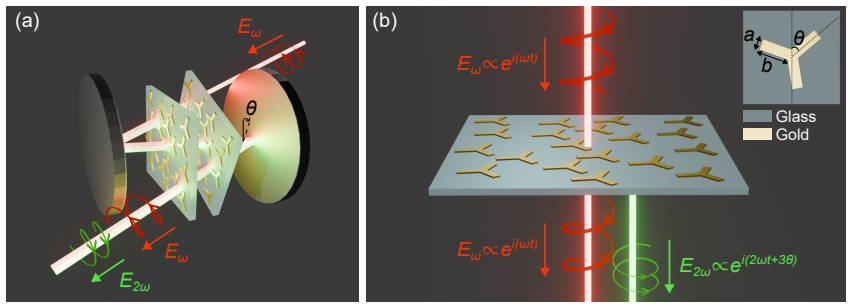
Reconfiguring the spectral output of nonlinear metasurfaces after fabrication remains challenging. We address this by exploiting the nonlinear Pancharatnam--Berry phase of $C_{3v}$-symmetric plasmonic metasurfaces. By integrating two metasurfaces inside a multipass cell, we experimentally demonstrate continuous spectral tuning of second-harmonic generation (SHG) phase-matching peaks across a 900--970 nm pump range by rotating one metasurface relative to the other. The extracted geometric phase follows the $3\sigma\theta$ dependence, and a full $2\pi$ tuning cycle is completed with $120^{\circ}$ of physical rotation. This establishes geometric-phase metasurfaces as a reconfigurable nonlinear platform, where mechanical rotation enables post-fabrication and broadband tuning of nonlinear optical responses.
0
0
physics.optics 2026-05-13 2 theorems

Cross-attention autoencoder stays accurate under spectrometer shifts

Bin Latent Transformer (BiLT): A shift-invariant autoencoder for calibration-free spectral unmixing of turbid media

Learnable probes extract shift-invariant features for reliable recovery of optical properties in turbid samples.

Figure from the paper full image
abstract click to expand
The accurate recovery of constituent-level optical properties from integrating sphere measurements is a central analytical challenge in pharmaceutical analysis, food science, and biomedical diagnostics. Neural network autoencoders can extract spectrally resolved absorption and scattering coefficients for each constituent without prior knowledge, but their fully connected encoders bind learned features to absolute wavelength indices, causing accuracy loss under spectrometer calibration drift or hardware exchange. This work introduces the Bin Latent Transformer (BiLT)-Autoencoder, in which the dense encoder is replaced by a cross-attention scanner: 16 learnable probe vectors query a convolutional feature map, aggregating morphological spectral information independently of absolute wavelength position. A physics-constrained linear decoder with enforced absorption/scattering separation and a three-phase curriculum augmentation strategy complete the architecture. On a liquid phantom benchmark (intralipid and two ink absorbers; 496 samples), the model achieves $R^2 = 0.979$ and $0.975$ for $\mu_a(\lambda)$ and $\mu_s'(\lambda)$, respectively, on held-out test spectra, maintaining $R^2 > 0.90$ for $\mu_a$ and $R^2 \approx 0.99$ for $\mu_s'$ across the full tested shift range of $\pm 10$ spectral bands. The model generalises to a simulated spectrometer with a broader instrument line shape (${\approx}24$nm FWHM) without retraining, retaining $R^2 \approx 0.96$ and $0.974$ for the two channels. Attention map analysis reveals a physically interpretable two-component probe strategy: sparse anchor probes at absorption-edge wavelengths combined with a diffuse, SNR-driven ensemble at the high-transmittance long-wavelength region, which recruits additional probes dynamically under noise to provide implicit spectral averaging.
0
0
physics.optics 2026-05-13 2 theorems

Fluorescence removal enables ppm detection in Raman gas sensing

Systematic Investigation and Suppression of Fluorescence in High-Sensitivity Cavity-Enhanced Raman Gas Sensing

Step-by-step removal of fluorescent optics in a multi-pass cavity reveals weak Raman signals from ambient methane at 2 ppm and yields 3-11-5

Figure from the paper full image
abstract click to expand
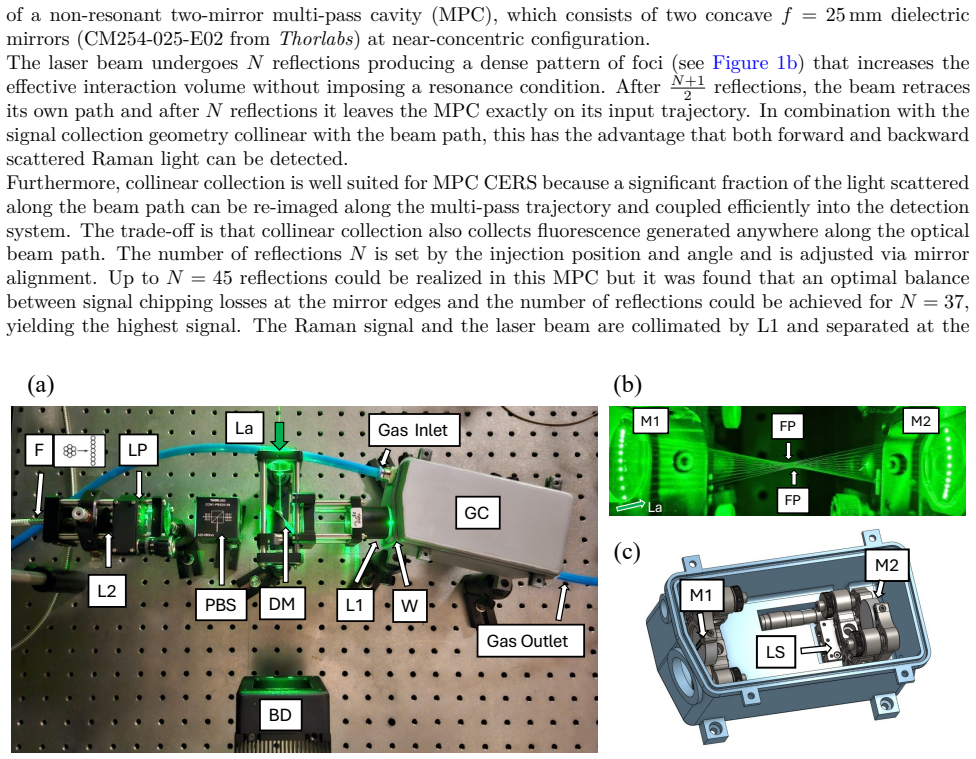
Raman spectroscopy enables broadband, multi-species gas analysis by providing access to an entire vibrational spectrum in a single measurement. However, the sensitivity of gas-phase Raman sensing is often limited by weak signals and fluorescence background from various optical elements that constrain the achievable signal-to-noise ratio (SNR) through signal-dependent noise contributions (e.g. shot noise). Here, we present a cavity-enhanced Raman spectroscopy (CERS) gas sensor employing a 500 mW, 532 nm continuous wave (CW) laser and a simple, non-resonant two-mirror multi-pass cavity (MPC) operated at ambient pressure and near the concentric condition, providing up to 45 internal reflections. To quantitatively capture the impact of fluorescence on performance, a CCD-specific noise model was developed that links fluorescenceinduced baseline levels to measurement noise. Complementary optical simulations were employed to assess the signal collection efficiency in the MPC. Through a systematic analysis of fluorescence sources, the background was reduced substantially by step-wise elimination of fluorescent optics. The fluorescence-minimized setup resolves weak Raman signatures in ambient-air spectra, including CO2 peaks, O2 and N2 overtones, and ambient CH4 (2 ppm). Calibration measurements for O2 (diluted in N2), N2 (in O2) and H2 (in N2) demonstrate detection limits of 11 ppm, 5 ppm and 3 ppm, respectively, with a 180 s measurement time. The results highlight fluorescence mitigation as a key design lever for robust, field-oriented CERS instrumentation for trace gas sensing.
0
0
physics.optics 2026-05-13 Recognition

Leakage in quasi-BICs triggers supercritical coupling for diverging quality factor

Theory of Supercritical Coupling And Generalized Bound States in the Continuum

Bright-dark supermode model shows reactive coupling balances radiation and losses to create generalized bound states in open photonic slabs.

Figure from the paper full image
abstract click to expand
Bound states in the continuum (BICs) arise from destructive interference suppressing radiation despite spectral overlap with the continuum. Here we show that Friedrich--Wintgen interference naturally emerges from a bright--dark supermode decomposition of resonances coupled through a shared radiation channel. In this basis, any finite leakage of a quasi-BIC induces a causality-driven reactive coupling enabling non-Hermitian pumping of the dark sector. We derive the optimal condition for this process and show that it corresponds to the supercritical coupling regime previously identified in [Nature 626, 765 (2024)], while naturally recovering universal quasi-BIC asymmetry scaling. Extending the theory to Dirac-like dispersions in photonic crystal slabs, we identify an open-Dirac singularity where the Dirac gap matches the supercritical regime. A four-wave Hamiltonian quantitatively reproduces rigorous coupled-wave analysis, revealing the breakdown of conventional critical coupling. Near this regime, absorptive cross-coupling induces coherent absorption interference and enables suppression of effective dissipative losses beyond conventional material limits. These results motivate the concept of a generalized bound state in the continuum (gBIC) as a limiting non-Hermitian state where radiative and effective gain compensate, producing a true divergence of the total quality factor. Overall, this work establishes a unified framework connecting BIC interference, Dirac topology, and non-Hermitian physics for ultra-high-Q enhancement and loss engineering in open photonic systems.
0
0
physics.optics 2026-05-13 1 theorem

Substrates alter visible Mie resonances in silicon nanospheres

Probe- and Substrate-Dependent Visibility of Mie Resonances in Silicon Nanospheres

Electric and magnetic modes can be suppressed or inverted depending on the supporting surface and how the particle is excited

abstract click to expand
Silicon nanospheres are high-quality optical resonators and promising building blocks for Mie-tronic devices. While the Mie resonances of an isolated sphere are well understood, practical implementations require substrates that inevitably modify the measured optical response. Here, we investigate how substrates alter the observable spectrum of individual nanospheres, focusing on three fundamentally different cases: a thin silicon nitride membrane, that emulates a free-standing particle, bulk silicon, which is common in experiments, and gold, where mirror charges lead to hybrid optical modes. Cathodoluminescence and dark-field spectroscopy, combined with electrodynamic simulations, show that the measured resonances are not intrinsic to the particle but depend strongly on the environment and the excitation mechanism. We find that substrate-induced effects and probe-specific selection rules can suppress, enhance, or even invert the spectral signatures of electric and magnetic modes. These results provide practical guidelines for interpreting and designing substrate-supported dielectric resonators for Mie-tronic applications.
0
0
physics.optics 2026-05-13

Criteria fully identify entanglement dimension in HD teleportation

General Criteria for Certifying Genuine High-Dimensional Quantum Teleportation

Fidelity and robustness measures work from input-output data alone under partial measurements, with the second requiring no local-operation

Figure from the paper full image
abstract click to expand
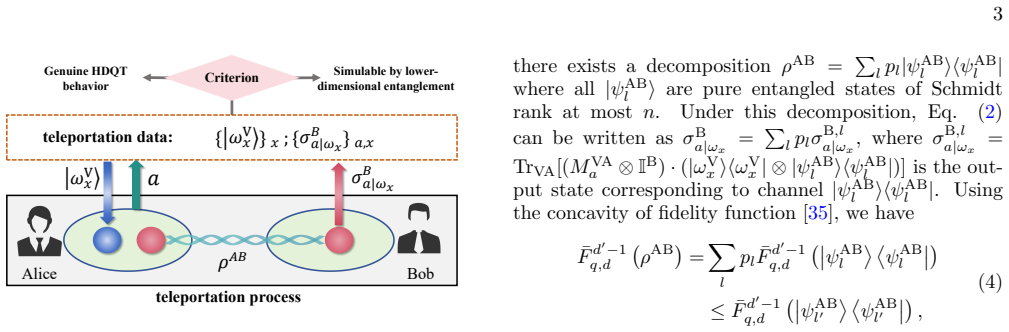
Developing reliable methods for certifying the dimension of a given quantum system or process is essential to ensure the validity of claimed realization of high-dimensional (HD) quantum advantages. The existing criteria for certifying genuine HD quantum teleportation (HDQT) mainly focus on demonstrating the successful transmission of genuine HD quantum states. However, a complete certification of HDQT must also identify the entanglement dimension of resource, which is critical for verifying whether the transmission capacity and noise resilience meet the necessary thresholds. Here we propose two universal criteria (based on fidelity and robustness, respectively) for certifying genuine HDQT behaviors that can close this gap by fully identifying the dimension of the entanglement. Both criteria require only the input and output teleportation data and remain feasible under partial Bell-state measurements. Furthermore, the robustness-based criterion has stronger noise resistance and it requires no prior assumptions about local operations, making it robust even in black-box scenario. Our results establish a universal and reliable theoretical framework for validating the core quantum advantage in HDQT, pivotal for ensuring the reliable links in HD quantum networks.
0
0
physics.optics 2026-05-13 Recognition

Formula converts Ince-Gaussian modes across any ellipticity

Non-orthogonal Transformations of Structured Light Using Ellipticity-Dependent Ince-Gaussian Modes

The closed-form map lets experimenters switch directly between non-orthogonal structured-light bases with spatial light modulators.

Figure from the paper full image
abstract click to expand
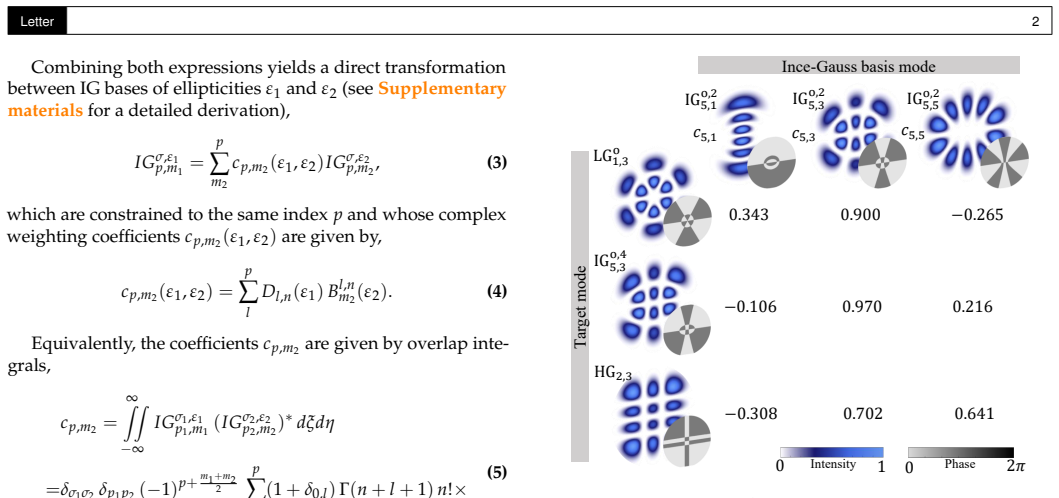
The Ince-Gaussian modes form a complete set of solutions to the paraxial wave equation parametrized by an ellipticity parameter {\epsilon}, enabling a continuous transition between Laguerre-Gaussian and Hermite-Gaussian modes While each fixed {\epsilon} defines an orthogonal basis, modes associated with different ellipticities are not mutually orthogonal, and no explicit transformation between such bases has been reported. Here, we derive the first explicit finite analytical expression to transformation between Ince-Gaussian bases of arbitrary ellipticity, enabling direct and experimentally accessible mapping between non-orthogonal structured-light representations. We further demonstrate an experimental implementation using spatial light modulators to perform ellipticity-resolved modal decomposition. This framework introduces ellipticity as a controllable degree of freedom for structured light engineering, enabling new strategiesfor mode conversion, encoding, and high-dimensional optical information processing.
0
0
physics.optics 2026-05-13 Recognition

Symmetry break activates strong chirality in achiral metasurfaces

Intrinsic chirality of dielectric metasurfaces unlocked by resonant chiral modes

A thin polymer layer on a free-standing silicon membrane unlocks resonant chiral modes and produces enhanced circular dichroism in the near-

Figure from the paper full image
abstract click to expand
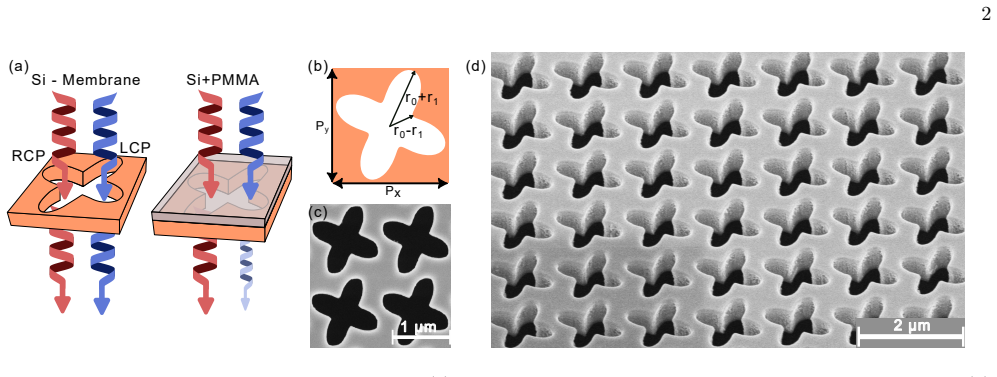
Controlling optical chirality at the subwavelength scales is essential for many applications of nanophotonic structures in polarization optics, sensing, and nonlinear photonics. Achieving a strong chiroptical response in planar dielectric metasurfaces without intrinsically chiral building blocks (or "meta-atoms") remains challenging. The recent theoretical study [ACS Photonics 12, 6717 (2025)] predicted that bilayer metasurfaces with rotated C$_4$-symmetric apertures can exhibit pronounced chiral response originating from resonant chiral photonic modes realizing maximum chirality under the mode strong coupling. That observation uncovers a novel mechanism of metasurface chirality. Here, we confirm experimentally this novel concept and demonstrate resonantly enhanced circular dichroism in the near-infrared frequency range. We fabricate a free-standing silicon membrane metasurface that is nominally achiral. When out-of-plane symmetry is broken by a thin PMMA layer, it unlocks and activates a strong chiral response. The observed circular dichroism is explained by the properties of chiral photonic modes, and it is governed by interlayer coupling and symmetry breaking, in agreement with theoretical predictions. These results establish bilayer metasurfaces as a simple and versatile platform for engineering strong mode-induced chirality in compact planar photonic metadevices.
0
0
physics.optics 2026-05-13 1 theorem

Metasurface q-BIC detects streptavidin binding at 18 nM in flow

Sensitive biodetection in flow using metasurface hosting quasi-bound state in the continuum resonances

Asymmetric nanoresonators confine a resonance in the air gap for real-time transmission readout at 315 nm per RIU sensitivity.

Figure from the paper full image
abstract click to expand
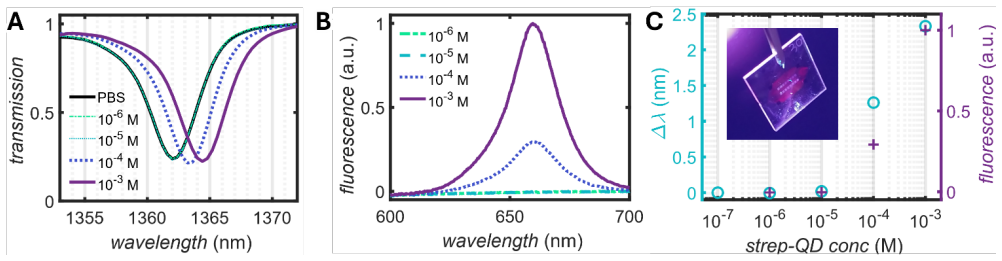
We have designed optical metasurfaces hosting high-quality factor quasi-bound state in the continuum (q-BIC) resonances for optical biosensing in flow. The unit cell of the metasurface contains two rectangular bars. An asymmetry factor is introduced by varying the gap width between the bars, to enable optical coupling to a q-BIC resonance confined to the air gap between neighboring nanoresonators. The location of the resonances makes them highly sensitive to changes in the local refractive index, leading to experimental bulk refractive index sensitivities exceeding 315 +/- 22 nm/RIU and a figure-of-merit of 66 +/- 5 RIU-1. Successful streptavidin-biotin binding was observed by measuring the metasurface transmission in real-time by exposing the metasurface to various concentrations of analytes via a commercial microfluidic flow cell apparatus. The experimental limit of detection, defined as 3{\sigma} above noise, was found to be 1.8x10⁻⁸ M. This platform represents a compact optical approach for point-of-care diagnostics with fast read-out.
0
0
physics.optics 2026-05-13 2 theorems

Topological states double in frequency while staying protected

Doubly topological harmonic generation

Nonlinear phase matching at one interface adds spin-momentum locking, opening doubly protected nonlinear devices for quantum tech.

Figure from the paper full image
abstract click to expand
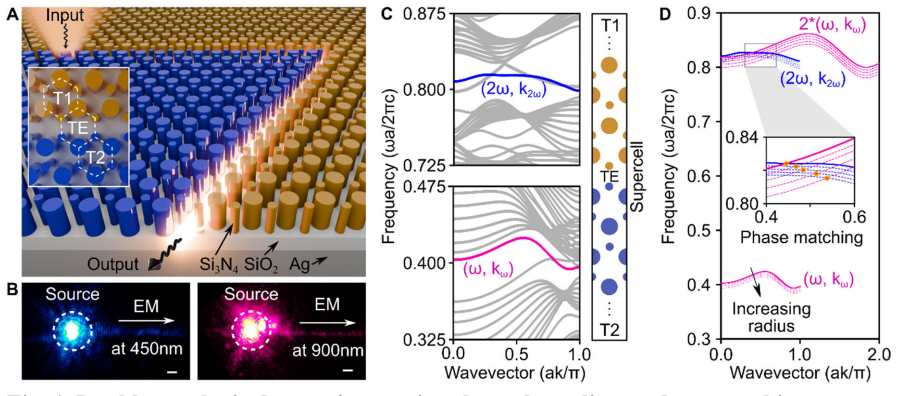
The proposition that band geometry alone can protect optical states against disorder has proven not merely theoretically elegant but experimentally incontrovertible. A key attribute of photonic topological systems is their capacity to simultaneously possess high-intensity excitations at multiple distinct frequencies that are confined to the same topological interface. However, exploiting this freedom to protect the interaction between at least two topological states has remained an open experimental challenge. Here, we report an interaction between two topological states, with one being precisely frequency-doubled to the other, supported in a hybrid plasmonic and photonic topological insulator via nonlinear phase matching. We find that the phase matching inherits a unique spin-momentum locking unseen in conventional nonlinear systems. This ability to bring two topological states into phase-matched nonlinear interaction at a single interface sets the stage for a new class of doubly protected nonlinear photonic devices, potentially finding implications in generating entangled photon pairs with enhanced resilience and robustness for secure quantum information technology.
0
0
physics.optics 2026-05-12 2 theorems

Borophene-ZnO hybrids boost nonlinear response 100x

Plasmon exciton coupling enhances second order nonlinear response in borophene ZnO hybrid structures

Plasmon-exciton coupling produces resonant second-harmonic signals from near-infrared light in the hybrid structure.

abstract click to expand
Nonlinear optical processes in low dimensional materials are often weak or symmetry forbidden, limiting their use in nanoscale light sources and on chip frequency conversion. Here, we show that combining two weakly nonlinear systems, anisotropic borophene and excitonic zinc oxide, yields an enhanced and resonant nonlinear response. In borophene ZnO heterostructures, cathodoluminescence reveals a two orders of magnitude enhancement at 400 nm and 800 nm, due to an enhanced two photon absorption process. Under tunable near infrared excitation, a clear second harmonic signal emerges with quadratic power dependence and strong resonance near 800 nm. We attribute this to nonlinear plasmon exciton coupling, which reshapes the excitonic response and enables efficient hybrid pathways for frequency conversion. These results establish anisotropic plasmon exciton hybridization as a route to controlling nonlinear optical responses in low dimensional heterostructures.
0
0
physics.optics 2026-05-12 Recognition

Alternative designs double EUV metalens focusing efficiency

Design strategies for efficient, fabrication-feasible extreme-ultraviolet metalens

Semi-analytical layouts improve performance in lossy materials without needing smaller fabricated features

Figure from the paper full image
abstract click to expand
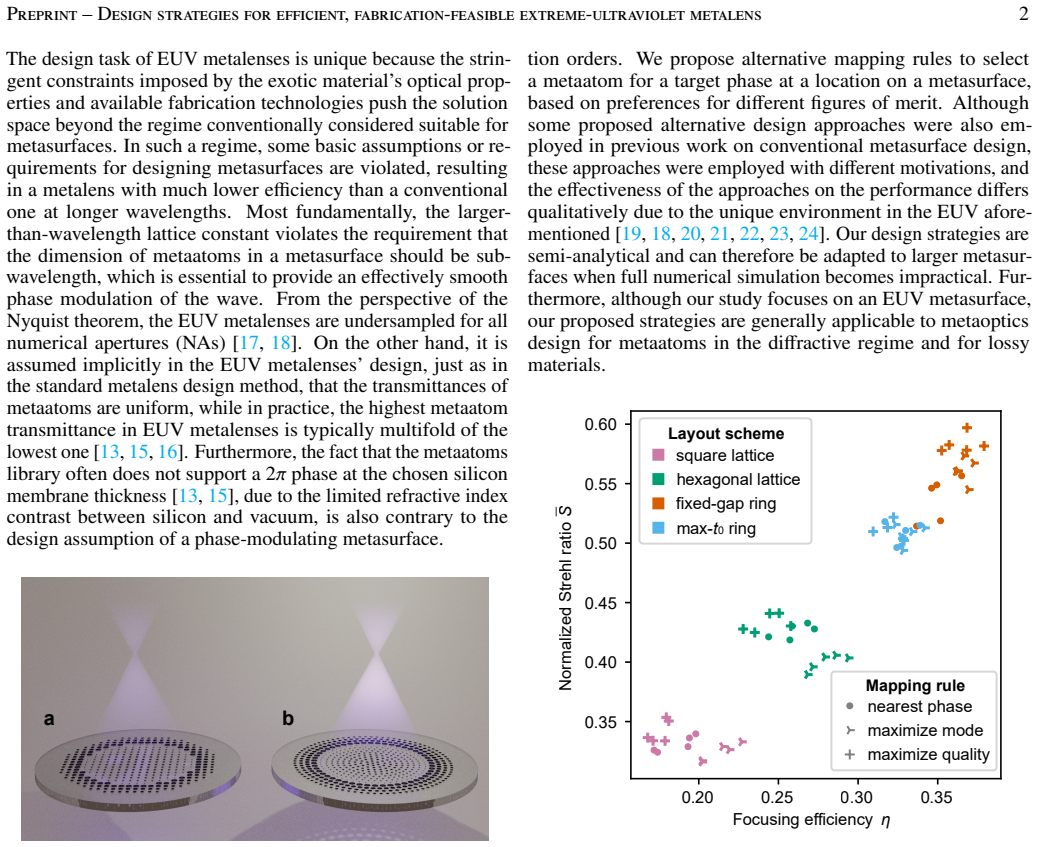
The concept of metasurfaces was recently applied to the extreme ultraviolet (EUV) spectral regime, providing a new opportunity for transmissive focusing elements in a regime where materials are highly lossy. The realization of metalenses in the EUV, however, is challenging due to the optical losses and low refractive index contrast of available materials, as well as the larger-than-wavelength periodicity of metaatom arrays imposed by fabrication limits. In this paper, we propose alternative EUV metalens design strategies, including layout schemes and metaatom mapping rules. We demonstrate that the focusing efficiency can be roughly doubled compared with the simple square-lattice design of an EUV metalens purely by using an alternative semi-analytical design approach without reducing the metasurface's minimum feature size. The proposed strategies are generally applicable to metaoptics design for efficiency improvement when metaatoms are lossy or induce diffraction orders.
0
0
physics.optics 2026-05-12 Recognition

Symmetry quantizes real Berry phase in time-varying non-Hermitian media

Partial Quantisation of Non-Hermitian Berry Phases in Time-Varying Media

The real part of the phase becomes a measurable topological index while geometric gain or loss stays free.

Figure from the paper full image
abstract click to expand
A fundamental symmetry of the non-Hermitian operators describing wave-propagation in time-varying media imbue such systems with non-trivial topology. This topology may be measured directly in a wide range of experimental settings as a quantised real part of the Berry phase, contrasting unconstrained geometric gain or loss. This topological index is provided explicitly for practical examples, including a non-Hermitian analogue of the Su-Schrieffer-Heeger model.
0
0
physics.optics 2026-05-12 Recognition

Silicon array reconfigures skyrmions for turbulence-resistant links

Dynamically Reconfigurable Optical Skyrmions Enabled by a Silicon Microring Optical Phased Array for Robust Free-Space Communication

The microring phased array switches skyrmion types and numbers, keeping symbol error rates lower than OAM over a wider Kolmogorov turbulence

abstract click to expand
Optical skyrmions offer a robust vectorial information degree of freedom for free-space communication, but practical deployment requires a compact platform capable of active topological reconfiguration. Here, we propose a silicon microring-resonator optical phased array that integrates spin-selective emission and programmable phase control on a single chip. Optimized inner- and outer-grating microring emitters provide decoupled LCP and RCP radiation bases with polarization fractions of 90.27% and 91.40%, enabling active switching between N\'eel-type and Bloch-type skyrmions, while dynamically tuning the skyrmion number across Nsk =-1.914 to 1.918. Using these programmable topological states, a 4-symbol free-space communication link is constructed and compared with ideal LG-OAM encoding under Kolmogorov turbulence. The skyrmion-encoded link maintains a lower symbol error rate over a broader turbulence range, demonstrating that topological observables are more robust than scalar OAM modes. These results establish actively reconfigurable optical skyrmions as compact, programmable, and turbulence-tolerant information carriers for next-generation free-space optical communication.
0
0
physics.optics 2026-05-12 2 theorems

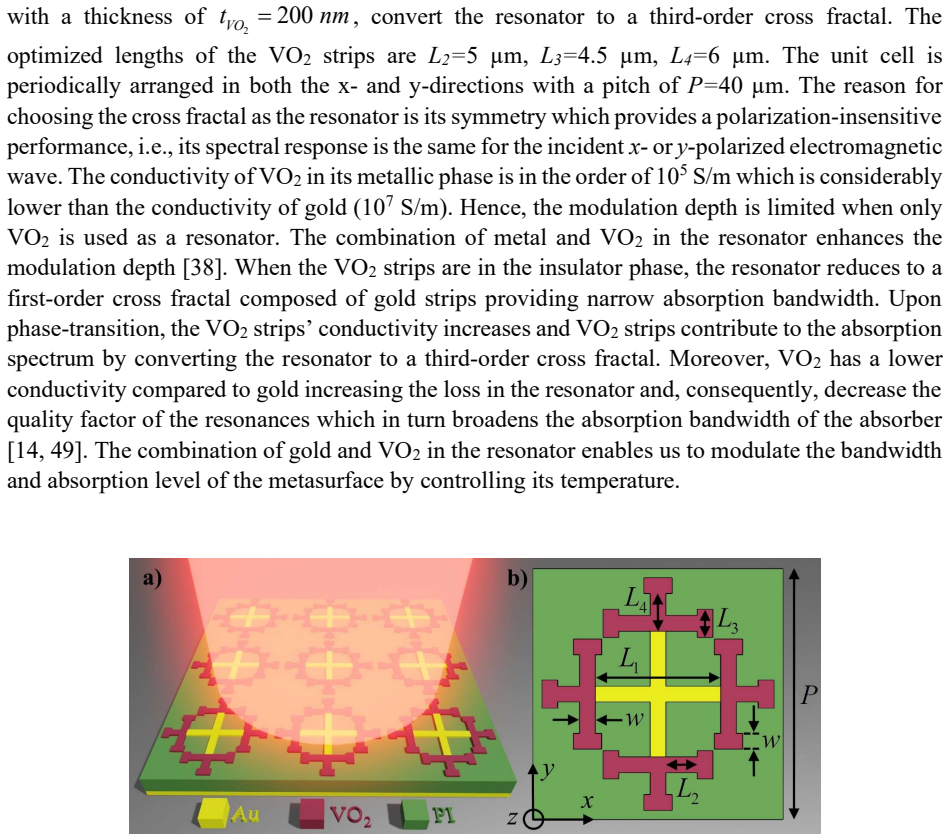
Hybrid metasurface redshifts THz peak for y-pol and blocks x-pol

Polarization-sensitive tunable extraordinary terahertz transmission based on a hybrid metal-vanadium dioxide metasurface

VO2 phase change shifts the y-polarized resonance from 0.88 to 0.81 THz while dropping x-polarized transmission below 0.14 across 0.5-1.1 TH

Figure from the paper full image
abstract click to expand
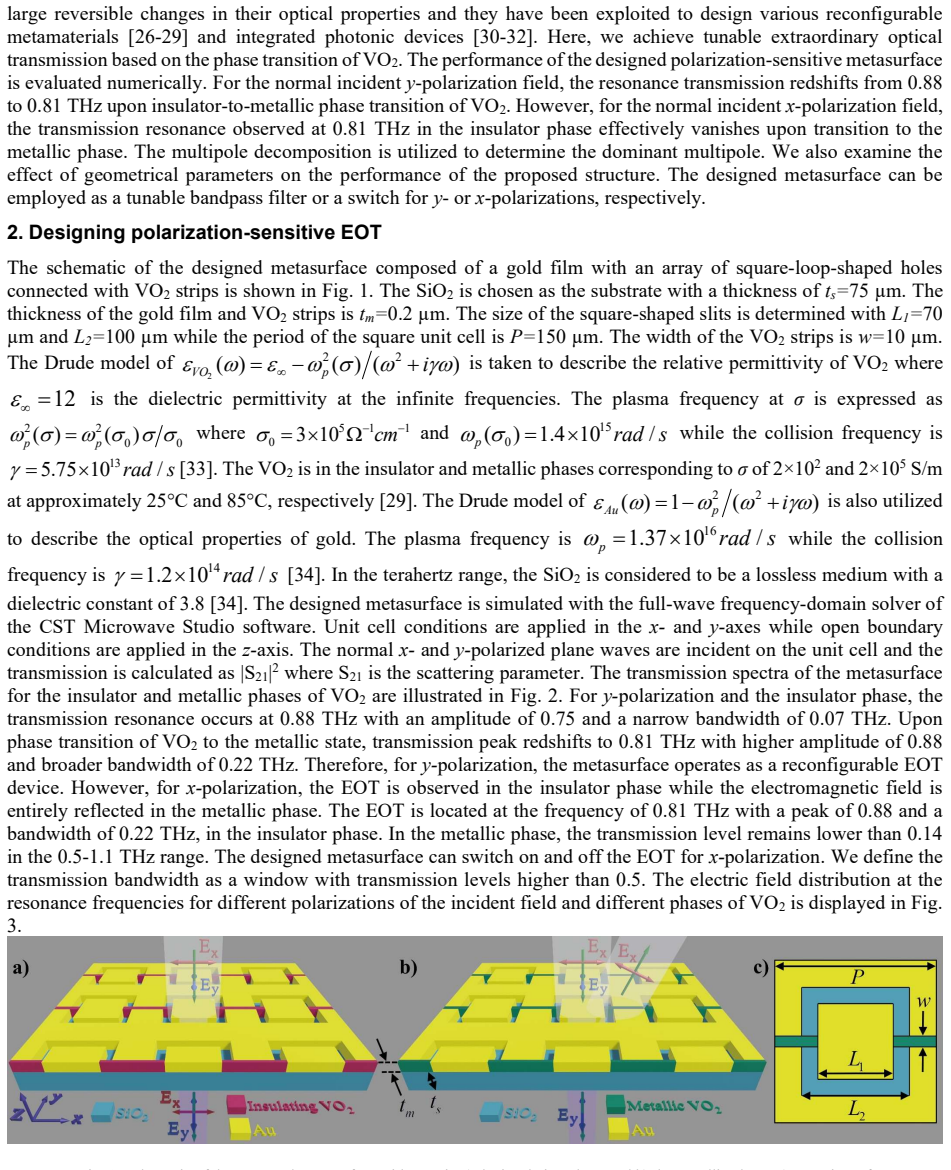
A thermally tunable extraordinary terahertz transmission in a hybrid metal-vanadium dioxide (VO2) metasurface is numerically demonstrated. The metasurface consists of a metal sheet perforated by square loops while the loops are connected with strips of VO2. The frequency and amplitude of the transmission resonance are modulated by controlling the conductivity of the VO2. For y-polarized incident field, the resonance transmission peak redshifts from 0.88 to 0.81 THz upon insulator-to-metallic phase transition of VO2. For x-polarized incident field, the transmission resonance at 0.81 THz is observed in the insulator phase. However, in the metallic phase of VO2, the electromagnetic field is effectively reflected in the 0.5-1.1 THz range with a transmission level lower than 0.14. The proposed metasurface can be utilized as a terahertz modulator, reconfigurable filter, or switch.
0
0
physics.optics 2026-05-12 2 theorems

Noise-ordered features boost low-light optical classification

Measurement-Adapted Eigentask Representations for Photon-Limited Optical Readout

Eigentasks rank readout by resolvability under photon and detector noise, outperforming PCA by up to 10 points in few-shot tasks.

Figure from the paper full image
abstract click to expand
Optical readout in low-light imaging is fundamentally limited by measurement noise, including photon shot noise, detector noise, and quantization error. In this regime, downstream inference depends not only on the optical front end, but also on how noisy high-dimensional sensor measurements are represented before classification or decision-making. Here we show that eigentasks provide a measurement-adapted representation for optical sensor outputs by ordering readout features according to their resolvability under noise. Using experimental data from a lens-based optical imaging system and a reanalysis of published data from a single-photon-detection neural network, we find that eigentask representations frequently outperform standard baselines including principal component analysis and filtering-based compression. The advantage is most pronounced in photon-limited, few-shot, and higher-difficulty classification regimes. In few-shot MPEG-7 classification, for example, the advantage over other methods reaches about 10 percentage points as the number of classes increases. In these settings, eigentasks yield more informative low-dimensional features and improve sample-efficient downstream learning. These results identify measurement-adapted representation as a promising strategy for optical inference when photon budget, acquisition time, and task complexity are constrained.
0
0
physics.optics 2026-05-12 2 theorems

Diamond membranes enable photonic and opto-mechanical devices from UV to IR

Diamond membranes: platform for photonic and opto-mechanical applications

Grating tests show polarization absorption reversal at 1-2 wavelength periods, laser cutting yields long narrow features, and models display

Figure from the paper full image
abstract click to expand
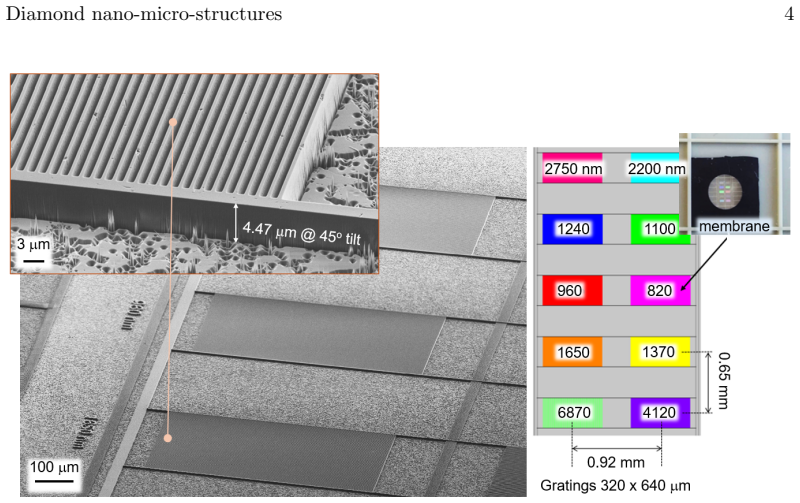
Diamond 1 - 10 micrometers thick membranes are platform for photonic, quantum and opto-mechanic devices with applications across UV-IR spectral ranges. IR characterization of diamond gratings in reflection and transmission showed a change of the IR absorbance dichroism between positive and negative when the grating period was 1-2 wavelengths (free space) including inside the region of the intrinsic diamond absorbance. Femtosecond laser cutting of micrometers-wide and mm-long structures are demonstrated by steps of carbonization > 0.4 J/cm2/pulse (1030 nm/200 fs) and oxidation of diamond membranes. Light intensity distribution inside form-birefringent diamond structure was modeled for a scaled-down structure and wavelength to reveal characteristic interference patterns for different polarizations.
0
0
physics.optics 2026-05-12 2 theorems

JSON schema lifts LLM extraction of laser structures by up to 24%

Information Extraction of Nested Complex Structure of Quantum Cascade Lasers via Large Language Models

Guided prompting lets mid-tier models pull nested quantum cascade laser parameters from papers at high accuracy, enabling automated device-d

abstract click to expand
The rapid advancement of Large Language Models has transformed scientific research workflows, including enabling the automated extraction of data directly from published literature. Most existing efforts, however, focus on extracting simple labeled key-value entities, whereas many scientific applications require more complex, hierarchically structured data. A representative example is Quantum Cascade Lasers, whose device architectures are defined by tens of interdependent parameters organized in nested layer sequences. In this work we propose a \emph{JSON-Schema Guided Information Extraction Pipeline} (JSG-IE) that enables reliable extraction of deeply structured device data without model fine-tuning. By transforming extraction into a schema-constrained generation task, our approach significantly improves structural consistency and accuracy. Across 12 state-of-the-art LLMs, a properly designed JSON Schema improves performance by 5.7\% over conventional prompting, with the highest $F_1$ score up to 83.4\%, achieved by the reasoning-enabled Kimi-k2-thinking model. Importantly, this performance enhancement is most significant for mid-tier and open-source models, where $F_1$ gains reach as high as 24.1\%, effectively enabling these widely accessible models to achieve extraction fidelity previously restricted to much larger architectures. This framework provides a scalable path toward automated construction of high-fidelity device databases, accelerating data-driven optoelectronic design.
0
0
physics.optics 2026-05-12 Recognition

Five filters map MoS2 thickness to 8 nm precision

Sparse Spectral Imaging for Thickness Mapping of 3R-MoS₂ on PDMS

Strategic near-infrared bandpass images replace full spectra for non-destructive mapping of 3R-MoS2 up to 691 nm with 8.3 nm mean uncertain

Figure from the paper full image
abstract click to expand
We present a non-destructive, spatially resolved thickness characterization method for rhombohedral (3R) molybdenum disulfide (MoS$_2$) on polydimethylsiloxane (PDMS) substrates. Unlike broadband spectroscopic approaches, the proposed method reduces the measurement to a small number of discrete intensity images, enabling direct thickness mapping with a conventional microscope architecture and commercially available bandpass filters. Our approach combines a systematic framework for selecting optimal discrete wavelength samples of the material's reflectance with a robust thickness retrieval algorithm based on a multivariate Gaussian probability model. By sampling the reflectance with just five strategically chosen near-infrared bandpass filters, we demonstrate thickness characterization up to 691 nm with a mean 95% confidence-interval width of 8.3 nm. The method is adaptable to other van der Waals materials and conventional optical thin-film systems. It therefore provides a foundation for scalable, real-time thickness characterization in, e.g., dry-transfer fabrication workflows, where thickness screening remains a critical bottleneck for the production of van der Waals heterostructure devices.
0
0
physics.optics 2026-05-11 2 theorems

Tm fiber laser produces low-coherence noise-like pulses over 350 nm

Noise-like pulse laser source with ultrabroadband tunability and coherence-limited sub-structure

Uncorrelated sub-pulses yield 100 fs coherence time and powers up to 213 mW for speckle-free imaging

abstract click to expand
High brightness and low coherence laser sources with wideband tunability are essential for many full-field imaging applications aiming for high contrast and speckle free performance. However, this combination of parameters is challenging to achieve. The current solutions focus on decreasing spatial coherence or generation of time-varying speckle patterns, while suppression of temporal coherence typically compromises brightness. Here we demonstrate a wideband pulsed laser source with low temporal coherence and the absence of phase correlation between pulses as an alternative approach with simultaneous time and frequency diversity. The full gain spectrum of a Tm doped fiber laser (1650 nm 2000 nm) is operated in a tunable noise like pulse regime, which by nature is composed of countless structured elementary events with uncorrelated phases randomly varying from bunch to bunch. The measured spectral widths range from 13.8 nm to 18.8 nm, while the average output power varies between 63.3 mW and 213 mW. Numerical simulations reveal that temporal coherence decreases significantly with increasing optical gain, dropping from near unity at low gain to approximately 0.2 at high gain. The startup dynamics of the noise like pulse laser are experimentally studied using the dispersive Fourier transformation (DFT) method. Based on single shot spectra and frequency resolved optical gating traces, the coherence properties of the laser are further analyzed by calculating the mutual coherence function and cross-spectral density. The noise like pulse laser exhibits a coherence time of approximately 100 fs and an average pulse burst duration of about 40 ps in the high-gain regime.
0
0
physics.optics 2026-05-11 2 theorems

Bending-annealed LPFG doubles bending sensitivity with three-parameter decoupling

A Dual-Dip Heterogeneous LPFG Sensing System via Annealing under Bending with Temperature and Humidity Compensation

Dual resonance dips plus polymer coatings let one fiber read temperature, curvature and humidity independently.

abstract click to expand
Optical fiber multi parameter sensing is fundamentally constrained by cross-sensitivity and the complexity of multi sensor integration. Here, we present a dual-dip heterogeneous long-period fiber grating (LPFG) sensing platform enabled by bending assisted annealing, which introduces anisotropic refractive index redistribution and mode dependent coupling enhancement. This process yields enhanced sensitivity, improved dip contrast, and opposite spectral responses between dual resonance dips, providing intrinsic spectral heterogeneity. To overcome temperature cross sensitivity, a polymer-encapsulated cascaded LPFG-FBG architecture is developed, where the LPFG serves as the microbending sensitive element and the FBG acts as a reference channel. PDMS encapsulation enhances stress transfer and suppresses interfacial slippage, improving linearity and repeatability. As a result, the bending sensitivity increases from -3.44 to -8.97 nm per cm, and the detection limit improves from 0.017 to 0.006 cm. Building on this, a multi parameter sensing paradigm is established by integrating dual dip heterogeneity with LPFGFBG spectral orthogonality. With PAAm functionalization, the platform enables simultaneous and decoupled sensing of temperature, bending, and humidity, demonstrating scalable and versatile multi parameter capability. Overall, this work establishes a minimalistic yet robust paradigm for multi-parameter fiber-optic sensing, offering a scalable strategy for high-performance sensing in structural health monitoring and harsh environments.
0
0
physics.optics 2026-05-11 2 theorems

Symmetry tuning recovers scatterers across barriers

Symmetry-Empowered Through-Barrier Sensing in Complex Media

Optimizing broadband transmission in mirror-symmetric chaotic cavities infers unknown properties on the far side.

Figure from the paper full image
abstract click to expand
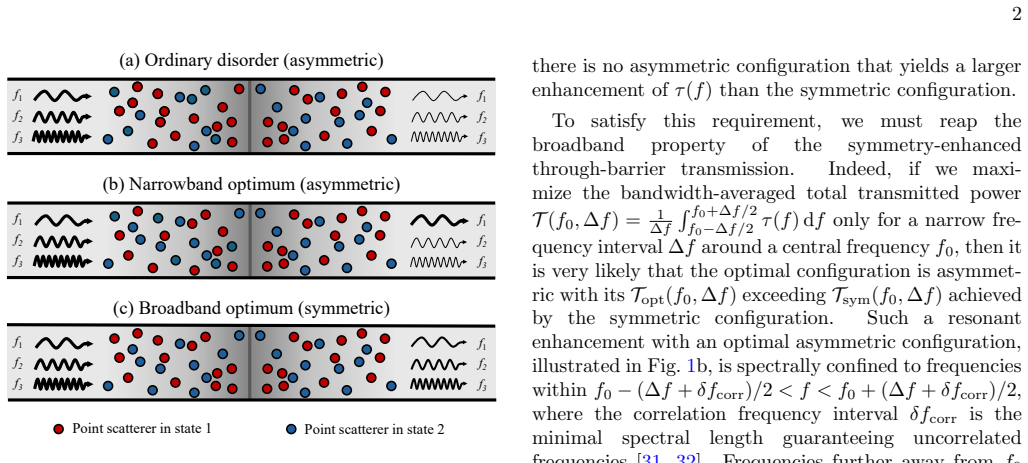
Symmetry strongly impacts wave transport in complex media. In this Letter, we demonstrate that the phenomenon of symmetry-induced through-barrier transmission enhancement enables quantitative sensing across barriers in complex media. We consider two mirror-symmetric chaotic cavities coupled through a narrow slit and containing point scatterers at mirror-symmetric positions. The characteristics of the scatterers in one cavity are unknown, whereas those of the scatterers in the other cavity are programmable. By tuning the programmable scatterers to maximize broadband total transmission, we recover the unknown scatterers' characteristics across the barrier. We show that reliable sensing requires a sufficiently large bandwidth, because otherwise a narrowband asymmetric resonant enhancement can dominate over the desired symmetry-induced enhancement. We further examine how absorption and barrier opacity influence the minimum required bandwidth. Our results establish a symmetry-empowered principle for through-barrier sensing in complex media, suggesting a route toward through-wall imaging in complex environments.
0
0
physics.optics 2026-05-11 2 theorems

Accuracy maps mark validity regions for scalar grating methods

Accuracy assessment of scalar wave propagation methods for diffractive optics design: from thin elements to thick binary grating

Overlap tests against rigorous calculations delineate where thin-element, BPM and WPM approximations remain reliable across frequency and厚度

Figure from the paper full image
abstract click to expand
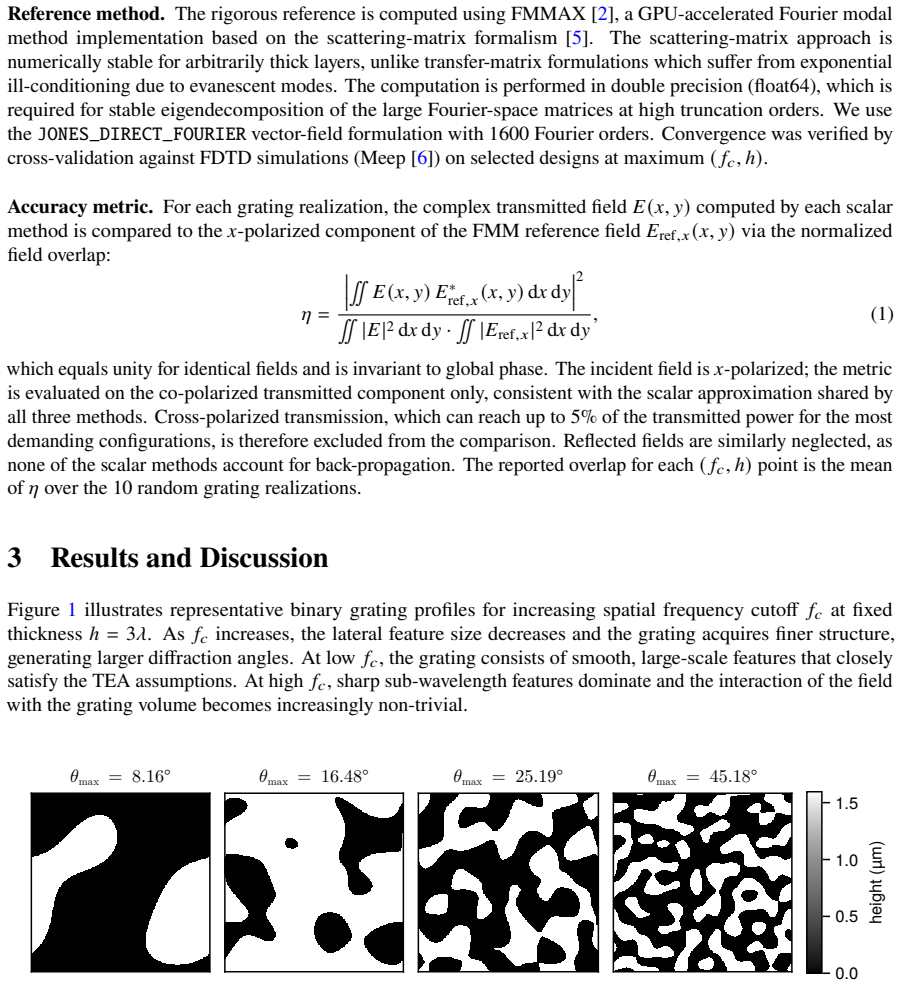
We present a systematic accuracy assessment of the thin-element approximation (TEA), the beam propagation method (BPM), and the wave propagation method (WPM) for binary diffractive gratings, using the rigorous Fourier modal method (FMM) as a reference. Random binary gratings are generated over a range of spatial frequency cutoffs and thicknesses, and the transmitted field overlap between each scalar method and the reference is measured. The results are summarized as accuracy maps in the spatial frequency-thickness parameter space, revealing the domain of validity of each method and providing practical guidelines for the choice of forward model in diffractive optics inverse design pipelines.
0
0
physics.optics 2026-05-11 Recognition

Guided-mode match keeps BIC wavelength fixed while Q rises

Substrate-engineered tunable bound states in the continuum and directional radiation in dielectric metasurfaces

In all-dielectric metasurfaces, substrate layers decide whether symmetry-protected resonances stay put or shift depending on wavelength detu

Figure from the paper full image
abstract click to expand
Tunable bound states in the continuum (BICs) in metasurfaces offer powerful opportunities to control light-matter interactions, yet the role of out-of-plane symmetry breaking remains poorly understood. Here, we reveal a mechanism that enables tunable high-Q BICs and directional radiation through out-of-plane symmetry breaking in all-dielectric metasurfaces. A substrate-free metasurface composed of periodically arranged multilayer cylinders that support overlapping magnetic dipole and electric quadrupole resonances, yielding electric mirror and symmetry-protected BIC responses at 1550 nm. Introducing multilayer substrates breaks out-of-plane symmetry and excites guided modes. When the guided-mode wavelength matches that of the BIC and coupling to the substrate is suppressed, the BIC wavelength remains nearly invariant, while the Q factor increases with layer number. In contrast, spectral detuning and enhanced coupling lead to pronounced blueshifts and rapid Q degradation. The interplay between guided-mode matching and coupling strength thus governs whether a BIC remains robust or becomes tunable. These findings establish a general framework for BIC engineering via out-of-plane symmetry breaking and provide a versatile platform for tunable metasurfaces with potential applications in integrated optics.
0
0
physics.optics 2026-05-11 2 theorems

Coherence filter recovers images from noise 20 times brighter

Noise-Resilient Imaging through Coherence Filtering

Temporal-coherence separation works even with spectral overlap and structured noise, offering a practical route to clearer pictures in low-

Figure from the paper full image
abstract click to expand
Noise is a significant challenge in imaging. Conventional intensity-based techniques mitigate noise through various filtering methods, but they often require prior knowledge of noise characteristics and struggle, especially under low-light conditions and with spatially structured noise. Quantum distillation provides enhanced noise rejection; however, its applicability is limited as it requires specialised illumination and substantial modifications to existing imaging setups. In this article, we introduce a coherence-based image distillation approach that separates object from noise by leveraging the difference in their temporal coherence properties. We implement this through our interferometric protocol, which enables imaging based on spatial coherence while simultaneously filtering out noise via temporal coherence. This overcomes the limitations of both intensity-based and quantum distillation methods. We experimentally demonstrate noise resilience by successfully recovering feature-rich objects, such as QR codes and grayscale wheels, obscured by spatially uniform and structured noise 20 times as intense as the object. We further show that our method remains effective for fields with substantial spectral overlap, outperforming spectral filtering in regimes where the latter provides little noise suppression. This approach provides a robust framework for noise-resilient imaging with applications in optical communication, fluorescence microscopy, and biological imaging at both high and low light levels.
0
0
physics.optics 2026-05-11 Recognition

Neural network predicts resolution from holographic images

Resolution Estimation of a Digital Holographic Microscope Using Neural Network Analysis of Reconstructed Images

It estimates source bandwidth as a proxy, matching standard metrics like FWHM and MTF without modeling every degradation.

Figure from the paper full image
abstract click to expand
This paper presents a method for estimating the resolution of a digital holographic microscope using neural network analysis of reconstructed images. The spectral bandwidth of the source ($\Delta \lambda$) is used as a controlled image degradation parameter. Numerical simulations were performed within inline Gabor holography. A dataset of reconstructed images was generated for several test objects over a $\Delta \lambda$ range from 0.05 to 20 nm. The model predicts $\Delta \lambda$ from reconstructed images with high precision. The predictions are consistent with standard resolution metrics, including FWHM, MTF, and the USAF resolution criterion. The generalization analysis shows that the model is sensitive to the type of degradation. It captures interferometric distortions and responds selectively to the underlying physical mechanism. The proposed approach enables resolution estimation without explicit modeling of all degradation factors and can be applied to compact holographic systems.
0
0
physics.optics 2026-05-11 2 theorems

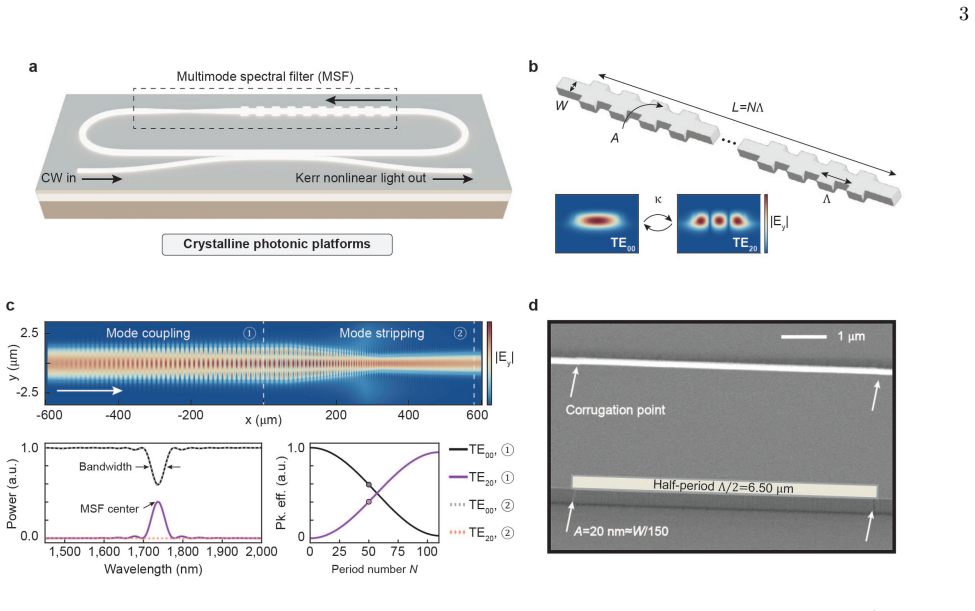
Mode-selective filtering quenches Raman scattering in nanophotonics

Raman suppression in nanophotonics enabled by multimode spectral filtering

Lithium niobate devices generate Kerr frequency combs by tailoring multimode coupling and losses over broad spectra.

Figure from the paper full image
abstract click to expand
Miniaturized photonic cavities generating nonlinear optical states of light are central to telecommunications and metrology applications. The emergence of such states is primarily underpinned by the ubiquitous Kerr nonlinearity that is present in all media. However, stimulated Raman scattering (SRS), an additional process inherent to many materials, has been shown to critically hinder the states' formation, imposing fundamental constraints on the choice of photonic platforms. Here, we introduce a novel strategy for the suppression of SRS in nanophotonic devices, adaptable to diverse Raman spectral responses. This is achieved by controlling the coupling and loss among multiple transverse spatial modes of the system, tailored across ultrabroad spectral bandwidths. Specifically, we combine nanometrically-corrugated Bragg gratings and tapered waveguides that, together enable co-directional multimode coupling and mode-selective filtering. We use lithium niobate as an exemplary Raman-active material to realize the concept, and we demonstrate the robust generation of two distinct Kerr nonlinear states (corresponding to coherent optical frequency combs) using the fabricated devices. The simplicity and generality of the concept suggest wide applicability to classical and quantum light generation on many technologically-relevant platforms nominally plagued by SRS (e.g., silicon and diamond photonics). More broadly, our multimode spectral shaping and filtering concept opens a path forward for highly-structured, wavelength-specific losses in nanophotonic waveguides and cavities, with potential applications in ultrafast and nonlinear integrated photonics.
0
0
physics.optics 2026-05-11 2 theorems

Thin-film lithium niobate chips process terahertz signals for wireless networks

Integrated lithium niobate microwave photonics: Driving next-generation wireless technologies

High electro-optic bandwidth and low drive voltages enable compact radio-over-fiber systems that reach millimeter-wave and terahertz bands.

abstract click to expand
Integrated microwave photonics (MWP) offers a powerful paradigm for handling high-speed microwave signals within chip-scale optical systems. It provides a cost-effective solution to address bandwidth, tunability, and loss bottlenecks of electronics-based radio frequency (RF) systems. The recently emerged thin-film lithium niobate (TFLN) photonic platform, with its exceptional electro-optic (EO) properties, low loss, and scalability, has shown promise to reshape the MWP landscape. Here, we discuss the performance implications of state-of-the-art TFLN photonic devices for MWP applications and offer insights into the emerging trends for next-generation wireless networks. In particular, the unparalleled EO bandwidth enables direct optical generation, processing, and reception of millimeter-wave or even terahertz (THz) signals, significantly expanding the operation frequency range of MWP systems. The low drive voltages and linearity of TFLN modulators lead to an unprecedented operation regime of radio-over-fiber (RoF) systems, featuring net gain, low noise figure and large dynamic range, simultaneously. The availability of a versatile device toolkit, combined with low optical loss and scalability, further supports the transition from traditional tabletop MWP systems to chip-scale solutions, with advanced functionalities, compact footprint, and enhanced system robustness. As the TFLN industrial ecosystem rapidly matures, TFLN-based MWP technology has the potential to deliver transformative solutions to future 6G integrated sensing and communication networks.
0
0
physics.optics 2026-05-11 2 theorems

Frequency detuning flips scattering in atomic trimers

Geometrical Tuning of Light-Matter Interaction in Atomic Trimer Antennas: A Symmetry-Resolved Modal Analysis

Nearly linear trimers switch light direction by frequency alone and host a strong magnetic mode for atomic probing.

abstract click to expand
Atomic trimers constitute the smallest geometry in which collective electric and magnetic responses emerge from coupled electric dipoles. We present a theoretical study of collective mode excitation in atomic trimers as the geometry is continuously tuned from linear to equilateral, using the coupled-dipole method with a multipole expansion formulated about the optimal scattering center. By combining eigenmode analysis and symmetry classification, we provide a complete symmetry-resolved map of the six in-plane and three out-of-plane modes, revealing how symmetry reduction across the $D_{\infty h}$, $C_{2v}$, and $D_{3h}$ configurations governs the evolution of eigenmodes and their spectral features, lifting degeneracies, activating dark modes, and enabling full access to the modal spectrum. Based on this modal understanding, we demonstrate that forward-backward scattering can be switched solely by frequency detuning in a nearly linear trimer, without geometric reconfiguration. Furthermore, a linear trimer under s-polarized excitation supports a magnetic mode with a strongly enhanced magnetic field and a large Purcell factor, making it a promising platform for probing magnetic dipole transitions in atoms, with emission preferentially directed into the transverse plane. These results establish atomic trimers as a minimal platform where symmetry-controlled electric-magnetic mode engineering can be fully resolved and exploited for tailoring light-matter interaction at the atomic level.
0
0
physics.optics 2026-05-11 2 theorems

Metasurface squeezes 1 mm free space into 80-micron device

Metasurface spaceplates reach a millimeter-scale squeezed length of free space

Cascaded multilayer design reaches 14x compression at 0.13 NA for compact imaging systems

Figure from the paper full image
abstract click to expand
Metasurfaces offer compact flat lenses (metalenses) for miniaturized imaging systems; however, the utmost miniaturization requires not only metalenses but also a substantial reduction of free space. A Spaceplate is a flat-optics element designed to mimic free-space propagation, effectively propagating light over a distance far exceeding its physical thickness, with the induced squeezed length serving as the key figure of merit. Despite substantial progress, most existing spaceplate designs have been fundamentally constrained by a trade-off between squeezed length and numerical aperture, and none has demonstrated a feasible structure supporting both a moderate numerical aperture and a millimeter-scale squeezed length. We report a metasurface spaceplate reaching the milestone of a millimeter-scale squeezed length with a practical numerical aperture. We achieved this by combining advantageous elements from existing approaches: high compression ratios and inverse-design flexibility in optimized multilayer metasurfaces, serving as the spaceplate unit structure, and preserving its numerical aperture by coupling its replicas, to construct a coupled cascaded spaceplate with an increased thickness. For operation in the mid-wave infrared, we demonstrated an optimized spaceplate exhibiting a high compression ratio of ~14 with a physical thickness of ~80 {\mu}m, resulting in a squeezed length of 1.09 mm, for a numerical aperture of 0.13. We developed a general framework for calculating the transmission characteristics of multilayered spaceplates while optimizing their layer thicknesses to accurately reproduce the target free space. Strikingly, millimeter-scale squeezed lengths with practical numerical apertures via metasurface spaceplates pave the way for ultrathin imaging systems through their utmost miniaturization, opening a new paradigm for augmented reality headsets, cellphones, and many more.
0
0
physics.optics 2026-05-11 2 theorems

Triple-ring metasurface steers beams to 67 degrees and cuts RCS 10-30 dB from 50-100 GHz

Ultra-BroadBand Electromagnetic Control Using a Triple Circular Ring Metasurface: Surface Wave Propagation, Beam Steering, and RCS reduction (50-100 Ghz)

Simulations show the FR-4 pattern maintains strong fields, redirects energy, and outperforms copper plates across a 50 GHz band.

abstract click to expand
Traditional metasurfaces often face challenges in achieving broadband functionality and dynamic adaptability, limiting their use in advanced electromagnetic systems. This paper presents a triple circular ring metasurface designed for multifunctional electromagnetic applications, including surface wave propagation, beam shaping, and ultra-broadband radar cross-section (RCS) reduction. The proposed structure uses a cost-effective FR-4 substrate and demonstrates strong electromagnetic reflection characteristics across 50-100 GHz. Except near 91 GHz, the metasurface exhibits amplitude and phase responses comparable to a conventional copper plate while maintaining efficient surface wave propagation. Significant electric and magnetic field amplitudes of nearly 1 V/m and 5x10^-3 A/m are sustained across the surface, unlike a standard copper plate. The metasurface also redirects incident energy toward a predefined direction of 67 degrees in the phi plane while minimizing radiation over a 360-degree angular range. In addition, it achieves a stable monostatic RCS reduction from -40 dB to -30 dB across a broad frequency range, outperforming conventional copper structures. Numerical simulations validate the proposed design. The results demonstrate strong potential for stealth technology, radar systems, and next-generation wireless communications.
0
0
physics.optics 2026-05-11 Recognition

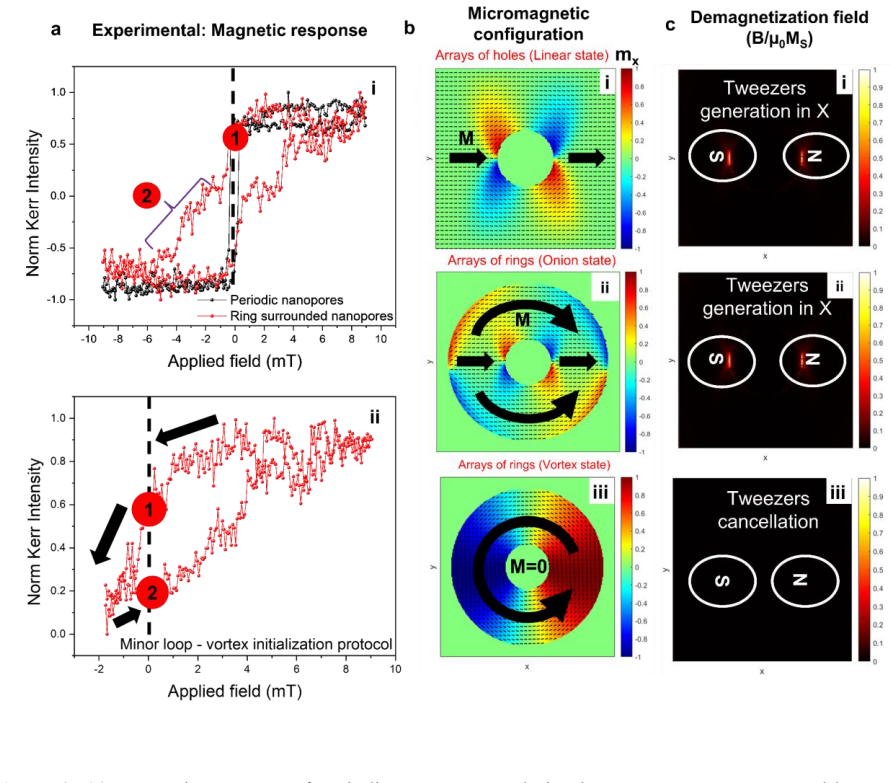
Magnetic pulses toggle nanopores to trap and release tagged particles

Reconfigurable Magnetic Nanopore Platform for Selective Trapping

Reversible magnetization switching in a ferromagnetic layer lets the pore capture or release biomolecules on command.

Figure from the paper full image
abstract click to expand
Solid-state nanopores offer a powerful platform for nanoscale analysis of individual analytes, including biomolecules and functionalized nanoparticles, by confining them within a precisely defined sensing region. However, their inherently passive operation restricts practical applications, as they cannot precisely control particle position or dynamics inside the pore. Here, we introduce magnetic nanopore architectures that integrate a ferromagnetic layer into the nanopore system. Acting as a magnetic discontinuity within an otherwise uniformly magnetized film, the nanopore generates localized stray magnetic fields that enable magnetic tweezing of magnetic nanoparticles, which can be functionalized with fluorescent biomolecules. Importantly, the nanopore geometry is designed to reversibly switch between a nearly uniform magnetization state and a magnetic flux-closure state through the application of short magnetic field pulses of controlled amplitude. This capability allows the magnetic tweezing effect to be selectively activated or deactivated, enabling controlled capture and release of tagged biomolecules on demand. As a proof of concept, we demonstrate the selective magnetic trapping of fluorescent magnetic particles. These findings pave the way for reconfigurable, on-chip magnetic nanopore platforms capable of selective trapping and high-throughput single-particle detection. KEYWORDS: Nanopores, magnetic tweezers, fluorescence microscopy, vortex state, active control, magnetic nanoparticles
0
0
physics.optics 2026-05-11 2 theorems

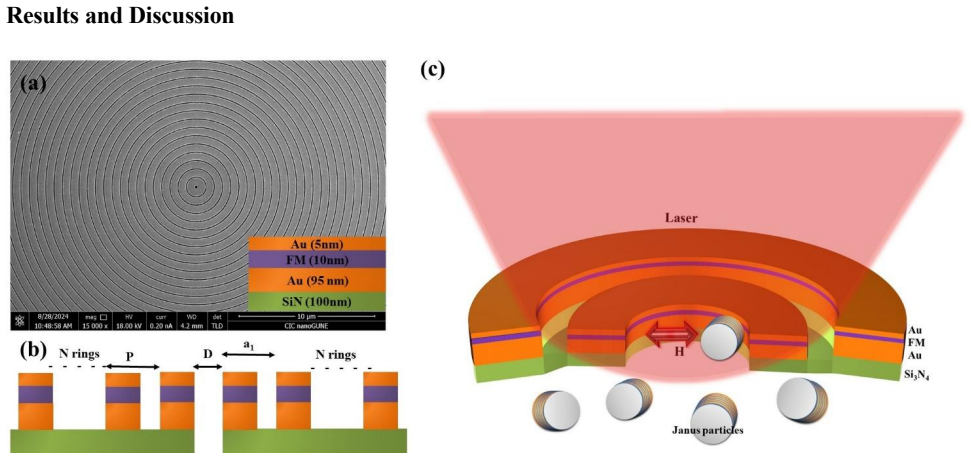
Magnetoplasmonic nanopores boost signals while controlling molecule flow

Magnetoplasmonic Nanopore Lensing for Enhanced Optical Readout and Controlled Translocation

Bull's-eye geometry concentrates plasmons for stronger readout and magnetic tweezing slows tagged molecules for better timing in single-biom

Figure from the paper full image
abstract click to expand
Plasmonic nanopores hold a significant promise for molecular sequencing, but their sensitivity and temporal resolution are constrained by limited signal strength and rapid translocation of molecules through the pore. Here we report an experimentally developed hybrid magnetoplasmonic nanopore platform based on bull's-eye geometry that concentrates surface plasmon polaritons into the pore, resulting in significant electric-field enhancement and improved signal readout. The addition of a ferromagnetic layer allows for magnetic tweezing of magneto-plasmonic nanoparticle-tagged molecules, providing active control over their translocation dynamics. Simulations reveal a further boost in enhancement arising from mirror-on-mirror plasmonic coupling between the nanopore and wall-aligned tagged nanoparticles. Together, experimental realization and simulation-guided insights establish a magnetically configurable, plasmonically enhanced nanopore platform that combines signal amplification with controlled translocation for advanced single-molecule sensing and sequencing. KEYWORDS: Nanopores, plasmonics, single-molecule sequencing, magneto-plasmonics, active control, magnetic tweezing.
0
0
physics.optics 2026-05-11 Recognition

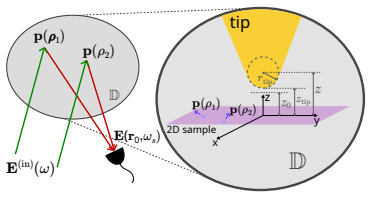
Out-of-plane modes control sample-tip scattering in TERS

Theory for TERS of 2D materials including out-of-plane Raman response

Analytical propagation shows TERS intensity tracks out-of-plane strength while tip-height curves track coherence length

Figure from the paper full image
abstract click to expand
Tip-Enhanced Raman Spectroscopy (TERS) can be used to make nanoscale spatial measurements of 2D materials, such as graphene and transition metal dichalcogenides (TMDs). The TERS theory introduced in [Phys. Rev. X 4, 031054 (2014)], however, was tailored for graphene, whose out-of-plane Raman response is neglected. In the present work, we include the out-of-plane response in the TERS theory. In doing so, we provide an exact analytical expression for the field propagation between the tip and the sample, and show that the contribution to the TERS signal that scatters first at the sample, then at the tip (sample-tip, or TS) is important only when the out-of-plane response is significant. We extensively study the variation of TERS experimental measurements when varying physical parameters of the system, like the tip radius, the out-of-plane response, the TERS coherence length, and others. It becomes evident that the TERS enhancement is very sensitive to the out-of-plane Raman response of the phonon mode, while normalized tip-approach measurements are more sensitive to the coherence length, and we show that the medium refractive index leads to an effective tip enhancement factor $f_e$. Our results lead to the conclusion that, in general, a strong TERS enhancement is a necessary condition for investigating the physics discussed here, which here means surveying the difference in TERS signals between different Raman modes. We use our model to analyze some graphene TERS experiments, showing that they are consistent with a negligible out-of-plane Raman response and a non-zero TERS coherence length in the fitting.
0
0
physics.optics 2026-05-11 2 theorems

Megawatt resonator aims to detect vacuum nonlinearity

Probing the electromagnetic nonlinearity of vacuum with continuous-wave lasers

Demonstration reaches 2.5 MW circulating power, entering the regime needed to observe photon-photon scattering.

Figure from the paper full image
abstract click to expand
In classical electrodynamics, light waves propagating in vacuum do not interact. In quantum physics, however, photon-photon interactions are mediated by virtual particles, giving rise to the electromagnetic nonlinearity of vacuum (EMNV). A direct measurement of EMNV would test a long-standing prediction of quantum electrodynamics and constrain new physics models. Despite its fundamental significance and extensive efforts to detect it, free-space EMNV has not yet been directly measured in the laboratory. Here, we propose a tabletop all-optical measurement of EMNV based on resonantly enhanced four-wave mixing in focusing optical resonators with a circulating power of a few megawatts. As a key experimental step toward this measurement, we demonstrate a resonator reaching a circulating power of 2.5 MW, approaching the parameter range needed to detect EMNV at the level predicted by quantum electrodynamics.
1 0
0
physics.optics 2026-05-11 2 theorems

Light trap creates four-body hot biexcitons in WS2 bilayer

Hot biexcitons driven by extreme optical confinement

A photonic cavity forces unproductive hot excitons to form stable four-particle states that retain valley coherence at room temperature.

Figure from the paper full image
abstract click to expand
A powerful means to understanding condensed matter that possesses a multi-constituent, non-isolated, and complex nature, with a preeminent example being two-dimensional (2D) materials, is studying many-body interactions. However, experimentally observing high-order many-body interactions is a daunting task due to its heavy reliance on the abundance of low-order complexes. Here, we report the observation of four-body hot biexcitons in an energetically unfavorable bilayer of tungsten disulfide (WS2) through creating extreme optical confinement. Specifically, we integrate a non-radiative bound state in the continuum (BIC) into a photonic crystal (PhC) defect cavity, forming a quasi-three-dimensional (q-3D) but open confinement for photons at the driving frequency. The extremely confined photons in both reciprocal and physical spaces then excite inherently unproductive two-body hot excitons situated slightly above the indirect bandgap so efficiently that they form overwhelmed higher-order four-body hot biexcitons. Distinctively, these hot biexcitons exhibit substantial valley polarization and coherence at room temperature, which we attribute to the topological nature of BICs and the associated q-3D confinement with an orbital angular momentum. Besides achieving room-temperature biexcitons, the q-3D confinement could be valuable for higher-order interactions, such as triexcitons, and many other many-body phenomena, including Bose-Einstein condensation.
0
0
physics.optics 2026-05-11 Recognition

Solar radiation ranks first in ERA5 turbulence predictions

Learning from Translation: Seasonal Errors and Feature Importance of the ERA5 Turbulence Predictions

Models trained on one year generalize across sites and years but improve in summer, showing missing seasonal factors in the reanalysis data.

Figure from the paper full image
abstract click to expand
Turbulence is a phenomena that is {\it locally} and statistically characterized by measurements, but it is caused by {\it nonlocal} energy cascades associated with the environment. The presence of turbulence coincides with fluctuations in the refractive index, which impact optical sensing, imaging, and signaling applications. Here, we study the machine learning models that predict near-surface optical turbulence strength $C_n^2$, derived from anemometer-based surface flux measurements through Monin-Obukhov similarity theory, using ERA5 reanalysis data as model inputs. We evaluate the model's ability to perform temporal extrapolation by training on one year of co-located $C_n^2$ observations and ERA5 data, and applying the model to ERA5 data from other years at the same site to reconstruct a multi-year time series. We compare the predictions across Southern California and New York. In spite of varying weather and terrain, the ML models show consistent performance and seasonal behavior across training years. All models show greater correlation, faster convergence, and lower prediction errors in the summer. However, some ERA5 features drive predictions in New York but not California and vice versa, and such feature dependence depends on the season. Seasonal error and feature trends suggest that turbulence is affected by atmospheric composition or other seasonal environmental considerations that are not currently monitored by ERA5. We find, regardless of terrain, the primary feature of importance to turbulence prediction is solar radiation, which underlines the central role of radiative energy transfer in driving atmospheric turbulence. We point toward physics-informed ML translation and feature selection as tools for improving the generalizability of data-driven models.
0
0
physics.optics 2026-05-11 2 theorems

Pre-training boosts all-optical denoising for severe noise

Pre-training Enables Extraordinary All-optical Image Denoising

Diffractive networks pre-trained on millions of simple images then fine-tuned raise PSNR from under 8 dB to over 18 dB across diverse image

abstract click to expand
Optical neural networks are emerging as powerful machine learning and information processing tools because of their potential advantages in speed and energy efficiency. The training methods of these physical models, however, remain underexplored compared to their digital counterparts and are leading to suboptimal performance. This paper reports a pre-training-driven approach that leads to snapshot image denoising with substantially improved quality. We demonstrated effective free-space optical denoising by a diffractive network optimized by a two-step process including (1) pre-training using a massive dataset of 3.45 million diverse but simple images and (2) fine-tuning with the corresponding task-specific datasets. Compared to conventional Fourier-domain filtering and directly trained diffractive networks, such a transfer learning process exhibited prominent advantages for denoising images degraded by severe noise, peak signal-to-noise ratio (PSNR) below 8 dB, while preserving fine image features and improving the PSNR to above 18 dB. Importantly, the same pre-trained optical network could be consistently fine-tuned to process degraded images from highly diverse styles ranging from handwritten digits (MNIST) and chest X-rays (ChestMNIST) to CIFAR-10 images and human faces (CelebA). We further demonstrated the critical role of our optical denoisers in vision-based applications, including face detection, plate recognition, and localization of UAVs in noisy conditions.
0
0
physics.optics 2026-05-11 2 theorems

SWG slot waveguide reaches 12.9 pm/ppm CO2 sensitivity

Transmission resonances in silicon subwavelength grating slot waveguide with functional host material for sensing applications

PHMB fills slot and pillar gaps to confine light inside the functional material instead of the cladding

Figure from the paper full image
abstract click to expand
A highly sensitive and selective CO2 gas sensor is presented based on a subwavelength grating (SWG) slot waveguide. Polyhexamethylene biguanide (PHMB) as a functional material fills the slot gap as well as the space between the silicon pillars of the SWG structure. Beyond the photonic bandgap of the SWG slot waveguide, there are transmission resonances sensitive to the refractive index changes of PHMB due to the infiltration of CO2 molecules into the functional material. The numerical simulations indicate that the sensitivity of the structure is S=12.9 pm/ppm which is considerably higher than the previously designed gas sensors based on functional materials. The higher sensitivity of the proposed sensor is attributed to the strong confinement of the light in the slot gap filled with functional material while previous designs have limited light-matter interaction by placing the functional material in the cladding. The proposed structure may be used to design various sensors by utilizing different functional material sensitive to the desired analyte.
0
0
physics.optics 2026-05-11 1 theorem

GST cladding segments switch SWG filter with 28.8 dB extinction

Subwavelength grating waveguide filter based on cladding modulation with phase-change material grating

Periodic phase-change loading on a silicon subwavelength waveguide also permits >4 nm wavelength tuning via partial crystallization.

Figure from the paper full image
abstract click to expand
Subwavelength engineering and utilizing phase-change materials with large contrast in their optical properties have become powerful design tools for integrated silicon photonics. Reversible phase-transition of phase-change materials such as Ge2Sb2Te5 (GST) provides a new degree of freedom and opens up the possibility of adding new functionalities to the designed devices. We present an optical filter based on a silicon subwavelength grating (SWG) waveguide evanescently coupled to phase-change material loading segments arranged periodically around the SWG core. The effect of the GST loading segments' geometry and their distance from the SWG core on the filter's central wavelength and bandwidth are studied with three-dimensional finite-difference time-domain simulations. The employment of GST in the structure adds a switching functionality with an extinction ratio of 28.8 dB. We also examine the possibility of using the proposed structure as a reconfigurable filter by controlling the partial crystallization of the GST offering a blueshift of more than 4 nm.
0
0
physics.optics 2026-05-11 2 theorems

Tunable high-Q Fano resonance packs denser pixels for molecular fingerprinting

High-Q Fano resonance in all-dielectric metasurfaces for molecular fingerprint detection

Quality factor near 2000 lets scaling steps shrink without spectral overlap, enabling compact label-free readout.

Figure from the paper full image
abstract click to expand
We present and numerically investigate a high-quality factor (high-Q) meta-atom with Fano resonance. Numerical simulations indicate that the designed meta-atom has a single sharp Fano resonance in the 1350-1750 1/cm range. Moreover, the frequency of the single resonance can be tuned in this frequency range by scaling the meta-atom. We exploit these properties to design a pixelated metasurface for spectrometer-less molecular fingerprint retrieval. The proposed meta-atom with an average quality factor of 2000 makes it possible to decrease the scaling step of metapixels without introducing any resonance overlap between the metapixels leading to higher precision in label-free and non-destructive identification of the molecular fingerprints.
0
0
physics.optics 2026-05-11 2 theorems

Pump-probe delay encircles THz exceptional point in 2 ps

Active Control of Topological Exceptional Points in Non-Hermitian Metasurfaces

Varying optical pump timing in a non-Hermitian metasurface produces sub-picosecond mode switching and direct readout of topological phase.

Figure from the paper full image
abstract click to expand
Active control and ultrafast switching of non-Hermitian photonic systems are essential for next-generation reconfigurable optical technologies. Here, we demonstrate dynamic temporal manipulation of EPs in the terahertz (THz) regime using optically excited germanium (Ge) as an active medium. By exploiting pump-probe delay as a continuous tuning parameter, we achieve sub-picosecond eigenmode switching (~0.5 ps) and realize a complete time-resolved EP encirclement within ~2 ps, enabling direct observation of topological phase accumulation. At EP, the metasurface exhibits highly asymmetric transmission for circularly polarized light, characteristic of chiral mode response. Furthermore, we observe ultrafast eigenmode switching and topological phase evolution within ~1 ps, achieving >99% cross-polarization modulation depth. The measured results show strong agreement with theoretical modeling, with a high Petermann factor of approximately 10^3, confirming the effectiveness of the design. Our work establishes pump-probe delay time as a dynamical control parameter for EP topology, introducing a new regime of ultrafast non-Hermitian photonics for high-speed switching, enhanced sensitivity, and tunable polarization control in the THz domain.
0
0
physics.optics 2026-05-11 Recognition

Metamaterial silicon membranes reach 12 GHz Brillouin at low power

Boundary-dominated optomechanics in silicon metamaterial membranes

Boundary-dominated geometry yields record gain and net amplification in millimeter waveguides below 15 mW.

abstract click to expand
Stimulated Brillouin scattering in integrated photonic waveguides enables coherent coupling between optical photons and gigahertz acoustic phonons, providing a powerful mechanism for on-chip microwave photonics and opto-acoustic signal processing. Despite theoretical predictions of ultra-strong Brillouin interactions arising from enhanced light-sound coupling at device boundaries, most state-of-the-art integrated demonstrations remain governed by bulk photoelastic effects. This limitation stems from trade-offs between optical loss, interaction with waveguide boundaries and accessible phonon frequencies associated with the use of transverse-electric optical modes coupled to horizontally breathing mechanical modes. Here we demonstrate a new approach based on transverse-magnetic optical modes coupled to vertically breathing mechanical modes in suspended silicon membranes engineered with subwavelength metamaterial claddings. In this geometry, the interaction is dominated by the moving-boundary effect occurring at smooth top and bottom interfaces, while the phonon frequency is set primarily by the membrane thickness rather than its width. We observe forward Brillouin interactions at a record frequency of 12 GHz with a gain of 7200 W$^{-1}$ m$^{-1}$ and a mechanical quality factor of 620, yielding the highest Brillouin gain-to-quality-factor ratio reported in silicon waveguides. The devices exhibit net Brillouin amplification in millimeter-scale waveguides with pump powers below 15 mW, establishing a scalable platform for high-frequency integrated opto-acoustic signal processing.
0
0
physics.optics 2026-05-11 2 theorems

Event-based spectrometer reaches tens of kHz spectral rates

Asynchronous Event-Based Spectroscopy for Microsecond-Resolved Spectral Reconstruction

Binary events are processed into calibrated spectra that preserve peaks while surpassing frame-based speed limits in dynamic settings.

Figure from the paper full image
abstract click to expand
Many physical and chemical processes of interest evolve on timescales that push the limits of conventional spectroscopic instrumentation. Indeed, the temporal resolution of standard spectrometers is often insufficient to track these dynamics, which is connected to the fact that most systems rely on frame-based sensors, imposing fundamental constraints on acquisition speed, sensitivity, and data efficiency, frequently limiting practical operation to the kHz regime. In this work, we present an approach to circumvent this limitation by developing an event-based spectrometer to enable spectral reconstruction with microsecond temporal resolution by leveraging a Czerny-Turner configuration combined with asynchronous and event-driven sensing. A dedicated signal processing pipeline converts the resulting stream of binary events into calibrated spectra through temporal accumulation, geometric correction, and vertical spatial integration of the spectral line, covering a 234nm bandwidth in the visible range with a spectral resolution of approximately 0.18nm per pixel. Performance characterization under temporally modulated illumination demonstrates that the event-based spectrometer can reconstruct spectra at probing rates of up to tens of kilohertz, far exceeding the practical limits of a conventional frame-based spectrometer operated in parallel, while accurately preserving spectral peak positions and relative spectral features. Finally, to further illustrate its potential applications, the system is validated in a microfluidic experiment integrated into an inverted microscope, where spectral changes induced by an absorbing dye are tracked with higher temporal fidelity and resolution compared with the frame-based approach. These results establish event-based spectroscopy as a promising paradigm for real-time, high-temporal-resolution spectral measurements in dynamic and low-light applications.
0
0
physics.optics 2026-05-11 2 theorems

Substrate near minus one permittivity boosts SERS by 10000 times

Static SERS with near-minus-one-epsilon substrate

The image dipole radiates in phase with the nanoparticle dipole, adding four orders of magnitude to the detected Raman intensity.

Figure from the paper full image
abstract click to expand
A mechanism for additional enhancement of SERS in the nanoparticle-on-mirror scheme is proposed. This new mechanism is based on the use of a substrate made of material with a near-minus-one permittivity. The setup involves a plasmonic nanoparticle in the form of an oblate ellipsoid positioned above the substrate and a Raman-active molecule located between them. In the conventional nanoparticle-on-mirror scheme, the plasmonic dipole resonance frequency coincides with the Stokes frequency of the Raman-active molecule. Consequently, due to the Purcell effect, the molecule's near fields mostly excites a dipole mode in nanoparticle. This dipole moment is many times greater than the dipole moment of the molecule by itself. If the real part of substrate permittivity is near minus one, the image of the nanoparticle dipole moment in the mirror-substrate is a dipole moment pointed in the same direction but approximately $ 1/{\rm{Im}} \varepsilon_{_{\rm{ENZ}}}$ times larger in magnitude. The simultaneous radiation of these two dipoles additionally increases the SERS intensity in $ 10^4$ times.
0
0
physics.optics 2026-05-11 2 theorems

Liquid crystals on SiN enable 98.5% visibility quantum interference

Scalable Liquid-Crystal Integrated Silicon Nitride Photonic Circuits for Reconfigurable Quantum Interference

Voltage-tunable phase modulators achieve low VπL and wafer-scale fabrication for reconfigurable quantum photonic circuits

abstract click to expand
Integrated quantum photonics requires compact, efficient, and low-power phase modulators. While silicon nitride (SiN) is a promising platform, existing modulators suffer from high power consumption, thermal crosstalk, or high driving voltages. Liquid crystal (LC) offers a compelling alternative because of the large index changes and industrial maturity. However, their suitability for supporting various applications in the photonic quantum system has not been experimentally confirmed.Here, we report the first experimental demonstration that LC-based phase modulators integrated on a SiN platform show highly visible quantum interference. We fabricated a liquid-crystal integrated Mach-Zehnder interferometer (LC-MZI) that achieved CMOS-compatible performance with V_pi * L < 1 V-mm. In two-photon interference experiments, the devices exhibited high-visibility quantum interference (~98.5%) with voltage-tunable phase control. Furthermore, we validated the scalability of our approach by demonstrating wafer-scale fabrication using stepper lithography. This work establishes LC-integrated SiN photonics as a scalable, reconfigurable, and energy-efficient platform for quantum photonic circuits.
0
0
physics.optics 2026-05-11 Recognition

Perturbation model fixes optical nonlinearities from noisy signals

Perturbation-based Compensation with EEPN-free Phase Recovery as Back Propagation

Feed-forward compensation using received data outperforms decision feedback and gains extra from symmetric phase recovery.

abstract click to expand
We propose a feed-forward perturbation-based method that uses the noisy received signal to compensate for nonlinear distortion, which outperforms the conventional decision-based method and avoids decision feedback. Additionally, combining it with the EEPN-free carrier phase recovery shows additional gain due to a fully symmetrical propagation-backpropagation structure.
0
0
physics.optics 2026-05-11 Recognition

Weak disorder breaks one-way light transport in Chern insulators

Fragility of Unidirectional Transport in Weakly Disordered Photonic Chern Insulators

Coupled defect states form reciprocal necklace channels inside the topological gap, allowing bidirectional propagation despite preserved top

abstract click to expand
Photonic Chern insulators enable unidirectional light transport protected by nontrivial band topology -- essential for robust photonic integrated circuits and error-free communication. However, disorder from impurities or defects inevitably exists in practical applications, yet how weak disorder affects topological chiral edge states remains insufficiently understood. Here, we reveal a previously unrecognized mechanism by which weak disorder can disrupt robust propagation of chiral edge states in photonic Chern insulators, despite the preservation of global topological invariants. By randomly replacing a small number of magnetized rods with nonmagnetized impurities in a magnetic photonic crystal, we find that when the excitation frequency approaches the single impurity defect state frequency, weak coupling between spatially extended defect states forms a topologically trivial impurity band inside the topological gap. This enables coexistence and coupling of defect states and chiral edge states. The reciprocal "necklace state" transport channels formed by coupled defect states break the expected unidirectional propagation in topological Chern insulators with weak disorder. Our work reveals that topological chiral edge state and disorder interactions are more intricate than previously understood and provides new insights into stability and control of topological transport in realistic applications.
0
0
physics.optics 2026-05-08 Recognition

Flow-matching model predicts full fields in photonic devices

Physics-Based Flow Matching for Full-Field Prediction of Silicon Photonic Devices

Conditional flow matching plus masked Helmholtz loss creates a fast surrogate for FDTD that generalizes to new device classes like S-bends

Figure from the paper full image
abstract click to expand
Designing photonic integrated circuits requires accurate electromagnetic field simulations, which remain computationally expensive even for simple device geometries. We present PIC-Flow, a generative neural surrogate that predicts electromagnetic field distributions for photonic devices given their geometry and operating wavelength as an alternative to costly finite-difference time-domain (FDTD) simulations. Our approach combines three key ideas: (i) conditional flow matching as the generative framework, learning a velocity field that transports Gaussian noise to physically valid field solutions; (ii) a real-valued U-Net operating on split real and imaginary field channels; and (iii) physics-constrained training through a Helmholtz residual loss enforcing $\nabla^2 E_z + k_0^2 \varepsilon E_z = 0$. We introduce an interface-aware masking scheme for the Helmholtz residual that excludes dielectric boundary pixels where finite-difference stencil errors dominate, yielding a physically meaningful compliance metric. The data set consists of 22,500 ground-truth FDTD simulations split evenly between multimode interferometers, Y-branches, and directional couplers at $\lambda=1.55\,\mu$m in an 80/10/10 split between training, validation, and test sets. We evaluate ablations on the network against the held out test devices and also show that the model generalizes to held out device classes such as S-bends, tapers, and cascaded Y-branches. Rather than a drop-in replacement for FDTD, this work establishes a foundation that, with broader data coverage, more compute, and further training optimization, could scale toward broadband, device-agnostic field prediction with dramatically improved runtime for rapid design-space exploration of complex photonic devices and circuits.
0
0
physics.optics 2026-05-08 Recognition

Tilted sensor maps pixels to range for passive UAV tracking

Monocular passive event-based range-finding of airborne objects using the Scheimpflug principle

A monocular camera with one-time calibration gives deterministic distances to drones out to 1 km while event sensing rejects static clutter.

Figure from the paper full image
abstract click to expand
Passive 3D sensing is increasingly critical for early detection and tracking of small aerial vehicles (UAVs), where traditional active ranging can be tactically undesirable. We present SCHeimpflug for Optical Ranging TechnologY (SCHORTY), a single-aperture passive and active ranging architecture that exploits the Scheimpflug principle to encode range along a tilted object space plane by tilting the sensor relative to the imaging optics. SCHORTY requires only a one-time geometric calibration to map pixel coordinates to range and is inherently sensor and waveband agnostic. We implement SCHORTY using both a visible frame-based camera and an event-based camera (EBC) with closely matched pixel sizes for comparable horizontal resolutions and range binning. Controlled flights of an octocopter and a fixed-wing UAV equipped with GPS provide ground truth distances out to 1.1 km. Experimental results show that SCHORTY achieves deterministic range assignment limited primarily by the projected pixel size, which grows squared distance, while avoiding computationally intensive inverse reconstructions common in coded aperture and PSF engineered systems. In the EBC configuration, EBC-SCHORTY inherently suppresses static background and emphasizes motion, improving UAV detectability in cluttered natural scenes and under turbulence and motion blur. Additionally, we observe an asymmetric defocus blur about the object plane that depends on UAV trajectory, suggesting an extra cue for localization and trajectory inference. These results demonstrate SCHORTY as a practical and Size, Weight, and Power (SWaP) efficient passive ranging solution for medium-range UAV observation and motivate future integration with 2.5D/3D PSF engineering and event-based deconvolution to enhance 3D sensing performance.
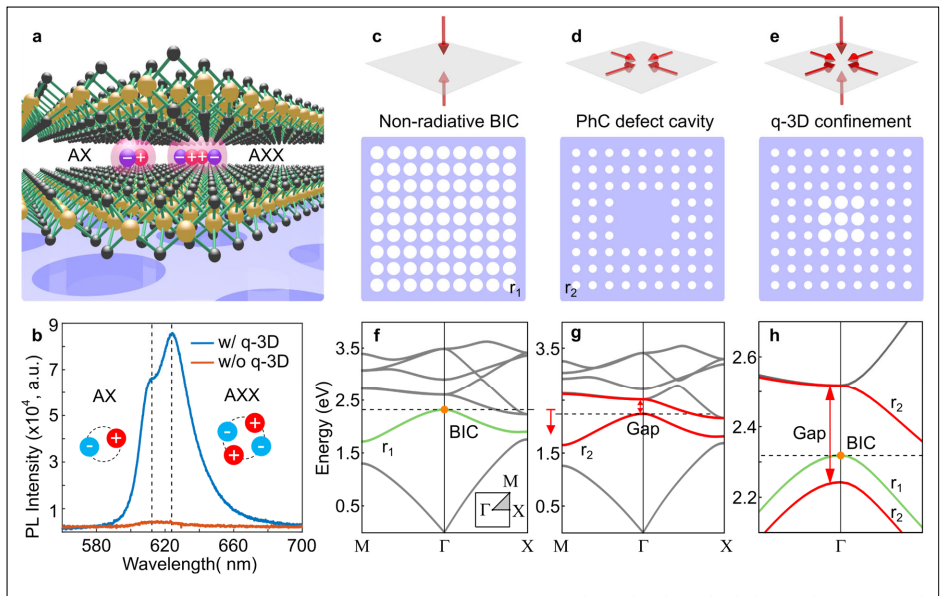
0
0
physics.optics 2026-05-08 2 theorems

Monolithic receiver front end hits 0.08 pJ/bit at 56 Gbaud

A 0.08 pJ/bit 56 GBaud Monolithic Optical Receiver Front End for IMDD Photonic Links

28.9 GHz bandwidth and sub-737 nA noise achieved at 9.22 mW in silicon photonics for IMDD links.

Figure from the paper full image
abstract click to expand
We present the design, fabrication, and measurement of a monolithically integrated optical receiver analog front end, where low power operation is a primary consideration with a goal of supporting 56 Gbaud intensity modulated direct detect transceivers. The need for low-power consumption and low-noise operation motivates a monolithic, layout driven design approach which begins with circuit topology selection and analysis. Various transistor unit cell layout configurations are explored, minimizing parasitics, enabling wide analog bandwidth and reduced input referred noise. The post-layout analog front end achieves a 28.9 GHz bandwidth with a low-frequency gain of 61.7 dB{\Omega}. This circuit was designed within the GlobalFoundries FotonixTM monolithic silicon photonics platform. The fabricated device is characterized by its DC operation, noise characteristics, and time domain behavior. The final design was validated by on-off keyed and PAM-4 electrical eye diagram measurements to 64 GBaud, consuming 9.22 mW of power from a 1.2 V supply with less than 737 nA RMS integrated input referred noise current and 0.08 pJ/bit.
0
0
physics.optics 2026-05-08

One d-plate realizes exact vector beam transformations when condition holds

A Unified SU(2) Framework for Vector Beam Transformations and Complex Beam Shaping

An algebraic condition on the target mapping lets a single birefringent element deliver the full transformation, including global phase, and

Figure from the paper full image
abstract click to expand
We present a constructive framework for designing transformations between structured light fields using birefringent optical elements, formulated in terms of SU(2) operations on polarization. Within this framework, transformations between vector beams are treated as spatially varying SU(2) operations, leading to a direct procedure for designing doubly inhomogeneous waveplates (d-plates) that implement the desired mapping. We identify a condition under which a single element implements a prescribed transformation exactly, including the global phase, and provide an explicit prescription for constructing the corresponding doubly inhomogeneous waveplate (d-plate) when this condition is satisfied, along with its realization using a finite sequence of singly inhomogeneous plates, including a QHQ configuration. Within this formulation, a broad class of problems in structured light can be treated within a single framework, including vector beam transformations, spin-orbital dynamics, and complex beam shaping. Crucially, the same SU(2) operations directly realize quantum channels on the orbital angular momentum degree of freedom, with polarization serving as a physical ancilla. These results establish a unified and explicitly constructive route to complex beam shaping and vector beam transformations based on SU(2) parameter synthesis, and provide a systematic foundation for designing next-generation photonic elements for structured light and spin-orbit information processing.
1 0
0
physics.optics 2026-05-08

Symmetry breaking tunes emission from coherent to Markovian in Lieb lattices

From flat to narrow bands: Engineering quantum emission in a one-dimensional Lieb lattice

Scaling laws quantify the crossover via narrow dispersive bands created from flat bands in one-dimensional photonic structures.

Figure from the paper full image
abstract click to expand
We develop a comprehensive theoretical framework that unifies quantum emission dynamics in one-dimensional Lieb lattices, bridging the gap between ideal flat-band coherence and realistic narrow-band dissipation. By coupling an emitter to sublattices with finite flat-band wavefunction overlap, we activate a collective, size-independent interaction fundamentally distinct from dispersive-band processes. Controllably breaking lattice symmetry transforms the flat band into a narrow dispersive band, enabling a continuous crossover from non-Markovian to Markovian dynamics governed by the competition between coupling strength and engineered bandwidth. Crucially, we derive explicit scaling laws that provide a quantitative blueprint for tuning spontaneous emission from coherent trapping to Markovian decay. Our work provides a unified framework that connects idealized flat-band physics to emerging narrow-band platforms such as moir$\rm\acute{e}$ photonic crystals, offering a practical toolkit for interpreting experiments and engineering quantum emission in structured photonic environments.
0
0
physics.optics 2026-05-08

Silica coatings retain 6% elastic anisotropy after standard baking

Elastic and structural anisotropy in silica thin films for gravitational-wave detectors

900 degree treatment removes the anisotropy and may help cut thermal noise in gravitational wave detectors

Figure from the paper full image
abstract click to expand
The thermal noise of mirror coatings for gravitational-wave detectors critically depends on the elastic properties of the constituent materials. Data analyses and theoretical models typically assume each material is homogeneous and isotropic, but isotropy has never been explicitly verified. Using Brillouin light scattering (BLS), we demonstrate for the first time that ion-beam-sputtered SiO2 -- a material still viable for future mirror coatings -- exhibits cylindrical elastic symmetry, with in-plane isotropy but a notable 6% compressive anisotropy along the film normal. This anisotropy remains unchanged after the post-deposition heat treatment currently used in ground-based detectors (500 $^\circ$C, 10 h) but is nearly eliminated at 900 $^\circ$C. Infrared reflectivity experiments support these findings by directly revealing heterogeneities in the distribution of bridging and non-bridging oxygen structures along the growth axis. While BLS measures the real part of the elastic constants at GHz frequencies, the data reveal negligible contributions from mechanical relaxations in the kHz-GHz range, making BLS a valid substitute for low-frequency properties obtained from standard anisotropy-insensitive techniques. Our results highlight that restoring isotropy through heat treatment -- by softening the material, enabling more than 7% out-of-plane expansion, and smoothing out structural heterogeneities -- may play a key role in reducing thermal noise. This proof-of-concept study extends beyond silica, providing critical insights for the design of future coatings.
0
0
physics.optics 2026-05-08

Bessel beams achieve 82% vortex conversion in vdW crystals

Near-unity efficiency optical vortex generation in van der Waals materials

Single wave vector in birefringent hBN exceeds prior 50% efficiency limit for compact generators.

Figure from the paper full image
abstract click to expand
Optical spin-orbit coupling provides a promising, fabrication-free route for developing ultra-compact optical vortex generators. However, the conversion efficiency has been theoretically limited to 0.5. Here, we demonstrate enhanced vortex generation efficiency by employing a Bessel beam as the input and propagating it through van der Waals (vdW) crystals. The large birefringence of vdW crystals and the single transverse wave vector of a Bessel beam allow a near unity spin-orbit conversion efficiency and a topological charge transition of $\ell \rightarrow \ell + 2$. Through combined analytical and experimental investigations, we demonstrate a conversion efficiency of up to 0.82 in hexagonal boron nitride (hBN) crystals with a thickness of $27.4\,\mu\mathrm{m}$. The higher efficiency of Bessel input beams over Gaussian beams is attributed to their distinct transverse wave vector distribution of constituent plane wave components. Furthermore, we demonstrate the dependence of conversion efficiency on the numerical aperture (NA) of the objective lens, which is in good alignment with theoretical predictions. These demonstrations provide a fabrication-free route to highly efficient optical vortex generation via microscale vdW materials platforms.
0
0
physics.optics 2026-05-08

LDE epitaxy yields C-band quantum dots with single-photon purity

Local droplet etching-assisted quantum dot epitaxy for telecom C-band quantum light emitters

Symmetric InGaAs dots in nanoholes emit at 0.2 meV linewidth and g(2)(0)=0.07 under continuous-wave drive.

Figure from the paper full image
abstract click to expand
Significant progress in quantum light sources for quantum communication applications requires reproducible and symmetric quantum emitters acting as single-photon sources capable of generating entangled photons on demand at specific telecom wavelengths. Here, we propose telecom-emitting epitaxial quantum dots (QDs) fabricated using the local droplet etching (LDE) approach. The resulting well-defined, low-density ($10^9$/cm$^2$) QDs based on In$_{x}$Ga$_{1-x}$As are formed in symmetric LDE nanoholes (in-plane aspect ratio of 1.14) in In$_{0.52}$Al$_{0.48}$As. Detailed transmission electron microscopy provides comprehensive insight into the structural integrity, interface quality, and compositional profiles of the QDs, which underpin their promising optical properties. Photoluminescence spectroscopy reveals narrow emission lines (0.2 meV) and high optical quality, while second-order autocorrelation measurements confirm clear single-photon emission, with $g^{(2)}(0)=0.07\pm0.02$ under above-band continuous-wave excitation and $g^{(2)}(0)=0.16 \pm 0.18$ under pulsed excitation. Precise numerical modeling, combining multiband $\boldsymbol{k} \cdot \boldsymbol{p}$ and configuration-interaction methods, supports the optical characterization and identifies thermal excitation pathways that explain the persistence of emission up to liquid-nitrogen temperatures. These results highlight the versatility of the LDE approach for integrating new material systems and pave the way toward scalable fabrication of quantum light sources with tailored emission properties.
0
0
physics.optics 2026-05-08

VO2 switches terahertz absorber between narrow and broad bands

Narrowband-to-broadband switchable and polarization-insensitive terahertz metasurface absorber enabled by phase-change material

Phase transition connects patches to turn a simple fractal into a complex one, expanding absorption width from 0.35 to 6.17 THz.

Figure from the paper full image
abstract click to expand
A terahertz absorber with controllable and switchable bandwidth and insensitive to polarization is of great interest. Here, we propose and demonstrate a metasurface absorber with switchable bandwidth based on a phase-change material of vanadium dioxide (VO2) and verify its performance by the finite element method simulations. The metasurface absorber is composed of a hybrid cross fractal as a resonator separated from a gold ground-plane by a polyimide spacer. Switching from narrowband to broadband absorber is achieved via connecting VO2 patches to the gold first-order cross fractal converting the resonator to a third-order cross fractal. In the insulator phase of VO2, the main narrowband absorption occurs at the frequency of 6.05 THz with a 0.99 absorption and a full-width half-maximum (FWHM) of 0.35 THz. Upon insulator-to-metal transition of VO2, the metasurface achieves a broadband absorption with the FWHM of 6.17 THz. The simulations indicate that by controlling the partial phase-transition of VO2, we can tune the bandwidth and absorption level of the absorber. Moreover, the designed absorber is insensitive to polarization due to symmetry and works well for a very wide range of incident angles. In the metallic state of VO2, the absorber has an absorption exceeding 0.5 in the 3.57-8.45 THz frequency range with incident angles up to 65{\deg}.
0
0
physics.optics 2026-05-08

VO2 phase switch shifts THz transmission peaks

Thermally reconfigurable extraordinary terahertz transmission using vanadium dioxide

Hybrid gold apertures with annular VO2 redshifts or blueshifts the extraordinary transmission window by heating.

Figure from the paper full image
abstract click to expand
We numerically demonstrate a reconfigurable extraordinary terahertz transmission based on a phase-change material of vanadium dioxide (VO2). The proposed hybrid metasurface is composed of an array of subwavelength apertures perforated on a gold film. The holes are partially filled with annular VO2 and gold disks to control the effective aperture area and the modes inside the aperture. Switching between the insulator and the metallic phase of VO2 provides a convenient way to shift the transmission window. We present two designs offering redshift or blueshift of the extraordinary terahertz transmission. Upon phase transition from the insulator to the metallic phase, in the first design, the transmission peak redshifts from 1.02 to 0.82 THz while in the second design the transmission peak blueshifts from 0.71 to 0.77 THz. Furthermore, the transmission level and resonance frequency can be modulated by controlling the partial phase transition of the VO2. The potential applications for the proposed structures are terahertz modulators and reconfigurable filters.
0
0
physics.optics 2026-05-08

Silicon-carbide microrings give erbium ions 70x room-temperature photon boost

Room temperature Purcell enhanced single erbium ions in silicon-carbide-on-insulator microring resonators

Seventy-fold Purcell enhancement and 54 MHz diffusion open telecom single-photon sources without cryogenic cooling.

abstract click to expand
Spin-carrying single-photon emitters operating in the telecommunication C-band (1530-1565nm) are prime candidates for integrated spin-photon interfaces, offering seamless compatibility with existing fiber-optic infrastructure, an essential component for future quantum networks. In this context, erbium-dopants ($\text{Er}^{3+}$) are particularly compelling due to their exceptional emitter properties, including small spectral diffusion and long spin coherence times. However, their low C-band photon-emission rate and operation at cryogenic temperatures has limited the realization of this technology. In this work, we demonstrate fully integrated single-photon emission from an ion implanted $\text{Er}^{3+}$-embedded into a 4H-silicon-carbide-on-insulator (4H-SiCOI) microring resonator operating at room temperature. By optimizing the mode overlap between the resonator and the $\text{Er}^{3+}$-defect, we achieved a $\sim$70$\times$ Purcell enhancement and recorded small spectral diffusion of $\sim$54 MHz. We further characterize the $\text{Er}^{3+}$ single photon emission via photon correlation g$^{(2)}$-histograms and investigate its performance under varying magnetic-field, demonstrating Zeeman splitting on single emitters.
0
0
physics.optics 2026-05-08

Q factors in GST BICs resist random shape flaws

Robustness of bound states in the continuum in metasurface based on Ge₂Sb₂Te₅ versus structural imperfections

Random trapezoid angle changes leave quality factors stable in both phases, following inverse-square scaling without losses.

Figure from the paper full image
abstract click to expand
We study the impact of lithography imperfections on quasi-bound states in the continuum (quasi-BICs) supported by a one-dimensional metasurface of Ge$_2$Sb$_2$Te$_5$ (GST) bars with trapezoidal deviations from rectangular cross-sections. Several mechanisms of quality ($Q$) factor scaling, including the impact of material losses, dispersion, and geometric imperfections are established. We demonstrate that transition to identical isosceles trapezoids, despite preserving the required $C_2$ symmetry, reduces the $Q$ factor in the amorphous phase due to absorption changes accompanying the resonance shift. Further, the $Q$ factor remains robust for both GST phases under random element-to-element variations of the trapezoid angle, while analytical and numerical estimations in the absence of material losses show inverse-quadratic scaling of the Q factor with the disorder amplitude. We reveal that in the GST-based metasurface, the $Q$ factor is tolerant to geometric imperfections for insignificant dispersion near the BIC wavelength, but changes in case of substantial dispersion. The phase shifting and established robustness of BICs in GST can be useful for applications where stable moderate $Q$ factors are essential.
0
0
physics.optics 2026-05-08

Deformed microcavity narrows DFB laser linewidth to 525 Hz over 2.25 nm tuning

Hybrid integrated narrow linewidth semiconductor laser based on the distributed feedback from an external deformed microcavity

Wavelength self-adaptive Rayleigh scattering feedback removes discrete resonance limits and improves SMSR to 76 dB.

Figure from the paper full image
abstract click to expand
Optical microcavities with rotational symmetry have been widely used for narrowing linewidth and reducing frequency noise, however, the narrow but wavelength dependent optical feedback restricts the narrow linewidth laser works only at some discrete wavelength matching the resonance of the microcavity. Here, we demonstrate a narrow linewidth semiconductor laser with continuous wavelength tunability by hybrid integrating a DFB laser chip with a deformed microcavity fabricated on a 220 nm SOI wafer. The deformed microcavity with vortex radius demonstrates the unique characteristics of unidirectional energy storage, wavelength self-adaptivity, and self-focusing of the Rayleigh scattering based distributed feedback. In addition, the strength of Rayleigh scattering is also significantly enhanced by the high numerical aperture silicon waveguide. The optical feedback signal measured by the optical frequency domain reflectometry (OFDR) shows that the deformed microcavity can effectively lengthen the equivalent propagation distance without wavelength dependence. With the wavelength self-adaptive optical feedback from the deformed microcavity, the intrinsic linewidth of a DFB laser diode is narrowed to 525 Hz and the side mode suppression ratio (SMSR) is improved to 76 dB in a maximum allowable continuous wavelength tuning range of 2.25 nm. The frequency noise and relative intensity noise (RIN) are reduced to 2.98 Hz2 /Hz and -148.74 dB/Hz at the offset frequency of 1 MHz, respectively. The work demonstrated here paves a new way for integrated tunable narrow linewidth lasers, which are of crucial importance in high-speed communication and high-precision spectroscopy
0
0
physics.optics 2026-05-08

Monochromatic light achieves 3D diffraction-limited tissue tomography

Programmable spatial coherence tomography: diffraction-limited three-dimensional reflection imaging under modulated monochromatic illumination

Pupil-coded patterns create spatial coherence diversity that lets the system self-calibrate aberrations and motion in thick samples.

abstract click to expand
Depth sectioning in reflection microscopy has predominantly relied on temporal coherence gating. Here we show that volumetric reflection tomography at diffraction-limited resolution can be achieved under monochromatic illumination by engineering spatial, rather than temporal, coherence. In programmable spatial coherence tomography (PSCT), a sequence of pupil-coded illumination patterns with angular-spectrum diversity generates measurement redundancy enabling the system to calibrate itself, jointly retrieving aberrations, illumination profiles, and sample motion without guide stars or modal priors. We demonstrate label-free volumetric imaging of thick human tissues, organoids, frequency-resolved dynamic contrast, and high-resolution in vivo brain imaging through a cranial window. These results position PSCT as an alternative to temporal coherence based reflection imaging in complex biological systems.
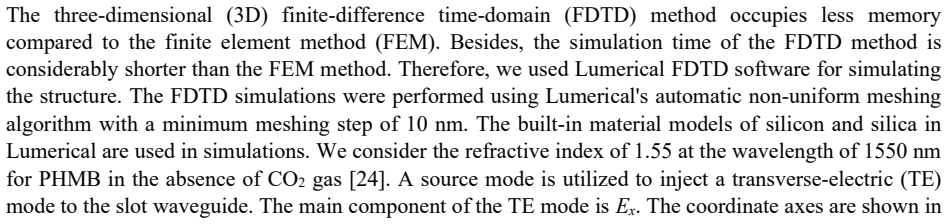
0
0
physics.optics 2026-05-08

Micropipette launcher reaches 93% efficiency loading particles into vacuum traps

Localized efficient in-vacuum loading of sim0.1-10 μm spherical and plate-like particles into optical traps using a pulled glass capillary

The compact piezoelectric device delivers spheres, prisms, and nanodiamonds directly into optical traps while preserving vacuum conditions.

Figure from the paper full image
abstract click to expand
We demonstrate a compact piezoelectric-driven micropipette launcher for localized in-vacuum delivery of nano- and microparticles into optical traps. The launcher has been integrated into multiple optical trapping setups, including a single-beam trap, a non-interfering dual beam trap, and a standing-wave dual beam trap, showcasing the versatility and ease of integration of the setup. Using the micropipette launcher, we have successfully trapped silica spheres of $170\text{ nm}$, $300\text{ nm}$, 3 $\mu\text{m}$ diameter, as well as 6 $\mu\text{m}\times$ 0.2 $\mu\text{m}$ $\beta$-NaYF hexagonal prisms and $\sim 100$ nm diameter high-purity nanodiamonds. We characterize the performance of the device including the peak acceleration, angular distribution of emitted particles, and the dependence on vertical displacement between the pipette tip and optical trap. Trapping efficiency as high as 93\% is achieved.
0
0
physics.optics 2026-05-08

Periodic hole shifts create radiative flat bands in photonic slab

Geometric Engineering of Flat Bands in a Single-layer Photonic Graphene

A density-wave displacement couples below-light-cone states into the continuum and switches topological phases by tuning Fourier components.

Figure from the paper full image
abstract click to expand
Photonic flat bands offer significant potential for strong light-matter interactions, nonlinear optics, and sensing thanks to their localization of light and high density of states. However, realizing these flat bands typically requires intricate fabrication, perfect alignment and/or specialized geometries, and a general design strategy is missing. In this work, we demonstrate a simple yet versatile strategy to engineer radiative flat bands above the light line, using only a single-layer honeycomb photonic crystal slab. By applying a density wave like geometric perturbation-a spatially periodic displacement of the lattice air holes-we couple intrinsic flat band states from below the light cone into the radiative continuum. This structural modulation creates a highly anisotropic band structure that exhibits linear, Dirac-like dispersion in one direction and nearly flat dispersion in the orthogonal direction, forming an extended van Hove singularity at band extrema. Furthermore, by tuning the Fourier components of the modulation, we can manipulate the Dirac mass term to realize band inversion and switch between two topologically distinct phases. As an application, we demonstrate a Jackiw-Rebbi interface state positioned at the junction of two domains with opposite Dirac mass, that also shows flat band dispersion along the interface. This density-wave perturbation approach provides a conceptually clear and fabrication friendly platform for programming complex photonic band dispersions, opening new avenues for both topological photonics and practical flat-band optoelectronic devices.
0
0
physics.optics 2026-05-08 Recognition

One pump frequency creates self-organized time quasicrystal

Self-organized photonic time quasicrystal from a single imposed clock

Nonlinear back-action selects two frequencies whose sum locks to the pump, yielding quasiperiodic order across lattice sites.

Figure from the paper full image
abstract click to expand
A photonic time crystal usually writes a clock into a medium. Here one clock does more than program the medium: it seeds a quasiperiodic temporal order that the nonlinear medium selects for itself. In a guided-wave lattice of nonlinear dipoles, a single-tone pump modulates the polarization sector, while Maxwell--polarization back-action selects two response frequencies whose only resolved low-order relation is the pump-locked sum condition. Their sum phase locks to the pump and the complementary phase winds, producing a photonic discrete time quasicrystal with torus-like phase dynamics and a discrete combination spectrum. Site-resolved measurements show locked-phase coherence across the measured lattice sites over a finite control-parameter window. These results establish a route from externally programmed time-varying media to self-organized temporal order in nonlinear photonic systems.
0
0
physics.optics 2026-05-08

One pump frequency seeds photonic time quasicrystal

Self-organized photonic time quasicrystal from a single imposed clock

Nonlinear back-action in a dipole lattice selects two frequencies whose sum locks to the pump, creating quasiperiodic order across sites.

Figure from the paper full image
abstract click to expand
A photonic time crystal usually writes a clock into a medium. Here one clock does more than program the medium: it seeds a quasiperiodic temporal order that the nonlinear medium selects for itself. In a guided-wave lattice of nonlinear dipoles, a single-tone pump modulates the polarization sector, while Maxwell--polarization back-action selects two response frequencies whose only resolved low-order relation is the pump-locked sum condition. Their sum phase locks to the pump and the complementary phase winds, producing a photonic discrete time quasicrystal with torus-like phase dynamics and a discrete combination spectrum. Site-resolved measurements show locked-phase coherence across the measured lattice sites over a finite control-parameter window. These results establish a route from externally programmed time-varying media to self-organized temporal order in nonlinear photonic systems.
0
0
physics.optics 2026-05-08

Hollow-core fiber hits 7.3e-21 instability over 152 km single-span

Hollow-Core Fiber for Long-Span Optical Frequency Transfer: Improved Instability and Extended Single-Span Reach

Lower thermal sensitivity and high power tolerance enable coherent transfer without amplifiers or repeaters.

Figure from the paper full image
abstract click to expand
Phase-coherent optical frequency transfer is essential for optical clock networking, relativistic geodesy, and distributed precision metrology. However, realizing coherent optical networks spanning thousands of kilometers in standard single-mode fiber (SMF) generally requires densely distributed amplifiers or repeater stations together with complex operational control, while long-term instability remains limited by thermally driven residual phase fluctuations. Here we show that hollow-core fiber (HCF) can simultaneously improve transfer instability and relax the reach limitation of long-span optical frequency transfer. Compared with SMF, HCF exhibits lower fiber-induced phase noise and shorter propagation delay, supporting improved short-term instability, while its much lower thermal sensitivity supports nearly one-order-of-magnitude better long-term instability. In addition, for long-haul HCF links, no observable stimulated Brillouin scattering induced saturation is found up to the maximum available injected power of 34 dBm, whereas the threshold of an equal-length SMF link remains only a few dBm. Together with the lower attenuation achievable in modern HCF, this enables ultra-long single-span optical frequency transfer. Using a 152 km HCF link with an average attenuation of 0.18 dB/km, we demonstrate single-span optical frequency transfer, achieving a fractional frequency instability of 7.3 x 10^-21 at 10,000 s and a fractional uncertainty of 1.8 x 10^-20. These results establish HCF as a transmission medium that simultaneously improves instability and extends single-span reach, opening a practical route toward future intercontinental optical frequency networks with ultrahigh precision.
0
0
physics.optics 2026-05-07

Corrugated PhC resonator yields 224 THz/s LiDAR chirps at low voltage

Photonic-crystal microresonator-based LiDAR engine

Designed feedback enables linear sweeps over 3 GHz and millimeter precision ranging using CMOS-compatible tuning.

Figure from the paper full image
abstract click to expand
Self-injection-locked (SIL) narrow-linewidth lasers based on high-Q microresonators are promising sources for frequency-modulated continuous-wave (FMCW) LiDAR, but the SIL mechanism as well as its key characteristics such as the frequency sweep range and the noise performance are often determined by uncontrolled backscattering in the resonator. Here, we investigate a tunable SIL laser based on a corrugated photonic-crystal (PhC) microresonator in which the feedback strength is set by design. Numerical and experimental results show that stronger SIL feedback expands the sweep range accessible through resonator modulation while also impacting the phase-noise and linewidth during sweeping, revealing a trade-off between frequency tunability and noise performance. Using CMOS-compatible microheater tuning (sub-1 V driving voltage), we demonstrate linearized up- and down-chirps with 224 THz/s over approximately 3 GHz and, in a proof-of-concept ranging experiment, measure a 10 m fiber length with a standard deviation below 3 mm. These results establish PhC microresonators with engineered SIL feedback as robust, compact, CMOS-compatible LiDAR engines.
0
0
physics.optics 2026-05-07

Chiral nanoantenna gap yields circularly polarized emission

Planar chiral nanoantenna for excitation-chirality-controlled hot spot modulation and emitter-coupled circularly polarized emission

Excitation handedness controls a nanogap hot spot that forces quantum emitter output into nearly perfect circular polarization.

abstract click to expand
A planar chiral plasmonic nanoantenna exhibiting an excitation-chirality-dependent hot spot in a nanogap is numerically investigated. Additionally, the underlying design principles are examined, providing a broadly applicable framework for engineering chiral nanoantennas through controlled geometrical or modal asymmetry. The hot spot can be turned on and off by changing the handedness of the exciting circularly polarized light (CPL). This effect stems from the rationally designed interference of plasmonic modes excited by the linearly polarized orthogonal components of CPL. The hot spot exhibits maximal near-field dissymmetry factor (about -2) at a wavelength of 842 nm. The intensity at the hot spot can also be continuously modulated by varying the excitation ellipticity and handedness, approaching a modulation depth of 100%. These attributes enable chirality- and ellipticity-dependent switching and dynamic modulation of the plasmonic near field. Moreover, placing a quantum emitter in the gap generates almost perfectly circularly polarized emission, offering a simple yet effective avenue to realize nanoscale circularly polarized single-photon sources.
0
0
physics.optics 2026-05-07

Spiral metasurface switches edge enhancement with polarization

Spiral metasurface enables tunable directional edge enhancement

Single compact device toggles vertical or horizontal modes without a 4f system for driving and imaging tasks

abstract click to expand
Tunable directional edge enhancement facilitates the acquisition of distinct morphological features from objects, a capability that plays a vital role in enhancing the reliability and safety of autonomous driving systems. However, building a simple, miniature, and switchable directional edge enhancement system remains an urgent challenge. To address this, we propose a compact spiral metasurface capable of achieving tunable vertical and horizontal edge enhancement imaging without requiring a conventional 4f system, relying instead on a single integrated device. This functionality is realized by engineering the metasurface's spiral phase profile and its polarization-dependent response, where the edge enhancement direction is controlled by varying the incident beam's polarization, enabling switching between vertical and horizontal enhancement modes. Simulations demonstrate the metasurface's capability for switchable edge detection of lane markings and barrier contours. Broadband operation is also confirmed through simulation results. Owing to its compactness, switchable functionality, and broadband performance, the proposed spiral metasurface shows significant potential for applications in optical analog computing and autonomous driving.
0
0
physics.optics 2026-05-07

Vortex beams detect handedness in 15-micron polymer structures

Characterization of Photopolymerized Microscopic Chiral Structures Using Photonic Orbital Angular Momentum

Helical dichroism signals reach 30 percent for enantiomers and drop to zero for achiral controls using standard lab equipment.

Figure from the paper full image
abstract click to expand
The controlled fabrication and chiroptical characterization of microscale chiral structures remain central challenges in photonics, sensing, and metamaterial engineering. Here we demonstrate an accessible, low-cost platform that combines digital micromirror device-enabled maskless photolithography with capillarity-induced self-assembly to produce polymer chiral microstructures of deterministic handedness, and a liquid-crystal spatial light modulator to generate vortex beams for their characterization via helical dichroism (HD). Using a standard 532 nm laser, we observe HD signals of approximately 30% for microstructures with a characteristic diameter of about 15 micrometers. Rigorous finite-difference time-domain simulations performed on three-dimensional geometries reconstructed from high-resolution Scanning Electron Microscopy data reproduce the experimental HD spectra and confirm the role of structural handedness in driving the differential orbital angular momentum (OAM) response. Near-mirror-symmetric HD spectra for opposite-handed enantiomers, combined with a vanishing response for achiral controls, establish OAM as a robust and spatially selective chiral probe at the microscale. Crucially, both fabrication and characterization rely on equipment standard in an optics laboratory, without recourse to femtosecond sources, plasmonic substrates, or costly photoresists. These results open practical pathways toward OAM-driven chiral sensing, enantioselective detection, and photonic logic devices.
0
0
physics.optics 2026-05-07

Grating tunes red upconversion decay by 15% selectively

Band-Selective LDOS Engineering of Yb/Er Upconversion: an Electromagnetic-Kinetic Diagnostic Framework

Spacer thickness varies plasmonic LDOS at 670 nm to control red emission rate while green and pump remain unaffected.

Figure from the paper full image
abstract click to expand
A central challenge in plasmonic upconversion is coupling between near-field engineering at the pump wavelength and local-density-of-optical-states (LDOS) engineering at the emission wavelengths. Here we show that a corrugated SU8/Au/Al2O3 grating coated with a dense NaYF4:Yb(20%),Er(5%) upconversion nanoparticle (UCNP) monolayer realises a band-selective platform: a broad plasmonic resonance near 670 nm aligned with the red 4F9/2 -> 4I15/2 Er3+ transition modulates the red decay rate by +/-15% as a function of the Al2O3 spacer thickness d, while the green 2H11/2 / 4S3/2 -> 4I15/2 transition is experimentally invariant (|k/k_ref - 1| < 1% across all d). The pump field at 980 nm is monotonically suppressed below the free-space reference (<f_exc> from 0.27 to 0.48 between d = 5 and 25 nm), so observables cleanly probe the emission-side LDOS without pump-side interference. We rationalise these results with a coupled electromagnetic-kinetic framework combining full-wave FDTD pump enhancement and orientation-averaged Purcell factors with a six-level Yb/Er rate-equation model separating radiative, intrinsic nonradiative and environment-induced nonradiative channels. The framework reproduces the 670 nm extinction resonance, the +/-10-15% red-band decay-rate modulation, and the monotonic decrease of the green/red ratio with d, but predicts a monotonic red-band trend that misses the experimental dip at d = 15 nm and over-predicts a green-band reduction (k/k_ref^550 approx. 0.73 vs. 1.00). Ridge-tip smoothing (h_round in {0, 5, 10} nm) shifts Purcell factors by only 1-3%, ruling out apex shape as the dominant cause. The framework thus serves as a diagnostic tool, isolating the green-band discrepancy as needing corrections beyond the half-ellipse model - likely grain-boundary damping in the evaporated gold or extra non-radiative channels at 550 nm not in the six-level kinetic model.
0
0
physics.optics 2026-05-07

SiC micropipe sidewalls act as giant traps enabling leakage

Unraveling the Defect Physics of SiC Micropipe Sidewalls by Non-Line-of-Sight Confocal Spectromicroscopy: Amphoteric Giant Traps

New multiple-reflection spectroscopy shows sidewall defects capture carriers in nanoseconds and sustain trap-assisted currents that cause Si

abstract click to expand
Micropipes are among the most detrimental defects in SiC wafer and are closely linked to catastrophic device failure. However, the microscopic defect nature of their internal sidewalls and the mechanism of the associated leakage current remain poorly understood, because their high-aspect-ratio geometry severely restricts direct optical probing. Here, we develop a non-line-of-sight confocal multiple-reflection spectromicroscopy technique combined with direct defect photoionization to unravel the defect physics of micropipe sidewalls. We show that these sidewalls host a high density of donor-like and acceptor-like deep-level states, giving rise to ultrabroad emission bands composed of intrinsic DAP-like recombination and detrapping-mediated free-to-bound transitions. Unlike conventional defect luminescence, the DAP-like emission remains dominant even at room temperature across all excitation powers. This behavior is attributed to rapid carrier capture by the sidewall defects, as evidenced by fast-rising and nanosecond-scale decay dynamics, along with coupled carrier kinetics. These results suggest that micropipe sidewalls can serve as extended amphoteric giant traps and carrier reservoirs, facilitating leakage current through trap-assisted transport. Our work provides a nondestructive optical approach for directly probing high-aspect-ratio extended defects and offers deep mechanistic insight into their defect physics and leakage mechanisms.
0
0
physics.optics 2026-05-07

Grain boundaries create plasmons in unpatterned silicon films

Emergence of Localized Surface Plasmons in Unpatterned Hyperdoped Polycrystalline Silicon

Hyperdoped polysilicon with 5-50 nm grains supports tunable mid-IR resonances without patterning.

Figure from the paper full image
abstract click to expand
The ability to engineer localized surface plasmon resonances at large scale usually relies on precise nanoscale patterning. Here, we demonstrate that mid-infrared plasmonic responses can instead emerge in unpatterned polysilicon films composed of nanometric (5-50 nm) grains, challenging established design paradigms and eliminating the need for external nanostructuring. Using tailored out-of-equilibrium annealing conditions, we show that hyperdoped polysilicon layers exhibit enhanced light-matter interactions that can be tuned across the mid-infrared range. By combining advanced electron microscopy, infrared spectroscopy and finite-difference time-domain electrodynamic simulations, we demonstrate that these remarkable optical properties originate from naturally formed metal-dielectric interfaces at grain boundaries, which support localized surface plasmon resonances. Importantly, this result is universal and can be extended to any doped semiconductor system, regardless of the synthesis technique, provided that the grain size remains in the nanometric range. This work opens up a new field in plasmonics centered on polycrystalline semiconductors, paving the way for cost-effective systems that are fully compatible with microelectronic and photovoltaic technologies, and capable of significantly reshaping light-matter interactions in the infrared range.
0
0
physics.optics 2026-05-07

Dual-input nanocryotrons create reconfigurable logic gates

Reconfigurable and cascaded logic gates using dual-input multilayered heater nanocryotrons

One device switches between logic functions and drives the next, cutting components needed for cryogenic circuits.

Figure from the paper full image
abstract click to expand
Superconducting electronics have emerged as a promising platform for advanced information processing, offering unique opportunities for on chip computation and signal manipulation at cryogenic temperatures. These devices hold particular potential in applications ranging from quantum computing to high sensitivity magnetic sensing, where integrated logic and scalable circuit architectures are essential for performing complex computational and signal-processing tasks. In this work, we present a dual-input multilayered heater nanocryotron (hTron) that introduces both multi input functionality and reconfigurable logic capability within a single device. This capability represents a step forward toward realizing more complex computational architectures. In addition, we demonstrate that these devices can, in principle, drive one another and potentially be integrated on a larger scale. Furthermore, the inherent reconfigurability of the demonstrated device allows for dynamic switching between logic operations without requiring additional components which reduces circuit area and simplifies cryogenic and biasing requirements, making the design highly suitable for scalable superconducting computing systems.
0
0
physics.optics 2026-05-07

Hemispheres arrayed in grid produce nonreciprocal light flow

The Nonreciprocal Mie-surfaces

Anapole mode in Mie scattering creates direction-dependent transmission that depends only on particle diameter

Figure from the paper full image
abstract click to expand
Hemispherical amorphous silicon nanoparticles exhibit asymmetric optical scattering for forward illumination (base-to-apex) and backward illumination (apex-to-base). There exists an anapole mode only for backward propagation, not for forward. Due to the anapole, light is allowed to scatter maximally along the forward direction, and not in the backward direction. A structured surface obtained by repeating hemispheres in a square grid in air exhibits nonreciprocal reflection and transmission for light propagating through it. This nonreciprocity only depends on the diameter of the hemisphere, not on the periodicity. The same surface on a glass substrate causes a minor spectral redshift in the nonreciprocity. Here, the individual materials are Lorentz reciprocal, but the current nonreciprocity is due to interference. The current nonreciprocity is purely based on anapole of Mie scattering; therefore, the surface is termed as ``Nonreciprocal Mie-surface''. Such surfaces could be used for the applications of passive linear nonreciprocal photonic devices.
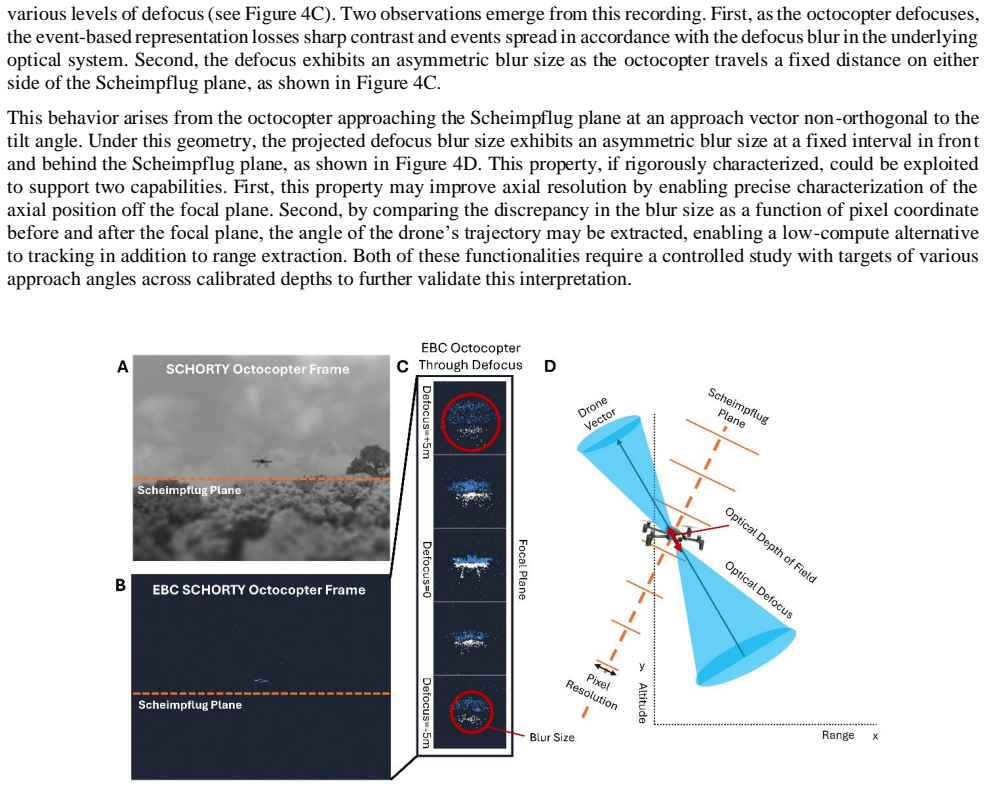
0

browse all of physics.optics → full archive · search · sub-categories