REVIEW 5 major objections 5 minor 2 cited by
The multiple classes of ultra-diffuse galaxies: Can we tell them apart?
T0 review · 5 major / 5 minor · reviewed 2026-08-12 · deepseek-v4-flash
Pith's one-line read This paper claims that nearly-UDGs are the same kind of object as ultra-diffuse galaxies—differing only in size and surface brightness—and that both populations split cleanly into a puffy-dwarf class and a failed-galaxy class.
desk verdict A careful and useful uniform SED analysis of 124 LSB dwarfs, but the two-class clustering result is less secure than the paper claims because a key input was manually zeroed before clustering. read the letter →
The pith
A machine-rendered reading of the paper's core claim, the machinery that carries it, and where it could break.
The reading
What carries the argument
The load-bearing machinery is a uniform spectral energy distribution (SED) fitting procedure applied to every galaxy, followed by an unsupervised centroid-based clustering algorithm (KMeans) run on eleven scaled properties. The SED fitting yields stellar masses, metallicities, ages, star formation timescales, and dust attenuation for all 124 galaxies under identical assumptions, so differences between samples are not artifacts of heterogeneous methods. The clustering uses the residual $\delta_{\rm dwarf\,MZR}$ (offset from the classical dwarf mass–metallicity relation), globular cluster number $N_{\rm GC}$, and axis ratio $b/a$ as the strongest discriminators, and a silhouette score selects the number of classes; the same two classes emerge whether NUDGes are included or not. The globular cluster counts and cluster system masses, measured from space-based imaging, play the decisive role in separating the classes and in the environmental argument.
What would settle it
Obtain spectroscopic redshifts for all 36 NUDGes; if the true distances move a substantial fraction of them across the UDG size or surface-brightness boundary, recompute their stellar masses and rerun the clustering to see whether the same two classes emerge with the same member galaxies.
Extended reading notes
Core claim
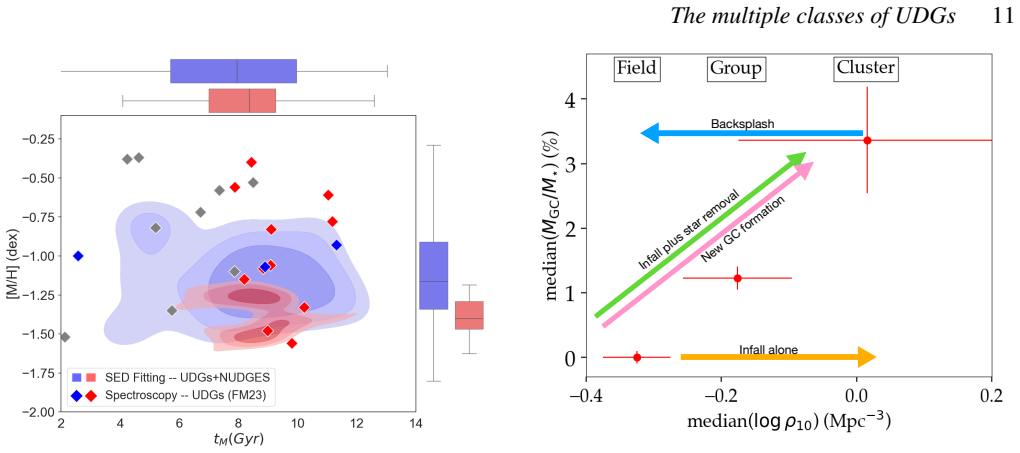
On the paper's own terms, the central discovery is that the UDG designation is less a physical class than a region of parameter space: galaxies just outside that region (NUDGes) share every stellar population property, structural property, and globular cluster trend with the UDGs inside it. When clustered on stellar mass, color, mass-to-light ratio, age, axis ratio, size, globular cluster number, globular cluster mass fraction, central surface brightness, star formation timescale, and offset from the dwarf mass–metallicity relation, both the 88-UDG sample and the 124-galaxy UDG+NUDGe sample split into two classes with high silhouette scores. Class A matches a 'puffy dwarf' formation path — low mass, blue, young, elongated, GC-poor, following the classical dwarf MZR — while Class B matches a 'failed galaxy' path — massive, red, old, round, GC-rich, below the MZR. The globular cluster system mass relative to stellar mass rises from field to group to cluster, and the paper argues that this monotonic difference, combined with the implausibility of forming or destroying globular clusters during infall, implies that the two classes did not simply evolve into one another but formed through distinct processes.
Load-bearing premise
The analysis assumes that galaxies without spectroscopic redshifts sit at the distance of their nearest massive neighbor, so roughly a quarter of the NUDGe sample could have systematically wrong distances and therefore wrong stellar masses, sizes, and stellar population properties.
Editorial extensions
If this is right
- The standard UDG selection by size and surface brightness mixes two physically distinct populations, so samples built on those cuts alone need to be re-examined.
- Globular cluster number and GC system mass fraction should be adopted as standard diagnostics for selecting extreme low-surface-brightness galaxies.
- NUDGes should be included in UDG studies when the question is about formation physics rather than about the operational cut.
- The two-class split means formation models must explain both a puffy-dwarf channel and a failed-galaxy channel, with the failed-galaxy class concentrated in denser environments.
- If the GC-environment trend is real, field GC-poor galaxies are unlikely to become cluster GC-rich galaxies through infall, so environment alone does not transform one class into the other.
Reading between the lines
- Beyond the paper's claims: if GC content is the sharper separator, a practical test would be to select low-surface-brightness dwarfs by GC richness alone and check whether they reproduce the same two stellar-population groups without any size or surface-brightness cut.
- Beyond the paper's claims: the distance assumption for NUDGes without redshifts is the main lever on the result; a spectroscopic campaign that measures distances for all 36 NUDGes would show whether the two classes survive with accurate sizes and masses.
- Beyond the paper's claims: galaxy formation simulations that produce puffy dwarfs versus failed galaxies could be run through the same clustering pipeline; if simulated populations do not separate along these axes, the mapping from observed classes to formation paths would need revision.
- Beyond the paper's claims: the flat-to-rising color gradients seen here are in tension with simulations predicting declining metallicity gradients for high-spin halos; deeper imaging or spectroscopy could determine whether the gradients trace age rather than metallicity.
Editorial analysis
A structured set of objections, weighed in public.
Referee Report
Summary. The paper assembles a sample of 88 ultra-diffuse galaxies (UDGs) from two earlier studies, refits the cluster-dominated subset with the same PROSPECTOR configuration used for the group/field sample, and adds 36 lower-surface-brightness dwarf galaxies ('NUDGes') from the MATLAS survey, all analysed with GALFITM and PROSPECTOR using DECaLS and WISE photometry. After comparing stellar populations, structures, globular cluster (GC) properties and environments, the authors report that NUDGes resemble UDGs in most respects and differ mainly in being smaller and brighter. They then apply KMeans clustering to the UDG-only and UDG+NUDGe samples and recover two classes, which they associate with 'puffy dwarf' and 'failed galaxy' formation pathways. Finally, they use the ratio of GC system mass to stellar mass as a function of environment to argue that these classes cannot simply evolve into one another and may have formed through distinct processes.
Significance. If the conclusions hold, the paper would strengthen the case that GC system properties, rather than size or surface brightness alone, are the physically meaningful separator among low-surface-brightness dwarf galaxies, and that two distinct formation channels (puffy dwarfs and early-quenched/failed galaxies) are present across the UDG/NUDG boundary. The work's main strengths are the homogeneous SED-fitting methodology applied to all 124 galaxies, the refitting of the B22 sample with the same configuration as B24, the use of WISE upper limits to constrain dust, the inclusion of HST-based GC counts, and the direct comparison of three NUDGes with MUSE spectroscopy. These are genuine assets and make the compilation a useful resource. However, the central two-class claim depends on several analysis choices that are not currently tested, most importantly the pre-processing of the mass-metallicity residual before clustering and the inconsistent UDG classification between the CFHT-based labels and the DECaLS photometry actually used.
major comments (5)
- [4.3] The pre-processing step in Section 4.3 that assigns δdwarf MZR = 0 to every galaxy within the scatter of the Simon (2019) relation is load-bearing for the central two-class result. Because δdwarf MZR is one of the eleven KMeans inputs and is later quoted as the leading discriminant (Table 1 and Section 5), the separation between Class A (δ ≈ 0) and Class B (δ < 0), and the placement of exactly the five NUDGes below the MZR into Class B, is partly imposed by this transformation rather than discovered. The paper does not report a run with the raw residual, with δdwarf MZR omitted, or with uncertainties propagated through repeated draws. Please add those sensitivity tests and show the silhouette scores and class centroids; if the two-class solution survives, the claim is much stronger.
- [3.1 and 4.2] The sample classification is inconsistent with the photometry used in the analysis. Section 3.1 states that UDG/non-UDG labels are kept from the CFHT determination even though all structural parameters are re-measured with shallower DECaLS data, and Section 4.2 admits that many UDGs are smaller than the 1.5 kpc threshold or brighter than the surface-brightness threshold when measured with DECaLS. Since the paper's first conclusion is that NUDGes differ from UDGs 'by definition' in size and surface brightness, the comparison is contaminated by dataset-dependent labels. Please either re-derive UDG/NUDG classifications from the homogeneous DECaLS measurements used throughout, or provide a quantitative cross-tabulation of how many objects move across each boundary and re-run the key comparisons on the consistently defined subsample.
- [3 and 3.3] The assumed distance for NUDGes without spectroscopic redshifts is the distance of the closest massive galaxy. The paper cites Heesters et al. (2023) that 75% of MATLAS dwarfs are at the host redshift, so roughly a quarter of the NUDGe sample may have distances, and therefore stellar masses, effective radii, ages and metallicities, that are systematically wrong. Because the NUDGes are the new sample and are included in the clustering, the conclusion that UDGs and NUDGes fall into the same two classes needs to be tested against this uncertainty. A simple check would be to repeat the clustering and the comparisons in Figures 4 and 5 using only NUDGes with spectroscopic distances, or to perturb distances by plausible factors and report the range of class memberships.
- [Appendix B2] The SED validation for the NUDGes rests on three MUSE galaxies, and the agreement is not uniform: MATLAS-1400 has SED [M/H] = −0.43 ± 0.63 dex versus [M/H] ≈ −1.2 from spectroscopy, a much larger offset than for the other two objects, and the B22 refit also shows a −0.25 dex median metallicity offset against Ferré-Mateu et al. (2023). Since δdwarf MZR is computed from [M/H] and is a leading clustering input, a metallicity bias of this size is large enough to move galaxies across the MZR scatter boundary and change class membership. Please quantify the sensitivity of the clustering to a ±0.25 dex shift in metallicity, and discuss the MATLAS-1400 discrepancy explicitly rather than attributing it to large uncertainties.
- [4.3] The identification of δdwarf MZR, N_GC, and b/a as 'key factors supporting the classification' is circular because these three quantities are among the inputs to KMeans. Finding that an input feature differs between output clusters is expected and does not independently corroborate the puffy dwarf / failed galaxy interpretation. Please rephrase this as a description of which input features drive the separation, and add a validation such as feature permutation or comparison with a classifier trained on a hold-out set; alternatively, show that the same two classes are recovered when the clustering is run on a subset of features or on the independent spectroscopic sample.
minor comments (5)
- [4.2] The text refers to the 'right-hand side of Fig. 3' for the size-luminosity diagram, but in the printed figure the size-luminosity panel is on the left; please correct the cross-reference.
- [Table C1] The table note lists a 'GALFITM DECaLS i-band magnitude' column, but the table contains g, r, g−r, z, g−z, and WISE columns; the note appears to be a leftover from an earlier version and should be corrected.
- [3.3] The phrase 'dynamic nestled sampling' should read 'dynamic nested sampling'.
- [4.4] The field environment conclusion in Section 4.4 rests on four galaxies with median M_GC/M_* = 0.00 ± 0.10%; please add a bootstrap uncertainty or explicitly caution that the field sample is very small.
- [Appendix A] The notation is inconsistent: logρ_N is defined in the appendix text while the main text and figures use logρ_10; please harmonise the symbols.
Circularity Check
No significant circularity: the two-class clustering is an unsupervised description of user-chosen inputs, and the main environmental and GC-mass inferences use variables not fed into the clustering.
full rationale
The paper's central claims are not circular in the sense of a derived result being equivalent to its inputs. The statement that NUDGes are similar to UDGs except for being 'by definition' smaller and having higher surface brightness is explicitly definitional, and the paper does not present that difference as an independent discovery; the substantive claim is the similarity in stellar populations, GC-richness trends, and star formation histories, which comes from new PROSPECTOR SED fits independently checked against spectroscopy in Appendix B2. The two-class KMeans result is an unsupervised clustering of eleven user-chosen properties, including the MZR residual, N_GC, and b/a; the classes are outputs, and describing them by median differences in those inputs is a summary of the clustering, not a prediction of the inputs. The manual assignment of delta_dwarf_MZR = 0 for galaxies within the MZR scatter is a preprocessing choice that could influence the clustering, and the paper does not report a sensitivity run without it; this is a robustness limitation, not a circular derivation, especially because the class ranges in delta_dwarf_MZR overlap (Table 1) and because environment (log_rho10) was excluded from the clustering yet differs between classes, providing an external check. The M_GC/M* versus environment trend in Fig. 7 is also independent of the cluster inputs. Self-citations to B22 and B24 are methodological and confirmatory, but the new NUDGe data and the environment-GC-mass analysis give independent content. The distance assumption for NUDGes is acknowledged as a caveat and is based on the independent Heesters et al. (2023) redshift-matching result. Appendix D even notes that metallicity correlates with the MZR residual 'by definition.' Overall, no load-bearing argument reduces to a self-citation chain or to a fitted parameter renamed as a prediction.
Assumptions & free parameters
free parameters (1)
- GC-rich threshold =
N_GC >= 20
assumptions (6)
- domain assumption The van Dokkum et al. (2015) definition of UDGs is adopted.
- domain assumption PROSPECTOR with a delayed-tau SFH recovers reliable stellar populations for these faint galaxies.
- domain assumption NUDGes without spectroscopic redshifts are at the distance of the closest massive galaxy.
- domain assumption The Simon (2019) and Ma et al. (2016) mass-metallicity relations are appropriate external benchmarks.
- domain assumption The local volume density log_rho10 from 2MRS KNN is a valid environment proxy.
- ad hoc to paper Galaxies within the scatter of the classical MZR are manually assigned delta_MZR = 0 before clustering.
Cite this review
Pith. "Pith review of The multiple classes of ultra-diffuse galaxies: Can we tell them apart?." pith.science (2026). https://pith.science/paper/DNT4CULO
@misc{pith2026241201901,
  author       = {Pith},
  title        = {Pith review of: The multiple classes of ultra-diffuse galaxies: Can we tell them apart?},
  year         = {2026},
  howpublished = {\url{https://pith.science/paper/DNT4CULO}},
  note         = {Machine review of arXiv:2412.01901}
}
read the original abstract
This study compiles stellar populations and internal properties of ultra-diffuse galaxies (UDGs) to highlight correlations with their local environment, globular cluster (GC) richness, and star formation histories. Complementing our sample of 88 UDGs, we include 36 low-surface brightness dwarf galaxies with UDG-like properties, referred to as NUDGes (nearly-UDGs). All galaxies were studied using the same spectral energy distribution fitting methodology to explore what sets UDGs apart from other galaxies. We show that NUDGes are similar to UDGs in all properties except for being, by definition, smaller and having higher surface brightness. We find that UDGs and NUDGes show similar behaviours in their GC populations, with the most metal-poor galaxies hosting consistently more GCs on average. This suggests that GC content may provide an effective way to distinguish extreme galaxies within the low surface brightness regime alongside traditional parameters like size and surface brightness. We confirm previous results using clustering algorithms that UDGs split into two main classes, which might be associated with the formation pathways of a puffy dwarf and a failed galaxy. The clustering applied to the UDGs+NUDGes dataset yields an equivalent result. The difference in mass contained in the GC system suggests that galaxies in different environments have not simply evolved from one another but may have formed through distinct processes.
Figures


Figures from the paper (3 more)


Forward citations
Cited by 2 Pith papers
-
Exploring Non-minimal coupling using ultra-diffuse galaxies
A Bayesian Jeans analysis of three ultra-diffuse galaxies finds no preference for a non-minimal dark-matter-gravity coupling and yields weak upper limits on its length scale.
-
Signs of `Everything Everywhere All At Once' formation in low surface brightness globular cluster-rich dwarf galaxies
Five globular cluster-rich low surface brightness dwarf galaxies show flat age and flat-to-rising metallicity gradients, suggesting co-eval 'everything everywhere all at once' formation.
Reference graph
Works this paper leans on
-
[1]
write newline
" write newline "" before.all 'output.state := FUNCTION fin.entry write newline FUNCTION new.block output.state before.all = 'skip after.block 'output.state := if FUNCTION new.sentence output.state after.block = 'skip output.state before.all = 'skip after.sentence 'output.state := if if FUNCTION not #0 #1 if FUNCTION and 'skip pop #0 if FUNCTION or pop #1...
-
[2]
write newline
" write newline "" before.all 'output.state := FUNCTION fin.entry write newline FUNCTION new.block output.state before.all = 'skip after.block 'output.state := if FUNCTION new.sentence output.state after.block = 'skip output.state before.all = 'skip after.sentence 'output.state := if if FUNCTION not #0 #1 if FUNCTION and 'skip pop #0 if FUNCTION or pop #1...
-
[3]
N., 2013, Journal of Improbable Astronomy, 1, 1
Author A. N., 2013, Journal of Improbable Astronomy, 1, 1
2013
-
[4]
D., 2015, Journal of Interesting Stuff, 17, 198
Jones C. D., 2015, Journal of Interesting Stuff, 17, 198
2015
-
[5]
B., 2014, The Example Journal, 12, 345 (Paper I)
Smith A. B., 2014, The Example Journal, 12, 345 (Paper I)
2014
-
[6]
Amorisco N. C., Loeb A., 2016, @doi [ ] 10.1093/mnrasl/slw055 , https://ui.adsabs.harvard.edu/abs/2016MNRAS.459L..51A 459, L51
-
[7]
Astropy Collaboration et al., 2013, @doi [ ] 10.1051/0004-6361/201322068 , https://ui.adsabs.harvard.edu/abs/2013A&A...558A..33A 558, A33
-
[8]
Astropy Collaboration et al., 2018, @doi [ ] 10.3847/1538-3881/aabc4f , https://ui.adsabs.harvard.edu/abs/2018AJ....156..123A 156, 123
Show all 109 references
-
[9]
E., et al., 2020, @doi [ ] 10.3847/1538-4365/ab7660 , https://ui.adsabs.harvard.edu/abs/2020ApJS..247...46B 247, 46
Barbosa C. E., et al., 2020, @doi [ ] 10.3847/1538-4365/ab7660 , https://ui.adsabs.harvard.edu/abs/2020ApJS..247...46B 247, 46
2020 doi
-
[10]
A., et al., 2021, @doi [Nature Astronomy] 10.1038/s41550-021-01458-1 , https://ui.adsabs.harvard.edu/abs/2021NatAs...5.1255B 5, 1255
Benavides J. A., et al., 2021, @doi [Nature Astronomy] 10.1038/s41550-021-01458-1 , https://ui.adsabs.harvard.edu/abs/2021NatAs...5.1255B 5, 1255
2021 doi
- [11]
-
[12]
A., 2020, @doi [ ] 10.3847/1538-3881/ab5b0e , https://ui.adsabs.harvard.edu/abs/2020AJ....159...56B 159, 56
Burkert A., Forbes D. A., 2020, @doi [ ] 10.3847/1538-3881/ab5b0e , https://ui.adsabs.harvard.edu/abs/2020AJ....159...56B 159, 56
2020 doi
-
[13]
L., et al., 2022, @doi [ ] 10.1093/mnras/stac2442 , https://ui.adsabs.harvard.edu/abs/2022MNRAS.517.2231B 517, 2231
Buzzo M. L., et al., 2022, @doi [ ] 10.1093/mnras/stac2442 , https://ui.adsabs.harvard.edu/abs/2022MNRAS.517.2231B 517, 2231
2022 doi
- [14]
-
[15]
C., Kinney A
Calzetti D., Armus L., Bohlin R. C., Kinney A. L., Koornneef J., Storchi-Bergmann T., 2000, @doi [ ] 10.1086/308692 , https://ui.adsabs.harvard.edu/abs/2000ApJ...533..682C 533, 682
2000 doi
-
[16]
V., Taibi S., 2023, @doi [ ] 10.1093/mnras/stac3243 , https://ui.adsabs.harvard.edu/abs/2023MNRAS.519.1545C 519, 1545
Cardona-Barrero S., Di Cintio A., Battaglia G., Macci \`o A. V., Taibi S., 2023, @doi [ ] 10.1093/mnras/stac3243 , https://ui.adsabs.harvard.edu/abs/2023MNRAS.519.1545C 519, 1545
2023 doi
-
[17]
Collins M. L. M., Read J. I., 2022, arXiv e-prints, https://ui.adsabs.harvard.edu/abs/2022arXiv220506825C p. arXiv:2205.06825
2022 arXiv
-
[18]
E., 2010, @doi [ ] 10.1088/0004-637X/712/2/833 , https://ui.adsabs.harvard.edu/abs/2010ApJ...712..833C 712, 833
Conroy C., Gunn J. E., 2010, @doi [ ] 10.1088/0004-637X/712/2/833 , https://ui.adsabs.harvard.edu/abs/2010ApJ...712..833C 712, 833
2010 doi
-
[19]
E., White M., 2009, @doi [ ] 10.1088/0004-637X/699/1/486 , https://ui.adsabs.harvard.edu/abs/2009ApJ...699..486C 699, 486
Conroy C., Gunn J. E., White M., 2009, @doi [ ] 10.1088/0004-637X/699/1/486 , https://ui.adsabs.harvard.edu/abs/2009ApJ...699..486C 699, 486
2009 doi
-
[20]
E., 2010, @doi [ ] 10.1088/0004-637X/708/1/58 , https://ui.adsabs.harvard.edu/abs/2010ApJ...708...58C 708, 58
Conroy C., White M., Gunn J. E., 2010, @doi [ ] 10.1088/0004-637X/708/1/58 , https://ui.adsabs.harvard.edu/abs/2010ApJ...708...58C 708, 58
2010 doi
-
[21]
J., 2019, @doi [ ] 10.3847/2041-8213/ab0e8c , https://ui.adsabs.harvard.edu/abs/2019ApJ...874L..12D 874, L12
Danieli S., van Dokkum P., Conroy C., Abraham R., Romanowsky A. J., 2019, @doi [ ] 10.3847/2041-8213/ab0e8c , https://ui.adsabs.harvard.edu/abs/2019ApJ...874L..12D 874, L12
2019 doi
-
[22]
Danieli S., et al., 2022, @doi [ ] 10.3847/2041-8213/ac590a , https://ui.adsabs.harvard.edu/abs/2022ApJ...927L..28D 927, L28
2022 doi
-
[23]
Dey A., et al., 2019, @doi [ ] 10.3847/1538-3881/ab089d , https://ui.adsabs.harvard.edu/abs/2019AJ....157..168D 157, 168
2019 doi
-
[24]
B., Dutton A
Di Cintio A., Brook C. B., Dutton A. A., Macci \`o A. V., Obreja A., Dekel A., 2017, @doi [ ] 10.1093/mnrasl/slw210 , https://ui.adsabs.harvard.edu/abs/2017MNRAS.466L...1D 466, L1
2017 doi
-
[25]
M., Cuillandre J.-C., Serra P., Bournaud F., Cappellari M., Emsellem E., 2014, @doi [ ] 10.1093/mnras/stu330 , https://ui.adsabs.harvard.edu/abs/2014MNRAS.440.1458D 440, 1458
Duc P.-A., Paudel S., McDermid R. M., Cuillandre J.-C., Serra P., Bournaud F., Cappellari M., Emsellem E., 2014, @doi [ ] 10.1093/mnras/stu330 , https://ui.adsabs.harvard.edu/abs/2014MNRAS.440.1458D 440, 1458
2014 doi
-
[26]
S., Forbes D
Ferr \'e -Mateu A., Gannon J. S., Forbes D. A., Buzzo M. L., Romanowsky A. J., Brodie J. P., 2023, @doi [ ] 10.1093/mnras/stad3102 , https://ui.adsabs.harvard.edu/abs/2023MNRAS.526.4735F 526, 4735
2023 doi
-
[27]
G., Sand D
Fielder C., Jones M. G., Sand D. J., Bennet P., Crnojevi \'c D., Karunakaran A., Mutlu-Pakdil B., Spekkens K., 2024, @doi [ ] 10.3847/1538-3881/ad74f6 , https://ui.adsabs.harvard.edu/abs/2024AJ....168..212F 168, 212
2024 doi
-
[28]
A., Gannon J., 2024, @doi [ ] 10.1093/mnras/stad4004 , https://ui.adsabs.harvard.edu/abs/2024MNRAS.528..608F 528, 608
Forbes D. A., Gannon J., 2024, @doi [ ] 10.1093/mnras/stad4004 , https://ui.adsabs.harvard.edu/abs/2024MNRAS.528..608F 528, 608
2024 doi
-
[29]
A., Alabi A., Romanowsky A
Forbes D. A., Alabi A., Romanowsky A. J., Brodie J. P., Arimoto N., 2020, @doi [ ] 10.1093/mnras/staa180 , https://ui.adsabs.harvard.edu/abs/2020MNRAS.492.4874F 492, 4874
2020 doi
-
[30]
S., et al., 2021, @doi [ ] 10.1093/mnras/stab277 , https://ui.adsabs.harvard.edu/abs/2021MNRAS.502.3144G 502, 3144
Gannon J. S., et al., 2021, @doi [ ] 10.1093/mnras/stab277 , https://ui.adsabs.harvard.edu/abs/2021MNRAS.502.3144G 502, 3144
2021 doi
-
[31]
S., et al., 2022, @doi [ ] 10.1093/mnras/stab3297 , https://ui.adsabs.harvard.edu/abs/2022MNRAS.510..946G 510, 946
Gannon J. S., et al., 2022, @doi [ ] 10.1093/mnras/stab3297 , https://ui.adsabs.harvard.edu/abs/2022MNRAS.510..946G 510, 946
2022 doi
-
[32]
S., et al., 2024, @doi [ ] 10.1093/mnras/stae1274 , https://ui.adsabs.harvard.edu/abs/2024MNRAS.531.1789G 531, 1789
Gannon J. S., et al., 2024, @doi [ ] 10.1093/mnras/stae1274 , https://ui.adsabs.harvard.edu/abs/2024MNRAS.531.1789G 531, 1789
2024 doi
-
[33]
P., et al., 2018, @doi [ ] 10.3847/1538-4357/aab842 , https://ui.adsabs.harvard.edu/abs/2018ApJ...857..104G 857, 104
Greco J. P., et al., 2018, @doi [ ] 10.3847/1538-4357/aab842 , https://ui.adsabs.harvard.edu/abs/2018ApJ...857..104G 857, 104
2018 doi
-
[34]
E., Harris G
Harris W. E., Harris G. L. H., Alessi M., 2013, @doi [ ] 10.1088/0004-637X/772/2/82 , https://ui.adsabs.harvard.edu/abs/2013ApJ...772...82H 772, 82
2013 doi
-
[35]
Haslbauer M., Dabringhausen J., Kroupa P., Javanmardi B., Banik I., 2019, @doi [ ] 10.1051/0004-6361/201833771 , https://ui.adsabs.harvard.edu/abs/2019A&A...626A..47H 626, A47
2019 doi
-
[36]
H \"a u ler B., et al., 2013, @doi [ ] 10.1093/mnras/sts633 , https://ui.adsabs.harvard.edu/abs/2013MNRAS.430..330H 430, 330
2013 doi
- [37]
-
[38]
Higson E., Handley W., Hobson M., Lasenby A., 2019, @doi [Statistics and Computing] 10.1007/s11222-018-9844-0 , https://ui.adsabs.harvard.edu/abs/2019S&C....29..891H 29, 891
2019 doi
-
[39]
P., et al., 2012, @doi [ ] 10.1088/0067-0049/199/2/26 , https://ui.adsabs.harvard.edu/abs/2012ApJS..199...26H 199, 26
Huchra J. P., et al., 2012, @doi [ ] 10.1088/0067-0049/199/2/26 , https://ui.adsabs.harvard.edu/abs/2012ApJS..199...26H 199, 26
2012 doi
-
[40]
Iodice E., et al., 2023, @doi [ ] 10.1051/0004-6361/202347129 , https://ui.adsabs.harvard.edu/abs/2023A&A...679A..69I 679, A69
2023 doi
-
[41]
R., Abraham R., Brodie J., Forbes D
Janssens S. R., Abraham R., Brodie J., Forbes D. A., Romanowsky A. J., 2019, @doi [ ] 10.3847/1538-4357/ab536c , https://ui.adsabs.harvard.edu/abs/2019ApJ...887...92J 887, 92
2019 doi
-
[42]
R., et al., 2024, @doi [ ] 10.1093/mnras/stae2137 , https://ui.adsabs.harvard.edu/abs/2024MNRAS.534..783J 534, 783
Janssens S. R., et al., 2024, @doi [ ] 10.1093/mnras/stae2137 , https://ui.adsabs.harvard.edu/abs/2024MNRAS.534..783J 534, 783
2024 doi
-
[43]
Johnson B., et al., 2021a, dfm/python-fsps: python-fsps v0.4.1rc1 , Zenodo, @doi 10.5281/zenodo.4737461
-
[44]
D., Leja J., Conroy C., Speagle J
Johnson B. D., Leja J., Conroy C., Speagle J. S., 2021b, @doi [ ] 10.3847/1538-4365/abef67 , https://ui.adsabs.harvard.edu/abs/2021ApJS..254...22J 254, 22
-
[45]
G., et al., 2023, @doi [ ] 10.3847/2041-8213/acaaab , https://ui.adsabs.harvard.edu/abs/2023ApJ...942L...5J 942, L5
Jones M. G., et al., 2023, @doi [ ] 10.3847/2041-8213/acaaab , https://ui.adsabs.harvard.edu/abs/2023ApJ...942L...5J 942, L5
2023 doi
-
[46]
E., Huang S., Beaton R., Goulding A
Kado-Fong E., Greene J. E., Huang S., Beaton R., Goulding A. D., Komiyama Y., 2020, @doi [ ] 10.3847/1538-4357/abacc2 , https://ui.adsabs.harvard.edu/abs/2020ApJ...900..163K 900, 163
2020 doi
-
[47]
Kado-Fong E., et al., 2021, @doi [ ] 10.3847/1538-4357/ac15f0 , https://ui.adsabs.harvard.edu/abs/2021ApJ...920...72K 920, 72
2021 doi
-
[48]
J., Pawlowski M
Kanehisa K. J., Pawlowski M. S., Heesters N., M \"u ller O., 2024, @doi [ ] 10.1051/0004-6361/202348242 , https://ui.adsabs.harvard.edu/abs/2024A&A...686A.280K 686, A280
2024 doi
-
[49]
N., Cohen J
Kirby E. N., Cohen J. G., Guhathakurta P., Cheng L., Bullock J. S., Gallazzi A., 2013, @doi [ ] 10.1088/0004-637X/779/2/102 , https://ui.adsabs.harvard.edu/abs/2013ApJ...779..102K 779, 102
2013 doi
-
[50]
G., Kang J., Lee J
Lee M. G., Kang J., Lee J. H., Jang I. S., 2017, @doi [ ] 10.3847/1538-4357/aa78fb , https://ui.adsabs.harvard.edu/abs/2017ApJ...844..157L 844, 157
2017 doi
-
[51]
D., Conroy C., van Dokkum P
Leja J., Johnson B. D., Conroy C., van Dokkum P. G., Byler N., 2017, @doi [ ] 10.3847/1538-4357/aa5ffe , https://ui.adsabs.harvard.edu/abs/2017ApJ...837..170L 837, 170
2017 doi
-
[52]
E., Greco J., Beaton R., Danieli S., Goulding A., Huang S., Kado-Fong E., 2023, @doi [ ] 10.3847/1538-4357/ace4c5 , https://ui.adsabs.harvard.edu/abs/2023ApJ...955....2L 955, 2
Li J., Greene J. E., Greco J., Beaton R., Danieli S., Goulding A., Huang S., Kado-Fong E., 2023, @doi [ ] 10.3847/1538-4357/ace4c5 , https://ui.adsabs.harvard.edu/abs/2023ApJ...955....2L 955, 2
2023 doi
-
[53]
W., C \^o t \'e P., Sales L
Lim S., Peng E. W., C \^o t \'e P., Sales L. V., den Brok M., Blakeslee J. P., Guhathakurta P., 2018, @doi [ ] 10.3847/1538-4357/aacb81 , https://ui.adsabs.harvard.edu/abs/2018ApJ...862...82L 862, 82
2018 doi
-
[54]
Lim S., et al., 2020, @doi [ ] 10.3847/1538-4357/aba433 , https://ui.adsabs.harvard.edu/abs/2020ApJ...899...69L 899, 69
2020 doi
-
[55]
F., Faucher-Gigu \`e re C.-A., Zolman N., Muratov A
Ma X., Hopkins P. F., Faucher-Gigu \`e re C.-A., Zolman N., Muratov A. L., Kere s D., Quataert E., 2016, @doi [ ] 10.1093/mnras/stv2659 , https://ui.adsabs.harvard.edu/abs/2016MNRAS.456.2140M 456, 2140
2016 doi
-
[56]
pp 281--297
MacQueen J., et al., 1967, in Proceedings of the fifth Berkeley symposium on mathematical statistics and probability. pp 281--297
1967
-
[57]
E., Aguerri J
Mancera Pi \ n a P. E., Aguerri J. A. L., Peletier R. F., Venhola A., Trager S., Choque Challapa N., 2019a, @doi [ ] 10.1093/mnras/stz238 , https://ui.adsabs.harvard.edu/abs/2019MNRAS.485.1036M 485, 1036
-
[58]
E., et al., 2019b, @doi [ ] 10.3847/2041-8213/ab40c7 , https://ui.adsabs.harvard.edu/abs/2019ApJ...883L..33M 883, L33
Mancera Pi \ n a P. E., et al., 2019b, @doi [ ] 10.3847/2041-8213/ab40c7 , https://ui.adsabs.harvard.edu/abs/2019ApJ...883L..33M 883, L33
-
[59]
E., Fraternali F., Oosterloo T., Adams E
Mancera Pi \ n a P. E., Fraternali F., Oosterloo T., Adams E. A. K., Oman K. A., Leisman L., 2022, @doi [ ] 10.1093/mnras/stab3491 , https://ui.adsabs.harvard.edu/abs/2022MNRAS.512.3230M 512, 3230
2022 doi
-
[60]
R., et al., 2021, @doi [ ] 10.1051/0004-6361/202141432 , https://ui.adsabs.harvard.edu/abs/2021A&A...654A.105M 654, A105
Marleau F. R., et al., 2021, @doi [ ] 10.1051/0004-6361/202141432 , https://ui.adsabs.harvard.edu/abs/2021A&A...654A.105M 654, A105
2021 doi
-
[61]
R., et al., 2024a, @doi [arXiv e-prints] 10.48550/arXiv.2405.13502 , https://ui.adsabs.harvard.edu/abs/2024arXiv240513502M p
Marleau F. R., et al., 2024a, @doi [arXiv e-prints] 10.48550/arXiv.2405.13502 , https://ui.adsabs.harvard.edu/abs/2024arXiv240513502M p. arXiv:2405.13502
-
[62]
R., et al., 2024b, @doi [ ] 10.1051/0004-6361/202449617 , https://ui.adsabs.harvard.edu/abs/2024A&A...690A.339M 690, A339
Marleau F. R., et al., 2024b, @doi [ ] 10.1051/0004-6361/202449617 , https://ui.adsabs.harvard.edu/abs/2024A&A...690A.339M 690, A339
-
[63]
Mart \' nez-Delgado D., et al., 2016, @doi [ ] 10.3847/0004-6256/151/4/96 , https://ui.adsabs.harvard.edu/abs/2016AJ....151...96M 151, 96
2016 doi
-
[64]
Mieske S., et al., 2008, @doi [ ] 10.1051/0004-6361:200810077 , https://ui.adsabs.harvard.edu/abs/2008A&A...487..921M 487, 921
2008 doi
-
[65]
C., et al., 2015, @doi [ ] 10.1088/2041-8205/809/2/L21 , https://ui.adsabs.harvard.edu/abs/2015ApJ...809L..21M 809, L21
Mihos J. C., et al., 2015, @doi [ ] 10.1088/2041-8205/809/2/L21 , https://ui.adsabs.harvard.edu/abs/2015ApJ...809L..21M 809, L21
2015 doi
-
[66]
Moore B., Katz N., Lake G., Dressler A., Oemler A., 1996, @doi [ ] 10.1038/379613a0 , https://ui.adsabs.harvard.edu/abs/1996Natur.379..613M 379, 613
1996 doi
-
[67]
J., Pardalos P
Mucherino A., Papajorgji P. J., Pardalos P. M., 2009, k-Nearest Neighbor Classification. Springer New York, New York, NY, pp 83--106, @doi 10.1007/978-0-387-88615-2_4 , https://doi.org/10.1007/978-0-387-88615-2_4
2009 doi
-
[68]
M \"u ller O., et al., 2020, @doi [ ] 10.1051/0004-6361/202038351 , https://ui.adsabs.harvard.edu/abs/2020A&A...640A.106M 640, A106
2020 doi
- [69]
-
[70]
Pandya V., et al., 2018, @doi [ ] 10.3847/1538-4357/aab498 , https://ui.adsabs.harvard.edu/abs/2018ApJ...858...29P 858, 29
2018 doi
-
[71]
Papastergis E., Adams E. A. K., Romanowsky A. J., 2017, @doi [ ] 10.1051/0004-6361/201730795 , https://ui.adsabs.harvard.edu/abs/2017A&A...601L..10P 601, L10
2017 doi
-
[72]
J., Koribalski B
Pfeffer J., Bekki K., Couch W. J., Koribalski B. S., Forbes D. A., 2022, @doi [ ] 10.1093/mnras/stac074 , https://ui.adsabs.harvard.edu/abs/2022MNRAS.511.1072P 511, 1072
2022 doi
-
[73]
Pfeffer J., et al., 2024, @doi [ ] 10.1093/mnras/stae850 , https://ui.adsabs.harvard.edu/abs/2024MNRAS.529.4914P 529, 4914
2024 doi
-
[74]
Planck Collaboration et al., 2020, @doi [ ] 10.1051/0004-6361/201833910 , https://ui.adsabs.harvard.edu/abs/2020A&A...641A...6P 641, A6
2020 doi
-
[75]
Poulain M., et al., 2021, @doi [ ] 10.1093/mnras/stab2092 , https://ui.adsabs.harvard.edu/abs/2021MNRAS.506.5494P 506, 5494
2021 doi
-
[76]
J., van der Burg R
Prole D. J., van der Burg R. F. J., Hilker M., Davies J. I., 2019, @doi [ ] 10.1093/mnras/stz1843 , https://ui.adsabs.harvard.edu/abs/2019MNRAS.488.2143P 488, 2143
2019 doi
-
[77]
Reaves G., 1956, @doi [ ] 10.1086/107292 , https://ui.adsabs.harvard.edu/abs/1956AJ.....61...69R 61, 69
1956 doi
-
[78]
J., Cabrera E., Janssens S
Romanowsky A. J., Cabrera E., Janssens S. R., 2024, @doi [Research Notes of the American Astronomical Society] 10.3847/2515-5172/ad7112 , https://ui.adsabs.harvard.edu/abs/2024RNAAS...8..202R 8, 202
2024 doi
-
[79]
Rong Y., et al., 2020, @doi [ ] 10.3847/1538-4357/aba74a , https://ui.adsabs.harvard.edu/abs/2020ApJ...899...78R 899, 78
2020 doi
-
[80]
F., Knapen J
Saifollahi T., Zaritsky D., Trujillo I., Peletier R. F., Knapen J. H., Amorisco N., Beasley M. A., Donnerstein R., 2022, @doi [ ] 10.1093/mnras/stac328 , https://ui.adsabs.harvard.edu/abs/2022MNRAS.511.4633S 511, 4633
2022 doi
-
[81]
arXiv:2405.13500
Saifollahi T., et al., 2024, @doi [arXiv e-prints] 10.48550/arXiv.2405.13500 , https://ui.adsabs.harvard.edu/abs/2024arXiv240513500S p. arXiv:2405.13500
2024 doi
-
[82]
V., Wetzel A., Fattahi A., 2022, @doi [Nature Astronomy] 10.1038/s41550-022-01689-w , https://ui.adsabs.harvard.edu/abs/2022NatAs...6..897S 6, 897
Sales L. V., Wetzel A., Fattahi A., 2022, @doi [Nature Astronomy] 10.1038/s41550-022-01689-w , https://ui.adsabs.harvard.edu/abs/2022NatAs...6..897S 6, 897
2022 doi
-
[83]
F., Finkbeiner D
Schlafly E. F., Finkbeiner D. P., 2011, @doi [ ] 10.1088/0004-637X/737/2/103 , https://ui.adsabs.harvard.edu/abs/2011ApJ...737..103S 737, 103
2011 doi
-
[84]
J., Finkbeiner D
Schlegel D. J., Finkbeiner D. P., Davis M., 1998, @doi [ ] 10.1086/305772 , https://ui.adsabs.harvard.edu/abs/1998ApJ...500..525S 500, 525
1998 doi
-
[85]
Shen Z., et al., 2021, @doi [ ] 10.3847/2041-8213/ac0335 , https://ui.adsabs.harvard.edu/abs/2021ApJ...914L..12S 914, L12
2021 doi
-
[86]
D., 2019, @doi [ ] 10.1146/annurev-astro-091918-104453 , https://ui.adsabs.harvard.edu/abs/2019ARA&A..57..375S 57, 375
Simon J. D., 2019, @doi [ ] 10.1146/annurev-astro-091918-104453 , https://ui.adsabs.harvard.edu/abs/2019ARA&A..57..375S 57, 375
2019 doi
-
[87]
V., eds, American Institute of Physics Conference Series Vol
Skilling J., 2004, in Fischer R., Preuss R., Toussaint U. V., eds, American Institute of Physics Conference Series Vol. 735, Bayesian Inference and Maximum Entropy Methods in Science and Engineering: 24th International Workshop on Bayesian Inference and Maximum Entropy Methods...
2004 doi
-
[88]
S., 2020, @doi [ ] 10.1093/mnras/staa278 , https://ui.adsabs.harvard.edu/abs/2020MNRAS.493.3132S 493, 3132
Speagle J. S., 2020, @doi [ ] 10.1093/mnras/staa278 , https://ui.adsabs.harvard.edu/abs/2020MNRAS.493.3132S 493, 3132
2020 doi
-
[89]
R., Forbes D
Spitler L. R., Forbes D. A., 2009, @doi [ ] 10.1111/j.1745-3933.2008.00567.x , https://ui.adsabs.harvard.edu/abs/2009MNRAS.392L...1S 392, L1
2009
-
[90]
Toloba E., et al., 2018, @doi [ ] 10.3847/2041-8213/aab603 , https://ui.adsabs.harvard.edu/abs/2018ApJ...856L..31T 856, L31
2018 doi
-
[91]
Toloba E., et al., 2023, @doi [ ] 10.3847/1538-4357/acd336 , https://ui.adsabs.harvard.edu/abs/2023ApJ...951...77T 951, 77
2023 doi
-
[92]
D., Munshi F., Wright A
Van Nest J. D., Munshi F., Wright A. C., Tremmel M., Brooks A. M., Nagai D., Quinn T., 2022, @doi [ ] 10.3847/1538-4357/ac43b7 , https://ui.adsabs.harvard.edu/abs/2022ApJ...926...92V 926, 92
2022 doi
-
[93]
Venhola A., et al., 2017, @doi [ ] 10.1051/0004-6361/201730696 , https://ui.adsabs.harvard.edu/abs/2017A&A...608A.142V 608, A142
2017 doi
-
[94]
Venhola A., et al., 2022, @doi [ ] 10.1051/0004-6361/202141756 , https://ui.adsabs.harvard.edu/abs/2022A&A...662A..43V 662, A43
2022 doi
-
[95]
P., H \"a u ler B., Rojas A
Vika M., Bamford S. P., H \"a u ler B., Rojas A. L., Borch A., Nichol R. C., 2013, @doi [ ] 10.1093/mnras/stt1320 , https://ui.adsabs.harvard.edu/abs/2013MNRAS.435..623V 435, 623
2013 doi
-
[96]
Villaume A., et al., 2022, @doi [ ] 10.3847/1538-4357/ac341e , https://ui.adsabs.harvard.edu/abs/2022ApJ...924...32V 924, 32
2022 doi
-
[97]
Wittmann C., et al., 2017, @doi [ ] 10.1093/mnras/stx1229 , https://ui.adsabs.harvard.edu/abs/2017MNRAS.470.1512W 470, 1512
2017 doi
-
[98]
L., et al., 2010, @doi [ ] 10.1088/0004-6256/140/6/1868 , https://ui.adsabs.harvard.edu/abs/2010AJ....140.1868W 140, 1868
Wright E. L., et al., 2010, @doi [ ] 10.1088/0004-6256/140/6/1868 , https://ui.adsabs.harvard.edu/abs/2010AJ....140.1868W 140, 1868
2010 doi
-
[99]
C., Tremmel M., Brooks A
Wright A. C., Tremmel M., Brooks A. M., Munshi F., Nagai D., Sharma R. S., Quinn T. R., 2021, @doi [ ] 10.1093/mnras/stab081 , https://ui.adsabs.harvard.edu/abs/2021MNRAS.502.5370W 502, 5370
2021 doi
-
[100]
Yagi M., Koda J., Komiyama Y., Yamanoi H., 2016, @doi [ ] 10.3847/0067-0049/225/1/11 , https://ui.adsabs.harvard.edu/abs/2016ApJS..225...11Y 225, 11
2016 doi
-
[101]
Zaritsky D., 2017, @doi [ ] 10.1093/mnrasl/slw198 , https://ui.adsabs.harvard.edu/abs/2017MNRAS.464L.110Z 464, L110
2017 doi
-
[102]
Zaritsky D., et al., 2019, @doi [ ] 10.3847/1538-4365/aaefe9 , https://ui.adsabs.harvard.edu/abs/2019ApJS..240....1Z 240, 1
2019 doi
-
[103]
E., Dey A., Kadowaki J., Spekkens K., Zhang H., 2021, @doi [ ] 10.3847/1538-4365/ac2607 , https://ui.adsabs.harvard.edu/abs/2021ApJS..257...60Z 257, 60
Zaritsky D., Donnerstein R., Karunakaran A., Barbosa C. E., Dey A., Kadowaki J., Spekkens K., Zhang H., 2021, @doi [ ] 10.3847/1538-4365/ac2607 , https://ui.adsabs.harvard.edu/abs/2021ApJS..257...60Z 257, 60
2021 doi
-
[104]
J., Spekkens K., Zhang H., 2023, @doi [arXiv e-prints] 10.48550/arXiv.2306.01524 , https://ui.adsabs.harvard.edu/abs/2023arXiv230601524Z p
Zaritsky D., Donnerstein R., Dey A., Karunakaran A., Kadowaki J., Khim D. J., Spekkens K., Zhang H., 2023, @doi [arXiv e-prints] 10.48550/arXiv.2306.01524 , https://ui.adsabs.harvard.edu/abs/2023arXiv230601524Z p. arXiv:2306.01524
-
[105]
S., Cui Q., Yesuf H
Zhao P., Liu F. S., Cui Q., Yesuf H. M., Wu H., 2024, @doi [ ] 10.3847/1538-4357/acfd90 , https://ui.adsabs.harvard.edu/abs/2024ApJ...960....9Z 960, 9
2024 doi
-
[106]
G., Abraham R., Merritt A., Zhang J., Geha M., Conroy C., 2015, @doi [ ] 10.1088/2041-8205/798/2/L45 , https://ui.adsabs.harvard.edu/abs/2015ApJ...798L..45V 798, L45
van Dokkum P. G., Abraham R., Merritt A., Zhang J., Geha M., Conroy C., 2015, @doi [ ] 10.1088/2041-8205/798/2/L45 , https://ui.adsabs.harvard.edu/abs/2015ApJ...798L..45V 798, L45
2015 doi
-
[107]
van Dokkum P., et al., 2017, @doi [ ] 10.3847/2041-8213/aa7ca2 , https://ui.adsabs.harvard.edu/abs/2017ApJ...844L..11V 844, L11
2017 doi
-
[108]
van Dokkum P., et al., 2018, @doi [ ] 10.1038/nature25767 , https://ui.adsabs.harvard.edu/abs/2018Natur.555..629V 555, 629
2018 doi
-
[109]
van Dokkum P., et al., 2019, @doi [ ] 10.3847/1538-4357/ab2914 , https://ui.adsabs.harvard.edu/abs/2019ApJ...880...91V 880, 91
2019 doi
Reviewed August 12, 2026 · model on record in the stance chip above.
Discussion (0). Continue with ORCID to comment.