REVIEW 2 major objections 4 minor 1 cited by
Turbulence-Induced Safety Factor Profile Flattening at Rational Surfaces in Tokamaks with Low Magnetic Shear
T0 review · 2 major / 4 minor · reviewed 2026-08-12 · deepseek-v4-flash
Pith's one-line read Turbulence-generated currents flatten the safety factor profile into steps at rational surfaces, and the resulting zero-shear zones cut turbulent heat transport by up to a factor of four — a candidate internal transport barrier trigger.
desk verdict Convincing flux-tube demonstration of a new q-flattening feedback loop; the tokamak claim awaits the companion ORB5 paper. read the letter →
The pith
A machine-rendered reading of the paper's core claim, the machinery that carries it, and where it could break.
The reading
What carries the argument
The load-bearing object is the zonal (flux-surface- and time-averaged) parallel vector potential $\langle A_\parallel\rangle_{y,t}$, which feeds back on the field-line pitch through the identity $\tilde{q}_{A_\parallel}(x)=\frac{1}{2\pi}\int_0^{2\pi}\frac{\partial\langle A_\parallel\rangle_{y,t}}{\partial x}\frac{J^{xyz}\sqrt{\gamma_1}}{C_{xy}C_y}\,dz$, an additive correction to the imposed safety factor profile in $q_{\rm tot}=q_0+(q_0/r_0)\hat{s}_0 x+\tilde{q}(x)+\tilde{q}_{A_\parallel}(x)+\Delta q$. The zonal current that sustains this potential is driven mainly by the radial divergence of the parallel electron momentum flux, a residual-stress mechanism that requires radial turbulence inhomogeneity, which exists naturally near rational surfaces. The flux-tube twist-and-shift boundary condition and its domain quantization create the pseudo-rational surfaces where eddies re-enter the domain after an integer number of poloidal turns and 'bite their own tail'; the binormal phase factor $\eta$ and the Fourier shear coefficients of the non-uniform shear formalism let the authors move those surfaces radially and impose or scan q-profile shapes. The completed circuit is: radial turbulence inhomogeneity drives a zonal parallel current, which builds zonal $A_\parallel$, which flattens q at rational surfaces, which lengthens eddies, which strengthens parallel self-interaction, and the result is strongly reduced turbulent transport.
What would settle it
Run an independent global gyrokinetic simulation of a reversed-shear tokamak discharge with q_min a few percent away from a low-order rational value, at low collisionality and with a weak electromagnetic response, and check whether stationary zonal A_parallel layers appear, pull the q profile toward the rational value, and reduce the heat flux relative to a matched case with q_min far from any rational surface; the companion global results are not yet published, so such a run can settle whether the effect survives outside the flux-tube geometry. Experimentally, the same prediction could be tested by seeking the stationary zonal current layers and the resulting step structure in the reconstructed safety factor profile near rational surfaces, using fluctuation diagnostics that have already detected turbulence-generated currents from electron-scale turbulence.
Extended reading notes
Core claim
The central discovery is that turbulence-generated currents can produce stationary, flux-surface-averaged (zonal) corrugations of the parallel vector potential $A_\parallel$, and that these corrugations modify the safety factor profile through Ampère's law. At low magnetic shear, the resulting q corrugations locally flatten the profile at rational surfaces, producing a stepped q profile with extended radial regions of zero total magnetic shear; the effect also appears for negative shear, and it is the zonal component of $A_\parallel$, not the non-zonal magnetic-island component, that carries the main feedback. The current is driven predominantly by the radial divergence of the parallel electron momentum flux — the residual-stress channel — which requires the radial turbulence inhomogeneity that exists naturally near rational surfaces. Once the q profile is flattened, turbulent eddies extend much further along the magnetic field and self-interact more strongly, and this enhanced self-interaction, rather than any direct change in linear stability or perpendicular eddy size, is what reduces the heat flux by up to roughly a factor of four. The same flattening is found in standard flux-tube simulations, in pseudo-global simulations with imposed and reversed-shear q profiles, and, according to the companion paper, in global gyrokinetic simulations, leading the authors to conclude that turbulence self-organization around rational surfaces at low shear is a genuine plasma response with a possible role in internal transport barrier triggering.
Load-bearing premise
The load-bearing premise is that the flux-tube domain's periodic twist-and-shift boundary condition, which quantizes the box so that it always contains a set of pseudo-rational surfaces, reproduces the physics of real rational surfaces in a tokamak; the flattening feedback is demonstrated in these periodic boxes, while the confirmation in genuine global geometry rests on a companion paper that is still in preparation and unavailable for inspection.
Editorial extensions
If this is right
- Local safety factor flattening at rational surfaces is self-generated under low magnetic shear: no external current drive is needed, only the turbulence and a weak electromagnetic response.
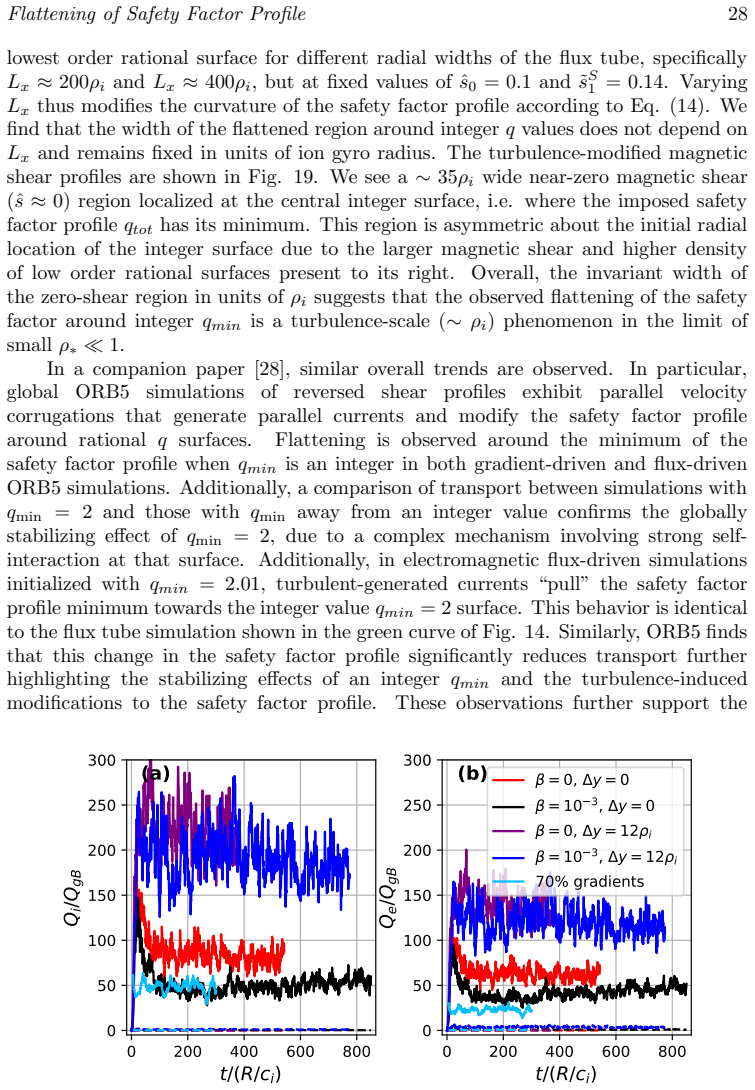
- Turbulent heat flux can drop by up to about a factor of four when the q profile becomes stepped, with the ion channel stabilized more than the electron channel and with density and temperature corrugations that mimic the signatures of an internal transport barrier.
- When the safety factor minimum approaches a low-order rational value, turbulent currents pull the profile toward that value, so the system is attracted to rational q rather than passing through it neutrally; a flux-matching analysis indicates that gradients would need to be reduced to about 70–75 percent of their original values to restore the same heat flux, the expected signature of a transport
- Collisions diffuse the current layers and weaken, but do not eliminate, the flattening, so the effect is strongest in hot, low-collisionality cores and is predicted to be more prominent in future devices.
- The flattening occurs for positive and negative average shear, and its radial width stays fixed in units of the ion gyroradius when the domain size changes, indicating a turbulence-scale phenomenon rather than a boundary-scale artifact.
Reading between the lines
- A consequence the authors leave implicit: if this feedback triggers internal transport barriers, the triggering threshold should scale with collisionality because collisions diffuse the current layers — heating that reduces collisionality would make barrier triggering easier, which would naturally produce the observed power-threshold behavior of ITBs.
- The mechanism requires only low shear and kinetic electrons, so it should operate in any toroidal magnetic configuration with rational surfaces; the authors flag stellarators (where global shear is often low) and edge regions where the bootstrap current creates local low-shear zones as natural places to look for the same flattening.
- The paper's flux-matching exercise suggests a decisive next test: a flux-driven global simulation in which gradients are free to evolve would show whether the q-flattening feedback produces actual stiffness, with gradients piling up at the barrier while flux is held constant — a direct experimental ITB trigger signature that the gradient-driven runs here can only hint at.
- The theory also sharpens the question of what sets ITB location: rather than a fixed q value, the barrier would sit where the turbulence-current feedback can flatten q, coupling barrier position to turbulence intensity and therefore to heating and density profiles.
Editorial analysis
A structured set of objections, weighed in public.
Referee Report
Summary. The paper investigates ion-scale turbulence-generated parallel currents and their feedback on the safety factor profile in low-magnetic-shear regimes near rational surfaces. Using flux-tube GENE simulations with kinetic electrons and weak electromagnetic effects, the authors show that a stationary zonal component of the parallel vector potential A∥ builds up near rational surfaces, producing corrugations of the effective safety factor profile. In the cases studied, this leads to extended regions of zero magnetic shear, increased parallel self-interaction of turbulent eddies, and, in some simulations, a several-fold reduction of turbulent heat flux. The authors support this mechanism with a series of control runs (zonal A∥ removed, imposed stepped q profiles, adiabatic electrons, beta scan) and with analytic derivations of the turbulent current drive (Appendix A) and of the q modification (Appendix B). They also report pseudo-global GENE simulations with non-uniform shear and compare against global ORB5 simulations, which are described only through the abstract-level claims of a companion paper that is still in preparation.
Significance. If the central result holds, the paper identifies a self-organized feedback loop in which turbulence-generated currents flatten the safety factor at rational surfaces, enhance parallel self-interaction, and reduce transport. This would be a qualitatively new mechanism relevant to internal transport barrier formation and would have implications beyond the specific cases simulated, including for stellarators with low global shear. The paper is methodologically strong in several respects: the current-drive equation (A.12) is verified term by term against simulation (Fig. A1), the q-modification formula (B.12) is derived from first principles, and the main claim is tested with multiple independent controls (zonal A∥ removal, imposed stepped q, adiabatic electrons, and a beta scan). These strengths make the core flux-tube result credible. The main caveat is that the transfer of the mechanism to real tokamak geometry rests on the companion ORB5 paper, which is not yet available for inspection.
major comments (2)
- [Sec. 1 and Sec. 4.4] The abstract's claim that this mechanism is relevant to tokamaks and ITB triggering rests on the global ORB5 validation, but the manuscript itself states in Sec. 1 that the companion paper [28] is 'in preparation' and it is not available for inspection. All simulations presented here use the periodic flux-tube twist-and-shift boundary condition (Eqs. 8 and 9), and Sec. 2.2 explicitly notes that rational surfaces in such flux tubes are 'pseudo-rational surfaces' that do not generally correspond to physical rational surfaces. The global transfer is therefore an unverified external premise, not an internal inconsistency. The authors should either include the ORB5 results or a quantitative summary of them in this manuscript, or temper the abstract and conclusions to state the result as demonstrated in flux-tube pseudo-rational geometry and only hypothesize the tokamak relevance.
- [Sec. 4.1, Fig. 4] The Npol=5 run with an imposed stepped q profile is the control that most directly distinguishes the proposed self-interaction mechanism from direct effects of profile curvature, but the text states that this simulation 'was performed for a short time due to its high computational cost' and that 'we believe the trends are clear.' Given that this control underlies the attribution of the four-fold transport reduction to enhanced parallel self-interaction, the limited time window weakens the strongest direct evidence. The authors should either extend this run to reach a converged quasi-steady state or provide a clear convergence criterion for the time-averaged fluxes reported in Fig. 4.
minor comments (4)
- [Appendix C] The captions of Table C4 and Table C5 are identical ('Key parameters for the nonlinear simulations with a non-uniform safety factor profile and a scan in ∆y0'), but the two tables describe different parameter sets and different figures; the Table C5 caption should be corrected.
- [References] In references [21] and [33], the author name appears as 'C J, Ajay' and 'C J A', which appears to be a formatting artifact of an author named Ajay C. J.; this should be corrected for consistency with standard indexing.
- [Sec. 2.2] The text around Eq. (5) uses the spelling 'Clebsh' where it should be 'Clebsch' (also in the first sentence of Appendix B).
- [Sec. 2.5 and text near Eq. (3)] The phrase 'Amp` ere's law' contains a spurious accent and should simply read 'Ampère's law' or 'Ampere's law'.
Circularity Check
No significant circularity: the current-drive equation and q-modification formula are independent derivations; the reliance on companion paper [28] is an external-validity gap, not a circular step.
full rationale
The derivation is self-contained against the simulation data. The turbulent current-drive model (Eq. 15, derived in Appendix A as Eq. A.12) is not fitted: its individual terms are evaluated independently and compared with d<j||>/dt in Fig. A1, identifying term (1), the divergence of the parallel electron momentum flux, as dominant. The q-modification formula (Eq. B.12) follows from expanding the physical safety-factor definition (Eq. B.4) for a small, time-stationary zonal A||; it is an analytic geometric relation, not an equivalence to the input. The transport reduction is probed by controlled experiments — setting the zonal A|| to zero and imposing the separately computed q(x) on an electrostatic simulation (Fig. 4) — rather than by fitting a parameter to the transport target. No prediction is constructed from the quantity it claims to predict; the flux-matching exercise (30% gradient reduction, Sec. 4.4) is a diagnostic comparison, not a fit. Self-citations to Refs. [19,22,23] document previously established self-interaction effects and support the interpretation without being the derivation itself. The unavailable companion paper [28] is an external-validation gap — a correctness risk for the tokamak/ITB claim — but not a circular step, because the flux-tube results are independently computed and not defined in terms of [28].
Assumptions & free parameters
free parameters (5)
- background magnetic shear s0 =
0, +/-0.1
- plasma beta =
0, 1e-5, 1e-4, 5e-4, 1e-3
- ion-to-electron mass ratio mi/me =
184, 368, 3680 (normal case 3670)
- non-uniform q profile Fourier coefficients, e.g. s1S = -0.14 =
various, e.g. -0.14, 0.025, 0.1
- collision frequency nu =
0.005 and 0.02 normalized units
assumptions (7)
- domain assumption Standard gyrokinetic ordering with a local Maxwellian equilibrium, treating fluctuations as small perturbations about the equilibrium.
- domain assumption Flux-tube scale separation and the periodic twist-and-shift boundary condition define the radial domain and its pseudo-rational surfaces.
- domain assumption The non-uniform shear extension imposes q non-uniformity that averages to zero across the periodic radial domain.
- domain assumption Electrostatic turbulence is dominant and beta is kept at or below 1e-3, so the only magnetic back-reaction retained is zonal A_parallel.
- domain assumption Electron FLR is neglected and electrons are treated as drift kinetic when deriving the current drive equation.
- domain assumption Stationary zonal A_parallel is the dominant magnetic field modification, with non-zonal magnetic islands subdominant.
- ad hoc to paper Parallel self-interaction at pseudo-rational surfaces reproduces physical rational-surface physics.
Cite this review
Pith. "Pith review of Turbulence-Induced Safety Factor Profile Flattening at Rational Surfaces in Tokamaks with Low Magnetic Shear." pith.science (2026). https://pith.science/paper/KBUIOH3M
@misc{pith2026241201913,
  author       = {Pith},
  title        = {Pith review of: Turbulence-Induced Safety Factor Profile Flattening at Rational Surfaces in Tokamaks with Low Magnetic Shear},
  year         = {2026},
  howpublished = {\url{https://pith.science/paper/KBUIOH3M}},
  note         = {Machine review of arXiv:2412.01913}
}
read the original abstract
In this paper, we investigate the effects of ion-scale turbulence-generated currents on the local safety factor profile under conditions of low magnetic shear and proximity to rational surfaces, relevant to Internal Transport Barrier (ITB) formation. Our results show that turbulent currents can generate stationary zonal magnetic potential corrugations, producing a stepped safety factor profile with extended regions of zero magnetic shear. This change significantly affects turbulence self-interaction, resulting in a substantial decrease in turbulent transport, indicating a potential triggering mechanism for transport barrier formation.
Figures


Figures from the paper (18 more)






Forward citations
Cited by 1 Pith paper
-
Global electromagnetic gyrokinetic simulations of internal transport barriers in reversed-shear tokamaks
Global electromagnetic gyrokinetic simulations show that an internal transport barrier forms only when the minimum safety factor sits at a low-order rational value, q=2, and that electron-driven zonal currents help lo...
Reference graph
Works this paper leans on
-
[28]
Giannatale G D, Volˇ cokas A, Ball J, Bottino A, Brunner S, Griveaux P, Murugappan M, Hayward-Schneider T and Villard L 2024 In preparation
work page 2024
-
[1]
Wolf R C 2003 Plasma Phys. Control. Fusion 45 R1
work page 2003
-
[2]
Connor J W and Hastie R J 2004 Plasma Phys. Control. Fusion 46 1501
work page 2004
-
[3]
Ida K and Fujita T 2018 Plasma Phys. Control. Fusion 60 033001
work page 2018
-
[4]
Garbet X, Idomura Y, Villard L and Watanabe T H 2010 Nucl. Fusion 50 043002
work page 2010
-
[5]
Joffrin E, Challis C D, Hender T C, Howell D F and Huysmans G T 2002 Nucl. Fusion 42 235
work page 2002
- [6]
- [7]
Show all 48 references
-
[8]
Eriksson L G, Fourment C, Fuchs V, Litaudon X, Challis C D, Crisanti F, Esposito B, Garbet X, Giroud C, Hawkes N, Maget P, Mazon D and Tresset G 2002 Phys. Rev. Lett. 88 145001
2002
-
[9]
Joffrin E, Gorini G, Challis C D, Hawkes N C, Hender T C, Howell D F, Maget P, Mantica P, Mazon D, Sharapov S E and Tresset G 2002 Plasma Phys. Control. Fusion 44 1739
2002
-
[10]
2006 Phys
Austin M E et al. 2006 Phys. Plasmas 13 082502
2006
-
[11]
Plasmas 13 052301
Waltz R E, Austin M E, Burrell K H and Candy J 2006 Phys. Plasmas 13 052301
2006
-
[12]
Staebler G M 2018 Nuclear Fusion 58 115001
2018
-
[13]
Hinton F L, Waltz R E and Candy J 2004 Physics of Plasmas 11 2433–2440
2004
-
[14]
G¨ urcan O D, Diamond P H, Hennequin P, McDevitt C J, Garbet X and Bourdelle C 2010 Physics of Plasmas 17 112309
2010
-
[15]
Miyato N, Kishimoto Y, Li J Q and Tokuda S 2007 34th EPS Conference on Plasma Physic 31 4.043
2007
-
[16]
Wang W X, Hahm T, Startsev E, Ethier S, Chen J, Yoo M and Ma C 2019 Nuclear Fusion 59 084002
2019
-
[17]
Chen X, Lu Z, Cai H, Ye L, Chen Y and Gao B 2021 Physics of Plasmas 28 112303
2021
-
[18]
Li E, Zou X L, Xu L Q, Chu Y Q, Feng X, Lian H, Liu H Q, Liu A D, Han M K, Dong J Q, Wang H H, Liu J W, Zang Q, Wang S X, Zhou T F, Huang Y H, Hu L Q, Zhou C, Qu H X, Chen Y, Lin S Y, Zhang B, Qian J P, Hu J S, Xu G S, Chen J L, Lu K, Liu F K, Song Y T, Li J G and Gong X Z (EA...
2022
-
[19]
Fusion 63 014003
Volˇ cokas A, Ball J and Brunner S 2023 Nucl. Fusion 63 014003
2023
-
[20]
Ball J, Brunner S and McMillan B F 2019 Plasma Phys. Control. Fusion 61 064004
2019
-
[21]
Plasma Phys
C J, Ajay, Brunner S, Mcmillan B, Ball J, Dominski J and Merlo G 2020 J. Plasma Phys. 86 905860504
2020
-
[22]
A Volˇ cokas A, Ball J and Brunner S 2024 Plasma Phys. Control. Fusion 67 015001
2024
-
[23]
Volˇ cokas A, Ball J and Brunner S 2024 Plasma Phys. Control. Fusion 67 015002
2024
-
[24]
Plasmas 7 1904–1910
Jenko F, Dorland W, Kotschenreuther M and Rogers B N 2000 Phys. Plasmas 7 1904–1910
2000
-
[25]
G¨ orler T, Lapillonne X, Brunner S, Dannert T, Jenko F, Merz F and Told D 2011 Journal of Computational Physics 230 7053–7071
2011
-
[26]
Ball J and Brunner S 2022 Plasma Physics and Controlled Fusion 65 014004
2022
-
[27]
Lanti E, Ohana N, Tronko N, Hayward-Schneider T, Bottino A, McMillan B, Mishchenko A, Scheinberg A, Biancalani A, Angelino P, Brunner S, Dominski J, Donnel P, Gheller C, Hatzky R, Jocksch A, Jolliet S, Lu Z, Martin Collar J, Novikau I, Sonnendr¨ ucker E, Vernay T and Villard L...
2020
-
[29]
Brizard A J and Hahm T S 2007 Rev. Mod. Phys. 79 421
2007
-
[30]
Abel I G, Plunk G G, Wang E, Barnes M, Cowley S C, Dorland W and Schekochihin A A 2013 Reports Prog. Phys. 76 116201
2013
-
[31]
thesis EPFL Lausanne
Lapillonne X 2010 Local and Global Eulerian Gyrokinetic Simulations of Microturbulence in Realistic Geometry with Applications to the TCV Tokamak Ph.D. thesis EPFL Lausanne
2010
-
[32]
Plasmas 2 2687–2700
Beer M A, Cowley S C and Hammett G W 1995 Phys. Plasmas 2 2687–2700
1995
-
[33]
Plasma Phys
Ball J, Brunner S and C J A 2020 J. Plasma Phys. 86 905860207
2020
-
[34]
Ball J and Brunner S 2021 Plasma Phys. Control. Fusion 63 064008
2021
-
[35]
St-Onge D A, Barnes M and Parra F I 2023 Plasma Phys. Control. Fusion 65 015016
2023
-
[36]
McDevitt C J, Tang X Z and Guo Z 2017 Physics of Plasmas 24 082307
2017
-
[37]
Parra F I and Barnes M 2015 Plasma Phys. Control. Fusion 57 045002 (Preprint 1407.1286)
2015 arXiv
-
[38]
Plasmas 5 973–978
Miller R L, Chu M S, Greene J M, Lin-Liu Y R and Waltz R E 1998 Phys. Plasmas 5 973–978
1998
-
[39]
Plasmas 22 062303
Dominski J, Brunner S, G¨ orler T, Jenko F, Told D and Villard L 2015Phys. Plasmas 22 062303
-
[40]
2000 Phys
Dimits A M et al. 2000 Phys. Plasmas 7 969–983
2000
-
[41]
Plasmas 24 022308
Dominski J, McMillan B F, Brunner S, Merlo G, Tran T M and Villard L 2017 Phys. Plasmas 24 022308
2017
-
[42]
Wallace J M 2014 Theor. Appl. Mech. Lett. 4 022003 Flattening of Safety Factor Profile 40
2014
-
[43]
Rosenbluth M N, MacDonald W M and Judd D L 1957 Phys. Rev. 107 1–6
1957
-
[44]
Abel I G, Barnes M, Cowley S C, Dorland W and Schekochihin A A 2008 Physics of Plasmas 15 122509
2008
-
[45]
Kessel C, Giruzzi G, Sips A, Budny R, Artaud J, Basiuk V, Imbeaux F, Joffrin E, Schneider M, Murakami M, Luce T, John H S, Oikawa T, Hayashi N, Takizuka T, Ozeki T, Na Y S, Park J, Garcia J and Tucillo A 2007 Nuclear Fusion 47 1274
2007
-
[46]
Zheng L, Kotschenreuther M and Valanju P 2013 Nuclear Fusion 53 063009
2013
-
[47]
Igochine V, Classen I, Dunne M, Gude A, G¨ unter S, Lackner K, McDermott R, Sertoli M, Vezinet D, Willensdorfer M, Yu Q, Zohm H and Team A U 2017 Nuclear Fusion 57 036015
2017
-
[48]
thesis Universit¨ at Ulm Ulm
G¨ orler T 2009Multiscale effects in plasma microturbulence Ph.D. thesis Universit¨ at Ulm Ulm
Reviewed August 12, 2026 · model on record in the stance chip above.
Discussion (0). Continue with ORCID to comment.