REVIEW 4 major objections 6 minor 2 cited by
Late-time Evolution and Instabilities of Tidal Disruption Disks
T0 review · 4 major / 6 minor · reviewed 2026-08-12 · deepseek-v4-flash
Pith's one-line read The paper argues that debris disks left by tidal disruption events do not fade steadily: about 100 days after the disruption they become thermally unstable and cycle between super-Eddington flares and slowly re-brightening low states for…
desk verdict A clear, honest semi-analytic survey of TDE disk thermal cycles; the physics is standard, the predictions are concrete, and the central caveat is openly acknowledged. read the letter →
The pith
A machine-rendered reading of the paper's core claim, the machinery that carries it, and where it could break.
The reading
What carries the argument
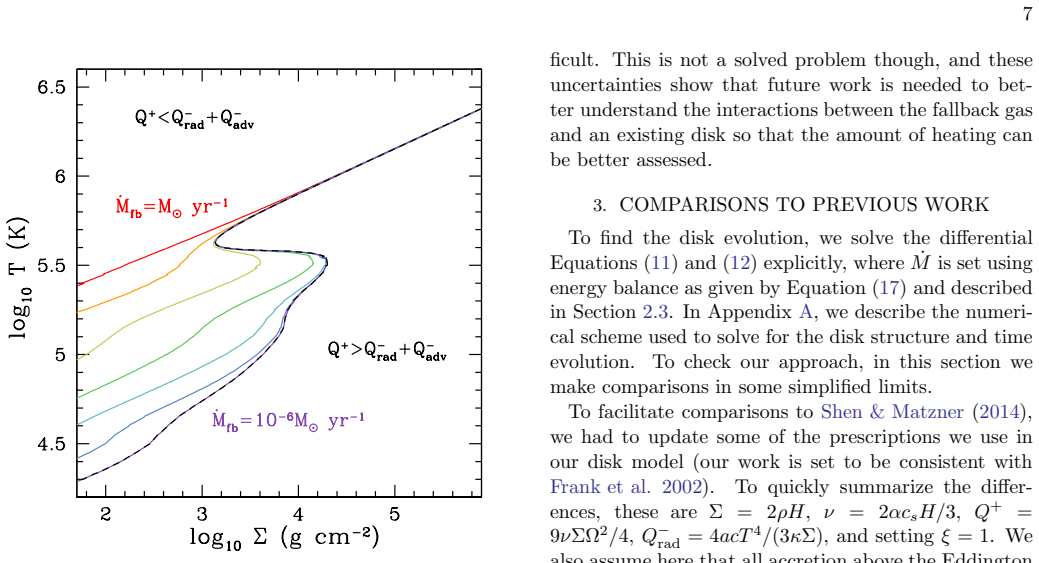
The load-bearing mechanism is the thermal instability of a radiation-pressure-dominated, radiatively cooled accretion disk. The model is a one-zone disk: it tracks total disk mass and angular momentum at a characteristic radius $R_d$, with the accretion rate set by local energy balance $9\nu\Sigma\Omega^2/8 = acT^4/(3\kappa\Sigma) + \dot M c_s^2 \xi/(2\pi R_d^2)$, and uses the $\alpha$-disk viscosity $\nu=\alpha P/(\Omega\rho)$ with the total pressure $P=P_g+P_r$. Along a sequence of equilibrium solutions, the branch with $dT/d\Sigma<0$ is thermally unstable, so when the evolving disk crosses into that region it cycles counterclockwise in the $\Sigma$–$T$ plane. The one-zone time evolution determines when the disk enters the unstable region and therefore sets the onset, duration, and recurrence of the flares.
What would settle it
Monitor one TDE from roughly $100$ days to $10$ years after disruption with UV/optical cadence of days. The model predicts repeated abrupt brightenings by more than an order of magnitude lasting one to two days, each followed by a slow rise over months to years. A light curve with no such repeated cycles, or with the first state transition arriving more than about a year after disruption for a $10^6\,M_\odot$ black hole, would contradict the model; so would a decade of radio monitoring with no delayed flares despite repeated predicted high states.
Extended reading notes
Core claim
The paper's central claim is that a standard $\alpha$-disk with viscosity proportional to the total (gas plus radiation) pressure, $\nu=\alpha P/(\Omega\rho)$, is thermally unstable in the radiation-pressure-dominated regime, and TDE disks necessarily enter this regime because fallback keeps feeding them for months to years. On the unstable branch, heating and cooling no longer balance stably: the disk jumps to a hot, super-Eddington state, drains its mass quickly, then drops to a cool low state where fallback slowly rebuilds it until the next jump. The authors find the cycles typically begin $\sim100$ days after the TDE and continue for up to $\sim10$ years, with the high states lasting only about one to two days and ejecting $10^{-3}$ to $10^{-1}\,M_\odot$ at $0.03$ to $0.3c$. Using OPAL opacities, the low state acquires a two-tiered structure from the iron-opacity bump, which helps it reach the UV/optical luminosities seen years after some TDEs. The authors also note that magnetic fields or heating from the fallback stream could stabilize the disk; they explore fallback heating and find it can suppress the instability while the fallback rate is high.
Load-bearing premise
The load-bearing premise is that the disk viscosity follows the classical $\alpha$-prescription with the total pressure, $\nu=\alpha P/(\Omega\rho)$; if magnetic fields, convection, or shock heating from the fallback stream stabilize the radiation-pressure-dominated disk, the high/low cycles, the ejections, and the associated radio flares would not occur.
Editorial extensions
If this is right
- Thermal-instability cycles begin roughly $100$ days after the TDE and can persist for up to about ten years, so late-time optical/UV emission from TDE disks should be strongly variable rather than steady.
- Each high state is super-Eddington, lasts one to two days, and ejects $\sim10^{-3}$ to $10^{-1}\,M_\odot$ at $\sim0.03$ to $0.3c$; collisions among successive ejections are a plausible origin for the delayed radio flares observed in many TDEs.
- In the low state the disk mass and accretion rate grow slowly over months to years, giving UV luminosities of $\sim10^{41}$ to $10^{42}\,\mathrm{erg\,s^{-1}}$; the same model predicts order-of-magnitude UV variations but only factor-of-a-few optical variations, roughly matching existing $g$- and $r$-band light curves.
- Lower black hole masses cycle faster and eject less mass per flare, so the timing and energetics of late-time flares could provide a new way to estimate the black hole mass in a TDE.
- Fallback-stream heating can stabilize the disk while the fallback rate is high, so the early evolution may be smooth in some events even though the later cycles still occur; whether cycles appear at all depends on unresolved disk physics such as magnetic-field stabilization.
Reading between the lines
- Beyond the paper: if the cycles are real, single snapshot UV observations are biased toward the brighter moments of the low-state rise, so the observed late-time UV sample may systematically overrepresent disks caught at high mass; high-cadence UV monitoring should catch the predicted dim phases.
- Beyond the paper: the predicted ejections repeat with a waiting time set by the disk cycle, so radio light curves should show quasi-periodic flares rather than a single event; sparse radio sampling could miss most of them, making targeted radio follow-up after an optical/UV state transition a sharper test.
- Beyond the paper: the same thermal-instability cycling should operate in any fallback-fed radiation-pressure-dominated disk, including disks formed by partial disruptions or by eccentric accretion onto lower-mass black holes; measuring whether such systems show similar episodic outflows would test the mechanism outside the original TDE setting.
- Beyond the paper: a direct measurement of the high-state outflow mass and velocity from radio afterglow modeling would calibrate the model's ejection efficiency parameter $p$, which currently sets the mass-loss rate through Equation (10).
Editorial analysis
A structured set of objections, weighed in public.
Referee Report
Summary. The paper presents a semi-analytic one-zone model for the long-term (years to decades) evolution of a TDE accretion disk fed by stellar fallback. The model solves for disk mass and angular momentum evolution using a Shakura-Sunyaev alpha-viscosity with total pressure, OPAL or analytic opacities, and an implicit thermal-equilibrium closure, including mass loss via a radius-dependent accretion rate. The central result is that radiation-pressure-dominated disks are thermally unstable and undergo repeated high/low accretion-state cycles beginning around 100 days after the TDE and lasting up to ~10 yr, with super-Eddington high states ejecting ~10^-3 to 10^-1 Msun at ~0.03-0.3c; low states produce late-time optical/UV luminosities within an order of magnitude of observed TDE plateau emission. The authors validate their code in the Shen & Matzner (2014) limit, explore variations of MBH, M*, alpha, and p, discuss stabilization by fallback heating and magnetic fields, and compare with late-time UV and radio observations qualitatively.
Significance. If the repeated-cycle picture is correct, it would provide a unified explanation for late-time UV variability, delayed radio flares, and state-dependent TDE disk behavior, making TDE disks a useful laboratory for radiation-pressure instability. Strengths of the paper are its transparency: the equations and time-stepping are clear, the comparison to Shen & Matzner (2014) is an external benchmark, the use of OPAL opacities is a concrete improvement, and the caveats are prominently acknowledged. However, the predictive content is heavily conditioned on an unresolved microphysical assumption—total-pressure alpha-viscosity with radiatively cooled, thermally unstable disks—and on the neglect of fallback-stream heating. The paper is therefore a well-executed parameter study of a hypothesized regime rather than a robust prediction; its significance will be settled by the sensitivity tests and targeted observations it proposes.
major comments (4)
- [Section 2.3, Eq. (15), Fig. 3] The central claim of the paper—that TDE disks repeatedly cycle between high and low accretion states—is produced by the choice nu = alpha P/(Omega rho) with P = P_g + P_rad in Eq. (15); this is what creates the dT/dSigma < 0 unstable branch in Fig. 3. The authors correctly note (Section 2.3 and Section 6) that using P = P_g (Sakimoto & Coroniti 1981; van Velzen et al. 2019) removes the instability and that magnetic stresses or fallback heating may stabilize the disk (Alush & Stone 2025). Because every quantitative prediction in Figures 8-15 is downstream of this choice, the paper needs a quantitative sensitivity study: for representative TDE parameters, recompute the evolution with a gas-pressure-only viscosity and with a prescription in which magnetic pressure stabilizes the disk, and report the fraction of parameter space in which cycles survive. The abstract and conclusions should then be phrased as explicitly conditional on this prescription rather than as a definite finding.
- [Section 2.4, Eq. (19), Fig. 4] Fallback-stream heating with eta of order unity removes the thermal instability at early times (Fig. 4), and the authors state in Section 2.4 that they have run time-dependent calculations with different heating levels but do not present them. This is a load-bearing omission because the claimed onset at ~100 days occurs early in the fallback epoch, when Mdot_fb is at its largest. I request that the time evolution be shown for representative values of eta (including the eta << 1 case motivated by Bonnerot et al. 2021) and that the interval of fallback-to-Eddington ratios over which cycles are quenched be quantified. Without this, the paper cannot claim that cycles are typical.
- [Section 6 and Appendix A] The one-zone model assumes that all disk mass and angular momentum reside at a single radius R_d and that the disk is in instantaneous thermal equilibrium (Appendix A). The authors themselves note in Section 6 that a real disk would undergo an outside-in transition to the low state on a ~1 yr timescale, with implications for AT2018fyk and AT2021ehb. Because the predicted cycle phase, duration, and high-state mass ejections are all timed by the one-zone clock, the paper should either (i) validate the cycle epoch against a simple 1D diffusion calculation for a representative model, or (ii) explicitly state an uncertainty budget on cycle onset times and flare epochs arising from this approximation. As written, the comparison of cycle behavior to observations in Section 5 is not calibrated against this known systematic.
- [Section 5.1, Fig. 14] The comparison to late-time UV observations combines 12 different TDEs into a single panel and is not a fit; the model tracks are generated with hand-selected values of alpha, p, cos theta, M_BH, M_*, and beta. The text already cautions that Fig. 14 should not be viewed as a light curve, but the paper repeatedly refers to matching observations. I recommend making the qualitative nature of the comparison explicit in the abstract and conclusions, or replacing Fig. 14 with an event-by-event comparison (or a likelihood-style envelope test) so that the reader can judge whether the low-state luminosity is truly matched or merely plausible.
minor comments (6)
- [Eq. (22)] The standard Shakura-Sunyaev effective-temperature profile has T_eff^4 proportional to 1 - (R_i/r)^{1/2}, not [1 - (R_i/r)]^{1/2}; please check the bracket and correct the SED normalization accordingly.
- [Section 4.2 and Fig. 9] The text says high-state flares occur out to approximately 6 yr, while the abstract quotes cycles lasting up to ~10 yr; please reconcile these values explicitly.
- [Section 3] The validation against Shen & Matzner (2014) uses modified prescriptions (Sigma = 2 rho H, nu = 2 alpha c_s H/3, etc.); please state explicitly that this reproduces the previous work only in that comparison limit and does not by itself validate the main-model assumptions.
- [Section 5.2] The claim that the radio flare parameters are similar to those from Cendes et al. (2024) is not supported by a quantitative comparison; please add a table or explicit ranges of radii, densities, and synchrotron luminosities, or soften the statement.
- [Section 6] There is a typo in the phrase 'especially the the UV with missions like ULTRASAT'; remove the duplicated article.
- [Appendix A] The convergence criterion epsilon < 10^-3 is stated without demonstrating convergence; adding a short convergence test for one representative model would help.
Circularity Check
No significant circularity: the central predictions are derived from an explicit, externally benchmarked one-zone disk model and are not fitted to the observations they are compared with.
full rationale
The derivation is self-contained and not circular. The disk evolution solves the ODEs (11)-(12) for Md and Jd, with Mdot set by energy balance (17); the thermal instability arises from the stated alpha-disk viscosity with total pressure (15), an assumption the paper explicitly flags and contrasts with alternative prescriptions (Sakimoto & Coroniti 1981; van Velzen et al. 2019; Alush & Stone 2025). Predicted cycle times, Mflare values, and UV/radio luminosities are outputs of the model, not fitted quantities: parameters alpha, p, xi, and eta are chosen from prior literature or by hand, and the Section 5 comparisons are qualitative overlays rather than fits. The numerical scheme is independently benchmarked against Shen & Matzner (2014), including late-time scalings from Cannizzo et al. (1990). The only self-citations (Metzger et al. 2008; Mockler et al. 2019) are contextual or one standard parameterization among several citations, and they do not carry the central claim. The acknowledged sensitivity to the total-pressure viscosity is a physical assumption, not a definitional identity, so it is a robustness concern rather than circularity.
Assumptions & free parameters
free parameters (4)
- alpha (Shakura-Sunyaev viscosity) =
0.1 (default), 0.03 (explored)
- p (outflow mass-loss power-law index) =
0.5 (default), 0.2 (explored)
- xi (logarithmic entropy gradient) =
1.5
- eta (fallback heating efficiency) =
1 in the Section 2.4 exploration
assumptions (5)
- domain assumption Disk viscosity follows the alpha prescription with total pressure, nu = alpha P/(Omega rho) (Eq. 15), so radiation-pressure-dominated disks are thermally unstable
- domain assumption One-zone approximation: most disk mass and angular momentum sit at Rd, with the interior in steady state
- domain assumption Thermal equilibrium holds at every timestep (thermal time much shorter than viscous time)
- domain assumption Fallback material circularizes promptly and feeds the disk at rate Mdot_fb(t)
- domain assumption Radiative cooling via local Rosseland mean opacity with no vertical convection
Cite this review
Pith. "Pith review of Late-time Evolution and Instabilities of Tidal Disruption Disks." pith.science (2026). https://pith.science/paper/X4OE6IZI
@misc{pith2026241201922,
  author       = {Pith},
  title        = {Pith review of: Late-time Evolution and Instabilities of Tidal Disruption Disks},
  year         = {2026},
  howpublished = {\url{https://pith.science/paper/X4OE6IZI}},
  note         = {Machine review of arXiv:2412.01922}
}
abstract
Observations of tidal disruption events (TDEs) on a timescale of years after the main flare show evidence of continued activity in the form of optical/UV emission, quasi-periodic eruptions, and delayed radio flares. Motivated by this, we explore the time evolution of these disks using semi-analytic models to follow the changing disk properties and feeding rate to the central black hole (BH). We find that thermal instabilities typically begin $\sim100\,{\rm days}$ after the TDE, causing the disk to cycle between high and low accretion states for up to $\sim10\,{\rm yrs}$. The high state is super-Eddington, which may be associated with outflows that eject $\sim10^{-3}-10^{-1}\,M_\odot$ over $\sim1-2\,{\rm days}$ with a range of velocities of $\sim0.03-0.3c$. Collision between these mass ejections may cause radio flares. In the low state, the accretion rate slowly grows over months to years as continued fallback accretion builds the disk's mass. In this phase, the disk has a luminosity of $\sim10^{41}-10^{42}\,{\rm erg\,s^{-1}}$ in the optical/UV as seen in some late-time observations. Although the accretion cycles we find occur for a typical $\alpha$-disk, in nature the disk could be stabilized by other effects such as the disk's magnetic field or heating from fallback accretion, the latter of which we explore. Thus higher cadence optical/UV observations along with joint radio monitoring will be key for following the disk state and testing these models.
Figures


Figures from the paper (11 more)


Forward citations
Cited by 2 Pith papers
-
Triple radio flares from tidal disruption events: jet-wind collisions and the discovery of a third radio flare from AT2020vwl
The TDE AT2020vwl showed a third radio flare at the time a jet-wind collision was predicted from its first two flares, the first predicted-and-confirmed third flare.
-
A Vision-Language Framework for Multispectral Scene Representation Using Language-Grounded Features
A lightweight projection layer trained to align frozen SpectralGPT multispectral features with LLaMA-3 text embeddings markedly improves EuroSAT classification and enables multispectral scene description.
Reference graph
Works this paper leans on
-
[1]
D., Berger, E., Guillochon, J., Zauderer, B
Alexander, K. D., Berger, E., Guillochon, J., Zauderer, B. A., & Williams, P. K. G. 2016, ApJL, 819, L25, doi: 10.3847/2041-8205/819/2/L25
-
[2]
D., van Velzen, S., Horesh, A., & Zauderer, B
Alexander, K. D., van Velzen, S., Horesh, A., & Zauderer, B. A. 2020, SSRv, 216, 81, doi: 10.1007/s11214-020-00702-w
-
[3]
Alush, Y., & Stone, N. C. 2025, arXiv e-prints, arXiv:2503.03811, doi: 10.48550/arXiv.2503.03811
-
[4]
Anumarlapudi, A., Dobie, D., Kaplan, D. L., et al. 2024, ApJ, 974, 241, doi: 10.3847/1538-4357/ad64d3
-
[5]
2021, Nature, 592, 704, doi: 10.1038/s41586-021-03394-6
Arcodia, R., Merloni, A., Nandra, K., et al. 2021, Nature, 592, 704, doi: 10.1038/s41586-021-03394-6
-
[6]
2022, A&A, 662, A49, doi: 10.1051/0004-6361/202243259
Arcodia, R., Miniutti, G., Ponti, G., et al. 2022, A&A, 662, A49, doi: 10.1051/0004-6361/202243259
-
[7]
2024, A&A, 684, A64, doi: 10.1051/0004-6361/202348881 Barniol Duran, R., Nakar, E., & Piran, T
Arcodia, R., Liu, Z., Merloni, A., et al. 2024, A&A, 684, A64, doi: 10.1051/0004-6361/202348881 Barniol Duran, R., Nakar, E., & Piran, T. 2013, ApJ, 772, 78, doi: 10.1088/0004-637X/772/1/78
-
[8]
Begelman, M. C. 1979, MNRAS, 187, 237, doi: 10.1093/mnras/187.2.237
Show all 81 references
-
[9]
C., & Pringle, J
Begelman, M. C., & Pringle, J. E. 2007, MNRAS, 375, 1070, doi: 10.1111/j.1365-2966.2006.11372.x
2007
-
[10]
D., & Begelman, M
Blandford, R. D., & Begelman, M. C. 1999, MNRAS, 303, L1, doi: 10.1046/j.1365-8711.1999.02358.x
1999
-
[11]
Bonnerot, C., Lu, W., & Hopkins, P. F. 2021, MNRAS, 504, 4885, doi: 10.1093/mnras/stab398
2021 doi
-
[12]
2020, ApJ, 890, 73, doi: 10.3847/1538-4357/ab6989
Bricman, K., & Gomboc, A. 2020, ApJ, 890, 73, doi: 10.3847/1538-4357/ab6989
2020 doi
-
[13]
K., Lee, H
Cannizzo, J. K., Lee, H. M., & Goodman, J. 1990, ApJ, 351, 38, doi: 10.1086/168442
1990 doi
-
[14]
D., et al
Cendes, Y., Berger, E., Alexander, K. D., et al. 2022, ApJ, 938, 28, doi: 10.3847/1538-4357/ac88d0 —. 2024, ApJ, 971, 185, doi: 10.3847/1538-4357/ad5541
2022 doi
-
[15]
2021, ApJL, 921, L40, doi: 10.3847/2041-8213/ac313b
Chakraborty, J., Kara, E., Masterson, M., et al. 2021, ApJL, 921, L40, doi: 10.3847/2041-8213/ac313b
2021 doi
-
[16]
Chevalier, R. A. 1998, ApJ, 499, 810, doi: 10.1086/305676
1998 doi
-
[17]
T., Alexander, K
Christy, C. T., Alexander, K. D., Margutti, R., et al. 2024, ApJ, 974, 18, doi: 10.3847/1538-4357/ad675b
2024 doi
-
[18]
2013, ApJL, 775, L9, doi: 10.1088/2041-8205/775/1/L9
Dai, L., Escala, A., & Coppi, P. 2013, ApJL, 775, L9, doi: 10.1088/2041-8205/775/1/L9
2013 doi
-
[19]
Miller, M. C. 2018, ApJL, 859, L20, doi: 10.3847/2041-8213/aab429
2018 doi
-
[20]
W., Jin, C., Blaes, O., & Ward, M
Done, C., Davis, S. W., Jin, C., Blaes, O., & Ward, M. 2012, MNRAS, 420, 1848, doi: 10.1111/j.1365-2966.2011.19779.x
2012
-
[21]
2023, A&A, 675, A100, doi: 10.1051/0004-6361/202346565
Franchini, A., Bonetti, M., Lupi, A., et al. 2023, A&A, 675, A100, doi: 10.1051/0004-6361/202346565
2023 doi
-
[22]
Frank, J., King, A., & Raine, D. J. 2002, Accretion Power in Astrophysics: Third Edition
2002
-
[23]
2019, MNRAS, 487, 4790, doi: 10.1093/mnras/stz1530
Gafton, E., & Rosswog, S. 2019, MNRAS, 487, 4790, doi: 10.1093/mnras/stz1530
2019 doi
-
[24]
Giustini, M., Miniutti, G., & Saxton, R. D. 2020, A&A, 636, L2, doi: 10.1051/0004-6361/202037610
2020 doi
-
[25]
J., Miller-Jones, J
Goodwin, A. J., Miller-Jones, J. C. A., van Velzen, S., et al. 2023a, MNRAS, 518, 847, doi: 10.1093/mnras/stac3127
-
[26]
J., Alexander, K
Goodwin, A. J., Alexander, K. D., Miller-Jones, J. C. A., et al. 2023b, MNRAS, 522, 5084, doi: 10.1093/mnras/stad1258
- [27]
-
[28]
2013, ApJ, 767, 25, doi: 10.1088/0004-637X/767/1/25 —
Guillochon, J., & Ramirez-Ruiz, E. 2013, ApJ, 767, 25, doi: 10.1088/0004-637X/767/1/25 —. 2015, ApJ, 809, 166, doi: 10.1088/0004-637X/809/2/166
2013 doi
-
[29]
H., & Blaes, O
Hirose, S., Krolik, J. H., & Blaes, O. 2009, ApJ, 691, 16, doi: 10.1088/0004-637X/691/1/16
2009 doi
-
[30]
B., & Arcavi, I
Horesh, A., Cenko, S. B., & Arcavi, I. 2021a, Nature Astronomy, 5, 491, doi: 10.1038/s41550-021-01300-8
-
[31]
2021b, ApJL, 920, L5, doi: 10.3847/2041-8213/ac25fe
Horesh, A., Sfaradi, I., Fender, R., et al. 2021b, ApJL, 920, L5, doi: 10.3847/2041-8213/ac25fe
-
[32]
2022, ApJ, 934, 132, doi: 10.3847/1538-4357/ac75d8
Hu, H., Inayoshi, K., Haiman, Z., Quataert, E., & Kuiper, R. 2022, ApJ, 934, 132, doi: 10.3847/1538-4357/ac75d8
2022 doi
-
[33]
A., & Rogers, F
Iglesias, C. A., & Rogers, F. J. 1996, ApJ, 464, 943, doi: 10.1086/177381 Jankoviƒ¸ c, T., Bonnerot, C., & Gomboc, A. 2024, Monthly Notices of the Royal Astronomical Society, 529, 673, doi: 10.1093/mnras/stae580
1996 doi
-
[34]
W., & Stone, J
Jiang, Y.-F., Davis, S. W., & Stone, J. M. 2016, ApJ, 827, 10, doi: 10.3847/0004-637X/827/1/10
2016 doi
-
[35]
M., & Davis, S
Jiang, Y.-F., Stone, J. M., & Davis, S. W. 2013, ApJ, 778, 65, doi: 10.1088/0004-637X/778/1/65
2013 doi
-
[36]
C., & Gilbaum, S
Kaur, K., Stone, N. C., & Gilbaum, S. 2023, MNRAS, 524, 1269, doi: 10.1093/mnras/stad1894
2023 doi
-
[38]
2020, ApJ, 905, 141, doi: 10.3847/1538-4357/abc489
Mockler, B., & Ramirez-Ruiz, E. 2020, ApJ, 905, 141, doi: 10.3847/1538-4357/abc489
2020 doi
-
[39]
J., Tanvir, N
Levan, A. J., Tanvir, N. R., Cenko, S. B., et al. 2011, Science, 333, 199, doi: 10.1126/science.1207143
2011 doi
-
[40]
P., & Eardley, D
Lightman, A. P., & Eardley, D. M. 1974, ApJL, 187, L1, doi: 10.1086/181377
1974 doi
- [41]
-
[42]
2022, in Handbook of X-ray and Gamma-ray Astrophysics, ed
Lu, W. 2022, in Handbook of X-ray and Gamma-ray Astrophysics, ed. C. Bambi & A. Sangangelo, 3, doi: 10.1007/978-981-16-4544-0 127-1
2022 doi
-
[43]
Lu, W., Matsumoto, T., & Matzner, C. D. 2024, MNRAS, 533, 979, doi: 10.1093/mnras/stae1770
2024 doi
-
[44]
2012, ApJ, 757, 134, doi: 10.1088/0004-637X/757/2/134
MacLeod, M., Guillochon, J., & Ramirez-Ruiz, E. 2012, ApJ, 757, 134, doi: 10.1088/0004-637X/757/2/134
2012 doi
-
[45]
2024, ApJ, 971, 49, doi: 10.3847/1538-4357/ad58ba
Matsumoto, T., & Piran, T. 2024, ApJ, 971, 49, doi: 10.3847/1538-4357/ad58ba
2024 doi
-
[46]
D., Piro, A
Metzger, B. D., Piro, A. L., & Quataert, E. 2008, MNRAS, 390, 781, doi: 10.1111/j.1365-2966.2008.13789.x
2008
-
[47]
2023a, A&A, 674, L1, doi: 10.1051/0004-6361/202346653 —
Miniutti, G., Giustini, M., Arcodia, R., et al. 2023a, A&A, 674, L1, doi: 10.1051/0004-6361/202346653 —. 2023b, A&A, 670, A93, doi: 10.1051/0004-6361/202244512
-
[48]
D., Giustini, M., et al
Miniutti, G., Saxton, R. D., Giustini, M., et al. 2019, Nature, 573, 381, doi: 10.1038/s41586-019-1556-x
2019 doi
-
[49]
C., Johnson, L
Mishra, B., Fragile, P. C., Johnson, L. C., & Klu´ zniak, W. 2016, MNRAS, 463, 3437, doi: 10.1093/mnras/stw2245
2016 doi
-
[50]
2019, ApJ, 872, 151, doi: 10.3847/1538-4357/ab010f
Mockler, B., Guillochon, J., & Ramirez-Ruiz, E. 2019, ApJ, 872, 151, doi: 10.3847/1538-4357/ab010f
2019 doi
-
[51]
2022, MNRAS, 510, 3650, doi: 10.1093/mnras/stab3742
Mou, G., Wang, T., Wang, W., & Yang, J. 2022, MNRAS, 510, 3650, doi: 10.1093/mnras/stab3742
2022 doi
-
[52]
Mummery, A., & Balbus, S. A. 2020, MNRAS, 492, 5655, doi: 10.1093/mnras/staa192
2020 doi
-
[53]
2024, MNRAS, 527, 2452, doi: 10.1093/mnras/stad3001
Mummery, A., van Velzen, S., Nathan, E., et al. 2024, MNRAS, 527, 2452, doi: 10.1093/mnras/stad3001
2024 doi
-
[54]
2011, Nature, 478, 82, doi: 10.1038/nature10365
Nakar, E., & Piran, T. 2011, Nature, 478, 82, doi: 10.1038/nature10365
2011 doi
-
[55]
R., Mummery, A., et al
Nicholl, M., Pasham, D. R., Mummery, A., et al. 2024, Nature, 634, 804, doi: 10.1038/s41586-024-08023-6
2024 doi
-
[56]
E., & Matsumoto, R
Oda, H., Machida, M., Nakamura, K. E., & Matsumoto, R. 2009, ApJ, 697, 16, doi: 10.1088/0004-637X/697/1/16
2009 doi
-
[57]
2022, ApJL, 928, L18, doi: 10.3847/2041-8213/ac5faf
Pan, X., Li, S.-L., Cao, X., Miniutti, G., & Gu, M. 2022, ApJL, 928, L18, doi: 10.3847/2041-8213/ac5faf
2022 doi
-
[58]
Phinney, E. S. 1989, in IAU Symposium, Vol. 136, The Center of the Galaxy, ed. M. Morris, 543
1989
-
[59]
A., Guillot, S., et al
Quintin, E., Webb, N. A., Guillot, S., et al. 2023, A&A, 675, A152, doi: 10.1051/0004-6361/202346440
2023 doi
-
[60]
Rees, M. J. 1988, Nature, 333, 523, doi: 10.1038/333523a0
1988 doi
-
[61]
Ryu, T., Krolik, J., Piran, T., & Noble, S. C. 2020, ApJ, 904, 98, doi: 10.3847/1538-4357/abb3cf
2020 doi
-
[62]
2016, MNRAS, 459, 4397, doi: 10.1093/mnras/stw913
Sadowski, A. 2016, MNRAS, 459, 4397, doi: 10.1093/mnras/stw913
2016 doi
-
[63]
J., & Coroniti, F
Sakimoto, P. J., & Coroniti, F. V. 1981, ApJ, 247, 19, doi: 10.1086/159005
1981 doi
-
[64]
2022, ApJ, 933, 176, doi: 10.3847/1538-4357/ac74bc
Sfaradi, I., Horesh, A., Fender, R., et al. 2022, ApJ, 933, 176, doi: 10.3847/1538-4357/ac74bc
2022 doi
-
[65]
2024, MNRAS, 527, 7672, doi: 10.1093/mnras/stad3717
Sfaradi, I., Beniamini, P., Horesh, A., et al. 2024, MNRAS, 527, 7672, doi: 10.1093/mnras/stad3717
2024 doi
-
[66]
I., & Sunyaev, R
Shakura, N. I., & Sunyaev, R. A. 1973, A&A, 24, 337 —. 1976, MNRAS, 175, 613, doi: 10.1093/mnras/175.3.613
1973 doi
-
[67]
Shen, R.-F., & Matzner, C. D. 2014, ApJ, 784, 87, doi: 10.1088/0004-637X/784/2/87
2014 doi
-
[68]
2024, ApJ, 964, 74, doi: 10.3847/1538-4357/ad2704
Shvartzvald, Y., Waxman, E., Gal-Yam, A., et al. 2024, ApJ, 964, 74, doi: 10.3847/1538-4357/ad2704
2024 doi
-
[69]
Steinberg, E., & Stone, N. C. 2024, Nature, 625, 463, doi: 10.1038/s41586-023-06875-y
2024 doi
-
[70]
M., & Pringle, J
Stone, J. M., & Pringle, J. E. 2001, MNRAS, 322, 461, doi: 10.1046/j.1365-8711.2001.04138.x
2001
-
[71]
2013, MNRAS, 435, 1809, doi: 10.1093/mnras/stt1270
Stone, N., Sari, R., & Loeb, A. 2013, MNRAS, 435, 1809, doi: 10.1093/mnras/stt1270
2013 doi
-
[72]
Teboul, O., & Metzger, B. D. 2023, ApJL, 957, L9, doi: 10.3847/2041-8213/ad0037
2023 doi
-
[73]
L., Kwan, T
Thomsen, L. L., Kwan, T. M., Dai, L., et al. 2022, ApJL, 937, L28, doi: 10.3847/2041-8213/ac911f van Velzen, S., Stone, N. C., Metzger, B. D., et al. 2019, ApJ, 878, 82, doi: 10.3847/1538-4357/ab1844
2022 doi
-
[74]
1995, Cataclysmic variable stars, Vol
Warner, B. 1995, Cataclysmic variable stars, Vol. 28
1995
-
[75]
2006, ApJ, 648, 523, doi: 10.1086/505854
Watarai, K.-y. 2006, ApJ, 648, 523, doi: 10.1086/505854
2006 doi
-
[76]
2022, A&A, 659, L2, doi: 10.1051/0004-6361/202243143
Arcodia, R. 2022, A&A, 659, L2, doi: 10.1051/0004-6361/202243143
2022 doi
-
[77]
R., van Velzen, S., et al
Wevers, T., Pasham, D. R., van Velzen, S., et al. 2019, MNRAS, 488, 4816, doi: 10.1093/mnras/stz1976
2019 doi
-
[78]
R., Pasham, D
Wevers, T., Coughlin, E. R., Pasham, D. R., et al. 2023, ApJL, 942, L33, doi: 10.3847/2041-8213/ac9f36
2023 doi
-
[79]
2022, ApJ, 937, 8, doi: 10.3847/1538-4357/ac898a
Yao, Y., Lu, W., Guolo, M., et al. 2022, ApJ, 937, 8, doi: 10.3847/1538-4357/ac898a
2022 doi
-
[80]
2014, ARA&A, 52, 529, doi: 10.1146/annurev-astro-082812-141003
Yuan, F., & Narayan, R. 2014, ARA&A, 52, 529, doi: 10.1146/annurev-astro-082812-141003
2014 doi
-
[81]
A., Berger, E., Margutti, R., et al
Zauderer, B. A., Berger, E., Margutti, R., et al. 2013, ApJ, 767, 152, doi: 10.1088/0004-637X/767/2/152
2013 doi
- [82]
Reviewed August 12, 2026 · model on record in the stance chip above.
Discussion (0). Continue with ORCID to comment.