REVIEW 4 major objections 5 minor 51 references
Improving Language Transfer Capability of Decoder-only Architecture in Multilingual Neural Machine Translation
T0 review · 4 major / 5 minor · reviewed 2026-08-11 · deepseek-v4-flash
Pith's one-line read Decoder-only translation models underperform because they fail to transfer source representations into the target language, and a two-stage design plus instruction contrastive learning fixes this.
desk verdict A worthwhile empirical recipe for decoder-only multilingual translation whose central mechanism claim is contradicted by its own large-scale ablations. read the letter →
The pith
A machine-rendered reading of the paper's core claim, the machinery that carries it, and where it could break.
The reading
What carries the argument
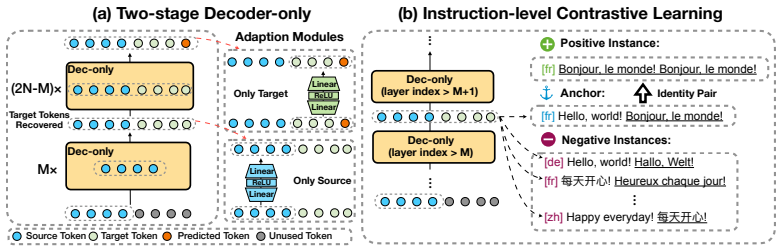
The central object is the representation-alignment identity $\mathrm{encoder}(l_y, x_a) = \mathrm{encoder}(l_y, x_b)$, which says that an ideal encoder maps two source sentences with the same target language and parallel semantics into the same target-language subspace. TDO implements this by excluding target tokens from the first $M$ decoder-only layers, then fusing them in the remaining layers; a shared FFN adapter at each boundary compensates for the fact that the target tokens enter later. InstruCL is the second mechanism: for each instance it builds a positive identity pair $(l_y, y, y)$, translating the target sentence to itself, and uses a contrastive loss on the instruction token at layer $1.5N$ so that instruction representations from different source languages but the same target language are pulled together. Together, these mechanisms carry the argument: the similarity score measuring target-language preference, the ratio of similarity to the identity pair over similarity to the source-side pair, rises from about layer 4 and stays high into the second stage.
What would settle it
Train a TDO variant with the same parameter count but no target-token exclusion, either by letting target tokens attend from the start or by replacing the split with a learned routing that keeps source and target information separate, and check whether the zero-shot gains persist; if they do, the two-stage exclusion is not the cause. A cheaper check is to feed two parallel source sentences in different languages with the same target language through the first $M$ layers and compute the cosine similarity of the resulting representations; if it is not higher than the vanilla decoder-only model's similarity, the claimed alignment of Equation 4 has not occurred.
Extended reading notes
Core claim
The central claim is that the decoder-only architecture is not inherently weak at multilingual translation; it lacks the explicit language-transfer step that encoder-decoder models get for free. In an encoder-decoder model, the encoder output is an intermediate state $H$ that is implicitly aligned across source languages because the decoder must produce the same target sentence regardless of source language, formalized as $\mathrm{encoder}(l_y, x_a) = \mathrm{encoder}(l_y, x_b)$. Decoder-only models fuse source and target tokens in one joint masked attention pass, so no such aligned state exists and source representations keep mostly source-language features. The paper's Two-stage Decoder-only architecture splits the stack so that target tokens are withheld from the first $M$ layers, making those layers behave like an encoder, and only then are target tokens fused; two shared feed-forward adapters smooth the boundary. Instruction-level Contrastive Learning adds a loss on the translation-instruction token that pulls each instance's instruction representation toward a same-language identity pair, providing direct supervision for language transfer in the second stage. The authors conclude from their experiments and layer-wise similarity measurements that TDO achieves the alignment of Equation 4 and that this, not added parameters, is what improves zero-shot translation.
Load-bearing premise
The load-bearing assumption is that simply withholding target tokens from the first $M$ layers and adding a shared adapter is enough to make those layers behave like an encoder and align different source languages in the target-language subspace; the paper supports this with similarity measurements but does not prove it formally, so if the gains actually come from the contrastive loss, the adapters, or the extra parameters, the architectural claim weakens.
Editorial extensions
If this is right
- Decoder-only multilingual models can match encoder-decoder models on supervised directions and beat them on zero-shot directions while using about 10% fewer parameters, under the tested settings.
- Zero-shot transfer is governed by whether source representations occupy the target-language subspace; measuring layer-wise target-language preference can predict which architecture will transfer better.
- The first stage of TDO is about language transfer and the second about linguistic diversity; on small datasets more layers should go to the first stage, on large datasets the balance shifts, and InstruCL matters most in the second stage.
- InstruCL also helps encoder-decoder and plain decoder-only models; it is most effective when applied in the middle of the decoder-only second stage, not in the first stage, and it reduces the off-target ratio.
- Pre-trained encoder-decoder translation models can be converted into TDO by initializing from the decoder and freezing embeddings, and TDO then outperforms the encoder-decoder initialization on all four metrics in the fine-tuning experiments.
Reading between the lines
- If the mechanism is confirmed, the same two-stage separation could be applied to the attention patterns of large language models used for translation, since the paper explicitly leaves LLM-scale decoder-only translation as future work; the expected test is whether excluding target tokens in early layers helps LLMs transfer to low-resource pairs.
- The paper's similarity metric is computed on averaged sentence representations; a sharper test would track whether individual source tokens, not just sentence averages, land in the target subspace, since token-level alignment is what the cross-attention analogy predicts.
- The contrastive loss relies on within-batch negatives, so the gains may depend on batch composition; a testable extension is curriculum or hard-negative mining over languages, which could further reduce the off-target ratio.
- Because the first stage is described as an implicit encoder, a natural next question is whether the learned alignment is compositional, that is, whether instruction representations for language pairs never seen together are recognized in the subspace; the OPUS-100 results with 95 languages make this testable.
Signed reviews
Editorial analysis
A structured set of objections, weighed in public.
Referee Report
Summary. The paper claims that decoder-only multilingual NMT underperforms because source-token representations are not transferred into the target-language subspace, and proposes a Two-stage Decoder-only (TDO) architecture that excludes target tokens for the first M layers, with adaption modules at the stage boundary, plus Instruction-level Contrastive Learning (InstruCL) on the translation-instruction token. Experiments on TED-19 and OPUS-100, in both from-scratch and fine-tuning settings, report that TDO+InstruCL is competitive with encoder-decoder baselines on supervised directions and improves zero-shot translation by up to 3.39 BLEU, 6.99 chrF++, 3.22 BERTScore, and 4.81 COMET. A layer-wise similarity analysis (Appendix A) is offered as evidence that the proposed methods increase target-language preference in source representations.
Significance. If the causal interpretation is correct, TDO+InstruCL provides a decoder-only architecture that matches or exceeds encoder-decoder MNMT at comparable or slightly lower parameter counts, with practical zero-shot gains. The evaluation is genuinely broad: two corpora, training from scratch and fine-tuning, four automatic metrics plus target-off ratio, ablations over architecture components, M, and the InstruCL layer index, and released code. The main weakness is that the evidence for the architectural mechanism is incomplete and partly contradicted by the paper's own large-scale ablations; moreover, the representation metric used to support the mechanism is not independently validated. These issues affect the central attribution of the gains, so the paper needs substantial revision before the claims can be accepted.
major comments (4)
- [§5.3, Table 1 (OPUS-100 blocks)] The ablation does not support the causal claim that the two-stage split repairs decoder-only language transfer. With N=12, d=512, zero-shot BLEU is 6.62 for the prefix decoder-only baseline, 5.32 for TDO(+Prefix), 5.97 for TDO+Adaption, and only 7.93/8.52 after adding InstruCL; the N=6, d=1024 block shows the same pattern (8.15 vs 7.06, then 9.28 with CL). Since Section 7 concludes that the improvements derive from TDO-enhanced language transfer, the OPUS-100 results attribute the zero-shot gains to the contrastive objective rather than to the architecture itself. Please either restrict the architectural claim to TED-19 or provide OPUS-100 representation evidence that TDO improves transfer even when BLEU does not.
- [§6.1 and Appendix A] Figure 4's similarity score is the only direct evidence that TDO realizes the alignment in Eq. 4, but Eq. 11 is an average over parallel sentences and is not shown to track translation quality. The score is computed with an SVCCA procedure taken from prior work, and no variance or per-pair distribution is reported. A concrete test would be to correlate the similarity score with held-out BLEU/COMET across the models in Table 1, or to probe Eq. 4 directly by measuring pairwise similarity of the encoder outputs of parallel sentences sharing a target language; as it stands, the representation analysis is interpretive rather than confirmatory.
- [§6.2, Figure 5] The M sweep on OPUS-100 shows that zero-shot BLEU is best at M=3 and declines as M grows, while the main experiments use M=N and claim that a larger first stage improves transfer. This non-monotonicity is consistent with the 'second stage benefits linguistic diversity' explanation, but it undercuts the simple statement that excluding target tokens in the first stage is what transfers source representations into the target subspace. Please reconcile the M-sweep behavior with the proposed mechanism and state which M value is recommended for large corpora.
- [Tables 1–3 and Appendix I] The paper reports single point estimates without confidence intervals or multiple seeds. Several fine-tuning differences are small, for example Table 2, NLLB-600M: TDO+CL vs TDO zero-shot BLEU is 15.48 vs 15.48, yet the text draws conclusions about InstruCL effectiveness from differences of this size. Please report variance or significance at least for the headline comparisons and for the component ablations in Table 1.
minor comments (5)
- [Table 2 caption] The caption says 'Abbreviations align with Table 2,' but it should refer to Table 1.
- [§6.1] The label 'InstrucCL' is used once in the enumeration of analyzed models; elsewhere the method is called InstruCL.
- [Appendix A] The notation after singular value decomposition is unclear: h_a ∈ R^{d_a} is introduced without defining d_a and d_b, and the relationship between the token-level H and the sentence-level h should be stated more carefully.
- [Figure 5 caption] The term 'variation ratio' should be defined explicitly, including the reference model against which the variation is computed and the handling of negative values.
- [Appendix I] There is a typo in 'Tabel 3 shows the experimental results,' and the placeholder '-' in the idx column would be clearer as 'n/a'.
Circularity Check
No significant circularity: the TDO and InstruCL results are measured against external benchmarks, and the self-cited similarity analysis is interpretive rather than a fitted prediction.
full rationale
The paper's central comparison is against external benchmarks (TED-19, OPUS-100) with four standard metrics, and the reported gains are direct test-set scores of the proposed architecture, not quantities reconstructed from the inputs. The main load-bearing design—excluding target tokens for M layers and adding InstruCL—is evaluated by ablations against prefix decoder-only and encoder-decoder baselines; the hyperparameters M and the layer index for InstruCL are varied in Sections 6.2 and 6.3, and the headline numbers in Table 1 are not fitted to the test set. The representation analysis (Figures 1b and 4) uses a similarity score from the authors' prior work (Qu et al., 2024), and the identity-pair proxy for the target language in Section 4.2 is also attributed to that work; these self-citations are interpretive supports for the mechanism story, but they are not used as a substitute for the translation evaluation, and the central claim that TDO plus InstruCL improves zero-shot translation does not reduce to the metric by construction. The ablation pattern on OPUS-100, where TDO alone does not improve zero-shot BLEU over the prefix decoder-only baseline, is a legitimate internal-validity concern about which component drives the gain, but it is not circularity: the paper does not define the prediction in terms of the fitted component, and no load-bearing argument reduces to a self-citation chain or to the metric's definition. No circular step satisfying the quotation-and-reduction requirement was found.
Assumptions & free parameters
free parameters (2)
- M, the number of first-stage layers =
M = N (balanced) in main experiments; swept over 1..11 on TED-19 and 3..21 on OPUS-100
- Layer index for InstruCL =
1.5N (main experiments); swept over layers 1..12
assumptions (3)
- domain assumption The representation analysis of Qu et al. (2024), using SVCCA-based similarity, reliably measures target-language vs source-language features. The paper's motivation and its verification of TDO (Figures 1b, 4) depend on this measure.
- domain assumption A shared FFN adapter at the M-layer boundary is sufficient to bridge the representational gap between untransformed source tokens and newly introduced target tokens.
- domain assumption The identity pair (ly, y, y) is a valid proxy for the target-language representation, so pulling the instruction token toward it improves transfer.
invented entities (1)
-
Translation instruction token representation as an alignment anchor
Cite this review
Pith. "Pith review of Improving Language Transfer Capability of Decoder-only Architecture in Multilingual Neural Machine Translation." pith.science (2026). https://pith.science/paper/WZIFDKSD
@misc{pith2026241202101,
  author       = {Pith},
  title        = {Pith review of: Improving Language Transfer Capability of Decoder-only Architecture in Multilingual Neural Machine Translation},
  year         = {2026},
  howpublished = {\url{https://pith.science/paper/WZIFDKSD}},
  note         = {Machine review of arXiv:2412.02101}
}
read the original abstract
Existing multilingual neural machine translation (MNMT) approaches mainly focus on improving models with the encoder-decoder architecture to translate multiple languages. However, decoder-only architecture has been explored less in MNMT due to its underperformance when trained on parallel data solely. In this work, we attribute the issue of the decoder-only architecture to its lack of language transfer capability. Specifically, the decoder-only architecture is insufficient in encoding source tokens with the target language features. We propose dividing the decoding process into two stages so that target tokens are explicitly excluded in the first stage to implicitly boost the transfer capability across languages. Additionally, we impose contrastive learning on translation instructions, resulting in improved performance in zero-shot translation. We conduct experiments on TED-19 and OPUS-100 datasets, considering both training from scratch and fine-tuning scenarios. Experimental results show that, compared to the encoder-decoder architecture, our methods not only perform competitively in supervised translations but also achieve improvements of up to 3.39 BLEU, 6.99 chrF++, 3.22 BERTScore, and 4.81 COMET in zero-shot translations.
Figures


Figures from the paper (5 more)


Reference graph
Works this paper leans on
-
[1]
Ankur Bapna and Orhan Firat. 2019. https://doi.org/10.18653/v1/D19-1165 Simple, scalable adaptation for neural machine translation . In Proceedings of the 2019 Conference on Empirical Methods in Natural Language Processing and the 9th International Joint Conference on Natural Language Processing (EMNLP-IJCNLP), pages 1538--1548, Hong Kong, China. Associat...
-
[2]
Tom Brown, Benjamin Mann, Nick Ryder, Melanie Subbiah, Jared D Kaplan, Prafulla Dhariwal, Arvind Neelakantan, Pranav Shyam, Girish Sastry, Amanda Askell, Sandhini Agarwal, Ariel Herbert-Voss, Gretchen Krueger, Tom Henighan, Rewon Child, Aditya Ramesh, Daniel Ziegler, Jeffrey Wu, Clemens Winter, Chris Hesse, Mark Chen, Eric Sigler, Mateusz Litwin, Scott Gr...
2020
-
[3]
Liang Chen, Shuming Ma, Dongdong Zhang, Furu Wei, and Baobao Chang. 2023. https://doi.org/10.18653/v1/2023.findings-acl.608 On the off-target problem of zero-shot multilingual neural machine translation . In Findings of the Association for Computational Linguistics: ACL 2023, pages 9542--9558, Toronto, Canada. Association for Computational Linguistics
-
[4]
Alexis Conneau, Kartikay Khandelwal, Naman Goyal, Vishrav Chaudhary, Guillaume Wenzek, Francisco Guzm \'a n, Edouard Grave, Myle Ott, Luke Zettlemoyer, and Veselin Stoyanov. 2019. Unsupervised cross-lingual representation learning at scale. arXiv preprint arXiv:1911.02116
arXiv 2019
-
[5]
Raj Dabre, Chenhui Chu, and Anoop Kunchukuttan. 2020. https://doi.org/10.1145/3406095 A survey of multilingual neural machine translation . ACM Comput. Surv., 53(5)
doi:10.1145/3406095 2020
-
[6]
Jacob Devlin, Ming - Wei Chang, Kenton Lee, and Kristina Toutanova. 2018. https://arxiv.org/abs/1810.04805 BERT: pre-training of deep bidirectional transformers for language understanding . CoRR, abs/1810.04805
arXiv 2018
-
[7]
Li Dong, Nan Yang, Wenhui Wang, Furu Wei, Xiaodong Liu, Yu Wang, Jianfeng Gao, Ming Zhou, and Hsiao-Wuen Hon. 2019. https://arxiv.org/abs/1905.03197 Unified language model pre-training for natural language understanding and generation . Preprint, arXiv:1905.03197
arXiv 2019
-
[8]
Angela Fan, Shruti Bhosale, Holger Schwenk, Zhiyi Ma, Ahmed El-Kishky, Siddharth Goyal, Mandeep Baines, Onur Celebi, Guillaume Wenzek, Vishrav Chaudhary, Naman Goyal, Tom Birch, Vitaliy Liptchinsky, Sergey Edunov, Edouard Grave, Michael Auli, and Armand Joulin. 2020. https://arxiv.org/abs/2010.11125 Beyond english-centric multilingual machine translation ...
arXiv 2020
Show all 51 references
-
[9]
Yarman Vural, and Kyunghyun Cho
Orhan Firat, Baskaran Sankaran, Yaser Al-onaizan, Fatos T. Yarman Vural, and Kyunghyun Cho. 2016. https://doi.org/10.18653/v1/D16-1026 Zero-resource translation with multi-lingual neural machine translation . In Proceedings of the 2016 Conference on Empirical Methods in Natura...
2016 doi
-
[10]
Yingbo Gao, Christian Herold, Zijian Yang, and Hermann Ney. 2022. https://aclanthology.org/2022.aacl-main.43 Is encoder-decoder redundant for neural machine translation? In Proceedings of the 2nd Conference of the Asia-Pacific Chapter of the Association for Computational Lingu...
2022
-
[11]
Naman Goyal, Jingfei Du, Myle Ott, Giri Anantharaman, and Alexis Conneau. 2021. Larger-scale transformers for multilingual masked language modeling. arXiv preprint arXiv:2105.00572
2021 arXiv
-
[12]
Naman Goyal, Cynthia Gao, Vishrav Chaudhary, Peng-Jen Chen, Guillaume Wenzek, Da Ju, Sanjana Krishnan, Marc ' Aurelio Ranzato, Francisco Guzm \'a n, and Angela Fan. 2022. https://doi.org/10.1162/tacl_a_00474 The F lores-101 evaluation benchmark for low-resource and multilingua...
2022 doi
-
[13]
Jiatao Gu, Yong Wang, Kyunghyun Cho, and Victor O.K. Li. 2019. https://doi.org/10.18653/v1/P19-1121 Improved zero-shot neural machine translation via ignoring spurious correlations . In Proceedings of the 57th Annual Meeting of the Association for Computational Linguistics, pa...
2019 doi
-
[14]
Ashish Jaiswal, Ashwin Ramesh Babu, Mohammad Zaki Zadeh, Debapriya Banerjee, and Fillia Makedon. 2021. https://arxiv.org/abs/2011.00362 A survey on contrastive self-supervised learning . Preprint, arXiv:2011.00362
2021 arXiv
-
[15]
Le, Maxim Krikun, Yonghui Wu, Zhifeng Chen, Nikhil Thorat, Fernanda Vi \'e gas, Martin Wattenberg, Greg Corrado, Macduff Hughes, and Jeffrey Dean
Melvin Johnson, Mike Schuster, Quoc V. Le, Maxim Krikun, Yonghui Wu, Zhifeng Chen, Nikhil Thorat, Fernanda Vi \'e gas, Martin Wattenberg, Greg Corrado, Macduff Hughes, and Jeffrey Dean. 2017. https://doi.org/10.1162/tacl_a_00065 G oogle ' s multilingual neural machine translat...
2017 doi
-
[16]
Jungo Kasai, Nikolaos Pappas, Hao Peng, James Cross, and Noah Smith. 2021. https://openreview.net/forum?id=KpfasTaLUpq Deep encoder, shallow decoder: Reevaluating non-autoregressive machine translation . In International Conference on Learning Representations
2021
-
[17]
Kingma and Jimmy Ba
Diederik P. Kingma and Jimmy Ba. 2017. https://arxiv.org/abs/1412.6980 Adam: A method for stochastic optimization . Preprint, arXiv:1412.6980
2017 arXiv
-
[18]
Taku Kudo and John Richardson. 2018. https://doi.org/10.18653/v1/D18-2012 S entence P iece: A simple and language independent subword tokenizer and detokenizer for neural text processing . In Proceedings of the 2018 Conference on Empirical Methods in Natural Language Processin...
2018 doi
-
[19]
Sneha Kudugunta, Ankur Bapna, Isaac Caswell, and Orhan Firat. 2019. https://doi.org/10.18653/v1/D19-1167 Investigating multilingual NMT representations at scale . In Proceedings of the 2019 Conference on Empirical Methods in Natural Language Processing and the 9th Internationa...
2019 doi
-
[20]
Yinhan Liu, Jiatao Gu, Naman Goyal, Xian Li, Sergey Edunov, Marjan Ghazvininejad, Mike Lewis, and Luke Zettlemoyer. 2020. https://arxiv.org/abs/2001.08210 Multilingual denoising pre-training for neural machine translation . Preprint, arXiv:2001.08210
2020 arXiv
-
[21]
Myle Ott, Sergey Edunov, Alexei Baevski, Angela Fan, Sam Gross, Nathan Ng, David Grangier, and Michael Auli. 2019. https://doi.org/10.18653/v1/N19-4009 fairseq: A fast, extensible toolkit for sequence modeling . In Proceedings of the 2019 Conference of the North A merican Chap...
2019 doi
-
[22]
Xiao Pan, Mingxuan Wang, Liwei Wu, and Lei Li. 2021. https://doi.org/10.18653/v1/2021.acl-long.21 Contrastive learning for many-to-many multilingual neural machine translation . In Proceedings of the 59th Annual Meeting of the Association for Computational Linguistics and the ...
2021 doi
-
[23]
Kishore Papineni, Salim Roukos, Todd Ward, and Wei-Jing Zhu. 2002. https://doi.org/10.3115/1073083.1073135 B leu: a method for automatic evaluation of machine translation . In Proceedings of the 40th Annual Meeting of the Association for Computational Linguistics, pages 311--3...
2002
-
[24]
Telmo Pires, Robin Schmidt, Yi-Hsiu Liao, and Stephan Peitz. 2023. https://doi.org/10.18653/v1/2023.acl-long.825 Learning language-specific layers for multilingual machine translation . In Proceedings of the 61st Annual Meeting of the Association for Computational Linguistics ...
2023 doi
-
[25]
Maja Popovi \'c . 2015. https://doi.org/10.18653/v1/W15-3049 chr F : character n-gram F -score for automatic MT evaluation . In Proceedings of the Tenth Workshop on Statistical Machine Translation, pages 392--395, Lisbon, Portugal. Association for Computational Linguistics
2015 doi
-
[26]
Maja Popovi \'c . 2017. https://doi.org/10.18653/v1/W17-4770 chr F ++: words helping character n-grams . In Proceedings of the Second Conference on Machine Translation, pages 612--618, Copenhagen, Denmark. Association for Computational Linguistics
2017 doi
-
[27]
Matt Post. 2018. https://doi.org/10.18653/v1/W18-6319 A call for clarity in reporting BLEU scores . In Proceedings of the Third Conference on Machine Translation: Research Papers, pages 186--191, Brussels, Belgium. Association for Computational Linguistics
2018 doi
-
[28]
Zhi Qu, Chenchen Ding, and Taro Watanabe. 2024. https://arxiv.org/abs/2406.08092 Languages transferred within the encoder: On representation transfer in zero-shot multilingual translation . Preprint, arXiv:2406.08092
2024 arXiv
-
[29]
Zhi Qu and Taro Watanabe. 2022. https://aclanthology.org/2022.coling-1.467 Adapting to non-centered languages for zero-shot multilingual translation . In Proceedings of the 29th International Conference on Computational Linguistics, pages 5251--5265, Gyeongju, Republic of Kore...
2022
-
[30]
Alec Radford, Karthik Narasimhan, Tim Salimans, Ilya Sutskever, et al. 2018. https://cdn.openai.com/research-covers/language-unsupervised/language_understanding_paper.pdf Improving language understanding by generative pre-training
2018
-
[31]
Colin Raffel, Noam Shazeer, Adam Roberts, Katherine Lee, Sharan Narang, Michael Matena, Yanqi Zhou, Wei Li, and Peter J. Liu. 2023. https://arxiv.org/abs/1910.10683 Exploring the limits of transfer learning with a unified text-to-text transformer . Preprint, arXiv:1910.10683
2023 arXiv
-
[32]
Maithra Raghu, Justin Gilmer, Jason Yosinski, and Jascha Sohl-Dickstein. 2017. Svcca: Singular vector canonical correlation analysis for deep learning dynamics and interpretability. In Proceedings of the 31st International Conference on Neural Information Processing Systems, N...
2017
-
[33]
Ricardo Rei, Jos \'e G. C. de Souza, Duarte Alves, Chrysoula Zerva, Ana C Farinha, Taisiya Glushkova, Alon Lavie, Luisa Coheur, and Andr \'e F. T. Martins. 2022. https://aclanthology.org/2022.wmt-1.52 COMET -22: Unbabel- IST 2022 submission for the metrics shared task . In Pro...
2022
-
[34]
Ricardo Rei, Craig Stewart, Ana C Farinha, and Alon Lavie. 2020. https://doi.org/10.18653/v1/2020.emnlp-main.213 COMET : A neural framework for MT evaluation . In Proceedings of the 2020 Conference on Empirical Methods in Natural Language Processing (EMNLP), pages 2685--2702, ...
2020 doi
-
[35]
David Stap, Vlad Niculae, and Christof Monz. 2023. https://doi.org/10.18653/v1/2023.findings-emnlp.998 Viewing knowledge transfer in multilingual machine translation through a representational lens . In Findings of the Association for Computational Linguistics: EMNLP 2023, pag...
2023 doi
-
[36]
Shaomu Tan and Christof Monz. 2023. https://doi.org/10.18653/v1/2023.emnlp-main.836 Towards a better understanding of variations in zero-shot neural machine translation performance . In Proceedings of the 2023 Conference on Empirical Methods in Natural Language Processing, pag...
2023 doi
-
[37]
NLLB Team, Marta R. Costa-jussà, James Cross, Onur Çelebi, Maha Elbayad, Kenneth Heafield, Kevin Heffernan, Elahe Kalbassi, Janice Lam, Daniel Licht, Jean Maillard, Anna Sun, Skyler Wang, Guillaume Wenzek, Al Youngblood, Bapi Akula, Loic Barrault, Gabriel Mejia Gonzalez, Prang...
2022 arXiv
-
[38]
Ashish Vaswani, Noam Shazeer, Niki Parmar, Jakob Uszkoreit, Llion Jones, Aidan N Gomez, ukasz Kaiser, and Illia Polosukhin. 2017. https://proceedings.neurips.cc/paper/2017/file/3f5ee243547dee91fbd053c1c4a845aa-Paper.pdf Attention is all you need . In Advances in Neural Informa...
2017
-
[39]
Thomas Wang, Adam Roberts, Daniel Hesslow, Teven Le Scao, Hyung Won Chung, Iz Beltagy, Julien Launay, and Colin Raffel. 2022. https://arxiv.org/abs/2204.05832 What language model architecture and pretraining objective work best for zero-shot generalization? Preprint, arXiv:2204.05832
2022 arXiv
-
[40]
Liwei Wu, Shanbo Cheng, Mingxuan Wang, and Lei Li. 2021. https://doi.org/10.18653/v1/2021.findings-acl.264 Language tags matter for zero-shot neural machine translation . In Findings of the Association for Computational Linguistics: ACL-IJCNLP 2021, pages 3001--3007, Online. A...
2021 doi
-
[41]
Haoran Xu, Young Jin Kim, Amr Sharaf, and Hany Hassan Awadalla. 2024. https://openreview.net/forum?id=farT6XXntP A paradigm shift in machine translation: Boosting translation performance of large language models . In The Twelfth International Conference on Learning Representations
2024
-
[42]
Wen Yang, Chong Li, Jiajun Zhang, and Chengqing Zong. 2023. https://arxiv.org/abs/2305.18098 Bigtranslate: Augmenting large language models with multilingual translation capability over 100 languages . Preprint, arXiv:2305.18098
2023 arXiv
-
[43]
Yilin Yang, Akiko Eriguchi, Alexandre Muzio, Prasad Tadepalli, Stefan Lee, and Hany Hassan. 2021. https://doi.org/10.18653/v1/2021.emnlp-main.578 Improving multilingual translation by representation and gradient regularization . In Proceedings of the 2021 Conference on Empiric...
2021 doi
-
[44]
Qi Ye, Sachan Devendra, Felix Matthieu, Padmanabhan Sarguna, and Neubig Graham. 2018. When and why are pre-trained word embeddings useful for neural machine translation. In HLT-NAACL
2018
-
[45]
Biao Zhang, Behrooz Ghorbani, Ankur Bapna, Yong Cheng, Xavier Garcia, Jonathan Shen, and Orhan Firat. 2022. https://proceedings.mlr.press/v162/zhang22h.html Examining scaling and transfer of language model architectures for machine translation . In Proceedings of the 39th Inte...
2022
-
[46]
Biao Zhang, Philip Williams, Ivan Titov, and Rico Sennrich. 2020 a . https://doi.org/10.18653/v1/2020.acl-main.148 Improving massively multilingual neural machine translation and zero-shot translation . In Proceedings of the 58th Annual Meeting of the Association for Computati...
2020 doi
-
[47]
Shaolei Zhang, Qingkai Fang, Zhuocheng Zhang, Zhengrui Ma, Yan Zhou, Langlin Huang, Mengyu Bu, Shangtong Gui, Yunji Chen, Xilin Chen, and Yang Feng. 2023. https://arxiv.org/abs/2306.10968 Bayling: Bridging cross-lingual alignment and instruction following through interactive t...
2023 arXiv
-
[48]
Weinberger, and Yoav Artzi
Tianyi Zhang, Varsha Kishore, Felix Wu, Kilian Q. Weinberger, and Yoav Artzi. 2020 b . https://arxiv.org/abs/1904.09675 Bertscore: Evaluating text generation with bert . Preprint, arXiv:1904.09675
2020 arXiv
-
[49]
Wenhao Zhu, Hongyi Liu, Qingxiu Dong, Jingjing Xu, Shujian Huang, Lingpeng Kong, Jiajun Chen, and Lei Li. 2023. https://arxiv.org/abs/2304.04675 Multilingual machine translation with large language models: Empirical results and analysis . Preprint, arXiv:2304.04675
2023 arXiv
-
[50]
online" 'onlinestring :=
ENTRY address archivePrefix author booktitle chapter edition editor eid eprint eprinttype howpublished institution journal key month note number organization pages publisher school series title type volume year doi pubmed url lastchecked label extra.label sort.label short.list...
-
[51]
write newline
" write newline "" before.all 'output.state := FUNCTION n.dashify 't := "" t empty not t #1 #1 substring "-" = t #1 #2 substring "--" = not "--" * t #2 global.max substring 't := t #1 #1 substring "-" = "-" * t #2 global.max substring 't := while if t #1 #1 substring * t #2 gl...
Reviewed August 11, 2026 · model on record in the stance chip above.
Discussion (0). Continue with ORCID to comment.