REVIEW 4 major objections 5 minor 45 references
Multimodal Remote Sensing Scene Classification Using VLMs and Dual-Cross Attention Networks
T0 review · 4 major / 5 minor · reviewed 2026-08-11 · deepseek-v4-flash
Pith's one-line read Pairing VLM-generated text with images through a dual cross-attention network improves remote sensing scene classification across five datasets, and the generated text outperforms human-annotated captions on the captioning benchmark.
desk verdict Competent empirical study whose central comparison is undercut by a label-leaking VLM prompt; worth a serious referee, but the reported margins shouldn't be taken at face value. read the letter →
The pith
A machine-rendered reading of the paper's core claim, the machinery that carries it, and where it could break.
The reading
What carries the argument
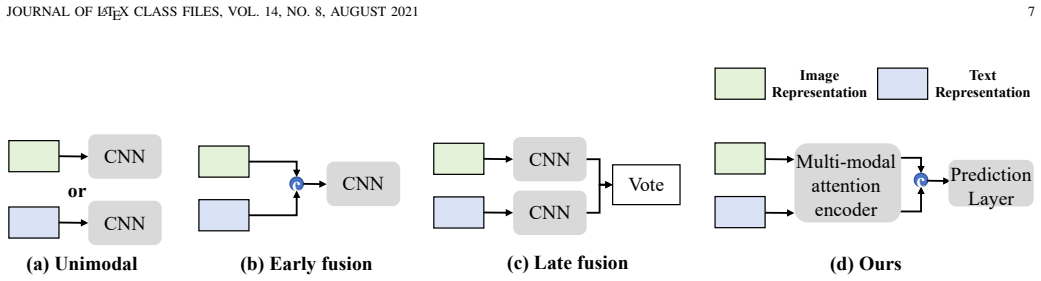
The central object is the Multimodal Dual-Attention Encoder: $N$ stacked transformer layers (here $N=2$, with 4 attention heads) in which the CLIP text embedding first undergoes self-attention, then text-to-image cross-attention, then the enhanced text is passed through an MLP and used as the query for image-to-text cross-attention. Each branch is residual-connected and layer-normalized, and the final image and text representations are concatenated and fed to a linear projection for classification. This bidirectional attention is the component the paper credits for integrating the modalities, and it is the object whose removal (no-CAtt), partial removal (ICAtt, TCAtt), and full presence (Ours) structure the experimental comparisons.
What would settle it
Train the no-CAtt transformer architecture on images alone, or with randomly permuted VLM captions, at matched parameter count; if its accuracy matches the full model's on AID or PatternNet, the claimed contribution of dual cross-attention fusion is not supported.
Extended reading notes
Core claim
The paper's claim is that textual descriptions produced zero-shot by a pretrained vision-language model, without fine-tuning, can be fused with image features by a dual cross-attention encoder so that the combined representation classifies remote sensing scenes better than either modality alone or than simple concatenation or voting fusion. The mechanism lets text tokens attend to image patches and image patches attend back to text tokens across transformer layers, then concatenates the refined representations for a linear classifier. The paper reports that the full model outperforms all baselines and ablations on AID, PatternNet, Million-AID Level 2, Million-AID Level 3, and DeepGlobe, with overall accuracy gains up to 11.6% over the best baseline. It also reports 99.3% overall accuracy with VLM captions versus 96.4% with human captions on the UCM-captioning dataset, and gains for zero-shot inference on AID.
Load-bearing premise
The load-bearing premise is that the accuracy gains come from fusing VLM text with images through dual cross-attention; the ablation labeled no-CAtt already replaces the CNN baseline heads with a Transformer attention stack, so if the extra performance is simply the stronger architecture, the central claim fails.
Editorial extensions
If this is right
- If the central claim holds, remote sensing scene classification can draw on VLM-generated text as a zero-cost auxiliary modality, removing the main obstacle to using text in this task: manual annotation.
- The reported results imply that cross-attention in both directions adds value beyond self-attention alone, since removing either direction lowers accuracy relative to the full model.
- The results imply that VLM descriptions carry at least as much discriminative signal as human captions, so annotation pipelines for scene classification could be automated without sacrificing accuracy.
- The zero-shot experiments imply that the multimodal representation transfers to unseen classes better than an image-only representation, which would make the framework useful for open-set or newly emerging land-cover classes.
Reading between the lines
- Editorial inference: the reported improvement over the CNN baselines may substantially reflect an architecture change rather than the fusion itself, because the no-CAtt ablation already replaces the two-layer CNN heads with a Transformer attention stack; a Transformer image-only or early-fusion baseline matched in capacity would be needed to isolate the contribution of dual cross-attention.
- Editorial inference: the VLM-versus-human caption comparison uses the longest of five human captions as the human-annotated condition, so the 2.9% margin may depend on that choice and on the template prompt the authors designed for LLaVA, rather than being a general statement that VLM text always beats human text.
- Editorial inference: in the zero-shot experiment, label attributes are expanded by an LLM and the projection layer is removed from the frozen model, so the improvement over the image-based baseline could come partly from richer label attributes rather than from the multimodal fusion alone.
Editorial analysis
A structured set of objections, weighed in public.
Referee Report
Summary. The paper proposes a multimodal remote sensing scene classification (RSSC) framework that pairs images with VLM-generated text descriptions and fuses them through a dual cross-attention encoder. The text is produced by LLaVA using a prompt that asks for a scene classification statement. Experiments on AID, PatternNet, Million-AID, DeepGlobe, and UCM-captioning report consistent improvements over four self-defined baselines, ablations that remove one or both cross-attention directions, and a comparison between VLM captions and human captions. A zero-shot classification experiment is also reported. The main finding is that the prompt leaks the class label into the text modality, so the experimental evidence does not currently support the paper's claims.
Significance. The idea of replacing costly manual captions with VLM-generated text as an auxiliary modality is timely, and the proposed architecture is modular and clearly described. The paper provides code, 5-fold cross-validation with standard deviations, and ablation studies. However, the significance of the empirical contribution is undermined by a label-leakage confound in the text generation prompt, by weak baselines, and by an architectural confound that conflates Transformer-based heads with cross-modal fusion. If the authors revise the prompt to avoid classification statements, add stronger baselines, and run a no-cross-attention control matched in capacity, the framework could be a useful contribution. As it stands, the reported gains cannot be attributed to the proposed fusion mechanism.
major comments (4)
- [Section III-A, Table I] The prompt in Section III-A instructs LLaVA to end each description with 'Overall, this scene can be classified as [primary land cover classification] or secondary land cover classification if needed.' The examples in Fig. 1 confirm that the generated texts contain direct class guesses (e.g., 'urban or commercial area', 'urban or industrial area'). Because the text modality therefore often contains the ground-truth label or a near-synonym, every multimodal variant in Table I receives a soft label source. The comparison against Image-Only (IO) is consequently not a test of multimodal fusion, and the large margins (1.4% to 11.6%) may reflect the model's ability to exploit the leaked label rather than the value of dual cross-attention. I request that the authors either remove the classification sentence from the prompt or run a control experiment in which a text-only model is trained on the final sentence alone, and report whether the performance gap persists.
- [Section V-A, Table I (no CAtt)] The no CAtt ablation, which removes all cross-modal attention, already improves over the best baseline by 0.5% to 8.6% (Section V-A). The paper attributes this to 'the Transformer-based approach outperforming CNN models.' This admission shows that the architectural change from two CNN layers to a multi-layer attention stack is a major source of the improvement over the four baselines. The full model's gain over no CAtt is only 0.2% to 3.1% across datasets, and on DeepGlobe the gain over TCAtt is 1.6%. Thus the experiments do not isolate the contribution of the dual cross-attention mechanism. A matched-capacity Transformer-based unimodal baseline and a no-CAtt variant with comparable parameters are needed before one can attribute the results to cross-modal fusion.
- [Section IV-B and V-A] The baselines (IO, TO, EF, LF) are simple CNN head architectures defined in Section IV-B; they do not include any recent RSSC method, any ViT-based unimodal classifier, or any existing attention-based multimodal fusion approach. The claim in Section V-A that the proposed model 'consistently achieves the best performance across all experimental settings' is therefore restricted to these self-defined baselines. The authors should compare against at least one strong state-of-the-art unimodal RSSC model (e.g., a pretrained ViT or the LG-ViT cited in Related Work) and one standard cross-modal attention baseline, so that the practical significance of the proposed method is established.
- [Section V-A, Table II] The comparison of VLM captions and human-annotated captions is confounded by the prompt design. Human captions in the UCM-captioning dataset are not required to state a class, whereas the VLM prompt explicitly requires a classification statement. Additionally, the rule for selecting the human caption ('selecting the longest of the five available captions') is arbitrary and may systematically select less classification-oriented descriptions. The 2.9% OA advantage for VLM captions in Table II is therefore not evidence that VLM descriptions are semantically richer; it is consistent with the label-leakage explanation. The authors should either use a VLM prompt that does not request a class label, or apply the same classification-ending template to the human captions.
minor comments (5)
- [Section IV-A] The heading 'Dataset Decription' should read 'Dataset Description'.
- [Section III-D, Eq. (4)] The notation 'di k' and 'K i t' is inconsistent; please use the same subscript style as in Eq. (2).
- [Section III-A] The manuscript does not specify the LLaVA version or model size used for description generation; this information is needed for reproducibility.
- [Fig. 2] The text 'A&N' appears in several blocks without explanation; it likely denotes Add & Norm, but should be labeled clearly.
- [Section IV-A] The DeepGlobe patch selection threshold of 75% dominant class area is a heuristic; please justify it and report sensitivity to this threshold.
Circularity Check
VLM prompt forces generated captions to state the scene class, so the text modality leaks the classification label and the reported fusion/VLM-text gains are partly circular.
-
self definitional
[Section III-A (VLM-based Description Generation), Figure 1; used by Section V-A (Comparison with baselines)]
"Sentence Template: ''There are areas of land cover type 1, land cover type 2, additional objects or features as needed. Overall, this scene can be classified as [primary land cover classification] or secondary land cover classification if needed.'' ... Examples of the descriptions generated by LLaV A can be found in Fig. 1."
The auxiliary text modality is generated with a template that requires the VLM to state the scene classification. Figure 1 confirms the texts contain direct class guesses (e.g., 'this scene can be classified as an urban or commercial area'). The downstream classifier then receives, as an input feature, a sentence that often names the target label. The 'multimodal' predictions are therefore partly obtained by reading the answer from the generated text, so the claimed superiority of the dual cross-attention fusion over Image-Only is not an independent test of fusion.
-
self definitional
[Section V-A (Comparison of different text sources), Table II]
"The experimental results in Table II reveal that our model utilizing VLM-generated descriptions outperforms the version using human-annotated captions by a margin of 2.9%. This improvement suggests that VLM-generated descriptions can provide more effective textual information than simple human annotations."
The comparison is confounded by construction: VLM captions are produced with the 'this scene can be classified as ...' template, while the human-annotated UCM captions are ordinary descriptions that are not forced to name the class. Thus the 2.9% margin largely reflects the label-stating prompt asymmetry rather than the intrinsic quality of VLM text as a semantic modality.
full rationale
This paper contains no equation-level derivation, so the classic circularity routes (fitted parameters renamed as predictions, self-citation load-bearing, imported uniqueness theorems) are absent. The circularity is in the experimental construction: Section III-A instructs LLaVA to end every description with an explicit classification sentence, and Figure 1 shows the resulting texts contain the target class or a close synonym. Since the same text is fed to every multimodal baseline, ablation, and the proposed model, the comparisons against Image-Only, and especially the VLM-caption-versus-human-caption comparison, measure label leakage as much as fusion quality. The architecture confound (Transformer attention stack in the ablations versus CNN heads in the baselines) is a secondary validity issue, not a circularity. Overall, the central empirical claim--that dual cross-attention fusion of VLM text improves RSSC--is partially forced by the prompt design, so the paper is substantially circular in its evaluation, but not formally circular in its equations.
Assumptions & free parameters
free parameters (4)
- VLM prompt template =
Template in Section III-A that requests a classification sentence
- DeepGlobe patch purity threshold =
75%
- Human caption selection rule =
Longest of five captions
- Multimodal encoder depth and heads =
N=2 layers, 4 heads
assumptions (4)
- domain assumption LLaVA-generated descriptions are sufficiently accurate and informative despite known hallucination failure modes.
- ad hoc to paper The prompt template that asks LLaVA to output a primary and secondary classification produces text that is a valid complementary modality.
- ad hoc to paper DeepGlobe patches with over 75% dominant class area are a valid proxy for the original six-class land cover task.
- domain assumption Frozen ImageNet-pretrained ViT and CLIP text encoder features are sufficiently aligned for cross-attention fusion on remote sensing images.
Cite this review
Pith. "Pith review of Multimodal Remote Sensing Scene Classification Using VLMs and Dual-Cross Attention Networks." pith.science (2026). https://pith.science/paper/5XEJ6PJF
@misc{pith2026241202531,
  author       = {Pith},
  title        = {Pith review of: Multimodal Remote Sensing Scene Classification Using VLMs and Dual-Cross Attention Networks},
  year         = {2026},
  howpublished = {\url{https://pith.science/paper/5XEJ6PJF}},
  note         = {Machine review of arXiv:2412.02531}
}
read the original abstract
Remote sensing scene classification (RSSC) is a critical task with diverse applications in land use and resource management. While unimodal image-based approaches show promise, they often struggle with limitations such as high intra-class variance and inter-class similarity. Incorporating textual information can enhance classification by providing additional context and semantic understanding, but manual text annotation is labor-intensive and costly. In this work, we propose a novel RSSC framework that integrates text descriptions generated by large vision-language models (VLMs) as an auxiliary modality without incurring expensive manual annotation costs. To fully leverage the latent complementarities between visual and textual data, we propose a dual cross-attention-based network to fuse these modalities into a unified representation. Extensive experiments with both quantitative and qualitative evaluation across five RSSC datasets demonstrate that our framework consistently outperforms baseline models. We also verify the effectiveness of VLM-generated text descriptions compared to human-annotated descriptions. Additionally, we design a zero-shot classification scenario to show that the learned multimodal representation can be effectively utilized for unseen class classification. This research opens new opportunities for leveraging textual information in RSSC tasks and provides a promising multimodal fusion structure, offering insights and inspiration for future studies. Code is available at: https://github.com/CJR7/MultiAtt-RSSC
Figures


Figures from the paper (5 more)


Reference graph
Works this paper leans on
-
[1]
Deep learning for remote sensing image scene classification: A review and meta-analysis,
A. Thapa, T. Horanont, B. Neupane, and J. Aryal, “Deep learning for remote sensing image scene classification: A review and meta-analysis,” Remote Sensing, vol. 15, no. 19, p. 4804, 2023
2023
-
[2]
Scene and environment monitoring using aerial imagery and deep learning,
M. M. D. Oghaz, M. Razaak, H. Kerdegari, V . Argyriou, and P. Re- magnino, “Scene and environment monitoring using aerial imagery and deep learning,” in 2019 15th International Conference on Distributed Computing in Sensor Systems (DCOSS) . IEEE, 2019, pp. 362–369
work page 2019
-
[3]
Spatial context-aware method for urban land use classification using street view images,
F. Fang, L. Zeng, S. Li, D. Zheng, J. Zhang, Y . Liu, and B. Wan, “Spatial context-aware method for urban land use classification using street view images,” ISPRS Journal of Photogrammetry and Remote Sensing , vol. 192, pp. 1–12, 2022
work page 2022
-
[4]
Y . Su, Y . Zhong, Q. Zhu, and J. Zhao, “Urban scene understanding based on semantic and socioeconomic features: From high-resolution remote sensing imagery to multi-source geographic datasets,” ISPRS Journal of Photogrammetry and Remote Sensing , vol. 179, pp. 50–65, 2021
work page 2021
-
[5]
Y . Gu, Y . Wang, and Y . Li, “A survey on deep learning-driven remote sensing image scene understanding: Scene classification, scene retrieval and scene-guided object detection,” Applied sciences, vol. 9, no. 10, p. 2110, 2019
work page 2019
-
[6]
J. A. dos Santos, O. A. Penatti, and R. d. S. Torres, “Evaluating the potential of texture and color descriptors for remote sensing image retrieval and classification,” in International conference on computer vision theory and applications , vol. 2. SCITEPRESS, 2010, pp. 203– 208
work page 2010
-
[7]
Indexing of remote sensing images with different resolutions by multiple features,
B. Luo, S. Jiang, and L. Zhang, “Indexing of remote sensing images with different resolutions by multiple features,”IEEE Journal of Selected Topics in Applied Earth Observations and Remote Sensing, vol. 6, no. 4, pp. 1899–1912, 2013
work page 1912
-
[8]
G. Sheng, W. Yang, T. Xu, and H. Sun, “High-resolution satellite scene classification using a sparse coding based multiple feature combination,” International journal of remote sensing , vol. 33, no. 8, pp. 2395–2412, 2012
work page 2012
Show all 45 references
-
[9]
Remote sensing image scene classification meets deep learning: Challenges, methods, benchmarks, and opportunities,
G. Cheng, X. Xie, J. Han, L. Guo, and G.-S. Xia, “Remote sensing image scene classification meets deep learning: Challenges, methods, benchmarks, and opportunities,” IEEE Journal of Selected Topics in Applied Earth Observations and Remote Sensing , vol. 13, pp. 3735– 3756, 2020
2020
-
[10]
Scene classification based on multiscale convolutional neural network,
Y . Liu, Y . Zhong, and Q. Qin, “Scene classification based on multiscale convolutional neural network,” IEEE Transactions on Geoscience and Remote Sensing, vol. 56, no. 12, pp. 7109–7121, 2018
2018
-
[11]
Gan-based semisupervised scene classifi- cation of remote sensing image,
D. Guo, Y . Xia, and X. Luo, “Gan-based semisupervised scene classifi- cation of remote sensing image,” IEEE Geoscience and Remote Sensing Letters, vol. 18, no. 12, pp. 2067–2071, 2020
2020
-
[12]
Scvit: A spatial-channel feature preserving vision transformer for remote sensing image scene classification,
P. Lv, W. Wu, Y . Zhong, F. Du, and L. Zhang, “Scvit: A spatial-channel feature preserving vision transformer for remote sensing image scene classification,” IEEE Transactions on Geoscience and Remote Sensing , vol. 60, pp. 1–12, 2022
2022
-
[13]
Vision transformer with contrastive learning for remote sensing image scene classification,
M. Bi, M. Wang, Z. Li, and D. Hong, “Vision transformer with contrastive learning for remote sensing image scene classification,”IEEE Journal of Selected Topics in Applied Earth Observations and Remote Sensing, vol. 16, pp. 738–749, 2022
2022
-
[14]
Deep learning-a new approach for multi-label scene classification in plan- etscope and sentinel-2 imagery,
I. Shendryk, Y . Rist, R. Lucas, P. Thorburn, and C. Ticehurst, “Deep learning-a new approach for multi-label scene classification in plan- etscope and sentinel-2 imagery,” in IGARSS 2018-2018 IEEE Interna- tional Geoscience and Remote Sensing Symposium . IEEE, 2018, pp. 1116–1119
2018
-
[15]
A multi- level label-aware semi-supervised framework for remote sensing scene classification,
Q. Liu, M. He, Y . Kuang, L. Wu, J. Yue, and L. Fang, “A multi- level label-aware semi-supervised framework for remote sensing scene classification,” IEEE Transactions on Geoscience and Remote Sensing , 2023
2023
-
[16]
He and Q
Y . He and Q. Weng, High spatial resolution remote sensing: data, analysis, and applications . CRC press, 2018
2018
-
[17]
A lightweight multi-scale crossmodal text-image retrieval method in remote sensing,
Z. Yuan, W. Zhang, X. Rong, X. Li, J. Chen, H. Wang, K. Fu, and X. Sun, “A lightweight multi-scale crossmodal text-image retrieval method in remote sensing,” IEEE Transactions on Geoscience and Remote Sensing, vol. 60, pp. 1–19, 2021
2021
-
[18]
Multi-label semantic feature fusion for remote sensing image captioning,
S. Wang, X. Ye, Y . Gu, J. Wang, Y . Meng, J. Tian, B. Hou, and L. Jiao, “Multi-label semantic feature fusion for remote sensing image captioning,” ISPRS Journal of Photogrammetry and Remote Sensing , vol. 184, pp. 1–18, 2022
2022
-
[19]
Teaw: Text-aware few-shot remote sensing image scene classification,
K. Cheng, C. Yang, Z. Fan, D. Wu, and N. Guan, “Teaw: Text-aware few-shot remote sensing image scene classification,” in ICASSP 2023- 2023 IEEE International Conference on Acoustics, Speech and Signal Processing (ICASSP). IEEE, 2023, pp. 1–5
2023
-
[20]
Remoteclip: A vision language foundation model for remote sensing,
F. Liu, D. Chen, Z. Guan, X. Zhou, J. Zhu, Q. Ye, L. Fu, and J. Zhou, “Remoteclip: A vision language foundation model for remote sensing,” IEEE Transactions on Geoscience and Remote Sensing , 2024
2024
-
[21]
Land-cover classification with high-resolution remote sensing images using transferable deep models,
X.-Y . Tong, G.-S. Xia, Q. Lu, H. Shen, S. Li, S. You, and L. Zhang, “Land-cover classification with high-resolution remote sensing images using transferable deep models,” Remote Sensing of Environment , vol. 237, p. 111322, 2020
2020
-
[22]
A dual- model architecture with grouping-attention-fusion for remote sensing scene classification,
J. Shen, T. Zhang, Y . Wang, R. Wang, Q. Wang, and M. Qi, “A dual- model architecture with grouping-attention-fusion for remote sensing scene classification,” Remote Sensing, vol. 13, no. 3, p. 433, 2021
2021
-
[23]
Scene classification with recurrent attention of vhr remote sensing images,
Q. Wang, S. Liu, J. Chanussot, and X. Li, “Scene classification with recurrent attention of vhr remote sensing images,” IEEE Transactions on Geoscience and Remote Sensing, vol. 57, no. 2, pp. 1155–1167, 2018
2018
-
[24]
Classification of remote sensing images using efficientnet-b3 cnn model with attention,
H. Alhichri, A. S. Alswayed, Y . Bazi, N. Ammour, and N. A. Alajlan, “Classification of remote sensing images using efficientnet-b3 cnn model with attention,” IEEE access, vol. 9, pp. 14 078–14 094, 2021
2021
-
[25]
Rs-deepsuperlearner: fusion of cnn ensemble for remote sensing scene classification,
H. Alhichri, “Rs-deepsuperlearner: fusion of cnn ensemble for remote sensing scene classification,” Annals of GIS, vol. 29, no. 1, pp. 121–142, 2023
2023
-
[26]
Contextual spatial-channel attention network for remote sensing scene classification,
Y .-E. Hou, K. Yang, L. Dang, and Y . Liu, “Contextual spatial-channel attention network for remote sensing scene classification,” IEEE Geo- science and Remote Sensing Letters , 2023
2023
-
[27]
A local–global interactive vision trans- former for aerial scene classification,
T. Peng, J. Yi, and Y . Fang, “A local–global interactive vision trans- former for aerial scene classification,” IEEE Geoscience and Remote Sensing Letters, vol. 20, pp. 1–5, 2023
2023
-
[28]
Nir/rgb image fusion for scene classification using deep neural networks,
R. Soroush and Y . Baleghi, “Nir/rgb image fusion for scene classification using deep neural networks,” The Visual Computer , vol. 39, no. 7, pp. 2725–2739, 2023
2023
-
[29]
Mrssc: a benchmark dataset for multimodal remote sensing scene classification,
K. Liu, A. Wu, X. Wan, and S. Li, “Mrssc: a benchmark dataset for multimodal remote sensing scene classification,” The International Archives of the Photogrammetry, Remote Sensing and Spatial Informa- tion Sciences, vol. 43, pp. 785–792, 2021
2021
-
[30]
An optical image-aided approach for zero-shot sar image scene classifica- tion,
Y . Ma, J. Pei, X. Zhang, W. Huo, Y . Zhang, Y . Huang, and J. Yang, “An optical image-aided approach for zero-shot sar image scene classifica- tion,” in 2023 IEEE Radar Conference (RadarConf23) . IEEE, 2023, pp. 1–6
2023
-
[31]
Alignment and fusion using distinct sensor data for multimodal aerial scene classification,
X. Sun, J. Gao, and Y . Yuan, “Alignment and fusion using distinct sensor data for multimodal aerial scene classification,” IEEE Transactions on Geoscience and Remote Sensing , 2024
2024
-
[32]
Text2seg: Remote sensing image semantic segmentation via text-guided visual foundation models,
J. Zhang, Z. Zhou, G. Mai, M. Hu, Z. Guan, S. Li, and L. Mu, “Text2seg: Remote sensing image semantic segmentation via text-guided visual foundation models,” arXiv preprint arXiv:2304.10597 , 2023
2023
-
[33]
Parameter-efficient transfer learning for remote sensing image-text retrieval,
Y . Yuan, Y . Zhan, and Z. Xiong, “Parameter-efficient transfer learning for remote sensing image-text retrieval,” IEEE Transactions on Geoscience and Remote Sensing , 2023
2023
-
[34]
Interacting- enhancing feature transformer for cross-modal remote-sensing image and text retrieval,
X. Tang, Y . Wang, J. Ma, X. Zhang, F. Liu, and L. Jiao, “Interacting- enhancing feature transformer for cross-modal remote-sensing image and text retrieval,” IEEE Transactions on Geoscience and Remote Sensing, vol. 61, pp. 1–15, 2023
2023
-
[35]
Few-shot remote sensing image scene classification: Recent advances, new baselines, and future trends,
C. Qiu, X. Zhang, X. Tong, N. Guan, X. Yi, K. Yang, J. Zhu, and A. Yu, “Few-shot remote sensing image scene classification: Recent advances, new baselines, and future trends,” ISPRS Journal of Photogrammetry and Remote Sensing , vol. 209, pp. 368–382, 2024
2024
-
[36]
Few-shot medical image classification with simple shape and texture text descriptors using vision- language models,
M. Byra, M. F. Rachmadi, and H. Skibbe, “Few-shot medical image classification with simple shape and texture text descriptors using vision- language models,” arXiv preprint arXiv:2308.04005 , 2023
2023 arXiv
-
[37]
Vision-language model for generating textual descriptions from clinical images: model development and validation study,
J. Ji, Y . Hou, X. Chen, Y . Pan, and Y . Xiang, “Vision-language model for generating textual descriptions from clinical images: model development and validation study,”JMIR Formative Research, vol. 8, p. e32690, 2024
2024
-
[38]
Medical image understanding with pretrained vision language models: A comprehensive study,
Z. Qin, H. Yi, Q. Lao, and K. Li, “Medical image understanding with pretrained vision language models: A comprehensive study,” 2023. [Online]. Available: https://openreview.net/forum?id=txlWziuCE5W
2023
-
[39]
Vlm- cpl: Consensus pseudo labels from vision-language models for hu- man annotation-free pathological image classification,
L. Zhong, X. Liao, S. Zhang, X. Zhang, and G. Wang, “Vlm- cpl: Consensus pseudo labels from vision-language models for hu- man annotation-free pathological image classification,” arXiv preprint arXiv:2403.15836, 2024
2024 arXiv
-
[40]
Improved zero-shot classification by adapting vlms with text descriptions,
O. Saha, G. Van Horn, and S. Maji, “Improved zero-shot classification by adapting vlms with text descriptions,” in Proceedings of the IEEE/CVF Conference on Computer Vision and Pattern Recognition , 2024, pp. 17 542–17 552
2024
-
[41]
Exploiting lmm-based knowledge for image classification tasks,
M. Tzelepi and V . Mezaris, “Exploiting lmm-based knowledge for image classification tasks,” in International Conference on Engineering Applications of Neural Networks . Springer, 2024, pp. 166–177
2024
-
[42]
Visual instruction tuning,
H. Liu, C. Li, Q. Wu, and Y . J. Lee, “Visual instruction tuning,” Advances in neural information processing systems , vol. 36, 2024. JOURNAL OF LATEX CLASS FILES, VOL. 14, NO. 8, AUGUST 2021 14
2024
-
[43]
An image is worth 16x16 words: Transformers for image recognition at scale,
A. Dosovitskiy, L. Beyer, A. Kolesnikov, D. Weissenborn, X. Zhai, T. Unterthiner, M. Dehghani, M. Minderer, G. Heigold, S. Gelly et al., “An image is worth 16x16 words: Transformers for image recognition at scale,” arXiv preprint arXiv:2010.11929 , 2020
2010 arXiv
-
[44]
Learning transferable visual models from natural language supervision,
A. Radford, J. W. Kim, C. Hallacy, A. Ramesh, G. Goh, S. Agarwal, G. Sastry, A. Askell, P. Mishkin, J. Clark et al., “Learning transferable visual models from natural language supervision,” in International conference on machine learning . PMLR, 2021, pp. 8748–8763
2021
-
[45]
Segment anything,
A. Kirillov, E. Mintun, N. Ravi, H. Mao, C. Rolland, L. Gustafson, T. Xiao, S. Whitehead, A. C. Berg, W.-Y . Loet al., “Segment anything,” in Proceedings of the IEEE/CVF International Conference on Computer Vision, 2023, pp. 4015–4026
2023
Reviewed August 11, 2026 · model on record in the stance chip above.
Discussion (0). Continue with ORCID to comment.