REVIEW 34 references
Mobile Cell-Free Massive MIMO with Multi-Agent Reinforcement Learning: A Scalable Framework
T0 review · reviewed 2026-08-11 · deepseek-v4-flash
Pith's one-line read A scalable multi-agent reinforcement learning framework jointly optimizes UAV mobility and downlink power control in mobile cell-free massive MIMO, reporting sum spectral-efficiency gains of up to 45.97% over standard MADDPG.
desk verdict The action-decomposition idea is real, but the reported SE gains are confounded by an inner-loop reward search that the baselines don't get. read the letter →
The pith
A machine-rendered reading of the paper's core claim, the machinery that carries it, and where it could break.
The reading
What carries the argument
The load-bearing object is the SF-MADDPG framework and its three nested mechanisms: a GNN-aided communication architecture that updates each agent's observation by aggregating hidden states from neighboring agents; a dynamic hyper permutation network that separates entity-uncorrelated actions (mobility) into a permutation-invariant branch and entity-correlated actions (AP power and antenna power) into a permutation-equivariant branch, with hypernetworks generating customized weight matrices so the candidate solution space is not constrained; and a directional decoupling architecture that combines an attention-based intrinsic reward network with a hypernetwork-based mixed reward network to distribute the global sum-SE reward according to each agent's contribution. The permutation design is backed by a minimum-modification principle: making the input module permutation-invariant makes the invariant output module automatically invariant, while the equivariant output module needs the original observation order as an additional input. The optimization target is the closed-form downlink sum spectral efficiency derived under MR precoding and channel hardening, where power decisions depend on large-scale fading coefficients rather than instantaneous small-scale fading.
What would settle it
A concrete falsifier would be to rerun the proposed framework with N=2 or N=4 antennas per mobile-AP while keeping the deployment otherwise identical, and to compare both large-scale-only policies and policies that also observe instantaneous CSI; if the reported sum-SE gains over MADDPG shrink or reverse, the channel-hardening assumption, rather than the architecture, is carrying the improvement.
Extended reading notes
Core claim
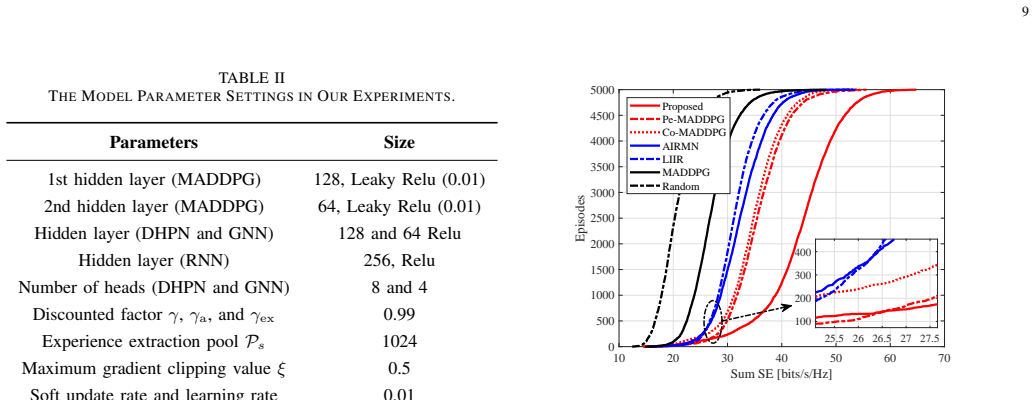
The paper establishes that a multi-agent reinforcement learning framework can jointly solve mobility and downlink power control for a cell-free massive MIMO system whose access points are mobile UAVs, and that the architecture's three components work together: a GNN-aided communication layer lets agents share neighbor information, a dynamic hyper permutation network compresses the state-action space by exploiting permutation invariance for mobility actions and permutation equivariance for power actions, and a directional decoupling architecture with an attention-based intrinsic reward network assigns credit to individual agents. The paper reports that this SF-MADDPG framework improves sum spectral efficiency by 45.97% over MADDPG, 25.29% over AIRMN, 18.79% over Co-MADDPG, and 14.41% over Pe-MADDPG under the joint architecture, while also converging about 43.5% faster than MADDPG. It further reports that the performance gap over permutation-only and collaboration-only baselines stays near 10% as the number of mobile access points grows from 9 to 64, and that the gap over some baselines widens as the number of UEs grows. The paper interprets these results as showing that mobility-enabled channel reconstruction, permutation-based observation compression, and contribution-based reward partitioning are jointly responsible for the gains.
Load-bearing premise
The whole optimization runs on the channel-hardening premise: the normalized instantaneous channel gain is taken to converge to its deterministic average, so power decisions can be made from large-scale fading coefficients alone, and the authors rely on adding antennas per mobile-AP to make outdated decisions harmless; in the simulations most mobile-APs use only N=8 antennas, which may be too few for that premise to hold.
Editorial extensions
If this is right
- Sum spectral efficiency in mobile cell-free massive MIMO can be improved by roughly 46% over basic MADDPG, 25% over attention-based credit-assignment MARL, and 14% over permutation-based MARL when mobility, power control, GNN collaboration, and reward decomposition are jointly used.
- Compressing order-insensitive actions through permutation invariance cuts the observation dimension of those actions from O((K+L)L! + (NK)K!) to O(L + (NK)K!), which is the stated reason the framework converges about 43.5% faster than MADDPG.
- The joint mobility-and-power architecture yields higher sum SE than mobility-only control, with reported gains of 8.2% for SF-MADDPG, 15.31% for Pe-MADDPG, and 15.59% for AIRMN when power actions are added.
- The performance advantage over permutation-only and collaboration-only baselines remains roughly constant as the number of mobile APs scales from 9 to 64, and it grows with the number of UEs, up to a 14.69% gap over one baseline, indicating that credit assignment matters more in UE-dense deployments.
- The framework outperforms centralized multidimensional graph neural network baselines by 21.87% to 31.81%, which the paper attributes to the ability of mobile APs to reconstruct channels through movement rather than relying on global information at a fixed geometry.
Reading between the lines
- The paper's separation of actions into entity-uncorrelated and entity-correlated groups is a general design rule for distributed resource allocation: the same permutation-invariant/equivariant decomposition could be applied to RIS phase control, uplink power control, or user scheduling in cell-free networks.
- Because the reported gains over credit-assignment baselines widen with the number of UEs, a direct test is to vary the UE-to-AP ratio and inspect the intrinsic reward network's per-agent allocations; the framework's advantage should concentrate in regimes where contributions are most uneven.
- The channel-hardening premise suggests a stress test: if the same framework is trained with N=2 or N=4 antennas per mobile-AP, where hardening is much weaker, the reported gains over MADDPG would either persist, showing the architecture is robust, or shrink, showing the large-scale-fading approximation is doing the work.
- The comparison with centralized MDGNN implies that mobility is the main missing ingredient in fixed-geometry centralized learning; a natural extension would be to give MDGNN predicted mobility or position-aware inputs and see whether the centralized baseline closes the gap.
Signed reviews
Editorial analysis
A structured set of objections, weighed in public.
Circularity Check
Reported sum-SE gains are partly forced by Algorithm 1's inner loop, which selects actions by directly optimizing the same sum-SE metric used for evaluation.
-
fitted input called prediction
[Algorithm 1 (Sec. III-D), Algorithm 2 line 5 (Sec. IV-B), and Sec. V numerical comparison]
"Algorithm 1, step 8: 'Update sum reward r(i) ex,t = PK k=1 SE(i) k,t with generated actions [a(i) l,t,inv, a(i) l,t,equiv];' step 9: 'until r(i) ex,t < r(i) ex,t or i ⩾ Imax;' Algorithm 2, step 5: 'Obtain action information al,t generated by HDPN architecture with ol,t based on Algorithm 1.' Sec. V: 'the proposed SF-MADDPG yields a 45.97%, 25.29%, 18.79%, and 14.41% improvement in sum SE.'"
The action chosen at each decision step is not a single-shot policy output: Algorithm 1 iteratively generates candidate actions and evaluates them using the extrinsic sum-SE reward, i.e., precisely the metric reported in the numerical comparisons. The reported gains therefore do not isolate the claimed architecture combination (GNN communication, permutation, directional decoupling); part of the improvement is forced by construction because the method performs an online search over the objective function while the baselines are not described as having the same search budget. This is a fitted input (actions fitted to sum SE) being presented as an architectural prediction.
full rationale
Apart from the Algorithm 1 confound, the paper's SE expression is imported from the external reference [4] (not fitted to the results), and the RL comparison is an empirical benchmark rather than a derived law. Self-citations ([5], [17], [20]) are used as design antecedents and baselines, not as load-bearing uniqueness or derivation theorems; the 'Theorems' on permutation invariance/equivariance are definitional properties of composition, not circular predictions. The channel-hardening assumption is an assumption, not a circular step. Thus the central circularity burden is the inference-time reward-based action search in Algorithm 1, which makes the headline percentage gains partially reduce to direct access to the evaluation metric. If Imax were 1 at test time or baselines were given the same search budget, the architectural claim could be isolated; as written, the evidence is confounded.
Assumptions & free parameters
free parameters (6)
- Learning rate and soft update rate =
0.01
- Discount factors gamma, gamma_a, gamma_ex =
0.99
- Network hidden sizes and attention heads =
128/64/256, 8 and 4 heads
- Experience replay pool capacity =
1024
- Maximum gradient clipping value =
0.5
- Number of GNN layers J =
not reported
assumptions (6)
- domain assumption Channel hardening: normalized instantaneous channel gain converges to deterministic average gain, so power can be optimized using large-scale fading coefficients only.
- standard math Standard MMSE channel estimation and use-and-then-forget capacity bound from [4].
- domain assumption Correlated Rayleigh fading with covariance Rmk and large-scale fading beta_mk = L(d_mk).
- domain assumption TDD protocol with orthogonal pilots and tau_p = K.
- domain assumption The environment is Markov and each agent's partial observation plus GNN messages is sufficient for near-optimal policies.
- domain assumption MR precoding is used and the closed-form SE expression remains accurate.
invented entities (4)
-
Dynamic Hyper Permutation Network (DHPN)
-
Attention-based intrinsic reward network (ARN)
-
Hypernetwork-based mixed reward network (HRN)
-
GNN-aided communication architecture
Cite this review
Pith. "Pith review of Mobile Cell-Free Massive MIMO with Multi-Agent Reinforcement Learning: A Scalable Framework." pith.science (2026). https://pith.science/paper/NABAIEOK
@misc{pith2026241202581,
  author       = {Pith},
  title        = {Pith review of: Mobile Cell-Free Massive MIMO with Multi-Agent Reinforcement Learning: A Scalable Framework},
  year         = {2026},
  howpublished = {\url{https://pith.science/paper/NABAIEOK}},
  note         = {Machine review of arXiv:2412.02581}
}
read the original abstract
Cell-free massive multiple-input multiple-output (mMIMO) offers significant advantages in mobility scenarios, mainly due to the elimination of cell boundaries and strong macro diversity. In this paper, we examine the downlink performance of cell-free mMIMO systems equipped with mobile-APs utilizing the concept of unmanned aerial vehicles, where mobility and power control are jointly considered to effectively enhance coverage and suppress interference. However, the high computational complexity, poor collaboration, limited scalability, and uneven reward distribution of conventional optimization schemes lead to serious performance degradation and instability. These factors complicate the provision of consistent and high-quality service across all user equipments in downlink cell-free mMIMO systems. Consequently, we propose a novel scalable framework enhanced by multi-agent reinforcement learning (MARL) to tackle these challenges. The established framework incorporates a graph neural network (GNN)-aided communication mechanism to facilitate effective collaboration among agents, a permutation architecture to improve scalability, and a directional decoupling architecture to accurately distinguish contributions. In the numerical results, we present comparisons of different optimization schemes and network architectures, which reveal that the proposed scheme can effectively enhance system performance compared to conventional schemes due to the adoption of advanced technologies. In particular, appropriately compressing the observation space of agents is beneficial for achieving a better balance between performance and convergence.
Figures


Figures from the paper (5 more)


Reference graph
Works this paper leans on
-
[4]
Making cell-free massive MIMO competitive with MMSE processing and centralized implementation,
E. Bj ¨ornson and L. Sanguinetti, “Making cell-free massive MIMO competitive with MMSE processing and centralized implementation,” IEEE Trans. Wireless Commun. , vol. 19, no. 1, pp. 77–90, Jan. 2020
work page 2020
-
[1]
On the road to 6G: Visions, requirements, key technologies, and testbeds,
C.-X. Wang, X. You, X. Gao, X. Zhu, Z. Li, C. Zhang, H. Wang, Y . Huang, Y . Chen, H. Haas, J. S. Thompson, E. G. Larsson, M. D. Renzo, W. Tong, P. Zhu, X. Shen, H. V . Poor, and L. Hanzo, “On the road to 6G: Visions, requirements, key technologies, and testbeds,”IEEE Commun. Surveys Tuts., vol. 25, no. 2, pp. 905–974, Secondquarter 2023
work page 2023
-
[2]
Machine learning for large-scale optimization in 6G wireless networks,
Y . Shi, L. Lian, Y . Shi, Z. Wang, Y . Zhou, L. Fu, L. Bai, J. Zhang, and W. Zhang, “Machine learning for large-scale optimization in 6G wireless networks,” IEEE Commun. Surveys Tuts. , vol. 25, no. 4, pp. 2088–2132, Fourthquarter 2023
work page 2023
-
[3]
Prospective multiple antenna technologies for beyond 5G,
J. Zhang, E. Bj ¨ornson, M. Matthaiou, D. W. K. Ng, H. Yang, and D. J. Love, “Prospective multiple antenna technologies for beyond 5G,” IEEE J. Sel. Areas Commun. , vol. 38, no. 8, pp. 1637–1660, Aug. 2020
2020
-
[5]
Z. Liu, J. Zhang, Z. Liu, H. Du, Z. Wang, D. Niyato, M. Guizani, and B. Ai, “Cell-free XL-MIMO meets multi-agent reinforcement learning: Architectures, challenges, and future directions,” IEEE Wireless Com- mun., vol. 31, no. 4, pp. 155–162, Aug. 2024
work page 2024
-
[6]
Graph representation learning for wireless communications,
M. Mohsenivatani, S. Ali, V . Ranasinghe, N. Rajatheva, and M. Latva- Aho, “Graph representation learning for wireless communications,” IEEE Commun. Mag. , vol. 62, no. 1, pp. 141–147, Jan. 2024
work page 2024
-
[7]
J. S. Vardakas, K. Ramantas, E. Vinogradov, M. A. Rahman, A. Girycki, S. Pollin, S. Pryor, P. Chanclou, and C. Verikoukis, “Machine learning- based cell-free support in the O-RAN architecture: An innovative converged optical-wireless solution toward 6G networks,”IEEE Wireless Commun., vol. 29, no. 5, pp. 20–26, Oct. 2022
work page 2022
-
[8]
Design and optimization of RSMA for coexisting HTC/MTC in 6G and future networks,
S. Zhang, J. Liu, Z. Shi, J. Wang, and N. Kato, “Design and optimization of RSMA for coexisting HTC/MTC in 6G and future networks,” IEEE Trans. Wireless Commun., vol. 22, no. 12, pp. 9533–9548, Dec. 2023
work page 2023
Show all 34 references
-
[9]
Performance of cell-free massive MIMO with rician fading and phase shifts,
O. ¨Ozdogan, E. Bj ¨ornson, and J. Zhang, “Performance of cell-free massive MIMO with rician fading and phase shifts,” IEEE Trans. Wireless Commun., vol. 18, no. 11, pp. 5299–5315, Nov. 2019
2019
-
[10]
Uplink performance of RIS-aided cell-free massive MIMO system with electromagnetic interference,
E. Shi, J. Zhang, D. W. K. Ng, and B. Ai, “Uplink performance of RIS-aided cell-free massive MIMO system with electromagnetic interference,” IEEE J. Sel. Areas Commun. , vol. 41, no. 8, pp. 2431– 2445, Aug. 2023
2023
-
[11]
Air-ground collaborative resource optimization in UA V empowered cell-free massive MIMO systems,
L. Xu, Q. Zhu, W. Xia, T. Q. S. Quek, and H. Zhu, “Air-ground collaborative resource optimization in UA V empowered cell-free massive MIMO systems,” IEEE Trans. Commun., vol. 72, no. 4, pp. 2485–2499, Apr. 2024
2024
-
[12]
UxNB-enabled cell-free massive MIMO with HAPS-assisted Sub-THz backhauling,
O. Abbasi and H. Yanikomeroglu, “UxNB-enabled cell-free massive MIMO with HAPS-assisted Sub-THz backhauling,” IEEE Trans. Veh. Technol., vol. 73, no. 5, pp. 6937–6953, May. 2024. 13
2024
-
[13]
Analysis of UA V communications in cell-free massive MIMO systems,
C. D’Andrea, A. Garcia-Rodriguez, G. Geraci, L. G. Giordano, and S. Buzzi, “Analysis of UA V communications in cell-free massive MIMO systems,” IEEE Open J. Commun. Soc. , vol. 1, pp. 133–147, Jan. 2020
2020
-
[14]
Joint power control and LSFD for wireless-powered cell-free massive MIMO,
O. T. Demir and E. Bj ¨ornson, “Joint power control and LSFD for wireless-powered cell-free massive MIMO,” IEEE Trans. Wireless Com- mun., vol. 20, no. 3, pp. 1756–1769, Mar. 2021
2021
-
[15]
Joint power control and access point scheduling in fronthaul-constrained uplink cell-free massive MIMO systems,
M. Guenach, A. A. Gorji, and A. Bourdoux, “Joint power control and access point scheduling in fronthaul-constrained uplink cell-free massive MIMO systems,” IEEE Trans. Commun., vol. 69, no. 4, pp. 2709–2722, Apr. 2021
2021
-
[16]
Learning decentralized power control in cell-free massive MIMO networks,
D. Yu, H. Lee, S.-E. Hong, and S.-H. Park, “Learning decentralized power control in cell-free massive MIMO networks,” IEEE Trans. Veh. Technol., vol. 72, no. 7, pp. 9653–9658, Jul. 2023
2023
-
[17]
Double-layer power control for mobile cell-free XL-MIMO with multi-agent reinforcement learning,
Z. Liu, J. Zhang, Z. Liu, H. Xiao, and B. Ai, “Double-layer power control for mobile cell-free XL-MIMO with multi-agent reinforcement learning,” IEEE Trans. Wireless Commun., vol. 23, no. 5, pp. 4658–4674, May 2024
2024
-
[18]
In- teraction pattern disentangling for multi-agent reinforcement learning,
S. Liu, J. Song, Y . Zhou, N. Yu, K. Chen, Z. Feng, and M. Song, “In- teraction pattern disentangling for multi-agent reinforcement learning,” IEEE Trans. Pattern Anal. Mach. Intell., vol. 46, no. 12, pp. 8157–8172, Dec. 2024
2024
-
[19]
Emergent communication in multi-agent reinforcement learning for future wireless networks,
M. Chafii, S. Naoumi, R. Alami, E. Almazrouei, M. Bennis, and M. Debbah, “Emergent communication in multi-agent reinforcement learning for future wireless networks,” IEEE Internet Things Mag. , vol. 6, no. 4, pp. 18–24, Dec. 2023
2023
-
[20]
Graph neural network meets multi-agent reinforcement learning: fundamentals, applications, and future directions,
Z. Liu, J. Zhang, E. Shi, Z. Liu, D. Niyato, B. Ai, and X. S. Shen, “Graph neural network meets multi-agent reinforcement learning: fundamentals, applications, and future directions,” IEEE Wireless Commun. , early access, 2024
2024
-
[21]
Multi-agent graph-attention communication and teaming,
Y . Niu, R. R. Paleja, and M. C. Gombolay, “Multi-agent graph-attention communication and teaming,” in AAMAS, 2021
2021
-
[22]
Graph neural networks for wireless communications: From theory to practice,
Y . Shen, J. Zhang, S. H. Song, and K. B. Letaief, “Graph neural networks for wireless communications: From theory to practice,” IEEE Trans. Wireless Commun., vol. 22, no. 5, pp. 3554–3569, May 2023
2023
-
[23]
The road to 6G: Ten physical layer chal- lenges for communications engineers,
M. Matthaiou, O. Yurduseven, H. Q. Ngo, D. Morales-Jimenez, S. L. Cotton, and V . F. Fusco, “The road to 6G: Ten physical layer chal- lenges for communications engineers,” IEEE Communications Maga- zine, vol. 59, no. 1, pp. 64–69, Jan. 2021
2021
-
[24]
Deep reinforcement learning: A brief survey,
K. Arulkumaran, M. P. Deisenroth, M. Brundage, and A. A. Bharath, “Deep reinforcement learning: A brief survey,” IEEE Signal Process. Mag., vol. 34, no. 6, pp. 26–38, Nov. 2017
2017
-
[25]
Decentralized computation offloading with cooperative UA Vs: Multi-agent deep reinforcement learning perspective,
S. Hwang, H. Lee, J. Park, and I. Lee, “Decentralized computation offloading with cooperative UA Vs: Multi-agent deep reinforcement learning perspective,”IEEE Wireless Commun., vol. 29, no. 4, pp. 24–31, Aug. 2022
2022
-
[26]
Multi-agent reinforcement learning-based joint precoding and phase shift optimization for RIS- aided cell-free massive MIMO systems,
Y . Zhu, E. Shi, Z. Liu, J. Zhang, and B. Ai, “Multi-agent reinforcement learning-based joint precoding and phase shift optimization for RIS- aided cell-free massive MIMO systems,” IEEE Trans. Veh. Technol. , vol. 73, no. 9, pp. 14 015–14 020, Sep. 2024
2024
-
[27]
Effective commu- nications: A joint learning and communication framework for multi- agent reinforcement learning over noisy channels,
T.-Y . Tung, S. Kobus, J. P. Roig, and D. G ¨und¨uz, “Effective commu- nications: A joint learning and communication framework for multi- agent reinforcement learning over noisy channels,” IEEE J. Sel. Areas Commun., vol. 39, no. 8, pp. 2590–2603, Aug. 2021
2021
-
[28]
Learning random access schemes for massive machine-type communication with MARL,
M. A. Jadoon, A. Pastore, M. Navarro, and A. Valcarce, “Learning random access schemes for massive machine-type communication with MARL,” IEEE Trans. Mach. Learn. Commun. Netw., vol. 2, pp. 95–109, 2024
2024
-
[29]
Permutation invariant policy optimization for mean-field multi-agent re- inforcement learning: A principled approach,
Y . Li, L. Wang, J. Yang, E. Wang, Z. Wang, T. Zhao, and H. Zha, “Permutation invariant policy optimization for mean-field multi-agent re- inforcement learning: A principled approach,” arXiv:2105.08268, 2021
2021 arXiv
-
[30]
Boosting multiagent reinforcement learning via permutation invariant and permutation equivariant networks,
J. Hao, X. Hao, H. Mao, W. Wang, Y . Yang, D. Li, Y . Zhang, and Z. Wang, “Boosting multiagent reinforcement learning via permutation invariant and permutation equivariant networks,” in ICLR, 2023
2023
-
[31]
LIIR: Learn- ing individual intrinsic reward in multi-agent reinforcement learning,
Y . Du, L. Han, M. Fang, J. Liu, T. Dai, and D. Tao, “LIIR: Learn- ing individual intrinsic reward in multi-agent reinforcement learning,” NeurIPS, vol. 32, 2019
2019
-
[32]
Generating individual intrinsic reward for cooperative multiagent reinforcement learning,
H. Wu, H. Li, J. Zhang, Z. Wang, and J. Zhang, “Generating individual intrinsic reward for cooperative multiagent reinforcement learning,” International Journal of Advanced Robotic Systems, vol. 18, no. 5, 2021
2021
-
[33]
Attention-based intrinsic reward mixing network for credit assignment in multi-agent reinforcement learning,
W. Li, W. Liu, S. Shao, S. Huang, and A. Song, “Attention-based intrinsic reward mixing network for credit assignment in multi-agent reinforcement learning,” IEEE Trans. Games , vol. 16, no. 2, pp. 270– 281, Jun. 2024
2024
-
[34]
Multidimensional graph neural networks for wireless communications,
S. Liu, J. Guo, and C. Yang, “Multidimensional graph neural networks for wireless communications,” IEEE Trans. Wireless Commun., vol. 23, no. 4, pp. 3057–3073, Apr. 2024
2024
Reviewed August 11, 2026 · model on record in the stance chip above.
Discussion (0). Continue with ORCID to comment.