REVIEW 5 major objections 6 minor 97 references
Optimized CNNs for Rapid 3D Point Cloud Object Recognition
T0 review · 5 major / 6 minor · reviewed 2026-08-11 · deepseek-v4-flash
Pith's one-line read The paper claims that three-layer sparse voting CNNs with L1 regularization beat the prior state of the art on the MVTec 3D-AD point-cloud benchmark.
desk verdict The advertised sparse-voting L1 CNN never appears in the experiments; the paper evaluates a GCN on FPFH + multi-view ResNet features for anomaly detection, making the central claim unsupported. read the letter →
The pith
A machine-rendered reading of the paper's core claim, the machinery that carries it, and where it could break.
The reading
What carries the argument
The advertised mechanism is the feature-centric voting rule from Vote3D, which the paper claims can be implemented as sparse convolutional filters that touch only occupied voxels, together with an L1 penalty on activations to enforce intermediate sparsity. In the full text, the operational layer is presented as a graph convolution with $H^{(l)} = \sigma(\tilde{D}^{-1/2}\tilde{A}\tilde{D}^{-1/2}H^{(l-1)}W^{(l)})$, where the adjacency comes from k-nearest neighbors, and no voting or L1 term appears. The graph convolution is what carries the reported experiments; the voting-plus-L1 description carries the abstract's contribution claim.
What would settle it
Train the network exactly as the abstract specifies (a three-layer vote-based sparse CNN with an L1 penalty on activations) on the MVTec 3D-AD data and measure I-ROC and P-PRO; if the resulting scores do not reach 95.15% I-ROC and 92.93% P-PRO, or if the only architecture that reaches those numbers is the FPFH-plus-ResNet graph-convolution network in the full text, then the central claim is refuted.
Extended reading notes
Core claim
The paper's central claim is that feature-centric voting can be generalized from the handcrafted Vote3D detector to learned convolutional layers, so that computation scales with occupied cells rather than the full 3D grid, and that adding an L1 penalty on filter activations preserves this sparsity across intermediate layers. A three-layer network built this way, referred to as Vote3Deep, is asserted to achieve state-of-the-art accuracy on the MVTec 3D-AD benchmark, improving average precision by up to 40% over prior laser-based methods while maintaining competitive processing speed. The authors intend this as evidence that native 3D sparse convolution can replace 2D projection and dense volumetric processing in real-time object detection.
Load-bearing premise
The central claim rests on the assumption that the graph convolution in equation (9) is the sparse, feature-voting convolutional layer described in the abstract, and that the L1 penalty is part of the training objective; the paper's equations and experiment section provide no voting rule and no L1 loss term.
Editorial extensions
If this is right
- If the voting-based sparse layers and L1 regularization work as described, native 3D point-cloud detection could run in real time, with computation proportional only to occupied voxels.
- A three-layer network replacing much deeper multi-modal pipelines would simplify training, reduce memory footprint, and cut inference latency.
- L1-induced sparse intermediate activations would lower the cost of later detector stages and make pruning and compression of the model easier.
- The claimed up-to-40% average-precision gain over prior laser-based methods would set a new benchmark on MVTec 3D-AD and make sparse 3D CNNs attractive for robotics and autonomous driving.
Reading between the lines
- The full text's equations and experiments never exhibit a voting rule or an L1 loss, so the high scores on MVTec 3D-AD may come from the FPFH-plus-ResNet feature concatenation rather than from the promised sparse convolutional layers; a minimal check is to replace the graph convolution with a linear classifier on the same features.
- If the L1 penalty is absent from the training objective, the paper's proposed sparsity-accuracy trade-off remains unverified; comparing training with and without the penalty on an identical architecture would directly test this.
- The benchmark is the unsupervised anomaly-detection split of MVTec 3D-AD, whereas the Vote3D baseline targets supervised car/pedestrian/cyclist detection in KITTI-style data; the claimed advance over 'laser-vision' methods may not transfer to supervised 3D object detection suites.
Editorial analysis
A structured set of objections, weighed in public.
Referee Report
Summary. The paper advertises a method for 3D point cloud object detection based on feature-centric voting sparse convolutional layers and an L1 regularization penalty on filter activations, claiming that three-layer Vote3Deep models outperform prior state of the art on the MVTec 3D-AD benchmark while remaining fast. The actual manuscript describes a pipeline that removes background planes, extracts FPFH and multi-view ResNet18 features, applies a graph convolution (Eq. (9)), pools to a graph-level representation, and scores points with an MLP; Section 4 evaluates I-ROC and P-PRO on the MVTec 3D-AD anomaly-detection benchmark. The central claim and the evaluated method diverge substantially.
Significance. If the claimed three-layer sparse voting CNN with L1-induced sparsity really outperformed prior laser-only and laser-vision methods on a 3D object detection benchmark, that would be a significant practical result for real-time perception. However, the paper as written does not establish this: the only implemented layer is a standard graph convolution, no L1 term appears in the training objective, and the experiments are on unsupervised anomaly detection rather than object detection. The reported anomaly-detection numbers (95.15% I-ROC, 92.93% P-PRO) are competitive, but without variance estimates or a clean table they cannot be adjudicated, and the L1 and voting contributions are untested. On the positive side, the paper uses an external benchmark and explicitly acknowledges limitations in Section 4.3.4, so there is no circular derivation; the problem is that the experiments do not test the advertised method.
major comments (5)
- [Section 3.2, Eq. (9)] Equation (9) defines H^(l) = sigma(D^(-1/2) A D^(-1/2) H^(l-1) W^(l)), which is the standard graph-convolution update on a k-NN adjacency matrix. It contains no voting rule, no sparse convolution operator, and no mechanism that restricts computation to occupied cells; the Introduction's statement that the voting mechanism is equivalent to dense convolution and scales with occupied cells is never realized in the architecture. Consequently, the reported results in Section 4 do not evaluate the sparse Vote3Deep layer that the abstract claims.
- [Sections 1 and 3, training objective] The abstract and Introduction promise an L1 penalty on filter activations to promote sparsity in intermediate layers, and contribution 2 in Section 1 repeats this claim. However, no training objective, loss function, regularization coefficient, or ablation involving L1 appears anywhere in Sections 3-4. The L1 mechanism is therefore not part of the evaluated system, and the efficiency argument built on it is unsupported.
- [Section 4, Tables 1-2] The evaluation is on the MVTec 3D-AD anomaly-detection benchmark with I-ROC and P-PRO metrics, and the model outputs anomaly scores (Eq. (12)) that are thresholded in Eq. (15). This is unsupervised anomaly detection and localization, not 3D object detection with bounding boxes and average precision. The abstract and Introduction frame the contribution as object detection and compare against laser-only and laser-vision detection methods; those claims are not supported by these experiments.
- [Table 3] Table 3 is unreadable: rows labeled 'P-PRO 0.8304 0.9230' and 'ResNet18 873±234 0.8918 0.9145' mix what appear to be different feature configurations and numerical values with no row or column labels, no units for 873±234, and no explanation of the two-line entries. In addition, Tables 1 and 2 report no error bars or number of runs, so the claimed improvements over CPMF (I-ROC 0.9515 vs 0.9502; P-PRO 0.9293 vs 0.9282) are within plausible noise and are not statistically established.
- [Section 4, implementation details] No runtime, latency, or throughput measurements are reported, despite the abstract's claims of competitive processing speeds and real-time suitability and Section 2's extensive discussion of computational cost. Without timing measurements on the actual model or a complexity analysis of the proposed operations, the efficiency claim is not tested.
minor comments (6)
- [Abstract and Section 4.1.1] The benchmark is MVTec 3D-AD anomaly detection, not object detection; the terminology should be corrected throughout, including the abstract, Section 1's 'object detection benchmark', and Section 4.1.1's 'MVTec 3D dataset'.
- [Eq. (4)] The equation contains the typo 'ender(P, v)'; it should read 'Render(P, v)'.
- [Eq. (14)] The symbol 'Ff uesd(pi)' is a typo for 'F_fused(pi)', and the notation for the fused feature vector is inconsistent between Eqs. (13) and (14) and the surrounding text.
- [Table captions] Table 1's caption uses 'I-AUC' while the text and Table 2 use 'I-ROC' and 'P-PRO'; the metric names should be unified.
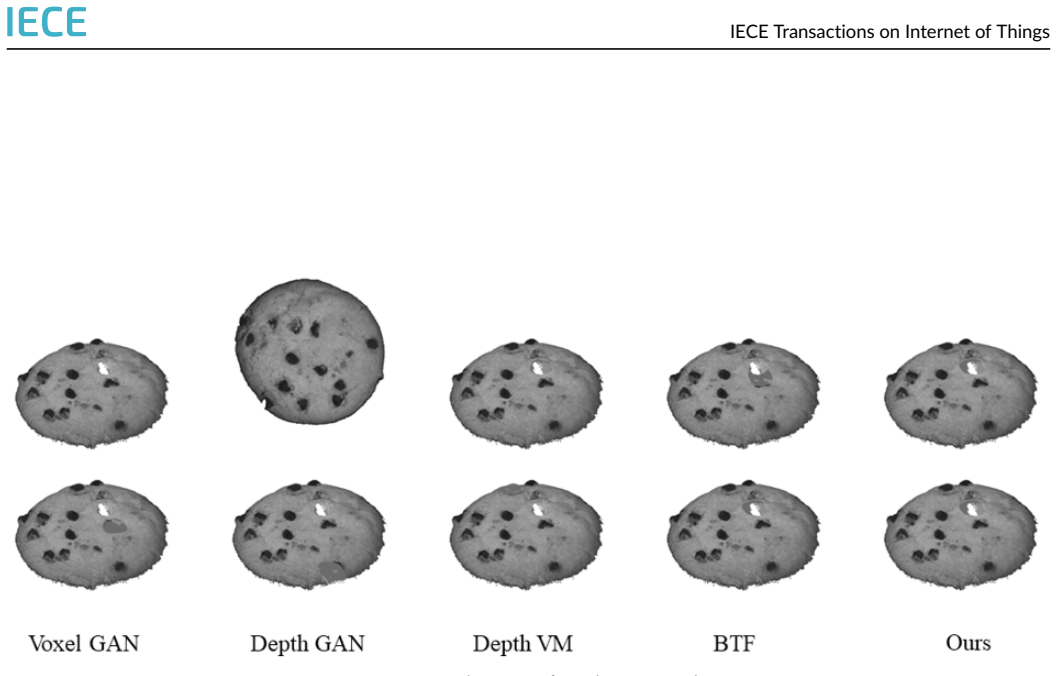
- [Section 4.3.1 and Figures 3-4] The text says 'Fig. 3 displays two examples of images taken from different views', but Figure 3 is the quantitative comparison and the view examples appear in Figure 4; the cross-references are swapped.
- [References] Reference [19] is cited as the MVTec 3D-AD Vision Benchmark Suite, but [19] is the KITTI benchmark paper; the MVTec 3D-AD dataset is reference [2].
Circularity Check
No circular derivation; the advertised Vote3Deep/L1 sparse-convolution method is absent from the implemented pipeline, but the benchmark results are external and not constructed from the target claim.
full rationale
The paper does not contain a circular derivation in the sense of a fitted parameter renamed as a prediction or an equation reducing to its own input by construction. The implemented pipeline is explicit: FPFH features and multi-view ResNet features are concatenated, a k-NN graph is built, graph convolution is applied through Eq. (9) H^(l) = sigma(D^(-1/2) A D^(-1/2) H^(l-1) W^(l)), a readout and MLP produce anomaly scores, and these are evaluated on the external MVTec 3D-AD benchmark with I-ROC and P-PRO metrics. None of these quantities is fitted to the reported I-ROC or P-PRO values, and no uniqueness theorem or self-citation chain forces the claimed outcome. The most serious problem is a method/claim mismatch, not circularity: the abstract promises a feature-centric voting mechanism and L1-regularized sparse convolutional layers, but no voting rule, no sparse-convolution operator, and no L1 loss term appear anywhere in the method. Eq. (9) is the standard graph-convolution rule, and the experiments evaluate anomaly detection rather than 3D object detection. This makes the headline state-of-the-art claim unsupported, but the unsupported claim is not equivalent to its inputs; it is simply untested by the described experiments. There are many self-citations in the reference list, including refs. [8], [14], [39], [42], [43], [52], [61], [83], [86], [91], and [94], but none of them is load-bearing for the central claim: the key external supports are the MVTec dataset, BTF, CPMF, and Vote3D. The limitation subsection honestly acknowledges that some anomalies are only identifiable with RGB information and that rendered-image quality can be degraded by acquisition noise. Overall, no circular step can be exhibited from the paper's equations or citations; the appropriate finding is no significant circularity, with a low score reflecting minor self-citation noise and the substantial gap between the advertised and actual method, which belongs to correctness risk rather than circularity.
Assumptions & free parameters
free parameters (4)
- L1 regularization coefficient =
not reported
- Number of rendering views Nv =
not reported for final results; experiments explore 1,3,6,...,27
- Anomaly threshold tau =
not reported
- k in k-NN graph =
not reported
assumptions (5)
- ad hoc to paper The graph convolution in Eq. (9) is the sparse feature-centric voting convolution described in the abstract.
- ad hoc to paper An L1 penalty on filter activations is part of the training objective.
- domain assumption MVTec 3D-AD anomaly detection results are evidence of object detection performance.
- domain assumption FPFH handcrafted features, as used in BTF, provide sufficient 3D features for the pipeline.
- domain assumption ImageNet-pretrained ResNet features transfer to rendered PCD views.
Cite this review
Pith. "Pith review of Optimized CNNs for Rapid 3D Point Cloud Object Recognition." pith.science (2026). https://pith.science/paper/E44LPBDY
@misc{pith2026241202855,
  author       = {Pith},
  title        = {Pith review of: Optimized CNNs for Rapid 3D Point Cloud Object Recognition},
  year         = {2026},
  howpublished = {\url{https://pith.science/paper/E44LPBDY}},
  note         = {Machine review of arXiv:2412.02855}
}
abstract
This study introduces a method for efficiently detecting objects within 3D point clouds using convolutional neural networks (CNNs). Our approach adopts a unique feature-centric voting mechanism to construct convolutional layers that capitalize on the typical sparsity observed in input data. We explore the trade-off between accuracy and speed across diverse network architectures and advocate for integrating an $\mathcal{L}_1$ penalty on filter activations to augment sparsity within intermediate layers. This research pioneers the proposal of sparse convolutional layers combined with $\mathcal{L}_1$ regularization to effectively handle large-scale 3D data processing. Our method's efficacy is demonstrated on the MVTec 3D-AD object detection benchmark. The Vote3Deep models, with just three layers, outperform the previous state-of-the-art in both laser-only approaches and combined laser-vision methods. Additionally, they maintain competitive processing speeds. This underscores our approach's capability to substantially enhance detection performance while ensuring computational efficiency suitable for real-time applications.
Figures


Figures from the paper (2 more)


Reference graph
Works this paper leans on
-
[1]
Johnson, Jonathan Sprinkle, and Meiyi Ma
Ziyan An, Xia Wang, Taylor T. Johnson, Jonathan Sprinkle, and Meiyi Ma. Runtime monitoring of acci- dents in driving recordings with multi-type logic in 10 IECE T ransactions on Internet of Things empirical models. InInternational Conference on Run- time Verification, pages 376–388. Springer, 2023
2023
-
[2]
PaulBergmann,XinJin,DavidSattlegger,andCarsten Steger. The mvtec 3d-ad dataset for unsupervised 3d anomaly detection and localization.arXiv preprint arXiv:2112.09045, 2021
arXiv 2021
-
[3]
Anomaly detec- tion in 3d point clouds using deep geometric descrip- tors
Paul Bergmann and David Sattlegger. Anomaly detec- tion in 3d point clouds using deep geometric descrip- tors. InProceedings of the IEEE/CVF Winter Conference on Applications of Computer Vision, pages 2613–2623, 2023
2023
-
[4]
Expectedfile-deliverytimeofdtnprotocolover asymmetric space internetwork channels
Bin Cao, Ruhai Wang, Alaa Sabbagh, Siwei Peng, Kan- glian Zhao, Juan A Fraire, Guannan Yang, and Yue Wang. Expectedfile-deliverytimeofdtnprotocolover asymmetric space internetwork channels. In2018 6th IEEE International Conference on Wireless for Space and Extreme Environments (WiSEE), pages 147–151. IEEE, 2018
2018
-
[5]
Complementary pseudo multimodal feature for point cloud anomaly detection.Pattern Recognition, 156:110761, 2024
Yunkang Cao, Xiaohao Xu, and Weiming Shen. Complementary pseudo multimodal feature for point cloud anomaly detection.Pattern Recognition, 156:110761, 2024
2024
-
[6]
Convolutional neural network (cnn) for im- agedetectionandrecognition
Rahul Chauhan, Kamal Kumar Ghanshala, and RC Joshi. Convolutional neural network (cnn) for im- agedetectionandrecognition. In 2018firstinternational conference on secure cyber computing and communication (ICSCCC), pages 278–282. IEEE, 2018
2018
-
[7]
VoxResNet: Deep Voxelwise Residual Networks for Volumetric Brain Segmentation
Hao Chen, Qi Dou, Lequan Yu, and Pheng-Ann Heng. Voxresnet: Deep voxelwise residual networks for volumetric brain segmentation. arXiv preprint arXiv:1608.05895, 2016
work page Pith review arXiv 2016
-
[8]
Enhancing visual question answer- ing through ranking-based hybrid training and mul- timodal fusion
PeiyuanChen,ZechengZhang,YipingDong,LiZhou, and Han Wang. Enhancing visual question answer- ing through ranking-based hybrid training and mul- timodal fusion. Journal of Intelligence Technology and Innovation, 2(3):19–46, 2024
2024
Show all 97 references
-
[9]
Few-shot name entity recognition on stackoverflow
XinweiChen,KunLi,TianyouSong,andJiangjianGuo. Few-shot name entity recognition on stackoverflow. arXiv preprint arXiv:2404.09405, 2024
2024 arXiv
-
[10]
Mix of experts language model for named entity recognition
Xinwei Chen, Kun Li, Tianyou Song, and Jiangjian Guo. Mix of experts language model for named entity recognition. arXiv preprint arXiv:2404.19192, 2024
2024 arXiv
-
[11]
Modeling and simulation of dna origami based elec- tronic read-only memory
Arpan De, Hashem Mohammad, Yiren Wang, Rajku- mar Kubendran, Arindam K Das, and MP Anantram. Modeling and simulation of dna origami based elec- tronic read-only memory. In2022 IEEE 22nd Inter- national Conference on Nanotechnology (NANO), pages 385–388. IEEE, 2022
2022
-
[12]
Performance analysis of dna crossbar arrays for high- densitymemorystorageapplications
Arpan De, Hashem Mohammad, Yiren Wang, Rajku- mar Kubendran, Arindam K Das, and MP Anantram. Performance analysis of dna crossbar arrays for high- densitymemorystorageapplications. ScientificReports, 13(1):6650, 2023
2023
-
[13]
Overview of the ransac algorithm
Konstantinos G Derpanis. Overview of the ransac algorithm. Image Rochester NY, 4(1):2–3, 2010
2010
-
[14]
The design of autonomous uav proto- types for inspecting tunnel construction environment
Yiping Dong. The design of autonomous uav proto- types for inspecting tunnel construction environment. Journal of Intelligence Technology and Innovation, 2(3):1– 18, 2024
2024
-
[15]
Automatic detection of cerebral microbleeds from mr images via 3d convolutional neural networks
QiDou,HaoChen,LequanYu,LeiZhao,JingQin,De- feng Wang, Vincent CT Mok, Lin Shi, and Pheng-Ann Heng. Automatic detection of cerebral microbleeds from mr images via 3d convolutional neural networks. IEEE transactions on medical imaging, 35(5):1182–1195, 2016
2016
-
[16]
A density-based algorithm for discovering clusters in large spatial databases with noise
MartinEster,Hans-PeterKriegel,JörgSander,Xiaowei Xu, et al. A density-based algorithm for discovering clusters in large spatial databases with noise. Inkdd, volume 96, pages 226–231, 1996
1996
-
[17]
An image detection technique based on morphologi- cal edge detection and background differencing for real-time traffic analysis.Pattern Recognition Letters, 16(12):1321–1330, 1995
Mahmood Fathy and Mohammed Yakoob Siyal. An image detection technique based on morphologi- cal edge detection and background differencing for real-time traffic analysis.Pattern Recognition Letters, 16(12):1321–1330, 1995
1995
-
[18]
Random sam- pleconsensus: aparadigmformodelfittingwithappli- cations to image analysis and automated cartography
Martin A Fischler and Robert C Bolles. Random sam- pleconsensus: aparadigmformodelfittingwithappli- cations to image analysis and automated cartography. Communications of the ACM, 24(6):381–395, 1981
1981
-
[19]
Are we ready for autonomous driving? the kitti vision benchmark suite
AndreasGeiger,PhilipLenz,andRaquelUrtasun. Are we ready for autonomous driving? the kitti vision benchmark suite. In2012 IEEE conference on computer vision and pattern recognition, pages 3354–3361. IEEE, 2012
2012
-
[20]
Research on empirical correction models of gps block iif and bds satellite inter-frequency clock bias
Xiaopeng Gong, Shengfeng Gu, Yidong Lou, Fu Zheng, Xinhao Yang, Zhipeng Wang, and Jingnan Liu. Research on empirical correction models of gps block iif and bds satellite inter-frequency clock bias. Journal of Geodesy, 94:1–11, 2020
2020
-
[21]
Graphical Structural Learning of rs-fMRI data in Heavy Smokers.arXiv preprint arXiv:2409.08395, 2024
Yiru Gong, Qimin Zhang, Huili Zheng, Zheyan Liu, and Shaohan Chen. Graphical Structural Learning of rs-fMRI data in Heavy Smokers.arXiv preprint arXiv:2409.08395, 2024
2024 arXiv
-
[22]
Sparse3dconvolutionalneuralnetworks
BenGraham. Sparse3dconvolutionalneuralnetworks. arXiv preprint arXiv:1505.02890, 2015
2015 arXiv
-
[23]
Spatially-sparseconvolutionalneu- ral networks.arXiv preprint arXiv:1409.6070, 2014
BenjaminGraham. Spatially-sparseconvolutionalneu- ral networks.arXiv preprint arXiv:1409.6070, 2014
2014 arXiv
-
[24]
Deep residual learning for image recognition
Kaiming He, Xiangyu Zhang, Shaoqing Ren, and Jian Sun. Deep residual learning for image recognition. In Proceedings of the IEEE conference on computer vision and pattern recognition, pages 770–778, 2016
2016
-
[25]
Backtothefeature: classical 3d features are (almost) all you need for 3d anomaly detection
EliahuHorwitzandYedidHoshen. Backtothefeature: classical 3d features are (almost) all you need for 3d anomaly detection. In Proceedings of the IEEE/CVF Conference on Computer Vision and Pattern Recognition, pages 2967–2976, 2023
2023
-
[26]
Relation networks for object detection
Han Hu, Jiayuan Gu, Zheng Zhang, Jifeng Dai, and Yichen Wei. Relation networks for object detection. In Proceedings of the IEEE conference on computer vision and pattern recognition, pages 3588–3597, 2018
2018
-
[27]
11 IECE T ransactions on Internet of Things Risk analysis in customer relationship management viaqrcnn-lstmandcross-attentionmechanism
Yaowen Huang, Jun Der Leu, Baoli Lu, and Yan Zhou. 11 IECE T ransactions on Internet of Things Risk analysis in customer relationship management viaqrcnn-lstmandcross-attentionmechanism. Journal of Organizational and End User Computing (JOEUC), 36(1):1–22, 2024
2024
-
[28]
Learning sparse high dimensional filters: Image fil- tering, dense crfs and bilateral neural networks
Varun Jampani, Martin Kiefel, and Peter V Gehler. Learning sparse high dimensional filters: Image fil- tering, dense crfs and bilateral neural networks. In Proceedings of the IEEE Conference on Computer Vision and Pattern Recognition, pages 4452–4461, 2016
2016
-
[29]
Trajectory track- ing using frenet coordinates with deep deterministic policy gradient.arXiv preprint arXiv:2411.13885, 2024
Tongzhou Jiang, Lipeng Liu, Junyue Jiang, Tianyao Zheng, Yuhui Jin, and Kunpeng Xu. Trajectory track- ing using frenet coordinates with deep deterministic policy gradient.arXiv preprint arXiv:2411.13885, 2024
2024 arXiv
-
[30]
Du- alvd: An adaptive dual encoding model for deep vi- sual understanding in visual dialogue
Xiaoze Jiang, Jing Yu, Zengchang Qin, Yingying Zhuang, Xingxing Zhang, Yue Hu, and Qi Wu. Du- alvd: An adaptive dual encoding model for deep vi- sual understanding in visual dialogue. InProceedings oftheAAAIconferenceonartificialintelligence ,volume34, pages 11125–11132, 2020
2020
-
[31]
Dbscan: Past, present and future
Kamran Khan, Saif Ur Rehman, Kamran Aziz, Simon Fong, and Sababady Sarasvady. Dbscan: Past, present and future. InThe fifth international conference on the applications of digital information and web technologies (ICADIWT 2014), pages 232–238. IEEE, 2014
2014
-
[32]
Imagenet classification with deep convolutional neuralnetworks
Alex Krizhevsky, Ilya Sutskever, and Geoffrey E Hin- ton. Imagenet classification with deep convolutional neuralnetworks. Advancesinneuralinformationprocess- ing systems, 25, 2012
2012
-
[33]
Traffic smoothing via connected & automated vehicles: A modular, hierarchical control design deployed in a 100-cav flow smoothing experiment.IEEE Control Sys- tems Magazine, 2024
JWLee,HWang,KJang,AHayat,MBunting,AAlan- qary, WBarbour, ZFu, XGong, GGunter, etal. Traffic smoothing via connected & automated vehicles: A modular, hierarchical control design deployed in a 100-cav flow smoothing experiment.IEEE Control Sys- tems Magazine, 2024
2024
-
[34]
Vehicle detection from3dlidarusingfullyconvolutionalnetwork
Bo Li, Tianlei Zhang, and Tian Xia. Vehicle detection from3dlidarusingfullyconvolutionalnetwork. arXiv preprint arXiv:1608.07916, 2016
2016 arXiv
-
[35]
Deep reinforcement learning-based obstacle avoidance for robot move- ment in warehouse environments
Keqin Li, Jiajing Chen, Denzhi Yu, Tao Dajun, Xinyu Qiu, Lian Jieting, Sun Baiwei, Zhang Shengyuan, Zhenyu Wan, Ran Ji, et al. Deep reinforcement learning-based obstacle avoidance for robot move- ment in warehouse environments. arXiv preprint arXiv:2409.14972, 2024
2024 arXiv
-
[36]
Optimizing automated picking systems in warehouse robots using machine learning
Keqin Li, Jin Wang, Xubo Wu, Xirui Peng, Runmian Chang, Xiaoyu Deng, Yiwen Kang, Yue Yang, Fang- hao Ni, and Bo Hong. Optimizing automated picking systems in warehouse robots using machine learning. arXiv preprint arXiv:2408.16633, 2024
2024
-
[37]
Ltpnet inte- gration of deep learning and environmental decision support systems for renewable energy demand fore- casting
Te Li, Mengze Zhang, and Yan Zhou. Ltpnet inte- gration of deep learning and environmental decision support systems for renewable energy demand fore- casting. arXiv preprint arXiv:2410.15286, 2024
2024 arXiv
-
[38]
Enhancing the reliability of out-of-distribution im- age detection in neural networks
Shiyu Liang, Yixuan Li, and Rayadurgam Srikant. Enhancing the reliability of out-of-distribution im- age detection in neural networks. arXiv preprint arXiv:1706.02690, 2017
2017 arXiv
-
[39]
Dsem- nerf: Multimodalfeaturefusionandglobal-localatten- tion for enhanced 3d scene reconstruction.Information Fusion, page 102752, 2024
Dong Liu, Zhiyong Wang, and Peiyuan Chen. Dsem- nerf: Multimodalfeaturefusionandglobal-localatten- tion for enhanced 3d scene reconstruction.Information Fusion, page 102752, 2024
2024
-
[40]
Guiran Liu and Binrong Zhu. Design and implemen- tation of intelligent robot control system integrating computer vision and mechanical engineering.Interna- tional Journal of Computer Science and Information Tech- nology, 3(1):219–226, 2024
2024
-
[41]
Td3 based collision free mo- tion planning for robot navigation
Hao Liu, Yi Shen, Chang Zhou, Yuelin Zou, Zijun Gao, and Qi Wang. Td3 based collision free mo- tion planning for robot navigation. arXiv preprint arXiv:2405.15460, 2024
2024 arXiv
-
[42]
Eitnet: An iot-enhanced framework for real-time bas- ketball action recognition.Alexandria Engineering Jour- nal, 110:567–578, 2025
Jingyu Liu, Xinyu Liu, Mingzhe Qu, and Tianyi Lyu. Eitnet: An iot-enhanced framework for real-time bas- ketball action recognition.Alexandria Engineering Jour- nal, 110:567–578, 2025
2025
-
[43]
Real-time monitor- ing of lower limb movement resistance based on deep learning
Yuanmeng Liu, Tianyi Lyu, et al. Real-time monitor- ing of lower limb movement resistance based on deep learning. Alexandria Engineering Journal, 111:136–147, 2025
2025
-
[44]
Fleet rebalancing for expanding shared e- mobility systems: A multi-agent deep reinforcement learning approach
Man Luo, Bowen Du, Wenzhe Zhang, Tianyou Song, Kun Li, Hongming Zhu, Mark Birkin, and Hongkai Wen. Fleet rebalancing for expanding shared e- mobility systems: A multi-agent deep reinforcement learning approach. IEEE Transactions on Intelligent Transportation Systems, 24(4):386...
2023
-
[45]
3d convolu- tionalneuralnetworksforlandingzonedetectionfrom lidar
Daniel Maturana and Sebastian Scherer. 3d convolu- tionalneuralnetworksforlandingzonedetectionfrom lidar. In2015 IEEE international conference on robotics and automation (ICRA), pages 3471–3478. IEEE, 2015
2015
-
[46]
Voxnet: A 3d convolutional neural network for real-time object recognition
Daniel Maturana and Sebastian Scherer. Voxnet: A 3d convolutional neural network for real-time object recognition. In2015 IEEE/RSJ international conference on intelligent robots and systems (IROS), pages 922–928. IEEE, 2015
2015
-
[47]
3d object detection with pointformer
Xuran Pan, Zhuofan Xia, Shiji Song, Li Erran Li, and Gao Huang. 3d object detection with pointformer. InProceedings of the IEEE/CVF conference on computer vision and pattern recognition, pages 7463–7472, 2021
2021
-
[48]
Maxk-gnn: Extremely fast gpu kernel design for accelerating graph neural net- works training
Hongwu Peng, Xi Xie, Kaustubh Shivdikar, Md Amit Hasan,JiahuiZhao,ShaoyiHuang,OmerKhan,David Kaeli, and Caiwen Ding. Maxk-gnn: Extremely fast gpu kernel design for accelerating graph neural net- works training. InProceedings of the 29th ACM Interna- tional Conference on Archit...
2024
-
[49]
Automatic news gen- eration and fact-checking system based on language processing
Xirui Peng, Qiming Xu, Zheng Feng, Haopeng Zhao, Lianghao Tan, Yan Zhou, Zecheng Zhang, Chenwei Gong, and Yingqiao Zheng. Automatic news gen- eration and fact-checking system based on language processing. JournalofIndustrialEngineeringandApplied Science, 2(3):1–11, 2024
2024
-
[50]
Deep feature learning for knee cartilage segmentation us- ing a triplanar convolutional neural network
Adhish Prasoon, Kersten Petersen, Christian Igel, 12 IECE T ransactions on Internet of Things François Lauze, Erik Dam, and Mads Nielsen. Deep feature learning for knee cartilage segmentation us- ing a triplanar convolutional neural network. InIn- ternational conference on med...
2013
-
[51]
Robust domain generalization for multi-modal object recog- nition
Yuxin Qiao, Keqin Li, Junhong Lin, Rong Wei, Chufeng Jiang, Yang Luo, and Haoyu Yang. Robust domain generalization for multi-modal object recog- nition. In2024 5th International Conference on Artificial Intelligence and Electromechanical Automation (AIEA), pages 392–397. IEEE, 2024
2024
-
[52]
Iot-based 3d pose estimation and motion optimization for athletes: Application of c3d and openpose
Fei Ren, Chao Ren, and Tianyi Lyu. Iot-based 3d pose estimation and motion optimization for athletes: Application of c3d and openpose. arXiv preprint arXiv:2411.12676, 2024
2024 arXiv
-
[53]
Reinforcement learning with com- munication latency with application to stop-and-go wave dissipation
Alex Richardson, Xia Wang, Abhishek Dubey, and Jonathan Sprinkle. Reinforcement learning with com- munication latency with application to stop-and-go wave dissipation. In2024 IEEE Intelligent Vehicles Sym- posium (IV), pages 1187–1193. IEEE, 2024
2024
-
[54]
Asymmetricstudent-teachernetworks for industrial anomaly detection
MarcoRudolph,TomWehrbein,BodoRosenhahn,and BastianWandt. Asymmetricstudent-teachernetworks for industrial anomaly detection. InProceedings of the IEEE/CVF winter conference on applications of computer vision, pages 2592–2602, 2023
2023
-
[55]
Im- agenet large scale visual recognition challenge.Inter- national journal of computer vision, 115:211–252, 2015
OlgaRussakovsky,JiaDeng,HaoSu,JonathanKrause, Sanjeev Satheesh, Sean Ma, Zhiheng Huang, Andrej Karpathy, Aditya Khosla, Michael Bernstein, et al. Im- agenet large scale visual recognition challenge.Inter- national journal of computer vision, 115:211–252, 2015
2015
-
[56]
Fast point feature histograms (fpfh) for 3d registra- tion
Radu Bogdan Rusu, Nico Blodow, and Michael Beetz. Fast point feature histograms (fpfh) for 3d registra- tion. In 2009 IEEE international conference on robotics and automation, pages 3212–3217. IEEE, 2009
2009
-
[57]
Harnessing XGBoost for robust biomarker selec- tion of obsessive-compulsive disorder (OCD) from adolescentbraincognitivedevelopment(ABCD)data
Xinyu Shen, Qimin Zhang, Huili Zheng, and Weiwei Qi. Harnessing XGBoost for robust biomarker selec- tion of obsessive-compulsive disorder (OCD) from adolescentbraincognitivedevelopment(ABCD)data. In Pier Paolo Piccaluga, Ahmed El-Hashash, and Xi- angqian Guo, editors,Fourth In...
2024
-
[58]
Deep learning powered estimate of the extrinsic parameters on unmanned surface ve- hicles
Yi Shen, Hao Liu, Chang Zhou, Wentao Wang, Zijun Gao, and Qi Wang. Deep learning powered estimate of the extrinsic parameters on unmanned surface ve- hicles. arXiv preprint arXiv:2406.04821, 2024
2024 arXiv
-
[59]
Multi-gnss satellite clock estimation con- strained with oscillator noise model in the existence of data discontinuity.Journal of Geodesy, 93:515–528, 2019
Chuang Shi, Shiwei Guo, Shengfeng Gu, Xinhao Yang, Xiaopeng Gong, Zhiguo Deng, Maorong Ge, and Har- ald Schuh. Multi-gnss satellite clock estimation con- strained with oscillator noise model in the existence of data discontinuity.Journal of Geodesy, 93:515–528, 2019
2019
-
[60]
Very deep convolutional networks for large-scale image recogni- tion
Karen Simonyan and Andrew Zisserman. Very deep convolutional networks for large-scale image recogni- tion. arXiv preprint arXiv:1409.1556, 2014
2014 arXiv
-
[61]
Mingxiu Sui, Liheng Jiang, Tianyi Lyu, Han Wang, Li Zhou, Peiyuan Chen, and Ammar Alhosain. Appli- cation of deep learning models based on efficientdet and openpose in user-oriented motion rehabilitation robot control.Journal of Intelligence Technology and In- novation, 2(3):4...
2024
-
[62]
Support vec- tor machine.Machine learning models and algorithms for big data classification: thinking with examples for effective learning, pages 207–235, 2016
Shan Suthaharan and Shan Suthaharan. Support vec- tor machine.Machine learning models and algorithms for big data classification: thinking with examples for effective learning, pages 207–235, 2016
2016
-
[63]
Real-time mon- itoring and analysis of track and field athletes based on edge computing and deep reinforcement learning algorithm
Xiaowei Tang, Bin Long, and Li Zhou. Real-time mon- itoring and analysis of track and field athletes based on edge computing and deep reinforcement learning algorithm. arXiv preprint arXiv:2411.06720, 2024
2024 arXiv
-
[64]
Image anomaly detection and prediction scheme based on ssa optimized resnet50- bigru model.arXiv preprint arXiv:2406.13987, 2024
Qianhui Wan, Zecheng Zhang, Liheng Jiang, Zhaoqi Wang, and Yan Zhou. Image anomaly detection and prediction scheme based on ssa optimized resnet50- bigru model.arXiv preprint arXiv:2406.13987, 2024
2024 arXiv
-
[65]
Theoretical analysis of meta reinforcement learning: Generalization bounds and convergence guarantees
Cangqing Wang, Mingxiu Sui, Dan Sun, Zecheng Zhang, and Yan Zhou. Theoretical analysis of meta reinforcement learning: Generalization bounds and convergence guarantees. CMNM ’24, page 153–159, New York, NY, USA, 2024. Association for Computing Machinery
2024
-
[66]
Voting for voting in online point cloud object detection
Dominic Zeng Wang and Ingmar Posner. Voting for voting in online point cloud object detection. In Robotics: science and systems, volume 1, pages 10–15. Rome, Italy, 2015
2015
-
[67]
Jingyi Wang, Zhiqun Wang, and Guiran Liu. Record- ing brain activity while listening to music using wear- able eeg devices combined with bidirectional long short-term memory networks.Alexandria Engineering Journal, 109:1–10, 2024
2024
-
[68]
Cross-border commodity pricing strategy optimization via mixed neural network for time series analysis.arXiv preprint arXiv:2408.12115, 2024
Lijuan Wang, Yijia Hu, and Yan Zhou. Cross-border commodity pricing strategy optimization via mixed neural network for time series analysis.arXiv preprint arXiv:2408.12115, 2024
2024 arXiv
-
[69]
Intelligent design and optimiza- tion of exercise equipment based on fusion algorithm of yolov5-resnet 50
Long Wang, Wendong Ji, Gang Wang, Yinqiu Feng, and Minghua Du. Intelligent design and optimiza- tion of exercise equipment based on fusion algorithm of yolov5-resnet 50. Alexandria Engineering Journal, 104:710–722, 2024
2024
-
[70]
Deeplearning-basedanomalydetectionandlog analysis for computer networks.Journal of Information and Computing, 2(2):34–63, 2024
Shuzhan Wang, Ruxue Jiang, Zhaoqi Wang, and Yan Zhou. Deeplearning-basedanomalydetectionandlog analysis for computer networks.Journal of Information and Computing, 2(2):34–63, 2024
2024
-
[71]
Using automated vehicle data as a fitness tracker for sustainability
Xia Wang, Sobenna Onwumelu, and Jonathan Sprin- kle. Using automated vehicle data as a fitness tracker for sustainability. In2024 Forum for Innovative Sustain- able Transportation Systems (FISTS), pages 1–6. IEEE, 2024
2024
-
[72]
A machine learn- ing approach for accurate and real-time dna sequence identification
Yiren Wang, Mashari Alangari, Joshua Hihath, Arindam K Das, and MP Anantram. A machine learn- ing approach for accurate and real-time dna sequence identification. BMC genomics, 22:1–10, 2021. 13 IECE T ransactions on Internet of Things
2021
-
[73]
Computational study of the role of counterions and solvent dielectric in determining the conductance of b-dna.Physical Review E, 107(4):044404, 2023
Yiren Wang, Busra Demir, Hashem Mohammad, Ersin Emre Oren, and MP Anantram. Computational study of the role of counterions and solvent dielectric in determining the conductance of b-dna.Physical Review E, 107(4):044404, 2023
2023
-
[74]
Classification of dna sequences: Performance evaluation of multiple machine learning methods
Yiren Wang, Vikram Khandelwal, Arindam K Das, and MP Anantram. Classification of dna sequences: Performance evaluation of multiple machine learning methods. In2022IEEE22ndInternationalConferenceon Nanotechnology (NANO), pages 333–336. IEEE, 2022
2022
-
[75]
Performance evaluation of quic with bbr in satellite internet
Yue Wang, Kanglian Zhao, Wenfeng Li, Juan Fraire, Zhili Sun, and Yuan Fang. Performance evaluation of quic with bbr in satellite internet. In2018 6th IEEE InternationalConferenceonWirelessforSpaceandExtreme Environments (WiSEE), pages 195–199. IEEE, 2018
2018
-
[76]
View-gcn: View- based graph convolutional network for 3d shape anal- ysis
Xin Wei, Ruixuan Yu, and Jian Sun. View-gcn: View- based graph convolutional network for 3d shape anal- ysis. InProceedings of the IEEE/CVF Conference on Com- puter Vision and Pattern Recognition, pages 1850–1859, 2020
2020
-
[77]
Big data and machine learning in defence
Yijie Weng. Big data and machine learning in defence. InternationalJournalofComputerScienceandInformation Technology, 16(2):25–35, 2024
2024
-
[78]
Leveraging artificial in- telligence to enhance data security and combat cyber attacks
Yijie Weng and Jianhao Wu. Leveraging artificial in- telligence to enhance data security and combat cyber attacks. Journal of Artificial Intelligence General science (JAIGS) ISSN: 3006-4023, 5(1):392–399, 2024
2024
-
[79]
Yijie Weng, Jianhao Wu, et al. Fortifying the global data fortress: a multidimensional examination of cy- ber security indexes and data protection measures across 193 nations.International Journal of Frontiers in Engineering Technology, 6(2):13–28, 2024
2024
-
[80]
Comprehensive overview of artificial intelligence applications in modern industries
Yijie Weng, Jianhao Wu, Tara Kelly, and William John- son. Comprehensive overview of artificial intelligence applications in modern industries. arXiv preprint arXiv:2409.13059, 2024
2024 arXiv
-
[81]
Xinyao Xi, Chen Zhang, Wen Jia, and Ruxue Jiang. Enhancing human pose estimation in sports training: Integrating spatiotemporal transformer for improved accuracy and real-time performance.Alexandria Engi- neering Journal, 109:144–156, 2024
2024
-
[82]
Accel-gcn: High- performance gpu accelerator design for graph con- volution networks
Xi Xie, Hongwu Peng, Amit Hasan, Shaoyi Huang, Jiahui Zhao, Haowen Fang, Wei Zhang, Tong Geng, Omer Khan, and Caiwen Ding. Accel-gcn: High- performance gpu accelerator design for graph con- volution networks. In2023 IEEE/ACM International Conference on Computer Aided Design (I...
2023
-
[83]
Dpmpc-planner: A real-time uav trajectory planning framework for complex static environments with dy- namic obstacles
ZhefanXu,DiDeng,YipingDong,andKenjiShimada. Dpmpc-planner: A real-time uav trajectory planning framework for complex static environments with dy- namic obstacles. In 2022 International Conference on Robotics and Automation (ICRA), pages 250–256. IEEE, 2022
2022
-
[84]
Application of deep learning for automatic identifica- tion of hazardous materials and urban safety supervi- sion
Tieyi Yan, Jiaxi Wu, Munish Kumar, and Yan Zhou. Application of deep learning for automatic identifica- tion of hazardous materials and urban safety supervi- sion. Journal of Organizational and End User Computing (JOEUC), 36(1):1–20, 2024
2024
-
[85]
Regional bds satellite clock estimation with triple-frequency ambi- guity resolution based on undifferenced observation
Xinhao Yang, Shengfeng Gu, Xiaopeng Gong, Weiwei Song, Yidong Lou, and Jingnan Liu. Regional bds satellite clock estimation with triple-frequency ambi- guity resolution based on undifferenced observation. GPS Solutions, 23:1–11, 2019
2019
-
[86]
Gta-net: An iot-integrated 3dhumanposeestimationsystemforreal-timeadoles- cent sports posture correction.Alexandria Engineering Journal, 112:585–597, 2025
Shizhe Yuan and Li Zhou. Gta-net: An iot-integrated 3dhumanposeestimationsystemforreal-timeadoles- cent sports posture correction.Alexandria Engineering Journal, 112:585–597, 2025
2025
-
[87]
Wide resid- ual networks.arXiv preprint arXiv:1605.07146, 2016
Sergey Zagoruyko and Nikos Komodakis. Wide resid- ual networks.arXiv preprint arXiv:1605.07146, 2016
2016 arXiv
-
[88]
Cu-net: a u-net architecture for efficient brain- tumor segmentation on brats 2019 dataset
Qimin Zhang, Weiwei Qi, Huili Zheng, and Xinyu Shen. Cu-net: a u-net architecture for efficient brain- tumor segmentation on brats 2019 dataset. arXiv preprint arXiv:2406.13113, 2024
2019 arXiv
-
[89]
Deep analysis of time series data for smart grid startup strategies: A transformer-lstm-pso model approach
Zecheng Zhang. Deep analysis of time series data for smart grid startup strategies: A transformer-lstm-pso model approach. Journal of Management Science and Operations, 2(3):16–43, 2024
2024
-
[90]
Identification of prognostic biomarkers for stage iii non-small cell lung carcinoma in female nonsmokers using machine learning.arXiv preprint arXiv:2408.16068, 2024
Huili Zheng, Qimin Zhang, Yiru Gong, Zheyan Liu, and Shaohan Chen. Identification of prognostic biomarkers for stage iii non-small cell lung carcinoma in female nonsmokers using machine learning.arXiv preprint arXiv:2408.16068, 2024
2024 arXiv
-
[91]
Triz method for urban building energy opti- mization: Gwo-sarima-lstmforecastingmodel
Shirong Zheng, Shaobo Liu, Zhenhong Zhang, Dian Gu, Chunqiu Xia, Huadong Pang, and Enock Mintah Ampaw. Triz method for urban building energy opti- mization: Gwo-sarima-lstmforecastingmodel. Journal of Intelligence Technology and Innovation, 2(3):78–103, 2024
2024
-
[92]
Open3d: A modern library for 3d data processing
Qian-Yi Zhou, Jaesik Park, and Vladlen Koltun. Open3d: A modern library for 3d data processing. arXiv preprint arXiv:1801.09847, 2018
2018 arXiv
-
[93]
Adapi: Facilitating dnn modeladaptivityforefficientprivateinferenceinedge computing
TongZhou,JiahuiZhao,YukuiLuo,XiXie,WujieWen, Caiwen Ding, and Xiaolin Xu. Adapi: Facilitating dnn modeladaptivityforefficientprivateinferenceinedge computing. arXiv preprint arXiv:2407.05633, 2024
2024 arXiv
-
[94]
Optimizationofautomatedgarbagerecognitionmodel basedonresnet-50andweaklysupervisedcnnforsus- tainable urban development.Alexandria Engineering Journal, 108:415–427, 2024
Yan Zhou, Zhaoqi Wang, Shirong Zheng, Li Zhou, Lu Dai, Hao Luo, Zecheng Zhang, and Mingxiu Sui. Optimizationofautomatedgarbagerecognitionmodel basedonresnet-50andweaklysupervisedcnnforsus- tainable urban development.Alexandria Engineering Journal, 108:415–427, 2024
2024
-
[95]
Fa- cial sentiment classification based on resnet-18 model
YitaoZhou,FujiRen,ShunNishide,andXinKang. Fa- cial sentiment classification based on resnet-18 model. In2019 International Conference on electronic engineering and informatics (EEI), pages 463–466. IEEE, 2019
2019
-
[96]
Complex scene under- standing and object detection algorithm assisted by artificial intelligence.Academic Journal of Science and Technology, 12(3):12–15, 2024
Binrong Zhu and Guiran Liu. Complex scene under- standing and object detection algorithm assisted by artificial intelligence.Academic Journal of Science and Technology, 12(3):12–15, 2024
2024
-
[97]
In Proceedings of the 2020 4th international conference on digital signal processing, pages 155–159, 2020
YingyingZhuang,YuezhangChen,andJieZheng.Mu- 14 IECE T ransactions on Internet of Things sic genre classification with transformer classifier. In Proceedings of the 2020 4th international conference on digital signal processing, pages 155–159, 2020. 15
2020
Reviewed August 11, 2026 · model on record in the stance chip above.
Discussion (0). Continue with ORCID to comment.