REVIEW 4 major objections 5 minor 1 cited by
Dynamic Graph Neural ODE Network for Multi-modal Emotion Recognition in Conversation
T0 review · 4 major / 5 minor · reviewed 2026-08-11 · deepseek-v4-flash
Pith's one-line read The paper claims that a residual mixhop GCN update can be rewritten as a graph ODE, and that solving this ODE instead of stacking layers captures temporal emotion dependencies and outperforms existing models on IEMOCAP and MELD.
desk verdict The mixhop+ODE combination is new for MERC, but Proposition 1 is mathematically broken and the empirical numbers lack the transparency to carry the paper. read the letter →
The pith
A machine-rendered reading of the paper's core claim, the machinery that carries it, and where it could break.
The reading
What carries the argument
The load-bearing object is the graph ODE in Eq. 7, together with the adaptive mixhop aggregation in Eq. 6. The update takes a symmetric normalized adjacency matrix $\hat{A}$ (with a self-loop regularization controlled by $\alpha$) and a learned weight matrix $W$, sums messages from neighbors at different hop distances $n=1,\dots,N$, and adds a residual connection $H_0$ so the discrete layer can be read as a Riemann sum. Proposition 1 then replaces the discrete index $n$ by continuous time $t$, using the matrix logarithms $\ln \hat{A}$ and $\ln W$ (obtained by diagonalizing $\hat{A}-I$ and $W-I$) to write the rate of change of the hidden state $H(t)$. An ODE solver integrates this rate starting from an initial state built from the encoder output $E=f(X)$, and the result is fed to a linear classifier. This machinery is what converts 'number of layers' into 'integration time' and gives the paper its claim of stable deep graph networks.
What would settle it
Take a trained DGODE, record the actual matrices $\hat{A}$ and $W$, solve Eq. 6 for several discrete steps, and compare against a high-precision numerical solution of Eq. 7 sampled at integer times with the same matrices; a mismatch beyond solver tolerance would show the claimed equivalence is false. A cheaper check is to construct a deliberately non-diagonalizable (defective) $W$ and test whether the discrete and ODE trajectories still agree.
Extended reading notes
Core claim
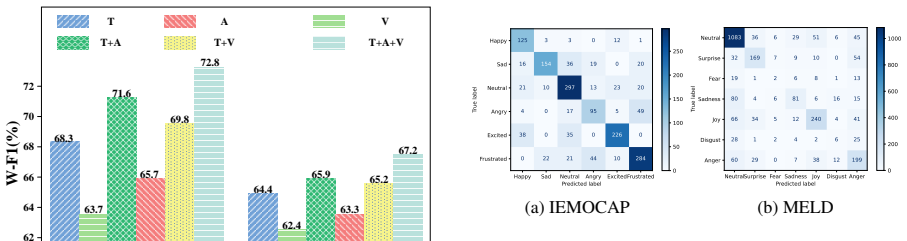
At the center of the paper is Proposition 1: the residual mixhop update $H_{n+1} = \sum_{n=1}^N \hat{A}^n H_n W + H_0$ is the Riemann-sum discretization of the graph ODE $\frac{dH(t)}{dt} = \frac{1}{N}\sum_{n=1}^N \left[\ln \hat{A}\,H(t) + H(t)\ln W + E\right]$, so the discrete hidden states of the graph network are samples of a continuous dynamical system. The paper's reading of this identity is that depth in a GCN is really integration time: instead of choosing a number of layers, the model chooses an evolution interval and solves the ODE with a numerical solver (e.g., Runge-Kutta), propagating each speaker's emotional state forward through the conversation graph. With the adaptive mixhop aggregation feeding multi-hop neighbor information into the flow, DGODE claims to capture both long-range conversational relations and the temporal dependency of emotions, while avoiding the performance collapse that the paper observes for baselines such as MMGCN and M3Net beyond four layers. On IEMOCAP the model reports a weighted F1 of 72.8 and on MELD 67.2, the best among the compared methods.
Load-bearing premise
The load-bearing premise is that the learned adjacency and weight matrices can be diagonalized and that the encoder output can serve simultaneously as the initial state and as the forcing term; if either fails for an arbitrary trained network, the ODE in Eq. 7 is not a faithful continuous analog of the discrete updates.
Editorial extensions
If this is right
- The number of GCN layers stops being a discrete hyperparameter: adding computation means integrating the ODE over a longer interval, so performance should stay stable instead of degrading after a few layers.
- Emotional state from earlier utterances flows continuously into later utterances, which is the paper's mechanism for capturing the temporal dependency of speakers' emotions.
- Because multi-hop neighbors are aggregated before the ODE integration, the model can use distant conversational relations without stacking many discrete layers.
- If the reported numbers hold, DGODE establishes the best weighted F1 among the compared methods on IEMOCAP (72.8) and MELD (67.2), and the paper's layer-depth experiments show it stays accurate when the network is made deeper.
Reading between the lines
- If Proposition 1 is taken at face value, the same continuous-depth recipe should transfer to other graph-based sequence problems where temporal dynamics matter, such as dialogue state tracking or audiovisual stream emotion detection; this is an extension the paper does not explore.
- A testable consequence of the depth-stability claim is that over-smoothing should not reappear even at very long integration times; varying the ODE solver tolerance and measuring node-representation similarity would settle this.
- The manuscript's own limitation section says that the fine-grained dynamic changes captured by the model may not match coarse utterance-level emotion labels; evaluating on time-resolved or continuous emotion labels would test whether the dynamics it captures are the right ones.
- The proposition's reliance on diagonalizability suggests a robust follow-up: derive the continuous analog using the matrix logarithm without eigen-decomposition, which would extend the equivalence to arbitrary trained weight matrices.
Editorial analysis
A structured set of objections, weighed in public.
Referee Report
Summary. The paper proposes DGODE, a graph ODE-based architecture for multimodal emotion recognition in conversation. The method combines an adaptive mixhop aggregation rule with a continuous-depth ODE formulation, claiming in Proposition 1 that the discrete update in Eq. (6) is equivalent to the ODE in Eq. (7). The authors argue that this continuous representation captures temporal dependencies in speakers' emotions, reduces overfitting, and avoids over-smoothing, and they report state-of-the-art results on IEMOCAP and MELD. The central theoretical contribution is the claimed discrete-to-continuous equivalence, which is used to justify the model design and the name 'graph ODE.'
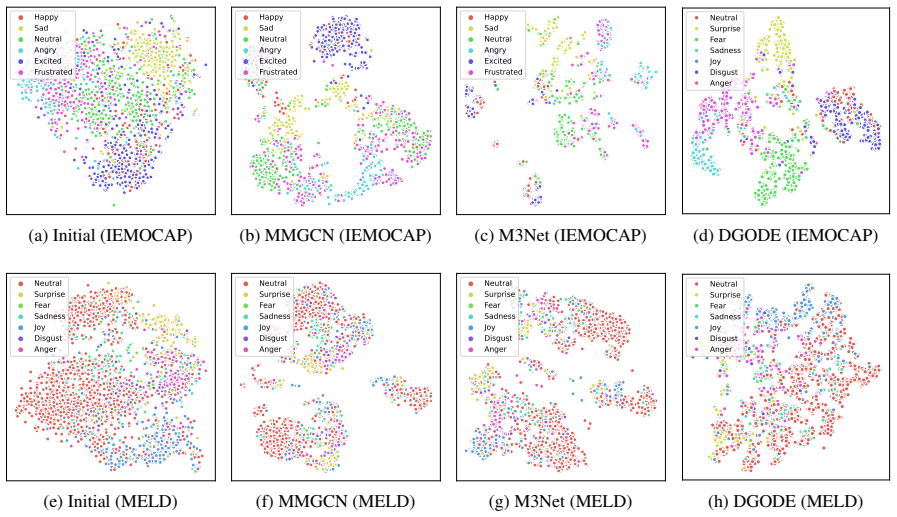
Significance. If the claimed equivalence were correct, DGODE would be a principled continuous-depth graph network for emotion recognition, with a clear mathematical link between the mixhop layer count and an ODE trajectory. The paper also includes a reasonable amount of empirical work: comparisons with many baselines, ablations, confusion-matrix analysis, and t-SNE visualizations. However, the mathematical derivation in Proposition 1 and Appendix A is internally inconsistent, and the ODE in Eq. (7) is not actually equivalent to the discrete update in Eq. (6). Since this equivalence is the paper's main intellectual contribution and the basis for the temporal-dependency and overfitting claims, the theoretical significance of the work is not established. The empirical results may indicate practical value of a heuristic architecture, but the paper does not convincingly demonstrate the mechanism it claims.
major comments (4)
- [4.2 and Appendix A] The derivation of Proposition 1 does not correctly relate Eq. (6) to Eq. (13). Eq. (6) is a recurrence in the layer index n, with the right-hand side containing a sum over hop counts. The closed form of that recurrence is H_n = sum_{j=0}^{n-1} (sum_{k=1}^N A^k)^j H_0 W^j, not the expression in Eq. (13), which is a sum over hop counts of A^k E W^k. For N > 1 these are different objects, so the Riemann-sum interpretation in Eq. (14) is applied to a discrete process that is not the one defined by Eq. (6).
- [4.3, Eqs. (7) and (8)] Eq. (8) is not the solution of Eq. (7). The ODE in Eq. (7) is dH/dt = ln(A) H + H ln(W) + E, whose solution involves exponentials e^{t ln A} and e^{t ln W}. Eq. (8), however, uses exponentials e^{(A-I)t} and e^{(W-I)t} and eigenvalues of (A-I) and (W-I); this is the solution of dH/dt = (A-I)H + H(W-I) + E. The two ODEs coincide only if ln(A)=A-I and ln(W)=W-I, which is not true for a normalized adjacency matrix and a learned weight matrix. Thus the closed-form solution given in the proposition contradicts the ODE it claims to solve.
- [4.3 and Appendix A, Eq. (18)] The initial condition and forcing term are defined circularly. In Proposition 1, E appears simultaneously as the encoder output f(X), as the forcing term in Eq. (7), and as the initial condition through E = H(0) = (ln A)^{-1}(A-I)E. Appendix Eq. (18) defines H(0) again with a different expression involving the eigendecomposition. Since H(0) is defined in terms of E and E is defined in terms of H(0), the initial value problem is not well posed, and no proof is given that the encoder output f(X) satisfies the stipulated relation.
- [4.3, Proposition 1] The ODE variable is an artificial layer coordinate, not conversation time. The derivation explicitly regards Eq. (6) as a Riemann sum from t=0 to t=n, where n is the number of hops/layers. The resulting 'time' is therefore the continuous layer index, not the temporal position of an utterance in a conversation. Consequently, the repeated claim that the ODE 'captures the temporal dependency of speakers' emotions' is not supported by the mathematical formulation; the model does not integrate over conversation time, and any temporal benefit is only asserted empirically.
minor comments (5)
- [5.6] The subsection heading contains a typo: 'Abalation Study' should be 'Ablation Study'.
- [2.1] The word 'Meaningwhile' should be 'Meanwhile'.
- [5.5 and Figure 5] The caption of Figure 5 refers to 'confusion matrices', but the figure shows bar charts; the caption should be corrected to match the displayed content.
- [4.3] The notation for the adjacency matrix is inconsistent: Eq. (7) uses \hat{A} but Eq. (8) and the surrounding text use A in the exponential terms, and the definition of E in Proposition 1 mixes \hat{A} and A. The symbols should be harmonized throughout the derivation.
- [6] The conclusion describes the method as 'based on the perspective of controlled diffusion', but this concept is not introduced or explained in the body of the paper.
Circularity Check
Mild self-referential definition of E in Proposition 1; benchmark results are not circular.
-
self definitional
[Section 4.3, Proposition 1 (Eqs. 7-8); Appendix A, Eq. (20)]
"where E = H(0) = (ln ˆA)−1( ˆA − I)E, E = f (X) is the output of the encoderf."
The proposition claims Eq. 6 is discretized as the ODE in Eq. 7, but the proof derives the ODE's forcing term by defining H(0) in terms of E and then setting the integration constant c equal to that same E (Appendix Eq. 20: c = ... = E). As typeset, the same symbol E appears on both sides: it is the encoder output f(X), the initial condition H(0) (up to a fixed-point equation), and the ODE inhomogeneous term. The equivalence is therefore not an independent derivation from Eq. 6; it is an input assumption in which the continuous ODE is forced to contain the same E that the discrete Riemann-sum ansatz already contains. This is a local self-definitional step in the theoretical claim, although it does not make the supervised emotion-classification results circular.
full rationale
Apart from the self-referential E notation in Proposition 1, the paper's empirical claims are self-contained against external benchmarks. DGODE is trained and evaluated on IEMOCAP and MELD with standard supervised protocols, and the reported F1/W-F1 numbers are compared with published baselines; no fitted parameter is renamed as a prediction, and no load-bearing conclusion depends on a self-citation. The many self-citations in the related-work section and the DER-GCN baseline are not used to justify the method. The limitations discussion about dynamic changes mismatching overall emotion labels is an honest caveat, not a circular step. The deeper mathematical problems in Proposition 1—Eq. 8 solves dH/dt = (A-I)H + H(W-I) + E rather than Eq. 7 with ln A and ln W, and the Riemann-sum rewrite is not equivalent to Eq. 6 as written—are correctness/rigor issues rather than circular-reduction issues. Because the self-referential step is confined to the theoretical derivation and does not infect the external evaluation, the overall circularity score is low.
Assumptions & free parameters
free parameters (6)
- alpha
- N (number of hops)
- hidden_size =
512
- L2 weight decay =
1e-5
- dropout =
0.5
- ODE solver tolerances/steps
assumptions (3)
- ad hoc to paper Eq. 6 can be viewed as a Riemann sum of an ODE from t=0 to t=n
- domain assumption The matrices A - I and W - I are diagonalizable
- ad hoc to paper The encoder output E can serve simultaneously as initial condition and forcing term
Cite this review
Pith. "Pith review of Dynamic Graph Neural ODE Network for Multi-modal Emotion Recognition in Conversation." pith.science (2026). https://pith.science/paper/7WMSIFST
@misc{pith2026241202935,
  author       = {Pith},
  title        = {Pith review of: Dynamic Graph Neural ODE Network for Multi-modal Emotion Recognition in Conversation},
  year         = {2026},
  howpublished = {\url{https://pith.science/paper/7WMSIFST}},
  note         = {Machine review of arXiv:2412.02935}
}
read the original abstract
Multimodal emotion recognition in conversation (MERC) refers to identifying and classifying human emotional states by combining data from multiple different modalities (e.g., audio, images, text, video, etc.). Most existing multimodal emotion recognition methods use GCN to improve performance, but existing GCN methods are prone to overfitting and cannot capture the temporal dependency of the speaker's emotions. To address the above problems, we propose a Dynamic Graph Neural Ordinary Differential Equation Network (DGODE) for MERC, which combines the dynamic changes of emotions to capture the temporal dependency of speakers' emotions, and effectively alleviates the overfitting problem of GCNs. Technically, the key idea of DGODE is to utilize an adaptive mixhop mechanism to improve the generalization ability of GCNs and use the graph ODE evolution network to characterize the continuous dynamics of node representations over time and capture temporal dependencies. Extensive experiments on two publicly available multimodal emotion recognition datasets demonstrate that the proposed DGODE model has superior performance compared to various baselines. Furthermore, the proposed DGODE can also alleviate the over-smoothing problem, thereby enabling the construction of a deep GCN network.
Figures


Figures from the paper (2 more)

Forward citations
Cited by 1 Pith paper
-
GroupFace: Imbalanced Age Estimation Based on Multi-hop Attention Graph Convolutional Network and Group-aware Margin Optimization
GroupFace combines a multi-hop attention graph network with a reinforcement-learning margin scheduler for imbalanced face age estimation, reporting modest benchmark gains but with internal inconsistencies in the rewar...
Reference graph
Works this paper leans on
-
[1]
Wei Ai, Wen Deng, Hongyi Chen, Jiayi Du, Tao Meng, and Yuntao Shou. 2024 a . Mcsff: Multi-modal consistency and specificity fusion framework for entity alignment. arXiv preprint arXiv:2410.14584
arXiv 2024
-
[2]
Wei Ai, Yinghui Gao, Jianbin Li, Jiayi Du, Tao Meng, Yuntao Shou, and Keqin Li. 2024 b . Seg: Seeds-enhanced iterative refinement graph neural network for entity alignment. arXiv preprint arXiv:2410.20733
arXiv 2024
-
[3]
Wei Ai, Jianbin Li, Ze Wang, Jiayi Du, Tao Meng, Yuntao Shou, and Keqin Li. 2024 c . Graph contrastive learning via cluster-refined negative sampling for semi-supervised text classification. arXiv preprint arXiv:2410.18130
arXiv 2024
-
[4]
Wei Ai, Jianbin Li, Ze Wang, Yingying Wei, Tao Meng, Yuntao Shou, and Keqin Lib. 2024 d . Contrastive multi-graph learning with neighbor hierarchical sifting for semi-supervised text classification. arXiv preprint arXiv:2411.16787
work page Pith review arXiv 2024
-
[5]
Wei Ai, Yuntao Shou, Tao Meng, and Keqin Li. 2024 e . Der-gcn: Dialog and event relation-aware graph convolutional neural network for multimodal dialog emotion recognition. IEEE Transactions on Neural Networks and Learning Systems
work page 2024
-
[6]
Wei Ai, Yuntao Shou, Tao Meng, Nan Yin, and Keqin Li. 2023 a . Der-gcn: Dialogue and event relation-aware graph convolutional neural network for multimodal dialogue emotion recognition. arXiv preprint arXiv:2312.10579
arXiv 2023
-
[7]
Wei Ai, Yingying Wei, Hongen Shao, Yuntao Shou, Tao Meng, and Keqin Li. 2024 f . Edge-enhanced minimum-margin graph attention network for short text classification. Expert Systems with Applications, 251:124069
work page 2024
-
[8]
Wei Ai, FuChen Zhang, Tao Meng, YunTao Shou, HongEn Shao, and Keqin Li. 2023 b . A two-stage multimodal emotion recognition model based on graph contrastive learning. In 2023 IEEE 29th International Conference on Parallel and Distributed Systems (ICPADS), pages 397--404. IEEE
work page 2023
Show all 68 references
-
[9]
Carlos Busso, Murtaza Bulut, Chi-Chun Lee, Abe Kazemzadeh, Emily Mower, Samuel Kim, Jeannette N Chang, Sungbok Lee, and Shrikanth S Narayanan. 2008. Iemocap: Interactive emotional dyadic motion capture database. Language resources and evaluation, 42:335--359
2008
-
[10]
Feiyu Chen, Jie Shao, Shuyuan Zhu, and Heng Tao Shen. 2023. Multivariate, multi-frequency and multimodal: Rethinking graph neural networks for emotion recognition in conversation. In Proceedings of the IEEE/CVF Conference on Computer Vision and Pattern Recognition, pages 10761--10770
2023
-
[11]
Ricky TQ Chen, Yulia Rubanova, Jesse Bettencourt, and David K Duvenaud. 2018. Neural ordinary differential equations. Advances in Neural Information Processing Systems, 31
2018
-
[12]
Vishal Chudasama, Purbayan Kar, Ashish Gudmalwar, Nirmesh Shah, Pankaj Wasnik, and Naoyuki Onoe. 2022. M2fnet: Multi-modal fusion network for emotion recognition in conversation. In Proceedings of the IEEE/CVF Conference on Computer Vision and Pattern Recognition, pages 4652--4661
2022
-
[13]
o llmer, and Bj \
Florian Eyben, Martin W \"o llmer, and Bj \"o rn Schuller. 2010. Opensmile: the munich versatile and fast open-source audio feature extractor. In Proceedings of the 18th ACM International Conference on Multimedia, pages 1459--1462
2010
-
[14]
Weiquan Fan, Xiaofen Xing, Bolun Cai, and Xiangmin Xu. 2023. Mgat: Multi-granularity attention based transformers for multi-modal emotion recognition. In ICASSP 2023-2023 IEEE International Conference on Acoustics, Speech and Signal Processing (ICASSP), pages 1--5. IEEE
2023
-
[15]
Deepanway Ghosal, Navonil Majumder, Soujanya Poria, Niyati Chhaya, and Alexander Gelbukh. 2019. Dialoguegcn: A graph convolutional neural network for emotion recognition in conversation. In Proceedings of the 2019 Conference on Empirical Methods in Natural Language Processing ...
2019
-
[16]
Jingwen Hu, Yuchen Liu, Jinming Zhao, and Qin Jin. 2021. Mmgcn: Multimodal fusion via deep graph convolution network for emotion recognition in conversation. In Proceedings of the 59th Annual Meeting of the Association for Computational Linguistics and the 11th International J...
2021
-
[17]
Gao Huang, Zhuang Liu, Laurens Van Der Maaten, and Kilian Q Weinberger. 2017. Densely connected convolutional networks. In Proceedings of the IEEE Conference on Computer Vision and Pattern Recognition, pages 4700--4708
2017
-
[18]
Taichi Ishiwatari, Yuki Yasuda, Taro Miyazaki, and Jun Goto. 2020. Relation-aware graph attention networks with relational position encodings for emotion recognition in conversations. In Proceedings of the 2020 conference on empirical methods in natural language processing (EM...
2020
-
[19]
Wenxiang Jiao, Haiqin Yang, Irwin King, and Michael R Lyu. 2019. Higru: Hierarchical gated recurrent units for utterance-level emotion recognition. In Proceedings of the 2019 Conference of the North American Chapter of the Association for Computational Linguistics: Human Langu...
2019
-
[20]
Taewoon Kim and Piek Vossen. 2021. Emoberta: Speaker-aware emotion recognition in conversation with roberta. arXiv preprint arXiv:2108.12009
2021 arXiv
-
[21]
Thomas N Kipf and Max Welling. 2022. Semi-supervised classification with graph convolutional networks. In International Conference on Learning Representations
2022
-
[22]
Joosung Lee and Wooin Lee. 2022. Compm: Context modeling with speaker’s pre-trained memory tracking for emotion recognition in conversation. In Proceedings of the 2022 Conference of the North American Chapter of the Association for Computational Linguistics: Human Language Tec...
2022
-
[23]
Shimin Li, Hang Yan, and Xipeng Qiu. 2022 a . Contrast and generation make bart a good dialogue emotion recognizer. In Proceedings of the AAAI Conference on Artificial Intelligence, volume 36, pages 11002--11010
2022
-
[24]
Zaijing Li, Fengxiao Tang, Ming Zhao, and Yusen Zhu. 2022 b . Emocaps: Emotion capsule based model for conversational emotion recognition. In Findings of the Association for Computational Linguistics: ACL 2022, pages 1610--1618
2022
-
[25]
Zheng Lian, Bin Liu, and Jianhua Tao. 2021. Ctnet: Conversational transformer network for emotion recognition. IEEE/ACM Transactions on Audio, Speech, and Language Processing, 29:985--1000
2021
-
[26]
Y Liu. 2019. Roberta: A robustly optimized bert pretraining approach. arXiv preprint arXiv:1907.11692
2019 arXiv
-
[27]
Hui Ma, Jian Wang, Hongfei Lin, Bo Zhang, Yijia Zhang, and Bo Xu. 2023. A transformer-based model with self-distillation for multimodal emotion recognition in conversations. IEEE Transactions on Multimedia
2023
-
[28]
Navonil Majumder, Soujanya Poria, Devamanyu Hazarika, Rada Mihalcea, Alexander Gelbukh, and Erik Cambria. 2019. Dialoguernn: An attentive rnn for emotion detection in conversations. In Proceedings of the AAAI Conference on Artificial Intelligence, volume 33, pages 6818--6825
2019
-
[29]
Tao Meng, Yuntao Shou, Wei Ai, Jiayi Du, Haiyan Liu, and Keqin Li. 2024 a . A multi-message passing framework based on heterogeneous graphs in conversational emotion recognition. Neurocomputing, 569:127109
2024
-
[30]
Tao Meng, Yuntao Shou, Wei Ai, Nan Yin, and Keqin Li. 2024 b . Deep imbalanced learning for multimodal emotion recognition in conversations. IEEE Transactions on Artificial Intelligence
2024
-
[31]
Tao Meng, Fuchen Zhang, Yuntao Shou, Wei Ai, Nan Yin, and Keqin Li. 2024 c . Revisiting multimodal emotion recognition in conversation from the perspective of graph spectrum. arXiv preprint arXiv:2404.17862
2024 arXiv
-
[32]
Tao Meng, Fuchen Zhang, Yuntao Shou, Hongen Shao, Wei Ai, and Keqin Li. 2024 d . Masked graph learning with recurrent alignment for multimodal emotion recognition in conversation. IEEE/ACM Transactions on Audio, Speech, and Language Processing
2024
-
[33]
Bonan Min, Hayley Ross, Elior Sulem, Amir Pouran Ben Veyseh, Thien Huu Nguyen, Oscar Sainz, Eneko Agirre, Ilana Heintz, and Dan Roth. 2023. Recent advances in natural language processing via large pre-trained language models: A survey. ACM Computing Surveys, 56(2):1--40
2023
-
[34]
Soujanya Poria, Erik Cambria, Devamanyu Hazarika, Navonil Majumder, Amir Zadeh, and Louis-Philippe Morency. 2017. Context-dependent sentiment analysis in user-generated videos. In Proceedings of the 55th annual meeting of the association for computational linguistics (volume 1...
2017
-
[35]
Soujanya Poria, Devamanyu Hazarika, Navonil Majumder, Gautam Naik, Erik Cambria, and Rada Mihalcea. 2019. Meld: A multimodal multi-party dataset for emotion recognition in conversations. In Proceedings of the 57th Annual Meeting of the Association for Computational Linguistics...
2019
-
[36]
Minjie Ren, Xiangdong Huang, Wenhui Li, Dan Song, and Weizhi Nie. 2021. Lr-gcn: Latent relation-aware graph convolutional network for conversational emotion recognition. IEEE Transactions on Multimedia, 24:4422--4432
2021
-
[37]
Weizhou Shen, Junqing Chen, Xiaojun Quan, and Zhixian Xie. 2021 a . Dialogxl: All-in-one xlnet for multi-party conversation emotion recognition. In Proceedings of the AAAI Conference on Artificial Intelligence, volume 35, pages 13789--13797
2021
-
[38]
Weizhou Shen, Siyue Wu, Yunyi Yang, and Xiaojun Quan. 2021 b . Directed acyclic graph network for conversational emotion recognition. In Proceedings of the 59th Annual Meeting of the Association for Computational Linguistics and the 11th International Joint Conference on Natur...
2021
-
[39]
Dongming Sheng, Dong Wang, Ying Shen, Haitao Zheng, and Haozhuang Liu. 2020. Summarize before aggregate: A global-to-local heterogeneous graph inference network for conversational emotion recognition. In Proceedings of the 28th International Conference on Computational Linguis...
2020
-
[40]
Yuntao Shou, Wei Ai, Jiayi Du, Tao Meng, and Haiyan Liu. 2024 a . Efficient long-distance latent relation-aware graph neural network for multi-modal emotion recognition in conversations. arXiv preprint arXiv:2407.00119
2024 arXiv
-
[41]
Yuntao Shou, Wei Ai, Tao Meng, and Keqin Li. 2023 a . Czl-ciae: Clip-driven zero-shot learning for correcting inverse age estimation. arXiv preprint arXiv:2312.01758
2023 arXiv
-
[42]
Yuntao Shou, Wei Ai, Tao Meng, and Nan Yin. 2023 b . Graph information bottleneck for remote sensing segmentation. arXiv preprint arXiv:2312.02545
2023
-
[43]
YunTao Shou, Wei Ai, Tao Meng, FuChen Zhang, and KeQin Li. 2023 c . Graphunet: Graph make strong encoders for remote sensing segmentation. In 2023 IEEE 29th International Conference on Parallel and Distributed Systems (ICPADS), pages 2734--2737. IEEE
2023
-
[44]
Yuntao Shou, Xiangyong Cao, Huan Liu, and Deyu Meng. 2025. Masked contrastive graph representation learning for age estimation. Pattern Recognition, 158:110974
2025
-
[45]
Yuntao Shou, Xiangyong Cao, and Deyu Meng. 2024 b . Spegcl: Self-supervised graph spectrum contrastive learning without positive samples. arXiv preprint arXiv:2410.10365
2024 arXiv
-
[46]
Yuntao Shou, Haozhi Lan, and Xiangyong Cao. 2024 c . Contrastive graph representation learning with adversarial cross-view reconstruction and information bottleneck. arXiv preprint arXiv:2408.00295
2024 arXiv
-
[47]
Yuntao Shou, Huan Liu, Xiangyong Cao, Deyu Meng, and Bo Dong. 2024 d . A low-rank matching attention based cross-modal feature fusion method for conversational emotion recognition. IEEE Transactions on Affective Computing
2024
-
[48]
Yuntao Shou, Tao Meng, Wei Ai, and Keqin Li. 2023 d . Adversarial representation with intra-modal and inter-modal graph contrastive learning for multimodal emotion recognition. arXiv preprint arXiv:2312.16778
2023 arXiv
-
[49]
Yuntao Shou, Tao Meng, Wei Ai, Canhao Xie, Haiyan Liu, and Yina Wang. 2022 a . Object detection in medical images based on hierarchical transformer and mask mechanism. Computational Intelligence and Neuroscience, 2022(1):5863782
2022
-
[50]
Yuntao Shou, Tao Meng, Wei Ai, Sihan Yang, and Keqin Li. 2022 b . Conversational emotion recognition studies based on graph convolutional neural networks and a dependent syntactic analysis. Neurocomputing, 501:629--639
2022
-
[51]
Yuntao Shou, Tao Meng, Wei Ai, Nan Yin, and Keqin Li. 2023 e . A comprehensive survey on multi-modal conversational emotion recognition with deep learning. arXiv preprint arXiv:2312.05735
2023
-
[52]
Yuntao Shou, Tao Meng, Wei Ai, Fuchen Zhang, Nan Yin, and Keqin Li. 2024 e . Adversarial alignment and graph fusion via information bottleneck for multimodal emotion recognition in conversations. Information Fusion, 112:102590
2024
-
[53]
Yuntao Shou, Tao Meng, Fuchen Zhang, Nan Yin, and Keqin Li. 2024 f . Revisiting multi-modal emotion learning with broad state space models and probability-guidance fusion. arXiv preprint arXiv:2404.17858
2024 arXiv
-
[54]
Yuntao Shou, Peiqiang Yan, Xingjian Yuan, Xiangyong Cao, Qian Zhao, and Deyu Meng. 2024 g . Graph domain adaptation with dual-branch encoder and two-level alignment for whole slide image-based survival prediction. arXiv preprint arXiv:2411.14001
2024 arXiv
-
[55]
Geng Tu, Tian Xie, Bin Liang, Hongpeng Wang, and Ruifeng Xu. 2024. Adaptive graph learning for multimodal conversational emotion detection. In Proceedings of the AAAI Conference on Artificial Intelligence, volume 38, pages 19089--19097
2024
-
[56]
Louis-Pascal Xhonneux, Meng Qu, and Jian Tang. 2020. Continuous graph neural networks. In International Conference on Machine Learning, pages 10432--10441. PMLR
2020
-
[57]
Songlong Xing, Sijie Mai, and Haifeng Hu. 2020. Adapted dynamic memory network for emotion recognition in conversation. IEEE Transactions on Affective Computing, 13(3):1426--1439
2020
-
[58]
Nan Yin, Fuli Feng, Zhigang Luo, Xiang Zhang, Wenjie Wang, Xiao Luo, Chong Chen, and Xian-Sheng Hua. 2022 a . Dynamic hypergraph convolutional network. In 2022 IEEE 38th International Conference on Data Engineering (ICDE), pages 1621--1634. IEEE
2022
-
[59]
Sport: A subgraph perspective on graph classification with label noise
Nan Yin, Li Shen, Chong Chen, Xian-Sheng Hua, and Xiao Luo. Sport: A subgraph perspective on graph classification with label noise. ACM Transactions on Knowledge Discovery from Data
-
[60]
Nan Yin, Li Shen, Baopu Li, Mengzhu Wang, Xiao Luo, Chong Chen, Zhigang Luo, and Xian-Sheng Hua. 2022 b . Deal: An unsupervised domain adaptive framework for graph-level classification. In Proceedings of the 30th ACM International Conference on Multimedia, pages 3470--3479
2022
-
[61]
Nan Yin, Li Shen, Mengzhu Wang, Long Lan, Zeyu Ma, Chong Chen, Xian-Sheng Hua, and Xiao Luo. 2023 a . Coco: A coupled contrastive framework for unsupervised domain adaptive graph classification. In International Conference on Machine Learning, pages 40040--40053. PMLR
2023
-
[62]
Nan Yin, Li Shen, Mengzhu Wang, Xiao Luo, Zhigang Luo, and Dacheng Tao. 2023 b . Omg: towards effective graph classification against label noise. IEEE Transactions on Knowledge and Data Engineering
2023
-
[63]
Nan Yin, Li Shen, Huan Xiong, Bin Gu, Chong Chen, Xian-Sheng Hua, Siwei Liu, and Xiao Luo. 2023 c . Messages are never propagated alone: Collaborative hypergraph neural network for time-series forecasting. IEEE Transactions on Pattern Analysis and Machine Intelligence
2023
-
[64]
Nan Yin, Mengzhu Wan, Li Shen, Hitesh Laxmichand Patel, Baopu Li, Bin Gu, and Huan Xiong. 2024 a . Continuous spiking graph neural networks. arXiv preprint arXiv:2404.01897
2024 arXiv
-
[65]
Nan Yin, Mengzhu Wang, Zhenghan Chen, Giulia De Masi, Huan Xiong, and Bin Gu. 2024 b . Dynamic spiking graph neural networks. In Proceedings of the AAAI Conference on Artificial Intelligence, volume 38, pages 16495--16503
2024
-
[66]
RunKai Ying, Yuntao Shou, and Chang Liu. 2021. Prediction model of dow jones index based on lstm-adaboost. In 2021 International Conference on Communications, Information System and Computer Engineering (CISCE), pages 808--812. IEEE
2021
-
[67]
Duzhen Zhang, Feilong Chen, and Xiuyi Chen. 2023. Dualgats: Dual graph attention networks for emotion recognition in conversations. In Proceedings of the 61st Annual Meeting of the Association for Computational Linguistics (Volume 1: Long Papers), pages 7395--7408
2023
-
[68]
Yiping Zhang, Yuntao Shou, Tao Meng, Wei Ai, and Keqin Li. 2024. A multi-view mask contrastive learning graph convolutional neural network for age estimation. Knowledge and Information Systems, pages 1--26
2024
Reviewed August 11, 2026 · model on record in the stance chip above.
Discussion (0). Continue with ORCID to comment.