REVIEW 4 major objections 3 minor 71 references
Real-Time AIoT for AAV Antenna Interference Detection via Edge-Cloud Collaboration
T0 review · 4 major / 3 minor · reviewed 2026-08-11 · deepseek-v4-flash
Pith's one-line read A lightweight edge detector plus selective keyframe uploads lets drones find antenna interference sources in real time, cutting end-to-end latency by 88.9% versus cloud-only processing.
desk verdict The detector work is solid and worth reading, but the headline 28.2% accuracy claim rests on a misdefined metric and an internal inconsistency. read the letter →
The pith
A machine-rendered reading of the paper's core claim, the machinery that carries it, and where it could break.
The reading
What carries the argument
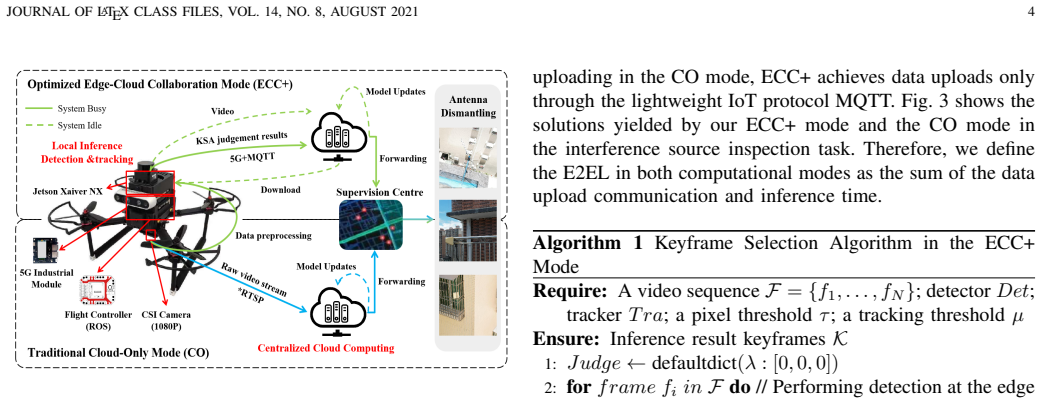
The system's load-bearing mechanism is the combination of the EdgeAnt detector, the AntSort tracker, and the keyframe selection algorithm (KSA). EdgeAnt is a single-stage detector whose backbone LHGNet prunes and reconfigures HGNetv2, whose neck HetBiFPN mixes dual-path and tri-path feature fusion with heterogeneous convolution kernels, and whose enhancement layer TSRBlock uses dilated convolutions to keep small antenna targets visible. AntSort takes the detector's boxes and injects IMU acceleration from the drone as a control input to a Kalman filter, replacing the usual RANSAC-based camera motion compensation. The KSA filters detections by a pixel-size threshold $\tau=120$ and uploads only targets that have been tracked for more than $\mu=6$ consecutive frames, so each confirmed interference source is reported to the cloud once rather than continuously.
What would settle it
Collect fresh aerial footage of the same three antenna types under different altitudes, cities, and lighting; run the released EdgeAnt code with the fixed KSA thresholds; if mAP drops substantially below 42.1% or latency savings shrink, the reported state-of-the-art and the 88.9% reduction are overfit to the single evaluation scene.
Extended reading notes
Core claim
The central claim is that an optimized edge-cloud collaboration mode, in which all detection and tracking happens on the UAV and only selectively chosen keyframe results are uploaded via MQTT, gives real-time antenna interference source localization without sacrificing accuracy. The paper reports that EdgeAnt, a single-stage detector built from a lightweight backbone (LHGNet), a heterogeneous bidirectional feature pyramid neck (HetBiFPN), and a small-object enhancement layer (EL) with two-step residual blocks, achieves 42.1% mAP on the authors' antenna interference source dataset with 3.0 million parameters and 14.7 GFLOPs, and 38.9% mAP on COCO with 5.4 GFLOPs. Deployed with TensorRT on Jetson Xavier NX it sustains 21.1 FPS at $1088 \times 1088$ input, and with NCNN on Raspberry Pi 4B it sustains 4.8 FPS at $640 \times 640$. In the full system, the keyframe selection algorithm reduces end-to-end latency from 1012 ms in cloud-only mode to 62 ms of communication plus 51.3 ms of inference in ECC+ mode, an 88.9% reduction, while accuracy rises from 75.0% to 90.4%.
Load-bearing premise
The results depend on the custom antenna dataset (600 training and 200 validation images with about 3,200 targets) being representative of real interference-source imagery, and on the KSA thresholds ($\tau=120$ pixels and $\mu=6$ frames) transferring to other flights and cameras.
Editorial extensions
If this is right
- Detector performance transfers across hardware: on Jetson Xavier NX with TensorRT the EdgeAnt pipeline sustains over 20 FPS at $1088 \times 1088$, the only tested detector to meet real-time inspection needs.
- The ECC+ mode keeps end-to-end latency under 150 ms even for 1080p video, and the influence of uplink bandwidth fluctuations shrinks relative to cloud-only mode.
- With the KSA, each confirmed interference source is uploaded once rather than streamed continuously, so communication cost and false-positive traffic drop while accuracy rises.
- The multi-UAV path planning formulation indicates that increasing fleet size from one to five UAVs reduces per-UAV energy and communication delay until airspace congestion offsets the gain.
Reading between the lines
- Because the KSA thresholds are fixed in pixels and frames, a natural testable extension is to make them adaptive to flight altitude and camera focal length; the paper's own data suggest target pixel size varies with viewing angle.
- The reported 28.2% accuracy improvement over cloud-only mode is measured on uploaded frames; an independent evaluation should separate detector recall from upload policy to see whether the gain is real detection improvement or simply fewer false uploads.
- The same edge-cloud collaboration pattern with selective keyframes could apply to other aerial small-object inspection tasks, such as utility insulator defects or rooftop solar panel faults, since the architecture is task-agnostic.
Editorial analysis
A structured set of objections, weighed in public.
Referee Report
Summary. The paper proposes an AIoT system for UAV-based detection of unauthorized antenna interference sources, using an edge-cloud collaboration mode (ECC+) in which all detection and tracking run on the drone's edge device and a keyframe selection algorithm (KSA) uploads only selected inference results. The core detection component is EdgeAnt, a lightweight detector built from the LHGNet backbone, the HetBiFPN neck, and a small-object enhancement layer, together with an IMU-aided tracker called AntSort. The detector is ablated on a custom antenna dataset, benchmarked on COCO, and deployed on Jetson Xavier NX and Raspberry Pi 4B. System-level experiments compare E2EL, accuracy, power, and bandwidth across CO, ECC, and ECC+ modes, and a multi-UAV path-planning simulation is included.
Significance. The detector part of the paper is the strongest contribution: EdgeAnt is carefully ablated component-by-component, and the COCO benchmark provides an independent check that the architecture generalizes beyond the custom antenna dataset. The deployment measurements on two edge devices and the public detector code are also valuable, and the reported real-time inference speeds are credible. However, the headline system-level accuracy claim is not currently supported by the paper's own equations and tables: Eq. (23) computes precision on uploaded frames rather than accuracy or recall, and the claimed 28.2% improvement does not match any row in Tables VI or VII. The KSA thresholds are also selected on the evaluation scenario without a held-out validation sequence. If the system-level metrics are corrected and validated on a separate flight, the paper would make a useful engineering contribution.
major comments (4)
- [Section IV.D, Eq. (23)] Equation (23) defines Accuracy = TP/(TP+FN), but the text immediately defines FN as "the number of noninterference source target frames uploaded," which is false positives, not false negatives in the detection sense. The quantity computed is therefore precision on uploaded frames, not accuracy and not recall. True negatives are not counted at all, and true antennas that are detected in fewer than mu consecutive frames are never uploaded, so they never enter the denominator. Under this metric, ECC+ can report a higher "accuracy" simply by filtering out low-confidence uploads while silently discarding missed interference sources, which is exactly the failure mode an inspection system must avoid. Please replace this with a standard detection metric, such as recall or F1 over all ground-truth target frames in the test video, and recompute all system accuracy numbers.
- [Abstract and Section IV.D, Tables VI and VII] The abstract claims that compared with CO mode, ECC+ "increases accuracy by 28.2%." This number is not supported by Tables VI or VII. For EdgeAnt+AntSort, Table VI gives 90.4 for ECC+ versus 86.4 for the CO mode with the same detector, a gain of 4.0 percentage points, and versus 75.0 for the CO YOLOv8-n+BotSort baseline, a gain of 15.4 percentage points. Table VII gives 90.4 versus 68.2 for 720p CO (+22.2 percentage points) and versus 32.9 for 480p CO (+57.5 percentage points). The only arithmetic that yields roughly 28% is 42.1/32.9, which would mix EdgeAnt's detector mAP with the 480p CO-mode accuracy, a category error. Please either identify the exact baseline and calculation behind the 28.2% claim or remove it.
- [Section IV.C, Fig. 14, and Section IV.D] The KSA parameters tau=120 px and mu=6 frames are tuned on the evaluation scenario: tau is derived from the observed Yagi antenna size in that imagery, and mu is selected from the interval that appears effective in test videos of the same scenario. No held-out flight sequence is used to validate transfer, and no sensitivity analysis is reported. Because the reported system accuracy and latency gains depend on these thresholds, the gains may be overfitted to one particular altitude, camera, and antenna distribution. Please validate the thresholds on a separate flight with different settings and report system accuracy and E2EL as functions of tau and mu.
- [Section IV.B, Tables II-V] All detector accuracy and mAP figures are reported as single point estimates. With only 600 training and 200 validation images in the custom antenna dataset, differences between top-ranked models, such as 0.423 versus 0.419 mAP in Table II, may be within run-to-run noise. Please report means and standard deviations over multiple training runs or bootstrap confidence intervals, and state the number of runs used. This is needed before the "state-of-the-art" claim on the custom dataset can be assessed.
minor comments (3)
- [Section III.B, Eqs. (2), (10), (12)] The multi-UAV objective function contains weighting coefficients alpha_1 through alpha_5, but the paper never states their values or how they were chosen. The simulation results in Fig. 17 are therefore not reproducible. Please provide the coefficient values and a brief sensitivity analysis.
- [Section IV.A.1] The detector code is publicly released, but the custom antenna dataset is not. Since the central detector comparison is on this dataset and the system validation uses a single 40-second video, the paper would be substantially stronger if the dataset and test video are released, or if a detailed public benchmark is used as an additional check.
- [Section IV.C and Tables IV-V] There are several cross-reference errors: the COCO results are said to be "shown in Table IV" but appear in Table V, and the text "Fig. 5 shows the final complete neck architecture" refers to a figure that depicts the multi-UAV setup rather than the neck. Please correct these references.
Circularity Check
System-level accuracy claim is partially circular: Eq. (23) defines 'Accuracy' as precision over the frames KSA chooses to upload, so the ECC+ accuracy gain is partly built into the metric.
-
self definitional
[Section IV.A.4 (Evaluation Criteria, 'E2EL and Accuracy'), Eq. (23), with Algorithm 1 in Section III.A]
"Accuracy is defined as in (23). Accuracy = TP/(TP+FN)×100% ... where TP refers to the number of correct interference source target frames uploaded to the server and FN refers to the number of noninterference source target frames uploaded. ... if (Judge[t.id][0]>=µ) and (Judge[t.id][2]−Judge[t.id][1]<= (µ−1)) then K ← K ∪ {f_i}; Exist_id ← Exist_id ∪ {t.id};"
The 'Accuracy' metric counts only frames the system itself uploads after KSA filtering: FN is defined as non-interference frames uploaded, not as missed ground-truth targets. Algorithm 1 uploads a target only after it has been tracked for at least µ consecutive frames, so any missed detection that never survives µ frames is never placed in the denominator. The quantity computed is precision over system-selected keyframes, not accuracy. Therefore the reported ECC+ accuracy gain (90.4% vs 86.4% in Table VI, abstracted as '+28.2%') is in part produced by the definition: filtering uploads by the KSA necessarily raises TP/(TP+FP) on the surviving set. This is a self-referential metric rather than an independently measured system outcome.
full rationale
The detector-level contribution is not circular: EdgeAnt is benchmarked on COCO (Table V) and ablated against external backbones and necks (Tables II–III), and its mAP claims stand independently of the system-level metric. Self-citations are limited to prior antenna-detector work [3] and are not load-bearing. The circular content is confined to the system-level accuracy claim. Equation (23) defines 'Accuracy' as TP/(TP+FN) with FN explicitly defined as 'noninterference source target frames uploaded'—i.e., false positives among uploads—while Algorithm 1 uploads only detections that survive pixel and tracking thresholds. Missed targets are never counted, so the metric is precision over self-selected keyframes. Since KSA chooses which frames enter the numerator/denominator, the ECC+ accuracy improvement is partly true by definition, not by measurement. The abstract's '+28.2%' additionally cannot be recovered from Tables VI/VII (the closest values are +4.6 points at 1080p and +20.5 points vs the CO YOLOv8-n+BotSort row; no row yields 28.2%), and the only arithmetic match mixes detector mAP with a 480p CO accuracy, a category error. This internal inconsistency does not affect detector validity but undermines the headline system-level benefit. Score is 6 because the central detector content is independent while one headline prediction reduces by construction.
Assumptions & free parameters
free parameters (3)
- KSA pixel threshold tau =
120 pixels
- KSA tracking threshold mu =
6 consecutive frames
- Multi-UAV objective weights alpha1..alpha5 (Eqs. 2, 10, 12) =
not reported
assumptions (5)
- domain assumption Custom antenna dataset is representative and correctly labeled
- ad hoc to paper KSA thresholds chosen on the test video generalize to other flights
- domain assumption E2EL as TC+TI+eta captures the delays that determine real-time performance
- domain assumption IMU linear acceleration is a valid control input for camera-motion compensation in tracking
- domain assumption All detectors were compared under equivalent, fair training conditions
Cite this review
Pith. "Pith review of Real-Time AIoT for AAV Antenna Interference Detection via Edge-Cloud Collaboration." pith.science (2026). https://pith.science/paper/KUHM26LW
@misc{pith2026241203055,
  author       = {Pith},
  title        = {Pith review of: Real-Time AIoT for AAV Antenna Interference Detection via Edge-Cloud Collaboration},
  year         = {2026},
  howpublished = {\url{https://pith.science/paper/KUHM26LW}},
  note         = {Machine review of arXiv:2412.03055}
}
read the original abstract
In the fifth-generation (5G) era, eliminating communication interference sources is crucial for maintaining network performance. Interference often originates from unauthorized or malfunctioning antennas, and radio monitoring agencies must address numerous sources of such antennas annually. Unmanned aerial vehicles (UAVs) can improve inspection efficiency. However, the data transmission delay in the existing cloud-only (CO) artificial intelligence (AI) mode fails to meet the low latency requirements for real-time performance. Therefore, we propose a computer vision-based AI of Things (AIoT) system to detect antenna interference sources for UAVs. The system adopts an optimized edge-cloud collaboration (ECC+) mode, combining a keyframe selection algorithm (KSA), focusing on reducing end-to-end latency (E2EL) and ensuring reliable data transmission, which aligns with the core principles of ultra-reliable low-latency communication (URLLC). At the core of our approach is an end-to-end antenna localization scheme based on the tracking-by-detection (TBD) paradigm, including a detector (EdgeAnt) and a tracker (AntSort). EdgeAnt achieves state-of-the-art (SOTA) performance with a mean average precision (mAP) of 42.1% on our custom antenna interference source dataset, requiring only 3 million parameters and 14.7 GFLOPs. On the COCO dataset, EdgeAnt achieves 38.9% mAP with 5.4 GFLOPs. We deployed EdgeAnt on Jetson Xavier NX (TRT) and Raspberry Pi 4B (NCNN), achieving real-time inference speeds of 21.1 (1088) and 4.8 (640) frames per second (FPS), respectively. Compared with CO mode, the ECC+ mode reduces E2EL by 88.9%, increases accuracy by 28.2%. Additionally, the system offers excellent scalability for coordinated multiple UAVs inspections. The detector code is publicly available at https://github.com/SCNU-RISLAB/EdgeAnt.
Figures


Figures from the paper (11 more)


Reference graph
Works this paper leans on
-
[1]
A comprehensive survey on internet of things (iot) toward 5g wireless systems,
L. Chettri and R. Bera, “A comprehensive survey on internet of things (iot) toward 5g wireless systems,”IEEE Internet of Things Journal, vol. 7, no. 1, pp. 16–32, 2020
work page 2020
-
[2]
A survey on the convergence of edge computing and ai for uavs: Opportunities and challenges,
P. McEnroe, S. Wang, and M. Liyanage, “A survey on the convergence of edge computing and ai for uavs: Opportunities and challenges,”IEEE Internet of Things Journal, vol. 9, no. 17, pp. 15435–15459, 2022
work page 2022
-
[3]
X. Tang, X. Chen, J. Cheng, J. Wu, R. Fan, C. Zhang, and Z. Zhou, “Yolo-ant: A lightweight detector via depthwise separable convolutional and large kernel design for antenna interference source detection,”IEEE Transactions on Instrumentation and Measurement, vol. 73, pp. 1–18, 2024
work page 2024
-
[4]
A new method for locating radio interference sources,
R. Wang, “A new method for locating radio interference sources,”Radio and TV technology, vol. 44, pp. 130–132, 2017
work page 2017
-
[5]
Joint front–edge–cloud iovt analytics: Resource-effective design and schedul- ing,
Y . Chen, T. Zhao, P. Cheng, M. Ding, and C. W. Chen, “Joint front–edge–cloud iovt analytics: Resource-effective design and schedul- ing,”IEEE Internet of Things Journal, vol. 9, no. 23, pp. 23941–23953, 2022
work page 2022
-
[6]
The convergence and inter- play of edge, fog, and cloud in the ai-driven internet of things (iot),
F. Firouzi, B. Farahani, and A. Marin ˇsek, “The convergence and inter- play of edge, fog, and cloud in the ai-driven internet of things (iot),” Information Systems, vol. 107, p. 101840, 2022. JOURNAL OF LATEX CLASS FILES, VOL. 14, NO. 8, AUGUST 2021 16
work page 2022
-
[7]
Fog and iot: An overview of research opportunities,
M. Chiang and T. Zhang, “Fog and iot: An overview of research opportunities,”IEEE Internet of Things Journal, vol. 3, no. 6, pp. 854– 864, 2016
work page 2016
-
[8]
Mobile edge computing: A survey,
N. Abbas, Y . Zhang, A. Taherkordi, and T. Skeie, “Mobile edge computing: A survey,”IEEE Internet of Things Journal, vol. 5, no. 1, pp. 450–465, 2018
2018
Show all 71 references
-
[9]
Ai for uav-assisted iot applications: A comprehensive review,
N. Cheng, S. Wu, X. Wang, Z. Yin, C. Li, W. Chen, and F. Chen, “Ai for uav-assisted iot applications: A comprehensive review,”IEEE Internet of Things Journal, vol. 10, no. 16, pp. 14438–14461, 2023
2023
-
[10]
Mr-dro: A fast and efficient task offloading algorithm in heterogeneous edge/cloud computing environments,
Z. Zhang, N. Wang, H. Wu, C. Tang, and R. Li, “Mr-dro: A fast and efficient task offloading algorithm in heterogeneous edge/cloud computing environments,”IEEE Internet of Things Journal, vol. 10, no. 4, pp. 3165–3178, 2023
2023
-
[11]
You only look once: Unified, real-time object detection,
J. Redmon, S. K. Divvala, R. B. Girshick, and A. Farhadi, “You only look once: Unified, real-time object detection,”2016 IEEE Conference on Computer Vision and Pattern Recognition (CVPR), pp. 779–788, 2015
2016
-
[12]
Multi- uav-enabled load-balance mobile-edge computing for iot networks,
L. Yang, H. Yao, J. Wang, C. Jiang, A. Benslimane, and Y . Liu, “Multi- uav-enabled load-balance mobile-edge computing for iot networks,” IEEE Internet of Things Journal, vol. 7, no. 8, pp. 6898–6908, 2020
2020
-
[13]
E3-uav: An edge-based energy- efficient object detection system for unmanned aerial vehicles,
J. Suo, X. Zhang, W. Shi, and W. Zhou, “E3-uav: An edge-based energy- efficient object detection system for unmanned aerial vehicles,”IEEE Internet of Things Journal, vol. 11, no. 3, pp. 4398–4413, 2024
2024
-
[14]
Hybrid motion model for multiple object tracking in mobile devices,
Y . Wu, H. Sheng, Y . Zhang, S. Wang, Z. Xiong, and W. Ke, “Hybrid motion model for multiple object tracking in mobile devices,”IEEE Internet of Things Journal, vol. 10, no. 6, pp. 4735–4748, 2023
2023
-
[15]
Delving into the trajectory long-tail distribution for muti-object tracking,
S. Chen, E. Yu, J. Li, and W. Tao, “Delving into the trajectory long-tail distribution for muti-object tracking,” inProceedings of the IEEE/CVF Conference on Computer Vision and Pattern Recognition, pp. 19341– 19351, 2024
2024
-
[16]
Flow-guided feature aggregation for video object detection,
X. Zhu, Y . Wang, J. Dai, L. Yuan, and Y . Wei, “Flow-guided feature aggregation for video object detection,” inProceedings of the IEEE international conference on computer vision, pp. 408–417, 2017
2017
-
[17]
Memory enhanced global-local aggregation for video object detection,
Y . Chen, Y . Cao, H. Hu, and L. Wang, “Memory enhanced global-local aggregation for video object detection,”2020 IEEE/CVF Conference on Computer Vision and Pattern Recognition (CVPR), pp. 10334–10343, 2020
2020
-
[18]
Light-yolov5: A lightweight drone detector for resource-constrained cameras,
J. Han, R. Cao, A. Brighente, and M. Conti, “Light-yolov5: A lightweight drone detector for resource-constrained cameras,”IEEE Internet of Things Journal, vol. 11, no. 6, pp. 11046–11057, 2024
2024
-
[19]
Deep feature flow for video recognition,
X. Zhu, Y . Xiong, J. Dai, L. Yuan, and Y . Wei, “Deep feature flow for video recognition,” in2017 IEEE Conference on Computer Vision and Pattern Recognition (CVPR), pp. 4141–4150, 2017
2017
-
[20]
Empowering things with intelligence: A survey of the progress, challenges, and opportunities in artificial intelligence of things,
J. Zhang and D. Tao, “Empowering things with intelligence: A survey of the progress, challenges, and opportunities in artificial intelligence of things,”IEEE Internet of Things Journal, vol. 8, no. 10, pp. 7789–7817, 2021
2021
-
[21]
Toward efficient fire detection in iot environment: A modified attention network and large-scale data set,
N. Dilshad, S. U. Khan, N. S. Alghamdi, T. Taleb, and J. Song, “Toward efficient fire detection in iot environment: A modified attention network and large-scale data set,”IEEE Internet of Things Journal, vol. 11, no. 8, pp. 13467–13481, 2024
2024
-
[22]
An effec- tive lightweight crowd counting method based on an encoder–decoder network for internet of video things,
J. Yi, F. Chen, Z. Shen, Y . Xiang, S. Xiao, and W. Zhou, “An effec- tive lightweight crowd counting method based on an encoder–decoder network for internet of video things,”IEEE Internet of Things Journal, vol. 11, no. 2, pp. 3082–3094, 2024
2024
-
[23]
Lightweight lae for anomaly detection with sound-based architecture in smart poultry farm,
V . Goyal, A. Yadav, S. Kumar, and R. Mukherjee, “Lightweight lae for anomaly detection with sound-based architecture in smart poultry farm,” IEEE Internet of Things Journal, vol. 11, no. 5, pp. 8199–8209, 2024
2024
-
[24]
Attention to task-aligned object detection for end–edge–cloud video surveillance,
Y . Liu, Z. Yu, D. Zong, and L. Zhu, “Attention to task-aligned object detection for end–edge–cloud video surveillance,”IEEE Internet of Things Journal, vol. 11, no. 8, pp. 13781–13792, 2024
2024
-
[25]
Ec²detect: Real- time online video object detection in edge-cloud collaborative iot,
S. Guo, C. Zhao, G. Wang, J. Yang, and S. Yang, “Ec²detect: Real- time online video object detection in edge-cloud collaborative iot,”IEEE Internet of Things Journal, vol. 9, no. 20, pp. 20382–20392, 2022
2022
-
[26]
Internet of things (iot) and agricultural unmanned aerial vehicles (uavs) in smart farming: A comprehensive review,
A. D. Boursianis, M. S. Papadopoulou, P. Diamantoulakis, A. Liopa- Tsakalidi, P. Barouchas, G. Salahas, G. Karagiannidis, S. Wan, and S. K. Goudos, “Internet of things (iot) and agricultural unmanned aerial vehicles (uavs) in smart farming: A comprehensive review,”Internet of ...
2022
-
[27]
Adaptive sparse convolutional networks with global context enhancement for faster object detection on drone images,
B. Du, Y . Huang, J. Chen, and D. Huang, “Adaptive sparse convolutional networks with global context enhancement for faster object detection on drone images,” inProceedings of the IEEE/CVF conference on computer vision and pattern recognition, pp. 13435–13444, 2023
2023
-
[28]
Drone-yolo: An efficient neural network method for target detection in drone images,
Z. Zhang, “Drone-yolo: An efficient neural network method for target detection in drone images,”Drones, vol. 7, no. 8, 2023
2023
-
[29]
A modified yolov8 detection network for uav aerial image recognition,
Y . Li, Q. Fan, H. Huang, Z. Han, and Q. Gu, “A modified yolov8 detection network for uav aerial image recognition,”Drones, vol. 7, no. 5, 2023
2023
-
[30]
Adaptive feature fusion and improved attention mechanism-based small object detection for uav target tracking,
X. Xiong, M. He, T. Li, G. Zheng, W. Xu, X. Fan, and Y . Zhang, “Adaptive feature fusion and improved attention mechanism-based small object detection for uav target tracking,”IEEE Internet of Things Journal, vol. 11, no. 12, pp. 21239–21249, 2024
2024
-
[31]
Split-and-shuffle detector for real-time traffic object detection in aerial image,
G. Mao, H. Liang, Y . Yao, L. Wang, and H. Zhang, “Split-and-shuffle detector for real-time traffic object detection in aerial image,”IEEE Internet of Things Journal, vol. 11, no. 8, pp. 13312–13326, 2024
2024
-
[32]
Sac-rsm: A high- performance uav-side road surveillance model based on super-resolution assisted learning,
W. Zheng, H. Xu, P. Li, R. Wang, and X. Shao, “Sac-rsm: A high- performance uav-side road surveillance model based on super-resolution assisted learning,”IEEE Internet of Things Journal, vol. 11, no. 22, pp. 36066–36083, 2024
2024
-
[33]
Lwuavdet: A lightweight uav object detection network on edge devices,
X. Min, W. Zhou, R. Hu, Y . Wu, Y . Pang, and J. Yi, “Lwuavdet: A lightweight uav object detection network on edge devices,”IEEE Internet of Things Journal, vol. 11, no. 13, pp. 24013–24023, 2024
2024
-
[34]
Anchor-free multi-uav detection and classification using spectrogram,
R. Zhao, T. Li, Y . Li, Y . Ruan, and R. Zhang, “Anchor-free multi-uav detection and classification using spectrogram,”IEEE Internet of Things Journal, vol. 11, no. 3, pp. 5259–5272, 2024
2024
-
[35]
Intelligent mobile drone system based on real-time object detection,
J. C. Chuanlong Li, Xingming Sun, “Intelligent mobile drone system based on real-time object detection,”Journal on Artificial Intelligence, vol. 1, no. 1, pp. 1–8, 2019
2019
-
[36]
Small insulator defects detection based on multiscale feature interaction transformer for uav-assisted power iovt,
J. Wu, R. Jing, Y . Bai, Z. Tian, W. Chen, S. Zhang, F. Richard Yu, and V . C. M. Leung, “Small insulator defects detection based on multiscale feature interaction transformer for uav-assisted power iovt,” IEEE Internet of Things Journal, vol. 11, no. 13, pp. 23410–23427, 2024
2024
-
[37]
Learning to aggregate multi-scale context for instance segmentation in remote sensing images,
Y . Liu, H. Li, C. Hu, S. Luo, Y . Luo, and C. W. Chen, “Learning to aggregate multi-scale context for instance segmentation in remote sensing images,”IEEE Transactions on Neural Networks and Learning Systems, pp. 1–15, 2024
2024
-
[38]
A path planning method for sweep coverage with multiple uavs,
J. Li, Y . Xiong, J. She, and M. Wu, “A path planning method for sweep coverage with multiple uavs,”IEEE Internet of Things Journal, vol. 7, no. 9, pp. 8967–8978, 2020
2020
-
[39]
Detrs beat yolos on real-time object detection,
Y . Zhao, W. Lv, S. Xu, J. Wei, G. Wang, Q. Dang, Y . Liu, and J. Chen, “Detrs beat yolos on real-time object detection,”arXiv preprint arXiv:2304.08069, 2023
2023 arXiv
-
[40]
Path aggregation network for instance segmentation,
S. Liu, L. Qi, H. Qin, J. Shi, and J. Jia, “Path aggregation network for instance segmentation,” inProceedings of the IEEE conference on computer vision and pattern recognition, pp. 8759–8768, 2018
2018
-
[41]
Efficientdet: Scalable and efficient object detection,
M. Tan, R. Pang, and Q. V . Le, “Efficientdet: Scalable and efficient object detection,” inProceedings of the IEEE/CVF conference on computer vision and pattern recognition, pp. 10781–10790, 2020
2020
-
[42]
Xception: Deep learning with depthwise separable convolu- tions,
F. Chollet, “Xception: Deep learning with depthwise separable convolu- tions,” inProceedings of the IEEE conference on computer vision and pattern recognition, pp. 1251–1258, 2017
2017
-
[43]
Ghostnet: More features from cheap operations,
K. Han, Y . Wang, Q. Tian, J. Guo, C. Xu, and C. Xu, “Ghostnet: More features from cheap operations,” inProceedings of the IEEE/CVF conference on computer vision and pattern recognition, pp. 1580–1589, 2020
2020
-
[44]
Feature pyramid networks for object detection,
T.-Y . Lin, P. Doll´ar, R. Girshick, K. He, B. Hariharan, and S. Belongie, “Feature pyramid networks for object detection,” inProceedings of the IEEE conference on computer vision and pattern recognition, pp. 2117– 2125, 2017
2017
-
[45]
Hetconv: Hetero- geneous kernel-based convolutions for deep cnns,
P. Singh, V . K. Verma, P. Rai, and V . P. Namboodiri, “Hetconv: Hetero- geneous kernel-based convolutions for deep cnns,” in2019 IEEE/CVF Conference on Computer Vision and Pattern Recognition (CVPR), pp. 4830–4839, 2019
2019
-
[46]
Spatial pyramid pooling in deep convolutional networks for visual recognition,
K. He, X. Zhang, S. Ren, and J. Sun, “Spatial pyramid pooling in deep convolutional networks for visual recognition,”IEEE Transactions on Pattern Analysis and Machine Intelligence, vol. 37, no. 9, pp. 1904– 1916, 2015
1904
-
[47]
Yolov9: Learning what you want to learn using programmable gradient information,
C.-Y . Wang, I.-H. Yeh, and H.-Y . Mark Liao, “Yolov9: Learning what you want to learn using programmable gradient information,” inEuro- pean Conference on Computer Vision, pp. 1–21, Springer, 2025
2025
-
[48]
Yolov10: Real-time end-to-end object detection,
A. Wang, H. Chen, L. Liu, K. Chen, Z. Lin, J. Han, and G. Ding, “Yolov10: Real-time end-to-end object detection,” 2024
2024
-
[49]
Large selective kernel network for remote sensing object detection,
Y . Li, Q. Hou, Z. Zheng, M.-M. Cheng, J. Yang, and X. Li, “Large selective kernel network for remote sensing object detection,” in 2023 IEEE/CVF International Conference on Computer Vision (ICCV), pp. 16748–16759, 2023
2023
-
[50]
Dwrseg: Rethinking efficient acquisition of multi-scale contextual information for real-time semantic segmentation,
H. Wei, X. Liu, S. Xu, Z. Dai, Y . Dai, and X. Xu, “Dwrseg: Rethinking efficient acquisition of multi-scale contextual information for real-time semantic segmentation,” 2023
2023
-
[51]
Bot-sort: Robust associa- tions multi-pedestrian tracking,
N. Aharon, R. Orfaig, and B.-Z. Bobrovsky, “Bot-sort: Robust associa- tions multi-pedestrian tracking,”arXiv preprint arXiv:2206.14651, 2022. JOURNAL OF LATEX CLASS FILES, VOL. 14, NO. 8, AUGUST 2021 17
2022 arXiv
-
[52]
Research on antenna detection technology of communi- cation base station based on computer vision,
van der Ven, “Research on antenna detection technology of communi- cation base station based on computer vision,” Master’s thesis, Beijing University of Posts and Telecommunications, 2021
2021
-
[53]
Microsoft coco: Common objects in context,
T.-Y . Lin, M. Maire, S. Belongie, J. Hays, P. Perona, D. Ramanan, P. Doll ´ar, and C. L. Zitnick, “Microsoft coco: Common objects in context,” inComputer Vision – ECCV 2014(D. Fleet, T. Pajdla, B. Schiele, and T. Tuytelaars, eds.), (Cham), pp. 740–755, Springer International ...
2014
-
[54]
Cspnet: A new backbone that can enhance learning capability of cnn,
C.-Y . Wang, H.-Y . Mark Liao, Y .-H. Wu, P.-Y . Chen, J.-W. Hsieh, and I.- H. Yeh, “Cspnet: A new backbone that can enhance learning capability of cnn,” in2020 IEEE/CVF Conference on Computer Vision and Pattern Recognition Workshops (CVPRW), pp. 1571–1580, 2020
2020
-
[55]
Searching for mobilenetv3,
A. Howard, M. Sandler, B. Chen, W. Wang, L.-C. Chen, M. Tan, G. Chu, V . Vasudevan, Y . Zhu, R. Pang, H. Adam, and Q. Le, “Searching for mobilenetv3,” in2019 IEEE/CVF International Conference on Computer Vision (ICCV), pp. 1314–1324, 2019
2019
-
[56]
Efficientvit: Lightweight multi-scale attention for high-resolution dense prediction,
H. Cai, J. Li, M. Hu, C. Gan, and S. Han, “Efficientvit: Lightweight multi-scale attention for high-resolution dense prediction,” in2023 IEEE/CVF International Conference on Computer Vision (ICCV), pp. 17256–17267, 2023
2023
-
[57]
Shufflenet v2: Practical guidelines for efficient cnn architecture design,
N. Ma, X. Zhang, H.-T. Zheng, and J. Sun, “Shufflenet v2: Practical guidelines for efficient cnn architecture design,” inProceedings of the European conference on computer vision (ECCV), pp. 116–131, 2018
2018
-
[58]
Repvit: Revisiting mobile cnn from vit perspective,
A. Wang, H. Chen, Z. Lin, J. Han, and G. Ding, “Repvit: Revisiting mobile cnn from vit perspective,” inProceedings of the IEEE/CVF Conference on Computer Vision and Pattern Recognition, pp. 15909– 15920, 2024
2024
-
[59]
Deep residual learning for image recognition,
K. He, X. Zhang, S. Ren, and J. Sun, “Deep residual learning for image recognition,” in2016 IEEE Conference on Computer Vision and Pattern Recognition (CVPR), pp. 770–778, 2016
2016
-
[60]
Slim-neck by gsconv: a lightweight-design for real-time detector architectures,
H. Li, J. Li, H. Wei, Z. Liu, Z. Zhan, and Q. Ren, “Slim-neck by gsconv: a lightweight-design for real-time detector architectures,”Journal of Real-Time Image Processing, vol. 21, Mar. 2024
2024
-
[61]
Accurate leukocyte detection based on deformable-detr and multi-level feature fusion for aiding diagnosis of blood diseases,
Y . Chen, C. Zhang, B. Chen, Y . Huang, Y . Sun, C. Wang, X. Fu, Y . Dai, F. Qin, Y . Peng, and Y . Gao, “Accurate leukocyte detection based on deformable-detr and multi-level feature fusion for aiding diagnosis of blood diseases,”Computers in biology and medicine, vol. 170, p...
2024
-
[62]
Damo-yolo : A report on real-time object detection design,
X. Xu, Y . Jiang, W. Chen, Y . Huang, Y . Zhang, and X. Sun, “Damo-yolo : A report on real-time object detection design,” 2023
2023
-
[63]
RTMDet: An Empirical Study of Designing Real-Time Object Detectors,
C. Lyu, W. Zhang, H. Huang, Y . Zhou, Y . Wang, Y . Liu, S. Zhang, and K. Chen, “RTMDet: An Empirical Study of Designing Real-Time Object Detectors,”arXiv e-prints, p. arXiv:2212.07784, Dec. 2022
2022 arXiv
-
[64]
Yolox: Exceeding yolo series in 2021,
Z. Ge, S. Liu, F. Wang, Z. Li, and J. Sun, “Yolox: Exceeding yolo series in 2021,”arXiv preprint arXiv:2107.08430, 2021
2021 arXiv
-
[65]
YOLOv3: An Incremental Improvement,
J. Redmon and A. Farhadi, “YOLOv3: An Incremental Improvement,” arXiv e-prints, p. arXiv:1804.02767, Apr. 2018
2018 arXiv
-
[66]
Yolov6: A single-stage object detection framework for industrial applications,
C. Li, L. Li, H. Jiang, K. Weng, Y . Geng, L. Li, Z. Ke, Q. Li, M. Cheng, W. Nie, Y . Li, B. Zhang, Y . Liang, L. Zhou, X. Xu, X. Chu, X. Wei, and X. Wei, “Yolov6: A single-stage object detection framework for industrial applications,” 2022
2022
-
[67]
Yolov7: Trainable bag-of-freebies sets new state-of-the-art for real-time object detectors,
C.-Y . Wang, A. Bochkovskiy, and H.-Y . M. Liao, “Yolov7: Trainable bag-of-freebies sets new state-of-the-art for real-time object detectors,” inProceedings of the IEEE/CVF conference on computer vision and pattern recognition, pp. 7464–7475, 2023
2023
-
[68]
Pp-yoloe: An evolved version of yolo,
S. Xu, X. Wang, W. Lv, Q. Chang, C. Cui, K. Deng, G. Wang, Q. Dang, S. Wei, Y . Du, and B. Lai, “Pp-yoloe: An evolved version of yolo,” 2022
2022
-
[69]
Ssd: Single shot multibox detector,
W. Liu, D. Anguelov, D. Erhan, C. Szegedy, S. Reed, C.-Y . Fu, and A. C. Berg, “Ssd: Single shot multibox detector,” inComputer Vision – ECCV 2016(B. Leibe, J. Matas, N. Sebe, and M. Welling, eds.), (Cham), pp. 21–37, Springer International Publishing, 2016
2016
-
[70]
YOLOv4: Op- timal Speed and Accuracy of Object Detection,
A. Bochkovskiy, C.-Y . Wang, and H.-Y . M. Liao, “YOLOv4: Op- timal Speed and Accuracy of Object Detection,”arXiv e-prints, p. arXiv:2004.10934, Apr. 2020. Jun Dong(Student Member, IEEE) is currently pursuing the bachelor’s degree in Internet of Things (IoT) engineering with t...
2004 arXiv
-
[2018]
His research interests include statistical signal processing, Bayesian estimation theory, and fault detection and diagnosis
In 2015, he joined Jiangnan University as an associate professor, where he is currently a professor. His research interests include statistical signal processing, Bayesian estimation theory, and fault detection and diagnosis. Dr. Zhao was a recipient of the Alexander von Humbo...
2015
Reviewed August 11, 2026 · model on record in the stance chip above.
Discussion (0). Continue with ORCID to comment.