REVIEW 2 major objections 5 minor 39 references
Successive magnetic transitions in the spin-5/2 easy-axis triangular-lattice antiferromagnet Na$_2$BaMn(PO$_4$)$_2$: A neutron diffraction study
T0 review · 2 major / 5 minor · reviewed 2026-08-11 · deepseek-v4-flash
Pith's one-line read The zero-field ground state of the spin-5/2 triangular-lattice antiferromagnet Na2BaMn(PO4)2 is a Y-like spin configuration, with a c-axis collinear phase between two successive transitions at 1.13 K and 1.28 K.
desk verdict A solid neutron-diffraction determination of the Y-like ground state in a classical spin-5/2 triangular antiferromagnet, with the intermediate-phase structure plausible but not nailed down. read the letter →
The pith
A machine-rendered reading of the paper's core claim, the machinery that carries it, and where it could break.
The reading
What carries the argument
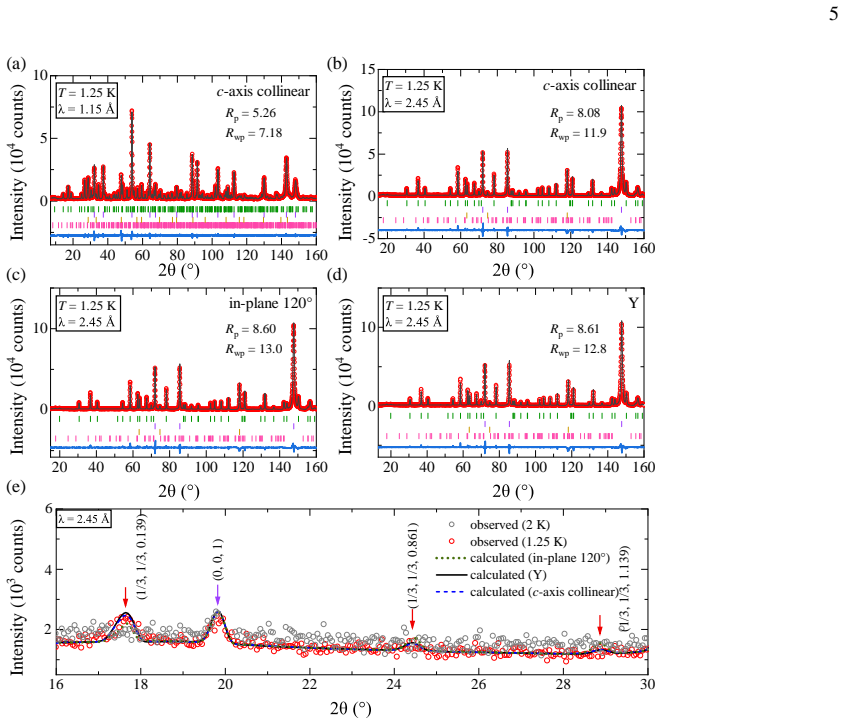
The analysis is carried by irreducible-representation decomposition of the magnetic representation for the Mn$^{2+}$ site, which splits into three representations: $\Gamma_1$ (spins along $c$, cosinusoidally modulated by the incommensurate $k_z$), and $\Gamma_2,\Gamma_3$ (coplanar $120^\circ$ structures of opposite in-plane chirality). The Y ground state is the superposition of all three with the $\Gamma_2:\Gamma_3$ coefficients fixed at 1:$-1$, while the intermediate phase is modeled by $\Gamma_1$ alone. Neutron powder diffraction at 67 mK and 1.25 K discriminates among these models: at 67 mK the single-representation models misfit the magnetic reflection intensities, while at 1.25 K the in-plane components refine to zero and the higher-symmetry $\Gamma_1$ model fits as well as the Y model. The temperature dependence of the integrated magnetic reflection intensity and the refined moment components then ties the two macroscopic anomalies in specific heat and magnetization to the in-plane and out-of-plane ordering separately.
What would settle it
A single-crystal neutron diffraction experiment at a temperature between $T_{N1}$ and $T_{N2}$ that resolves magnetic intensity requiring an in-plane moment component, or a powder measurement at several temperatures in that window showing nonzero in-plane scattering, would falsify the c-axis collinear assignment. Conversely, measuring the in-plane moment to remain zero throughout the window while the $c$-axis moment orders at $T_{N2}$ would confirm it.
Extended reading notes
Core claim
The paper reports that the zero-field magnetic ground state of Na$_2$BaMn(PO$_4$)$_2$ is a Y-like spin structure, not a simple $120^\circ$ or $c$-axis collinear state: refinement of the 67 mK powder patterns requires the superposition of the $c$-axis collinear irreducible representation with the two in-plane $120^\circ$ representations, with the in-plane pair entered in a 1:$-1$ ratio. On warming through $T_{N1}\approx1.13$ K, the in-plane moment components vanish and the remaining $c$-axis moments stay ordered up to $T_{N2}\approx1.28$ K, giving a $c$-axis collinear intermediate phase with U(1) spin-rotation symmetry preserved. The magnetic propagation vector is incommensurate in both phases, and its $c$-axis component jumps between the two phases, which the authors attribute to the different interlayer spin arrangements. The paper interprets the two transitions as the separate ordering of the out-of-plane and in-plane moment components of an easy-axis triangular-lattice antiferromagnet, with the intermediate collinear phase stabilized by thermal fluctuations rather than by quantum fluctuations.
Load-bearing premise
The load-bearing premise is that the single 1.25 K powder pattern, in which the in-plane magnetic intensities refine to zero, proves the intermediate phase has exactly zero in-plane moment; if powder averaging or the limited set of tested models hides a small in-plane component, the two-step picture would need revision.
Editorial extensions
If this is right
- Above $T_{N1}$ the in-plane moments are zero while $c$-axis moments remain ordered, so the two anomalies at $T_{N1}$ and $T_{N2}$ are the separate ordering temperatures of the in-plane and out-of-plane spin components.
- The $c$-axis collinear intermediate phase must be an amplitude-modulated antiferromagnet, not the field-induced up-up-down ferrimagnet, because the propagation vector has incommensurate $k_z$ and no $k=0$ ferromagnetic intensity appears at 1.25 K.
- The incommensurate $k_z$ and resolution-limited magnetic Bragg peaks imply the interlayer couplings are not negligible, so a purely two-dimensional model will miss part of the physics.
- The Y ground state in this $S=5/2$ system shows that the Y-like configuration is not a purely quantum effect, extending the spin-supersolid-like spin pattern to the classical limit.
- The success of the same irreducible representations at both temperatures means the exchange anisotropy and symmetry constraints of the $P\bar{3}$ structure are sufficient to describe the ordered phases within the tested model space.
Reading between the lines
- If single-crystal neutron diffraction confirms the intermediate phase, Na$_2$BaMn(PO$_4$)$_2$ could serve as a clean classical reference for the easy-axis XXZ triangular lattice, where temperature rather than quantum fluctuations selects the collinear state.
- The jump in $k_z$ between the two phases suggests the interlayer registry, not just the intralayer spin pattern, changes at $T_{N1}$; a microscopic model fit to the two measured $k_z$ values could constrain the interlayer exchange ratio.
- One could test the thermal-fluctuation interpretation by measuring the intermediate phase under applied magnetic field: a field along $c$ should compete with the collinear state and may reveal whether the collinear phase is a robust thermodynamic phase or a narrow fluctuation-stabilized window.
- Given the marginal difference between the collinear and Y fits at 1.25 K in powder data, the claim would be sharpened by measurements at several temperatures within $T_{N1}<T<T_{N2}$ rather than a single temperature.
Signed reviews
Editorial analysis
A structured set of objections, weighed in public.
Referee Report
Summary. The paper reports a combined thermodynamic and neutron powder diffraction study of the spin-5/2 triangular-lattice antiferromagnet Na2BaMn(PO4)2. Specific heat and dc magnetization show two successive transitions at TN1 ≈ 1.13 K and TN2 ≈ 1.28 K. At 67 mK, refinement of the NPD data favors a Y-like magnetic structure with both in-plane and c-axis Mn2+ moment components, with Rwp = 5.77 versus 9.62 and 9.72 for the in-plane 120° and c-axis collinear alternatives. Between TN1 and TN2, the magnetic propagation vector changes, most notably kz, and the authors assign a c-axis collinear structure based on refinements at a single temperature, 1.25 K, where the c-axis collinear model and the Y-like model give similar Rwp values. The paper interprets the two transitions as separate ordering of the out-of-plane and in-plane spin components, in line with easy-axis triangular-lattice XXZ expectations, and notes incommensurate kz as evidence of interlayer coupling.
Significance. If the ground-state Y structure and the two-step ordering scenario are correct, this is a valuable experimental realization of the classical spin-5/2 limit of the easy-axis triangular-lattice XXZ model, complementing the quantum spin-1/2 and spin-1 compounds in the same phosphate family. The ground-state assignment is well supported: the Y-like refinement gives a substantially lower Rwp than the single-IR alternatives, and the comparison shown in Fig. 3(e) directly demonstrates systematic intensity mismatches for the competing models. The paper also benefits from being grounded in externally established structural results and theoretical predictions from Refs. [28,29]. The intermediate-phase assignment, however, rests on weaker evidence, and the central claim of the paper depends on that assignment; the analysis needs quantitative uncertainty handling before the result can be regarded as conclusive.
major comments (2)
- [Section III, Figs. 5 and 6] The assignment of the intermediate phase (TN1 < T < TN2) as purely c-axis collinear is not established by the evidence presented. The refinement comparison at 1.25 K is made at a single temperature, and the text itself states that the difference between the c-axis collinear and Y-like models is 'quite marginal' and that adding in-plane components does not improve the fit. Non-improvement of Rwp with additional parameters is not equivalent to a zero in-plane moment, particularly in powder data where the relevant magnetic reflections are weak or overlapping. To support the claim, the authors should provide error bars on the refined moments and either a statistical comparison (e.g., a Hamilton test or equivalent) or an explicit sensitivity estimate that quantifies the upper bound on an in-plane component compatible with the 1.25 K pattern. If such an analysis is not possible, the intermediate-phase structure should be presented as one plausible model rather than as the determined structure.
- [Section III, Fig. 6(c)] The temperature dependence of the moment sizes is central to the two-step-ordering scenario, but Fig. 6(c) reports refined out-of-plane and in-plane moments without error bars and with only one intermediate temperature point (1.25 K). The statement that the in-plane moment 'tends to vanish at TN1 already' therefore cannot be quantitatively tested, and the continuity or discontinuity of the in-plane order parameter across TN1 is not resolved. The authors should add refinement uncertainties and, if feasible, additional temperatures around TN1, or they should explicitly restrict the claim to consistency rather than determination.
minor comments (5)
- [Introduction, paragraph 4] The sentence 'two sharp anomalies can be observed at TN1 ∼ 1.13 K at TN2 ∼ 1.28 K' appears to have a typo; 'at' before TN2 should presumably be 'and'.
- [Abstract and Section III] The abstract says the magnetic propagation vector shows a dramatic change, but the reported evidence concerns specifically kz; please state this explicitly to avoid overstating the change in the full vector.
- [Figure 5 caption and main text] The figure caption says panels (a) and (b) are fitted with a c-axis collinear structure, while the main text says panels (b), (c), and (d) use c-axis collinear, in-plane 120°, and Y-like structures respectively; the description of the panels should be made consistent.
- [Section II, sample synthesis] The phrase 'the mixture were pelletized' should be 'the mixture was pelletized'.
- [Section III, Fig. 6(c)] Even if error bars are added in a revision, the figure would benefit from a legend distinguishing the three Mn sites in the triangular unit, because the text refers to Mn1, Mn2, and Mn3 but the symbols are not defined in the caption.
Circularity Check
No significant circularity: this is an experimental neutron-diffraction study whose structural assignments are compared against external theoretical models; the only self-citation (Ref. [24]) is corroborated by an independent study and is not load-bearing.
full rationale
The paper's central claims are empirical determinations from neutron powder diffraction, not derivations from fitted parameters. The Y-like ground state is identified by refining the 67 mK data against three model structures (in-plane 120 degrees, c-axis collinear, and Y-like) and comparing R factors (Section III, Fig. 3); the theoretical Y-state expectation is cited to external Refs. [28-30], not to the authors' own prior work. No Hamiltonian parameters are fitted to the data, and no quantity nominally 'predicted' is in fact an output of a fit. The intermediate-phase c-axis collinear assignment (Section III, Fig. 5) is a model choice based on the statement that the Y-like structure 'does not improve the fitting to the magnetic intensities at all,' which may be statistically fragile (a correctness risk), but it is not circular: the data are not constructed to force that model. The only self-citation to the authors' previous work, Ref. [24], supplies the room-temperature space group and Curie-Weiss temperature; the paper immediately adds 'well consistent with an independent NPD study from Kajita et al. [25],' so the self-citation is not load-bearing. The concern that the absence of in-plane intensity at 1.25 K is interpreted as zero in-plane moment is a legitimate experimental-uncertainty critique, but it does not amount to a self-defined prediction or a fitted-input-as-prediction. Overall, the paper is self-contained against external benchmarks and exhibits no significant circularity.
Assumptions & free parameters
assumptions (4)
- standard math The magnetic structure can be decomposed into irreducible representations of the P-3 space group for the Mn 1b site.
- domain assumption The easy-axis XXZ model with nearest-neighbor exchange and single-ion anisotropy describes the magnetism of Na2BaMn(PO4)2.
- domain assumption The ratio of the Γ2 and Γ3 coefficients is fixed to 1:-1 when constructing the Y-like state.
- domain assumption The incommensurate kz component implies significant interlayer coupling.
Cite this review
Pith. "Pith review of Successive magnetic transitions in the spin-5/2 easy-axis triangular-lattice antiferromagnet Na$_2$BaMn(PO$_4$)$_2$: A neutron diffraction study." pith.science (2026). https://pith.science/paper/6GKNHXGP
@misc{pith2026241203149,
  author       = {Pith},
  title        = {Pith review of: Successive magnetic transitions in the spin-5/2 easy-axis triangular-lattice antiferromagnet Na$_2$BaMn(PO$_4$)$_2$: A neutron diffraction study},
  year         = {2026},
  howpublished = {\url{https://pith.science/paper/6GKNHXGP}},
  note         = {Machine review of arXiv:2412.03149}
}
abstract
Motivated by the recent observations of various exotic quantum states in the equilateral triangular-lattice phosphates Na$_2$BaCo(PO$_4$)$_2$ with $J\rm_{eff}$ = 1/2 and Na$_2$BaNi(PO$_4$)$_2$ with $S$ = 1, the magnetic properties of spin-5/2 antiferromagnet Na$_2$BaMn(PO$_4$)$_2$, their classical counterpart, are comprehensively investigated experimentally. DC magnetization and specific heat measurements on polycrystalline samples indicate two successive magnetic transitions at $T\rm_{N1}$ $\approx$ 1.13 K and $T\rm_{N2}$ $\approx$ 1.28 K, respectively. Zero-field neutron powder diffraction measurement at 67 mK reveals a Y-like spin configuration as its ground-state magnetic structure, with both the $ab$-plane and $c$-axis components of the Mn$^{2+}$ moments long-range ordered. The incommensurate magnetic propagation vector $k$ shows a dramatic change for the intermediate phase between $T\rm_{N1}$ and $T\rm_{N2}$, in which the spin state is speculated to change into a collinear structure with only the $c$-axis moments ordered, as stabilized by thermal fluctuations. The successive magnetic transitions observed in Na$_2$BaMn(PO$_4$)$_2$ are in line with the expectation for a triangle-lattice antiferromagnet with an easy-axis magnetic anisotropy.
Figures


Figures from the paper (3 more)


Reference graph
Works this paper leans on
-
[1]
A. P. Ramirez, Strongly geometrically frustrated magnets, Annu. Rev. Mater. Res. 24, 453 (1994)
work page 1994
-
[2]
M. F. Collins and O. A. Petrenko, Review/Synthèse: Triangular antiferromagnets, Can. J. Phys. 75, 605 (1997)
work page 1997
-
[3]
K. Kanoda and R. Kato, Mott physics in organic conductors with triangular lattices, Annu. Rev. Condens. Matter Phys. 2, 167 (2011)
work page 2011
-
[4]
Anderson, Resonating valence bonds: A new kind of insula- tor ?, Mater
P. Anderson, Resonating valence bonds: A new kind of insula- tor ?, Mater. Res. Bull. 8, 153 (1973)
work page 1973
-
[5]
Balents, Spin liquids in frustrated magnets, Nature 464, 199 (2010)
L. Balents, Spin liquids in frustrated magnets, Nature 464, 199 (2010)
2010
-
[6]
Y . Zhou, K. Kanoda, and T.-K. Ng, Quantum spin liquid states, Rev. Mod. Phys. 89, 025003 (2017)
2017
-
[7]
Broholm, R
C. Broholm, R. J. Cava, S. A. Kivelson, D. G. Nocera, M. R. Norman, and T. Senthil, Quantum spin liquids, Science 367, eaay0668 (2020)
2020
- [8]
Show all 39 references
-
[9]
A. V . Chubukov and D. I. Golosov, Quantum theory of an anti- ferromagnet on a triangular lattice in a magnetic field, J. Phys.: Condens. Matter 3, 69 (1991)
1991
-
[10]
O. A. Starykh, Unusual ordered phases of highly frustrated magnets: a review, Rep. Prog. Phys. 78, 052502 (2015)
2015
-
[11]
Khatua, B
J. Khatua, B. Sana, A. Zorko, M. Gomilšek, K. Sethupathi, M. R. Rao, M. Baenitz, B. Schmidt, and P. Khuntia, Experimen- tal signatures of quantum and topological states in frustrated magnetism, Phys. Rep. 1041, 1 (2023)
2023
-
[12]
Gao, Y .-C
Y . Gao, Y .-C. Fan, H. Li, F. Yang, X.-T. Zeng, X.-L. Sheng, R. Zhong, Y . Qi, Y . Wan, and W. Li, Spin supersolidity in nearly ideal easy-axis triangular quantum antiferromagnet Na2BaCo(PO4)2, npj Quantum Mater. 7, 89 (2022)
2022
-
[13]
Xiang, C
J. Xiang, C. Zhang, Y . Gao, W. Schmidt, K. Schmalzl, C.-W. Wang, B. Li, N. Xi, X.-Y . Liu, H. Jin, G. Li, J. Shen, Z. Chen, Y . Qi, Y . Wan, W. Jin, W. Li, P. Sun, and G. Su, Giant mag- netocaloric effect in spin supersolid candidate Na2BaCo(PO4)2, Nature 625, 270 (2024)
2024
-
[14]
Sheng, J.-W
J. Sheng, J.-W. Mei, L. Wang, W. Jiang, L. Xu, H. Ge, N. Zhao, T. Li, A. Candini, B. Xi, J. Zhao, Y . Fu, J. Yang, Y . Zhang, G. Biasiol, S. Wang, J. Zhu, P. Miao, X. Tong, D. Yu, R. Mole, L. Ma, Z. Zhang, Z. Ouyang, W. Tong, A. Podlesnyak, L. Wang, F. Ye, D. Yu, L. Wu, and Z....
2023 arXiv
-
[15]
N. Li, Q. Huang, X. Y . Yue, W. J. Chu, Q. Chen, E. S. Choi, X. Zhao, H. D. Zhou, and X. F. Sun, Possible itinerant excita- tions and quantum spin state transitions in the effective spin-1/2 triangular-lattice antiferromagnet Na 2BaCo(PO4)2, Nat. Com- mun. 11, 4216 (2020)
2020
-
[16]
Sheng, L
J. Sheng, L. Wang, A. Candini, W. Jiang, L. Huang, B. Xi, J. Zhao, H. Ge, N. Zhao, Y . Fu, J. Ren, J. Yang, P. Miao, X. Tong, D. Yu, S. Wang, Q. Liu, M. Kofu, R. Mole, G. Biasiol, D. Yu, I. A. Zaliznyak, J.-W. Mei, and L. Wu, Two-dimensional quantum universality in the spin-1/...
2022
-
[17]
N. Li, Q. Huang, A. Brassington, X. Y . Yue, W. J. Chu, S. K. Guang, X. H. Zhou, P. Gao, E. X. Feng, H. B. Cao, E. S. Choi, Y . Sun, Q. J. Li, X. Zhao, H. D. Zhou, and X. F. Sun, Quan- tum spin state transitions in the spin-1 equilateral triangular lat- tice antiferromagnet Na...
2021
-
[18]
J. Kim, K. Kim, E. Choi, Y . Joon Ko, D. Woo Lee, S. Ho Lim, J. Hoon Jung, and S. Lee, Magnetic phase di- agram of a 2-dimensional triangular lattice antiferromagnet Na2BaMn(PO4)2, J. Phys.: Condens. Matter34, 475803 (2022)
2022
-
[19]
Zhong, S
R. Zhong, S. Guo, G. Xu, Z. Xu, and R. J. Cava, Strong quan- tum fluctuations in a quantum spin liquid candidate with a Co-based triangular lattice, Proc. Natl. Acad. Sci. U.S.A. 116, 14505 (2019)
2019
-
[20]
S. Lee, C. H. Lee, A. Berlie, A. D. Hillier, D. T. Adroja, R. Zhong, R. J. Cava, Z. H. Jang, and K.-Y . Choi, Temporal and field evolution of spin excitations in the disorder-free triangu- lar antiferromagnet Na2BaCo(PO4)2, Phys. Rev. B103, 024413 (2021)
2021
-
[21]
Wellm, W
C. Wellm, W. Roscher, J. Zeisner, A. Alfonsov, R. Zhong, R. J. Cava, A. Savoyant, R. Hayn, J. van den Brink, B. Büchner, O. Janson, and V . Kataev, Frustration enhanced by kitaev ex- change in a ˜j = 1 2 triangular antiferromagnet, Phys. Rev. B 104, L100420 (2021)
2021
-
[22]
Nishio-Hamane, T
D. Nishio-Hamane, T. Minakawa, and H. Okada, Iwateite, Na2BaMn(PO4)2, a new mineral from the Tanohata mine, Iwate Prefecture, Japan, J. Mineral. Petrol. Sci. 109, 34 (2014)
2014
-
[23]
Nénert, M
G. Nénert, M. M. Murshed, T. B. Hamed, T. M. Gesing, and M. B. Amara, Crystal structure of the synthetic analogue of iwa- teite, Na2BaMn(PO4)2: an X-ray powder diffraction and raman study, Z. Kristallogr. 235, 433 (2020)
2020
-
[24]
Zhang, J
C. Zhang, J. Xiang, Q. Zhu, L. Wu, S. Zhang, J. Xu, W. Yin, P. Sun, W. Li, G. Su, and W. Jin, Structural, magnetic, and magnetocaloric properties of triangular-lattice transition-metal phosphates, Phys. Rev. Mater.8, 044409 (2024)
2024
-
[25]
Kajita, T
Y . Kajita, T. Nagai, S. Yamagishi, K. Kimura, M. Hagi- hala, and T. Kimura, Ferroaxial transitions in glaserite-type Na2BaM(PO4)2 (M = Mg, Mn, Co, and Ni), Chem. Mater. 36, 7451 (2024)
2024
-
[26]
at the Swiss Neutron Spallation Source (SINQ), at the Paul Scherrer Institute in Villigen, Switzerland. Polycrys- talline samples of NBMP with a total mass of 9.7 grams were loaded into a cylindrical copper cell, and cooled down to the base temperature of 67 mK using a dilutio...
-
[27]
Fischer, G
P. Fischer, G. Frey, M. Koch, M. Könnecke, V . Pomjakushin, J. Schefer, R. Thut, N. Schlumpf, R. Bürge, U. Greuter, S. Bondt, and E. Berruyer, High-resolution powder diffractome- ter HRPT for thermal neutrons at SINQ, Physica B 276–278, 146 (2000)
2000
-
[28]
Rodríguez-Carvajal, Recent advances in magnetic structure determination by neutron powder diffraction, Physica B 192, 55 (1993)
J. Rodríguez-Carvajal, Recent advances in magnetic structure determination by neutron powder diffraction, Physica B 192, 55 (1993)
1993
-
[29]
Miyashita and H
S. Miyashita and H. Kawamura, Phase transitions of anisotropic Heisenberg antiferromagnets on the triangular lattice, J. Phys. Soc. Jpn. 54, 3385 (1985)
1985
-
[30]
Miyashita, Magnetic properties of Ising-like Heisenberg an- tiferromagnets on the triangular lattice, J
S. Miyashita, Magnetic properties of Ising-like Heisenberg an- tiferromagnets on the triangular lattice, J. Phys. Soc. Jpn. 55, 3605 (1986)
1986
-
[31]
Yamamoto, G
D. Yamamoto, G. Marmorini, and I. Danshita, Quantum phase diagram of the triangular-lattice XXZ model in a magnetic field, Phys. Rev. Lett. 112, 127203 (2014). 8
2014
-
[32]
S. J. Sebastian, S. S. Islam, A. Jain, S. M. Yusuf, M. Uhlarz, and R. Nath, Collinear order in the spin- 5 2 triangular-lattice antifer- romagnet Na3Fe(PO4)2, Phys. Rev. B 105, 104425 (2022)
2022
-
[33]
B. Saha, A. K. Bera, S. M. Yusuf, R. Roy, S. Kanungo, D. Le, and A. Krajewska, Magnetic excitations and spin- hamiltonian of the spin-5/2 distorted triangular lattice antifer- romagnet Na3Fe(PO4)2, Phys. Rev. B 110, 094421 (2024)
2024
-
[34]
M. M. Bordelon, E. Kenney, C. Liu, T. Hogan, L. Posthuma, M. Kavand, Y . Lyu, M. Sherwin, N. P. Butch, C. Brown, M. J. Graf, L. Balents, and S. D. Wilson, Field-tunable quantum dis- ordered ground state in the triangular-lattice antiferromagnet NaYbO2, Nat. Phys. 15, 1058 (2019)
2019
-
[35]
Kimura, H
K. Kimura, H. Nakamura, K. Ohgushi, and T. Kimura, Magne- toelectric control of spin-chiral ferroelectric domains in a trian- gular lattice antiferromagnet, Phys. Rev. B 78, 140401 (2008)
2008
-
[36]
Frontzek, G
M. Frontzek, G. Ehlers, A. Podlesnyak, H. Cao, M. Matsuda, O. Zaharko, N. Aliouane, S. Barilo, and S. V . Shiryaev, Mag- netic structure of CuCrO 2: a single crystal neutron diffraction study, J. Phys.: Condens. Matter 24, 016004 (2011)
2011
-
[37]
Kitazawa, H
H. Kitazawa, H. Suzuki, H. Abe, J. Tang, and G. Kido, High-field magnetization of triangular lattice antiferromagnet: GdPd2Al3, Physica B 259-261, 890 (1999)
1999
-
[38]
Inami, N
T. Inami, N. Terada, H. Kitazawa, and O. Sakai, Resonant mag- netic X-ray diffraction study on the triangular lattice antiferro- magnet GdPd2Al3, J. Phys. Soc. Jpn. 78, 084713 (2009)
2009
-
[39]
Ishii, S
R. Ishii, S. Tanaka, K. Onuma, Y . Nambu, M. Tokunaga, T. Sakakibara, N. Kawashima, Y . Maeno, C. Broholm, D. P. Gautreaux, J. Y . Chan, and S. Nakatsuji, Successive phase transitions and phase diagrams for the quasi-two-dimensional easy-axis triangular antiferromagnet Rb 4Mn(...
2011
Reviewed August 11, 2026 · model on record in the stance chip above.
Discussion (0). Continue with ORCID to comment.