REVIEW 3 major objections 6 minor 1 cited by
First Detection of Radio Emission from the Intermediate Mass Black Hole in POX 52: Deep Multi-Band Observations with ATCA and VLA
T0 review · 3 major / 6 minor · reviewed 2026-08-11 · deepseek-v4-flash
Pith's one-line read POX 52's intermediate-mass black hole is detected in radio, confirming AGN activity.
desk verdict A solid first multi-band radio detection of POX 52 that deserves a serious referee, but the AGN-vs-star-formation claim is stronger than the quoted SFR error bars justify. read the letter →
The pith
A machine-rendered reading of the paper's core claim, the machinery that carries it, and where it could break.
The reading
What carries the argument
The central object is the radio source at the optical center of POX 52, associated with the intermediate-mass black hole. The argument is carried by multi-band radio continuum observations: ATCA provided integrated flux densities at 5.5 and 9 GHz, and the VLA in A configuration provided S- and C-band measurements, giving four flux points from 2 to 10 GHz. From these the paper derives steep spectral indices ($0.99 \pm 0.26$ and $0.63 \pm 0.03$), deconvolved Gaussian sizes on sub-arcsecond scales, an integrated-to-peak flux ratio showing the source is slightly resolved, and a brightness temperature lower limit near $10^2$ K. The decisive quantitative step is comparing the observed flux with the radio emission expected from star formation, computed from the SED-based star formation rate ($0.15\ M_\odot\ \mathrm{yr}^{-1}$) using the Kennicutt & Evans (2012) calibration; the observed flux exceeds that prediction, and the compact, variable morphology then points to AGN-powered synchrotron radiation.
What would settle it
Measure the 1.4 GHz flux density at the optical position of POX 52 with the VLA in A configuration down to a few microJy. If the observed 1.4 GHz flux were several times the roughly 222 $\mu$Jy predicted from the SED-based star formation rate and the standard calibration, or if the radio emission resolved into kiloparsec-scale star-forming structure, the AGN-origin interpretation would be weakened; a compact, variable, steep-spectrum source comparable to or below that prediction would confirm it.
Extended reading notes
Core claim
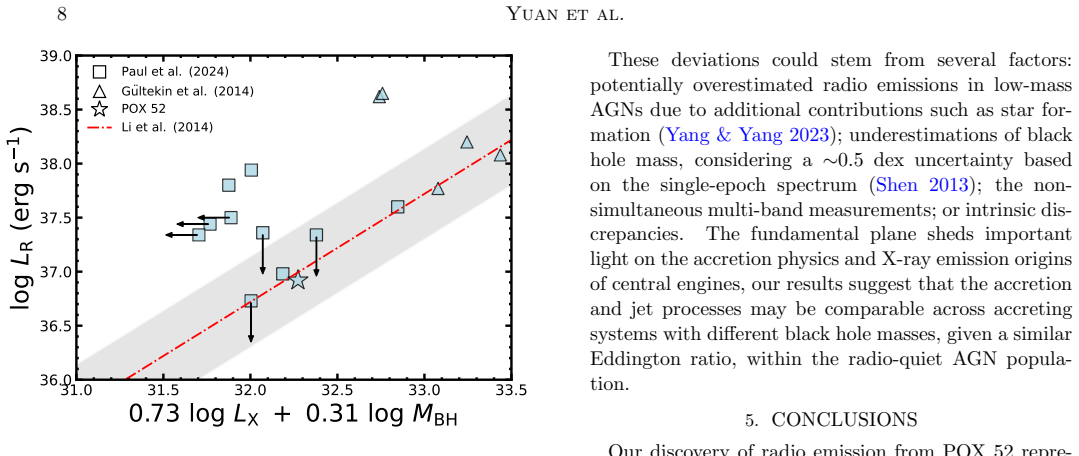
The paper's central claim is that POX 52, a dwarf elliptical galaxy at $z = 0.021$ thought to host a ~160,000-solar-mass black hole accreting near the Eddington limit, is now detected at centimeter wavelengths for the first time. The measured integrated flux densities are $260 \pm 31$ $\mu$Jy at 5.5 GHz and $160 \pm 22$ $\mu$Jy at 9 GHz with ATCA, and $229 \pm 11$ $\mu$Jy in VLA S band and $146 \pm 8$ $\mu$Jy in VLA C band. The emission is compact, only slightly resolved by the VLA, with steep spectra ($\alpha = 0.99 \pm 0.26$ from ATCA and $\alpha = 0.63 \pm 0.03$ from the VLA) that indicate optically thin synchrotron radiation. After showing that the expected contribution from star formation (about 222 $\mu$Jy at 1.4 GHz given the SED-derived star formation rate of $0.15\ M_\odot\ \mathrm{yr}^{-1}$) is too low to explain the data, the authors conclude that the radio emission confirms AGN activity in the IMBH, most likely a low-power jet or AGN-driven wind/outflow, and that POX 52 sits on the low-mass extension of the fundamental plane for high-accretion, radio-quiet AGNs.
Load-bearing premise
The claim that the radio emission is AGN-dominated rests on the star formation rate adopted from the SED fit ($0.15\ M_\odot\ \mathrm{yr}^{-1}$) and on the standard calibration that converts that rate into a predicted radio flux; if the true star formation rate were several times higher, star formation could account for the observed flux.
Editorial extensions
If this is right
- POX 52 becomes one of only a handful of IMBHs with confirmed radio emission, and the first high-Eddington dwarf elliptical IMBH detected at centimeter wavelengths.
- The radio variability over two decades means earlier non-detections of POX 52 were sensitivity or state related, not evidence against an active black hole.
- The steep spectrum and compact, slightly resolved morphology at sub-arcsecond scales point to optically thin synchrotron from a low-power jet or AGN-driven wind rather than a corona or star formation.
- The source's position on the fundamental plane for radio-quiet, high-Eddington AGNs supports the idea that accretion and jet/wind coupling are scale-invariant down to ~160,000 solar masses.
Reading between the lines
- The paper's star-formation-subtraction recipe could be applied to the dozens of IMBH candidates selected in optical and X-ray surveys to estimate the true radio detection rate and the fraction whose radio flux is contaminated by star formation.
- If the radio variability tracks the accretion state, simultaneous radio and X-ray monitoring of POX 52 would test the fundamental plane without the non-simultaneous data used here.
- A milliarcsecond-scale observation could decide between the jet and wind/outflow interpretations, since a compact jet core on sub-parsec scales would be below the VLA resolution and would appear as a bright point-like component.
- The decades-long variability implies that snapshot radio surveys systematically undercount active IMBHs; stacking repeated survey epochs could recover a population that individual detections miss.
Editorial analysis
A structured set of objections, weighed in public.
Referee Report
Summary. The paper reports the first multi-band centimeter detection of POX 52, a dwarf galaxy believed to host an intermediate-mass black hole (IMBH). The authors present ATCA observations at 5.5 and 9 GHz and VLA A-configuration observations at S (2–4 GHz) and C (4–8 GHz) bands, detecting the source with signal-to-noise ratios between about 11 and 32. They measure a steep radio spectrum (VLA: α = 0.63 ± 0.03; ATCA: α = 0.99 ± 0.26), classify the source as radio-quiet by both radio-optical and radio-X-ray criteria, find that the VLA morphology is slightly resolved on ~100 pc scales, and place POX 52 on the fundamental plane of black hole activity. They conclude that the radio emission originates predominantly from AGN activity, likely a low-power jet or AGN-driven winds/outflows, and that the source shows radio variability over two decades.
Significance. The first radio detection of POX 52 is a valuable observational result, providing a new data point for studies of IMBHs in dwarf galaxies. The observations are of high quality, with four independent detections, standard calibration, and quoted uncertainties. If the AGN-origin conclusion holds, the source becomes an important anchor for the low-mass end of the fundamental plane in the high-Eddington, radio-quiet regime. However, the paper's central physical claim—that the radio emission is dominated by AGN activity rather than star formation—depends on the quantitative exclusion of star formation in Section 4.1.1, and that exclusion is not currently robust to the intrinsic scatter of the SFR–radio calibration. The variability claim, used as additional evidence against star formation, is also overstated relative to the data.
major comments (3)
- [Section 4.1.1, Eq. (4)] The comparison between the observed radio flux densities and the expected emission from star formation propagates only the formal SFR uncertainty (0.15 ± 0.01 M_sun/yr) and neglects the ~0.3 dex intrinsic scatter of the Kennicutt & Evans (2012)/Murphy et al. (2011) SFR–radio calibration. Including this scatter, the 1σ upper envelope of the star-formation prediction is about 260 µJy at 3 GHz and 160 µJy at 6 GHz, which is comparable to or above the observed VLA S-band (229 ± 11 µJy) and C-band (146 ± 8 µJy) flux densities. Only the ATCA 5.5 GHz point (260 ± 31 µJy) exceeds the star-formation prediction by roughly 1.6σ. The statement that the expected star-formation emission is 'significantly lower' than the observed fluxes is therefore not quantitatively supported. Either the full scatter must be included in the comparison, or additional arguments must be provided that directly localize the radio emission to the AGN, before the conclusion that the radio emission predominantly originates from AGN activity can be accepted.
- [Sections 4.1.1 and 4.1.3] The variability claim is overstated and inconsistently described. The two radio epochs are separated by approximately 8 months, not 'monthly timescales' as stated in the temporal-characteristics bullet in Section 4.1.1 and in the conclusions of Section 5. The apparent ATCA-to-VLA flux decrease could still be affected by differences in uv coverage and resolution; the short-baseline VLA test alleviates this concern but does not fully eliminate it because the two arrays sample different spatial frequencies. The 2004 VLA C-band upper limit (78 µJy) is a non-detection and can only weakly constrain variability. Since the variability argument is also used to argue against a star-formation origin, this claim should be softened and the actual time baseline described accurately.
- [Section 4.1.1, 'Multi-band diagnostics'] The BPT, WISE, and X-ray diagnostics demonstrate that POX 52 hosts an AGN, but they do not localize the observed radio emission to the AGN itself. The conclusion in Section 5 that 'the detected radio emission confirms the presence of AGN activity' is therefore too strong as written: even with an AGN firmly established in the host, the radio emission could still be substantially contributed by star formation or by a nuclear wind that is not directly tied to the central black hole. The paper should explicitly acknowledge this logical gap and qualify the conclusion accordingly.
minor comments (6)
- [Abstract] The word 'habor' should be 'harbor'.
- [Section 4.1.3] 'ACTA' should be 'ATCA' in '8 months between ACTA and VLA observations'.
- [Section 4.3] 'regmin' should be 'regime' in 'extend the fundamental plane to the IMBH regmin'.
- [Table 1 and Section 3.4] Column (7) of Table 1 lists the ATCA source size as 'unresolved', but Section 3.4 states that the source 'might be marginally resolved along one direction'; please reconcile these descriptions.
- [Figure 1] The color bars in Figure 1 are labeled 'Jy/beam', but the quoted noise levels are in µJy/beam; please verify that the color-bar scale is correct.
- [Section 3.1] The VLA spectral index is derived from the S band and the uv-tapered C-band maps, but this is not explicitly stated in the text; please clarify to avoid confusion with the full-resolution C-band data used elsewhere.
Circularity Check
No significant circularity: the radio fluxes are measured against external calibrators, the star-formation comparison uses an external SFR and published calibrations, and the fundamental-plane check applies an existing relation without refitting.
full rationale
The paper's derivation chain is self-contained against external benchmarks. The detected flux densities are produced by standard interferometric calibration using PKS B1934-638 and 3C 286, with uncertainties including the 3% flux-calibration limit; nothing in the detection is derived from the paper's own conclusions. The spectral index and radio loudness are computed directly from measured flux densities and external photometric/X-ray values (Barth et al. 2004; Kawamuro et al. 2024), not from fitted parameters that predetermine the result. The exclusion of star formation in §4.1.1 uses Eq. (4) with the externally derived SFR of 0.15 M_sun/yr from Kawamuro et al. (2024) and the Kennicutt & Evans (2012)/Murphy et al. (2011) calibration; the expected radio flux is then compared with observation rather than fitted to it, so the AGN-origin conclusion is not forced by the paper's own construction. The fundamental-plane analysis in §4.3 explicitly avoids fitting a new relation ('we avoid to derive new relationships in our work') and instead checks consistency with the published Li et al. (2008) relation, so the placement of POX 52 on that plane is not circular. Citations to works with overlapping authorship (e.g., Wang et al. 2023, 2024; Yang et al. 2022, 2023) are contextual or supporting and do not carry the load of any central claim; no uniqueness theorem, ansatz, or fitted input is imported through self-citation. The skeptical concern about the ~0.3 dex scatter of the star-formation calibration is a statistical robustness issue for the AGN-origin interpretation, not a circularity in the derivation chain.
Assumptions & free parameters
assumptions (7)
- domain assumption The Kennicutt & Evans (2012) SFR-to-1.4 GHz radio luminosity relation (Eq. 4) applies to POX 52.
- domain assumption The assumed spectral index of α = 0.7 for star formation-driven radio emission (Section 4.1.1).
- domain assumption The SFR = 0.15 ± 0.01 M_sun/yr derived from UV-IR SED fitting (Kawamuro et al. 2024) is accurate.
- domain assumption The black hole mass estimate MBH ~ 1.6e5 M_sun from single-epoch spectroscopy (Barth et al. 2004) is correct.
- domain assumption The X-ray luminosity LX ~ 1e42 erg/s from Kawamuro et al. (2024) is accurate.
- domain assumption The fundamental plane relation of Li et al. (2008), fitted to 227 radio-quiet broad-line AGNs, applies to IMBH-mass sources.
- domain assumption The radio source is physically associated with POX 52 based on positional coincidence with the Gaia DR3 optical center.
Cite this review
Pith. "Pith review of First Detection of Radio Emission from the Intermediate Mass Black Hole in POX 52: Deep Multi-Band Observations with ATCA and VLA." pith.science (2026). https://pith.science/paper/QLAEPV2V
@misc{pith2026241203316,
  author       = {Pith},
  title        = {Pith review of: First Detection of Radio Emission from the Intermediate Mass Black Hole in POX 52: Deep Multi-Band Observations with ATCA and VLA},
  year         = {2026},
  howpublished = {\url{https://pith.science/paper/QLAEPV2V}},
  note         = {Machine review of arXiv:2412.03316}
}
read the original abstract
We present the first multi-band centimeter detection of POX 52, a nearby dwarf galaxy believed to habor a robust intermediate mass black hole (IMBH). We conducted the deep observations using the Australia Telescope Compact Array (ATCA), spanning frequencies from 4.5 to 10 GHz, as well as the sensitive observations from the Karl G. Jansky Very Large Array (VLA) operating in its most extended A-configuration at S band (2--4 GHz) and C band (4--8 GHz). In the ATCA observations, the source shows a compact morphology, with only one direction marginally resolved. The higher resolution of the VLA allowed us to slightly resolve the source, fitting it well with a two-dimensional Gaussian model. The detected radio emission confirms the presence of Active Galactic Nucleus (AGN) activity, indicating either a low-power jet or AGN-driven winds/outflows. Our dual-epoch observations with ATCA and VLA, together with previous non-detection flux density upper limits, reveal radio emission variability spanning two decades. In addition, we find that POX 52 aligns well with the low-mass extension of the fundamental plane for high-accretion, radio-quiet massive AGNs.
Figures


Forward citations
Cited by 1 Pith paper
-
Simulation-based inference for AGN jet population modelling: Towards more robust comparisons of black hole jet speeds
Using neural-posterior-estimation simulation-based inference on the MOJAVE FSRQ sample, the authors infer a Lorentz factor distribution slope b = -1.32 (+0.20, -0.19), consistent with X-ray binary jets at 2 sigma.
Reference graph
Works this paper leans on
-
[1]
Askar, A., Baldassare, V. F., & Mezcua, M. 2023, arXiv e-prints, arXiv:2311.12118, doi: 10.48550/arXiv.2311.12118
-
[2]
Baldassare, V. F., Geha, M., & Greene, J. 2018, ApJ, 868, 152, doi: 10.3847/1538-4357/aae6cf
-
[3]
Siemiginowska, A., & Schwartz, D. A. 2022, MNRAS, 513, 4673, doi: 10.1093/mnras/stac1153
-
[4]
Barth, A. J., Ho, L. C., Rutledge, R. E., & Sargent, W. L. W. 2004, ApJ, 607, 90, doi: 10.1086/383302
doi:10.1086/383302 2004
-
[5]
2003, A&A, 403, 857, doi: 10.1051/0004-6361:20030382 1 https://github.com/alecthomson/RACS-tool
Bondi, M., Ciliegi, P., Zamorani, G., et al. 2003, A&A, 403, 857, doi: 10.1051/0004-6361:20030382 1 https://github.com/alecthomson/RACS-tool
-
[6]
Braun, R., Bonaldi, A., Bourke, T., Keane, E., & Wagg, J. 2019, arXiv e-prints, arXiv:1912.12699, doi: 10.48550/arXiv.1912.12699 CASA Team, Bean, B., Bhatnagar, S., et al. 2022, PASP, 134, 114501, doi: 10.1088/1538-3873/ac9642
-
[7]
Chang, N., Xie, F. G., Liu, X., et al. 2021, MNRAS, 503, 1987, doi: 10.1093/mnras/stab521
-
[8]
2021, ApJ, 921, 98, doi: 10.3847/1538-4357/ac1e92
Cho, H., Woo, J.-H., Treu, T., et al. 2021, ApJ, 921, 98, doi: 10.3847/1538-4357/ac1e92
Show all 85 references
-
[9]
Clark, B. G. 1980, A&A, 89, 377
1980
-
[10]
Condon, J. J. 1992, ARA&A, 30, 575, doi: 10.1146/annurev.aa.30.090192.003043
1992
-
[11]
Connors, R. M. T. 2017, PhD thesis, University of
2017
-
[12]
C., Yuan, W., et al
Dong, X.-B., Ho, L. C., Yuan, W., et al. 2012, ApJ, 755, 167, doi: 10.1088/0004-637X/755/2/167
2012 doi
-
[13]
2004, A&A, 414, 895, doi: 10.1051/0004-6361:20031683
Falcke, H., K¨ ording, E., & Markoff, S. 2004, A&A, 414, 895, doi: 10.1051/0004-6361:20031683
2004 doi
-
[14]
V., & Ho, L
Filippenko, A. V., & Ho, L. C. 2003, ApJL, 588, L13, doi: 10.1086/375361 Gaia Collaboration, Vallenari, A., Brown, A. G. A., et al. 2023, A&A, 674, A1, doi: 10.1051/0004-6361/202243940
2003 doi
-
[15]
A., Boyce, M
Gordon, Y. A., Boyce, M. M., O’Dea, C. P., et al. 2021, ApJS, 255, 30, doi: 10.3847/1538-4365/ac05c0
2021 doi
-
[16]
E., & Ho, L
Greene, J. E., & Ho, L. C. 2004, ApJ, 610, 722, doi: 10.1086/421719 —. 2006, ApJ, 641, 117, doi: 10.1086/500353 —. 2007, ApJ, 670, 92, doi: 10.1086/522082
2004 doi
-
[17]
E., Ho, L
Greene, J. E., Ho, L. C., & Ulvestad, J. S. 2006, ApJ, 636, 56, doi: 10.1086/497905
2006 doi
-
[18]
Guedel, M., & Benz, A. O. 1993, ApJL, 405, L63, doi: 10.1086/186766 G¨ ultekin, K., Cackett, E. M., King, A. L., Miller, J. M., &
1993 doi
-
[19]
2014, ApJL, 788, L22, doi: 10.1088/2041-8205/788/2/L22 G¨ ultekin, K., Richstone, D
Pinkney, J. 2014, ApJL, 788, L22, doi: 10.1088/2041-8205/788/2/L22 G¨ ultekin, K., Richstone, D. O., Gebhardt, K., et al. 2009, ApJ, 698, 198, doi: 10.1088/0004-637X/698/1/198 G¨ ultekin, K., Nyland, K., Gray, N., et al. 2022, MNRAS, 516, 6123, doi: 10.1093/mnras/stac2608
2014 doi
-
[20]
Ho, L. C. 2002, ApJ, 564, 120, doi: 10.1086/324399
2002 doi
- [21]
-
[22]
T., Jackson, C
Huynh, M. T., Jackson, C. A., Norris, R. P., & Prandoni, I. 2005, AJ, 130, 1373, doi: 10.1086/432873
2005 doi
-
[23]
2020, ARA&A, 58, 27, doi: 10.1146/annurev-astro-120419-014455
Inayoshi, K., Visbal, E., & Haiman, Z. 2020, ARA&A, 58, 27, doi: 10.1146/annurev-astro-120419-014455
2020 doi
-
[24]
2024, Astronomical Techniques and Instruments, 1, 84, doi: 10.61977/ati2024012
Jiang, P., Chen, R., Gan, H., et al. 2024, Astronomical Techniques and Instruments, 1, 84, doi: 10.61977/ati2024012
2024 doi
-
[25]
2012, ApJ, 751, 39, doi: 10.1088/0004-637X/751/1/39
Kamizasa, N., Terashima, Y., & Awaki, H. 2012, ApJ, 751, 39, doi: 10.1088/0004-637X/751/1/39
2012 doi
-
[26]
2024, ApJ, 960, 15, doi: 10.3847/1538-4357/ad0972
Kawamuro, T., Ricci, C., Yamada, S., et al. 2024, ApJ, 960, 15, doi: 10.3847/1538-4357/ad0972
2024 doi
-
[27]
I., Sramek, R., Schmidt, M., Shaffer, D
Kellermann, K. I., Sramek, R., Schmidt, M., Shaffer, D. B., & Green, R. 1989, AJ, 98, 1195, doi: 10.1086/115207
1989 doi
-
[28]
I., Sramek, R
Kellermann, K. I., Sramek, R. A., Schmidt, M., Green, R. F., & Shaffer, D. B. 1994, AJ, 108, 1163, doi: 10.1086/117145
1994 doi
-
[29]
C., & Evans, N
Kennicutt, R. C., & Evans, N. J. 2012, ARA&A, 50, 531, doi: 10.1146/annurev-astro-081811-125610
2012 doi
-
[30]
2023, ApJL, 957, L7, doi: 10.3847/2041-8213/ad037a
Kokorev, V., Fujimoto, S., Labbe, I., et al. 2023, ApJL, 957, L7, doi: 10.3847/2041-8213/ad037a
2023 doi
-
[31]
Y., Kellermann, K
Kovalev, Y. Y., Kellermann, K. I., Lister, M. L., et al. 2005, AJ, 130, 2473, doi: 10.1086/497430
2005 doi
-
[32]
A., Chandler, C
Lacy, M., Baum, S. A., Chandler, C. J., et al. 2020, PASP, 132, 035001, doi: 10.1088/1538-3873/ab63eb
2020 doi
-
[33]
D., & Behar, E
Laor, A., Baldi, R. D., & Behar, E. 2019, MNRAS, 482, 5513, doi: 10.1093/mnras/sty3098
2019 doi
-
[34]
D., Basu-Zych, A
Lehmer, B. D., Basu-Zych, A. R., Mineo, S., et al. 2016, ApJ, 825, 7, doi: 10.3847/0004-637X/825/1/7
2016 doi
-
[35]
2008, ApJ, 688, 826, doi: 10.1086/592314
Li, Z.-Y., Wu, X.-B., & Wang, R. 2008, ApJ, 688, 826, doi: 10.1086/592314
2008 doi
-
[36]
2018, ApJS, 235, 40, doi: 10.3847/1538-4365/aab88e
Liu, H.-Y., Yuan, W., Dong, X.-B., Zhou, H., & Liu, W.-J. 2018, ApJS, 235, 40, doi: 10.3847/1538-4365/aab88e
2018 doi
-
[37]
R., Greene, J
Ludwig, R. R., Greene, J. E., Barth, A. J., & Ho, L. C. 2012, ApJ, 756, 51, doi: 10.1088/0004-637X/756/1/51
2012 doi
-
[38]
Maccarone, T. J. 2004, MNRAS, 351, 1049, doi: 10.1111/j.1365-2966.2004.07859.x Mart ´ ınez-Palomera, J., Lira, P., Bhalla-Ladd, I., F¨ orster, F., & Plotkin, R. M. 2020, ApJ, 889, 113, doi: 10.3847/1538-4357/ab5f5b
2004
-
[39]
2007, in Astronomical Society of the Pacific Conference Series, Vol
Golap, K. 2007, in Astronomical Society of the Pacific Conference Series, Vol. 376, Astronomical Data Analysis Software and Systems XVI, ed. R. A. Shaw, F. Hill, & D. J. Bell, 127
2007
-
[40]
2003, MNRAS, 345, 1057, doi: 10.1046/j.1365-2966.2003.07017.x
Merloni, A., Heinz, S., & di Matteo, T. 2003, MNRAS, 345, 1057, doi: 10.1046/j.1365-2966.2003.07017.x
2003
-
[41]
2017, International Journal of Modern Physics D, 26, 1730021, doi: 10.1142/S021827181730021X
Mezcua, M. 2017, International Journal of Modern Physics D, 26, 1730021, doi: 10.1142/S021827181730021X
2017 doi
-
[42]
J., Condon, J
Murphy, E. J., Condon, J. J., Schinnerer, E., et al. 2011, ApJ, 737, 67, doi: 10.1088/0004-637X/737/2/67
2011 doi
-
[43]
J., Bremseth, J., Mason, B
Murphy, E. J., Bremseth, J., Mason, B. S., et al. 2012, ApJ, 761, 97, doi: 10.1088/0004-637X/761/2/97
2012 doi
- [44]
-
[45]
S., Saikia, D
Nandi, P., Stalin, C. S., Saikia, D. J., et al. 2023, ApJ, 959, 116, doi: 10.3847/1538-4357/ad0c57
2023 doi
- [46]
-
[47]
D., Laor, A., et al
Panessa, F., Baldi, R. D., Laor, A., et al. 2019, Nature Astronomy, 3, 387, doi: 10.1038/s41550-019-0765-4
2019 doi
-
[48]
2007, A&A, 467, 519, doi: 10.1051/0004-6361:20066943
Panessa, F., Barcons, X., Bassani, L., et al. 2007, A&A, 467, 519, doi: 10.1051/0004-6361:20066943
2007 doi
-
[49]
2013, MNRAS, 432, 1138, doi: 10.1093/mnras/stt547
Panessa, F., & Giroletti, M. 2013, MNRAS, 432, 1138, doi: 10.1093/mnras/stt547
2013 doi
-
[50]
2022, MNRAS, 515, 473, doi: 10.1093/mnras/stac1745
Panessa, F., Chiaraluce, E., Bruni, G., et al. 2022, MNRAS, 515, 473, doi: 10.1093/mnras/stac1745
2022 doi
-
[51]
D., Plotkin, R
Paul, J. D., Plotkin, R. M., Brandt, W. N., et al. 2024, ApJ, 974, 66, doi: 10.3847/1538-4357/ad67d1 First Detection of Radio Emission from the Intermediate Mass Black Hole in POX 5211
2024 doi
-
[52]
A., & Butler, B
Perley, R. A., & Butler, B. J. 2017, ApJS, 230, 7, doi: 10.3847/1538-4365/aa6df9
2017 doi
-
[54]
2000, A&AS, 146, 31, doi: 10.1051/aas:2000360
Prandoni, I., Gregorini, L., Parma, P., et al. 2000, A&AS, 146, 31, doi: 10.1051/aas:2000360
2000 doi
-
[55]
2018, ApJ, 860, 134, doi: 10.3847/1538-4357/aac32b
Qian, L., Dong, X.-B., Xie, F.-G., Liu, W., & Li, D. 2018, ApJ, 860, 134, doi: 10.3847/1538-4357/aac32b
2018 doi
-
[56]
2016, MNRAS, 459, 2082, doi: 10.1093/mnras/stw772
Raginski, I., & Laor, A. 2016, MNRAS, 459, 2082, doi: 10.1093/mnras/stw772
2016 doi
-
[57]
E., Condon, J
Reines, A. E., Condon, J. J., Darling, J., & Greene, J. E. 2020, ApJ, 888, 36, doi: 10.3847/1538-4357/ab4999
2020 doi
-
[58]
E., Greene, J
Reines, A. E., Greene, J. E., & Geha, M. 2013, ApJ, 775, 116, doi: 10.1088/0004-637X/775/2/116
2013 doi
-
[59]
L., et al
Saikia, P., K¨ ording, E., Coppejans, D. L., et al. 2018, A&A, 616, A152, doi: 10.1051/0004-6361/201833233
2018 doi
-
[60]
E., & Molina, M
Salehirad, S., Reines, A. E., & Molina, M. 2022, ApJ, 937, 7, doi: 10.3847/1538-4357/ac8876
2022 doi
-
[61]
J., Johnson, M
Sargent, A. J., Johnson, M. C., Reines, A. E., et al. 2022, ApJ, 933, 160, doi: 10.3847/1538-4357/ac74be
2022 doi
-
[62]
F., Schawinski, K., Treister, E., et al
Sartori, L. F., Schawinski, K., Treister, E., et al. 2015, MNRAS, 454, 3722, doi: 10.1093/mnras/stv2238
2015 doi
-
[63]
J., McAlpine, W., et al
Satyapal, S., Secrest, N. J., McAlpine, W., et al. 2014, ApJ, 784, 113, doi: 10.1088/0004-637X/784/2/113
2014 doi
- [64]
- [65]
-
[66]
W., R¨ ottgering, H
Shimwell, T. W., R¨ ottgering, H. J. A., Best, P. N., et al. 2017, A&A, 598, A104, doi: 10.1051/0004-6361/201629313
2017 doi
-
[67]
W., Tasse, C., Hardcastle, M
Shimwell, T. W., Tasse, C., Hardcastle, M. J., et al. 2019, A&A, 622, A1, doi: 10.1051/0004-6361/201833559
2019 doi
-
[68]
W., Hardcastle, M
Shimwell, T. W., Hardcastle, M. J., Tasse, C., et al. 2022, A&A, 659, A1, doi: 10.1051/0004-6361/202142484
2022 doi
-
[69]
J., Benford, D
Stern, D., Assef, R. J., Benford, D. J., et al. 2012, ApJ, 753, 30, doi: 10.1088/0004-637X/753/1/30
2012 doi
-
[70]
Terashima, Y., & Wilson, A. S. 2003, ApJ, 583, 145, doi: 10.1086/345339
2003 doi
-
[71]
R., Clark, B
Thompson, A. R., Clark, B. G., Wade, C. M., & Napier, P. J. 1980, ApJS, 44, 151, doi: 10.1086/190688
1980 doi
-
[72]
E., Barth, A
Thornton, C. E., Barth, A. J., Ho, L. C., Rutledge, R. E., & Greene, J. E. 2008, ApJ, 686, 892, doi: 10.1086/591519
2008 doi
-
[73]
2018, MNRAS, 474, 3825, doi: 10.1093/mnras/stx3028 van Wassenhove, S., Volonteri, M., Walker, M
Valiante, R., Schneider, R., Graziani, L., & Zappacosta, L. 2018, MNRAS, 474, 3825, doi: 10.1093/mnras/stx3028 van Wassenhove, S., Volonteri, M., Walker, M. G., & Gair, J. R. 2010, MNRAS, 408, 1139, doi: 10.1111/j.1365-2966.2010.17189.x
2018
-
[74]
L., Impey, C
Visnovsky, K. L., Impey, C. D., Foltz, C. B., et al. 1992, ApJ, 391, 560, doi: 10.1086/171370
1992 doi
-
[75]
2008, MNRAS, 383, 1079, doi: 10.1111/j.1365-2966.2007.12589.x
Volonteri, M., Lodato, G., & Natarajan, P. 2008, MNRAS, 383, 1079, doi: 10.1111/j.1365-2966.2007.12589.x
2008
-
[76]
2023, MNRAS, 525, 6064, doi: 10.1093/mnras/stad2651
Wang, A., An, T., Zhang, Y., et al. 2023, MNRAS, 525, 6064, doi: 10.1093/mnras/stad2651
2023 doi
-
[77]
2006, ApJ, 645, 890, doi: 10.1086/504401
Wang, R., Wu, X.-B., & Kong, M.-Z. 2006, ApJ, 645, 890, doi: 10.1086/504401
2006 doi
-
[78]
C., Zhong, Y., & Luo, B
Wang, Y., Wang, T., Ho, L. C., Zhong, Y., & Luo, B. 2024, A&A, 689, A327, doi: 10.1051/0004-6361/202449732
2024 doi
-
[79]
J., & Baldassare, V
Wasleske, E. J., & Baldassare, V. F. 2024, ApJ, 971, 68, doi: 10.3847/1538-4357/ad5442
2024 doi
-
[80]
E., Ferris, R
Wilson, W. E., Ferris, R. H., Axtens, P., et al. 2011, MNRAS, 416, 832, doi: 10.1111/j.1365-2966.2011.19054.x
2011
-
[81]
2019, Nature Astronomy, 3, 755, doi: 10.1038/s41550-019-0790-3
Woo, J.-H., Cho, H., Gallo, E., et al. 2019, Nature Astronomy, 3, 755, doi: 10.1038/s41550-019-0790-3
2019 doi
-
[82]
2024, ApJS, 271, 64, doi: 10.3847/1538-4365/ad2b64
Wu, J.-Z., Dong, X.-B., Qian, L., et al. 2024, ApJS, 271, 64, doi: 10.3847/1538-4365/ad2b64
2024 doi
-
[83]
M., et al
Yang, J., Yang, X., Wrobel, J. M., et al. 2022, MNRAS, 514, 6215, doi: 10.1093/mnras/stac1753
2022 doi
-
[84]
2023, MNRAS, 520, 5964, doi: 10.1093/mnras/stad493
Yang, J., Paragi, Z., Frey, S., et al. 2023, MNRAS, 520, 5964, doi: 10.1093/mnras/stad493
2023 doi
-
[85]
2023, Galaxies, 11, 53, doi: 10.3390/galaxies11020053
Yang, X., & Yang, J. 2023, Galaxies, 11, 53, doi: 10.3390/galaxies11020053
2023 doi
-
[86]
Yuan, F., Yu, Z., & Ho, L. C. 2009, ApJ, 703, 1034, doi: 10.1088/0004-637X/703/1/1034
2009 doi
Reviewed August 11, 2026 · model on record in the stance chip above.
Discussion (0). Continue with ORCID to comment.