REVIEW 4 major objections 4 minor 1 cited by
MOVE: Multi-skill Omnidirectional Legged Locomotion with Limited View in 3D Environments
T0 review · 4 major / 4 minor · reviewed 2026-08-11 · deepseek-v4-flash
Pith's one-line read A single policy gives a camera-limited quadruped all-direction parkour.
desk verdict A solid end-to-end framework for omnidirectional legged locomotion with limited vision; the real-world results are impressive, but the 'inference beyond FOV' claim is softer than advertised and the evaluation lacks statistical rigor. read the letter →
The pith
A machine-rendered reading of the paper's core claim, the machinery that carries it, and where it could break.
The reading
What carries the argument
The central object is PS-Net, the pseudo-siamese representation learner: two encoders with similar but not shared weights. The standard input encoder processes proprioceptive history through an MLP and the front depth image through a CNN, fuses them with self-attention, and passes the result through a GRU to produce a latent vector. The surroundings encoder processes privileged information, including a cube map made of five egocentric depth images (forward, up, down, left, right) plus sparse foot-depth data, with a cross-attention module whose query comes from the privileged proprioceptive state, forcing the encoder to focus on visual structure. The two encoders are coupled by a mixed loss of supervised reconstruction (velocity, next proprioceptive state, front depth) and a stop-gradient contrastive similarity term; this is what lets a robot with a narrow front camera infer the shape of terrain beside, below, and around it. The cube map itself is the privileged representation that makes the inference possible, chosen to sample depth more uniformly than LiDAR-like projections and cheap to generate in simulation.
What would settle it
Run the trained policy on the same real quadruped with the depth camera fully taped over, on a set of lateral and backward stair-climbing trials, and compare success to the reported blind performance; if the robot fails to clear even a few steps without vision, the claim that proprioception alone can infer unseen surroundings would be refuted. A complementary check is to measure the real camera's depth error distribution on occluded scenes and compare it to the training noise pattern, since a large mismatch would break the sim-to-real premise.
Extended reading notes
Core claim
The paper's central claim is that MOVE, a one-stage end-to-end learning framework, makes multi-skill omnidirectional legged locomotion possible with limited and noisy egocentric vision. The policy inputs are proprioceptive history and a single depth image, and a single neural network outputs the motor commands for all skills with no mode switching. The key idea is to train a pseudo-siamese representation learner (PS-Net) with asymmetric attention: one encoder sees only real-robot observations, while a structurally similar but non-weight-sharing encoder sees privileged simulation data including a five-face cube map and sparse foot-depth samples. A mixed loss of reconstruction terms (velocity, next proprioceptive state, front depth) plus a stop-gradient contrastive term makes the real-observation encoder learn to infer terrain beyond its field of view, so the robot can climb stairs laterally and backward, crawl with vision fully obstructed, and recover from sudden visual noise, while still using vision aggressively for forward jumps and high steps. The authors report zero-shot sim-to-real transfer on a low-cost quadruped with onboard inference, with quantitative success rates in simulation and qualitative demonstrations in real indoor and outdoor settings.
Load-bearing premise
The whole robustness story depends on the simulated depth images and terrain randomization matching the real camera and real outdoor environments closely enough, because the paper adds a hand-crafted patterned noise to training depth images without specifying or validating a quantitative noise model.
Editorial extensions
If this is right
- One neural network can span sighted parkour (0.7-meter-high jumps, 0.9-meter-long jumps, 0.25-meter stairs, 0.2-meter crawls) and blind or omnidirectional versions of similar skills, removing the need for explicit skill scheduling.
- A simulation-only cube-map supervisor lets the standard encoder learn to infer terrain beyond its field of view without building a runtime map.
- The mixed reconstruction and stop-gradient contrastive objective improves omnidirectional speed tracking on complex 3D terrain over either loss alone, and the asymmetric cross-attention mechanism prevents representation collapse during contrastive learning.
- The same policy transfers zero-shot to a real quadruped with onboard inference, maintaining success in environments with leaf piles, tall grass, reflective glass, and complete camera obstruction.
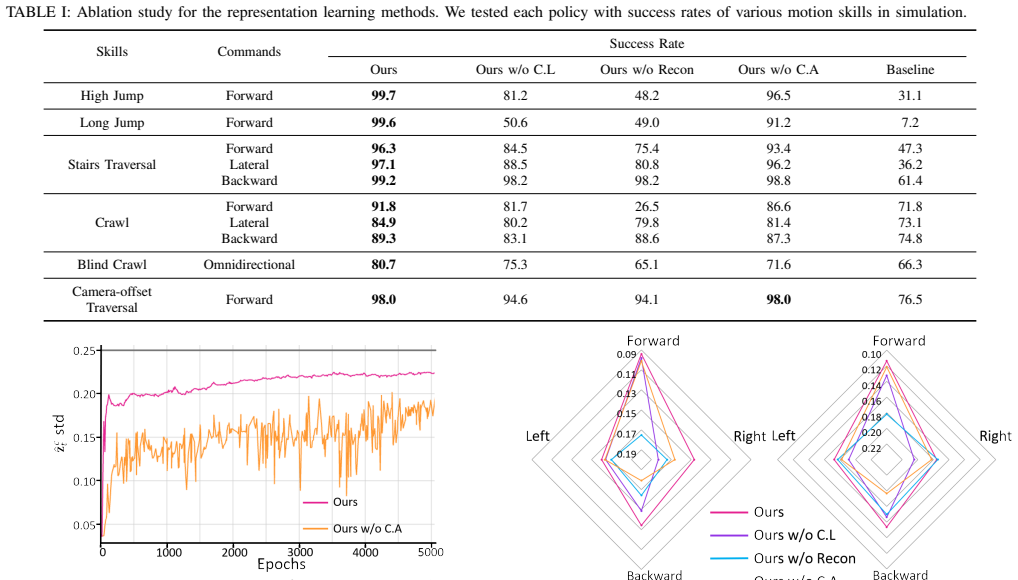
- Ablation results show degradation is graded: removing contrastive learning or reconstruction individually lowers success rates, and removing both drops forward long-jump success from about 99.6 percent to about 7 percent.
Reading between the lines
- The method is not tied to a specific simulator or robot: the cube-map supervisor could be rendered in any reasonable physics simulator, so the pseudo-siamese recipe is a candidate template for other vision-limited mobile robots.
- Because the contrastive term is what carries beyond-field-of-view inference, a direct stress test is to shrink the camera's field of view in simulation and measure how much performance degrades; the paper does not report such a sweep.
- The paper's own limitation, that depth images lack semantic content, suggests the natural next increment is adding RGB supervision, which the asymmetric attention mechanism would likely carry over without redesigning the policy.
Editorial analysis
A structured set of objections, weighed in public.
Referee Report
Summary. The manuscript proposes MOVE, a one-stage end-to-end reinforcement learning framework for a quadruped robot equipped only with a front-facing depth camera and a short proprioceptive history. The policy is trained in Isaac Gym with a pseudo-siamese representation learner (PS-Net) that combines supervised reconstruction losses (velocity, next proprioception, front depth) with a contrastive loss against privileged cube-map observations, and is then deployed zero-shot on a DEEP Robotics Lite3. The paper claims that a single policy, without manual skill switching, can perform forward tasks such as high/long jumping, stair climbing, and crawling, as well as non-forward tasks such as lateral and backward stair climbing and blind crawling, in both simulation and the real world. Ablations in Table I compare the full method against variants without contrastive learning, without reconstruction, without cross-attention, and against a PPO baseline, and real-world experiments are reported in Figs. 7-9.
Significance. If the central claims are established, MOVE would be a useful contribution to low-cost legged locomotion with egocentric vision: it demonstrates a single learned policy performing a diverse set of dynamic skills, including omnidirectional motion under visual disturbance, which is more than most prior egocentric-vision locomotion works show. The paper's strengths include extensive real-world deployment in varied outdoor conditions, ablations of the main representation-learning components, and a representation-collapse diagnostic in Fig. 5. The main risk is that the load-bearing claim of 'inferring surroundings beyond the field of view' is not directly evidenced, and the quantitative support currently rests on single-run simulation numbers with no error bars and an unspecified depth-noise model. The contribution is therefore promising but needs additional evidence before the perceptual-inference claim can be accepted.
major comments (4)
- [IV-A and Table I] It is not stated explicitly whether the numbers in Table I come from a single policy trained once on all environments jointly or from separately trained policies per skill. The text says 'a series of simulation environments' were designed and 'each policy' was tested, which leaves the no-manual-switching claim ambiguous. If each skill is trained independently, the claim of multi-skill integration in one network is not supported by the reported experiments. Please state clearly whether one set of weights was used for all rows, and if so, describe how the shared training environment is constructed.
- [III-A.2, Eq. (3), and Table I] The central claim that PS-Net enables the policy to infer surroundings beyond the camera's field of view is not directly supported by the reported results. The deployment input consists only of the front depth image and the last H=10 proprioceptive steps, while the privileged cube map in Eq. (3) explicitly excludes the rear direction. For backward stair climbing, the terrain behind the robot is therefore neither in the standard input nor in the contrastive target, so the contrastive loss cannot inject that information. Table I shows that removing contrastive learning leaves backward stairs at 98.2% vs. 99.2%, lateral stairs at 88.5% vs. 97.1%, and blind crawl at 75.3% vs. 80.7%; these small margins are consistent with reactive, contact-based proprioceptive recovery rather than anticipatory inference. Please provide direct evidence of beyond-FOV encoding, for example by probing the latent z_c_t to decode side/back terrain properties or by constructing a test in which front depth is decorrelated from side/back geometry.
- [IV-A and IV-C] The sim-to-real robustness claim relies on a depth-noise model that is not specified. Section IV-A states only that 'patterned noise' was introduced into the simulated depth images, without giving the noise model, its parameters, or any calibration against the RealSense D435i used on the Lite3. The paper also reports no quantitative comparison of simulated versus real depth artifacts for the blind, reflective-glass, leaf-pile, or tall-grass conditions described in Fig. 9. Please specify the noise model and parameters, and preferably add ablations over noise levels or real-sensor depth statistics to justify the zero-shot transfer.
- [IV-B and Table I] All simulation results in Table I are point estimates from what appears to be a single training run, despite the use of 1,000 robots per evaluation. There are no standard errors, no seeds, and no statistical comparisons, yet several ablation margins are small (e.g., lateral stairs 97.1% vs. 96.2% for Ours vs. Ours w/o C.A., and camera-offset traversal 98.0% vs. 98.0%). Please report means and variances over at least three seeds and indicate which differences are statistically meaningful; otherwise the qualitative ranking of ablations cannot be assessed.
minor comments (4)
- [III-B.3, Eq. (7)] The symbol 'Lconstrast' in Eq. (7) appears to be a typo for 'Lcontrast' as used in Eq. (5).
- [Fig. 2 caption] The caption describes the training as a combination of 'supervised and unsupervised learning method'; since the contrastive component uses paired standard and privileged observations, 'self-supervised' would be the more accurate term.
- [IV-A] The robot bounding box is given as '610mm × 37mm × 445mm'; the middle dimension appears to be missing a digit, since a 37 mm width is implausible for the Lite3.
- [IV-C and Fig. 7] The real-world quantitative results in Fig. 7 would be easier to interpret if the number of trials and the success criterion per scenario were reported, since the success-rate axis alone does not indicate the statistical strength of the comparison.
Circularity Check
No circularity found: the training objectives are supervised by simulator ground truth and the reported success rates are post-training measurements, not fitted quantities.
full rationale
The paper's derivation chain is not circular. The reconstruction loss (Eq. 6) regresses the latent estimates against simulator ground-truth quantities (vt, ot+1, and the front-facing cube-map depth), and the contrastive loss (Eq. 7) aligns the standard-input latent with the surroundings encoder's output from the privileged cube map mt. None of these targets is derived from the evaluation success rates in Table I or Fig. 7; those are measured after training on held-out terrain distributions. The privileged cube map is a training-time representation choice, not a fitted constant. The paper's central claim that the robot 'infers its surroundings beyond its field of view' is supported (or not) by task-level transfer results; the skeptical concern that standard inputs may not carry enough information for non-forward inference is an evidential/correctness question, not a circularity, because the paper does not define the target metric in terms of the input or fit the metric to the inputs. The only self-citation, [7] for the reward function, is not load-bearing: the paper states it adopts 'the same simple yet effective reward function with minimal modifications,' and the novelty (PS-Net, cube-map supervision, contrastive/reconstruction mixture) is evaluated independently against ablations and real-world tests. The stated limitation in Section V (reliance on depth images without RGB semantics) is a capability limitation, not a circular dependency.
Assumptions & free parameters
free parameters (4)
- Depth image noise model (patterned noise parameters) =
unspecified
- Latent dimension d of contrastive vector z_c_t =
16
- Observation history length H =
10
- Reward function weights =
not listed
assumptions (4)
- domain assumption Isaac Gym simulation is a sufficiently accurate model of the Deep Robotics Lite3 dynamics, contacts, and sensors for sim-to-real transfer.
- domain assumption The privileged cube map mt (five egocentric depth images plus foot-depth samples) is a sufficient 3D terrain representation for the evaluated skills.
- domain assumption The contrastive objective (Eq. 7) with stop-gradient prevents representation collapse and yields transferable features.
- domain assumption PPO with a privileged critic converges to a policy that transfers to the standard input at deployment.
Cite this review
Pith. "Pith review of MOVE: Multi-skill Omnidirectional Legged Locomotion with Limited View in 3D Environments." pith.science (2026). https://pith.science/paper/2IPNIAQM
@misc{pith2026241203353,
  author       = {Pith},
  title        = {Pith review of: MOVE: Multi-skill Omnidirectional Legged Locomotion with Limited View in 3D Environments},
  year         = {2026},
  howpublished = {\url{https://pith.science/paper/2IPNIAQM}},
  note         = {Machine review of arXiv:2412.03353}
}
read the original abstract
Legged robots possess inherent advantages in traversing complex 3D terrains. However, previous work on low-cost quadruped robots with egocentric vision systems has been limited by a narrow front-facing view and exteroceptive noise, restricting omnidirectional mobility in such environments. While building a voxel map through a hierarchical structure can refine exteroception processing, it introduces significant computational overhead, noise, and delays. In this paper, we present MOVE, a one-stage end-to-end learning framework capable of multi-skill omnidirectional legged locomotion with limited view in 3D environments, just like what a real animal can do. When movement aligns with the robot's line of sight, exteroceptive perception enhances locomotion, enabling extreme climbing and leaping. When vision is obstructed or the direction of movement lies outside the robot's field of view, the robot relies on proprioception for tasks like crawling and climbing stairs. We integrate all these skills into a single neural network by introducing a pseudo-siamese network structure combining supervised and contrastive learning which helps the robot infer its surroundings beyond its field of view. Experiments in both simulations and real-world scenarios demonstrate the robustness of our method, broadening the operational environments for robotics with egocentric vision.
Figures


Figures from the paper (4 more)



Forward citations
Cited by 1 Pith paper
-
KiVi: Kinesthetic-Visuospatial Integration for Dynamic and Safe Egocentric Legged Locomotion
A quadruped locomotion controller that explicitly separates proprioceptive and visual pathways stays stable under camera occlusion and visual corruption that destabilizes fused-vision policies.
Reference graph
Works this paper leans on
-
[5]
Learning to walk in confined spaces using 3d representation,
T. Miki, J. Lee, L. Wellhausen, and M. Hutter, “Learning to walk in confined spaces using 3d representation,” arXiv preprint arXiv:2403.00187, 2024
arXiv 2024
-
[12]
Quadruped robot traversing 3d complex environments with limited perception,
Y . Cheng, H. Liu, G. Pan, L. Ye, H. Liu, and B. Liang, “Quadruped robot traversing 3d complex environments with limited perception,” arXiv preprint arXiv:2404.18225 , 2024
arXiv 2024
-
[1]
Learning agile and dynamic motor skills for legged robots,
J. Hwangbo, J. Lee, A. Dosovitskiy, D. Bellicoso, V . Tsounis, V . Koltun, and M. Hutter, “Learning agile and dynamic motor skills for legged robots,” Science Robotics, vol. 4, no. 26, p. eaau5872, 2019
2019
-
[2]
Learning robust perceptive locomotion for quadrupedal robots in the wild,
T. Miki, J. Lee, J. Hwangbo, L. Wellhausen, V . Koltun, and M. Hutter, “Learning robust perceptive locomotion for quadrupedal robots in the wild,” Science Robotics , vol. 7, no. 62, p. eabk2822, 2022
2022
-
[3]
Walk these ways: Tuning robot control for generalization with multiplicity of behavior,
G. B. Margolis and P. Agrawal, “Walk these ways: Tuning robot control for generalization with multiplicity of behavior,” in Conference on Robot Learning . PMLR, 2023, pp. 22–31
2023
-
[4]
Coupling vision and proprioception for navigation of legged robots,
Z. Fu, A. Kumar, A. Agarwal, H. Qi, J. Malik, and D. Pathak, “Coupling vision and proprioception for navigation of legged robots,” in Proceedings of the IEEE/CVF Conference on Computer Vision and Pattern Recognition, 2022, pp. 17 273–17 283
2022
-
[6]
Learning agile locomotion on risky terrains,
C. Zhang, N. Rudin, D. Hoeller, and M. Hutter, “Learning agile locomotion on risky terrains,” arXiv preprint arXiv:2311.10484 , 2023
arXiv 2023
-
[7]
Pie: Parkour with implicit-explicit learning framework for legged robots,
S. Luo, S. Li, R. Yu, Z. Wang, J. Wu, and Q. Zhu, “Pie: Parkour with implicit-explicit learning framework for legged robots,” arXiv preprint arXiv:2408.13740, 2024
arXiv 2024
Show all 41 references
-
[8]
Learning quadrupedal locomotion over challenging terrain,
J. Lee, J. Hwangbo, L. Wellhausen, V . Koltun, and M. Hutter, “Learning quadrupedal locomotion over challenging terrain,” Science robotics, vol. 5, no. 47, p. eabc5986, 2020
2020
-
[9]
Rma: Rapid motor adaptation for legged robots,
A. Kumar, Z. Fu, D. Pathak, and J. Malik, “Rma: Rapid motor adaptation for legged robots,” arXiv preprint arXiv:2107.04034 , 2021
2021 arXiv
-
[10]
Dreamwaq: Learning robust quadrupedal locomotion with implicit terrain imagination via deep reinforcement learning,
I. M. A. Nahrendra, B. Yu, and H. Myung, “Dreamwaq: Learning robust quadrupedal locomotion with implicit terrain imagination via deep reinforcement learning,” in 2023 IEEE International Conference on Robotics and Automation (ICRA) . IEEE, 2023, pp. 5078–5084
2023
-
[11]
Hybrid internal model: A simple and efficient learner for agile legged locomotion,
J. Long, Z. Wang, Q. Li, J. Gao, L. Cao, and J. Pang, “Hybrid internal model: A simple and efficient learner for agile legged locomotion,” arXiv preprint arXiv:2312.11460 , 2023
2023 arXiv
-
[13]
Combining teacher- student with representation learning: A concurrent teacher-student re- inforcement learning paradigm for legged locomotion,
H. Wang, H. Luo, W. Zhang, and H. Chen, “Combining teacher- student with representation learning: A concurrent teacher-student re- inforcement learning paradigm for legged locomotion,” arXiv preprint arXiv:2405.10830, 2024
2024 arXiv
-
[14]
Anymal parkour: Learning agile navigation for quadrupedal robots,
D. Hoeller, N. Rudin, D. Sako, and M. Hutter, “Anymal parkour: Learning agile navigation for quadrupedal robots,” Science Robotics , vol. 9, no. 88, p. eadi7566, 2024
2024
-
[15]
Elevation mapping for locomotion and navigation using gpu,
T. Miki, L. Wellhausen, R. Grandia, F. Jenelten, T. Homberger, and M. Hutter, “Elevation mapping for locomotion and navigation using gpu,” in 2022 IEEE/RSJ International Conference on Intelligent Robots and Systems (IROS) . IEEE, 2022, pp. 2273–2280
2022
-
[16]
Neural scene representation for locomotion on structured terrain,
D. Hoeller, N. Rudin, C. Choy, A. Anandkumar, and M. Hutter, “Neural scene representation for locomotion on structured terrain,” IEEE Robotics and Automation Letters , vol. 7, no. 4, pp. 8667–8674, 2022
2022
-
[17]
Learning vision-guided quadrupedal locomotion end-to-end with cross-modal transformers,
R. Yang, M. Zhang, N. Hansen, H. Xu, and X. Wang, “Learning vision-guided quadrupedal locomotion end-to-end with cross-modal transformers,” arXiv preprint arXiv:2107.03996 , 2021
2021 arXiv
-
[18]
Legged locomotion in challenging terrains using egocentric vision,
A. Agarwal, A. Kumar, J. Malik, and D. Pathak, “Legged locomotion in challenging terrains using egocentric vision,” inConference on robot learning. PMLR, 2023, pp. 403–415
2023
-
[19]
Learning visual locomotion with cross-modal supervision,
A. Loquercio, A. Kumar, and J. Malik, “Learning visual locomotion with cross-modal supervision,” in 2023 IEEE International Conference on Robotics and Automation (ICRA) . IEEE, 2023, pp. 7295–7302
2023
-
[20]
Neural volumetric memory for visual locomotion control,
R. Yang, G. Yang, and X. Wang, “Neural volumetric memory for visual locomotion control,” in Proceedings of the IEEE/CVF Conference on Computer Vision and Pattern Recognition , 2023, pp. 1430–1440
2023
-
[21]
Robot parkour learning,
Z. Zhuang, Z. Fu, J. Wang, C. Atkeson, S. Schwertfeger, C. Finn, and H. Zhao, “Robot parkour learning,” arXiv preprint arXiv:2309.05665 , 2023
2023 arXiv
-
[22]
Extreme parkour with legged robots,
X. Cheng, K. Shi, A. Agarwal, and D. Pathak, “Extreme parkour with legged robots,” arXiv preprint arXiv:2309.14341 , 2023
2023 arXiv
-
[23]
Dynamic walk of a biped,
H. Miura and I. Shimoyama, “Dynamic walk of a biped,” The International Journal of Robotics Research , vol. 3, no. 2, pp. 60–74, 1984
1984
-
[24]
Hopping in legged systems—modeling and simulation for the two-dimensional one-legged case,
M. H. Raibert, “Hopping in legged systems—modeling and simulation for the two-dimensional one-legged case,” IEEE Transactions on Systems, Man, and Cybernetics , no. 3, pp. 451–463, 1984
1984
-
[25]
Positive force feedback in bouncing gaits?
H. Geyer, A. Seyfarth, and R. Blickhan, “Positive force feedback in bouncing gaits?” Proceedings of the Royal Society of London. Series B: Biological Sciences , vol. 270, no. 1529, pp. 2173–2183, 2003
2003
-
[26]
Simbicon: Simple biped locomotion control,
K. Yin, K. Loken, and M. Van de Panne, “Simbicon: Simple biped locomotion control,” ACM Transactions on Graphics (TOG) , vol. 26, no. 3, pp. 105–es, 2007
2007
-
[27]
A compliant hybrid zero dynamics controller for stable, efficient and fast bipedal walking on mabel,
K. Sreenath, H.-W. Park, I. Poulakakis, and J. W. Grizzle, “A compliant hybrid zero dynamics controller for stable, efficient and fast bipedal walking on mabel,” The International Journal of Robotics Research , vol. 30, no. 9, pp. 1170–1193, 2011
2011
-
[28]
Rapidly exponentially stabilizing control lyapunov functions and hybrid zero dynamics,
A. D. Ames, K. Galloway, K. Sreenath, and J. W. Grizzle, “Rapidly exponentially stabilizing control lyapunov functions and hybrid zero dynamics,” IEEE Transactions on Automatic Control , vol. 59, no. 4, pp. 876–891, 2014
2014
-
[29]
Mit cheetah 3: Design and control of a robust, dynamic quadruped robot,
G. Bledt, M. J. Powell, B. Katz, J. Di Carlo, P. M. Wensing, and S. Kim, “Mit cheetah 3: Design and control of a robust, dynamic quadruped robot,” in 2018 IEEE/RSJ International Conference on Intelligent Robots and Systems (IROS) . IEEE, 2018, pp. 2245–2252
2018
-
[30]
Anymal-a highly mobile and dynamic quadrupedal robot,
M. Hutter, C. Gehring, D. Jud, A. Lauber, C. D. Bellicoso, V . Tsounis, J. Hwangbo, K. Bodie, P. Fankhauser, M. Bloesch et al. , “Anymal-a highly mobile and dynamic quadrupedal robot,” in 2016 IEEE/RSJ international conference on intelligent robots and systems (IROS) . IEEE, 2...
2016
-
[31]
Deep whole-body control: learning a unified policy for manipulation and locomotion,
Z. Fu, X. Cheng, and D. Pathak, “Deep whole-body control: learning a unified policy for manipulation and locomotion,” in Conference on Robot Learning . PMLR, 2023, pp. 138–149
2023
-
[32]
Concurrent training of a control policy and a state estimator for dynamic and robust legged locomotion,
G. Ji, J. Mun, H. Kim, and J. Hwangbo, “Concurrent training of a control policy and a state estimator for dynamic and robust legged locomotion,” IEEE Robotics and Automation Letters , vol. 7, no. 2, pp. 4630–4637, 2022
2022
-
[33]
Moral: Learning morphologically adaptive locomotion controller for quadrupedal robots on challenging terrains,
Z. Luo, Y . Dong, X. Li, R. Huang, Z. Shu, E. Xiao, and P. Lu, “Moral: Learning morphologically adaptive locomotion controller for quadrupedal robots on challenging terrains,” IEEE Robotics and Au- tomation Letters , 2024
2024
-
[34]
Legged robot state estimation using invariant kalman filtering and learned contact events,
T.-Y . Lin, R. Zhang, J. Yu, and M. Ghaffari, “Legged robot state estimation using invariant kalman filtering and learned contact events,” arXiv preprint arXiv:2106.15713 , 2021
2021 arXiv
-
[35]
Learning robust and agile legged locomotion using adversarial motion priors,
J. Wu, G. Xin, C. Qi, and Y . Xue, “Learning robust and agile legged locomotion using adversarial motion priors,” IEEE Robotics and Automation Letters , 2023
2023
-
[36]
Lifelike agility and play in quadrupedal robots using reinforcement learning and generative pre- trained models,
L. Han, Q. Zhu, J. Sheng, C. Zhang, T. Li, Y . Zhang, H. Zhang, Y . Liu, C. Zhou, R. Zhao et al. , “Lifelike agility and play in quadrupedal robots using reinforcement learning and generative pre- trained models,” Nature Machine Intelligence , pp. 1–12, 2024
2024
-
[37]
Advanced skills by learning locomotion and local navigation end-to-end,
N. Rudin, D. Hoeller, M. Bjelonic, and M. Hutter, “Advanced skills by learning locomotion and local navigation end-to-end,” in 2022 IEEE/RSJ International Conference on Intelligent Robots and Systems (IROS). IEEE, 2022, pp. 2497–2503
2022
-
[38]
Proximal policy optimization algorithms,
J. Schulman, F. Wolski, P. Dhariwal, A. Radford, and O. Klimov, “Proximal policy optimization algorithms,” arXiv preprint arXiv:1707.06347, 2017
2017 arXiv
-
[39]
Exploring simple siamese representation learn- ing,
X. Chen and K. He, “Exploring simple siamese representation learn- ing,” in Proceedings of the IEEE/CVF conference on computer vision and pattern recognition , 2021, pp. 15 750–15 758
2021
-
[40]
Learning to walk in minutes using massively parallel deep reinforcement learning,
N. Rudin, D. Hoeller, P. Reist, and M. Hutter, “Learning to walk in minutes using massively parallel deep reinforcement learning,” in Conference on Robot Learning . PMLR, 2022, pp. 91–100
2022
-
[41]
Deeprobotics lite3,
“Deeprobotics lite3,” https://www.deeprobotics.cn/en/index/product1. html, accessed on 2024-07-22
2024
Reviewed August 11, 2026 · model on record in the stance chip above.
Discussion (0). Continue with ORCID to comment.